Chapter 17.3 pgs. 403-407 What events led to the outbreak of  war?
Section 1 Democrats hold convention in April 1860, Charleston, SC. – only few weeks before Republicans nominated Lincoln Northern and Southern Democrats differ on slavery issue Southerners wanted the party to defend slavery Northerners wanted the party to support popular sovereignty
Sect. 1 Northerners win the platform(party’s statement of beliefs)vote This caused 50 Southern delegates to walk out of the convention Remaining delegates tried to nominate Stephen A. Douglas – the Southerners left there would not support Douglas because of his support for popular sovereignty
Sect. 1 Douglas could not win enough support to gain the nomination Democrats reconvene at Baltimore in June Northerners and Southerners still disagree  Meeting barely gets started and most Southerners walk out
Sect. 1 Democrats nominate two candidates for election Northerners – Stephen A. Douglas Southerners – John Breckinridge of Kentucky (current Vice-Pres also supporter of slavery)
Sect. 1 Is also Constitutional Union Party made up former Whigs and Know Nothing members who couldn’t support either party whose main goal was to preserve the Union CUP nominates – John Bell of Tennessee Four candidates for the election of 1860 Lincoln, Douglas, Breckinridge, Bell
Sect. 1 Goals of parties Republicans – slavery stay out of territories, gain support in North and West, favored tariffs, free land for Western settlers, and construction of RR to the Pacific CUP – conserve Union N. Dem.-- Popular sovereignty S. Dem. -- Slavery
Sect. 1 Questions What issue split the Democratic Party? What was unusual about the number of candidates for president in 1860? What was the aim of the Constitutional Union Party?
Section 2 The Election of 1860 Turned into two different races for the presidency One in the North and one in the South Lincoln and Douglas had most of Northern support and Breckinridge and Bell competed in the South
Sect. 2 Lincoln and Breckinridge had the most extreme views on slavery Lincoln opposed expansion of slavery into the territories Breckinridge insisted the federal gov’t be required to protect slavery in any territory Douglas and Bell were moderates because they didn’t want the federal gov’t to pass new laws on slavery
Sect. 2 Outcome of election proved nation was tired of compromise Lincoln defeated Douglas in the North  Breckinridge carried most of South Douglas and Bell managed to win only in the states between North and Deep South Lincoln wins the election due to the North having more people in it than the South
Sect. 2 Also, support for his rivals was spread out Lincoln’s victory alarms many in South Despite Lincoln’s statements that he would do nothing to abolish slavery in the South, many Southerners mistrusted him they feared he along with the Republicans would move to ban slavery So much so he didn’t even win a single southern state Many didn’t even put his name on the ballot
Sect. 2 Lincoln Profile Born February 12, 1809 in Kentucky Grew up on Indiana frontier Was a lawyer, he split rails, worked flatboats, and tended store Educated himself by reading by firelight at night Nicknamed “Honest Abe” due to his fairness and clear thinking in politics
Sect. 2 Lincoln had a keen sense of humor Hated slavery, but not an abolitionist Didn’t want to interfere with South and slavery there but did believe Western territories should remain free Key events: Civil War, Emancipation Proclamation, Gettysburg Address, Kansas, West Virginia, and Nevada become states Assassinated in office April 14, 1865
Sect. 2 Map work Which states were won by Lincoln By Douglas By Breckinridge By Bell Which state voted for Lincoln and Douglas and who won the state and by what count
Sect. 2 Questions How did  Breckinridge’s stance on the expansion of slavery in the territories differ from Lincoln’s? Why were Douglas and Bell thought to be moderates? What did Southerners fear Lincoln would do after the election?
Section 3 Before the 1860 election many Southerners warned if Lincoln won, they would secede They based their arguments on the idea of states’ rights They felt states had voluntarily joined the Union, therefore they also had the right to leave the Union
Sect. 3 Not all Southerners believed they should secede Senator John J. Crittenden of Kentucky proposed a compromise plan in early December known as the Crittenden Plan He proposed extending the Missouri Compromise Line to the Pacific, area above free, below slave He even proposed an unamendable amendment to the Constitution that would guarantee forever the right to hold slaves in states south of the line
Sect. 3 Bill received little support Southerners believe the North would put an abolitionist in the White House Slavery in the West was no longer an issue Most Republicans were unwilling to surrender what they had won in the election Southerners felt secession was only way to go
Sect. 3 South begins to secede December 20, 1860 South Carolina becomes 1 st  state to secede Over next 6 week period, Mississippi, Florida, Alabama, Georgia, Louisiana, and Texas also seceded February 1861 these states met in Montgomery, AL to decide what to do
Sect. 3 They formed the Confederate States of America Named Jefferson Davis president of the Confederacy Also formed new government Drafted a Confederate Constitution; modeled after the original Constitution but with some differences
Sect. 3 Confederate Constitution 1 st  – said within the Confederacy, each state was sovereign and independent 2 nd  – Confederate Congress could not interfere with slavery 3 rd  – banned tariffs on imports 4 th  – limited the President to a single 6 year term
Sect. 3 Having formed the Confederacy and their own government, the Confederate States were prepared to defend their separation Many felt war was unavoidable However, they wanted to wait to see what the Union government would do in response
Sect. 3 Map work Name free states Name slave states loyal to Union Name Confederate States (all of them those that seceded before and after 1861) Are there more Union or Confederate? How might this affect the outcome of the civil war that is to come?
Sect. 3 Questions What argument did some Southerners use to justify secession? What were the results of the convention held by the six seceded states? What were the six states? How was the Confederate Constitution different from the U.S. Constitution?
Section 4 Union’s response to secession Northerners considered secession of Southern states unconstitutional President Buchanan, who was near the end of his term, argued against secession He believed states did not have that right He believed Federal Government not state’s was sovereign
Sect. 4 He believed if secession were permitted, the Union would become weak, like a “rope of sand” He believed Constitution was framed to prevent such a thing However, he wasn’t sure how to prevent the secession.  He knew if he used force war would erupt, so ultimately he did nothing to prevent it from happening
Sect. 4 With secession other issues arose like majority rules  Southerners felt Northerners would use their majority to force the South to abolish slavery Northerners simply responded that the South did not want to abide by the rules of democracy.  They claimed the South was not willing to live with the election results
Sect. 4 Everyone was anticipating Lincoln’s inauguration They wondered what would the new President do to solve the crisis March 4 Lincoln takes the oath of office and delivered his First Inaugural Address Despite facing many serious troubles Lincoln hoped for peace
Sect. 4 Lincoln assured the South he had no intention of abolishing slavery He did speak forcefully about secession Ended his speech with an appeal to friendship Lincoln would not press the South and did not want invasion However he would not abandon the government’s property there such as forts which needed supplies Over March and April many waited to see what Lincoln would do Civil War here we come!!!!
Sect. 4 Questions What was the response of the Northerners and President Buchanan to secession? How did Lincoln try to reassure the South in his First Inaugural Address?
Secession
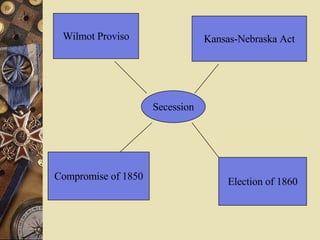
Secession Wilmot Proviso Compromise of 1850 Kansas-Nebraska Act Election of 1860
Secession Wilmot Proviso (1846) – Bill to outlaw slaver in territories obtained from Mexico; caused conflict in Congress between North and South Compromise of 1850 – Laws meant to settle problem of slavery; California became free state; new fugitive slave law passed; caused conflict by failing to resolve slavery issue
Secession Kansas-Nebraska Act (1854) – Law to organize Kansas and Nebraska territories; overturned Missouri Compromise; caused violence in Kansas Election of 1860 – Lincoln elected with support only in free states; caused states in Deep South to decide to secede

Chapter 17

  • 1.
    Chapter 17.3 pgs.403-407 What events led to the outbreak of war?
  • 2.
    Section 1 Democratshold convention in April 1860, Charleston, SC. – only few weeks before Republicans nominated Lincoln Northern and Southern Democrats differ on slavery issue Southerners wanted the party to defend slavery Northerners wanted the party to support popular sovereignty
  • 3.
    Sect. 1 Northernerswin the platform(party’s statement of beliefs)vote This caused 50 Southern delegates to walk out of the convention Remaining delegates tried to nominate Stephen A. Douglas – the Southerners left there would not support Douglas because of his support for popular sovereignty
  • 4.
    Sect. 1 Douglascould not win enough support to gain the nomination Democrats reconvene at Baltimore in June Northerners and Southerners still disagree Meeting barely gets started and most Southerners walk out
  • 5.
    Sect. 1 Democratsnominate two candidates for election Northerners – Stephen A. Douglas Southerners – John Breckinridge of Kentucky (current Vice-Pres also supporter of slavery)
  • 6.
    Sect. 1 Isalso Constitutional Union Party made up former Whigs and Know Nothing members who couldn’t support either party whose main goal was to preserve the Union CUP nominates – John Bell of Tennessee Four candidates for the election of 1860 Lincoln, Douglas, Breckinridge, Bell
  • 7.
    Sect. 1 Goalsof parties Republicans – slavery stay out of territories, gain support in North and West, favored tariffs, free land for Western settlers, and construction of RR to the Pacific CUP – conserve Union N. Dem.-- Popular sovereignty S. Dem. -- Slavery
  • 8.
    Sect. 1 QuestionsWhat issue split the Democratic Party? What was unusual about the number of candidates for president in 1860? What was the aim of the Constitutional Union Party?
  • 9.
    Section 2 TheElection of 1860 Turned into two different races for the presidency One in the North and one in the South Lincoln and Douglas had most of Northern support and Breckinridge and Bell competed in the South
  • 10.
    Sect. 2 Lincolnand Breckinridge had the most extreme views on slavery Lincoln opposed expansion of slavery into the territories Breckinridge insisted the federal gov’t be required to protect slavery in any territory Douglas and Bell were moderates because they didn’t want the federal gov’t to pass new laws on slavery
  • 11.
    Sect. 2 Outcomeof election proved nation was tired of compromise Lincoln defeated Douglas in the North Breckinridge carried most of South Douglas and Bell managed to win only in the states between North and Deep South Lincoln wins the election due to the North having more people in it than the South
  • 12.
    Sect. 2 Also,support for his rivals was spread out Lincoln’s victory alarms many in South Despite Lincoln’s statements that he would do nothing to abolish slavery in the South, many Southerners mistrusted him they feared he along with the Republicans would move to ban slavery So much so he didn’t even win a single southern state Many didn’t even put his name on the ballot
  • 13.
    Sect. 2 LincolnProfile Born February 12, 1809 in Kentucky Grew up on Indiana frontier Was a lawyer, he split rails, worked flatboats, and tended store Educated himself by reading by firelight at night Nicknamed “Honest Abe” due to his fairness and clear thinking in politics
  • 14.
    Sect. 2 Lincolnhad a keen sense of humor Hated slavery, but not an abolitionist Didn’t want to interfere with South and slavery there but did believe Western territories should remain free Key events: Civil War, Emancipation Proclamation, Gettysburg Address, Kansas, West Virginia, and Nevada become states Assassinated in office April 14, 1865
  • 15.
    Sect. 2 Mapwork Which states were won by Lincoln By Douglas By Breckinridge By Bell Which state voted for Lincoln and Douglas and who won the state and by what count
  • 16.
    Sect. 2 QuestionsHow did Breckinridge’s stance on the expansion of slavery in the territories differ from Lincoln’s? Why were Douglas and Bell thought to be moderates? What did Southerners fear Lincoln would do after the election?
  • 17.
    Section 3 Beforethe 1860 election many Southerners warned if Lincoln won, they would secede They based their arguments on the idea of states’ rights They felt states had voluntarily joined the Union, therefore they also had the right to leave the Union
  • 18.
    Sect. 3 Notall Southerners believed they should secede Senator John J. Crittenden of Kentucky proposed a compromise plan in early December known as the Crittenden Plan He proposed extending the Missouri Compromise Line to the Pacific, area above free, below slave He even proposed an unamendable amendment to the Constitution that would guarantee forever the right to hold slaves in states south of the line
  • 19.
    Sect. 3 Billreceived little support Southerners believe the North would put an abolitionist in the White House Slavery in the West was no longer an issue Most Republicans were unwilling to surrender what they had won in the election Southerners felt secession was only way to go
  • 20.
    Sect. 3 Southbegins to secede December 20, 1860 South Carolina becomes 1 st state to secede Over next 6 week period, Mississippi, Florida, Alabama, Georgia, Louisiana, and Texas also seceded February 1861 these states met in Montgomery, AL to decide what to do
  • 21.
    Sect. 3 Theyformed the Confederate States of America Named Jefferson Davis president of the Confederacy Also formed new government Drafted a Confederate Constitution; modeled after the original Constitution but with some differences
  • 22.
    Sect. 3 ConfederateConstitution 1 st – said within the Confederacy, each state was sovereign and independent 2 nd – Confederate Congress could not interfere with slavery 3 rd – banned tariffs on imports 4 th – limited the President to a single 6 year term
  • 23.
    Sect. 3 Havingformed the Confederacy and their own government, the Confederate States were prepared to defend their separation Many felt war was unavoidable However, they wanted to wait to see what the Union government would do in response
  • 24.
    Sect. 3 Mapwork Name free states Name slave states loyal to Union Name Confederate States (all of them those that seceded before and after 1861) Are there more Union or Confederate? How might this affect the outcome of the civil war that is to come?
  • 25.
    Sect. 3 QuestionsWhat argument did some Southerners use to justify secession? What were the results of the convention held by the six seceded states? What were the six states? How was the Confederate Constitution different from the U.S. Constitution?
  • 26.
    Section 4 Union’sresponse to secession Northerners considered secession of Southern states unconstitutional President Buchanan, who was near the end of his term, argued against secession He believed states did not have that right He believed Federal Government not state’s was sovereign
  • 27.
    Sect. 4 Hebelieved if secession were permitted, the Union would become weak, like a “rope of sand” He believed Constitution was framed to prevent such a thing However, he wasn’t sure how to prevent the secession. He knew if he used force war would erupt, so ultimately he did nothing to prevent it from happening
  • 28.
    Sect. 4 Withsecession other issues arose like majority rules Southerners felt Northerners would use their majority to force the South to abolish slavery Northerners simply responded that the South did not want to abide by the rules of democracy. They claimed the South was not willing to live with the election results
  • 29.
    Sect. 4 Everyonewas anticipating Lincoln’s inauguration They wondered what would the new President do to solve the crisis March 4 Lincoln takes the oath of office and delivered his First Inaugural Address Despite facing many serious troubles Lincoln hoped for peace
  • 30.
    Sect. 4 Lincolnassured the South he had no intention of abolishing slavery He did speak forcefully about secession Ended his speech with an appeal to friendship Lincoln would not press the South and did not want invasion However he would not abandon the government’s property there such as forts which needed supplies Over March and April many waited to see what Lincoln would do Civil War here we come!!!!
  • 31.
    Sect. 4 QuestionsWhat was the response of the Northerners and President Buchanan to secession? How did Lincoln try to reassure the South in his First Inaugural Address?
  • 32.
  • 33.
    Secession Wilmot ProvisoCompromise of 1850 Kansas-Nebraska Act Election of 1860
  • 34.
    Secession Wilmot Proviso(1846) – Bill to outlaw slaver in territories obtained from Mexico; caused conflict in Congress between North and South Compromise of 1850 – Laws meant to settle problem of slavery; California became free state; new fugitive slave law passed; caused conflict by failing to resolve slavery issue
  • 35.
    Secession Kansas-Nebraska Act(1854) – Law to organize Kansas and Nebraska territories; overturned Missouri Compromise; caused violence in Kansas Election of 1860 – Lincoln elected with support only in free states; caused states in Deep South to decide to secede