Silberschatz, Galvin and Gagne ©2018
Operating System Concepts – 10th Edition
Chapter 14: File System
Implementation
14.2 Silberschatz, Galvin and Gagne ©2018
Operating System Concepts – 10th Edition
Outline
 File-System Structure
 File-System Operations
 Directory Implementation
 Allocation Methods
 Free-Space Management
 Efficiency and Performance
 Recovery
 Example: WAFL File System
14.3 Silberschatz, Galvin and Gagne ©2018
Operating System Concepts – 10th Edition
Objectives
 Describe the details of implementing local file systems and
directory structures
 Discuss block allocation and free-block algorithms and trade-offs
 Explore file system efficiency and performance issues
 Look at recovery from file system failures
 Describe the WAFL file system as a concrete example
14.4 Silberschatz, Galvin and Gagne ©2018
Operating System Concepts – 10th Edition
File-System Structure
 File structure
• Logical storage unit
• Collection of related information
 File system resides on secondary storage (disks)
• Provided user interface to storage, mapping logical to physical
• Provides efficient and convenient access to disk by allowing
data to be stored, located retrieved easily
 Disk provides in-place rewrite and random access
• I/O transfers performed in blocks of sectors (usually 512
bytes)
 File control block (FCB) – storage structure consisting of
information about a file
 Device driver controls the physical device
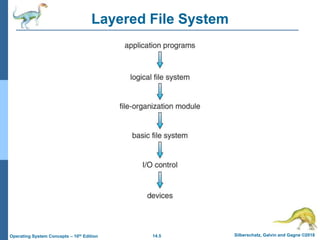
 File system organized into layers
14.5 Silberschatz, Galvin and Gagne ©2018
Operating System Concepts – 10th Edition
Layered File System
14.6 Silberschatz, Galvin and Gagne ©2018
Operating System Concepts – 10th Edition
File System Layers
 Device drivers manage I/O devices at the I/O control layer
• Given commands like “read drive1, cylinder 72, track 2, sector 10,
into memory location 1060” outputs low-level hardware specific
commands to hardware controller
 Basic file system given command like “retrieve block 123” translates
to device driver
 Also manages memory buffers and caches (allocation, freeing,
replacement)
• Buffers hold data in transit
• Caches hold frequently used data
 File organization module understands files, logical address, and
physical blocks
 Translates logical block # to physical block #
 Manages free space, disk allocation
14.7 Silberschatz, Galvin and Gagne ©2018
Operating System Concepts – 10th Edition
File System Layers (Cont.)
 Logical file system manages metadata information
• Translates file name into file number, file handle, location
by maintaining file control blocks (inodes in UNIX)
• Directory management
• Protection
 Layering useful for reducing complexity and redundancy, but
adds overhead and can decrease performance
 Logical layers can be implemented by any coding method
according to OS designer
14.8 Silberschatz, Galvin and Gagne ©2018
Operating System Concepts – 10th Edition
 Many file systems, sometimes many within an operating system
• Each with its own format (CD-ROM is ISO 9660; Unix has UFS,
FFS; Windows has FAT, FAT32, NTFS as well as floppy, CD,
DVD Blu-ray, Linux has more than 130 types, with extended file
system ext3 and ext4 leading; plus distributed file systems, etc.)
• New ones still arriving – ZFS, GoogleFS, Oracle ASM, FUSE
File System Layers (Cont.)
14.9 Silberschatz, Galvin and Gagne ©2018
Operating System Concepts – 10th Edition
File-System Operations
 We have system calls at the API level, but how do we implement their
functions?
• On-disk and in-memory structures
 Boot control block contains info needed by system to boot OS from
that volume
• Needed if volume contains OS, usually first block of volume
 Volume control block (superblock, master file table) contains
volume details
• Total # of blocks, # of free blocks, block size, free block pointers or
array
 Directory structure organizes the files
• Names and inode numbers, master file table
14.10 Silberschatz, Galvin and Gagne ©2018
Operating System Concepts – 10th Edition
File-System Implementation (Cont.)
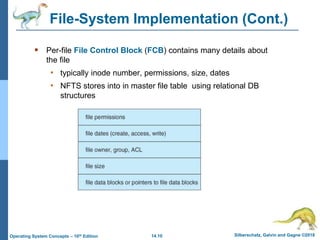
 Per-file File Control Block (FCB) contains many details about
the file
• typically inode number, permissions, size, dates
• NFTS stores into in master file table using relational DB
structures
14.11 Silberschatz, Galvin and Gagne ©2018
Operating System Concepts – 10th Edition
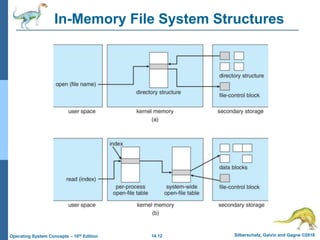
In-Memory File System Structures
 Mount table storing file system mounts, mount points, file system
types
 system-wide open-file table contains a copy of the FCB of each file
and other info
 per-process open-file table contains pointers to appropriate entries
in system-wide open-file table as well as other info
 The following figure illustrates the necessary file system structures
provided by the operating systems
 Figure 12-3(a) refers to opening a file
 Figure 12-3(b) refers to reading a file
 Plus buffers hold data blocks from secondary storage
 Open returns a file handle for subsequent use
 Data from read eventually copied to specified user process memory
address
14.12 Silberschatz, Galvin and Gagne ©2018
Operating System Concepts – 10th Edition
In-Memory File System Structures
14.13 Silberschatz, Galvin and Gagne ©2018
Operating System Concepts – 10th Edition
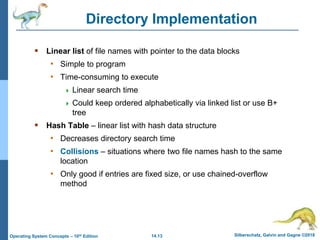
Directory Implementation
 Linear list of file names with pointer to the data blocks
• Simple to program
• Time-consuming to execute
 Linear search time
 Could keep ordered alphabetically via linked list or use B+
tree
 Hash Table – linear list with hash data structure
• Decreases directory search time
• Collisions – situations where two file names hash to the same
location
• Only good if entries are fixed size, or use chained-overflow
method
14.14 Silberschatz, Galvin and Gagne ©2018
Operating System Concepts – 10th Edition
Allocation Methods - Contiguous
 An allocation method refers to how disk blocks are allocated for files:
 Contiguous allocation – each file occupies set of contiguous blocks
• Best performance in most cases
• Simple – only starting location (block #) and length (number of
blocks) are required
• Problems include finding space for file, knowing file size, external
fragmentation, need for compaction off-line (downtime) or on-
line
14.15 Silberschatz, Galvin and Gagne ©2018
Operating System Concepts – 10th Edition
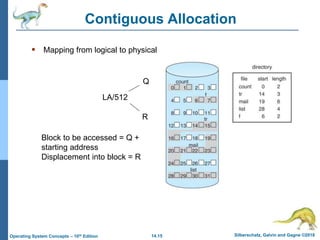
Contiguous Allocation
 Mapping from logical to physical
LA/512
Q
R
Block to be accessed = Q +
starting address
Displacement into block = R
14.16 Silberschatz, Galvin and Gagne ©2018
Operating System Concepts – 10th Edition
Extent-Based Systems
 Many newer file systems (i.e., Veritas File System) use a modified
contiguous allocation scheme
 Extent-based file systems allocate disk blocks in extents
 An extent is a contiguous block of disks
• Extents are allocated for file allocation
• A file consists of one or more extents
14.17 Silberschatz, Galvin and Gagne ©2018
Operating System Concepts – 10th Edition
Allocation Methods - Linked
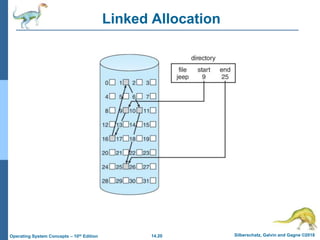
 Linked allocation – each file a linked list of blocks
• File ends at nil pointer
• No external fragmentation
• Each block contains pointer to next block
• No compaction, external fragmentation
• Free space management system called when new block needed
• Improve efficiency by clustering blocks into groups but increases
internal fragmentation
• Reliability can be a problem
• Locating a block can take many I/Os and disk seeks
14.19 Silberschatz, Galvin and Gagne ©2018
Operating System Concepts – 10th Edition
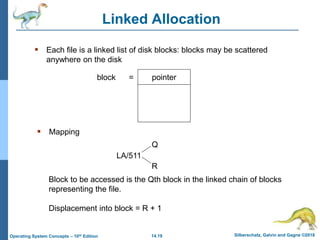
Linked Allocation
 Each file is a linked list of disk blocks: blocks may be scattered
anywhere on the disk
pointer
block =
 Mapping
Block to be accessed is the Qth block in the linked chain of blocks
representing the file.
Displacement into block = R + 1
LA/511
Q
R
14.20 Silberschatz, Galvin and Gagne ©2018
Operating System Concepts – 10th Edition
Linked Allocation
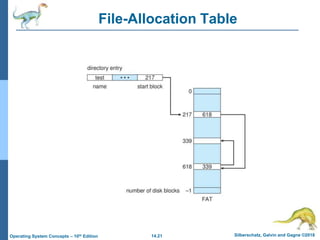
14.21 Silberschatz, Galvin and Gagne ©2018
Operating System Concepts – 10th Edition
File-Allocation Table
14.22 Silberschatz, Galvin and Gagne ©2018
Operating System Concepts – 10th Edition
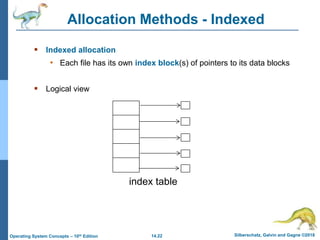
Allocation Methods - Indexed
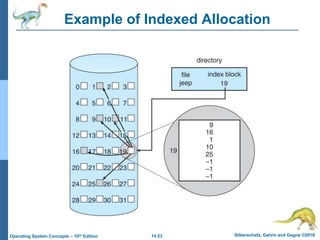
 Indexed allocation
• Each file has its own index block(s) of pointers to its data blocks
 Logical view
index table
14.23 Silberschatz, Galvin and Gagne ©2018
Operating System Concepts – 10th Edition
Example of Indexed Allocation
14.28 Silberschatz, Galvin and Gagne ©2018
Operating System Concepts – 10th Edition
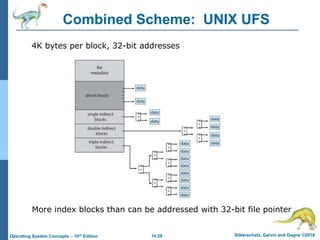
More index blocks than can be addressed with 32-bit file pointer
4K bytes per block, 32-bit addresses
Combined Scheme: UNIX UFS
14.29 Silberschatz, Galvin and Gagne ©2018
Operating System Concepts – 10th Edition
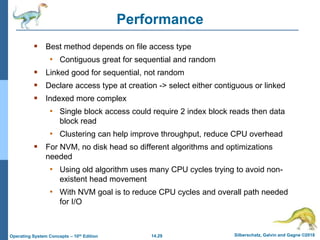
Performance
 Best method depends on file access type
• Contiguous great for sequential and random
 Linked good for sequential, not random
 Declare access type at creation -> select either contiguous or linked
 Indexed more complex
• Single block access could require 2 index block reads then data
block read
• Clustering can help improve throughput, reduce CPU overhead
 For NVM, no disk head so different algorithms and optimizations
needed
• Using old algorithm uses many CPU cycles trying to avoid non-
existent head movement
• With NVM goal is to reduce CPU cycles and overall path needed
for I/O
14.31 Silberschatz, Galvin and Gagne ©2018
Operating System Concepts – 10th Edition
Free-Space Management
 File system maintains free-space list to track available
blocks/clusters
• (Using term “block” for simplicity)
 Bit vector or bit map (n blocks)
…
0 1 2 n-1
bit[i] =

1  block[i] free
0  block[i] occupied
Block number calculation
(number of bits per word) *
(number of 0-value words) +
offset of first 1 bit
CPUs have instructions to return offset within word of first “1” bit
14.32 Silberschatz, Galvin and Gagne ©2018
Operating System Concepts – 10th Edition
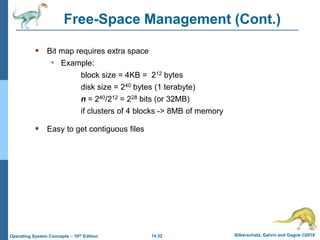
Free-Space Management (Cont.)
 Bit map requires extra space
• Example:
block size = 4KB = 212 bytes
disk size = 240 bytes (1 terabyte)
n = 240/212 = 228 bits (or 32MB)
if clusters of 4 blocks -> 8MB of memory
 Easy to get contiguous files
14.33 Silberschatz, Galvin and Gagne ©2018
Operating System Concepts – 10th Edition
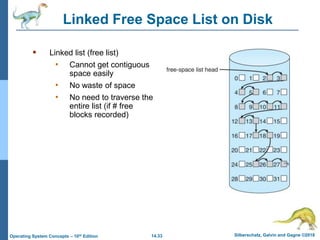
Linked Free Space List on Disk
 Linked list (free list)
• Cannot get contiguous
space easily
• No waste of space
• No need to traverse the
entire list (if # free
blocks recorded)
14.34 Silberschatz, Galvin and Gagne ©2018
Operating System Concepts – 10th Edition
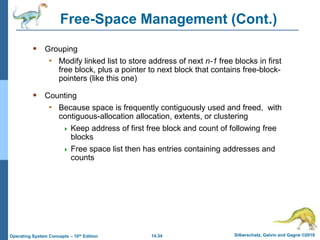
Free-Space Management (Cont.)
 Grouping
• Modify linked list to store address of next n-1 free blocks in first
free block, plus a pointer to next block that contains free-block-
pointers (like this one)
 Counting
• Because space is frequently contiguously used and freed, with
contiguous-allocation allocation, extents, or clustering
 Keep address of first free block and count of following free
blocks
 Free space list then has entries containing addresses and
counts
14.35 Silberschatz, Galvin and Gagne ©2018
Operating System Concepts – 10th Edition
Free-Space Management (Cont.)
 Space Maps
• Used in ZFS
• Consider meta-data I/O on very large file systems
 Full data structures like bit maps couldn’t fit in memory ->
thousands of I/Os
• Divides device space into metaslab units and manages metaslabs
 Given volume can contain hundreds of metaslabs
• Each metaslab has associated space map
 Uses counting algorithm
• But records to log file rather than file system
 Log of all block activity, in time order, in counting format
• Metaslab activity -> load space map into memory in balanced-tree
structure, indexed by offset
 Replay log into that structure
 Combine contiguous free blocks into single entry
14.36 Silberschatz, Galvin and Gagne ©2018
Operating System Concepts – 10th Edition
TRIMing Unused Blocks
 HDDS overwrite in place so need only free list
 Blocks not treated specially when freed
• Keeps its data but without any file pointers to it, until overwritten
 Storage devices not allowing overwrite (like NVM) suffer badly with
same algorithm
• Must be erased before written, erases made in large chunks
(blocks, composed of pages) and are slow
• TRIM is a newer mechanism for the file system to inform the
NVM storage device that a page is free
 Can be garbage collected or if block is free, now block can be
erased
14.37 Silberschatz, Galvin and Gagne ©2018
Operating System Concepts – 10th Edition
Efficiency and Performance
 Efficiency dependent on:
• Disk allocation and directory algorithms
• Types of data kept in file’s directory entry
• Pre-allocation or as-needed allocation of metadata structures
• Fixed-size or varying-size data structures
14.38 Silberschatz, Galvin and Gagne ©2018
Operating System Concepts – 10th Edition
Efficiency and Performance (Cont.)
 Performance
• Keeping data and metadata close together
• Buffer cache – separate section of main memory for frequently
used blocks
• Synchronous writes sometimes requested by apps or needed
by OS
 No buffering / caching – writes must hit disk before
acknowledgement
 Asynchronous writes more common, buffer-able, faster
• Free-behind and read-ahead – techniques to optimize
sequential access
• Reads frequently slower than writes
14.39 Silberschatz, Galvin and Gagne ©2018
Operating System Concepts – 10th Edition
Page Cache
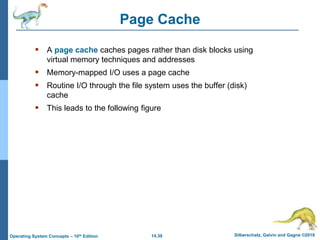
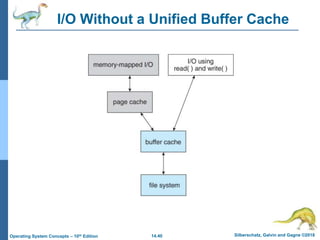
 A page cache caches pages rather than disk blocks using
virtual memory techniques and addresses
 Memory-mapped I/O uses a page cache
 Routine I/O through the file system uses the buffer (disk)
cache
 This leads to the following figure
14.40 Silberschatz, Galvin and Gagne ©2018
Operating System Concepts – 10th Edition
I/O Without a Unified Buffer Cache
14.41 Silberschatz, Galvin and Gagne ©2018
Operating System Concepts – 10th Edition
Unified Buffer Cache
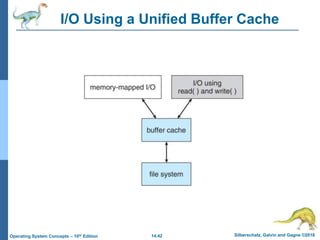
 A unified buffer cache uses the same page cache to
cache both memory-mapped pages and ordinary file
system I/O to avoid double caching
 But which caches get priority, and what replacement
algorithms to use?
14.42 Silberschatz, Galvin and Gagne ©2018
Operating System Concepts – 10th Edition
I/O Using a Unified Buffer Cache
14.43 Silberschatz, Galvin and Gagne ©2018
Operating System Concepts – 10th Edition
Recovery
 Consistency checking – compares data in directory structure
with data blocks on disk, and tries to fix inconsistencies
• Can be slow and sometimes fails
 Use system programs to back up data from disk to another
storage device (magnetic tape, other magnetic disk, optical)
 Recover lost file or disk by restoring data from backup
14.44 Silberschatz, Galvin and Gagne ©2018
Operating System Concepts – 10th Edition
Log Structured File Systems
 Log structured (or journaling) file systems record each metadata
update to the file system as a transaction
 All transactions are written to a log
• A transaction is considered committed once it is written to the log
(sequentially)
• Sometimes to a separate device or section of disk
• However, the file system may not yet be updated
 The transactions in the log are asynchronously written to the file
system structures
• When the file system structures are modified, the transaction is
removed from the log
 If the file system crashes, all remaining transactions in the log must
still be performed
 Faster recovery from crash, removes chance of inconsistency of
metadata
14.45 Silberschatz, Galvin and Gagne ©2018
Operating System Concepts – 10th Edition
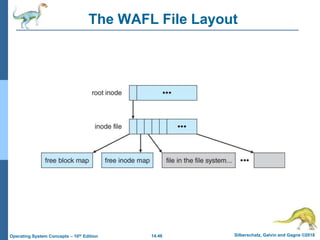
Example: WAFL File System
 Used on Network Appliance “Filers” – distributed file system
appliances
 “Write-anywhere file layout”
 Serves up NFS, CIFS, http, ftp
 Random I/O optimized, write optimized
• NVRAM for write caching
 Similar to Berkeley Fast File System, with extensive modifications
14.46 Silberschatz, Galvin and Gagne ©2018
Operating System Concepts – 10th Edition
The WAFL File Layout
14.47 Silberschatz, Galvin and Gagne ©2018
Operating System Concepts – 10th Edition
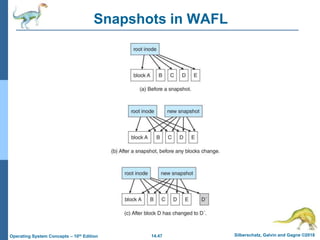
Snapshots in WAFL
14.48 Silberschatz, Galvin and Gagne ©2018
Operating System Concepts – 10th Edition
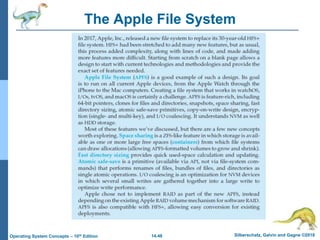
The Apple File System
Silberschatz, Galvin and Gagne ©2018
Operating System Concepts – 10th Edition
End of Chapter 14

Chapter 14 Computer Architecture

  • 1.
    Silberschatz, Galvin andGagne ©2018 Operating System Concepts – 10th Edition Chapter 14: File System Implementation
  • 2.
    14.2 Silberschatz, Galvinand Gagne ©2018 Operating System Concepts – 10th Edition Outline  File-System Structure  File-System Operations  Directory Implementation  Allocation Methods  Free-Space Management  Efficiency and Performance  Recovery  Example: WAFL File System
  • 3.
    14.3 Silberschatz, Galvinand Gagne ©2018 Operating System Concepts – 10th Edition Objectives  Describe the details of implementing local file systems and directory structures  Discuss block allocation and free-block algorithms and trade-offs  Explore file system efficiency and performance issues  Look at recovery from file system failures  Describe the WAFL file system as a concrete example
  • 4.
    14.4 Silberschatz, Galvinand Gagne ©2018 Operating System Concepts – 10th Edition File-System Structure  File structure • Logical storage unit • Collection of related information  File system resides on secondary storage (disks) • Provided user interface to storage, mapping logical to physical • Provides efficient and convenient access to disk by allowing data to be stored, located retrieved easily  Disk provides in-place rewrite and random access • I/O transfers performed in blocks of sectors (usually 512 bytes)  File control block (FCB) – storage structure consisting of information about a file  Device driver controls the physical device  File system organized into layers
  • 5.
    14.5 Silberschatz, Galvinand Gagne ©2018 Operating System Concepts – 10th Edition Layered File System
  • 6.
    14.6 Silberschatz, Galvinand Gagne ©2018 Operating System Concepts – 10th Edition File System Layers  Device drivers manage I/O devices at the I/O control layer • Given commands like “read drive1, cylinder 72, track 2, sector 10, into memory location 1060” outputs low-level hardware specific commands to hardware controller  Basic file system given command like “retrieve block 123” translates to device driver  Also manages memory buffers and caches (allocation, freeing, replacement) • Buffers hold data in transit • Caches hold frequently used data  File organization module understands files, logical address, and physical blocks  Translates logical block # to physical block #  Manages free space, disk allocation
  • 7.
    14.7 Silberschatz, Galvinand Gagne ©2018 Operating System Concepts – 10th Edition File System Layers (Cont.)  Logical file system manages metadata information • Translates file name into file number, file handle, location by maintaining file control blocks (inodes in UNIX) • Directory management • Protection  Layering useful for reducing complexity and redundancy, but adds overhead and can decrease performance  Logical layers can be implemented by any coding method according to OS designer
  • 8.
    14.8 Silberschatz, Galvinand Gagne ©2018 Operating System Concepts – 10th Edition  Many file systems, sometimes many within an operating system • Each with its own format (CD-ROM is ISO 9660; Unix has UFS, FFS; Windows has FAT, FAT32, NTFS as well as floppy, CD, DVD Blu-ray, Linux has more than 130 types, with extended file system ext3 and ext4 leading; plus distributed file systems, etc.) • New ones still arriving – ZFS, GoogleFS, Oracle ASM, FUSE File System Layers (Cont.)
  • 9.
    14.9 Silberschatz, Galvinand Gagne ©2018 Operating System Concepts – 10th Edition File-System Operations  We have system calls at the API level, but how do we implement their functions? • On-disk and in-memory structures  Boot control block contains info needed by system to boot OS from that volume • Needed if volume contains OS, usually first block of volume  Volume control block (superblock, master file table) contains volume details • Total # of blocks, # of free blocks, block size, free block pointers or array  Directory structure organizes the files • Names and inode numbers, master file table
  • 10.
    14.10 Silberschatz, Galvinand Gagne ©2018 Operating System Concepts – 10th Edition File-System Implementation (Cont.)  Per-file File Control Block (FCB) contains many details about the file • typically inode number, permissions, size, dates • NFTS stores into in master file table using relational DB structures
  • 11.
    14.11 Silberschatz, Galvinand Gagne ©2018 Operating System Concepts – 10th Edition In-Memory File System Structures  Mount table storing file system mounts, mount points, file system types  system-wide open-file table contains a copy of the FCB of each file and other info  per-process open-file table contains pointers to appropriate entries in system-wide open-file table as well as other info  The following figure illustrates the necessary file system structures provided by the operating systems  Figure 12-3(a) refers to opening a file  Figure 12-3(b) refers to reading a file  Plus buffers hold data blocks from secondary storage  Open returns a file handle for subsequent use  Data from read eventually copied to specified user process memory address
  • 12.
    14.12 Silberschatz, Galvinand Gagne ©2018 Operating System Concepts – 10th Edition In-Memory File System Structures
  • 13.
    14.13 Silberschatz, Galvinand Gagne ©2018 Operating System Concepts – 10th Edition Directory Implementation  Linear list of file names with pointer to the data blocks • Simple to program • Time-consuming to execute  Linear search time  Could keep ordered alphabetically via linked list or use B+ tree  Hash Table – linear list with hash data structure • Decreases directory search time • Collisions – situations where two file names hash to the same location • Only good if entries are fixed size, or use chained-overflow method
  • 14.
    14.14 Silberschatz, Galvinand Gagne ©2018 Operating System Concepts – 10th Edition Allocation Methods - Contiguous  An allocation method refers to how disk blocks are allocated for files:  Contiguous allocation – each file occupies set of contiguous blocks • Best performance in most cases • Simple – only starting location (block #) and length (number of blocks) are required • Problems include finding space for file, knowing file size, external fragmentation, need for compaction off-line (downtime) or on- line
  • 15.
    14.15 Silberschatz, Galvinand Gagne ©2018 Operating System Concepts – 10th Edition Contiguous Allocation  Mapping from logical to physical LA/512 Q R Block to be accessed = Q + starting address Displacement into block = R
  • 16.
    14.16 Silberschatz, Galvinand Gagne ©2018 Operating System Concepts – 10th Edition Extent-Based Systems  Many newer file systems (i.e., Veritas File System) use a modified contiguous allocation scheme  Extent-based file systems allocate disk blocks in extents  An extent is a contiguous block of disks • Extents are allocated for file allocation • A file consists of one or more extents
  • 17.
    14.17 Silberschatz, Galvinand Gagne ©2018 Operating System Concepts – 10th Edition Allocation Methods - Linked  Linked allocation – each file a linked list of blocks • File ends at nil pointer • No external fragmentation • Each block contains pointer to next block • No compaction, external fragmentation • Free space management system called when new block needed • Improve efficiency by clustering blocks into groups but increases internal fragmentation • Reliability can be a problem • Locating a block can take many I/Os and disk seeks
  • 18.
    14.19 Silberschatz, Galvinand Gagne ©2018 Operating System Concepts – 10th Edition Linked Allocation  Each file is a linked list of disk blocks: blocks may be scattered anywhere on the disk pointer block =  Mapping Block to be accessed is the Qth block in the linked chain of blocks representing the file. Displacement into block = R + 1 LA/511 Q R
  • 19.
    14.20 Silberschatz, Galvinand Gagne ©2018 Operating System Concepts – 10th Edition Linked Allocation
  • 20.
    14.21 Silberschatz, Galvinand Gagne ©2018 Operating System Concepts – 10th Edition File-Allocation Table
  • 21.
    14.22 Silberschatz, Galvinand Gagne ©2018 Operating System Concepts – 10th Edition Allocation Methods - Indexed  Indexed allocation • Each file has its own index block(s) of pointers to its data blocks  Logical view index table
  • 22.
    14.23 Silberschatz, Galvinand Gagne ©2018 Operating System Concepts – 10th Edition Example of Indexed Allocation
  • 23.
    14.28 Silberschatz, Galvinand Gagne ©2018 Operating System Concepts – 10th Edition More index blocks than can be addressed with 32-bit file pointer 4K bytes per block, 32-bit addresses Combined Scheme: UNIX UFS
  • 24.
    14.29 Silberschatz, Galvinand Gagne ©2018 Operating System Concepts – 10th Edition Performance  Best method depends on file access type • Contiguous great for sequential and random  Linked good for sequential, not random  Declare access type at creation -> select either contiguous or linked  Indexed more complex • Single block access could require 2 index block reads then data block read • Clustering can help improve throughput, reduce CPU overhead  For NVM, no disk head so different algorithms and optimizations needed • Using old algorithm uses many CPU cycles trying to avoid non- existent head movement • With NVM goal is to reduce CPU cycles and overall path needed for I/O
  • 25.
    14.31 Silberschatz, Galvinand Gagne ©2018 Operating System Concepts – 10th Edition Free-Space Management  File system maintains free-space list to track available blocks/clusters • (Using term “block” for simplicity)  Bit vector or bit map (n blocks) … 0 1 2 n-1 bit[i] =  1  block[i] free 0  block[i] occupied Block number calculation (number of bits per word) * (number of 0-value words) + offset of first 1 bit CPUs have instructions to return offset within word of first “1” bit
  • 26.
    14.32 Silberschatz, Galvinand Gagne ©2018 Operating System Concepts – 10th Edition Free-Space Management (Cont.)  Bit map requires extra space • Example: block size = 4KB = 212 bytes disk size = 240 bytes (1 terabyte) n = 240/212 = 228 bits (or 32MB) if clusters of 4 blocks -> 8MB of memory  Easy to get contiguous files
  • 27.
    14.33 Silberschatz, Galvinand Gagne ©2018 Operating System Concepts – 10th Edition Linked Free Space List on Disk  Linked list (free list) • Cannot get contiguous space easily • No waste of space • No need to traverse the entire list (if # free blocks recorded)
  • 28.
    14.34 Silberschatz, Galvinand Gagne ©2018 Operating System Concepts – 10th Edition Free-Space Management (Cont.)  Grouping • Modify linked list to store address of next n-1 free blocks in first free block, plus a pointer to next block that contains free-block- pointers (like this one)  Counting • Because space is frequently contiguously used and freed, with contiguous-allocation allocation, extents, or clustering  Keep address of first free block and count of following free blocks  Free space list then has entries containing addresses and counts
  • 29.
    14.35 Silberschatz, Galvinand Gagne ©2018 Operating System Concepts – 10th Edition Free-Space Management (Cont.)  Space Maps • Used in ZFS • Consider meta-data I/O on very large file systems  Full data structures like bit maps couldn’t fit in memory -> thousands of I/Os • Divides device space into metaslab units and manages metaslabs  Given volume can contain hundreds of metaslabs • Each metaslab has associated space map  Uses counting algorithm • But records to log file rather than file system  Log of all block activity, in time order, in counting format • Metaslab activity -> load space map into memory in balanced-tree structure, indexed by offset  Replay log into that structure  Combine contiguous free blocks into single entry
  • 30.
    14.36 Silberschatz, Galvinand Gagne ©2018 Operating System Concepts – 10th Edition TRIMing Unused Blocks  HDDS overwrite in place so need only free list  Blocks not treated specially when freed • Keeps its data but without any file pointers to it, until overwritten  Storage devices not allowing overwrite (like NVM) suffer badly with same algorithm • Must be erased before written, erases made in large chunks (blocks, composed of pages) and are slow • TRIM is a newer mechanism for the file system to inform the NVM storage device that a page is free  Can be garbage collected or if block is free, now block can be erased
  • 31.
    14.37 Silberschatz, Galvinand Gagne ©2018 Operating System Concepts – 10th Edition Efficiency and Performance  Efficiency dependent on: • Disk allocation and directory algorithms • Types of data kept in file’s directory entry • Pre-allocation or as-needed allocation of metadata structures • Fixed-size or varying-size data structures
  • 32.
    14.38 Silberschatz, Galvinand Gagne ©2018 Operating System Concepts – 10th Edition Efficiency and Performance (Cont.)  Performance • Keeping data and metadata close together • Buffer cache – separate section of main memory for frequently used blocks • Synchronous writes sometimes requested by apps or needed by OS  No buffering / caching – writes must hit disk before acknowledgement  Asynchronous writes more common, buffer-able, faster • Free-behind and read-ahead – techniques to optimize sequential access • Reads frequently slower than writes
  • 33.
    14.39 Silberschatz, Galvinand Gagne ©2018 Operating System Concepts – 10th Edition Page Cache  A page cache caches pages rather than disk blocks using virtual memory techniques and addresses  Memory-mapped I/O uses a page cache  Routine I/O through the file system uses the buffer (disk) cache  This leads to the following figure
  • 34.
    14.40 Silberschatz, Galvinand Gagne ©2018 Operating System Concepts – 10th Edition I/O Without a Unified Buffer Cache
  • 35.
    14.41 Silberschatz, Galvinand Gagne ©2018 Operating System Concepts – 10th Edition Unified Buffer Cache  A unified buffer cache uses the same page cache to cache both memory-mapped pages and ordinary file system I/O to avoid double caching  But which caches get priority, and what replacement algorithms to use?
  • 36.
    14.42 Silberschatz, Galvinand Gagne ©2018 Operating System Concepts – 10th Edition I/O Using a Unified Buffer Cache
  • 37.
    14.43 Silberschatz, Galvinand Gagne ©2018 Operating System Concepts – 10th Edition Recovery  Consistency checking – compares data in directory structure with data blocks on disk, and tries to fix inconsistencies • Can be slow and sometimes fails  Use system programs to back up data from disk to another storage device (magnetic tape, other magnetic disk, optical)  Recover lost file or disk by restoring data from backup
  • 38.
    14.44 Silberschatz, Galvinand Gagne ©2018 Operating System Concepts – 10th Edition Log Structured File Systems  Log structured (or journaling) file systems record each metadata update to the file system as a transaction  All transactions are written to a log • A transaction is considered committed once it is written to the log (sequentially) • Sometimes to a separate device or section of disk • However, the file system may not yet be updated  The transactions in the log are asynchronously written to the file system structures • When the file system structures are modified, the transaction is removed from the log  If the file system crashes, all remaining transactions in the log must still be performed  Faster recovery from crash, removes chance of inconsistency of metadata
  • 39.
    14.45 Silberschatz, Galvinand Gagne ©2018 Operating System Concepts – 10th Edition Example: WAFL File System  Used on Network Appliance “Filers” – distributed file system appliances  “Write-anywhere file layout”  Serves up NFS, CIFS, http, ftp  Random I/O optimized, write optimized • NVRAM for write caching  Similar to Berkeley Fast File System, with extensive modifications
  • 40.
    14.46 Silberschatz, Galvinand Gagne ©2018 Operating System Concepts – 10th Edition The WAFL File Layout
  • 41.
    14.47 Silberschatz, Galvinand Gagne ©2018 Operating System Concepts – 10th Edition Snapshots in WAFL
  • 42.
    14.48 Silberschatz, Galvinand Gagne ©2018 Operating System Concepts – 10th Edition The Apple File System
  • 43.
    Silberschatz, Galvin andGagne ©2018 Operating System Concepts – 10th Edition End of Chapter 14