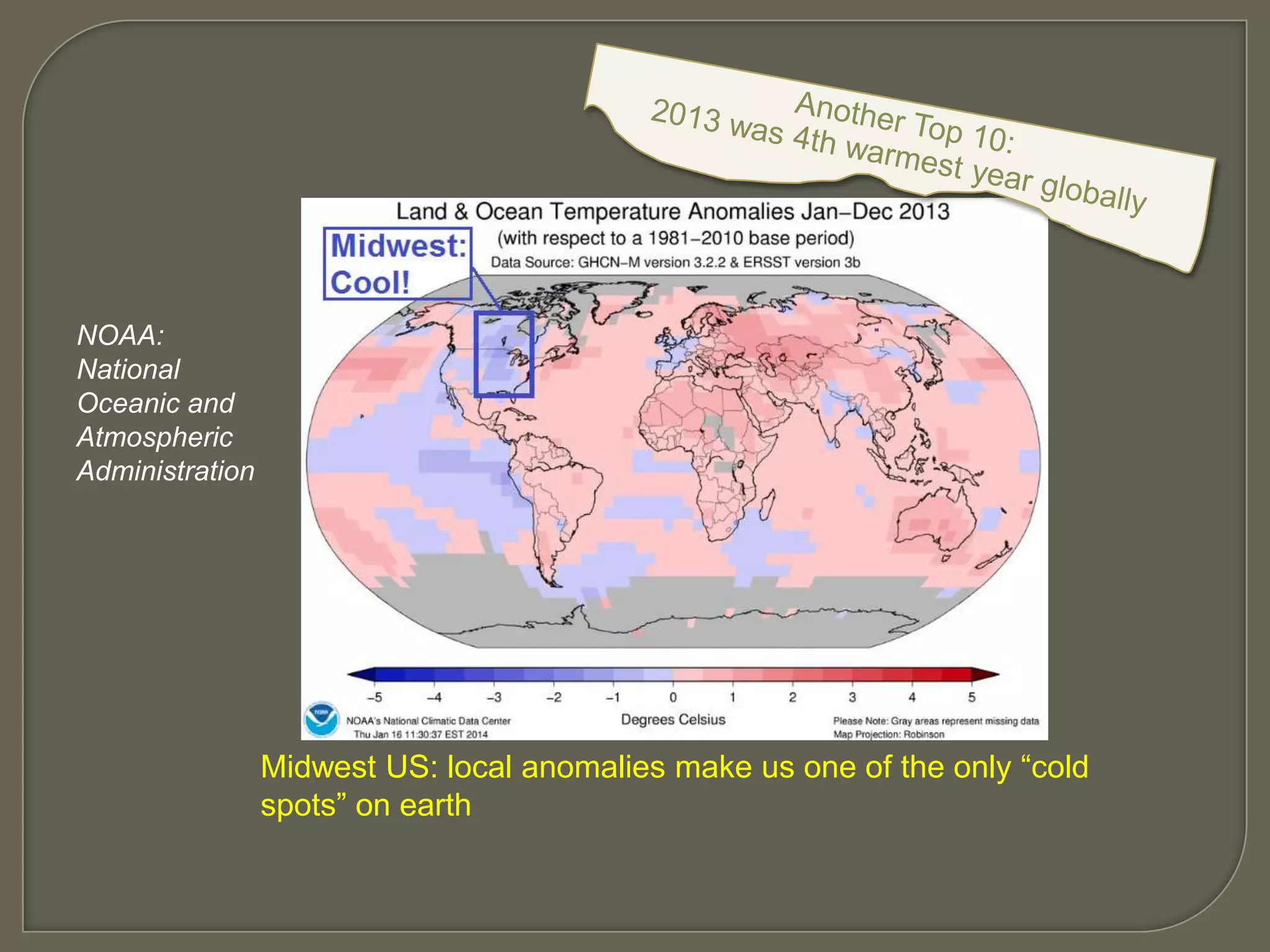
NOAA:
National
Oceanic and
Atmospheric
Administration

Midwest US: local anomalies make us one of the only ā€œcold
spotsā€ on earth
Big clichƩ #1
All geologic resources are finite
Once itā€Ÿs gone, itā€Ÿs gone
Long before that, itā€Ÿs scarce
Big clichƩ #2
mined
If it isnt grown, it must be ______
Water as a resource
Our supply
Groundwater sources and uses
Regional supply and demand
Solutions
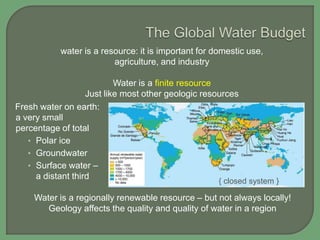
water is a resource: it is important for domestic use,
agriculture, and industry

Water is a finite resource
Just like most other geologic resources
Fresh water on earth:
a very small
percentage of total
• Polar ice
• Groundwater
• Surface water –
a distant third

{ closed system }

Water is a regionally renewable resource – but not always locally!
Geology affects the quality and quality of water in a region
Sick of this yet?
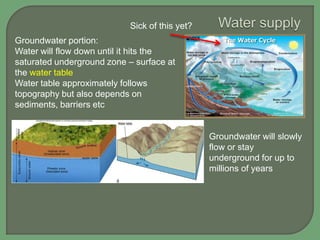
Groundwater portion:
Water will flow down until it hits the
saturated underground zone – surface at
the water table
Water table approximately follows
topography but also depends on
sediments, barriers etc

Groundwater will slowly
flow or stay
underground for up to
millions of years
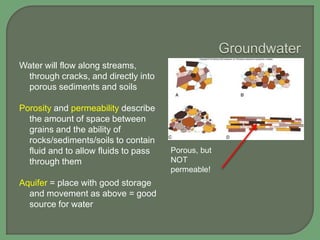
Water will flow along streams,
through cracks, and directly into
porous sediments and soils
Porosity and permeability describe
the amount of space between
grains and the ability of
rocks/sediments/soils to contain
fluid and to allow fluids to pass
through them
Aquifer = place with good storage
and movement as above = good
source for water

Porous, but
NOT
permeable!
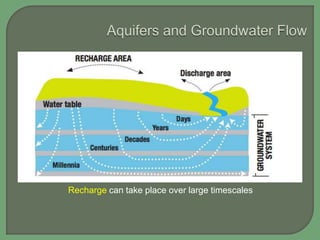
Recharge can take place over large timescales
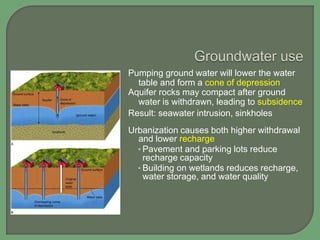
Pumping ground water will lower the water
table and form a cone of depression
Aquifer rocks may compact after ground
water is withdrawn, leading to subsidence
Result: seawater intrusion, sinkholes
Urbanization causes both higher withdrawal
and lower recharge
• Pavement and parking lots reduce
recharge capacity
• Building on wetlands reduces recharge,
water storage, and water quality
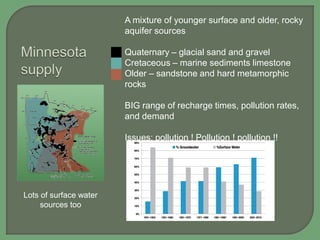
A mixture of younger surface and older, rocky
aquifer sources
Quaternary – glacial sand and gravel
Cretaceous – marine sediments limestone
Older – sandstone and hard metamorphic
rocks
BIG range of recharge times, pollution rates,
and demand

Issues: pollution ! Pollution ! pollution !!

Lots of surface water
sources too
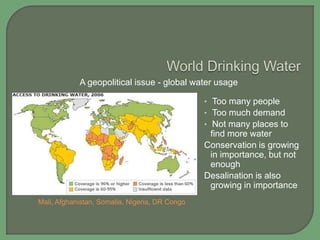
A geopolitical issue - global water usage
• Too many people
• Too much demand
• Not many places to

find more water
Conservation is growing
in importance, but not
enough
Desalination is also
growing in importance
Mali, Afghanistan, Somalia, Nigeria, DR Congo
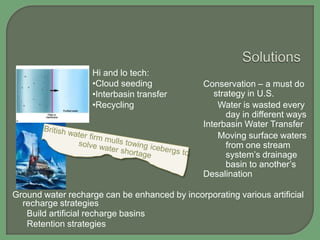
Hi and lo tech:
•Cloud seeding
•Interbasin transfer
•Recycling

Conservation – a must do
strategy in U.S.
Water is wasted every
day in different ways
Interbasin Water Transfer
Moving surface waters
from one stream
systemā€Ÿs drainage
basin to anotherā€Ÿs
Desalination

Ground water recharge can be enhanced by incorporating various artificial
recharge strategies
Build artificial recharge basins
Retention strategies
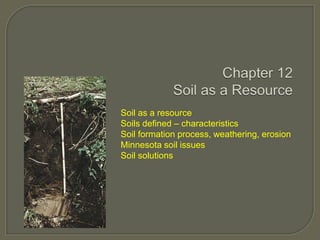
Soil as a resource
Soils defined – characteristics
Soil formation process, weathering, erosion
Minnesota soil issues
Soil solutions
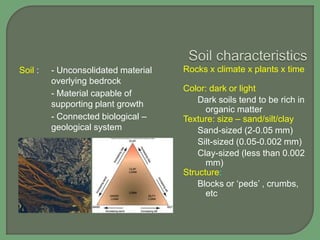
Soil :

- Unconsolidated material
overlying bedrock
- Material capable of
supporting plant growth
- Connected biological –
geological system

Rocks x climate x plants x time
Color: dark or light
Dark soils tend to be rich in
organic matter
Texture: size – sand/silt/clay
Sand-sized (2-0.05 mm)
Silt-sized (0.05-0.002 mm)
Clay-sized (less than 0.002
mm)
Structure:
Blocks or ā€žpedsā€Ÿ , crumbs,
etc
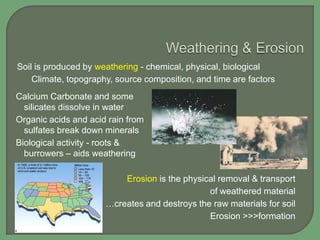
Soil is produced by weathering - chemical, physical, biological
Climate, topography, source composition, and time are factors
Calcium Carbonate and some
silicates dissolve in water
Organic acids and acid rain from
sulfates break down minerals
Biological activity - roots &
burrowers – aids weathering
Erosion is the physical removal & transport
of weathered material
…creates and destroys the raw materials for soil
Erosion >>>formation
Mineral   organic

Soil blanket shows zones of different colors, chemical
compositions, & properties
Topsoil [ā€žE Horizonā€Ÿ] rooted and organic
A Horizon - exposed to heavy leaching
B Horizon - accumulation / deposition + leaching
C Horizon - Very coarsely broken-up bedrock
R horizon: bedrock material

Most soils are defined
by the combination of
their profiles
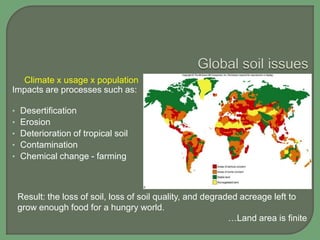
Climate x usage x population
Impacts are processes such as:
•
•
•
•
•

Desertification
Erosion
Deterioration of tropical soil
Contamination
Chemical change - farming

Result: the loss of soil, loss of soil quality, and degraded acreage left to
grow enough food for a hungry world.
…Land area is finite
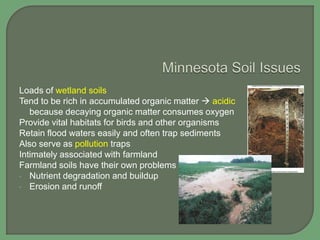
Loads of wetland soils
Tend to be rich in accumulated organic matter  acidic
because decaying organic matter consumes oxygen
Provide vital habitats for birds and other organisms
Retain flood waters easily and often trap sediments
Also serve as pollution traps
Intimately associated with farmland
Farmland soils have their own problems
• Nutrient degradation and buildup
• Erosion and runoff
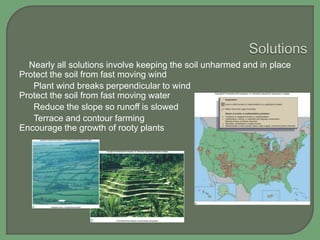
Nearly all solutions involve keeping the soil unharmed and in place
Protect the soil from fast moving wind
Plant wind breaks perpendicular to wind
Protect the soil from fast moving water
Reduce the slope so runoff is slowed
Terrace and contour farming
Encourage the growth of rooty plants
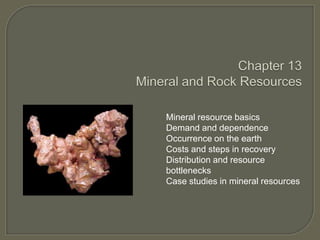
Mineral resource basics
Demand and dependence
Occurrence on the earth
Costs and steps in recovery
Distribution and resource
bottlenecks
Case studies in mineral resources
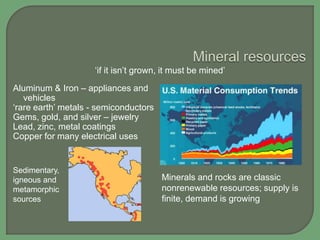
ā€žif it isnā€Ÿt grown, it must be minedā€Ÿ
Aluminum & Iron – appliances and
vehicles
ā€žrare earthā€Ÿ metals - semiconductors
Gems, gold, and silver – jewelry
Lead, zinc, metal coatings
Copper for many electrical uses

Sedimentary,
igneous and
metamorphic
sources

Minerals and rocks are classic
nonrenewable resources; supply is
finite, demand is growing
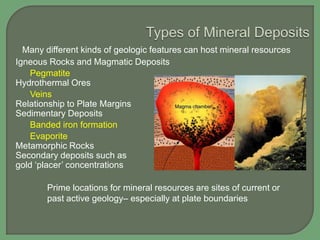
Many different kinds of geologic features can host mineral resources
Igneous Rocks and Magmatic Deposits
Pegmatite
Hydrothermal Ores
Veins
Relationship to Plate Margins
Sedimentary Deposits
Banded iron formation
Evaporite
Metamorphic Rocks
Secondary deposits such as
gold ā€žplacerā€Ÿ concentrations
Prime locations for mineral resources are sites of current or
past active geology– especially at plate boundaries
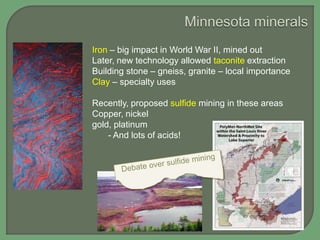
Iron – big impact in World War II, mined out
Later, new technology allowed taconite extraction
Building stone – gneiss, granite – local importance
Clay – specialty uses
Recently, proposed sulfide mining in these areas
Copper, nickel
gold, platinum
- And lots of acids!
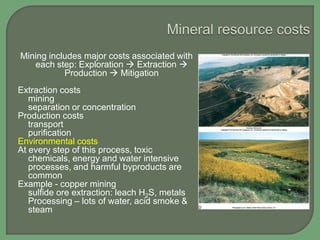
Mining includes major costs associated with
each step: Exploration  Extraction 
Production  Mitigation
Extraction costs
mining
separation or concentration
Production costs
transport
purification
Environmental costs
At every step of this process, toxic
chemicals, energy and water intensive
processes, and harmful byproducts are
common
Example - copper mining
sulfide ore extraction: leach H2S, metals
Processing – lots of water, acid smoke &
steam
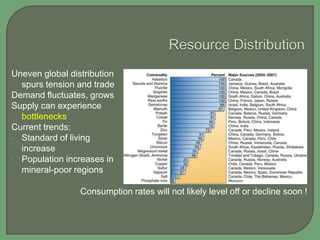
Uneven global distribution
spurs tension and trade
Demand fluctuates, grows
Supply can experience
bottlenecks
Current trends:
• Standard of living
increase
• Population increases in
mineral-poor regions

Consumption rates will not likely level off or decline soon !
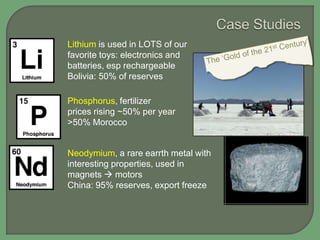
Lithium is used in LOTS of our
favorite toys: electronics and
batteries, esp rechargeable
Bolivia: 50% of reserves
Phosphorus, fertilizer
prices rising ~50% per year
>50% Morocco

Neodymium, a rare earrth metal with
interesting properties, used in
magnets  motors
China: 95% reserves, export freeze
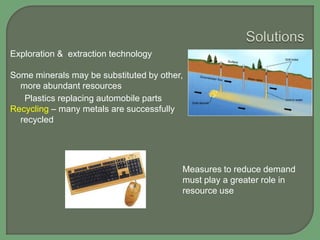
Exploration & extraction technology
Some minerals may be substituted by other,
more abundant resources
Plastics replacing automobile parts
Recycling – many metals are successfully
recycled

Measures to reduce demand
must play a greater role in
resource use
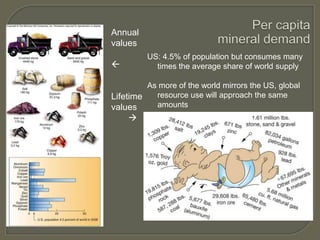
Annual
values
US: 4.5% of population but consumes many
times the average share of world supply



As more of the world mirrors the US, global
resource use will approach the same
Lifetime
amounts
values



Chapter 11 13

  • 1.
    NOAA: National Oceanic and Atmospheric Administration Midwest US:local anomalies make us one of the only ā€œcold spotsā€ on earth
  • 2.
    Big clichĆ© #1 Allgeologic resources are finite Once itā€Ÿs gone, itā€Ÿs gone Long before that, itā€Ÿs scarce Big clichĆ© #2 mined If it isnt grown, it must be ______
  • 3.
    Water as aresource Our supply Groundwater sources and uses Regional supply and demand Solutions
  • 4.
    water is aresource: it is important for domestic use, agriculture, and industry Water is a finite resource Just like most other geologic resources Fresh water on earth: a very small percentage of total • Polar ice • Groundwater • Surface water – a distant third { closed system } Water is a regionally renewable resource – but not always locally! Geology affects the quality and quality of water in a region
  • 5.
    Sick of thisyet? Groundwater portion: Water will flow down until it hits the saturated underground zone – surface at the water table Water table approximately follows topography but also depends on sediments, barriers etc Groundwater will slowly flow or stay underground for up to millions of years
  • 6.
    Water will flowalong streams, through cracks, and directly into porous sediments and soils Porosity and permeability describe the amount of space between grains and the ability of rocks/sediments/soils to contain fluid and to allow fluids to pass through them Aquifer = place with good storage and movement as above = good source for water Porous, but NOT permeable!
  • 7.
    Recharge can takeplace over large timescales
  • 8.
    Pumping ground waterwill lower the water table and form a cone of depression Aquifer rocks may compact after ground water is withdrawn, leading to subsidence Result: seawater intrusion, sinkholes Urbanization causes both higher withdrawal and lower recharge • Pavement and parking lots reduce recharge capacity • Building on wetlands reduces recharge, water storage, and water quality
  • 9.
    A mixture ofyounger surface and older, rocky aquifer sources Quaternary – glacial sand and gravel Cretaceous – marine sediments limestone Older – sandstone and hard metamorphic rocks BIG range of recharge times, pollution rates, and demand Issues: pollution ! Pollution ! pollution !! Lots of surface water sources too
  • 10.
    A geopolitical issue- global water usage • Too many people • Too much demand • Not many places to find more water Conservation is growing in importance, but not enough Desalination is also growing in importance Mali, Afghanistan, Somalia, Nigeria, DR Congo
  • 11.
    Hi and lotech: •Cloud seeding •Interbasin transfer •Recycling Conservation – a must do strategy in U.S. Water is wasted every day in different ways Interbasin Water Transfer Moving surface waters from one stream systemā€Ÿs drainage basin to anotherā€Ÿs Desalination Ground water recharge can be enhanced by incorporating various artificial recharge strategies Build artificial recharge basins Retention strategies
  • 12.
    Soil as aresource Soils defined – characteristics Soil formation process, weathering, erosion Minnesota soil issues Soil solutions
  • 13.
    Soil : - Unconsolidatedmaterial overlying bedrock - Material capable of supporting plant growth - Connected biological – geological system Rocks x climate x plants x time Color: dark or light Dark soils tend to be rich in organic matter Texture: size – sand/silt/clay Sand-sized (2-0.05 mm) Silt-sized (0.05-0.002 mm) Clay-sized (less than 0.002 mm) Structure: Blocks or ā€žpedsā€Ÿ , crumbs, etc
  • 14.
    Soil is producedby weathering - chemical, physical, biological Climate, topography, source composition, and time are factors Calcium Carbonate and some silicates dissolve in water Organic acids and acid rain from sulfates break down minerals Biological activity - roots & burrowers – aids weathering Erosion is the physical removal & transport of weathered material …creates and destroys the raw materials for soil Erosion >>>formation
  • 15.
    Mineral  organic Soil blanket shows zones of different colors, chemical compositions, & properties Topsoil [ā€žE Horizonā€Ÿ] rooted and organic A Horizon - exposed to heavy leaching B Horizon - accumulation / deposition + leaching C Horizon - Very coarsely broken-up bedrock R horizon: bedrock material Most soils are defined by the combination of their profiles
  • 16.
    Climate x usagex population Impacts are processes such as: • • • • • Desertification Erosion Deterioration of tropical soil Contamination Chemical change - farming Result: the loss of soil, loss of soil quality, and degraded acreage left to grow enough food for a hungry world. …Land area is finite
  • 17.
    Loads of wetlandsoils Tend to be rich in accumulated organic matter  acidic because decaying organic matter consumes oxygen Provide vital habitats for birds and other organisms Retain flood waters easily and often trap sediments Also serve as pollution traps Intimately associated with farmland Farmland soils have their own problems • Nutrient degradation and buildup • Erosion and runoff
  • 18.
    Nearly all solutionsinvolve keeping the soil unharmed and in place Protect the soil from fast moving wind Plant wind breaks perpendicular to wind Protect the soil from fast moving water Reduce the slope so runoff is slowed Terrace and contour farming Encourage the growth of rooty plants
  • 19.
    Mineral resource basics Demandand dependence Occurrence on the earth Costs and steps in recovery Distribution and resource bottlenecks Case studies in mineral resources
  • 20.
    ā€žif it isnā€Ÿtgrown, it must be minedā€Ÿ Aluminum & Iron – appliances and vehicles ā€žrare earthā€Ÿ metals - semiconductors Gems, gold, and silver – jewelry Lead, zinc, metal coatings Copper for many electrical uses Sedimentary, igneous and metamorphic sources Minerals and rocks are classic nonrenewable resources; supply is finite, demand is growing
  • 21.
    Many different kindsof geologic features can host mineral resources Igneous Rocks and Magmatic Deposits Pegmatite Hydrothermal Ores Veins Relationship to Plate Margins Sedimentary Deposits Banded iron formation Evaporite Metamorphic Rocks Secondary deposits such as gold ā€žplacerā€Ÿ concentrations Prime locations for mineral resources are sites of current or past active geology– especially at plate boundaries
  • 22.
    Iron – bigimpact in World War II, mined out Later, new technology allowed taconite extraction Building stone – gneiss, granite – local importance Clay – specialty uses Recently, proposed sulfide mining in these areas Copper, nickel gold, platinum - And lots of acids!
  • 23.
    Mining includes majorcosts associated with each step: Exploration  Extraction  Production  Mitigation Extraction costs mining separation or concentration Production costs transport purification Environmental costs At every step of this process, toxic chemicals, energy and water intensive processes, and harmful byproducts are common Example - copper mining sulfide ore extraction: leach H2S, metals Processing – lots of water, acid smoke & steam
  • 24.
    Uneven global distribution spurstension and trade Demand fluctuates, grows Supply can experience bottlenecks Current trends: • Standard of living increase • Population increases in mineral-poor regions Consumption rates will not likely level off or decline soon !
  • 25.
    Lithium is usedin LOTS of our favorite toys: electronics and batteries, esp rechargeable Bolivia: 50% of reserves Phosphorus, fertilizer prices rising ~50% per year >50% Morocco Neodymium, a rare earrth metal with interesting properties, used in magnets  motors China: 95% reserves, export freeze
  • 26.
    Exploration & extractiontechnology Some minerals may be substituted by other, more abundant resources Plastics replacing automobile parts Recycling – many metals are successfully recycled Measures to reduce demand must play a greater role in resource use
  • 27.
    Annual values US: 4.5% ofpopulation but consumes many times the average share of world supply  As more of the world mirrors the US, global resource use will approach the same Lifetime amounts values ļƒ