Supervision at a
Supervision at a
GlanceGlanceKeeping the Mission and Vision First
LaKeisha Weber, M.A.T.
Welcome Back
0 Introduction of the Leadership Team
0 Principal
0 Assistant Principal
0 Testing Coordinator
0 Teacher Leaders
0 Department Heads
0 Purpose of the Leadership Team:
0 Support the teachers and staff in their mission to propel
student growth and achievement
0 Disseminate information regarding testing procedures,
classroom expectations, and other pertinent
information
0 Supervise instruction instructional practices
A Shared Mission and Vision
Mission Vision
At Johnson Middle School, we believe that all
children can learn and reach their full
potential.
Teachers , students, and school leaders will
collaborate to set high expectations and
promote academic excellence and growth
for all students. Students will witness their
academic growth across content areas.
In partnership with the community, we will
build a professional learning environment
that respects the diversity of every student
and nurtures their self-esteem.
Together we will create a school culture that
fosters respect, trust, and academic
distinction. Adults and children will feel
accepted and supported. Education is a
collaborative effort that requires
commitment and hard work from all those
invested in student growth.
0 We believe in nurturing the
innate abilities of our students
by creating a diverse
environment that is free of
judgment and full of positivity.
Students will be prepared for
the rigor they will face in a
high school setting
Testing Data: Onward and Upward
2013-2014 2014-15 Projections
0 Letter Grade: C
 72.1 of 100 SPS score
 ELA- 52% on or above
grade level
 Math-63% on or above
grade level
 Science-59% on or above
grade level
 Social Studies-68% on or
above grade level
0 Letter Grade: B
 82.1 out of 100 SPS
score
 ELA- 62% on or above
grade level
 Math-75% on or above
grade level
 Science-65% on or above
grade level
 Social Studies-75% on or
above grade level
Growth Plan: 10 point overall SPS growth
Pulling it all Together
0 Our school’s mission, vision,
and testing data will drive our
teaching practices
0 Buy-in is needed from all staff
members to initiate change
and witness growth
0 Everyone in this school will
work collaboratively towards
OUR goals
The Purpose of
The Purpose of
Supervision
Supervision
Why Supervise Instruction?
0 The expectations of school and instructional leaders
are incessantly changing
0 Teacher evaluation is required and is a tool used to
determine teacher quality and job security
0 To ensure that teachers are academically moving
students in the right direction as well as growing
professionally, the school leadership team will
supervise instructional practices
0 Supervision of instruction is separate from evaluation
of instruction.
Why Supervise Instruction?
Supervision should foster teacher improvement and autonomy as well as
simplify teacher-driven instructional practices – Shawn Moore
0Supervision of your instruction, by myself or a member of the
leadership team, will push you to meet objectives
0Building capacity in teachers is important
0 Teachers are the content experts
0 Meetings regarding instruction and the curriculum will mandate teacher
input
0 Several models will be used to supervise teachers
Structure of
Structure of
Supervision
Supervision
When, Where, and How: The
Format of Supervision
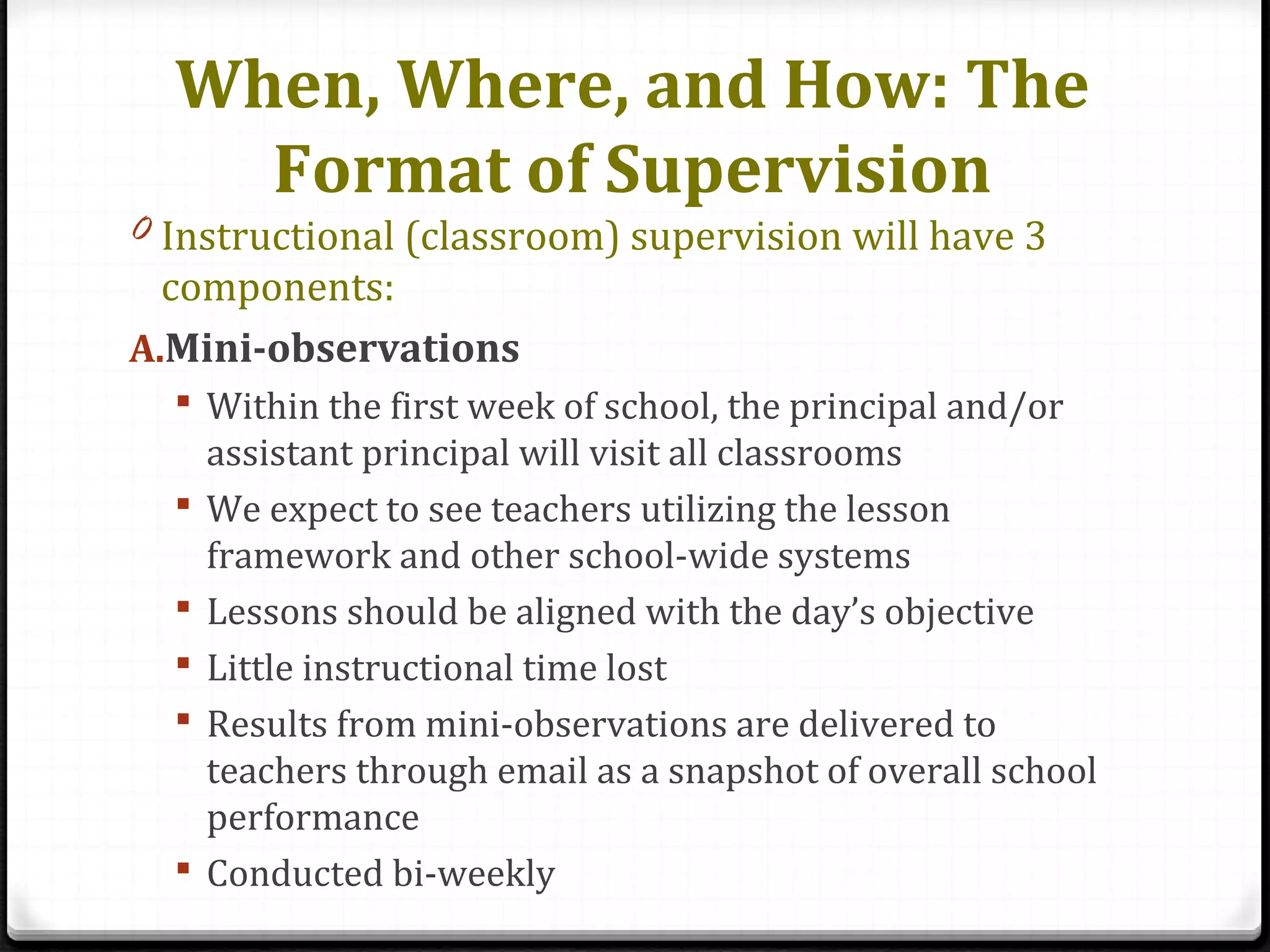
0 Instructional (classroom) supervision will have 3
components:
A.Mini-observations
 Within the first week of school, the principal and/or
assistant principal will visit all classrooms
 We expect to see teachers utilizing the lesson
framework and other school-wide systems
 Lessons should be aligned with the day’s objective
 Little instructional time lost
 Results from mini-observations are delivered to
teachers through email as a snapshot of overall school
performance
 Conducted bi-weekly
When, Where, and How: The
Format of Supervision (cont.)
0 Instructional (classroom) supervision will
have 3 components:
B. Formative evaluation
 Individualized
 Conducted by leadership team members
 Includes pre-conference, 20 minute in-class
evaluation, and post-conference
 Mocks district mandated evaluations (to aid in
teacher preparation)
 Performed monthly
When, Where, and How: The
Format of Supervision (cont)
0 Instructional (classroom) supervision will have 3
components:
C. Weekly data meetings
 Testing data is used to evaluate school and teacher efficacy
 Schools must show standardized testing growth
 During planning period 1 day per week
 Supervising assessment will determine whether or not
students are being tested on relevant content (Common
Core Standards, GLEs, etc.)
 Teachers will bring copy of weekly assessments, student
samples, and tracking data
 During the meetings, teachers will rflect on the prior week
and make plans on how they reteach objectives to show
80% mastery on the next quiz/test
The 3 components work collectively as a tool for
supervising instruction.
Bi-weekly
Monthly
Weekly
Data shows a 10%
increase in overall
student growth
Supervision: Roles
Supervision: Rolesand Responsibilities
and Responsibilities
Teachers and Principals
The Principal’s Role in Supervision
0 Supervision of instruction has developed a negative
reputation among teachers
0 Supervision in our organization will be used as a
means of monitoring the operations of all practices
within the school
0 Instructional supervision is used to manage
classroom practices in a way that builds teacher
effectiveness and student performance
0 Principal and leadership team will supervise the
instruction of all teachers
The Teacher’s Role in Supervision
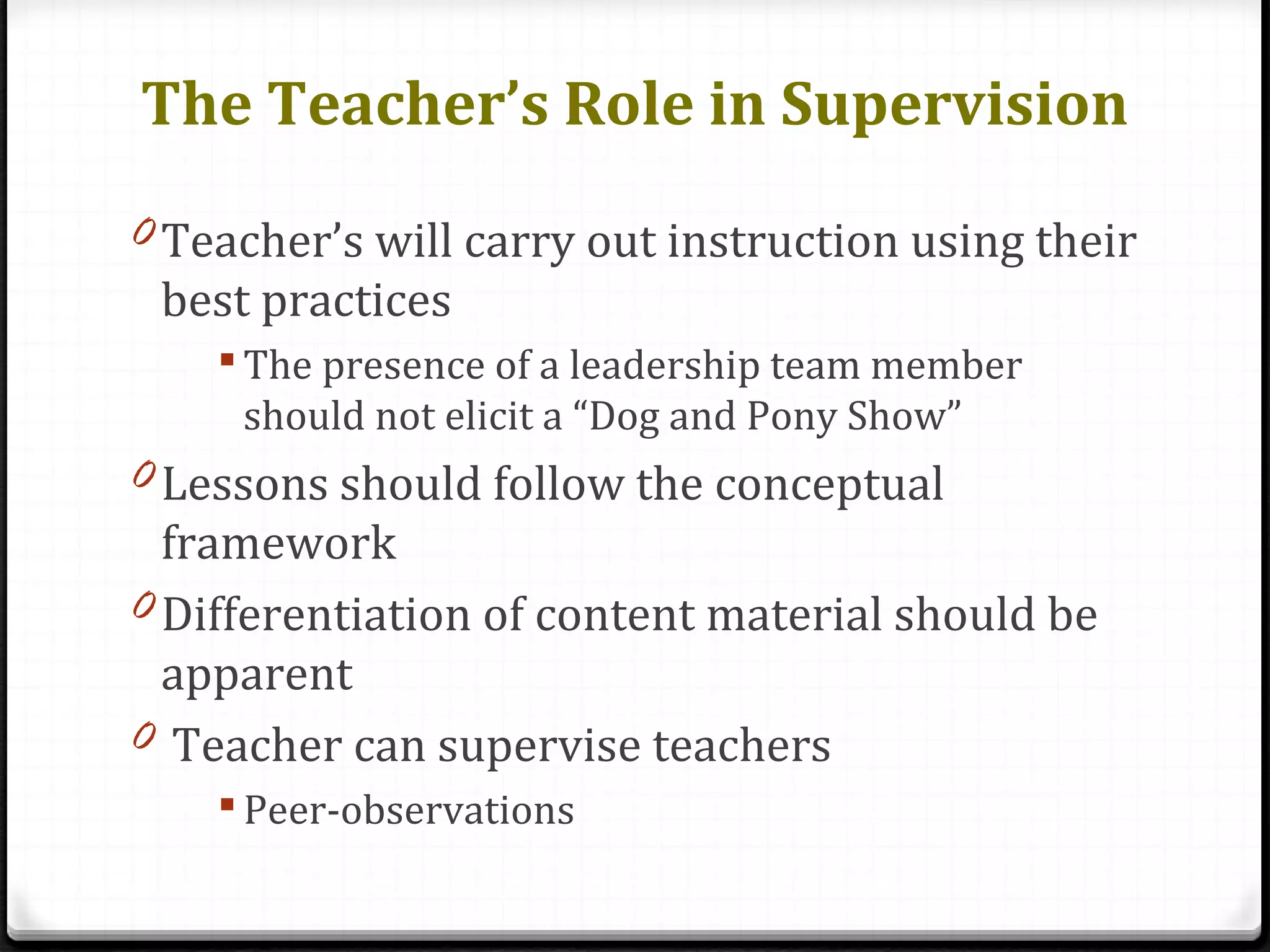
0 Teacher’s will carry out instruction using their
best practices
 The presence of a leadership team member
should not elicit a “Dog and Pony Show”
0 Lessons should follow the conceptual
framework
0 Differentiation of content material should be
apparent
0 Teacher can supervise teachers
 Peer-observations
Supervision
Supervision
versus Evaluation
versus EvaluationSimilarities and Differences
Supervision and evaluation are often mistaken as synonymous terms. Although
similar, supervision is the actual process of managing instruction in a way that
aligns with the school’s mission and vision. Evaluation is a method used by school
leaders to determine teacher efficiency.
Supervision Evaluation
0 Performed by school
leaders and/or teachers
0 Can be formal or informal
0 Designed to increase
teacher performance and
student achievement
0 Aligns with the beliefs and
vision of the principal and
other school leaders
0 Collaboration among
individuals is essential
0 Builds capacity in staff
0 Formative
0 Designed by district and
state educational officials
0 Carried out by the
principal or assistant
principal
0 Requires certain
components (pre-/post-
conference, scoring, etc.)
0 Can be summative,
formative, or both.
In Summary
The leadership team is here to support teachers and
students alike. We can only reach our goals as a team.
Expect a Great Year!
References
0 Glickman, Carl D., Stephen P. Gordon, and Jovita M.
Ross-Gordon. Supervision and Instructional
Leadership: A Developmental Approach. N.p.: n.p., n.d.
Print

Supervision at a glance

  • 1.
    Supervision at a Supervisionat a GlanceGlanceKeeping the Mission and Vision First LaKeisha Weber, M.A.T.
  • 2.
    Welcome Back 0 Introductionof the Leadership Team 0 Principal 0 Assistant Principal 0 Testing Coordinator 0 Teacher Leaders 0 Department Heads 0 Purpose of the Leadership Team: 0 Support the teachers and staff in their mission to propel student growth and achievement 0 Disseminate information regarding testing procedures, classroom expectations, and other pertinent information 0 Supervise instruction instructional practices
  • 3.
    A Shared Missionand Vision Mission Vision At Johnson Middle School, we believe that all children can learn and reach their full potential. Teachers , students, and school leaders will collaborate to set high expectations and promote academic excellence and growth for all students. Students will witness their academic growth across content areas. In partnership with the community, we will build a professional learning environment that respects the diversity of every student and nurtures their self-esteem. Together we will create a school culture that fosters respect, trust, and academic distinction. Adults and children will feel accepted and supported. Education is a collaborative effort that requires commitment and hard work from all those invested in student growth. 0 We believe in nurturing the innate abilities of our students by creating a diverse environment that is free of judgment and full of positivity. Students will be prepared for the rigor they will face in a high school setting
  • 4.
    Testing Data: Onwardand Upward 2013-2014 2014-15 Projections 0 Letter Grade: C  72.1 of 100 SPS score  ELA- 52% on or above grade level  Math-63% on or above grade level  Science-59% on or above grade level  Social Studies-68% on or above grade level 0 Letter Grade: B  82.1 out of 100 SPS score  ELA- 62% on or above grade level  Math-75% on or above grade level  Science-65% on or above grade level  Social Studies-75% on or above grade level Growth Plan: 10 point overall SPS growth
  • 5.
    Pulling it allTogether 0 Our school’s mission, vision, and testing data will drive our teaching practices 0 Buy-in is needed from all staff members to initiate change and witness growth 0 Everyone in this school will work collaboratively towards OUR goals
  • 6.
    The Purpose of ThePurpose of Supervision Supervision
  • 7.
    Why Supervise Instruction? 0The expectations of school and instructional leaders are incessantly changing 0 Teacher evaluation is required and is a tool used to determine teacher quality and job security 0 To ensure that teachers are academically moving students in the right direction as well as growing professionally, the school leadership team will supervise instructional practices 0 Supervision of instruction is separate from evaluation of instruction.
  • 8.
    Why Supervise Instruction? Supervisionshould foster teacher improvement and autonomy as well as simplify teacher-driven instructional practices – Shawn Moore 0Supervision of your instruction, by myself or a member of the leadership team, will push you to meet objectives 0Building capacity in teachers is important 0 Teachers are the content experts 0 Meetings regarding instruction and the curriculum will mandate teacher input 0 Several models will be used to supervise teachers
  • 9.
  • 10.
    When, Where, andHow: The Format of Supervision 0 Instructional (classroom) supervision will have 3 components: A.Mini-observations  Within the first week of school, the principal and/or assistant principal will visit all classrooms  We expect to see teachers utilizing the lesson framework and other school-wide systems  Lessons should be aligned with the day’s objective  Little instructional time lost  Results from mini-observations are delivered to teachers through email as a snapshot of overall school performance  Conducted bi-weekly
  • 11.
    When, Where, andHow: The Format of Supervision (cont.) 0 Instructional (classroom) supervision will have 3 components: B. Formative evaluation  Individualized  Conducted by leadership team members  Includes pre-conference, 20 minute in-class evaluation, and post-conference  Mocks district mandated evaluations (to aid in teacher preparation)  Performed monthly
  • 12.
    When, Where, andHow: The Format of Supervision (cont) 0 Instructional (classroom) supervision will have 3 components: C. Weekly data meetings  Testing data is used to evaluate school and teacher efficacy  Schools must show standardized testing growth  During planning period 1 day per week  Supervising assessment will determine whether or not students are being tested on relevant content (Common Core Standards, GLEs, etc.)  Teachers will bring copy of weekly assessments, student samples, and tracking data  During the meetings, teachers will rflect on the prior week and make plans on how they reteach objectives to show 80% mastery on the next quiz/test
  • 13.
    The 3 componentswork collectively as a tool for supervising instruction. Bi-weekly Monthly Weekly Data shows a 10% increase in overall student growth
  • 14.
    Supervision: Roles Supervision: RolesandResponsibilities and Responsibilities Teachers and Principals
  • 15.
    The Principal’s Rolein Supervision 0 Supervision of instruction has developed a negative reputation among teachers 0 Supervision in our organization will be used as a means of monitoring the operations of all practices within the school 0 Instructional supervision is used to manage classroom practices in a way that builds teacher effectiveness and student performance 0 Principal and leadership team will supervise the instruction of all teachers
  • 16.
    The Teacher’s Rolein Supervision 0 Teacher’s will carry out instruction using their best practices  The presence of a leadership team member should not elicit a “Dog and Pony Show” 0 Lessons should follow the conceptual framework 0 Differentiation of content material should be apparent 0 Teacher can supervise teachers  Peer-observations
  • 17.
  • 18.
    Supervision and evaluationare often mistaken as synonymous terms. Although similar, supervision is the actual process of managing instruction in a way that aligns with the school’s mission and vision. Evaluation is a method used by school leaders to determine teacher efficiency. Supervision Evaluation 0 Performed by school leaders and/or teachers 0 Can be formal or informal 0 Designed to increase teacher performance and student achievement 0 Aligns with the beliefs and vision of the principal and other school leaders 0 Collaboration among individuals is essential 0 Builds capacity in staff 0 Formative 0 Designed by district and state educational officials 0 Carried out by the principal or assistant principal 0 Requires certain components (pre-/post- conference, scoring, etc.) 0 Can be summative, formative, or both.
  • 19.
    In Summary The leadershipteam is here to support teachers and students alike. We can only reach our goals as a team. Expect a Great Year!
  • 20.
    References 0 Glickman, CarlD., Stephen P. Gordon, and Jovita M. Ross-Gordon. Supervision and Instructional Leadership: A Developmental Approach. N.p.: n.p., n.d. Print