CHAPTER 1 INTRODUCTION: TEN THEMES IN THE STUDY OF LIFE Copyright © 2002 Pearson Education, Inc., publishing as Benjamin Cummings
Biology, the study of life, is rooted in the human spirit. Biology has been pursued for centuries by men of God as they attempted to learn about God as they studied nature—called: Natural Theology Introduction Copyright © 2002 Pearson Education, Inc., publishing as Benjamin Cummings
Who were these “natural theologians?”
 
Blaise Pascal (1623-1662) Jansenist, a group of Calvinist French Catholic who emphasized salvation through God’s love and grace
 
Roger Bacon (1214-1294)  English Monk used glass to magnify organisms
 
Louis Pasteur  Experiments that demonstrated the cell theory—“all living things are made of cells and all cells come form pre-existing cells”
 
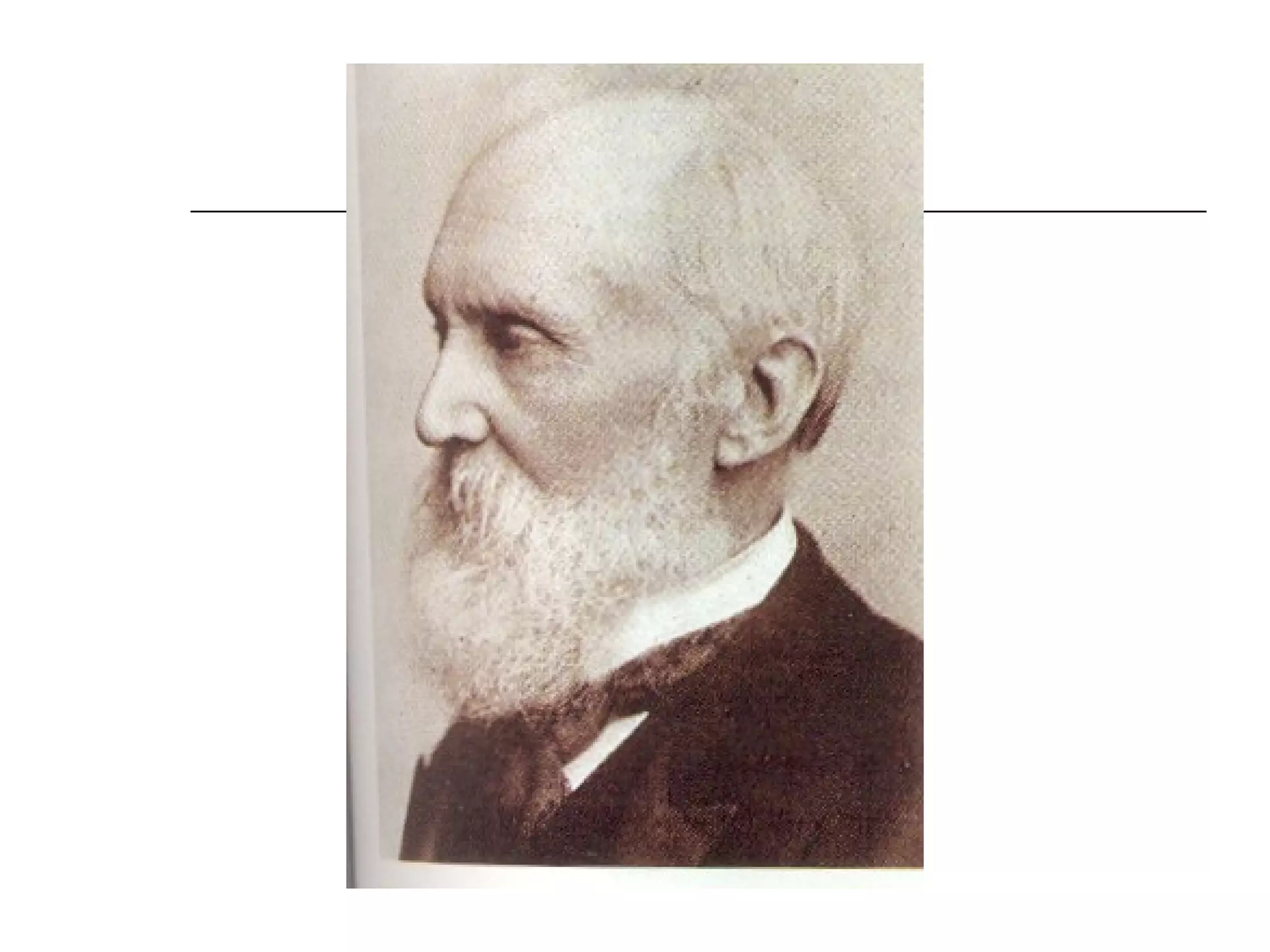
Lord Kelvin Opponent of Darwin Father of “Energetics”
 
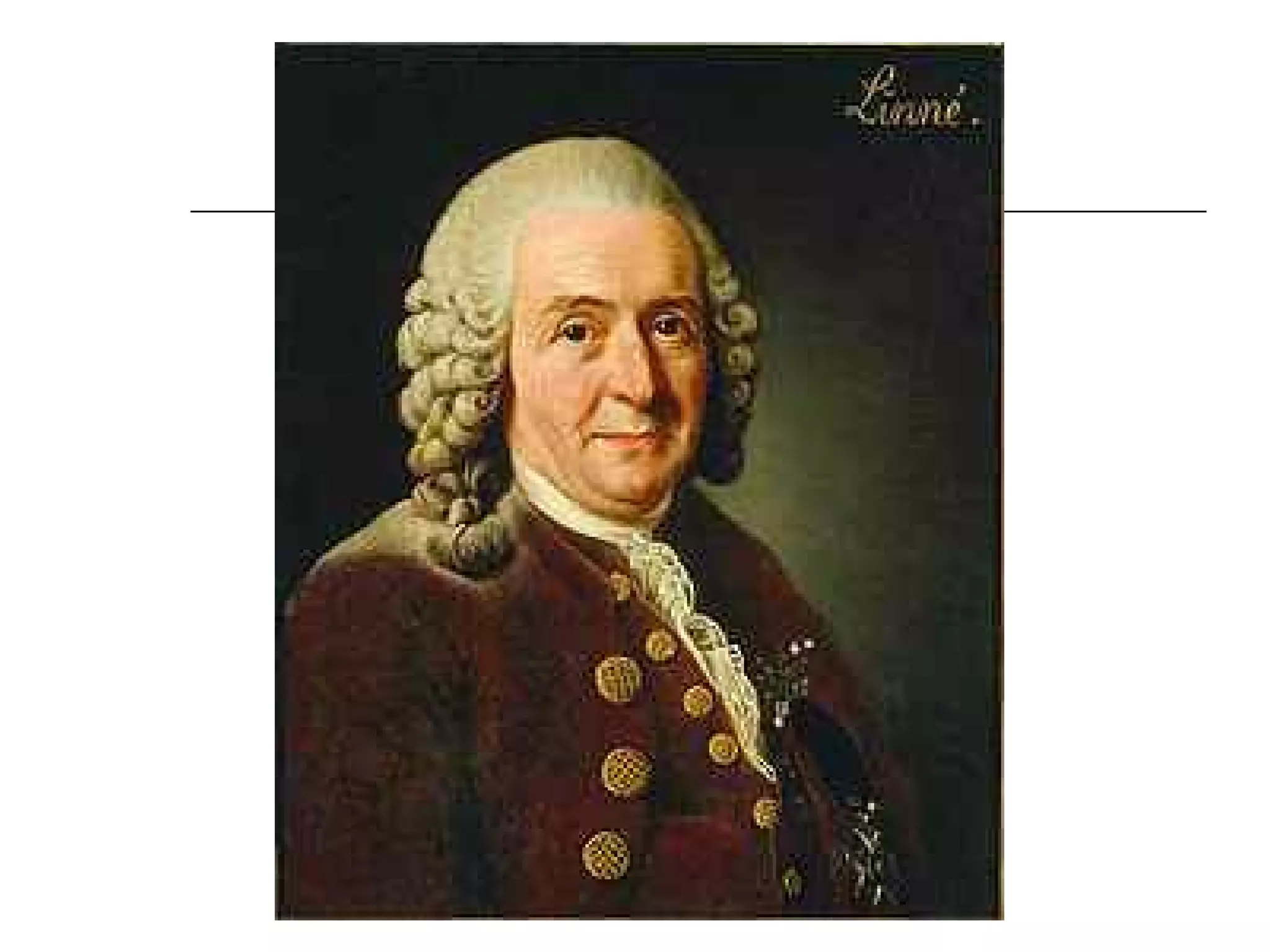
Carolus Linnaeus 1701-1778 Father of Modern taxonomy Accepted the Biblical account of creations Concluded that created kinds never alter enough to form new and different kinds
The list goes on: Michael Farraday Johann Kepler Isaac Newton Gregor Mendel Leonardo da Vinci Joseph Lister
Biologists explore life form a global to a microscopic scale


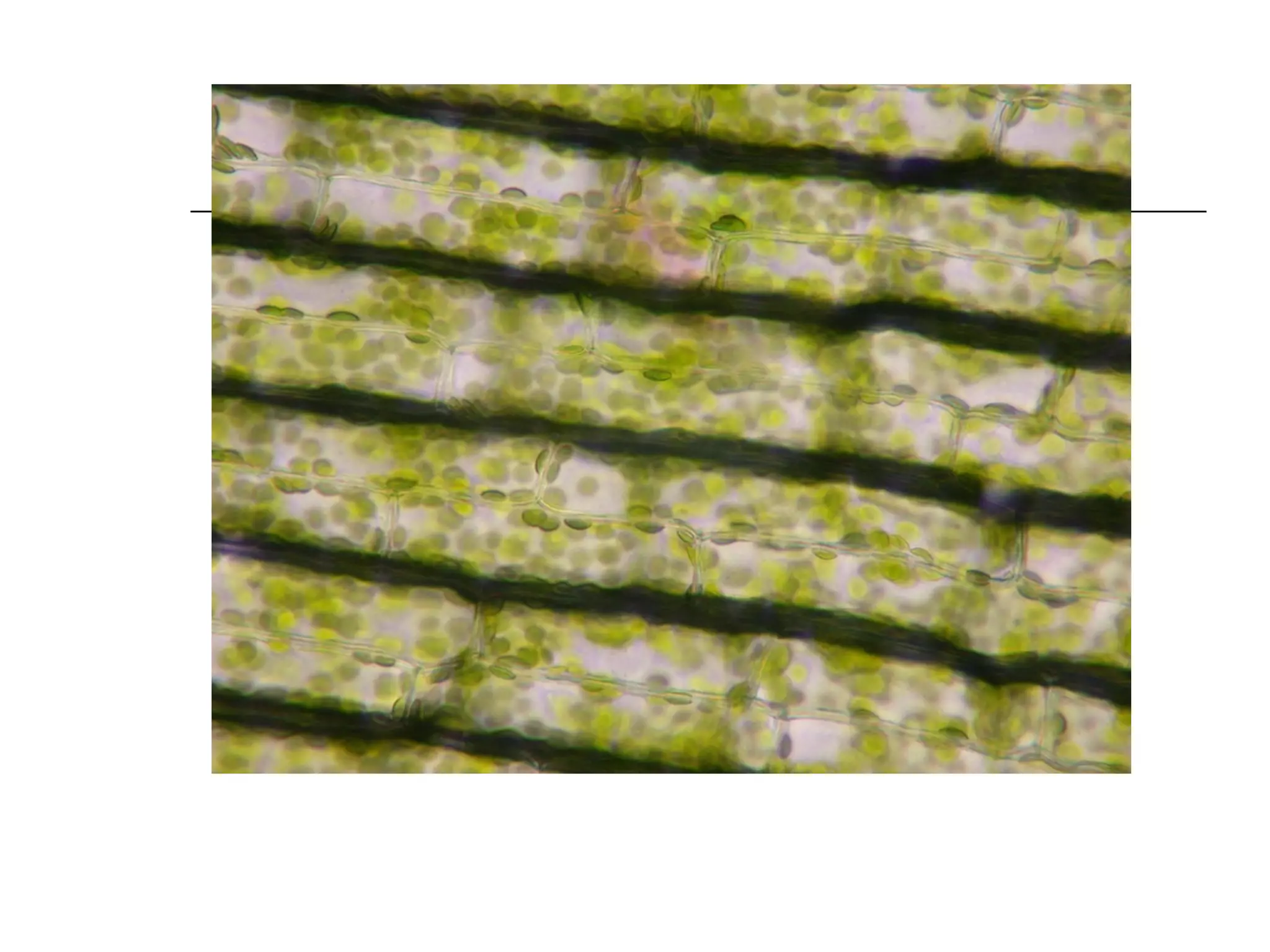
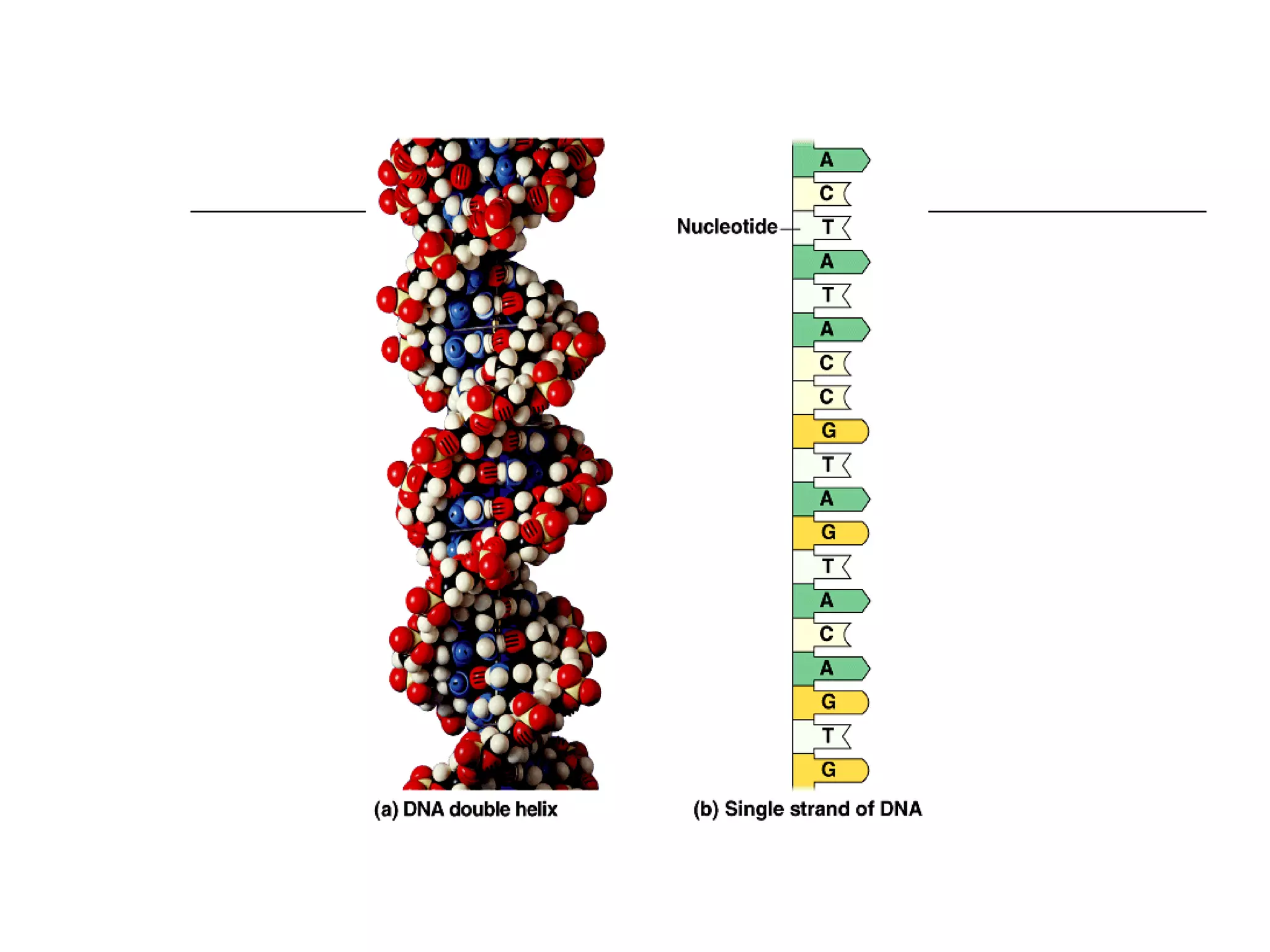
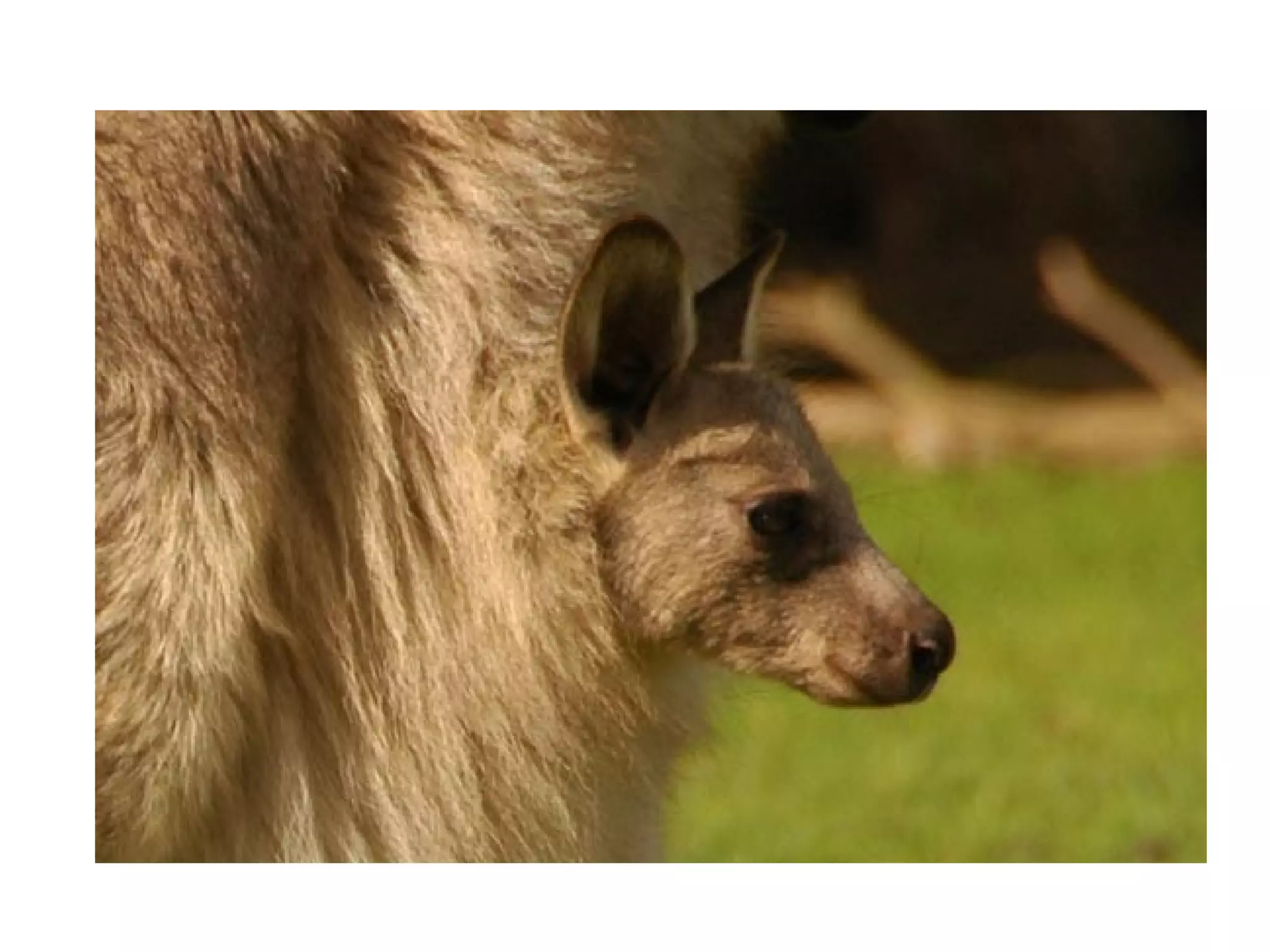
Life’s basic characteristic is a high degree of order. Each level of biological organization has emergent properties Copyright © 2002 Pearson Education, Inc., publishing as Benjamin Cummings Fig. 1.2(1) Fig. 1.2(2)
Biological organization is based on a hierarchy of structural levels, each building on the levels below. At the lowest level are atoms that are ordered into complex biological molecules. Many molecules are arranged into minute structures called organelles, which are the components of cells.
Cells are the subunits of organisms, the units of life. Copyright © 2002 Pearson Education, Inc., publishing as Benjamin Cummings Fig. 1.2(3)
Some organisms consist of a single cell, others are multicellular aggregates of specialized cells.
What is the upward hierarchy of biological complexity? Cells Tissues Organs Organ systems Organisms Populations Communities Ecosystems Biomes
Novel properties  emerge  at each step upward in the biological hierarchy. Copyright © 2002 Pearson Education, Inc., publishing as Benjamin Cummings
These  emergent  properties result from interactions between components. A cell is certainly much more than a bag of molecules.
This theme of emergent properties accents the importance of structural arrangement. The emergent properties of life are not supernatural, but simply reflect a hierarchy of structural organization.
Life resists a simple, one-sentence definition, yet we can recognize life by what living things do.  Copyright © 2002 Pearson Education, Inc., publishing as Benjamin Cummings Fig. 1.3
Whether multicellular or unicellular, all organisms must accomplish the same functions:
 
Growth and development
 
 
Metabolism
 
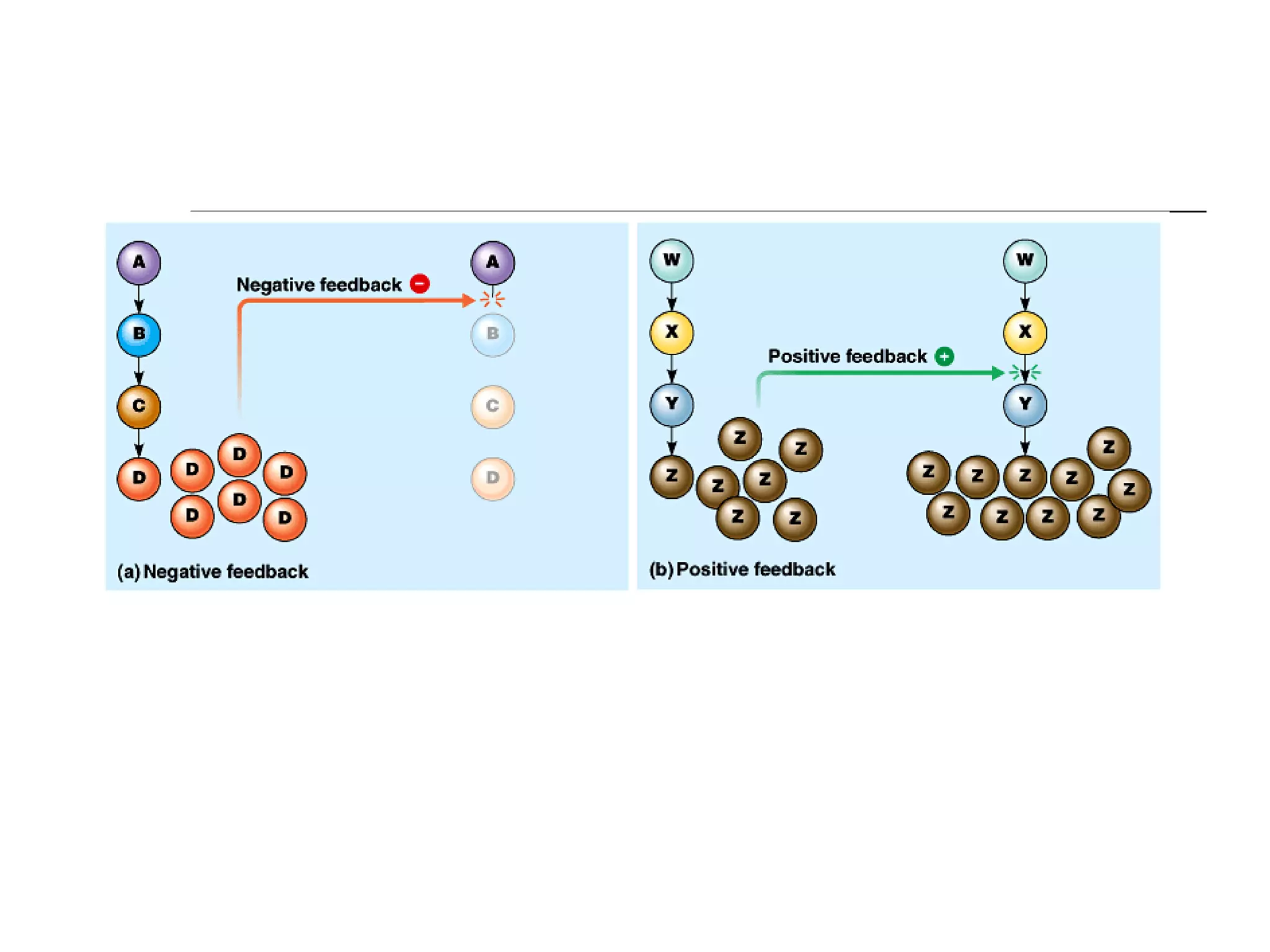
Regulation
 
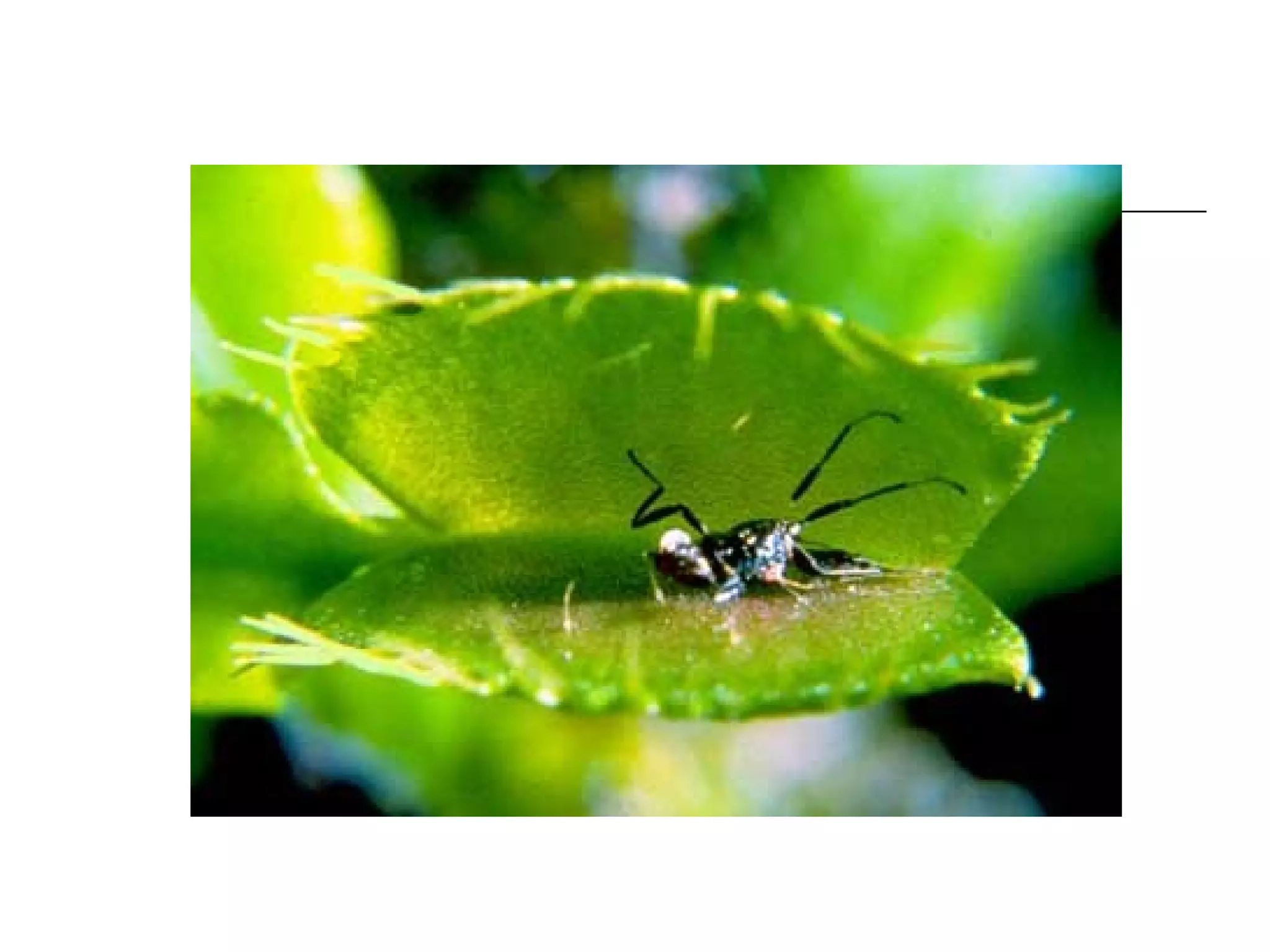
Respond to environment
 
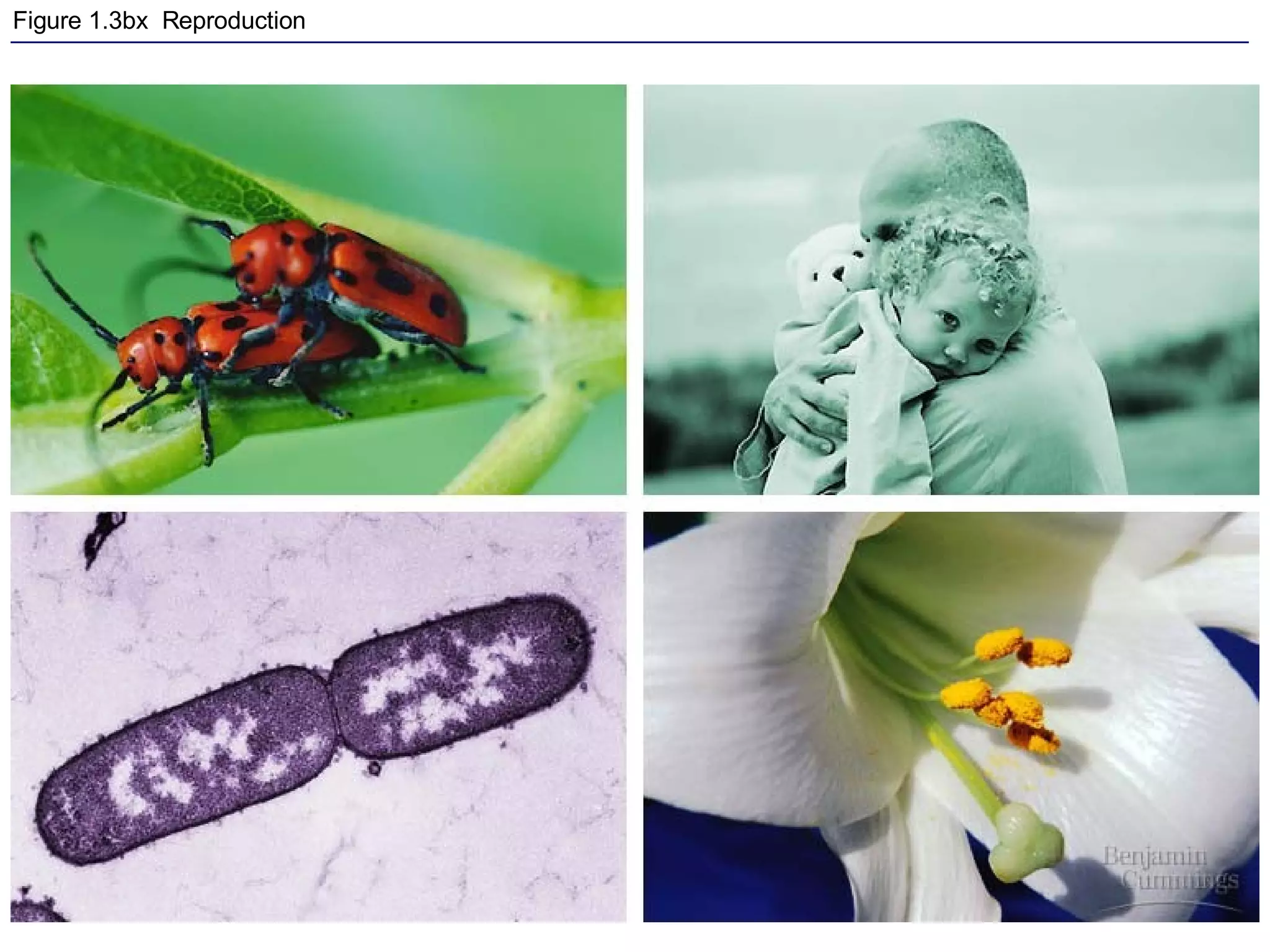
Figure 1.3bx  Reproduction
Reproduction


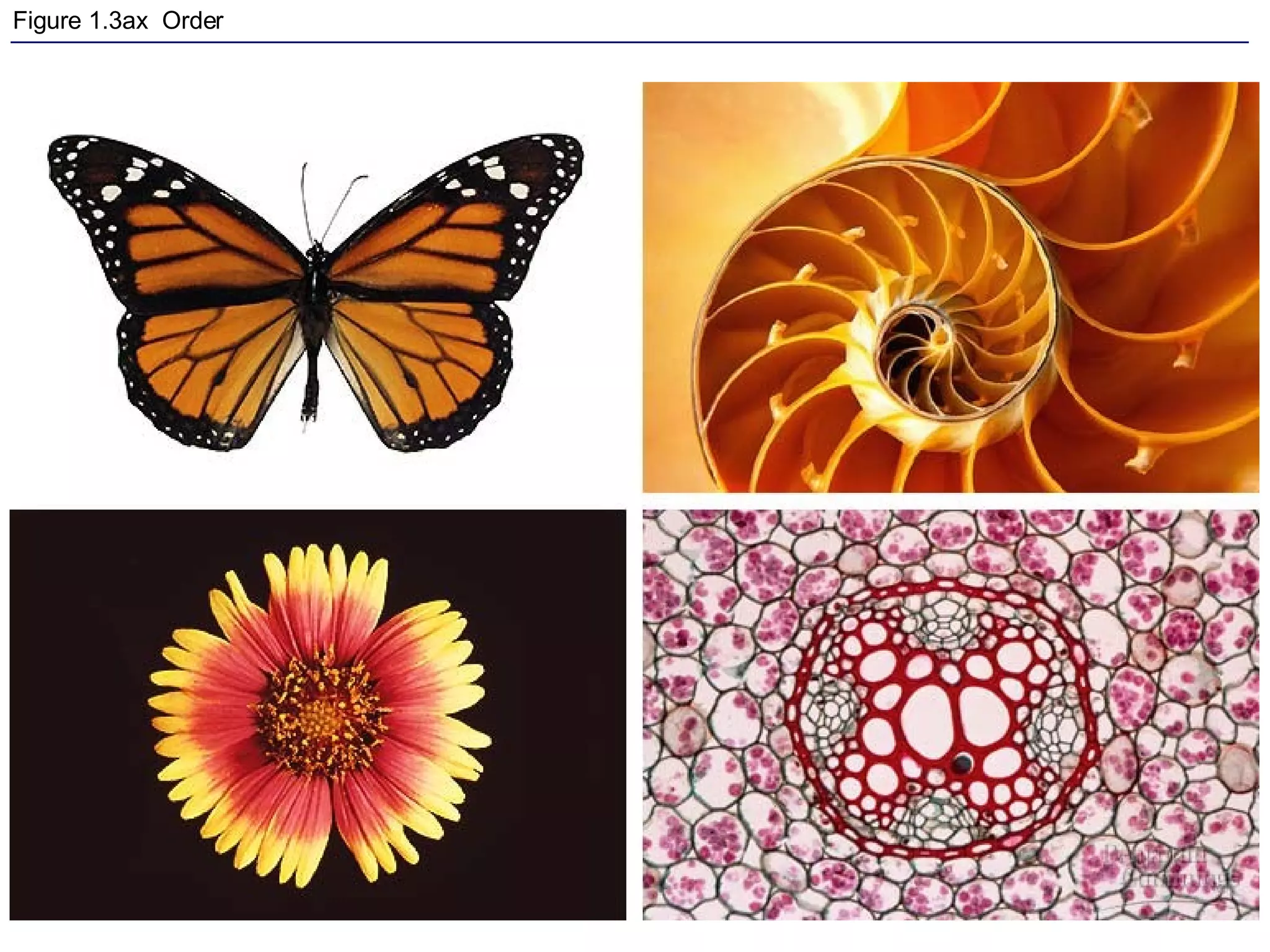
Living things exhibit order
 
Figure 1.3  Some properties of life
Figure 1.3ax  Order
The complex organization of life presents a dilemma to scientists seeking to understand biological processes. Copyright © 2002 Pearson Education, Inc., publishing as Benjamin Cummings
We cannot fully explain a higher level of organization by breaking down to its parts. At the same time, it is futile to try to analyze something as complex as an organism or cell without taking it apart.
Reductionism , reducing complex systems to simpler components, is a powerful strategy in biology. Reductionism is balanced by the longer-range objective of understanding emergent properties .
Science is a process
Science seeks natural causes for natural phenomena. The scope of science is limited to the study of structures and processes that we can observe and measure, either directly or indirectly.
Verifiable observations and measurements are the data of discovery science.
In some cases the observations entail a planned detailed dissection and description of a biological phenomenon, like the human genome. In other cases, curious and observant people make totally serendipitous discoveries. In 1928, Alexander Fleming accidentally discovered the antibacterial properties of  Pencillium  when this fungus contaminated some of his bacterial cultures.
Discovery science can  lead to important  conclusions via inductive  reasoning. An inductive  conclusion is a generalization that summarizes many  concurrent observations.
Organizing Species
Linnaeus  developed our system of organizing using 7 taxons Kingdom Phylum   Class   Order    Family    Genus    species
The scientific name is made of the Genus and species name (hence binomial nomenclature) Examples: Homo sapiens Drosophila melanogaster Salmonella typhimurium
Linnaeus used 2 groups Plant Kingdom Animal Kingdom
Whitaker used 5 kingdoms Monerans Plants Animals Fungi Protists
Scientists have now added a new taxon, called a “domain” Current system uses 3 domains: Bacteria Archaea Eukarya Both are prokaryotic
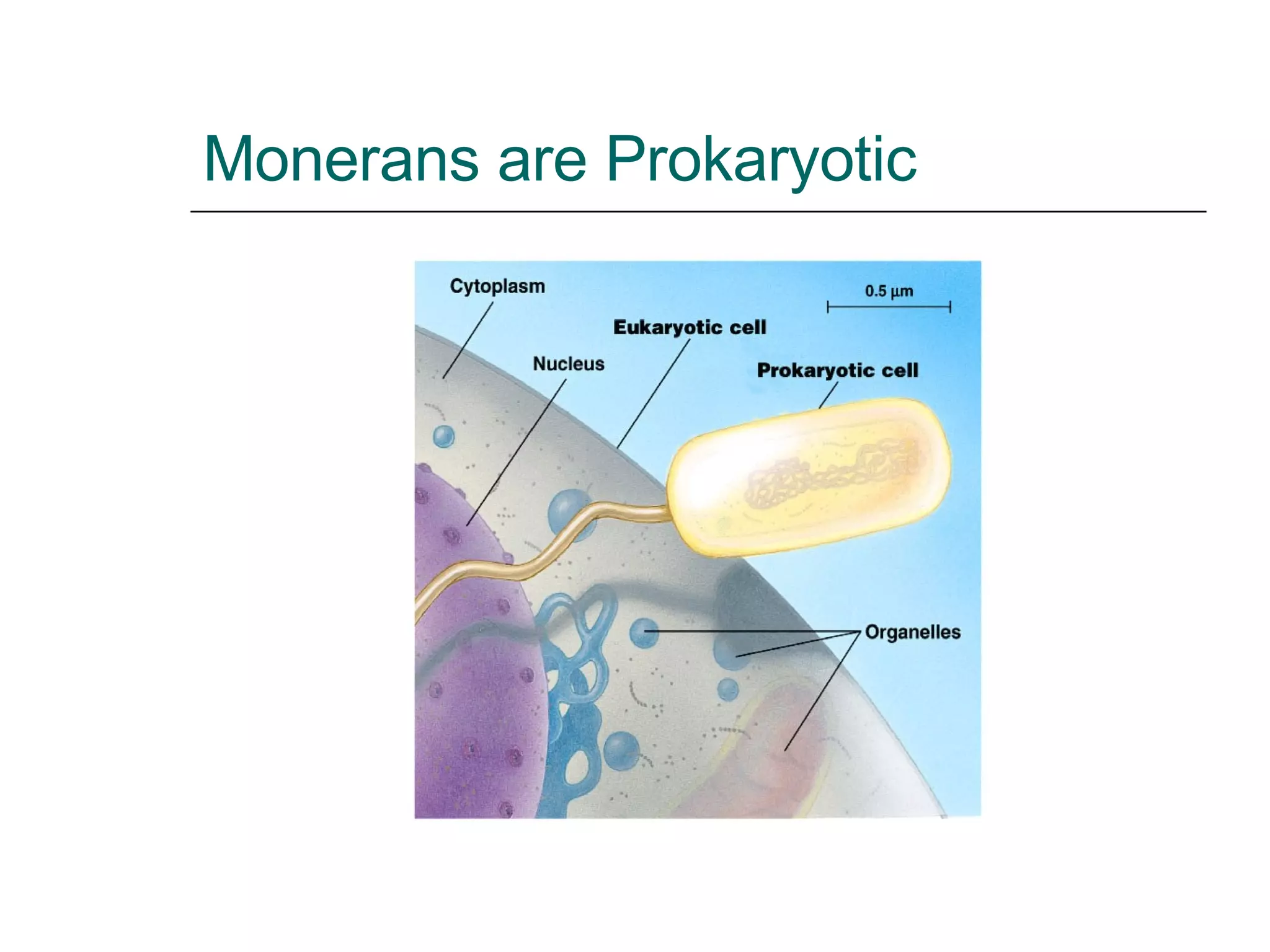
Monerans are Prokaryotic
Smaller than eukaryotes No membrane bound organelles DNA is not contained in a nucleus
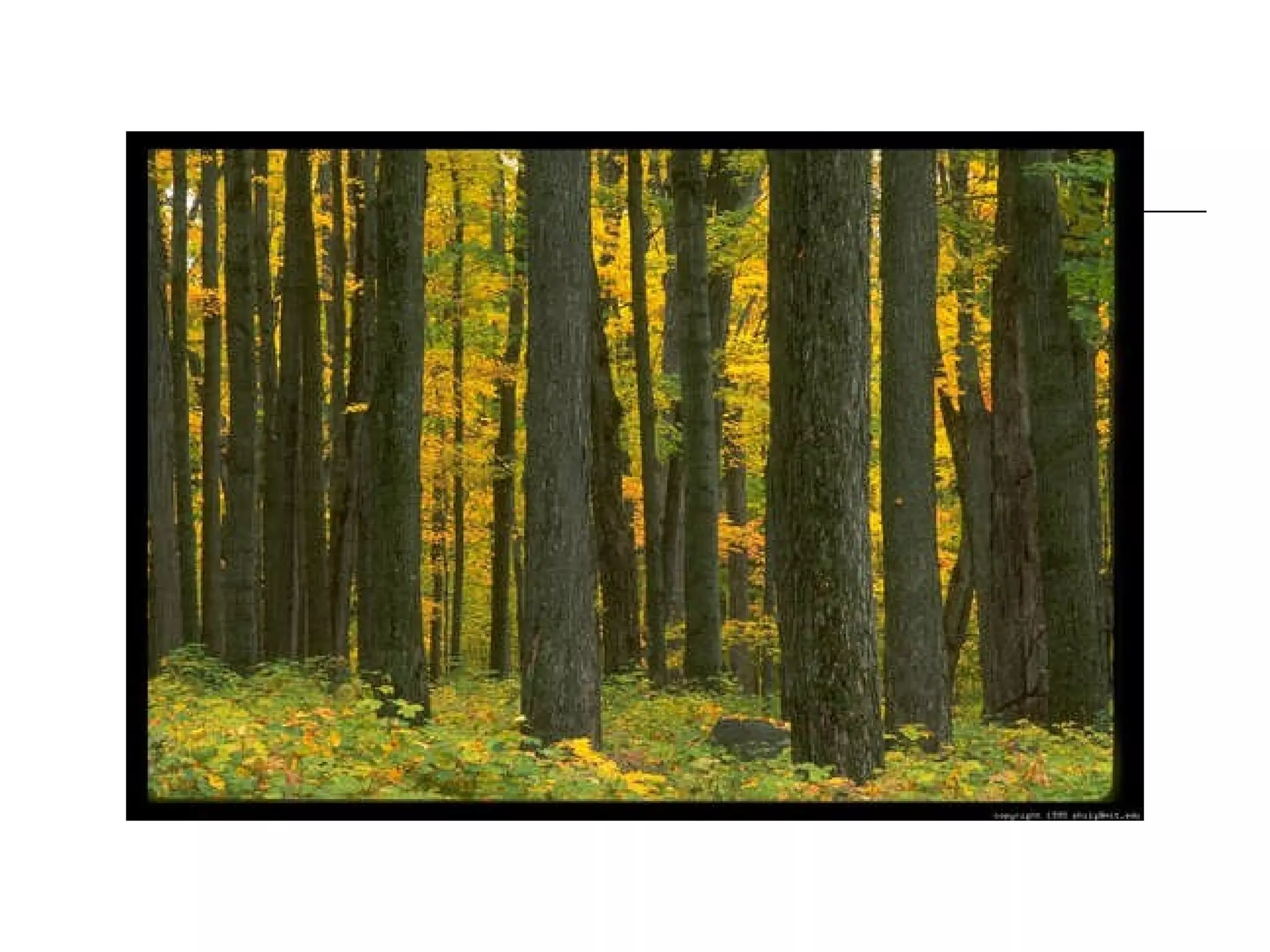
Plants, animals, fungi and protists are eukaryotes Larger Have membrane bound nucleus containing DNA Have membrane bound organelles that compartmentalize cells
Read Chapter One and complete the Learning Log!

Chapter 1

  • 1.
    CHAPTER 1 INTRODUCTION:TEN THEMES IN THE STUDY OF LIFE Copyright © 2002 Pearson Education, Inc., publishing as Benjamin Cummings
  • 2.
    Biology, the studyof life, is rooted in the human spirit. Biology has been pursued for centuries by men of God as they attempted to learn about God as they studied nature—called: Natural Theology Introduction Copyright © 2002 Pearson Education, Inc., publishing as Benjamin Cummings
  • 3.
    Who were these“natural theologians?”
  • 4.
  • 5.
    Blaise Pascal (1623-1662)Jansenist, a group of Calvinist French Catholic who emphasized salvation through God’s love and grace
  • 6.
  • 7.
    Roger Bacon (1214-1294) English Monk used glass to magnify organisms
  • 8.
  • 9.
    Louis Pasteur Experiments that demonstrated the cell theory—“all living things are made of cells and all cells come form pre-existing cells”
  • 10.
  • 11.
    Lord Kelvin Opponentof Darwin Father of “Energetics”
  • 12.
  • 13.
    Carolus Linnaeus 1701-1778Father of Modern taxonomy Accepted the Biblical account of creations Concluded that created kinds never alter enough to form new and different kinds
  • 14.
    The list goeson: Michael Farraday Johann Kepler Isaac Newton Gregor Mendel Leonardo da Vinci Joseph Lister
  • 15.
    Biologists explore lifeform a global to a microscopic scale
  • 16.
  • 17.
  • 18.
  • 19.
  • 20.
  • 21.
  • 22.
  • 23.
  • 24.
  • 25.
    Life’s basic characteristicis a high degree of order. Each level of biological organization has emergent properties Copyright © 2002 Pearson Education, Inc., publishing as Benjamin Cummings Fig. 1.2(1) Fig. 1.2(2)
  • 26.
    Biological organization isbased on a hierarchy of structural levels, each building on the levels below. At the lowest level are atoms that are ordered into complex biological molecules. Many molecules are arranged into minute structures called organelles, which are the components of cells.
  • 27.
    Cells are thesubunits of organisms, the units of life. Copyright © 2002 Pearson Education, Inc., publishing as Benjamin Cummings Fig. 1.2(3)
  • 28.
    Some organisms consistof a single cell, others are multicellular aggregates of specialized cells.
  • 29.
    What is theupward hierarchy of biological complexity? Cells Tissues Organs Organ systems Organisms Populations Communities Ecosystems Biomes
  • 30.
    Novel properties emerge at each step upward in the biological hierarchy. Copyright © 2002 Pearson Education, Inc., publishing as Benjamin Cummings
  • 31.
    These emergent properties result from interactions between components. A cell is certainly much more than a bag of molecules.
  • 32.
    This theme ofemergent properties accents the importance of structural arrangement. The emergent properties of life are not supernatural, but simply reflect a hierarchy of structural organization.
  • 33.
    Life resists asimple, one-sentence definition, yet we can recognize life by what living things do. Copyright © 2002 Pearson Education, Inc., publishing as Benjamin Cummings Fig. 1.3
  • 34.
    Whether multicellular orunicellular, all organisms must accomplish the same functions:
  • 35.
  • 36.
  • 37.
  • 38.
  • 39.
  • 40.
  • 41.
  • 42.
  • 43.
  • 44.
  • 45.
    Figure 1.3bx Reproduction
  • 46.
  • 47.
  • 48.
  • 49.
  • 50.
  • 51.
  • 52.
    Figure 1.3 Some properties of life
  • 53.
  • 54.
    The complex organizationof life presents a dilemma to scientists seeking to understand biological processes. Copyright © 2002 Pearson Education, Inc., publishing as Benjamin Cummings
  • 55.
    We cannot fullyexplain a higher level of organization by breaking down to its parts. At the same time, it is futile to try to analyze something as complex as an organism or cell without taking it apart.
  • 56.
    Reductionism , reducingcomplex systems to simpler components, is a powerful strategy in biology. Reductionism is balanced by the longer-range objective of understanding emergent properties .
  • 57.
    Science is aprocess
  • 58.
    Science seeks naturalcauses for natural phenomena. The scope of science is limited to the study of structures and processes that we can observe and measure, either directly or indirectly.
  • 59.
    Verifiable observations andmeasurements are the data of discovery science.
  • 60.
    In some casesthe observations entail a planned detailed dissection and description of a biological phenomenon, like the human genome. In other cases, curious and observant people make totally serendipitous discoveries. In 1928, Alexander Fleming accidentally discovered the antibacterial properties of Pencillium when this fungus contaminated some of his bacterial cultures.
  • 61.
    Discovery science can lead to important conclusions via inductive reasoning. An inductive conclusion is a generalization that summarizes many concurrent observations.
  • 62.
  • 63.
    Linnaeus developedour system of organizing using 7 taxons Kingdom Phylum Class Order Family Genus species
  • 64.
    The scientific nameis made of the Genus and species name (hence binomial nomenclature) Examples: Homo sapiens Drosophila melanogaster Salmonella typhimurium
  • 65.
    Linnaeus used 2groups Plant Kingdom Animal Kingdom
  • 66.
    Whitaker used 5kingdoms Monerans Plants Animals Fungi Protists
  • 67.
    Scientists have nowadded a new taxon, called a “domain” Current system uses 3 domains: Bacteria Archaea Eukarya Both are prokaryotic
  • 68.
  • 69.
    Smaller than eukaryotesNo membrane bound organelles DNA is not contained in a nucleus
  • 70.
    Plants, animals, fungiand protists are eukaryotes Larger Have membrane bound nucleus containing DNA Have membrane bound organelles that compartmentalize cells
  • 71.
    Read Chapter Oneand complete the Learning Log!