University of Hail
Electrical Engineering Department
EE 460: Power Electronics
Chapter 1/2: Introduction to Power
Electronics (Introduction)
Lecturer: Dr. Rabeh ABBASSI
At the end of this chapter you should be able to:
2
 Explain what is Power electronics
Understand the major applications of
power electronics
 List the major types of power
semiconductor devices
 Understand the main types of power
converters
 Describe the ideal characteristics of
power switching devices and their
control
3
what is Power
Electronics?
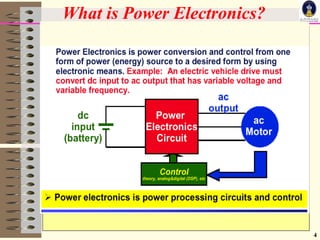
What is Power Electronics?
4
 ExpWhat is Power Electronics?
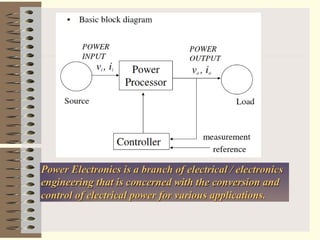
• Power electronics can also be thought of as a
technology which applies solid-state
electronics/devices for the control and
conversion of electric power.
• Electronics deals with the semiconductor
devices and circuits used in signal processing to
implement the control functions,
• power deals with both static and rotating
equipment that uses electric power.
• control deals with the steady-state stability of
the closed-loop system during the power
conversion process.
What is Power Electronics?
• In power electronic circuits there exists two
types of switching devices:
1. one type in the power stage that
handles high power up to hundreds of
giga watts (which represents the muscle
of the system) and
2. another type in the feedback control
circuit that handles low power up to
hundreds of milliwatts, representing the
brain or intelligence of the system.
What is Power Electronics?
• Devices which operate in linear mode are not
useful in high efficient power transfer because
of their relatively higher losses.
• The switches can be connected:
- In series to increase voltage handling
capability.
- In parallel to increase current handling.
• The power switches can also be connected into
a certain topology which can rectify or invert,
regulate and control the power flow through
the system.
What is Power Electronics?
9
Power Electronic
Converters
 The function of the power converter stage is to
perform the actual power conversion and processing
of the energy from the input to the output by
incorporating a matrix of power switching devices.
 Power conversion refers to the power electronic
circuit that changes one of the following:
1. Voltage form (ac or dc)
2. Voltage level (magnitude)
3. Voltage frequency (line or otherwise)
4. Voltage waveshape (sinusoidal or
nonsinusoidal, such as square, triangle, or
sawtooth),
5. Voltage phase (single-or-three-phase)
Classification of Power Converter Circuits
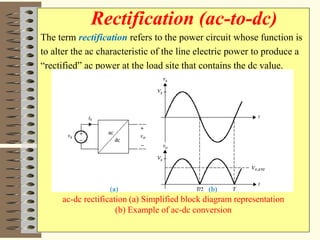
Rectification (ac-to-dc)
The term rectification refers to the power circuit whose function is
to alter the ac characteristic of the line electric power to produce a
“rectified” ac power at the load site that contains the dc value.
ac-dc rectification (a) Simplified block diagram representation
(b) Example of ac-dc conversion
(a) (b)
12
Rectification (ac-to-dc)
• There are several rectifier circuits configurations.
The popular ones are:
 Single-phase semi-controlled bridge rectifier.
 Single-phase fully-controlled bridge rectifier.
 Three-phase three-pulse, star-connected rectifier.
 Double three-phase, three-pulse star-connected rectifiers
with interphase transformer (IPT).
 Three-phase semi-controlled bridge rectifier.
 Three-phase fully-controlled bridge rectifier.
 Double 3-phase fully-controlled bridge rectifiers with IPT
13
Rectification (ac-to-dc)
• There are many applications for rectifiers:
 Variable speed DC drives
 Battery chargers
 DC power supplies
Inversion (dc-to-ac)
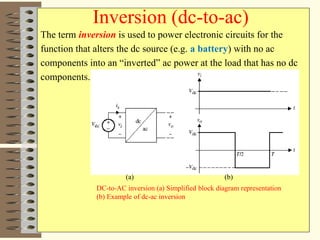
The term inversion is used to power electronic circuits for the
function that alters the dc source (e.g. a battery) with no ac
components into an “inverted” ac power at the load that has no dc
components.
(a) (b)
DC-to-AC inversion (a) Simplified block diagram representation
(b) Example of dc-ac inversion
15
• Some of the applications of inverters are:
 Emergency lighting systems
 AC variable speed drives
 Uninterrupted power supplies (UPS)
 Frequency converters
Inversion (dc-to-ac)
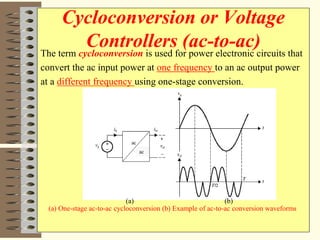
Cycloconversion or Voltage
Controllers (ac-to-ac)The term cycloconversion is used for power electronic circuits that
convert the ac input power at one frequency to an ac output power
at a different frequency using one-stage conversion.
(a) One-stage ac-to-ac cycloconversion (b) Example of ac-to-ac conversion waveforms
(a) (b)
ac
17
 Low power cycloconverters for low power AC
motors use Triacs instead of SCRs.
 Unlike the SCR which conducts in only one
direction, Triacs are capable of conducting in both
direction. Like SCRs, Triacs are also three
terminals devices.
 Cycloconverters are not very commonly used as
inverters.
AC Voltage Controller (ac-to-ac)
18
DC Chopper (dc-to-dc)
 When the SCR was introduced, a DC-to-DC converter
was called a chopper.
 Nowadays, SCR is rarely used in a DC-to-DC
converter. Rather a power BJT or a power MOSFET
are normally used in such a converter and this type of
converter is called Switch-Mode Power Supply
(SMPS).
 A switch-mode power supply can be one of the types:
- Step-down switch-mode power supply
- Step-up chopper
- Fly-back converter
- Resonant converter
19
• The typical applications for switch-mode
power supplies or choppers are:
 DC drive
 Battery charger
 DC power supply
DC Chopper (dc-to-dc)
20
Power electronic
applications
21
• PE applications have been steadily and rapidly
expanding to cover many sectors of our society.
• This growth is due to several factors;
 Technological advancement by the
semiconductor device industry
very fast high-power capabilities and
highly integrated power semiconductor
devices.
Recent Growth in Power Electronics
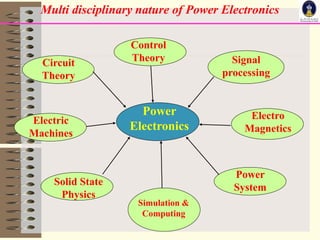
Multi disciplinary nature of Power Electronics
Power
ElectronicsElectric
Machines
Circuit
Theory
Solid State
Physics
Power
System
Electro
Magnetics
Signal
processing
Control
Theory
Simulation &
Computing
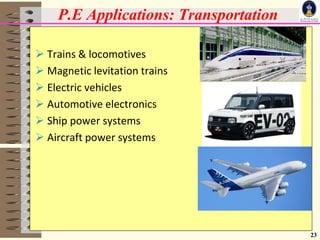
23
 Trains & locomotives
 Magnetic levitation trains
 Electric vehicles
 Automotive electronics
 Ship power systems
 Aircraft power systems
P.E Applications: Transportation
24
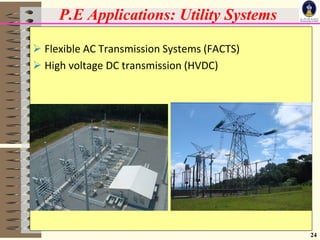
 Flexible AC Transmission Systems (FACTS)
 High voltage DC transmission (HVDC)
P.E Applications: Utility Systems
25
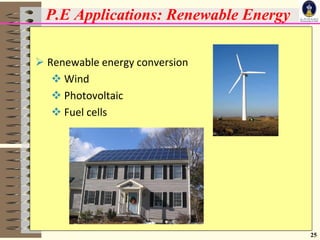
P.E Applications: Renewable Energy
 Renewable energy conversion
 Wind
 Photovoltaic
 Fuel cells
26
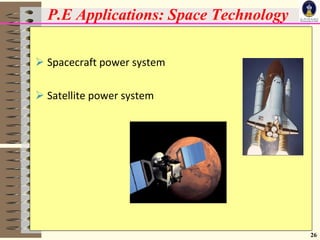
P.E Applications: Space Technology
 Spacecraft power system
 Satellite power system
27
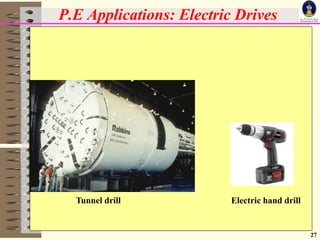
Tunnel drill Electric hand drill
P.E Applications: Electric Drives

Chapter 1 part 2 introduction

  • 1.
    University of Hail ElectricalEngineering Department EE 460: Power Electronics Chapter 1/2: Introduction to Power Electronics (Introduction) Lecturer: Dr. Rabeh ABBASSI
  • 2.
    At the endof this chapter you should be able to: 2  Explain what is Power electronics Understand the major applications of power electronics  List the major types of power semiconductor devices  Understand the main types of power converters  Describe the ideal characteristics of power switching devices and their control
  • 3.
  • 4.
    What is PowerElectronics? 4  ExpWhat is Power Electronics?
  • 6.
    • Power electronicscan also be thought of as a technology which applies solid-state electronics/devices for the control and conversion of electric power. • Electronics deals with the semiconductor devices and circuits used in signal processing to implement the control functions, • power deals with both static and rotating equipment that uses electric power. • control deals with the steady-state stability of the closed-loop system during the power conversion process. What is Power Electronics?
  • 7.
    • In powerelectronic circuits there exists two types of switching devices: 1. one type in the power stage that handles high power up to hundreds of giga watts (which represents the muscle of the system) and 2. another type in the feedback control circuit that handles low power up to hundreds of milliwatts, representing the brain or intelligence of the system. What is Power Electronics?
  • 8.
    • Devices whichoperate in linear mode are not useful in high efficient power transfer because of their relatively higher losses. • The switches can be connected: - In series to increase voltage handling capability. - In parallel to increase current handling. • The power switches can also be connected into a certain topology which can rectify or invert, regulate and control the power flow through the system. What is Power Electronics?
  • 9.
  • 10.
     The functionof the power converter stage is to perform the actual power conversion and processing of the energy from the input to the output by incorporating a matrix of power switching devices.  Power conversion refers to the power electronic circuit that changes one of the following: 1. Voltage form (ac or dc) 2. Voltage level (magnitude) 3. Voltage frequency (line or otherwise) 4. Voltage waveshape (sinusoidal or nonsinusoidal, such as square, triangle, or sawtooth), 5. Voltage phase (single-or-three-phase) Classification of Power Converter Circuits
  • 11.
    Rectification (ac-to-dc) The termrectification refers to the power circuit whose function is to alter the ac characteristic of the line electric power to produce a “rectified” ac power at the load site that contains the dc value. ac-dc rectification (a) Simplified block diagram representation (b) Example of ac-dc conversion (a) (b)
  • 12.
    12 Rectification (ac-to-dc) • Thereare several rectifier circuits configurations. The popular ones are:  Single-phase semi-controlled bridge rectifier.  Single-phase fully-controlled bridge rectifier.  Three-phase three-pulse, star-connected rectifier.  Double three-phase, three-pulse star-connected rectifiers with interphase transformer (IPT).  Three-phase semi-controlled bridge rectifier.  Three-phase fully-controlled bridge rectifier.  Double 3-phase fully-controlled bridge rectifiers with IPT
  • 13.
    13 Rectification (ac-to-dc) • Thereare many applications for rectifiers:  Variable speed DC drives  Battery chargers  DC power supplies
  • 14.
    Inversion (dc-to-ac) The terminversion is used to power electronic circuits for the function that alters the dc source (e.g. a battery) with no ac components into an “inverted” ac power at the load that has no dc components. (a) (b) DC-to-AC inversion (a) Simplified block diagram representation (b) Example of dc-ac inversion
  • 15.
    15 • Some ofthe applications of inverters are:  Emergency lighting systems  AC variable speed drives  Uninterrupted power supplies (UPS)  Frequency converters Inversion (dc-to-ac)
  • 16.
    Cycloconversion or Voltage Controllers(ac-to-ac)The term cycloconversion is used for power electronic circuits that convert the ac input power at one frequency to an ac output power at a different frequency using one-stage conversion. (a) One-stage ac-to-ac cycloconversion (b) Example of ac-to-ac conversion waveforms (a) (b) ac
  • 17.
    17  Low powercycloconverters for low power AC motors use Triacs instead of SCRs.  Unlike the SCR which conducts in only one direction, Triacs are capable of conducting in both direction. Like SCRs, Triacs are also three terminals devices.  Cycloconverters are not very commonly used as inverters. AC Voltage Controller (ac-to-ac)
  • 18.
    18 DC Chopper (dc-to-dc) When the SCR was introduced, a DC-to-DC converter was called a chopper.  Nowadays, SCR is rarely used in a DC-to-DC converter. Rather a power BJT or a power MOSFET are normally used in such a converter and this type of converter is called Switch-Mode Power Supply (SMPS).  A switch-mode power supply can be one of the types: - Step-down switch-mode power supply - Step-up chopper - Fly-back converter - Resonant converter
  • 19.
    19 • The typicalapplications for switch-mode power supplies or choppers are:  DC drive  Battery charger  DC power supply DC Chopper (dc-to-dc)
  • 20.
  • 21.
    21 • PE applicationshave been steadily and rapidly expanding to cover many sectors of our society. • This growth is due to several factors;  Technological advancement by the semiconductor device industry very fast high-power capabilities and highly integrated power semiconductor devices. Recent Growth in Power Electronics
  • 22.
    Multi disciplinary natureof Power Electronics Power ElectronicsElectric Machines Circuit Theory Solid State Physics Power System Electro Magnetics Signal processing Control Theory Simulation & Computing
  • 23.
    23  Trains &locomotives  Magnetic levitation trains  Electric vehicles  Automotive electronics  Ship power systems  Aircraft power systems P.E Applications: Transportation
  • 24.
    24  Flexible ACTransmission Systems (FACTS)  High voltage DC transmission (HVDC) P.E Applications: Utility Systems
  • 25.
    25 P.E Applications: RenewableEnergy  Renewable energy conversion  Wind  Photovoltaic  Fuel cells
  • 26.
    26 P.E Applications: SpaceTechnology  Spacecraft power system  Satellite power system
  • 27.
    27 Tunnel drill Electrichand drill P.E Applications: Electric Drives