Chapter 1
Sociology
• The scientific study of social
behavior and human groups
The Butterfly
Effect
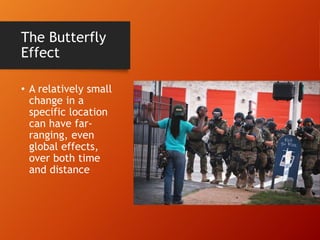
• A relatively small
change in a
specific location
can have far-
ranging, even
global effects,
over both time
and distance
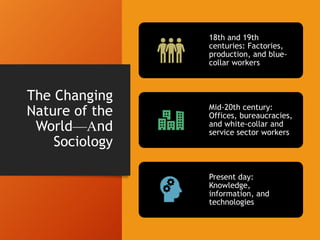
The Changing
Nature of the
World—And
Sociology
18th and 19th
centuries: Factories,
production, and blue-
collar workers
Mid-20th century:
Offices, bureaucracies,
and white-collar and
service sector workers
Present day:
Knowledge,
information, and
technologies
• No social change
today is as
important as
globalization
• A central issue in
sociology as well as
the social world
Central Concerns for a
21st-Century Sociologist:
Globalization
Central Concerns for a 21st-Century
Sociologist: Globalization
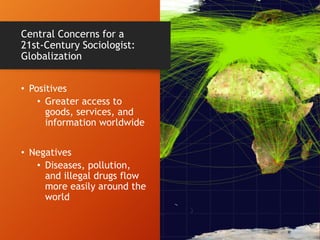
• Positives
• Greater access to
goods, services, and
information worldwide
• Negatives
• Diseases, pollution,
and illegal drugs flow
more easily around the
world
Central Concerns for a
21st-Century Sociologist:
Globalization
Central Concerns for a 21st-Century
Sociologist: Consumption
• As consumption increased, so did the use of
credit cards and credit card debt
• Consumption and
globalization are
deeply intertwined
Central Concerns for a
21st-Century Sociologist:
Consumption
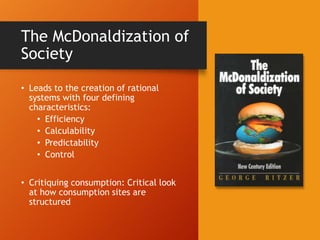
The McDonaldization of
Society
• Leads to the creation of rational
systems with four defining
characteristics:
• Efficiency
• Calculability
• Predictability
• Control
• Critiquing consumption: Critical look
at how consumption sites are
structured
• Sociologists have
tracked the
evolution of
technology from
assembly lines to
automated factories
to the digital world
Central Concerns for a
21st-Century Sociologist:
The Digital World
• The nature of the
differences and
similarities
between
mediated and
non-mediated
(e.g., face-to-
face) interaction
Central Concerns for a
21st-Century Sociologist:
The Digital World
Globalization, Consumption, the
Digital World and You
• Increased
socialization with
people from other
parts of the world
• Ease of
consumerism
through online
retailers
• Education
accessibility online
Sociology: Continuity and Change
• C. Wright Mills (1959) argued
that sociologists have a unique
perspective—the Sociological
Imagination
The Sociological Imagination
Demonstrates the connection
between history and biography
Connects personal experiences—
“troubles”— to larger social
patterns—“social issues”
The Sociological
Imagination
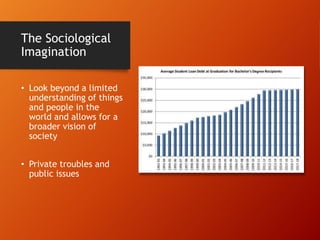
• Look beyond a limited
understanding of things
and people in the
world and allows for a
broader vision of
society
• Private troubles and
public issues
The Sociological Imagination: The
Micro/Macro Relationship
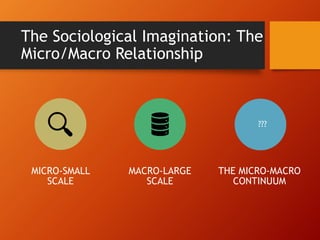
MICRO-SMALL
SCALE
MACRO-LARGE
SCALE
THE MICRO-MACRO
CONTINUUM
???
The Sociological Imagination: The
Micro/Macro Relationship
• Marx: What workers
thought and
did (micro) and the
capitalist economic
system (macro)
The Agency–
Structure
Relationship
• Structures:
Autonomous; able
to sustain
themselves for a
long time without
disruptions from
individuals.
• Often society-wide
patterns of
relationships,
norms, values, and
other social
phenomena.
The Sociological Imagination: The
Agency–Structure Relationship
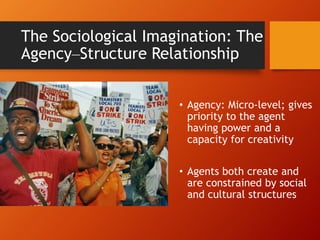
• Agency: Micro-level; gives
priority to the agent
having power and a
capacity for creativity
• Agents both create and
are constrained by social
and cultural structures
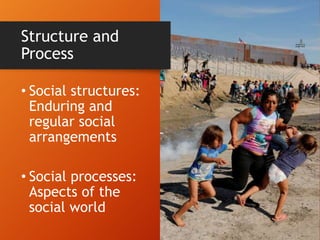
• Social structures:
Enduring and
regular social
arrangements
• Social processes:
Aspects of the
social world
Structure and
Process
• Scientific view:
Examining the
relationship between
structure and process
should be a purely
scientific endeavor.
Sociology’s
Purpose: Science or
Social Reform?
Sociology’s
Purpose: Science
or Social Reform?
• Social reform view:
As relationships
between structure
and process are
discovered, this
knowledge should
be used to solve
social problems.
Sociology and Other
Social Sciences and
Common Sense
• Sociology:
• One of the social
sciences
• Broadest of the
social science
fields
The Other
Sciences and
Globalization
Anthropology
Communications
Economics
Geography
Political science
Psychology
Sociology and
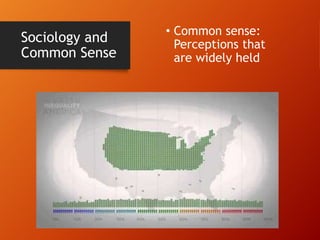
Common Sense
• Common sense:
Perceptions that
are widely held
Sociology and Common Sense
• Sociology: The systematic study of the
social world in both its minutest detail
and its broadest manifestations.

Chapter 1 Lecture Notes.pptx

  • 1.
  • 2.
    Sociology • The scientificstudy of social behavior and human groups
  • 3.
    The Butterfly Effect • Arelatively small change in a specific location can have far- ranging, even global effects, over both time and distance
  • 4.
    The Changing Nature ofthe World—And Sociology 18th and 19th centuries: Factories, production, and blue- collar workers Mid-20th century: Offices, bureaucracies, and white-collar and service sector workers Present day: Knowledge, information, and technologies
  • 5.
    • No socialchange today is as important as globalization • A central issue in sociology as well as the social world Central Concerns for a 21st-Century Sociologist: Globalization
  • 6.
    Central Concerns fora 21st-Century Sociologist: Globalization
  • 7.
    • Positives • Greateraccess to goods, services, and information worldwide • Negatives • Diseases, pollution, and illegal drugs flow more easily around the world Central Concerns for a 21st-Century Sociologist: Globalization
  • 8.
    Central Concerns fora 21st-Century Sociologist: Consumption • As consumption increased, so did the use of credit cards and credit card debt
  • 9.
    • Consumption and globalizationare deeply intertwined Central Concerns for a 21st-Century Sociologist: Consumption
  • 10.
    The McDonaldization of Society •Leads to the creation of rational systems with four defining characteristics: • Efficiency • Calculability • Predictability • Control • Critiquing consumption: Critical look at how consumption sites are structured
  • 11.
    • Sociologists have trackedthe evolution of technology from assembly lines to automated factories to the digital world Central Concerns for a 21st-Century Sociologist: The Digital World
  • 12.
    • The natureof the differences and similarities between mediated and non-mediated (e.g., face-to- face) interaction Central Concerns for a 21st-Century Sociologist: The Digital World
  • 13.
    Globalization, Consumption, the DigitalWorld and You • Increased socialization with people from other parts of the world • Ease of consumerism through online retailers • Education accessibility online
  • 14.
    Sociology: Continuity andChange • C. Wright Mills (1959) argued that sociologists have a unique perspective—the Sociological Imagination
  • 15.
    The Sociological Imagination Demonstratesthe connection between history and biography Connects personal experiences— “troubles”— to larger social patterns—“social issues”
  • 16.
    The Sociological Imagination • Lookbeyond a limited understanding of things and people in the world and allows for a broader vision of society • Private troubles and public issues
  • 17.
    The Sociological Imagination:The Micro/Macro Relationship MICRO-SMALL SCALE MACRO-LARGE SCALE THE MICRO-MACRO CONTINUUM ???
  • 18.
    The Sociological Imagination:The Micro/Macro Relationship • Marx: What workers thought and did (micro) and the capitalist economic system (macro)
  • 19.
    The Agency– Structure Relationship • Structures: Autonomous;able to sustain themselves for a long time without disruptions from individuals. • Often society-wide patterns of relationships, norms, values, and other social phenomena.
  • 20.
    The Sociological Imagination:The Agency–Structure Relationship • Agency: Micro-level; gives priority to the agent having power and a capacity for creativity • Agents both create and are constrained by social and cultural structures
  • 21.
    • Social structures: Enduringand regular social arrangements • Social processes: Aspects of the social world Structure and Process
  • 22.
    • Scientific view: Examiningthe relationship between structure and process should be a purely scientific endeavor. Sociology’s Purpose: Science or Social Reform?
  • 23.
    Sociology’s Purpose: Science or SocialReform? • Social reform view: As relationships between structure and process are discovered, this knowledge should be used to solve social problems.
  • 24.
    Sociology and Other SocialSciences and Common Sense • Sociology: • One of the social sciences • Broadest of the social science fields
  • 25.
  • 26.
    Sociology and Common Sense •Common sense: Perceptions that are widely held
  • 27.
    Sociology and CommonSense • Sociology: The systematic study of the social world in both its minutest detail and its broadest manifestations.

Editor's Notes

  • #3 Sociology is the systematic study of the ways in which people are affected by, and affect, the social structures and social processes that are associated with the groups, organizations, cultures, societies, and world in which they exist.
  • #4 Example: The Arab Spring revolutionary social movements beginning in Tunisia with the action of one individual, spreading across the Middle East and then leading to a countermovement of ISIL.
  • #5 18th and 19th centuries: Industrial Revolution Sociologists focused on factories, production, and blue-collar workers. Mid-20th century: Post-Industrial Age Sociologists focused on offices, bureaucracies, and white-collar and service sector workers. Present day: The Information Age Sociologists focus on knowledge, information, and technologies.
  • #6 See Figure 1.1 (next slide). Globalization is arguably the most important instigator of social change and affects all aspects of the social world. It is defined by increasingly fluid global flows and the structures that expedite and impede these flows.
  • #9 Checkpoint 1.2 Figure 1.4 Consumption is the process by which people obtain and utilize goods and services. Examples of intertwined consumption and globalization: U.S. imports from China, medical tourism, Internet commerce, travel.
  • #11 McDonaldization is the process by which the rational principles of the fast-food restaurant are coming to dominate more and more sectors of society and more societies throughout the world. Consumption sites example: McDonaldized settings, etailers, malls
  • #12 Technology: The interplay of machines, tools, skills, and procedures for the accomplishment of tasks. Sociologists have always been interested in the social aspects of technology. Digital world examples: Computers, cell phones, and the Internet. Social networking and multitasking are social phenomena of particular interest to sociologists.
  • #13 Mediated interaction: Technology such as the Internet and the smartphone comes between the people who are communicating. There is no such interference in non-mediated interaction.
  • #14 College students have fellow students and professors from other parts of the world. You shop on the Internet. An increasing portion of your education is obtained through the Internet.
  • #15 The Sociological Imagination says that sociologists have a distinctive way of looking at the world.
  • #16 C. Wright Mills (1916–1962) described this type of creative thinking as the ability to view one’s own society as an outsider.
  • #17 Figure 1.7 (next slide) Private Troubles and Public Issues Increasing levels of consumption and debt (private trouble) morphed into a near collapse of the global economy (public issue). ADHD, once a private trouble, is now a public issue . Will fleeting electronic social relationships (via Facebook and Twitter) lead all types of social relationships in the future?
  • #18 Micro-small scale Individual thoughts and actions and small group interactions Macro-large scale Groups, organizations, cultures, society, and the world, as well as the interactions between these large structures. The micro-macro continuum Runs from the most microscopic to the most macroscopic of social realities phenomena are roughly at the midpoint of this continuum best thought of as meso realities.
  • #19 Karl Marx (1818–1883) was interested in what workers thought and did (micro-scale phenomena) and the capitalist economic system (macro-scale phenomena). Randall Collins (2009) has sought to develop a theory of violence that deals with individuals skilled in violent interactions (micro-scale phenomena) and material resources used by violent organizations (macro-scale phenomena).
  • #20 Structure examples: The family, education, media, the state, and the economy. Goffman’s “dangerous giants”: Individuals who have the potential to disrupt and destroy the structures.
  • #21 Agency is the micro level; structure is the macro level. The agency–structure relationship has its roots in the European sociological perspective.
  • #22 Social structures: The family or the state, or even shopping malls. These change very slowly. Social processes: Shopping and childrearing practices. These change rapidly. Globalization can be divided into structures (such as the United Nations) and a variety of specific social processes (such as the migration of people across national borders).
  • #23 Checkpoint 1.4 The scientific view states that examining the relationship between structure and process should be a purely scientific endeavor. The social reform view states that as these relationships are discovered, this knowledge should be used to solve social problems.
  • #25 Sociology, with its emphasis on studying various aspects of the social world, is one of the social sciences. Checkpoint 1.5
  • #26 Anthropology: Studies cultural aspects of societies around the world. Communications: Studies mediated and nonmediated communication across the globe. Economics: Examines production, distribution, and consumption of resources through markets across the globe. Geography: Mapping of spatial relationships on a global scale. Political science: Nation-states. Psychology: Ways in which individual identities are shaped by awareness of the rest of the world.
  • #27 Example: https://www.youtube.com/watch?v=QPKKQnijnsM