HUMAN RESOURCE
MANAGEMENT
(MGT340)
CHAPTER 1:
INTRODUCTION TO
HUMAN RESOURCE
MANAGEMENT
CHAPTER
1
1– 2
LEARNING OBJECTIVE
After completing this chapter,
students should be able to:
 Define Human Resource
Management
 Identify the importance/challenges
of human resource management
 Identify and explain the impact of
current social, business and
economic changes on human
resource management
 Describe the structure of the
human resource function in
organizations
 Explain the functions within the
scope of human resource
management
3
W
H
AT
IS
H
RM
???
WHAT IS HRM???
WHAT IS HRM???
W
H
A
T
I
S
H
R
M
?
?
?
 Human resource
management is the
development and
implementation of systems
in an organization for
attracting, developing and
retaining a high-performing
workforce.
 The design of formal systems
in an organization to ensure
effective and efficient use of
human talent to accomplish
organizational goals.
DEFINITION OF
HUMAN RESOURCE MANAGEMENT
Azira Rahim (Faculty Business & Management) 5
Human resource management in a
simple words stand for managing
the employees of an organizations
Human resource management
(HRM) is the practice of recruiting,
hiring, deploying and managing an
organization's employees.
Azira Rahim (Faculty Business & Management) 6
WHY HRM IS
IMPORTANCE?
To manage the people within a
workplace to achieve the
organization's mission and reinforce
the culture
7
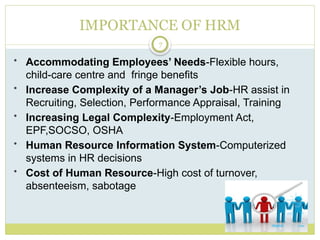
IMPORTANCE OF HRM
• Accommodating Employees’ Needs-Flexible hours,
child-care centre and fringe benefits
• Increase Complexity of a Manager’s Job-HR assist in
Recruiting, Selection, Performance Appraisal, Training
• Increasing Legal Complexity-Employment Act,
EPF,SOCSO, OSHA
• Human Resource Information System-Computerized
systems in HR decisions
• Cost of Human Resource-High cost of turnover,
absenteeism, sabotage
1–
8
 Technological changes
- Employees need to upgrade and develop their skills and knowledge.
- It is the job of HR department to provide training to employees.
 Globalization and increased competition
- Products and services may be produced in any country considered by the company
concerned, labor is not so mobile.
- Open businesses in other countries and wish to employ their own nationals in the
key positions to look after their interest.
CHALLENGES/CHANGES OF HRM
Azira Rahim (Faculty Business & Management)
9
Cont.
 Employee education and expectations
- People are staying longer at school and more students are pursuing
tertiary education.
- Higher level of education, workers are becoming more aware about
their employment rights.
 Workforce diversity
- Employees at workplace consists of different age groups that will going
to have different expectation.
- Therefore, company has to meet these different generations’ needs.
- Ex: Generation X, Y and baby boomers.
10
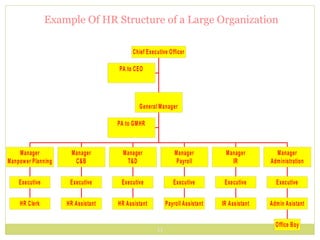
The Structure of HRM
 Big/ Large Organization
- In large organizations, the human resource function
becomes complex for a HR manager to handle.
Therefore, separate sections are created and there
would be one manager who is in charge of all the
human resource functions separately.
11
Example Of HR Structure of a Large Organization
PA to CEO
PA to GMHR
HR Clerk
Executive
Manager
Manpower Planning
HR Assistant
Executive
Manager
C&B
HR Assistant
Executive
Manager
T&D
Payroll Assistant
Executive
Manager
Payroll
IR Assistant
Executive
Manager
IR
Office Boy
Admin Asistant
Executive
Manager
Administration
General Manager
Chief Executive Officer
12
The Structure of HRM
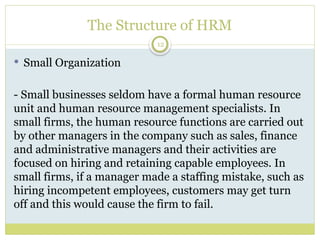
 Small Organization
- Small businesses seldom have a formal human resource
unit and human resource management specialists. In
small firms, the human resource functions are carried out
by other managers in the company such as sales, finance
and administrative managers and their activities are
focused on hiring and retaining capable employees. In
small firms, if a manager made a staffing mistake, such as
hiring incompetent employees, customers may get turn
off and this would cause the firm to fail.
13
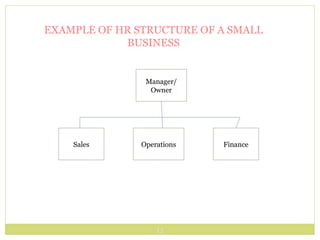
EXAMPLE OF HR STRUCTURE OF A SMALL
BUSINESS
Manager/
Owner
Sales Operations Finance
14
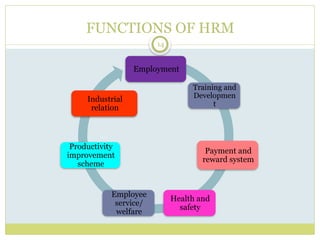
Employment
Training and
Developmen
t
Payment and
reward system
Health and
safety
Employee
service/
welfare
Productivity
improvement
scheme
Industrial
relation
FUNCTIONS OF HRM
1–
15
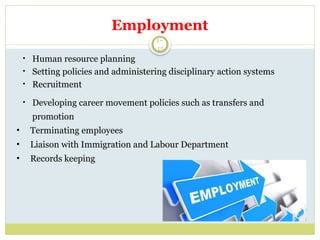
Employment
• Human resource planning
• Setting policies and administering disciplinary action systems
• Recruitment
• Developing career movement policies such as transfers and
promotion
• Terminating employees
• Liaison with Immigration and Labour Department
• Records keeping
1–
16
 Implementing induction activities
 Organizing skills training
 Organizing supervisory and management development
programmes
 Developing and managing performance management and
appraisal systems
Training and Development
1–
17
 Establishing a wage structure
 Developing information for payroll
 Establishing incentive schemes
 Advising on benefits
Payment/Reward Systems
HRM Principles & Practices
© Oxford University Press Malaysia, 2008
1–
18
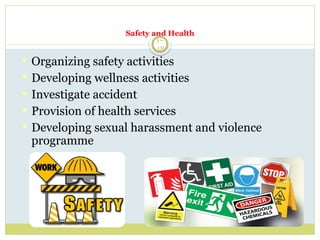
 Organizing safety activities
 Developing wellness activities
 Investigate accident
 Provision of health services
 Developing sexual harassment and violence
programme
Safety and Health
1–
19
 Supervise canteen facilities
 Provision of transport
 Provision of recreation facilities
 Counselling
Employee Services/Welfare
1–
20
 Developing quality programme such as ISO
programmes.
 Developing suggestion schemes, team problem
solving activities and Kaizen tools
Productivity Improvement Schemes
1–
21
 Grievance handling
 Relations with trade union representatives
 Collective bargaining negotiations
 Preparing for possibilities such as strike
action
Industrial Relations
SUMMARY
 Human resource management is very important in the
organization. Without employees, the organization will
not increase performance and productivity. Thus, it is
very important to develop and retain a high-
performing employees in the organization.
3–
22
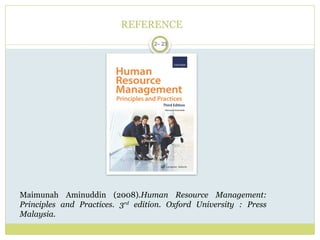
REFERENCE
Maimunah Aminuddin (2008).Human Resource Management:
Principles and Practices. 3rd
edition. Oxford University : Press
Malaysia.
2– 23
Azira Rahim (Faculty Business & Management) 24
Azira Rahim (Faculty Business & Management) 25
Azira Rahim (Faculty Business & Management) 26
Azira Rahim (Faculty Business & Management) 27

Chapter 1-Introduction to Human Resource Management

  • 1.
    HUMAN RESOURCE MANAGEMENT (MGT340) CHAPTER 1: INTRODUCTIONTO HUMAN RESOURCE MANAGEMENT CHAPTER 1
  • 2.
    1– 2 LEARNING OBJECTIVE Aftercompleting this chapter, students should be able to:  Define Human Resource Management  Identify the importance/challenges of human resource management  Identify and explain the impact of current social, business and economic changes on human resource management  Describe the structure of the human resource function in organizations  Explain the functions within the scope of human resource management
  • 3.
    3 W H AT IS H RM ??? WHAT IS HRM??? WHATIS HRM??? W H A T I S H R M ? ? ?
  • 4.
     Human resource managementis the development and implementation of systems in an organization for attracting, developing and retaining a high-performing workforce.  The design of formal systems in an organization to ensure effective and efficient use of human talent to accomplish organizational goals. DEFINITION OF HUMAN RESOURCE MANAGEMENT
  • 5.
    Azira Rahim (FacultyBusiness & Management) 5 Human resource management in a simple words stand for managing the employees of an organizations Human resource management (HRM) is the practice of recruiting, hiring, deploying and managing an organization's employees.
  • 6.
    Azira Rahim (FacultyBusiness & Management) 6 WHY HRM IS IMPORTANCE? To manage the people within a workplace to achieve the organization's mission and reinforce the culture
  • 7.
    7 IMPORTANCE OF HRM •Accommodating Employees’ Needs-Flexible hours, child-care centre and fringe benefits • Increase Complexity of a Manager’s Job-HR assist in Recruiting, Selection, Performance Appraisal, Training • Increasing Legal Complexity-Employment Act, EPF,SOCSO, OSHA • Human Resource Information System-Computerized systems in HR decisions • Cost of Human Resource-High cost of turnover, absenteeism, sabotage
  • 8.
    1– 8  Technological changes -Employees need to upgrade and develop their skills and knowledge. - It is the job of HR department to provide training to employees.  Globalization and increased competition - Products and services may be produced in any country considered by the company concerned, labor is not so mobile. - Open businesses in other countries and wish to employ their own nationals in the key positions to look after their interest. CHALLENGES/CHANGES OF HRM
  • 9.
    Azira Rahim (FacultyBusiness & Management) 9 Cont.  Employee education and expectations - People are staying longer at school and more students are pursuing tertiary education. - Higher level of education, workers are becoming more aware about their employment rights.  Workforce diversity - Employees at workplace consists of different age groups that will going to have different expectation. - Therefore, company has to meet these different generations’ needs. - Ex: Generation X, Y and baby boomers.
  • 10.
    10 The Structure ofHRM  Big/ Large Organization - In large organizations, the human resource function becomes complex for a HR manager to handle. Therefore, separate sections are created and there would be one manager who is in charge of all the human resource functions separately.
  • 11.
    11 Example Of HRStructure of a Large Organization PA to CEO PA to GMHR HR Clerk Executive Manager Manpower Planning HR Assistant Executive Manager C&B HR Assistant Executive Manager T&D Payroll Assistant Executive Manager Payroll IR Assistant Executive Manager IR Office Boy Admin Asistant Executive Manager Administration General Manager Chief Executive Officer
  • 12.
    12 The Structure ofHRM  Small Organization - Small businesses seldom have a formal human resource unit and human resource management specialists. In small firms, the human resource functions are carried out by other managers in the company such as sales, finance and administrative managers and their activities are focused on hiring and retaining capable employees. In small firms, if a manager made a staffing mistake, such as hiring incompetent employees, customers may get turn off and this would cause the firm to fail.
  • 13.
    13 EXAMPLE OF HRSTRUCTURE OF A SMALL BUSINESS Manager/ Owner Sales Operations Finance
  • 14.
    14 Employment Training and Developmen t Payment and rewardsystem Health and safety Employee service/ welfare Productivity improvement scheme Industrial relation FUNCTIONS OF HRM
  • 15.
    1– 15 Employment • Human resourceplanning • Setting policies and administering disciplinary action systems • Recruitment • Developing career movement policies such as transfers and promotion • Terminating employees • Liaison with Immigration and Labour Department • Records keeping
  • 16.
    1– 16  Implementing inductionactivities  Organizing skills training  Organizing supervisory and management development programmes  Developing and managing performance management and appraisal systems Training and Development
  • 17.
    1– 17  Establishing awage structure  Developing information for payroll  Establishing incentive schemes  Advising on benefits Payment/Reward Systems HRM Principles & Practices © Oxford University Press Malaysia, 2008
  • 18.
    1– 18  Organizing safetyactivities  Developing wellness activities  Investigate accident  Provision of health services  Developing sexual harassment and violence programme Safety and Health
  • 19.
    1– 19  Supervise canteenfacilities  Provision of transport  Provision of recreation facilities  Counselling Employee Services/Welfare
  • 20.
    1– 20  Developing qualityprogramme such as ISO programmes.  Developing suggestion schemes, team problem solving activities and Kaizen tools Productivity Improvement Schemes
  • 21.
    1– 21  Grievance handling Relations with trade union representatives  Collective bargaining negotiations  Preparing for possibilities such as strike action Industrial Relations
  • 22.
    SUMMARY  Human resourcemanagement is very important in the organization. Without employees, the organization will not increase performance and productivity. Thus, it is very important to develop and retain a high- performing employees in the organization. 3– 22
  • 23.
    REFERENCE Maimunah Aminuddin (2008).HumanResource Management: Principles and Practices. 3rd edition. Oxford University : Press Malaysia. 2– 23
  • 24.
    Azira Rahim (FacultyBusiness & Management) 24
  • 25.
    Azira Rahim (FacultyBusiness & Management) 25
  • 26.
    Azira Rahim (FacultyBusiness & Management) 26
  • 27.
    Azira Rahim (FacultyBusiness & Management) 27