Chapter 1
An
Introduction
to Fashion
Marketing
1
“Fashion is not art, it is industry”
Jean Muir
Some Marketing definitions…
“Marketing is a human activity, directed
at satisfying needs and wants through
exchange processes”
Kotler
Chartered Institute of Marketing
“Marketing is the management process
which identifies, anticipates and supplies
customer requirements efficiently and
profitably”
Drucker
“Marketing is the whole business seen from the
point of view of its final result, that is from the
customer’s point of view”
• Marketing is about making it easy for the
customer to say “YES”
• Write down what makes it easy for you to say
‘YES’ and make a purchase
• The aim of marketing is to eliminate the need
for selling
What is fashion?
• Fashion involves change, accepted change,
defined as a succession of short-term trends
or fads.
• Styles do not become fashions unless they win
acceptance amongst consumers.
• Fashion is not just about clothing.
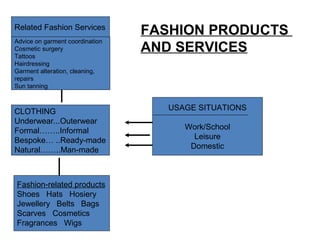
Related Fashion Services
Advice on garment coordination
Cosmetic surgery
Tattoos
Hairdressing
Garment alteration, cleaning,
repairs
Sun tanning
CLOTHING
Underwear...Outerwear
Formal……..Informal
Bespoke… ..Ready-made
Natural……..Man-made
Fashion-related products
Shoes Hats Hosiery
Jewellery Belts Bags
Scarves Cosmetics
Fragrances Wigs
USAGE SITUATIONS
Work/School
Leisure
Domestic
FASHION PRODUCTS
AND SERVICES
• But fashion fulfills more than just a basic need
of clothing and home furnishings.
• Fashion fulfills a need to reflect an image of
oneself to the world.
What is Fashion Marketing?
“…. the application of a range of techniques and
a business philosophy that centres upon the
customer and potential customer clothing and
clothing-related products and services in order
to meet the long-term goals of the organisation”
Mike Easey
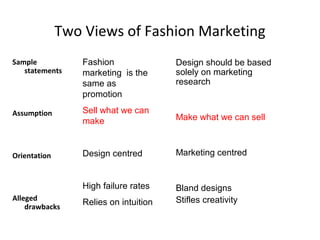
Two Views of Fashion Marketing
Sample
statements
Assumption
Orientation
Alleged
drawbacks
Design should be based
solely on marketing
research
Make what we can sell
Marketing centred
Bland designs
Stifles creativity
Fashion
marketing is the
same as
promotion
Sell what we can
make
Design centred
High failure rates
Relies on intuition
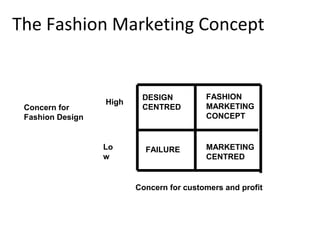
The Fashion Marketing Concept
DESIGN
CENTRED
FASHION
MARKETING
CONCEPT
FAILURE MARKETING
CENTRED
High
Lo
w
Concern for
Fashion Design
Concern for customers and profit
Fashion Merchandising
The retailers role in fashion marketing is very
important.
Merchandising = the buying and selling of
goods.
Fashion Merchandising aims to have:
– The right fashion merchandise, at the right place,
at the right time, in the right quantities at the
right price
Marketing Mix – 4 P’s
• Product – what a business offers customers to
satisfy needs
• Price – the amount the customer pays for
products
• Promotion – the ways a customer is informed
and encouraged to buy the product
• Place (distribution) – involves getting the
product to the customer
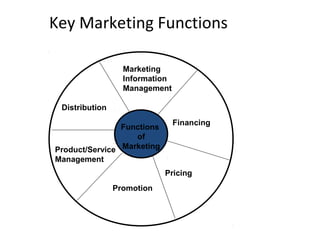
Key Marketing Functions
Functions
of
Marketing
Marketing
Information
Management
Financing
Pricing
Promotion
Product/Service
Management
Distribution
Marketing-Information Management
• Involves gathering and using information
about what consumers want.
Financing
• Involves planning ways to cover the costs of
successfully operating the business.
Pricing
• Is the process of setting the value or cost at
the right level.
• Must cover costs of all other marketing
functions.
• Is the only element of the mix which brings in
cash.
• Depends on the costs of production plus a
margin for profit.
• Needs to reflect demand.
Promotion
• Is communicating with the customers about
the product to achieve the desired objective
• Methods of promotion include:
– Advertising
– Personal selling
– Publicity
– Sales promotions
– Public relations
Product/Service Management
• Designing, producing, maintaining, improving
and/or acquiring products or services to meet
customer needs.
Place (Distribution)
• … involves moving the product each step from
the design idea to the consumer.
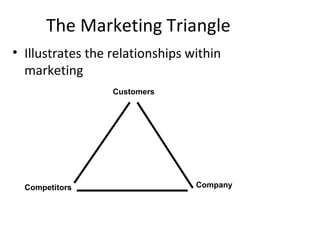
The Marketing Triangle
• Illustrates the relationships within
marketing
Customers
CompanyCompetitors
Marketing Dynamism
• Marketing Strategies cannot be static
• They must respond to a changing
environment

Chapter 1 introduction

  • 1.
  • 2.
    “Fashion is notart, it is industry” Jean Muir
  • 3.
    Some Marketing definitions… “Marketingis a human activity, directed at satisfying needs and wants through exchange processes” Kotler
  • 4.
    Chartered Institute ofMarketing “Marketing is the management process which identifies, anticipates and supplies customer requirements efficiently and profitably”
  • 5.
    Drucker “Marketing is thewhole business seen from the point of view of its final result, that is from the customer’s point of view”
  • 6.
    • Marketing isabout making it easy for the customer to say “YES” • Write down what makes it easy for you to say ‘YES’ and make a purchase • The aim of marketing is to eliminate the need for selling
  • 7.
    What is fashion? •Fashion involves change, accepted change, defined as a succession of short-term trends or fads. • Styles do not become fashions unless they win acceptance amongst consumers. • Fashion is not just about clothing.
  • 8.
    Related Fashion Services Adviceon garment coordination Cosmetic surgery Tattoos Hairdressing Garment alteration, cleaning, repairs Sun tanning CLOTHING Underwear...Outerwear Formal……..Informal Bespoke… ..Ready-made Natural……..Man-made Fashion-related products Shoes Hats Hosiery Jewellery Belts Bags Scarves Cosmetics Fragrances Wigs USAGE SITUATIONS Work/School Leisure Domestic FASHION PRODUCTS AND SERVICES
  • 9.
    • But fashionfulfills more than just a basic need of clothing and home furnishings. • Fashion fulfills a need to reflect an image of oneself to the world.
  • 10.
    What is FashionMarketing? “…. the application of a range of techniques and a business philosophy that centres upon the customer and potential customer clothing and clothing-related products and services in order to meet the long-term goals of the organisation” Mike Easey
  • 11.
    Two Views ofFashion Marketing Sample statements Assumption Orientation Alleged drawbacks Design should be based solely on marketing research Make what we can sell Marketing centred Bland designs Stifles creativity Fashion marketing is the same as promotion Sell what we can make Design centred High failure rates Relies on intuition
  • 12.
    The Fashion MarketingConcept DESIGN CENTRED FASHION MARKETING CONCEPT FAILURE MARKETING CENTRED High Lo w Concern for Fashion Design Concern for customers and profit
  • 13.
    Fashion Merchandising The retailersrole in fashion marketing is very important. Merchandising = the buying and selling of goods. Fashion Merchandising aims to have: – The right fashion merchandise, at the right place, at the right time, in the right quantities at the right price
  • 14.
    Marketing Mix –4 P’s • Product – what a business offers customers to satisfy needs • Price – the amount the customer pays for products • Promotion – the ways a customer is informed and encouraged to buy the product • Place (distribution) – involves getting the product to the customer
  • 15.
  • 16.
    Marketing-Information Management • Involvesgathering and using information about what consumers want.
  • 17.
    Financing • Involves planningways to cover the costs of successfully operating the business.
  • 18.
    Pricing • Is theprocess of setting the value or cost at the right level. • Must cover costs of all other marketing functions. • Is the only element of the mix which brings in cash. • Depends on the costs of production plus a margin for profit. • Needs to reflect demand.
  • 19.
    Promotion • Is communicatingwith the customers about the product to achieve the desired objective • Methods of promotion include: – Advertising – Personal selling – Publicity – Sales promotions – Public relations
  • 20.
    Product/Service Management • Designing,producing, maintaining, improving and/or acquiring products or services to meet customer needs.
  • 21.
    Place (Distribution) • …involves moving the product each step from the design idea to the consumer.
  • 22.
    The Marketing Triangle •Illustrates the relationships within marketing Customers CompanyCompetitors
  • 23.
    Marketing Dynamism • MarketingStrategies cannot be static • They must respond to a changing environment

Editor's Notes

  • #17 Info is critical to deciding how to make a product that will sell. Fashion changes from season to season and from year to year. Determining what will sell requires fashion marketers to keep in touch with their customers. They must decide far in advance on the design of a garment, acquire the fabric and other materials, produce the garment, sell it to retailers, and deliver it for customer viewing when the customer wants it and is ready to buy it.
  • #18 Planning includes how to cover operating expenses while waiting for income from the first sales. A textile manufacturer may require payment for fabric when it is delivered to a fashion designer, which is long before the customer pays for the garment. The designer may need to borrow money and pay finance fees, which adds costs to the price of the final product. It takes careful budget planning to assure that the product is priced to cover all costs plus a profit and is what a customer is willing to pay.
  • #20 Objectives may be to increase demand, to buy, to inform, etc. Fashion marketers create an image of who wears a brand of clothing though promotion. Using celebrities to advertise a brand leads consumers to believe they can be like the celebrity if they wear that brand.
  • #21 With information about what the customer wants and financing to make it happen, fashion marketers can start to work on the product.
  • #22 The number of businesses involved in the actual planning and movement of the product is a major factor in the final price. The channels of distribution can include intermediaries who help a designer or manufacturer get the product into retail stores. Distribution also includes the actual transportation of the product – for example, by truck or by air.