How is Java different from other languages
• Less than you think:
– Java is an imperative language (like C++, Ada, C, Pascal)
– Java is interpreted (like LISP, APL)
– Java is garbage-collected (like LISP, Eiffel, Modula-3)
– Java can be compiled (like LISP)
– Java is object-oriented (like C++, Ada, Eiffel)
• A succesful hybrid for a specific-application domain
• A reasonable general-purpose language for non-real-
time applications
• Work in progress: language evolving rapidly
Original design goals (white paper 1993)
• Simple
• Object-oriented (inheritance, polymorphism)
• Distributed
• Interpreted
• multithreaded
• Robust
• Secure
• Architecture-neutral
• a language with threads, objects, exceptions and
garbage-collection can’t really be simple!
Portability
• Critical concern: write once-run everywhere
• Consequences:
– Portable interpreter
– definition through virtual machine: the JVM
– run-time representation has high-level semantics
– supports dynamic loading
– (+) high-level representation can be queried at run-time to
provide reflection
– (-) Dynamic features make it hard to fully compile, safety
requires numerous run-time checks
Contrast with conventional systems languages
(C, C++, Ada)
• Conventional languages are fully compiled:
– run-time structure is machine language
– minimal run-time type information
– language provides low-level tools for accessing storage
– safety requires fewer run-time checks because compiler
– (least for Ada and somewhat for C++) can verify correctness
statically.
– Languages require static binding, run-time image cannot be
easily modified
– Different compilers may create portability problems
Serious omissions
• No parameterized classes (C++ templates, Ada
generics)
• Can simulate generic programming with untyped
style: casting Object down into specific class.
– Forces code duplication, or run-time conversions
• No operator overloading (syntactic annoyance)
• No enumerations (using final constants is clumsy)
A new construct: interfaces
• Allow otherwise unrelated classes to satisfy a given
requirement
• Orthogonal to inheritance
– inheritance: an A is-a B (has the attributes of a B,
and possibly others)
– interface: an A can-do X (and other unrelated
actions)
– better model for multiple inheritance
• More costly at run-time (minor consideration)
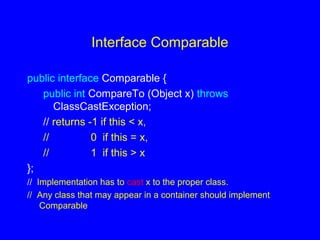
Interface Comparable
public interface Comparable {
public int CompareTo (Object x) throws
ClassCastException;
// returns -1 if this < x,
// 0 if this = x,
// 1 if this > x
};
// Implementation has to cast x to the proper class.
// Any class that may appear in a container should implement
Comparable
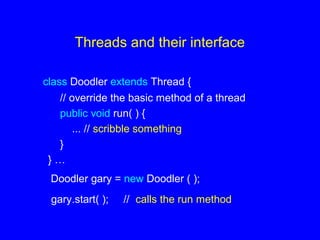
Threads and their interface
class Doodler extends Thread {
// override the basic method of a thread
public void run( ) {
... // scribble something
}
} …
Doodler gary = new Doodler ( );
gary.start( ); // calls the run method
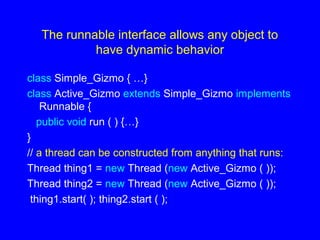
The runnable interface allows any object to
have dynamic behavior
class Simple_Gizmo { …}
class Active_Gizmo extends Simple_Gizmo implements
Runnable {
public void run ( ) {…}
}
// a thread can be constructed from anything that runs:
Thread thing1 = new Thread (new Active_Gizmo ( ));
Thread thing2 = new Thread (new Active_Gizmo ( ));
thing1.start( ); thing2.start ( );
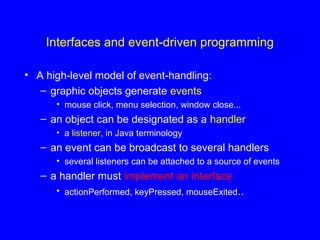
Interfaces and event-driven programming
• A high-level model of event-handling:
– graphic objects generate events
• mouse click, menu selection, window close...
– an object can be designated as a handler
• a listener, in Java terminology
– an event can be broadcast to several handlers
• several listeners can be attached to a source of events
– a handler must implement an interface
• actionPerformed, keyPressed, mouseExited..
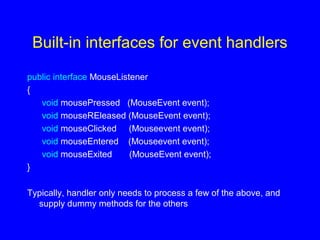
Built-in interfaces for event handlers
public interface MouseListener
{
void mousePressed (MouseEvent event);
void mouseREleased (MouseEvent event);
void mouseClicked (Mouseevent event);
void mouseEntered (Mouseevent event);
void mouseExited (MouseEvent event);
}
Typically, handler only needs to process a few of the above, and
supply dummy methods for the others
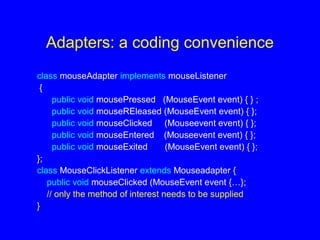
Adapters: a coding convenience
class mouseAdapter implements mouseListener
{
public void mousePressed (MouseEvent event) { } ;
public void mouseREleased (MouseEvent event) { };
public void mouseClicked (Mouseevent event) { };
public void mouseEntered (Mouseevent event) { };
public void mouseExited (MouseEvent event) { };
};
class MouseClickListener extends Mouseadapter {
public void mouseClicked (MouseEvent event {…};
// only the method of interest needs to be supplied
}
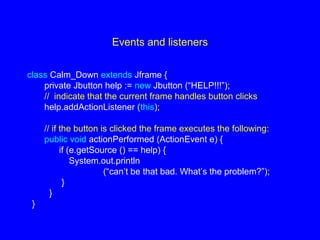
Events and listeners
class Calm_Down extends Jframe {
private Jbutton help := new Jbutton (“HELP!!!”);
// indicate that the current frame handles button clicks
help.addActionListener (this);
// if the button is clicked the frame executes the following:
public void actionPerformed (ActionEvent e) {
if (e.getSource () == help) {
System.out.println
(“can’t be that bad. What’s the problem?”);
}
}
}
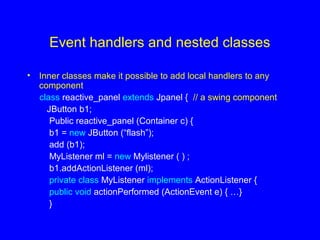
Event handlers and nested classes
• Inner classes make it possible to add local handlers to any
component
class reactive_panel extends Jpanel { // a swing component
JButton b1;
Public reactive_panel (Container c) {
b1 = new JButton (“flash”);
add (b1);
MyListener ml = new Mylistener ( ) ;
b1.addActionListener (ml);
private class MyListener implements ActionListener {
public void actionPerformed (ActionEvent e) { …}
}
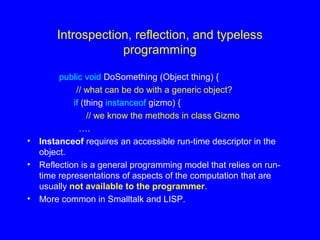
Introspection, reflection, and typeless
programming
public void DoSomething (Object thing) {
// what can be do with a generic object?
if (thing instanceof gizmo) {
// we know the methods in class Gizmo
….
• Instanceof requires an accessible run-time descriptor in the
object.
• Reflection is a general programming model that relies on run-
time representations of aspects of the computation that are
usually not available to the programmer.
• More common in Smalltalk and LISP.
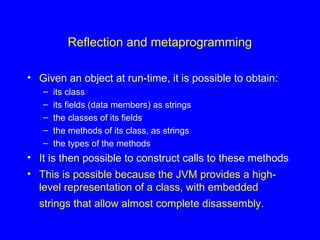
Reflection and metaprogramming
• Given an object at run-time, it is possible to obtain:
– its class
– its fields (data members) as strings
– the classes of its fields
– the methods of its class, as strings
– the types of the methods
• It is then possible to construct calls to these methods
• This is possible because the JVM provides a high-
level representation of a class, with embedded
strings that allow almost complete disassembly.
Reflection classes
• java.lang.Class
– Class.getMethods () returns array of method objects
– Class.getConstructor (Class[ ] parameterTypes)
• returns the constructor with those parameters
• java.lang.reflect.Array
– Array.NewInstance (Class componentType, int length)
• java.lang.reflect.Field
• java.lang.reflect.Method
• All of the above require the existence of run-time
objects that describe methods and classes
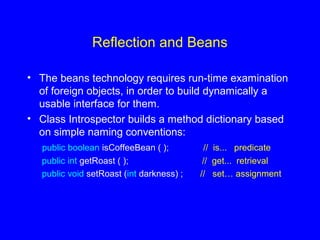
Reflection and Beans
• The beans technology requires run-time examination
of foreign objects, in order to build dynamically a
usable interface for them.
• Class Introspector builds a method dictionary based
on simple naming conventions:
public boolean isCoffeeBean ( ); // is... predicate
public int getRoast ( ); // get... retrieval
public void setRoast (int darkness) ; // set… assignment
An endless supply of libraries
• The power of the language is in the large set of
libraries in existence. The language is successful if
programmers find libraries confortable:
• JFC and the Swing package
• Pluggable look and Feel
• Graphics
• Files and Streams
• Networking
• Enterprise libraries: CORBA, RMI, Serialization,
JDBC

Basic info on java intro

  • 1.
    How is Javadifferent from other languages • Less than you think: – Java is an imperative language (like C++, Ada, C, Pascal) – Java is interpreted (like LISP, APL) – Java is garbage-collected (like LISP, Eiffel, Modula-3) – Java can be compiled (like LISP) – Java is object-oriented (like C++, Ada, Eiffel) • A succesful hybrid for a specific-application domain • A reasonable general-purpose language for non-real- time applications • Work in progress: language evolving rapidly
  • 2.
    Original design goals(white paper 1993) • Simple • Object-oriented (inheritance, polymorphism) • Distributed • Interpreted • multithreaded • Robust • Secure • Architecture-neutral • a language with threads, objects, exceptions and garbage-collection can’t really be simple!
  • 3.
    Portability • Critical concern:write once-run everywhere • Consequences: – Portable interpreter – definition through virtual machine: the JVM – run-time representation has high-level semantics – supports dynamic loading – (+) high-level representation can be queried at run-time to provide reflection – (-) Dynamic features make it hard to fully compile, safety requires numerous run-time checks
  • 4.
    Contrast with conventionalsystems languages (C, C++, Ada) • Conventional languages are fully compiled: – run-time structure is machine language – minimal run-time type information – language provides low-level tools for accessing storage – safety requires fewer run-time checks because compiler – (least for Ada and somewhat for C++) can verify correctness statically. – Languages require static binding, run-time image cannot be easily modified – Different compilers may create portability problems
  • 5.
    Serious omissions • Noparameterized classes (C++ templates, Ada generics) • Can simulate generic programming with untyped style: casting Object down into specific class. – Forces code duplication, or run-time conversions • No operator overloading (syntactic annoyance) • No enumerations (using final constants is clumsy)
  • 6.
    A new construct:interfaces • Allow otherwise unrelated classes to satisfy a given requirement • Orthogonal to inheritance – inheritance: an A is-a B (has the attributes of a B, and possibly others) – interface: an A can-do X (and other unrelated actions) – better model for multiple inheritance • More costly at run-time (minor consideration)
  • 7.
    Interface Comparable public interfaceComparable { public int CompareTo (Object x) throws ClassCastException; // returns -1 if this < x, // 0 if this = x, // 1 if this > x }; // Implementation has to cast x to the proper class. // Any class that may appear in a container should implement Comparable
  • 8.
    Threads and theirinterface class Doodler extends Thread { // override the basic method of a thread public void run( ) { ... // scribble something } } … Doodler gary = new Doodler ( ); gary.start( ); // calls the run method
  • 9.
    The runnable interfaceallows any object to have dynamic behavior class Simple_Gizmo { …} class Active_Gizmo extends Simple_Gizmo implements Runnable { public void run ( ) {…} } // a thread can be constructed from anything that runs: Thread thing1 = new Thread (new Active_Gizmo ( )); Thread thing2 = new Thread (new Active_Gizmo ( )); thing1.start( ); thing2.start ( );
  • 10.
    Interfaces and event-drivenprogramming • A high-level model of event-handling: – graphic objects generate events • mouse click, menu selection, window close... – an object can be designated as a handler • a listener, in Java terminology – an event can be broadcast to several handlers • several listeners can be attached to a source of events – a handler must implement an interface • actionPerformed, keyPressed, mouseExited..
  • 11.
    Built-in interfaces forevent handlers public interface MouseListener { void mousePressed (MouseEvent event); void mouseREleased (MouseEvent event); void mouseClicked (Mouseevent event); void mouseEntered (Mouseevent event); void mouseExited (MouseEvent event); } Typically, handler only needs to process a few of the above, and supply dummy methods for the others
  • 12.
    Adapters: a codingconvenience class mouseAdapter implements mouseListener { public void mousePressed (MouseEvent event) { } ; public void mouseREleased (MouseEvent event) { }; public void mouseClicked (Mouseevent event) { }; public void mouseEntered (Mouseevent event) { }; public void mouseExited (MouseEvent event) { }; }; class MouseClickListener extends Mouseadapter { public void mouseClicked (MouseEvent event {…}; // only the method of interest needs to be supplied }
  • 13.
    Events and listeners classCalm_Down extends Jframe { private Jbutton help := new Jbutton (“HELP!!!”); // indicate that the current frame handles button clicks help.addActionListener (this); // if the button is clicked the frame executes the following: public void actionPerformed (ActionEvent e) { if (e.getSource () == help) { System.out.println (“can’t be that bad. What’s the problem?”); } } }
  • 14.
    Event handlers andnested classes • Inner classes make it possible to add local handlers to any component class reactive_panel extends Jpanel { // a swing component JButton b1; Public reactive_panel (Container c) { b1 = new JButton (“flash”); add (b1); MyListener ml = new Mylistener ( ) ; b1.addActionListener (ml); private class MyListener implements ActionListener { public void actionPerformed (ActionEvent e) { …} }
  • 15.
    Introspection, reflection, andtypeless programming public void DoSomething (Object thing) { // what can be do with a generic object? if (thing instanceof gizmo) { // we know the methods in class Gizmo …. • Instanceof requires an accessible run-time descriptor in the object. • Reflection is a general programming model that relies on run- time representations of aspects of the computation that are usually not available to the programmer. • More common in Smalltalk and LISP.
  • 16.
    Reflection and metaprogramming •Given an object at run-time, it is possible to obtain: – its class – its fields (data members) as strings – the classes of its fields – the methods of its class, as strings – the types of the methods • It is then possible to construct calls to these methods • This is possible because the JVM provides a high- level representation of a class, with embedded strings that allow almost complete disassembly.
  • 17.
    Reflection classes • java.lang.Class –Class.getMethods () returns array of method objects – Class.getConstructor (Class[ ] parameterTypes) • returns the constructor with those parameters • java.lang.reflect.Array – Array.NewInstance (Class componentType, int length) • java.lang.reflect.Field • java.lang.reflect.Method • All of the above require the existence of run-time objects that describe methods and classes
  • 18.
    Reflection and Beans •The beans technology requires run-time examination of foreign objects, in order to build dynamically a usable interface for them. • Class Introspector builds a method dictionary based on simple naming conventions: public boolean isCoffeeBean ( ); // is... predicate public int getRoast ( ); // get... retrieval public void setRoast (int darkness) ; // set… assignment
  • 19.
    An endless supplyof libraries • The power of the language is in the large set of libraries in existence. The language is successful if programmers find libraries confortable: • JFC and the Swing package • Pluggable look and Feel • Graphics • Files and Streams • Networking • Enterprise libraries: CORBA, RMI, Serialization, JDBC