Corporate Restructuring
Ramadevi R. Iyer
1
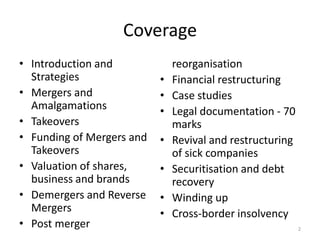
Coverage
• Introduction and
Strategies
• Mergers and
Amalgamations
• Takeovers
• Funding of Mergers and
Takeovers
• Valuation of shares,
business and brands
• Demergers and Reverse
Mergers
• Post merger
reorganisation
• Financial restructuring
• Case studies
• Legal documentation - 70
marks
• Revival and restructuring
of sick companies
• Securitisation and debt
recovery
• Winding up
• Cross-border insolvency
2
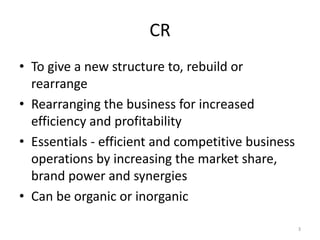
CR
• To give a new structure to, rebuild or
rearrange
• Rearranging the business for increased
efficiency and profitability
• Essentials - efficient and competitive business
operations by increasing the market share,
brand power and synergies
• Can be organic or inorganic
3
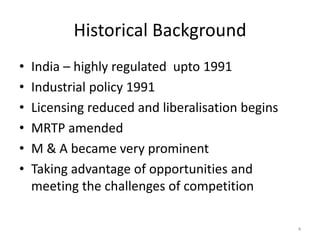
Historical Background
• India – highly regulated upto 1991
• Industrial policy 1991
• Licensing reduced and liberalisation begins
• MRTP amended
• M & A became very prominent
• Taking advantage of opportunities and
meeting the challenges of competition
4
Present Scenario
• WTO
• Restructuring wave
• Mergers, amalgamations, takeovers,
acquisitions and consolidation
• Various reasons
• Simple – cost-benefit analysis
• Conglomerates – combinations
• Business convenience
5
Global Scenario
• Consumer has many choices
• Technological advancements high
• Heavy focus on quality, range, cost and
reliability of products and services
• Turbulence – strategy
• Achieve and sustain superior performance
• UK most important investor in US
• Cross-country investments acceptable
6
National Scenario
• Tata – Corus
• Arcelor – Mittal
• Betapharm – Dr. Reddy
• Hindalco – Novelis
• Internationally presence is felt
• Costs lower, innovate speedily and increase
international presence
7
Need of CR
• Arrange business activities – predetermined
objectives
– Redirection of firms activities
– Deploy surplus cash from one business to finance
profitable growth in another
– Exploit inter-dependence among present or
prospective businesses
– Risk reduction
– Development of core competencies
8
Scope of CR
• Enhances economy
• Improves efficiency – profitability
• Focus on its competitive
advantage, operational synergy, efficient
allocation of managerial capabilities
• Consolidation
• Revival and rehab of sick unit
• Acquiring constant supply of RM
9
Regulatory Framework
• 1. The Companies Act, 1956
• 2. Companies (Court) Rules, 1959
• 3. Income Tax Act, 1961
• 4. Listing Agreement
• 5. The Indian Stamp Act 1899
• 6. SEBI (Substantial Acquisition of Shares
and Takeovers) Regulations 2011
10
Important aspects of CR
• Legal and procedural aspects
• Taxation Aspects
• Stamp duty aspects
• Economic aspects
• Valuation aspects
• Accounting aspects
• Due diligence aspects
• Competition aspects etc.
• Human and Cultural aspects
11
Kinds of CR
• Financial
• Technological
• Market
• Organisational
• Common tools –
Amalgamation, merger, demerger, slump
sale, acquisition, JV, disinvestment, Strategic
alliances and franchises
12
Cross Border Acquisitions
• UK in US
• Daimler Benz-Chrysler; BP – Amoco etc.
• Motivation:
– Growth orientation
– Access to inputs
– Exploit unique advantages
– Defensive
– Response to client needs
– Opportunism
13
Strategies – Chapter II
• Strategos – military
• General Manager
• Plan or course of action – vital importance
• Approach – flexible – achieve desired results
• Long-term or medium term
• Tactic
• Solving routine or non-routine
• Henry Mintzberg – 5Ps –
Plan, ploy, pattern, position, perspective
14
Introduction
• Why strategies?
– Better decisions
– Increased energy
– Increased capacity
– Improved customer satisfaction
– Competitive Advantage
– Better solutions
– Market recognition
– Greatly enhances the chance of success
15
Levels of strategies
• Corporate Level
• Divisional or business
• Functional
16
Strategic Planning
• Business environment – uncertain
• Different growth strategies for different
organisations
• Objectives
• Management tool – assess and adjust direction to
environment
• Constant change
• Requires sustained commitment, complexity and
ability to harness strategic opposites
17
Formulation and Execution of CR
Strategies
• Environmental Assessment – Internal and
external
• Vision and mission
• Objectives and procedures
• Strategic setting
• SWOT for internal
• Many stages – analysis for all types of
competitive forces and factors, planning,
budgeting, review and correction; risk
management 18
• Importance
– Why planning with strategy
– Planning required for survival
– Provides purpose and direction
– Thought out
– Great execution
– Communicate
– Benefits – better decisions, increased
energy, capacity, improved customer
satisfaction, competitive advantage, better
solutions, market recognition, enhances chances of
success
19
• Features
– Participation of responsible persons at different
levels
– Key ingredient of effective management
– Prepares the firm for facing and shaping future
– Based on quality data
– Draws from intuition and logic
– Avoid haphazard response
– Optimum leveraging of firm’s resources
20
….. Strategic planning and
long-range planning
Strategic
• Dynamic environment
• Objective is fixed method
may be varied
• Vision and mission based
and formed by
discussion, formal
techniques or otherwise
and from individual
inspiration
Long-range
• Assumed fixed environment
• Objective fixed and method
to achieve is planned
• Formulation is based on
fixed methods
21
…..Strategic Management
• Strategy is a plan or course of action which is
of vital, pervasive or continuing importance to
the organisation as a whole.
• Management is defined as the conducting or
supervising of something (as a business)
especially the executive function of planning,
organising, directing, controlling and
supervising any industrial or business project
or activity with, responsibility for results
22
….
• (i) matching business requirements with
internal capabilities,
• (ii) having strategically balanced portfolio,
• (iii)achieving and sustaining competitiveness,
and
• (iv)developing long-term internal and core
competencies
23
Competitive Advantage and
core competencies
• Competitive advantage – ownership of valuable
resources
• Abandon – no competitive advantage
• Core competency – resource based perspective
on corporate strategy
• Bundle of specific knowledge, skills, technologies,
capabilities and organisation which enables it to
create value in a market that other competitors
cannot do in the short term
24
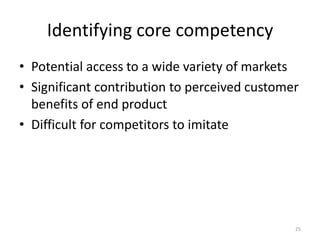
Identifying core competency
• Potential access to a wide variety of markets
• Significant contribution to perceived customer
benefits of end product
• Difficult for competitors to imitate
25
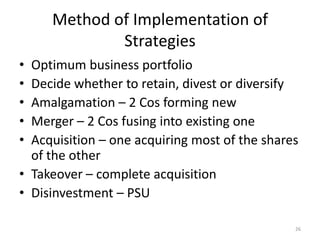
Method of Implementation of
Strategies
• Optimum business portfolio
• Decide whether to retain, divest or diversify
• Amalgamation – 2 Cos forming new
• Merger – 2 Cos fusing into existing one
• Acquisition – one acquiring most of the shares
of the other
• Takeover – complete acquisition
• Disinvestment – PSU
26
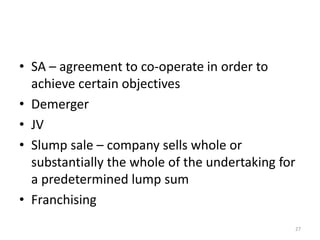
• SA – agreement to co-operate in order to
achieve certain objectives
• Demerger
• JV
• Slump sale – company sells whole or
substantially the whole of the undertaking for
a predetermined lump sum
• Franchising
27

Chapter 1 and 2

  • 1.
  • 2.
    Coverage • Introduction and Strategies •Mergers and Amalgamations • Takeovers • Funding of Mergers and Takeovers • Valuation of shares, business and brands • Demergers and Reverse Mergers • Post merger reorganisation • Financial restructuring • Case studies • Legal documentation - 70 marks • Revival and restructuring of sick companies • Securitisation and debt recovery • Winding up • Cross-border insolvency 2
  • 3.
    CR • To givea new structure to, rebuild or rearrange • Rearranging the business for increased efficiency and profitability • Essentials - efficient and competitive business operations by increasing the market share, brand power and synergies • Can be organic or inorganic 3
  • 4.
    Historical Background • India– highly regulated upto 1991 • Industrial policy 1991 • Licensing reduced and liberalisation begins • MRTP amended • M & A became very prominent • Taking advantage of opportunities and meeting the challenges of competition 4
  • 5.
    Present Scenario • WTO •Restructuring wave • Mergers, amalgamations, takeovers, acquisitions and consolidation • Various reasons • Simple – cost-benefit analysis • Conglomerates – combinations • Business convenience 5
  • 6.
    Global Scenario • Consumerhas many choices • Technological advancements high • Heavy focus on quality, range, cost and reliability of products and services • Turbulence – strategy • Achieve and sustain superior performance • UK most important investor in US • Cross-country investments acceptable 6
  • 7.
    National Scenario • Tata– Corus • Arcelor – Mittal • Betapharm – Dr. Reddy • Hindalco – Novelis • Internationally presence is felt • Costs lower, innovate speedily and increase international presence 7
  • 8.
    Need of CR •Arrange business activities – predetermined objectives – Redirection of firms activities – Deploy surplus cash from one business to finance profitable growth in another – Exploit inter-dependence among present or prospective businesses – Risk reduction – Development of core competencies 8
  • 9.
    Scope of CR •Enhances economy • Improves efficiency – profitability • Focus on its competitive advantage, operational synergy, efficient allocation of managerial capabilities • Consolidation • Revival and rehab of sick unit • Acquiring constant supply of RM 9
  • 10.
    Regulatory Framework • 1.The Companies Act, 1956 • 2. Companies (Court) Rules, 1959 • 3. Income Tax Act, 1961 • 4. Listing Agreement • 5. The Indian Stamp Act 1899 • 6. SEBI (Substantial Acquisition of Shares and Takeovers) Regulations 2011 10
  • 11.
    Important aspects ofCR • Legal and procedural aspects • Taxation Aspects • Stamp duty aspects • Economic aspects • Valuation aspects • Accounting aspects • Due diligence aspects • Competition aspects etc. • Human and Cultural aspects 11
  • 12.
    Kinds of CR •Financial • Technological • Market • Organisational • Common tools – Amalgamation, merger, demerger, slump sale, acquisition, JV, disinvestment, Strategic alliances and franchises 12
  • 13.
    Cross Border Acquisitions •UK in US • Daimler Benz-Chrysler; BP – Amoco etc. • Motivation: – Growth orientation – Access to inputs – Exploit unique advantages – Defensive – Response to client needs – Opportunism 13
  • 14.
    Strategies – ChapterII • Strategos – military • General Manager • Plan or course of action – vital importance • Approach – flexible – achieve desired results • Long-term or medium term • Tactic • Solving routine or non-routine • Henry Mintzberg – 5Ps – Plan, ploy, pattern, position, perspective 14
  • 15.
    Introduction • Why strategies? –Better decisions – Increased energy – Increased capacity – Improved customer satisfaction – Competitive Advantage – Better solutions – Market recognition – Greatly enhances the chance of success 15
  • 16.
    Levels of strategies •Corporate Level • Divisional or business • Functional 16
  • 17.
    Strategic Planning • Businessenvironment – uncertain • Different growth strategies for different organisations • Objectives • Management tool – assess and adjust direction to environment • Constant change • Requires sustained commitment, complexity and ability to harness strategic opposites 17
  • 18.
    Formulation and Executionof CR Strategies • Environmental Assessment – Internal and external • Vision and mission • Objectives and procedures • Strategic setting • SWOT for internal • Many stages – analysis for all types of competitive forces and factors, planning, budgeting, review and correction; risk management 18
  • 19.
    • Importance – Whyplanning with strategy – Planning required for survival – Provides purpose and direction – Thought out – Great execution – Communicate – Benefits – better decisions, increased energy, capacity, improved customer satisfaction, competitive advantage, better solutions, market recognition, enhances chances of success 19
  • 20.
    • Features – Participationof responsible persons at different levels – Key ingredient of effective management – Prepares the firm for facing and shaping future – Based on quality data – Draws from intuition and logic – Avoid haphazard response – Optimum leveraging of firm’s resources 20
  • 21.
    ….. Strategic planningand long-range planning Strategic • Dynamic environment • Objective is fixed method may be varied • Vision and mission based and formed by discussion, formal techniques or otherwise and from individual inspiration Long-range • Assumed fixed environment • Objective fixed and method to achieve is planned • Formulation is based on fixed methods 21
  • 22.
    …..Strategic Management • Strategyis a plan or course of action which is of vital, pervasive or continuing importance to the organisation as a whole. • Management is defined as the conducting or supervising of something (as a business) especially the executive function of planning, organising, directing, controlling and supervising any industrial or business project or activity with, responsibility for results 22
  • 23.
    …. • (i) matchingbusiness requirements with internal capabilities, • (ii) having strategically balanced portfolio, • (iii)achieving and sustaining competitiveness, and • (iv)developing long-term internal and core competencies 23
  • 24.
    Competitive Advantage and corecompetencies • Competitive advantage – ownership of valuable resources • Abandon – no competitive advantage • Core competency – resource based perspective on corporate strategy • Bundle of specific knowledge, skills, technologies, capabilities and organisation which enables it to create value in a market that other competitors cannot do in the short term 24
  • 25.
    Identifying core competency •Potential access to a wide variety of markets • Significant contribution to perceived customer benefits of end product • Difficult for competitors to imitate 25
  • 26.
    Method of Implementationof Strategies • Optimum business portfolio • Decide whether to retain, divest or diversify • Amalgamation – 2 Cos forming new • Merger – 2 Cos fusing into existing one • Acquisition – one acquiring most of the shares of the other • Takeover – complete acquisition • Disinvestment – PSU 26
  • 27.
    • SA –agreement to co-operate in order to achieve certain objectives • Demerger • JV • Slump sale – company sells whole or substantially the whole of the undertaking for a predetermined lump sum • Franchising 27