FINANCIAL ACCOUNTING
TOPIC 1 :
ACCOUNTING CONCEPTS
PUAN LYANA NATASHA MOHD FAIZUL
Contents
What is Accounting?
What is Book Keeping?
Accounting Standards &
Financial Reporting Standards
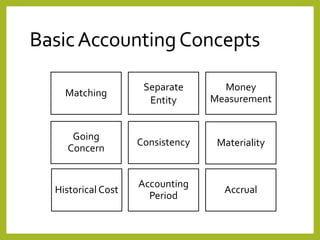
Basic Accounting Concepts
4
1
2
3
5 Cash Basis Vs Accrual Basis
What is Accounting?
 Accounting is a ‘Language of Business’ tool of providing
information about business entity to many groups of people.
(Perakaunan adalah bahasa perniagaan, ia menyediakan maklumat
mengenai entiti perniagaan kepada ramai pihak).
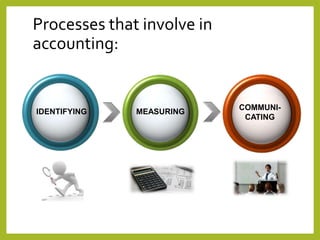
 Accounting is defined as the process of IDENTIFYING,
MEASURING and COMMUNICATING economic information
to permit informed judgments and decisions by users of the
information.
(Perakaunan adalah proses mengenalpasti, mengukur dan berkomunikasi
mengenai maklumat ekonomi bagi membenarkan pengguna-pengguna
akaun membuat keputusan)
IDENTIFYING MEASURING
COMMUNI-
CATING
Processes that involve in
accounting:
Users of Financial Accounting
Owner of
Business
Workers
Management
• Internal Users:-
MANAGEMENT
• To understand the profitability, liquidity and cash flow of
the organization every month, so that it can make
operational and financing decisions about the business.
OWNER OF BUSINESS
• To know the profit/loss of the business
• To determine the revenue and expenses for the business.
WORKERS/EMPLOYEES
• To assess an entity’s stability and profitability, and its
ability to provide remuneration, employment
opportunities and retirement benefits
Users of Financial Accounting
Suppliers
Government
Bank Shareholders
• External users:-
BANKS
• To decide whether to lend money to an entity, and
assess whether loans & interest will be paid when due.
SUPPLIERS
• To decide whether to sell goods to an entity and assess
the likelihood of being paid when due.
SHAREHOLDERS
• To determine whether they should buy, hold or sell.
• To assess the ability of the entity to pay dividends.
GOVERNMENT
• To regulate the activities of entities, assess taxation and
provide a basis for national statistics.
What is book keeping?
 Bookkeeping is only a part of accounting.
(Simpankira adalah sebahagian daripada perakaunan).
 It is an activity to classifying, recording and summarizing the
transactions using the double entry system.
(Simpan kira melibatkan proses merekod semua urus niaga
secara sistematik dan tepat berdasarkan Sistem Catatan
Bergu).
Accounting Standard & Financial
Reporting Standard
•Accounting Standards (Standard Perakaunan).
• A common set of principles, standards and procedures that
define the basic accounting policies.
• E.g : GAAP (General Accepted Accounting Principles) of US
•Financial Reporting Standards.
• A set of standards followed by companies in preparing
financial reports and statements.
• E.g : International Financial Reporting Standards (IFRS).
: Malaysian Financial Reporting Standards. (MFRS)
Matching
Separate
Entity
Money
Measurement
Going
Concern
Consistency
Accrual
Historical Cost
Accounting
Period
Materiality
BasicAccountingConcepts
Matching Concept
The assumption that in
measurement of profit, costs
should be set against the revenue
Untuk menentukan untung bersih bagi sesuatu
tempoh perakaunan, jumlah belanja bagi tempoh
itu ditolak daripada hasil yang diperoleh dalam
tempoh itu.
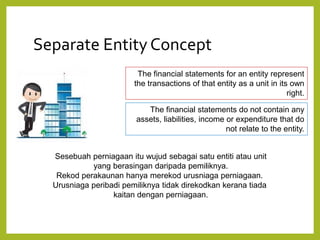
Separate Entity Concept
The financial statements for an entity represent
the transactions of that entity as a unit in its own
right.
The financial statements do not contain any
assets, liabilities, income or expenditure that do
not relate to the entity.
Sesebuah perniagaan itu wujud sebagai satu entiti atau unit
yang berasingan daripada pemiliknya.
Rekod perakaunan hanya merekod urusniaga perniagaan.
Urusniaga peribadi pemiliknya tidak direkodkan kerana tiada
kaitan dengan perniagaan.
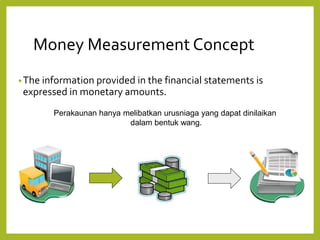
Money Measurement Concept
•The information provided in the financial statements is
expressed in monetary amounts.
Perakaunan hanya melibatkan urusniaga yang dapat dinilaikan
dalam bentuk wang.
Going Concern Concept
The assumption
that the business will
continue operating
into the foreseeable
future The assets will normally
be valued, and shown
in statement of financial
position, at their historical
cost
Perakaunan mengandaikan
bahawa perniagaan akan
terus berjalan untuk suatu
tempoh yang sangat lama
Aset perniagaan akan terus di
gunakan untukmenghasilkan
pendapatan bagi perniagaan .
Accruals Concept
The effects of transactions are recognised when they occur, not
when the cash or equivalent is received or paid
Earned
(revenue recognition
or realisation concept)
A sale is deemed to have
taken place at that point in
time at which the goods are
delivered or services
Provided.
Incurred
Goods and services are
deemed to have been
purchased on the date
they are received and not
When payment is made.
Transaksi dicatit apabila mereka berlaku, bukan ketika tunai diterima.
Consistency Concept
Allows a user to look at
a set financial statements
and assume that the same
policies, methods, and
estimation techniques have
been used from year to year.
Membolehkan pengguna
untuk merujuk kepada
penyata kewangan dan
mengandaikan polisi
yang sama, method dan
teknik digunakan.
Materiality Concept
Only material items should be
disclosed/ presented in financial
statements
Only apply accounting standards
to material items.
Dalam perakaunan, perbelanjaan perniagaan boleh bersifat
kebendaan atau bukan kebendaan.
Hanya perkara yang bersifat
kebendaan perlu dikemukakan
di dalam penyata kewangan.
Hanya mengaplikasikan
standard perakaunan ke atas
item bersifat kebendaan.
•Kos ini dikekalkan dalam rekod perakaunan dan sebarang perubahan harga
tidak mempengaruhi rekod yang telah dibuat.
Historical Cost Concept
Transactions reflect the actual
cost incurred, or revenue
earned.
The statement of financial
position can be regarded as
a history of management’s
past decision making,
Urusniaga direkodkan mengikut nilai yang sebenar, iaitu
berasaskan kos belian pada tarikh belian dilakukan
Accounting Period Concept
Divides the life of an entity into
time periods.
Users can assume that
financial statements represent
a period of time, typically one
year.
Tempoh perakaunan adalah
sama dan tetap bagi sesebuah
perniagaan iaitu boleh terdiri dari
pada 1 tahun, setengah tahun,
suku tahun atau satu bulan.
THANKYOU!

CHAPTER 1 ACCOUNTING CONCEPTS.pptx

  • 1.
    FINANCIAL ACCOUNTING TOPIC 1: ACCOUNTING CONCEPTS PUAN LYANA NATASHA MOHD FAIZUL
  • 2.
    Contents What is Accounting? Whatis Book Keeping? Accounting Standards & Financial Reporting Standards Basic Accounting Concepts 4 1 2 3 5 Cash Basis Vs Accrual Basis
  • 4.
    What is Accounting? Accounting is a ‘Language of Business’ tool of providing information about business entity to many groups of people. (Perakaunan adalah bahasa perniagaan, ia menyediakan maklumat mengenai entiti perniagaan kepada ramai pihak).  Accounting is defined as the process of IDENTIFYING, MEASURING and COMMUNICATING economic information to permit informed judgments and decisions by users of the information. (Perakaunan adalah proses mengenalpasti, mengukur dan berkomunikasi mengenai maklumat ekonomi bagi membenarkan pengguna-pengguna akaun membuat keputusan)
  • 5.
  • 6.
    Users of FinancialAccounting Owner of Business Workers Management • Internal Users:-
  • 7.
    MANAGEMENT • To understandthe profitability, liquidity and cash flow of the organization every month, so that it can make operational and financing decisions about the business. OWNER OF BUSINESS • To know the profit/loss of the business • To determine the revenue and expenses for the business. WORKERS/EMPLOYEES • To assess an entity’s stability and profitability, and its ability to provide remuneration, employment opportunities and retirement benefits
  • 8.
    Users of FinancialAccounting Suppliers Government Bank Shareholders • External users:-
  • 9.
    BANKS • To decidewhether to lend money to an entity, and assess whether loans & interest will be paid when due. SUPPLIERS • To decide whether to sell goods to an entity and assess the likelihood of being paid when due. SHAREHOLDERS • To determine whether they should buy, hold or sell. • To assess the ability of the entity to pay dividends. GOVERNMENT • To regulate the activities of entities, assess taxation and provide a basis for national statistics.
  • 11.
    What is bookkeeping?  Bookkeeping is only a part of accounting. (Simpankira adalah sebahagian daripada perakaunan).  It is an activity to classifying, recording and summarizing the transactions using the double entry system. (Simpan kira melibatkan proses merekod semua urus niaga secara sistematik dan tepat berdasarkan Sistem Catatan Bergu).
  • 12.
    Accounting Standard &Financial Reporting Standard •Accounting Standards (Standard Perakaunan). • A common set of principles, standards and procedures that define the basic accounting policies. • E.g : GAAP (General Accepted Accounting Principles) of US •Financial Reporting Standards. • A set of standards followed by companies in preparing financial reports and statements. • E.g : International Financial Reporting Standards (IFRS). : Malaysian Financial Reporting Standards. (MFRS)
  • 13.
  • 14.
    Matching Concept The assumptionthat in measurement of profit, costs should be set against the revenue Untuk menentukan untung bersih bagi sesuatu tempoh perakaunan, jumlah belanja bagi tempoh itu ditolak daripada hasil yang diperoleh dalam tempoh itu.
  • 15.
    Separate Entity Concept Thefinancial statements for an entity represent the transactions of that entity as a unit in its own right. The financial statements do not contain any assets, liabilities, income or expenditure that do not relate to the entity. Sesebuah perniagaan itu wujud sebagai satu entiti atau unit yang berasingan daripada pemiliknya. Rekod perakaunan hanya merekod urusniaga perniagaan. Urusniaga peribadi pemiliknya tidak direkodkan kerana tiada kaitan dengan perniagaan.
  • 16.
    Money Measurement Concept •Theinformation provided in the financial statements is expressed in monetary amounts. Perakaunan hanya melibatkan urusniaga yang dapat dinilaikan dalam bentuk wang.
  • 17.
    Going Concern Concept Theassumption that the business will continue operating into the foreseeable future The assets will normally be valued, and shown in statement of financial position, at their historical cost Perakaunan mengandaikan bahawa perniagaan akan terus berjalan untuk suatu tempoh yang sangat lama Aset perniagaan akan terus di gunakan untukmenghasilkan pendapatan bagi perniagaan .
  • 18.
    Accruals Concept The effectsof transactions are recognised when they occur, not when the cash or equivalent is received or paid Earned (revenue recognition or realisation concept) A sale is deemed to have taken place at that point in time at which the goods are delivered or services Provided. Incurred Goods and services are deemed to have been purchased on the date they are received and not When payment is made. Transaksi dicatit apabila mereka berlaku, bukan ketika tunai diterima.
  • 19.
    Consistency Concept Allows auser to look at a set financial statements and assume that the same policies, methods, and estimation techniques have been used from year to year. Membolehkan pengguna untuk merujuk kepada penyata kewangan dan mengandaikan polisi yang sama, method dan teknik digunakan.
  • 20.
    Materiality Concept Only materialitems should be disclosed/ presented in financial statements Only apply accounting standards to material items. Dalam perakaunan, perbelanjaan perniagaan boleh bersifat kebendaan atau bukan kebendaan. Hanya perkara yang bersifat kebendaan perlu dikemukakan di dalam penyata kewangan. Hanya mengaplikasikan standard perakaunan ke atas item bersifat kebendaan.
  • 21.
    •Kos ini dikekalkandalam rekod perakaunan dan sebarang perubahan harga tidak mempengaruhi rekod yang telah dibuat. Historical Cost Concept Transactions reflect the actual cost incurred, or revenue earned. The statement of financial position can be regarded as a history of management’s past decision making, Urusniaga direkodkan mengikut nilai yang sebenar, iaitu berasaskan kos belian pada tarikh belian dilakukan
  • 22.
    Accounting Period Concept Dividesthe life of an entity into time periods. Users can assume that financial statements represent a period of time, typically one year. Tempoh perakaunan adalah sama dan tetap bagi sesebuah perniagaan iaitu boleh terdiri dari pada 1 tahun, setengah tahun, suku tahun atau satu bulan.
  • 23.