Financial Accounting
TOPIC 9
The General Journal
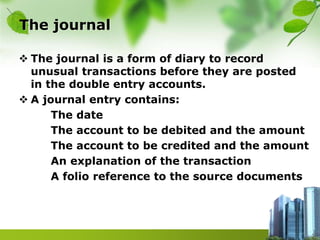
The journal
 The journal is a form of diary to record
unusual transactions before they are posted
in the double entry accounts.
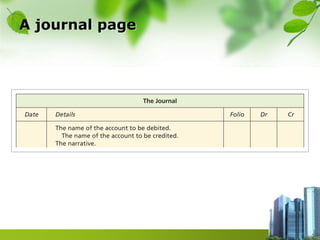
 A journal entry contains:
The date
The account to be debited and the amount
The account to be credited and the amount
An explanation of the transaction
A folio reference to the source documents
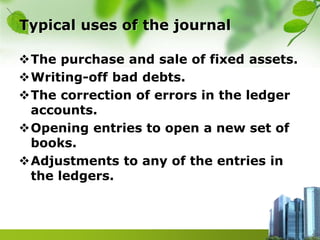
Typical uses of the journal
The purchase and sale of fixed assets.
Writing-off bad debts.
The correction of errors in the ledger
accounts.
Opening entries to open a new set of
books.
Adjustments to any of the entries in
the ledgers.
A journal page
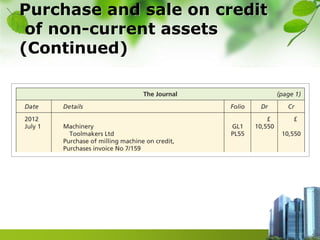
Purchase and sale on credit
of non-current assets
A milling machine is bought on credit
from Toolmakers Ltd for £10,550 on 1
July 2012.
Purchase and sale on credit
of non-current assets
(Continued)
Purchase and sale on credit
of non-current assets
(Continued)
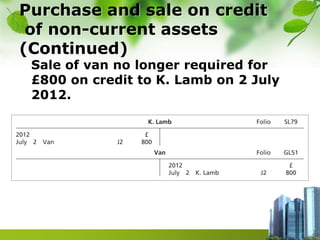
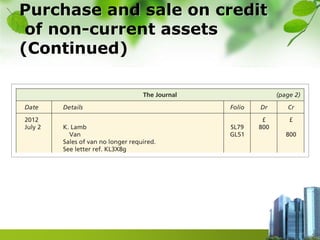
Sale of van no longer required for
£800 on credit to K. Lamb on 2 July
2012.
Purchase and sale on credit
of non-current assets
(Continued)
Bad debts
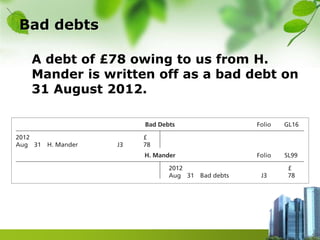
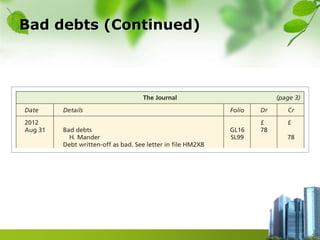
A debt of £78 owing to us from H.
Mander is written off as a bad debt on
31 August 2012.
Bad debts (Continued)
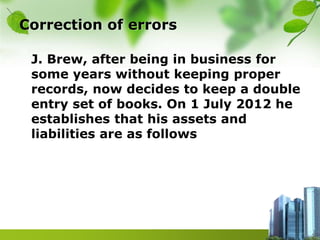
Correction of errors
J. Brew, after being in business for
some years without keeping proper
records, now decides to keep a double
entry set of books. On 1 July 2012 he
establishes that his assets and
liabilities are as follows
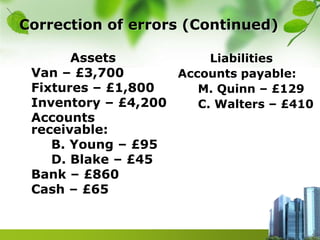
Correction of errors (Continued)
Assets
Van – £3,700
Fixtures – £1,800
Inventory – £4,200
Accounts
receivable:
B. Young – £95
D. Blake – £45
Bank – £860
Cash – £65
Liabilities
Accounts payable:
M. Quinn – £129
C. Walters – £410
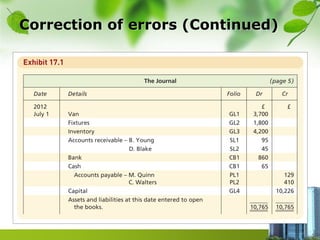
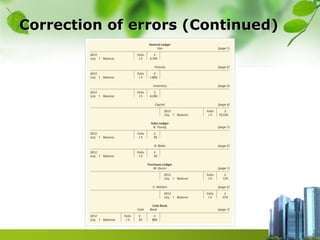
Correction of errors (Continued)
Adjustments to any of
the entries in the ledgers
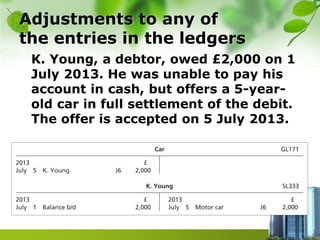
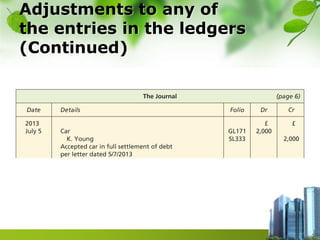
K. Young, a debtor, owed £2,000 on 1
July 2013. He was unable to pay his
account in cash, but offers a 5-year-
old car in full settlement of the debit.
The offer is accepted on 5 July 2013.
Adjustments to any of
the entries in the ledgers
(Continued)
Adjustments to any of
the entries in the ledgers
(Continued)
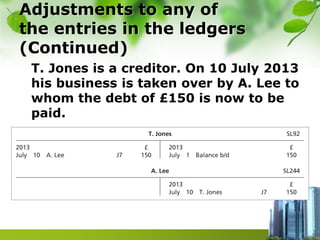
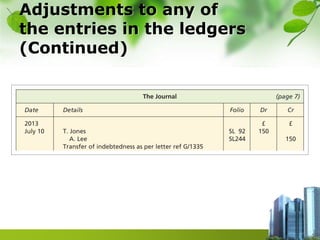
T. Jones is a creditor. On 10 July 2013
his business is taken over by A. Lee to
whom the debt of £150 is now to be
paid.
Adjustments to any of
the entries in the ledgers
(Continued)
Adjustments to any of
the entries in the ledgers
(Continued)
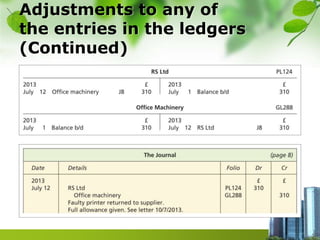
We had not yet paid for an office
printer we bought on credit for £310
because it was not working properly
when installed. On 12 July 2013 we
returned it to the supplier, RS Ltd. An
allowance of £310 was offered by the
supplier and accepted. As a result, we
no longer owe the supplier anything
for the printer.
Adjustments to any of
the entries in the ledgers
(Continued)
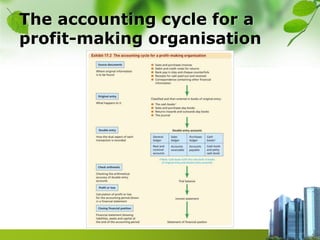
The accounting cycle for a
profit-making organisation
Thank You!

9 THE GENERAL JOURNAL.pptx

  • 1.
  • 2.
    The journal  Thejournal is a form of diary to record unusual transactions before they are posted in the double entry accounts.  A journal entry contains: The date The account to be debited and the amount The account to be credited and the amount An explanation of the transaction A folio reference to the source documents
  • 3.
    Typical uses ofthe journal The purchase and sale of fixed assets. Writing-off bad debts. The correction of errors in the ledger accounts. Opening entries to open a new set of books. Adjustments to any of the entries in the ledgers.
  • 4.
  • 5.
    Purchase and saleon credit of non-current assets A milling machine is bought on credit from Toolmakers Ltd for £10,550 on 1 July 2012.
  • 6.
    Purchase and saleon credit of non-current assets (Continued)
  • 7.
    Purchase and saleon credit of non-current assets (Continued) Sale of van no longer required for £800 on credit to K. Lamb on 2 July 2012.
  • 8.
    Purchase and saleon credit of non-current assets (Continued)
  • 9.
    Bad debts A debtof £78 owing to us from H. Mander is written off as a bad debt on 31 August 2012.
  • 10.
  • 11.
    Correction of errors J.Brew, after being in business for some years without keeping proper records, now decides to keep a double entry set of books. On 1 July 2012 he establishes that his assets and liabilities are as follows
  • 12.
    Correction of errors(Continued) Assets Van – £3,700 Fixtures – £1,800 Inventory – £4,200 Accounts receivable: B. Young – £95 D. Blake – £45 Bank – £860 Cash – £65 Liabilities Accounts payable: M. Quinn – £129 C. Walters – £410
  • 13.
  • 14.
  • 15.
    Adjustments to anyof the entries in the ledgers K. Young, a debtor, owed £2,000 on 1 July 2013. He was unable to pay his account in cash, but offers a 5-year- old car in full settlement of the debit. The offer is accepted on 5 July 2013.
  • 16.
    Adjustments to anyof the entries in the ledgers (Continued)
  • 17.
    Adjustments to anyof the entries in the ledgers (Continued) T. Jones is a creditor. On 10 July 2013 his business is taken over by A. Lee to whom the debt of £150 is now to be paid.
  • 18.
    Adjustments to anyof the entries in the ledgers (Continued)
  • 19.
    Adjustments to anyof the entries in the ledgers (Continued) We had not yet paid for an office printer we bought on credit for £310 because it was not working properly when installed. On 12 July 2013 we returned it to the supplier, RS Ltd. An allowance of £310 was offered by the supplier and accepted. As a result, we no longer owe the supplier anything for the printer.
  • 20.
    Adjustments to anyof the entries in the ledgers (Continued)
  • 21.
    The accounting cyclefor a profit-making organisation
  • 22.