Quote of the Day
Oh, people can come up with statistics to
 prove anything. 14% of people know
 that. ---Homer Simpson


      What are Statistics?
Chapter 1:The Nature of
Probability and Statistics

              Section 1:
      Descriptive and Inferential
             Statistics
Stats in Daily Life
   Of the people in the US, 14% said they feel
    happiest in June, and 14% said they feel
    happiest in December.
   The average in-state college tuition and fees
    for 4-year pubic college is $5,836.
   Every day in the US about 120 golfers claim
    that they made a hole-in-one.
   4 out of 5 doctors leaves one doctor.- Chevy
    Chase
What is Statistics?
   The science of conducting studies to
    collect, organize, summarize, analyze
    and draw conclusions from data.
What is Data?
   The values that the variables can
    assume.
   A collection of values forms a Data
    Set
       Each Value in the data set is called:
         
             Data Value or
            Datum
What is a variable?
   A characteristic or attribute that can
    assume different values.
Types of Statistics
1. Descriptive Statistics
        Consists of the collection, organization,
         summarization, and presentation of data
        Ex: Government Census
            Taken every ten years
         
             Describes average income, family size, etc..
       What does this mean?
        Basically used to describe a situation.
Types of Statistics
2.       Inferential Statistics
         Consists of generalizing from samples
          to populations, performing estimations
          and hypothesis tests, determining
          relationships among variables, and
          making predictions.
          
              Ex: Winning the lottery
                 1 in a million
        What does this mean ?
         Used to predict the outcome of an event.
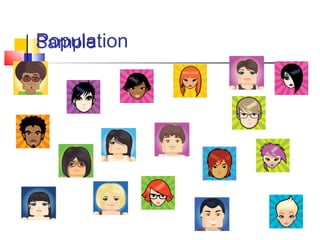
What is the difference between a
Population and a Sample?

    Population- consists of all subjects
     that are being studied.
    Sample- is a group selected from a
     population.
Population
Sample
Assignment
   Page 26
       #’s 1-6
Section 2: Types of Variables
       Qualitative Variables:
         Variables that can be placed into distinct
          categories, according to some
          characteristic or attribute.
         Ex: Gender, Eye color, Geographic
          Location
2 Types of Variables
   Quantitative Variables:
       Variables that are numerical and can be
        ordered or ranked.
       Ex: Age, height, weight, body temp
       Classified by two groups
            Discrete Variables
            Continuous Variables
Practice
   Page 26 #8
Discrete Variables
   Assume values that can be counted
   Assigned numbers such as 0,1,2,3,…
   Ex:
       # of children
       # of students
Continuous Variables
   Can assume an infinite number of
    values between any two specific values.
   Obtained by measuring
   Often include fractions and decimals.
   Ex:
       Temperature
       Time
       Length
Practice
   Page 27 #9
Measurement Scale
   Used to categorize, count, or measure
    variables.
   Types:
       Nominal
       Ordinal
       Interval
       Ratio
Nominal Level of Measurement
   Classifies data into mutually exclusive,
    exhausting categories in which no order
    or ranking can be imposed on the data.
   Ex:
       Male/Female
       Single/Married/Divorced/Widowed/Separated
       Democratic/Republican
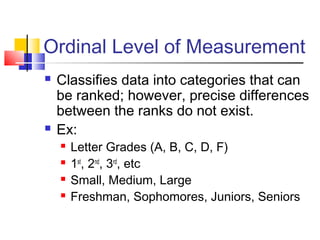
Ordinal Level of Measurement
   Classifies data into categories that can
    be ranked; however, precise differences
    between the ranks do not exist.
   Ex:
       Letter Grades (A, B, C, D, F)
       1st, 2nd, 3rd, etc
       Small, Medium, Large
       Freshman, Sophomores, Juniors, Seniors
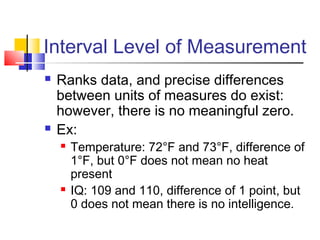
Interval Level of Measurement
   Ranks data, and precise differences
    between units of measures do exist:
    however, there is no meaningful zero.
   Ex:
       Temperature: 72°F and 73°F, difference of
        1°F, but 0°F does not mean no heat
        present
       IQ: 109 and 110, difference of 1 point, but
        0 does not mean there is no intelligence.
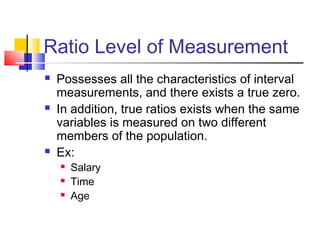
Ratio Level of Measurement
   Possesses all the characteristics of interval
    measurements, and there exists a true zero.
   In addition, true ratios exists when the same
    variables is measured on two different
    members of the population.
   Ex:
       Salary
       Time
       Age
Practice
   Page 26 #7
Section 3: Data Collection and
Sampling Techniques.
   Types:
       Random
       Systematic
       Stratified
       Cluster
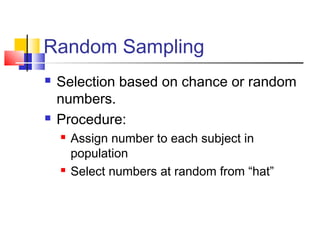
Random Sampling
   Selection based on chance or random
    numbers.
   Procedure:
       Assign number to each subject in
        population
       Select numbers at random from “hat”
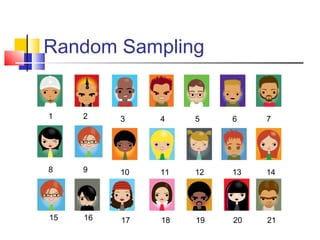
Random Sampling


1    2    3    4    5    6    7


8    9    10   11   12   13   14


15   16   17   18   19   20   21
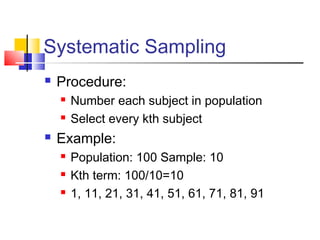
Systematic Sampling
   Procedure:
       Number each subject in population
       Select every kth subject
   Example:
       Population: 100 Sample: 10
       Kth term: 100/10=10
       1, 11, 21, 31, 41, 51, 61, 71, 81, 91
Systematic Sampling
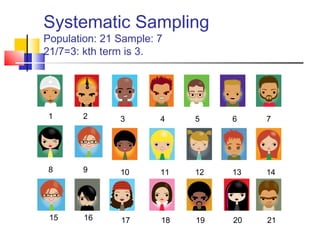
Population: 21 Sample: 7
21/7=3: kth term is 3.


 1      2      3       4    5    6    7


 8      9      10      11   12   13   14


 15     16     17      18   19   20   21
Stratified Sampling
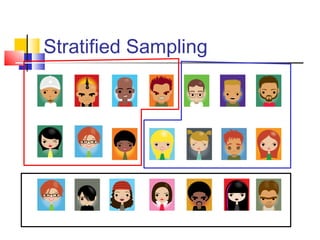
   Procedures:
       Population divided into groups called:
        Strata
       Groups have common characteristic
        needed for study.
       Samples randomly selected from each
        strata
Stratified Sampling
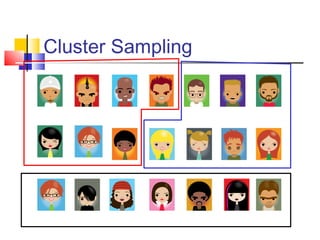
Cluster Sampling
   Population is divided into groups called:
    Clusters
   Select some clusters
   Survey every member of the cluster for
    sample

   Used with large populations
Cluster Sampling
Other sampling methods
   Convenience sampling
       Use subjects that are convent
       Ex: asking people as they enter the mall
   Sequential sampling
   Double sampling
   Multistage sampling
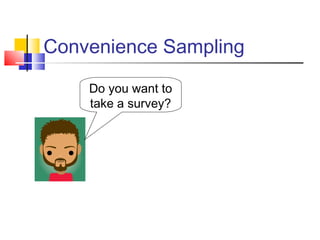
Convenience Sampling

    Do you want to
    take a survey?
Practice
   Page 27 #12
Section 4: 2 Types of Studies
       Observational Study
        Researchers merely observe what is
         happening or what has happened in the
         past
        Try to draw conclusions based on these
         observations.
        Ex: studying creatures in the wild
            “Meerkat Manor”
Section 4: 2 Types of Studies
   Experimental study
       Researchers manipulate one of the
        variables
       Tries to determine how to the manipulation
        influences other variables.
       Ex: New medication and placebos
Practice
   Page 27-28 #17
Statistical Studies include….
   Independent variables
       In an experimental study is the one that is
        being manipulated by the researcher.
       Also called: Explanatory variable

   Dependent variables
       Resultant variable
       Also called: Outcome variable
Misuses of Statistics
   Suspect Samples
       Too small
       Convenience
       Volunteers

   Changing the subject
       Increase of 3%
       Increase of $600,000
Misuses of Statistics
   Detached Statistics- no comparison
       “Works 5 times faster”
       “1/3 fewer calories”


   Implied Connection
       “Eating fish may help you achieve better in
        school”
Misuses of Statistics
   Misleading Graphs- Chapter 2

   Faulty Survey Questions
       “Do you feel there should be a 4 day
        school week?”
       “Do you feel there should be a 4 day
        school week from 4 am to midnight?”
Section 1-6: Computers and
Calculators
   Computer and Calculators GOOD
End of Chapter 1

Chapter 1

  • 1.
    Quote of theDay Oh, people can come up with statistics to prove anything. 14% of people know that. ---Homer Simpson What are Statistics?
  • 2.
    Chapter 1:The Natureof Probability and Statistics Section 1: Descriptive and Inferential Statistics
  • 3.
    Stats in DailyLife  Of the people in the US, 14% said they feel happiest in June, and 14% said they feel happiest in December.  The average in-state college tuition and fees for 4-year pubic college is $5,836.  Every day in the US about 120 golfers claim that they made a hole-in-one.  4 out of 5 doctors leaves one doctor.- Chevy Chase
  • 4.
    What is Statistics?  The science of conducting studies to collect, organize, summarize, analyze and draw conclusions from data.
  • 5.
    What is Data?  The values that the variables can assume.  A collection of values forms a Data Set  Each Value in the data set is called:  Data Value or  Datum
  • 6.
    What is avariable?  A characteristic or attribute that can assume different values.
  • 7.
    Types of Statistics 1.Descriptive Statistics  Consists of the collection, organization, summarization, and presentation of data  Ex: Government Census  Taken every ten years  Describes average income, family size, etc..  What does this mean?  Basically used to describe a situation.
  • 8.
    Types of Statistics 2. Inferential Statistics  Consists of generalizing from samples to populations, performing estimations and hypothesis tests, determining relationships among variables, and making predictions.  Ex: Winning the lottery  1 in a million  What does this mean ?  Used to predict the outcome of an event.
  • 9.
    What is thedifference between a Population and a Sample?  Population- consists of all subjects that are being studied.  Sample- is a group selected from a population.
  • 10.
  • 11.
    Assignment  Page 26  #’s 1-6
  • 12.
    Section 2: Typesof Variables  Qualitative Variables:  Variables that can be placed into distinct categories, according to some characteristic or attribute.  Ex: Gender, Eye color, Geographic Location
  • 13.
    2 Types ofVariables  Quantitative Variables:  Variables that are numerical and can be ordered or ranked.  Ex: Age, height, weight, body temp  Classified by two groups  Discrete Variables  Continuous Variables
  • 14.
    Practice  Page 26 #8
  • 15.
    Discrete Variables  Assume values that can be counted  Assigned numbers such as 0,1,2,3,…  Ex:  # of children  # of students
  • 16.
    Continuous Variables  Can assume an infinite number of values between any two specific values.  Obtained by measuring  Often include fractions and decimals.  Ex:  Temperature  Time  Length
  • 17.
    Practice  Page 27 #9
  • 18.
    Measurement Scale  Used to categorize, count, or measure variables.  Types:  Nominal  Ordinal  Interval  Ratio
  • 19.
    Nominal Level ofMeasurement  Classifies data into mutually exclusive, exhausting categories in which no order or ranking can be imposed on the data.  Ex:  Male/Female  Single/Married/Divorced/Widowed/Separated  Democratic/Republican
  • 20.
    Ordinal Level ofMeasurement  Classifies data into categories that can be ranked; however, precise differences between the ranks do not exist.  Ex:  Letter Grades (A, B, C, D, F)  1st, 2nd, 3rd, etc  Small, Medium, Large  Freshman, Sophomores, Juniors, Seniors
  • 21.
    Interval Level ofMeasurement  Ranks data, and precise differences between units of measures do exist: however, there is no meaningful zero.  Ex:  Temperature: 72°F and 73°F, difference of 1°F, but 0°F does not mean no heat present  IQ: 109 and 110, difference of 1 point, but 0 does not mean there is no intelligence.
  • 22.
    Ratio Level ofMeasurement  Possesses all the characteristics of interval measurements, and there exists a true zero.  In addition, true ratios exists when the same variables is measured on two different members of the population.  Ex:  Salary  Time  Age
  • 23.
    Practice  Page 26 #7
  • 24.
    Section 3: DataCollection and Sampling Techniques.  Types:  Random  Systematic  Stratified  Cluster
  • 25.
    Random Sampling  Selection based on chance or random numbers.  Procedure:  Assign number to each subject in population  Select numbers at random from “hat”
  • 26.
    Random Sampling 1 2 3 4 5 6 7 8 9 10 11 12 13 14 15 16 17 18 19 20 21
  • 27.
    Systematic Sampling  Procedure:  Number each subject in population  Select every kth subject  Example:  Population: 100 Sample: 10  Kth term: 100/10=10  1, 11, 21, 31, 41, 51, 61, 71, 81, 91
  • 28.
    Systematic Sampling Population: 21Sample: 7 21/7=3: kth term is 3. 1 2 3 4 5 6 7 8 9 10 11 12 13 14 15 16 17 18 19 20 21
  • 29.
    Stratified Sampling  Procedures:  Population divided into groups called: Strata  Groups have common characteristic needed for study.  Samples randomly selected from each strata
  • 30.
  • 31.
    Cluster Sampling  Population is divided into groups called: Clusters  Select some clusters  Survey every member of the cluster for sample  Used with large populations
  • 32.
  • 33.
    Other sampling methods  Convenience sampling  Use subjects that are convent  Ex: asking people as they enter the mall  Sequential sampling  Double sampling  Multistage sampling
  • 34.
    Convenience Sampling Do you want to take a survey?
  • 35.
    Practice  Page 27 #12
  • 36.
    Section 4: 2Types of Studies  Observational Study  Researchers merely observe what is happening or what has happened in the past  Try to draw conclusions based on these observations.  Ex: studying creatures in the wild  “Meerkat Manor”
  • 37.
    Section 4: 2Types of Studies  Experimental study  Researchers manipulate one of the variables  Tries to determine how to the manipulation influences other variables.  Ex: New medication and placebos
  • 38.
    Practice  Page 27-28 #17
  • 39.
    Statistical Studies include….  Independent variables  In an experimental study is the one that is being manipulated by the researcher.  Also called: Explanatory variable  Dependent variables  Resultant variable  Also called: Outcome variable
  • 40.
    Misuses of Statistics  Suspect Samples  Too small  Convenience  Volunteers  Changing the subject  Increase of 3%  Increase of $600,000
  • 41.
    Misuses of Statistics  Detached Statistics- no comparison  “Works 5 times faster”  “1/3 fewer calories”  Implied Connection  “Eating fish may help you achieve better in school”
  • 42.
    Misuses of Statistics  Misleading Graphs- Chapter 2  Faulty Survey Questions  “Do you feel there should be a 4 day school week?”  “Do you feel there should be a 4 day school week from 4 am to midnight?”
  • 43.
    Section 1-6: Computersand Calculators  Computer and Calculators GOOD
  • 44.