▪ A Trading Strategy ▪
Written by:
Marco Bennett
I. What Moves a Stock?
Have you ever wondered what causes the price movements in stocks? I’m not talking about
earning reports, news headlines, monetary policies, or macroeconomic speculation, but more
so the movements we notice day-to-day, and hour-by-hour that occur to a security following
no material change in a company’s fundamentals. Could there be more to intra-day price
fluctuations than simply the random timing of investor’s buy and sell orders?
Recently, I came across a possible answer while reading Jim Cramer’s, Get Rich Carefully.
Within the book, Mr. Cramer highlights the overpowering influences that sector groupings,
like broader index funds, can have on the market price of an individual stock.
In the past years, a relatively new investment fund has massively gained popularity among
institution investors. Exchange Traded Funds, or ETFs, are used to give big-portfolio managers
large and quick exposure to a group of stocks in preference to individual stocks. Mr. Cramer
argues that sector ETFs are greatly responsible for the short-term price movements of the
underlying companies’ stocks.
II. The Numbers Don’t Lie
Before developing a trading strategy based on this theory, it was necessary for me to perform
adequate research on the price correlations between sector ETFs and their underlying
securities.
In doing so, I gathered the daily market data within the past year for the Market Vectors Oil
Services Sector index, ticker OIH, which includes 100 publicly traded oil-companies around
the globe. To accurately test the correlation, I proceeded to congregate similar data for several
of the underlying companies. I eliminated the possibility of false biases that could arise from
choosing companies that are highly weighted within the ETF by selecting companies of
varying weights. By aggregating the day-to-day percent change in the stock price of these
securities, I was able to accurately perform a correlation test to see exactly how they move in
relation to the ETF. The results are shocking.
“In certain circumstances, financial markets can affect the
so-called fundamentals which they are supposed to reflect.
When that happens, markets enter into a state of dynamic
disequilibrium and behave quite differently from what
would be considered normal by the theory of efficient
markets.”
- George Soros, Chairman of Soros Fund
When contemplating what should decide the movement of a single security, I believe the
attributing factor should be the speculative nature of investors based on a fundamental or
technical analysis of the security in question. What I found, and what Mr. Cramer predicted, is
that this idea of simple company specific speculation is far from the truth!
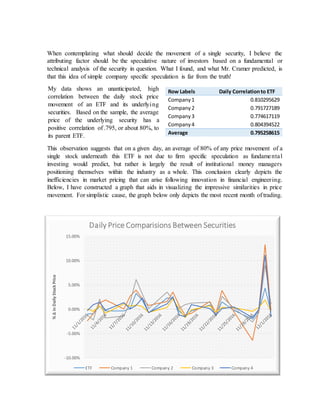
This observation suggests that on a given day, an average of 80% of any price movement of a
single stock underneath this ETF is not due to firm specific speculation as fundamental
investing would predict, but rather is largely the result of institutional money managers
positioning themselves within the industry as a whole. This conclusion clearly depicts the
inefficiencies in market pricing that can arise following innovation in financial engineering.
Below, I have constructed a graph that aids in visualizing the impressive similarities in price
movement. For simplistic cause, the graph below only depicts the most recent month of trading.
Row Labels Daily Correlationto ETF
Company1 0.810295629
Company2 0.791727189
Company3 0.774617119
Company4 0.804394522
Average 0.795258615
My data shows an unanticipated, high
correlation between the daily stock price
movement of an ETF and its underlying
securities. Based on the sample, the average
price of the underlying security has a
positive correlation of .795, or about 80%, to
its parent ETF.
-10.00%
-5.00%
0.00%
5.00%
10.00%
15.00%
%ΔinDailyStockPrice
Daily Price Comparisions Between Securities
ETF Company 1 Company 2 Company 3 Company 4
III. Banking a Profit
Why is there significance in knowing that individual stocks are highly correlated to their
sector’s ETF? The great part about ETFs is that it gives the investor a cheap and timely way
to take a position within an industry. It also provides the investor with a highly liquid asset
that might not be available through the purchase of individual securities. Instead of
differentiating between the good and bad companies through fundamental analysis, investors
are willing to purchase the known best alongside the horrible worst as a way of diversification.
With an estimated 80% correlation between ETF prices and the underlying individual
securities, the fundamental blunders of one company can adversely affect the short-term
market success of another if both are under the same ETF. Likewise, the reported success of
one, can artificially inflate the market price of another. These distortions in day-to-day
company valuations could also be supplemented by broad industry speculation; but non-the-
less, make rise to investment opportunities.
To take advantage of this market inefficiency, I would firstly find it necessary to research and
separate the companies within a sector ETF into three distinct, yet simple categories: Good,
neutral, and bad. If the ETF in question is trading down for the day, I would long the ‘good’
categorized companies since the high correlation atmosphere is likely putting downward
pressure on good companies that are fundamentally undervalued. Conversely, if the ETF is
trading up for the day, I would short the ‘bad’ companies since they are likely piggybacking
off good industry or competitor analysis.
By allocating all companies within the ETF into one of the three listed categories, this would
assist in deciding which underlying companies I could buy (Long) at a discount when the ETF
is down, and companies I can sell (Short) when the ETF is up. The challenge; however, comes
down to deciding which companies belong in each category.
When I evaluate the future success of a company, I look at the profitability of their operations
overtime. Companies with high or increasing profitability are more likely to extend or improve
dividends payments which is directly correlated to stock price performance. If profits are not
shelled out in the form of dividends, they are reinvested internally for further expansionary
benefits. A great financial metric I use to measure profitability is a company’s gross margin.
By comparing gross margin across companies within an ETF, you can get a sense of which
firms can remain competitive and outperform estimates overtime, and which ones are more
susceptible to underperforming analyst expectations.
Companies within an ETF that fall within the top 10% of gross margins, as defined by
favorable historical consistency, would be allocated into my ‘good’ category and those
companies that fall within the lowest 10% of margins would be allocated into my ‘bad’
category. The remaining companies will be allocated to the neutral category and will be set-
aside. Depending on whether the ETF is trading up or down compared to the previous session,
either a long or short position of the categorized stocks will be taken at the begging of each
trading day. Nearing the evening bell, I would liquidate my previously longed positions if the
ETF in question was trading up for the day and liquidate my short positions if the ETF was
down. If my position is short on the ‘bad’ companies and the parent ETF closes in the money,
or I am long on the ‘good’ companies, and the parent ETF closes in the red, my current
positions would be held.
IV. Final Thoughts
As time goes on and financial engineering continues, so will the complexity of accurately
valuing securities. In the long-run, markets will always adjust to reflect the fundamentals of
the companies and economies they are following. However, between the quarterly earnings
reports and the analyst’s projections, exists minor yet important near-term market
inefficiencies that may be exploited to your benefit. By remaining diligent and closely
analyzing market movers, an intelligent investor can take an inefficient innovation that causes
a distortion in reality and turn it into a lucrative opportunity.
My finance 410 academic course has allowed me to visualize the vast complexities of sales
and trading. I have grown to appreciate and value the derivative market as it has given me a
better understanding as to the risks associated with uncertainty in the secondary markets as
well as the various strategies investors can use to hedge against this uncertainty. After
completion if this course, I realize that near-term price movements of equities alongside
financial derivatives are prisoners to daily speculation regardless of their fundamental
certainty. In the long-term; however, fundamental analysis will never fail to impress. Next time
you decide to invest in the financial market, it is important to keep in mind one thing: The
direction of your investment is uncertain; the only thing certain, is that time will tell.

Inefficient Innovation: A Trading Strategy

  • 1.
    ▪ A TradingStrategy ▪ Written by: Marco Bennett
  • 2.
    I. What Movesa Stock? Have you ever wondered what causes the price movements in stocks? I’m not talking about earning reports, news headlines, monetary policies, or macroeconomic speculation, but more so the movements we notice day-to-day, and hour-by-hour that occur to a security following no material change in a company’s fundamentals. Could there be more to intra-day price fluctuations than simply the random timing of investor’s buy and sell orders? Recently, I came across a possible answer while reading Jim Cramer’s, Get Rich Carefully. Within the book, Mr. Cramer highlights the overpowering influences that sector groupings, like broader index funds, can have on the market price of an individual stock. In the past years, a relatively new investment fund has massively gained popularity among institution investors. Exchange Traded Funds, or ETFs, are used to give big-portfolio managers large and quick exposure to a group of stocks in preference to individual stocks. Mr. Cramer argues that sector ETFs are greatly responsible for the short-term price movements of the underlying companies’ stocks. II. The Numbers Don’t Lie Before developing a trading strategy based on this theory, it was necessary for me to perform adequate research on the price correlations between sector ETFs and their underlying securities. In doing so, I gathered the daily market data within the past year for the Market Vectors Oil Services Sector index, ticker OIH, which includes 100 publicly traded oil-companies around the globe. To accurately test the correlation, I proceeded to congregate similar data for several of the underlying companies. I eliminated the possibility of false biases that could arise from choosing companies that are highly weighted within the ETF by selecting companies of varying weights. By aggregating the day-to-day percent change in the stock price of these securities, I was able to accurately perform a correlation test to see exactly how they move in relation to the ETF. The results are shocking. “In certain circumstances, financial markets can affect the so-called fundamentals which they are supposed to reflect. When that happens, markets enter into a state of dynamic disequilibrium and behave quite differently from what would be considered normal by the theory of efficient markets.” - George Soros, Chairman of Soros Fund
  • 3.
    When contemplating whatshould decide the movement of a single security, I believe the attributing factor should be the speculative nature of investors based on a fundamental or technical analysis of the security in question. What I found, and what Mr. Cramer predicted, is that this idea of simple company specific speculation is far from the truth! This observation suggests that on a given day, an average of 80% of any price movement of a single stock underneath this ETF is not due to firm specific speculation as fundamental investing would predict, but rather is largely the result of institutional money managers positioning themselves within the industry as a whole. This conclusion clearly depicts the inefficiencies in market pricing that can arise following innovation in financial engineering. Below, I have constructed a graph that aids in visualizing the impressive similarities in price movement. For simplistic cause, the graph below only depicts the most recent month of trading. Row Labels Daily Correlationto ETF Company1 0.810295629 Company2 0.791727189 Company3 0.774617119 Company4 0.804394522 Average 0.795258615 My data shows an unanticipated, high correlation between the daily stock price movement of an ETF and its underlying securities. Based on the sample, the average price of the underlying security has a positive correlation of .795, or about 80%, to its parent ETF. -10.00% -5.00% 0.00% 5.00% 10.00% 15.00% %ΔinDailyStockPrice Daily Price Comparisions Between Securities ETF Company 1 Company 2 Company 3 Company 4
  • 4.
    III. Banking aProfit Why is there significance in knowing that individual stocks are highly correlated to their sector’s ETF? The great part about ETFs is that it gives the investor a cheap and timely way to take a position within an industry. It also provides the investor with a highly liquid asset that might not be available through the purchase of individual securities. Instead of differentiating between the good and bad companies through fundamental analysis, investors are willing to purchase the known best alongside the horrible worst as a way of diversification. With an estimated 80% correlation between ETF prices and the underlying individual securities, the fundamental blunders of one company can adversely affect the short-term market success of another if both are under the same ETF. Likewise, the reported success of one, can artificially inflate the market price of another. These distortions in day-to-day company valuations could also be supplemented by broad industry speculation; but non-the- less, make rise to investment opportunities. To take advantage of this market inefficiency, I would firstly find it necessary to research and separate the companies within a sector ETF into three distinct, yet simple categories: Good, neutral, and bad. If the ETF in question is trading down for the day, I would long the ‘good’ categorized companies since the high correlation atmosphere is likely putting downward pressure on good companies that are fundamentally undervalued. Conversely, if the ETF is trading up for the day, I would short the ‘bad’ companies since they are likely piggybacking off good industry or competitor analysis. By allocating all companies within the ETF into one of the three listed categories, this would assist in deciding which underlying companies I could buy (Long) at a discount when the ETF is down, and companies I can sell (Short) when the ETF is up. The challenge; however, comes down to deciding which companies belong in each category. When I evaluate the future success of a company, I look at the profitability of their operations overtime. Companies with high or increasing profitability are more likely to extend or improve dividends payments which is directly correlated to stock price performance. If profits are not shelled out in the form of dividends, they are reinvested internally for further expansionary benefits. A great financial metric I use to measure profitability is a company’s gross margin. By comparing gross margin across companies within an ETF, you can get a sense of which firms can remain competitive and outperform estimates overtime, and which ones are more susceptible to underperforming analyst expectations. Companies within an ETF that fall within the top 10% of gross margins, as defined by favorable historical consistency, would be allocated into my ‘good’ category and those companies that fall within the lowest 10% of margins would be allocated into my ‘bad’ category. The remaining companies will be allocated to the neutral category and will be set- aside. Depending on whether the ETF is trading up or down compared to the previous session, either a long or short position of the categorized stocks will be taken at the begging of each trading day. Nearing the evening bell, I would liquidate my previously longed positions if the ETF in question was trading up for the day and liquidate my short positions if the ETF was
  • 5.
    down. If myposition is short on the ‘bad’ companies and the parent ETF closes in the money, or I am long on the ‘good’ companies, and the parent ETF closes in the red, my current positions would be held. IV. Final Thoughts As time goes on and financial engineering continues, so will the complexity of accurately valuing securities. In the long-run, markets will always adjust to reflect the fundamentals of the companies and economies they are following. However, between the quarterly earnings reports and the analyst’s projections, exists minor yet important near-term market inefficiencies that may be exploited to your benefit. By remaining diligent and closely analyzing market movers, an intelligent investor can take an inefficient innovation that causes a distortion in reality and turn it into a lucrative opportunity. My finance 410 academic course has allowed me to visualize the vast complexities of sales and trading. I have grown to appreciate and value the derivative market as it has given me a better understanding as to the risks associated with uncertainty in the secondary markets as well as the various strategies investors can use to hedge against this uncertainty. After completion if this course, I realize that near-term price movements of equities alongside financial derivatives are prisoners to daily speculation regardless of their fundamental certainty. In the long-term; however, fundamental analysis will never fail to impress. Next time you decide to invest in the financial market, it is important to keep in mind one thing: The direction of your investment is uncertain; the only thing certain, is that time will tell.