Slack, Brandon-Jones and Johnston, Essentials of Operations Management, 1st Edition, © Slack, Brandon-Jones and Johnston, 2011
Chapter 4
The design of services and
products
Slack, Brandon-Jones and Johnston, Essentials of Operations Management, 1st Edition, © Slack, Brandon-Jones and Johnston, 2011
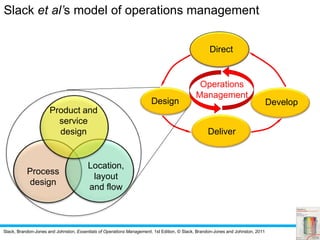
Design
Deliver
Direct
Develop
Operations
Management
Slack et al’s model of operations management
Location,
layout
and flow
Process
design
Product and
service
design
Slack, Brandon-Jones and Johnston, Essentials of Operations Management, 1st Edition, © Slack, Brandon-Jones and Johnston, 2011
In Chapter 4 – The design of products and services –
Slack et. al. identify the following key questions…….
Why is good product and service design important?
What are the stages in product and service design?
Why should product and service design and process
design be considered interactively?
How should interactive design be managed?
Key operations questions
Slack, Brandon-Jones and Johnston, Essentials of Operations Management, 1st Edition, © Slack, Brandon-Jones and Johnston, 2011
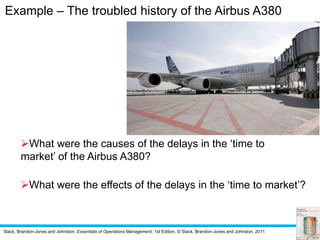
Example – The troubled history of the Airbus A380
What were the causes of the delays in the ‘time to
market’ of the Airbus A380?
What were the effects of the delays in the ‘time to market’?
Slack, Brandon-Jones and Johnston, Essentials of Operations Management, 1st Edition, © Slack, Brandon-Jones and Johnston, 2011
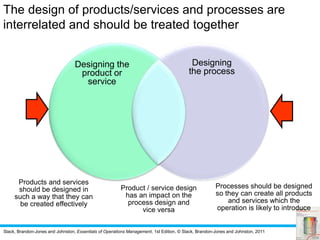
Products and services
should be designed in
such a way that they can
be created effectively
Designing the
product or
service
Processes should be designed
so they can create all products
and services which the
operation is likely to introduce
Designing
the process
Product / service design
has an impact on the
process design and
vice versa
The design of products/services and processes are
interrelated and should be treated together
Slack, Brandon-Jones and Johnston, Essentials of Operations Management, 1st Edition, © Slack, Brandon-Jones and Johnston, 2011
Why is design so important?
UK Design Council Survey…..
Design helps businesses connect strongly with their customers
90% of businesses growing rapidly say design is significant to
them, only 26% of static companies say the same.
Design reduces costs by making processes more efficient. It can
also reduce the time to market for new products and services.
Almost 70 per cent of companies seeing design as integral have
developed new products and services in the last three years,
compared to only a third of businesses overall.
Companies who were ‘effective users of design’ had financial
performances 200% better than average.
Slack, Brandon-Jones and Johnston, Essentials of Operations Management, 1st Edition, © Slack, Brandon-Jones and Johnston, 2011
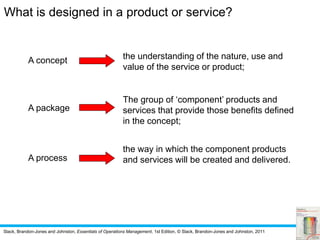
What is designed in a product or service?
A concept the understanding of the nature, use and
value of the service or product;
A package
The group of ‘component’ products and
services that provide those benefits defined
in the concept;
A process
the way in which the component products
and services will be created and delivered.
Slack, Brandon-Jones and Johnston, Essentials of Operations Management, 1st Edition, © Slack, Brandon-Jones and Johnston, 2011
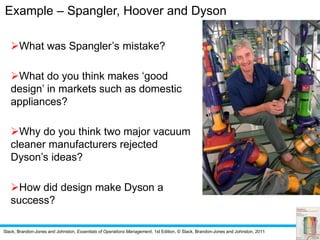
Example – Spangler, Hoover and Dyson
What was Spangler’s mistake?
What do you think makes ‘good
design’ in markets such as domestic
appliances?
Why do you think two major vacuum
cleaner manufacturers rejected
Dyson’s ideas?
How did design make Dyson a
success?
Slack, Brandon-Jones and Johnston, Essentials of Operations Management, 1st Edition, © Slack, Brandon-Jones and Johnston, 2011
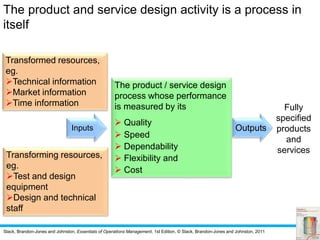
The product / service design
process whose performance
is measured by its
 Quality
 Speed
 Dependability
 Flexibility and
 Cost
Outputs
Fully
specified
products
and
services
Inputs
The product and service design activity is a process in
itself
Transformed resources,
eg.
Technical information
Market information
Time information
Transforming resources,
eg.
Test and design
equipment
Design and technical
staff
Slack, Brandon-Jones and Johnston, Essentials of Operations Management, 1st Edition, © Slack, Brandon-Jones and Johnston, 2011
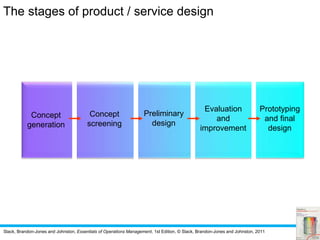
The stages of product / service design
Concept
generation
Concept
screening
Preliminary
design
Evaluation
and
improvement
Prototyping
and final
design
Slack, Brandon-Jones and Johnston, Essentials of Operations Management, 1st Edition, © Slack, Brandon-Jones and Johnston, 2011
Concept generation……
Ideas from customers formally through Marketing
activities
Listening to customers - on a day-to-day basis.
Ideas from competitor activity – For example reverse
engineering
Ideas from staff – Especially those who meet
customers every day.
Ideas from research and development
Slack, Brandon-Jones and Johnston, Essentials of Operations Management, 1st Edition, © Slack, Brandon-Jones and Johnston, 2011
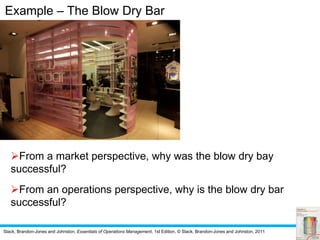
Example – The Blow Dry Bar
From a market perspective, why was the blow dry bay
successful?
From an operations perspective, why is the blow dry bar
successful?
Slack, Brandon-Jones and Johnston, Essentials of Operations Management, 1st Edition, © Slack, Brandon-Jones and Johnston, 2011
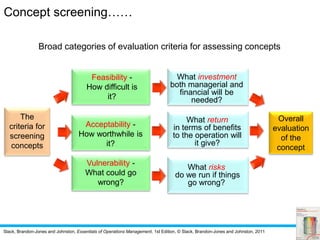
Broad categories of evaluation criteria for assessing concepts
Feasibility -
How difficult is
it?
The
criteria for
screening
concepts
What investment
both managerial and
financial will be
needed?
What return
in terms of benefits
to the operation will
it give?
What risks
do we run if things
go wrong?
Acceptability -
How worthwhile is
it?
Vulnerability -
What could go
wrong?
Overall
evaluation
of the
concept
Concept screening……
Slack, Brandon-Jones and Johnston, Essentials of Operations Management, 1st Edition, © Slack, Brandon-Jones and Johnston, 2011
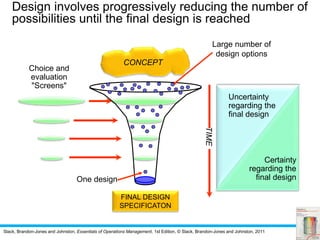
Uncertainty
regarding the
final design
Certainty
regarding the
final design
TIME
Design involves progressively reducing the number of
possibilities until the final design is reached
CONCEPT
FINAL DESIGN
SPECIFICATON
Choice and
evaluation
"Screens"
Large number of
design options
One design
Slack, Brandon-Jones and Johnston, Essentials of Operations Management, 1st Edition, © Slack, Brandon-Jones and Johnston, 2011
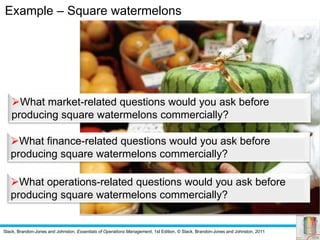
Example – Square watermelons
What market-related questions would you ask before
producing square watermelons commercially?
What finance-related questions would you ask before
producing square watermelons commercially?
What operations-related questions would you ask before
producing square watermelons commercially?
Slack, Brandon-Jones and Johnston, Essentials of Operations Management, 1st Edition, © Slack, Brandon-Jones and Johnston, 2011
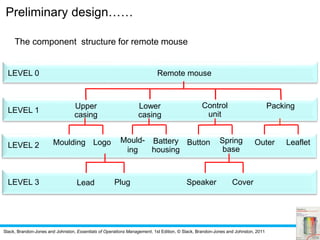
The component structure for remote mouse
LEVEL 0 Remote mouse
LEVEL 1
LEVEL 2
LEVEL 3 Lead Plug CoverSpeaker
LeafletOuterLogoMoulding Battery
housing
Mould-
ing
Spring
base
Button
Preliminary design……
Upper
casing
Control
unit
Lower
casing
Packing
Slack, Brandon-Jones and Johnston, Essentials of Operations Management, 1st Edition, © Slack, Brandon-Jones and Johnston, 2011
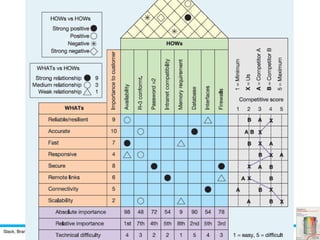
- quality function deployment;
- value engineering;
- Taguchi methods.
Design evaluation and improvement……
There are various ways of
evaluating preliminary designs
These include:
Slack, Brandon-Jones and Johnston, Essentials of Operations Management, 1st Edition, © Slack, Brandon-Jones and Johnston, 2011
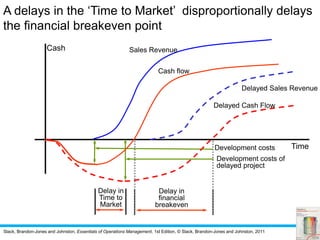
A delays in the ‘Time to Market’ disproportionally delays
the financial breakeven point
Delay in
financial
breakeven
Delay in
Time to
Market
Development costs
Development costs of
delayed project
Time
Cash Sales Revenue
Delayed Sales Revenue
Cash flow
Delayed Cash Flow
Slack, Brandon-Jones and Johnston, Essentials of Operations Management, 1st Edition, © Slack, Brandon-Jones and Johnston, 2011
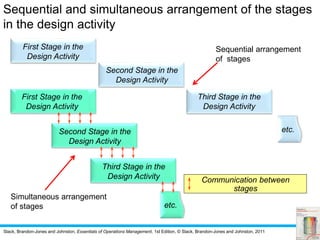
Sequential and simultaneous arrangement of the stages
in the design activity
Third Stage in the
Design Activity
Second Stage in the
Design Activity
First Stage in the
Design Activity
etc.
First Stage in the
Design Activity
Second Stage in the
Design Activity
Third Stage in the
Design Activity
etc.
Communication between
stages
Sequential arrangement
of stages
Simultaneous arrangement
of stages
Slack, Brandon-Jones and Johnston, Essentials of Operations Management, 1st Edition, © Slack, Brandon-Jones and Johnston, 2011
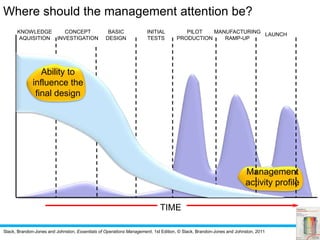
Management
activity profile
Where should the management attention be?
KNOWLEDGE
AQUISITION
CONCEPT
INVESTIGATION
BASIC
DESIGN
INITIAL
TESTS
PILOT
PRODUCTION
MANUFACTURING
RAMP-UP
LAUNCH
TIME
Ability to
influence the
final design
Slack, Brandon-Jones and Johnston, Essentials of Operations Management, 1st Edition, © Slack, Brandon-Jones and Johnston, 2011
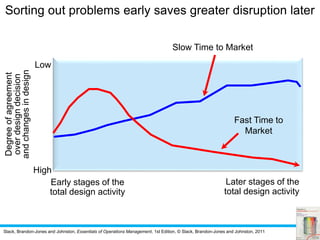
Low
High
Slow Time to Market
Fast Time to
Market
Sorting out problems early saves greater disruption laterDegreeofagreement
overdesigndecision
andchangesindesign
Early stages of the
total design activity
Later stages of the
total design activity
Slack, Brandon-Jones and Johnston, Essentials of Operations Management, 1st Edition, © Slack, Brandon-Jones and Johnston, 2011
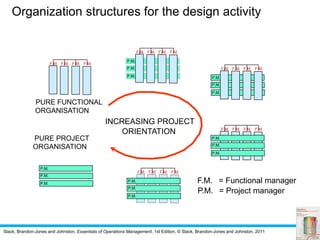
INCREASING PROJECT
ORIENTATION
P.M.
F.M. = Functional manager
= Project manager
Organization structures for the design activity
P.M.
P.M.
P.M.
F.M. F.M. F.M. F.M.
PURE FUNCTIONAL
ORGANISATION
F.M. F.M. F.M. F.M.
P.M.
P.M.
P.M.
F.M. F.M. F.M. F.M.
F.M. F.M. F.M. F.M.
P.M.
P.M.
P.M.
PURE PROJECT
ORGANISATION
P.M.
P.M.
P.M.
F.M. F.M. F.M. F.M.
P.M.
P.M.
P.M.

Chapter 04 essentials final

  • 1.
    Slack, Brandon-Jones andJohnston, Essentials of Operations Management, 1st Edition, © Slack, Brandon-Jones and Johnston, 2011 Chapter 4 The design of services and products
  • 2.
    Slack, Brandon-Jones andJohnston, Essentials of Operations Management, 1st Edition, © Slack, Brandon-Jones and Johnston, 2011 Design Deliver Direct Develop Operations Management Slack et al’s model of operations management Location, layout and flow Process design Product and service design
  • 3.
    Slack, Brandon-Jones andJohnston, Essentials of Operations Management, 1st Edition, © Slack, Brandon-Jones and Johnston, 2011 In Chapter 4 – The design of products and services – Slack et. al. identify the following key questions……. Why is good product and service design important? What are the stages in product and service design? Why should product and service design and process design be considered interactively? How should interactive design be managed? Key operations questions
  • 4.
    Slack, Brandon-Jones andJohnston, Essentials of Operations Management, 1st Edition, © Slack, Brandon-Jones and Johnston, 2011 Example – The troubled history of the Airbus A380 What were the causes of the delays in the ‘time to market’ of the Airbus A380? What were the effects of the delays in the ‘time to market’?
  • 5.
    Slack, Brandon-Jones andJohnston, Essentials of Operations Management, 1st Edition, © Slack, Brandon-Jones and Johnston, 2011 Products and services should be designed in such a way that they can be created effectively Designing the product or service Processes should be designed so they can create all products and services which the operation is likely to introduce Designing the process Product / service design has an impact on the process design and vice versa The design of products/services and processes are interrelated and should be treated together
  • 6.
    Slack, Brandon-Jones andJohnston, Essentials of Operations Management, 1st Edition, © Slack, Brandon-Jones and Johnston, 2011 Why is design so important? UK Design Council Survey….. Design helps businesses connect strongly with their customers 90% of businesses growing rapidly say design is significant to them, only 26% of static companies say the same. Design reduces costs by making processes more efficient. It can also reduce the time to market for new products and services. Almost 70 per cent of companies seeing design as integral have developed new products and services in the last three years, compared to only a third of businesses overall. Companies who were ‘effective users of design’ had financial performances 200% better than average.
  • 7.
    Slack, Brandon-Jones andJohnston, Essentials of Operations Management, 1st Edition, © Slack, Brandon-Jones and Johnston, 2011 What is designed in a product or service? A concept the understanding of the nature, use and value of the service or product; A package The group of ‘component’ products and services that provide those benefits defined in the concept; A process the way in which the component products and services will be created and delivered.
  • 8.
    Slack, Brandon-Jones andJohnston, Essentials of Operations Management, 1st Edition, © Slack, Brandon-Jones and Johnston, 2011 Example – Spangler, Hoover and Dyson What was Spangler’s mistake? What do you think makes ‘good design’ in markets such as domestic appliances? Why do you think two major vacuum cleaner manufacturers rejected Dyson’s ideas? How did design make Dyson a success?
  • 9.
    Slack, Brandon-Jones andJohnston, Essentials of Operations Management, 1st Edition, © Slack, Brandon-Jones and Johnston, 2011 The product / service design process whose performance is measured by its  Quality  Speed  Dependability  Flexibility and  Cost Outputs Fully specified products and services Inputs The product and service design activity is a process in itself Transformed resources, eg. Technical information Market information Time information Transforming resources, eg. Test and design equipment Design and technical staff
  • 10.
    Slack, Brandon-Jones andJohnston, Essentials of Operations Management, 1st Edition, © Slack, Brandon-Jones and Johnston, 2011 The stages of product / service design Concept generation Concept screening Preliminary design Evaluation and improvement Prototyping and final design
  • 11.
    Slack, Brandon-Jones andJohnston, Essentials of Operations Management, 1st Edition, © Slack, Brandon-Jones and Johnston, 2011 Concept generation…… Ideas from customers formally through Marketing activities Listening to customers - on a day-to-day basis. Ideas from competitor activity – For example reverse engineering Ideas from staff – Especially those who meet customers every day. Ideas from research and development
  • 12.
    Slack, Brandon-Jones andJohnston, Essentials of Operations Management, 1st Edition, © Slack, Brandon-Jones and Johnston, 2011 Example – The Blow Dry Bar From a market perspective, why was the blow dry bay successful? From an operations perspective, why is the blow dry bar successful?
  • 13.
    Slack, Brandon-Jones andJohnston, Essentials of Operations Management, 1st Edition, © Slack, Brandon-Jones and Johnston, 2011 Broad categories of evaluation criteria for assessing concepts Feasibility - How difficult is it? The criteria for screening concepts What investment both managerial and financial will be needed? What return in terms of benefits to the operation will it give? What risks do we run if things go wrong? Acceptability - How worthwhile is it? Vulnerability - What could go wrong? Overall evaluation of the concept Concept screening……
  • 14.
    Slack, Brandon-Jones andJohnston, Essentials of Operations Management, 1st Edition, © Slack, Brandon-Jones and Johnston, 2011 Uncertainty regarding the final design Certainty regarding the final design TIME Design involves progressively reducing the number of possibilities until the final design is reached CONCEPT FINAL DESIGN SPECIFICATON Choice and evaluation "Screens" Large number of design options One design
  • 15.
    Slack, Brandon-Jones andJohnston, Essentials of Operations Management, 1st Edition, © Slack, Brandon-Jones and Johnston, 2011 Example – Square watermelons What market-related questions would you ask before producing square watermelons commercially? What finance-related questions would you ask before producing square watermelons commercially? What operations-related questions would you ask before producing square watermelons commercially?
  • 16.
    Slack, Brandon-Jones andJohnston, Essentials of Operations Management, 1st Edition, © Slack, Brandon-Jones and Johnston, 2011 The component structure for remote mouse LEVEL 0 Remote mouse LEVEL 1 LEVEL 2 LEVEL 3 Lead Plug CoverSpeaker LeafletOuterLogoMoulding Battery housing Mould- ing Spring base Button Preliminary design…… Upper casing Control unit Lower casing Packing
  • 17.
    Slack, Brandon-Jones andJohnston, Essentials of Operations Management, 1st Edition, © Slack, Brandon-Jones and Johnston, 2011 - quality function deployment; - value engineering; - Taguchi methods. Design evaluation and improvement…… There are various ways of evaluating preliminary designs These include:
  • 18.
    Slack, Brandon-Jones andJohnston, Essentials of Operations Management, 1st Edition, © Slack, Brandon-Jones and Johnston, 2011
  • 19.
    Slack, Brandon-Jones andJohnston, Essentials of Operations Management, 1st Edition, © Slack, Brandon-Jones and Johnston, 2011 A delays in the ‘Time to Market’ disproportionally delays the financial breakeven point Delay in financial breakeven Delay in Time to Market Development costs Development costs of delayed project Time Cash Sales Revenue Delayed Sales Revenue Cash flow Delayed Cash Flow
  • 20.
    Slack, Brandon-Jones andJohnston, Essentials of Operations Management, 1st Edition, © Slack, Brandon-Jones and Johnston, 2011 Sequential and simultaneous arrangement of the stages in the design activity Third Stage in the Design Activity Second Stage in the Design Activity First Stage in the Design Activity etc. First Stage in the Design Activity Second Stage in the Design Activity Third Stage in the Design Activity etc. Communication between stages Sequential arrangement of stages Simultaneous arrangement of stages
  • 21.
    Slack, Brandon-Jones andJohnston, Essentials of Operations Management, 1st Edition, © Slack, Brandon-Jones and Johnston, 2011 Management activity profile Where should the management attention be? KNOWLEDGE AQUISITION CONCEPT INVESTIGATION BASIC DESIGN INITIAL TESTS PILOT PRODUCTION MANUFACTURING RAMP-UP LAUNCH TIME Ability to influence the final design
  • 22.
    Slack, Brandon-Jones andJohnston, Essentials of Operations Management, 1st Edition, © Slack, Brandon-Jones and Johnston, 2011 Low High Slow Time to Market Fast Time to Market Sorting out problems early saves greater disruption laterDegreeofagreement overdesigndecision andchangesindesign Early stages of the total design activity Later stages of the total design activity
  • 23.
    Slack, Brandon-Jones andJohnston, Essentials of Operations Management, 1st Edition, © Slack, Brandon-Jones and Johnston, 2011 INCREASING PROJECT ORIENTATION P.M. F.M. = Functional manager = Project manager Organization structures for the design activity P.M. P.M. P.M. F.M. F.M. F.M. F.M. PURE FUNCTIONAL ORGANISATION F.M. F.M. F.M. F.M. P.M. P.M. P.M. F.M. F.M. F.M. F.M. F.M. F.M. F.M. F.M. P.M. P.M. P.M. PURE PROJECT ORGANISATION P.M. P.M. P.M. F.M. F.M. F.M. F.M. P.M. P.M. P.M.