Chapter 12

The Term Newborn
Objectives

• Briefly describe three normal reflexes of the
  neonate, including the approximate age of
  their disappearance.
• Demonstrate the steps in the physical
  assessment of the newborn.
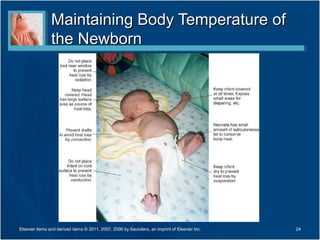
• State four methods of maintaining the body
  temperature of a newborn.
• State the cause and appearance of
  physiological jaundice in the newborn.
Elsevier items and derived items © 2011, 2007, 2006 by Saunders, an imprint of Elsevier Inc.   2
Objectives (cont.)

• Define the following skin manifestations in the
  newborn: lanugo, vernix caseosa, Mongolian
  spots, milia, acrocyanosis, desquamation.
• State the methods of preventing infection in
  newborns.
• Interpret discharge teaching for the mother
  and her newborn.


Elsevier items and derived items © 2011, 2007, 2006 by Saunders, an imprint of Elsevier Inc.   3
Adjustment to Life Outside the
                Uterus
• Adjustment is dependent upon
      –     Genetic background
      –     Health of the recent uterine environment
      –     A safe delivery
      –     Care during the first month of life


Elsevier items and derived items © 2011, 2007, 2006 by Saunders, an imprint of Elsevier Inc.   4
Adjustment to Life Outside the
                Uterus (cont.)
• Respirations stimulated due to chilling and
  chemical changes in the blood
      – Sensory and physical stimuli
      – First breath opens alveoli
      – Independent air exchange begins
• Initiates cardiopulmonary interdependence


Elsevier items and derived items © 2011, 2007, 2006 by Saunders, an imprint of Elsevier Inc.   5
Adjustment to Life Outside the
                Uterus (cont.)
• Ability to metabolize food hampered by
  immaturity of digestive system (deficient in
  enzymes from pancreas and liver)
• Kidney’s ability to concentrate urine and
  maintain fluid balance is limited due to
  decreased rate of glomerular flow and limited
  renal tubular reabsorption
• Neurological functions are primitive


Elsevier items and derived items © 2011, 2007, 2006 by Saunders, an imprint of Elsevier Inc.   6
Physical Characteristics


Elsevier items and derived items © 2011, 2007, 2006 by Saunders, an imprint of Elsevier Inc.   7
Nervous System: Reflexes

 • Moves arms and legs vigorously but cannot
   control them
 • Full-term infants are born with the following
   reflexes (which help keep them alive)
       –     Blinking
       –     Sneezing
       –     Gagging
       –     Sucking
       –     Grasping
 • They can also cry, swallow, and lift their head
   (slightly) when lying on their abdomen
Elsevier items and derived items © 2011, 2007, 2006 by Saunders, an imprint of Elsevier Inc.   8
Reflexes

•     Moro
•     Rooting
•     Tonic neck
•     Dancing


Elsevier items and derived items © 2011, 2007, 2006 by Saunders, an imprint of Elsevier Inc.   9
Head

• Molding from delivery process
      – May have swelling of the soft tissues of the
        scalp, called caput succedaneum
      – May see a cephalhematoma—a collection of
        blood beneath the periosteum of the cranial
        bone
            • Does not cross the suture line
• Fontanels (soft spots) protect the head during
  delivery and allow further brain growth

Elsevier items and derived items © 2011, 2007, 2006 by Saunders, an imprint of Elsevier Inc.   10
Visual Stimuli and Sensory
                Overload
• Can see and fixate on points of contrast
      – Toys with contrasting colors or those that
        make noise attract the newborn’s attention
• Tears are absent until 1 to 3 months of age
• Sensory overload can occur if there is too
  much detrimental stimulation
• Important for the nurse to keep surrounding
  environment as calm and quiet as possible,
  no bright lighting or loud alarms
Elsevier items and derived items © 2011, 2007, 2006 by Saunders, an imprint of Elsevier Inc.   11
Hearing

• Ears well-developed, but small
• Hearing ability present at birth (sick or premature
  newborn may not respond to sounds)
• Normal drainage and sneezing occurs after birth to rid
  ear canals of amniotic fluid
• May react to sudden sounds by increased pulse or
  respiratory rate or startle reflex
• Responds to voices by decreasing motor activity,
  sucking activity, and turning head toward the sound
• Hearing screening performed before discharge
Elsevier items and derived items © 2011, 2007, 2006 by Saunders, an imprint of Elsevier Inc.   12
Sleep

 • 15 to 20 hours per day                                                   • Specific pattern of
 • Phases of sleep-wake                                                       reactivity that can
                                                                              influence the response
   cycle                                                                      to stimuli and bonding
       –     First reactive                                                        – Quiet sleep
       –     Sleep                                                                 – Rapid eye movement
       –     Second reactive                                                         (REM) sleep
       –     Stability                                                             – Active alert
                                                                                   – Quiet alert
                                                                                   – Crying
                                                                                   – Transitional

Elsevier items and derived items © 2011, 2007, 2006 by Saunders, an imprint of Elsevier Inc.              13
Pain

• Produces catecholamines and cortisol
      – Heart and respiratory rates change
      – Blood pressure increases as does blood glucose
        levels
• Untreated pain can have long-term effects
      – Pain pathways and structures required for long-term
        memory are well developed by 24 weeks gestation
• Unrelieved pain can cause exhaustion, irritability,
  and delay the healing process


Elsevier items and derived items © 2011, 2007, 2006 by Saunders, an imprint of Elsevier Inc.   14
Pain Assessment Tools

•     COMFORT
•     CRIES
•     FLACC
•     PIPP
•     NIPS
•     NPASS


Elsevier items and derived items © 2011, 2007, 2006 by Saunders, an imprint of Elsevier Inc.   15
Conditioned Responses

• A response of reflex that is learned over time
• Example is a hungry infant stops crying when
  it hears its mother’s voice, even though food
  is not available
• Emotions particularly subject to this type of
  conditioning


Elsevier items and derived items © 2011, 2007, 2006 by Saunders, an imprint of Elsevier Inc.   16
Neonatal Behavioral Assessment
                Scale
• Measures inherent neurological capacities
  and response to selected stimuli
• Areas tested include
      –     Alertness
      –     Response to visual and auditory stimuli
      –     Motor coordination
      –     Level of excitement
      –     Organizational process in response to stress

Elsevier items and derived items © 2011, 2007, 2006 by Saunders, an imprint of Elsevier Inc.   17
Respiratory System

• Once umbilical cord is clamped and cut, the
  lungs take on the function of breathing
  oxygen and removing carbon dioxide
      – First breath helps to expand the collapsed
        lungs
      – Full expansion does not occur for several days
• Most critical period is the first hour of life
• Newborn should be position on the back or
  side to help maintain a patent airway
Elsevier items and derived items © 2011, 2007, 2006 by Saunders, an imprint of Elsevier Inc.   18
Bulb Suctioning

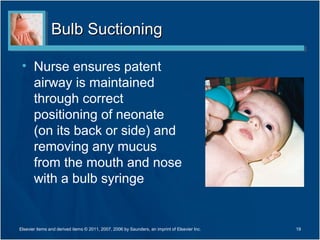
 • Nurse ensures patent
   airway is maintained
   through correct
   positioning of neonate
   (on its back or side) and
   removing any mucus
   from the mouth and nose
   with a bulb syringe


Elsevier items and derived items © 2011, 2007, 2006 by Saunders, an imprint of Elsevier Inc.   19
Apgar Score
• Standardized method of                                                       • Nurse monitors for
  evaluating newborn’s                                                           respiratory distress as
  condition immediately after                                                    evidenced by
  delivery                                                                           – Rate and character of
• Five objective signs                                                                 respirations
                                                                                     – Color (cyanosis)
  measured
                                                                                     – General behavior
    –     Heart rate
    –     Respiration                                                          • Sternal retractions must
    –     Muscle tone                                                            be reported immediately
    –     Reflexes                                                               to the health care
    –     Color                                                                  provider
• Score is obtained at 1 and 5
  minutes after birth
 Elsevier items and derived items © 2011, 2007, 2006 by Saunders, an imprint of Elsevier Inc.                  20
Circulatory System

 • Has approximately 300 mL of • If the ducts fail to close
   circulating blood volume      when they are
 • Neonatal circulation differs  supposed to, the
                                 neonate may become
   from fetal circulation
                                 cyanotic because the
 • Dependent upon ducts within
                                 blood bypasses the
   the heart to close at certain lungs and does not
   points in time, such as       pick up any oxygen
       – Foramen ovale
       – Ductus arteriosus


Elsevier items and derived items © 2011, 2007, 2006 by Saunders, an imprint of Elsevier Inc.   21
Providing Warmth

• Unstable heat-regulating system
• Acrocyanosis is evident because of sluggish
  peripheral circulation
• Cannot adapt to change in temperatures
  easily
• Sweat glands do not function during neonatal
  period, so infant is at risk for developing
  elevated temperature if overdressed or
  placed in overheated environment
Elsevier items and derived items © 2011, 2007, 2006 by Saunders, an imprint of Elsevier Inc.   22
Obtaining Temperature, Pulse
                Rate, and Respirations
• Temperature: can be                                                  • The nurse should report
  taken rectally or in                                                       – Temperature elevations
  the axilla                                                                   >99.8° F or <97.1° F
• Pulse and                                                                  – Pulse rates >160 or
                                                                               <110 beats/min
  respiratory rates:
                                                                             – Respirations >60 or
  count before taking
                                                                               <30 breaths/min
  temperature as
                                                                             – Noisy respirations
  infant may cry when
                                                                             – Nasal flaring or chest
  disturbed
                                                                               retraction


Elsevier items and derived items © 2011, 2007, 2006 by Saunders, an imprint of Elsevier Inc.            23
Maintaining Body Temperature of
                the Newborn


Elsevier items and derived items © 2011, 2007, 2006 by Saunders, an imprint of Elsevier Inc.   24
Musculoskeletal System

• Skeleton is flexible
• Movements are random and uncoordinated
• Development of muscle control proceeds
  from head to foot and from the center of the
  body to the periphery
• Head and neck muscles are the first ones
  under control


Elsevier items and derived items © 2011, 2007, 2006 by Saunders, an imprint of Elsevier Inc.   25
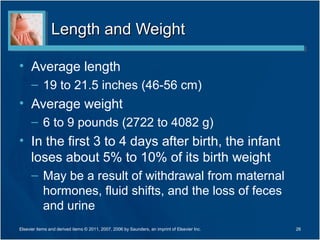
Length and Weight

• Average length
      – 19 to 21.5 inches (46-56 cm)
• Average weight
      – 6 to 9 pounds (2722 to 4082 g)
• In the first 3 to 4 days after birth, the infant
  loses about 5% to 10% of its birth weight
      – May be a result of withdrawal from maternal
        hormones, fluid shifts, and the loss of feces
        and urine
Elsevier items and derived items © 2011, 2007, 2006 by Saunders, an imprint of Elsevier Inc.   26
Genitourinary System

• Kidneys not fully developed at birth
      – Glomeruli are small
      – Renal blood flow is about a third of an adult
      – Ability to handle a water load is reduced
      – Renal tubules are short and have limited capacity for
        reabsorbing important substances
      – Decreased ability to concentrate urine and cope with
        fluid imbalances
• Important for nurse to note first void
• Newborn has about 6 wet diapers per day
Elsevier items and derived items © 2011, 2007, 2006 by Saunders, an imprint of Elsevier Inc.   27
Male Genitalia

• Testes descend into scrotum before birth
• Location of the urethral opening should be on
  the tip of the penis
• A white cheesy substance (smegma) is found
  under the foreskin
• Some parents may choose to have their child
  circumcised while others may not
      – Whatever their decision, proper care of the
        male genitalia must be taught to the parents
Elsevier items and derived items © 2011, 2007, 2006 by Saunders, an imprint of Elsevier Inc.   28
Female Genitalia

• May be slightly swollen
• Thin white or blood-tinged mucus may be
  discharged from the vagina
  (pseudomenstruation) caused by hormonal
  withdrawal from the mother
• Cleanse the vulva from the urethra to the
  anus to prevent fecal matter from entering the
  urinary meatus, leading to UTI


Elsevier items and derived items © 2011, 2007, 2006 by Saunders, an imprint of Elsevier Inc.   29
Integumentary System

• Assess turgor and overall skin condition
      – Usually covered with fine hair called lanugo
        (disappears within a week of birth)
      – Covered in vernix caseosa—made of cells and
        glandular secretions; thought to protect skin
        from irritation and effects of a watery
        environment
      – Physiological jaundice (icterus neonatorum)
        seen as a yellow tinge to the skin; caused by
        the rapid destruction of excess red blood cells
Elsevier items and derived items © 2011, 2007, 2006 by Saunders, an imprint of Elsevier Inc.   30
Safety Alert

• Jaundice that appears in the first day of life is
  not normal and should be recorded and
  reported


Elsevier items and derived items © 2011, 2007, 2006 by Saunders, an imprint of Elsevier Inc.   31
Gastrointestinal System

• Normal functions begin shortly after birth
• Meconium, the first stool, is a mixture of
  amniotic fluid and intestinal gland secretions
• Sticky, greenish black, thick, and passed 8 to
  24 hours after birth
• Stool color and consistency change over time
• Color, amount, and consistency are
  somewhat dependent upon what the infant is
  fed (breast milk versus formula)
Elsevier items and derived items © 2011, 2007, 2006 by Saunders, an imprint of Elsevier Inc.   32
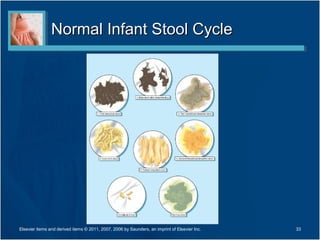
Normal Infant Stool Cycle


Elsevier items and derived items © 2011, 2007, 2006 by Saunders, an imprint of Elsevier Inc.   33
Gastrointestinal System Upsets

• Constipation
• Hiccoughs
• Digestion


Elsevier items and derived items © 2011, 2007, 2006 by Saunders, an imprint of Elsevier Inc.   34
Preventing Infections

• Newborn’s response to inflammation and
  infection is slow because of the immaturity of
  the immune system
• Umbilical cord stump primary site of infection
  if not kept clean
• Hand hygiene is the primary means of
  preventing infection and/or its spread


Elsevier items and derived items © 2011, 2007, 2006 by Saunders, an imprint of Elsevier Inc.   35
Immunoglobulin G (IgG)

• Crosses the placenta and provides newborn
  with passive immunity
• Rarely lasts longer than 3 months


Elsevier items and derived items © 2011, 2007, 2006 by Saunders, an imprint of Elsevier Inc.   36
Immunoglobulin M (IgM)

• Produced by the newborn
• Elevated level suggests serious infection


Elsevier items and derived items © 2011, 2007, 2006 by Saunders, an imprint of Elsevier Inc.   37
Immunoglobulin A (IgA)

• Produced after neonatal period (about 1
  month) ends
• Contained in breast milk
• Provides some resistance to respiratory and
  gastrointestinal infection
      – Before age 1 month, infants are at risk for
        such infections


Elsevier items and derived items © 2011, 2007, 2006 by Saunders, an imprint of Elsevier Inc.   38
Discharge Planning

• Begins upon admission of the laboring mother
• Areas may include
      –     Basic infant care
      –     Safety measures
      –     Immunizations
      –     Return appointments
      –     Proper use of a car seat
      –     Signs and symptoms of problems and who to
            contact
Elsevier items and derived items © 2011, 2007, 2006 by Saunders, an imprint of Elsevier Inc.   39
Home Care

•     Feeding
•     Furnishings
•     Clothing
•     Skin care


Elsevier items and derived items © 2011, 2007, 2006 by Saunders, an imprint of Elsevier Inc.   40
Question for Review

• When is the Apgar score assessed and what
  does it mean?


Elsevier items and derived items © 2011, 2007, 2006 by Saunders, an imprint of Elsevier Inc.   41
Review

•     Objectives
•     Key Terms
•     Key Points
•     Online Resources
•     Critical Thinking Question
•     Review Question


Elsevier items and derived items © 2011, 2007, 2006 by Saunders, an imprint of Elsevier Inc.   42

Chapter 012 lo

  • 1.
  • 2.
    Objectives • Briefly describethree normal reflexes of the neonate, including the approximate age of their disappearance. • Demonstrate the steps in the physical assessment of the newborn. • State four methods of maintaining the body temperature of a newborn. • State the cause and appearance of physiological jaundice in the newborn. Elsevier items and derived items © 2011, 2007, 2006 by Saunders, an imprint of Elsevier Inc. 2
  • 3.
    Objectives (cont.) • Definethe following skin manifestations in the newborn: lanugo, vernix caseosa, Mongolian spots, milia, acrocyanosis, desquamation. • State the methods of preventing infection in newborns. • Interpret discharge teaching for the mother and her newborn. Elsevier items and derived items © 2011, 2007, 2006 by Saunders, an imprint of Elsevier Inc. 3
  • 4.
    Adjustment to LifeOutside the Uterus • Adjustment is dependent upon – Genetic background – Health of the recent uterine environment – A safe delivery – Care during the first month of life Elsevier items and derived items © 2011, 2007, 2006 by Saunders, an imprint of Elsevier Inc. 4
  • 5.
    Adjustment to LifeOutside the Uterus (cont.) • Respirations stimulated due to chilling and chemical changes in the blood – Sensory and physical stimuli – First breath opens alveoli – Independent air exchange begins • Initiates cardiopulmonary interdependence Elsevier items and derived items © 2011, 2007, 2006 by Saunders, an imprint of Elsevier Inc. 5
  • 6.
    Adjustment to LifeOutside the Uterus (cont.) • Ability to metabolize food hampered by immaturity of digestive system (deficient in enzymes from pancreas and liver) • Kidney’s ability to concentrate urine and maintain fluid balance is limited due to decreased rate of glomerular flow and limited renal tubular reabsorption • Neurological functions are primitive Elsevier items and derived items © 2011, 2007, 2006 by Saunders, an imprint of Elsevier Inc. 6
  • 7.
    Physical Characteristics Elsevier itemsand derived items © 2011, 2007, 2006 by Saunders, an imprint of Elsevier Inc. 7
  • 8.
    Nervous System: Reflexes • Moves arms and legs vigorously but cannot control them • Full-term infants are born with the following reflexes (which help keep them alive) – Blinking – Sneezing – Gagging – Sucking – Grasping • They can also cry, swallow, and lift their head (slightly) when lying on their abdomen Elsevier items and derived items © 2011, 2007, 2006 by Saunders, an imprint of Elsevier Inc. 8
  • 9.
    Reflexes • Moro • Rooting • Tonic neck • Dancing Elsevier items and derived items © 2011, 2007, 2006 by Saunders, an imprint of Elsevier Inc. 9
  • 10.
    Head • Molding fromdelivery process – May have swelling of the soft tissues of the scalp, called caput succedaneum – May see a cephalhematoma—a collection of blood beneath the periosteum of the cranial bone • Does not cross the suture line • Fontanels (soft spots) protect the head during delivery and allow further brain growth Elsevier items and derived items © 2011, 2007, 2006 by Saunders, an imprint of Elsevier Inc. 10
  • 11.
    Visual Stimuli andSensory Overload • Can see and fixate on points of contrast – Toys with contrasting colors or those that make noise attract the newborn’s attention • Tears are absent until 1 to 3 months of age • Sensory overload can occur if there is too much detrimental stimulation • Important for the nurse to keep surrounding environment as calm and quiet as possible, no bright lighting or loud alarms Elsevier items and derived items © 2011, 2007, 2006 by Saunders, an imprint of Elsevier Inc. 11
  • 12.
    Hearing • Ears well-developed,but small • Hearing ability present at birth (sick or premature newborn may not respond to sounds) • Normal drainage and sneezing occurs after birth to rid ear canals of amniotic fluid • May react to sudden sounds by increased pulse or respiratory rate or startle reflex • Responds to voices by decreasing motor activity, sucking activity, and turning head toward the sound • Hearing screening performed before discharge Elsevier items and derived items © 2011, 2007, 2006 by Saunders, an imprint of Elsevier Inc. 12
  • 13.
    Sleep • 15to 20 hours per day • Specific pattern of • Phases of sleep-wake reactivity that can influence the response cycle to stimuli and bonding – First reactive – Quiet sleep – Sleep – Rapid eye movement – Second reactive (REM) sleep – Stability – Active alert – Quiet alert – Crying – Transitional Elsevier items and derived items © 2011, 2007, 2006 by Saunders, an imprint of Elsevier Inc. 13
  • 14.
    Pain • Produces catecholaminesand cortisol – Heart and respiratory rates change – Blood pressure increases as does blood glucose levels • Untreated pain can have long-term effects – Pain pathways and structures required for long-term memory are well developed by 24 weeks gestation • Unrelieved pain can cause exhaustion, irritability, and delay the healing process Elsevier items and derived items © 2011, 2007, 2006 by Saunders, an imprint of Elsevier Inc. 14
  • 15.
    Pain Assessment Tools • COMFORT • CRIES • FLACC • PIPP • NIPS • NPASS Elsevier items and derived items © 2011, 2007, 2006 by Saunders, an imprint of Elsevier Inc. 15
  • 16.
    Conditioned Responses • Aresponse of reflex that is learned over time • Example is a hungry infant stops crying when it hears its mother’s voice, even though food is not available • Emotions particularly subject to this type of conditioning Elsevier items and derived items © 2011, 2007, 2006 by Saunders, an imprint of Elsevier Inc. 16
  • 17.
    Neonatal Behavioral Assessment Scale • Measures inherent neurological capacities and response to selected stimuli • Areas tested include – Alertness – Response to visual and auditory stimuli – Motor coordination – Level of excitement – Organizational process in response to stress Elsevier items and derived items © 2011, 2007, 2006 by Saunders, an imprint of Elsevier Inc. 17
  • 18.
    Respiratory System • Onceumbilical cord is clamped and cut, the lungs take on the function of breathing oxygen and removing carbon dioxide – First breath helps to expand the collapsed lungs – Full expansion does not occur for several days • Most critical period is the first hour of life • Newborn should be position on the back or side to help maintain a patent airway Elsevier items and derived items © 2011, 2007, 2006 by Saunders, an imprint of Elsevier Inc. 18
  • 19.
    Bulb Suctioning •Nurse ensures patent airway is maintained through correct positioning of neonate (on its back or side) and removing any mucus from the mouth and nose with a bulb syringe Elsevier items and derived items © 2011, 2007, 2006 by Saunders, an imprint of Elsevier Inc. 19
  • 20.
    Apgar Score • Standardizedmethod of • Nurse monitors for evaluating newborn’s respiratory distress as condition immediately after evidenced by delivery – Rate and character of • Five objective signs respirations – Color (cyanosis) measured – General behavior – Heart rate – Respiration • Sternal retractions must – Muscle tone be reported immediately – Reflexes to the health care – Color provider • Score is obtained at 1 and 5 minutes after birth Elsevier items and derived items © 2011, 2007, 2006 by Saunders, an imprint of Elsevier Inc. 20
  • 21.
    Circulatory System •Has approximately 300 mL of • If the ducts fail to close circulating blood volume when they are • Neonatal circulation differs supposed to, the neonate may become from fetal circulation cyanotic because the • Dependent upon ducts within blood bypasses the the heart to close at certain lungs and does not points in time, such as pick up any oxygen – Foramen ovale – Ductus arteriosus Elsevier items and derived items © 2011, 2007, 2006 by Saunders, an imprint of Elsevier Inc. 21
  • 22.
    Providing Warmth • Unstableheat-regulating system • Acrocyanosis is evident because of sluggish peripheral circulation • Cannot adapt to change in temperatures easily • Sweat glands do not function during neonatal period, so infant is at risk for developing elevated temperature if overdressed or placed in overheated environment Elsevier items and derived items © 2011, 2007, 2006 by Saunders, an imprint of Elsevier Inc. 22
  • 23.
    Obtaining Temperature, Pulse Rate, and Respirations • Temperature: can be • The nurse should report taken rectally or in – Temperature elevations the axilla >99.8° F or <97.1° F • Pulse and – Pulse rates >160 or <110 beats/min respiratory rates: – Respirations >60 or count before taking <30 breaths/min temperature as – Noisy respirations infant may cry when – Nasal flaring or chest disturbed retraction Elsevier items and derived items © 2011, 2007, 2006 by Saunders, an imprint of Elsevier Inc. 23
  • 24.
    Maintaining Body Temperatureof the Newborn Elsevier items and derived items © 2011, 2007, 2006 by Saunders, an imprint of Elsevier Inc. 24
  • 25.
    Musculoskeletal System • Skeletonis flexible • Movements are random and uncoordinated • Development of muscle control proceeds from head to foot and from the center of the body to the periphery • Head and neck muscles are the first ones under control Elsevier items and derived items © 2011, 2007, 2006 by Saunders, an imprint of Elsevier Inc. 25
  • 26.
    Length and Weight •Average length – 19 to 21.5 inches (46-56 cm) • Average weight – 6 to 9 pounds (2722 to 4082 g) • In the first 3 to 4 days after birth, the infant loses about 5% to 10% of its birth weight – May be a result of withdrawal from maternal hormones, fluid shifts, and the loss of feces and urine Elsevier items and derived items © 2011, 2007, 2006 by Saunders, an imprint of Elsevier Inc. 26
  • 27.
    Genitourinary System • Kidneysnot fully developed at birth – Glomeruli are small – Renal blood flow is about a third of an adult – Ability to handle a water load is reduced – Renal tubules are short and have limited capacity for reabsorbing important substances – Decreased ability to concentrate urine and cope with fluid imbalances • Important for nurse to note first void • Newborn has about 6 wet diapers per day Elsevier items and derived items © 2011, 2007, 2006 by Saunders, an imprint of Elsevier Inc. 27
  • 28.
    Male Genitalia • Testesdescend into scrotum before birth • Location of the urethral opening should be on the tip of the penis • A white cheesy substance (smegma) is found under the foreskin • Some parents may choose to have their child circumcised while others may not – Whatever their decision, proper care of the male genitalia must be taught to the parents Elsevier items and derived items © 2011, 2007, 2006 by Saunders, an imprint of Elsevier Inc. 28
  • 29.
    Female Genitalia • Maybe slightly swollen • Thin white or blood-tinged mucus may be discharged from the vagina (pseudomenstruation) caused by hormonal withdrawal from the mother • Cleanse the vulva from the urethra to the anus to prevent fecal matter from entering the urinary meatus, leading to UTI Elsevier items and derived items © 2011, 2007, 2006 by Saunders, an imprint of Elsevier Inc. 29
  • 30.
    Integumentary System • Assessturgor and overall skin condition – Usually covered with fine hair called lanugo (disappears within a week of birth) – Covered in vernix caseosa—made of cells and glandular secretions; thought to protect skin from irritation and effects of a watery environment – Physiological jaundice (icterus neonatorum) seen as a yellow tinge to the skin; caused by the rapid destruction of excess red blood cells Elsevier items and derived items © 2011, 2007, 2006 by Saunders, an imprint of Elsevier Inc. 30
  • 31.
    Safety Alert • Jaundicethat appears in the first day of life is not normal and should be recorded and reported Elsevier items and derived items © 2011, 2007, 2006 by Saunders, an imprint of Elsevier Inc. 31
  • 32.
    Gastrointestinal System • Normalfunctions begin shortly after birth • Meconium, the first stool, is a mixture of amniotic fluid and intestinal gland secretions • Sticky, greenish black, thick, and passed 8 to 24 hours after birth • Stool color and consistency change over time • Color, amount, and consistency are somewhat dependent upon what the infant is fed (breast milk versus formula) Elsevier items and derived items © 2011, 2007, 2006 by Saunders, an imprint of Elsevier Inc. 32
  • 33.
    Normal Infant StoolCycle Elsevier items and derived items © 2011, 2007, 2006 by Saunders, an imprint of Elsevier Inc. 33
  • 34.
    Gastrointestinal System Upsets •Constipation • Hiccoughs • Digestion Elsevier items and derived items © 2011, 2007, 2006 by Saunders, an imprint of Elsevier Inc. 34
  • 35.
    Preventing Infections • Newborn’sresponse to inflammation and infection is slow because of the immaturity of the immune system • Umbilical cord stump primary site of infection if not kept clean • Hand hygiene is the primary means of preventing infection and/or its spread Elsevier items and derived items © 2011, 2007, 2006 by Saunders, an imprint of Elsevier Inc. 35
  • 36.
    Immunoglobulin G (IgG) •Crosses the placenta and provides newborn with passive immunity • Rarely lasts longer than 3 months Elsevier items and derived items © 2011, 2007, 2006 by Saunders, an imprint of Elsevier Inc. 36
  • 37.
    Immunoglobulin M (IgM) •Produced by the newborn • Elevated level suggests serious infection Elsevier items and derived items © 2011, 2007, 2006 by Saunders, an imprint of Elsevier Inc. 37
  • 38.
    Immunoglobulin A (IgA) •Produced after neonatal period (about 1 month) ends • Contained in breast milk • Provides some resistance to respiratory and gastrointestinal infection – Before age 1 month, infants are at risk for such infections Elsevier items and derived items © 2011, 2007, 2006 by Saunders, an imprint of Elsevier Inc. 38
  • 39.
    Discharge Planning • Beginsupon admission of the laboring mother • Areas may include – Basic infant care – Safety measures – Immunizations – Return appointments – Proper use of a car seat – Signs and symptoms of problems and who to contact Elsevier items and derived items © 2011, 2007, 2006 by Saunders, an imprint of Elsevier Inc. 39
  • 40.
    Home Care • Feeding • Furnishings • Clothing • Skin care Elsevier items and derived items © 2011, 2007, 2006 by Saunders, an imprint of Elsevier Inc. 40
  • 41.
    Question for Review •When is the Apgar score assessed and what does it mean? Elsevier items and derived items © 2011, 2007, 2006 by Saunders, an imprint of Elsevier Inc. 41
  • 42.
    Review • Objectives • Key Terms • Key Points • Online Resources • Critical Thinking Question • Review Question Elsevier items and derived items © 2011, 2007, 2006 by Saunders, an imprint of Elsevier Inc. 42

Editor's Notes

  • #5 Discuss how genetic background affects the newborn’s adjustment to life. Discuss the effects of prenatal care, labor, and delivery on the newborn.
  • #6 What is the nurse’s role in providing sensory and physical stimuli to assist the newborn in breathing?
  • #9 Describe each of the reflexes listed.
  • #10 Describe each reflex. What is the nurse’s role in assessing the newborn’s reflexes?
  • #11 Refer to Figure 12-5 on page 284 and discuss caput succedaneum and cephalhematoma. Why is the newborn’s head circumference measured?
  • #14 Describe each phase of the sleep-wake cycle. Discuss each of the patterns of reactivity listed.
  • #15 What is the nurse’s role in assessing pain in the newborn?
  • #16 Discuss the CRIES 10-point scale, the PIPP profile, the NIPS scale, and the NPASS scale.
  • #17 What are some examples of conditioned responses?
  • #18 How can this scale help new parents?
  • #19 What is the nurse’s role in maintaining a patent airway in the newborn?
  • #20 Describe proper suctioning with a bulb syringe.
  • #21 Give an example of how to measure the Apgar score. What are the implications of sternal retractions and the nurse’s role in managing this urgent situation? Audience Response Question #1 An Apgar score of 5 at 5 minutes indicates the neonate is in: 1. Good condition 2. Fair condition 3. Poor condition 4. Critical condition
  • #22 Discuss the difference between neonatal circulation from that of a fetus. Describe the location and pathophysiology of the foramen ovale and ductus arteriosus.
  • #23 How can you ensure the newborn is kept warm? Hands and feet are not used as a guide to determine warmth because the extremities tend to be cooler than the rest of the body.
  • #24 Discuss proper methods to count respiratory and pulse rates. How would you describe noisy respirations, nasal flaring, and chest retractions? Audience Response Question #2 A neonate&apos;s vital signs are assessed as follows: axillary temperature 96.5° F, pulse 125 bpm, respirations 44. The nurse is aware that: 1. these are within normal limits. 2. pulse is elevated. 3. respirations and temperature are normal. 4. temperature is decreased.
  • #25 What is another reason for swaddling a newborn besides temperature control?
  • #26 Audience Response Question #3 Average newborn length is19-21.5 inches. What is the average newborn weight? 1. 6 lb. - 7.5 lb. 2. 6 lb. - 9 lb 3. 7.5 lb. - 9.5 lb 4. 7 lb -10 lb
  • #27 Why is it important to weigh the newborn daily?
  • #28 Discuss the rationale regarding the importance of the first void. Why should the nurse monitor the frequency of urination?
  • #29 What instructions should be given to the parents regarding care of the genitalia?
  • #32 What causes jaundice?
  • #33 Give an example of typical documentation for a newborn’s stools.
  • #34 Discuss Figure 12-15 on page 298.
  • #35 Discuss methods to manage constipation and hiccoughs. What is the gastrocolic reflex? What vitamins are necessary for the newborn?
  • #36 What is considered proper umbilical cord care? Discuss the importance of hand hygiene.
  • #40 What information should be provided to parents in each of the areas listed?