Chapter 5

© Prentice Hall, 2002

SOCIAL
RESPONSIBILITY
AND MANAGERIAL
ETHICS
5-1
Learning Objectives
You should learn to:
– Explain the classical and socioeconomic views of
social responsibility
– List the arguments for and against business’s
being socially responsible
– Differentiate among social obligation, social
responsiveness, and social responsibility
– Explain the relationship between corporate social
responsibility and economic performance
– Describe values-based management and how it is
related to organizational culture
© Prentice Hall, 2002

5-2
Learning Objectives (cont.)
You should learn to:
– Explain what the “greening” of management is
and how organizations are “going green”
– Differentiate among the four views of ethics
– Identify the factors that affect ethical behavior
– Discuss various ways organizations can improve
the ethical behavior of their employees

© Prentice Hall, 2002

5-3
What Is Social Responsibility?
Two Opposing Views of Social Responsibility
– Classical view - management’s only social
responsibility is to maximize profits
• Milton Friedman - managers’ primary
responsibility is to serve the interests of the
stockholders
– doing “social good” adds to the cost of
doing business
– costs have to be passed on to consumers
© Prentice Hall, 2002

5-4
What is Social Responsibility (cont.)
Two Opposing Views of Social Responsibility (cont.)
– Socioeconomic view - businesses are not just economic
institutions
• management’s social responsibility goes beyond
making profits to include protecting and improving
society’s welfare
• businesses have responsibility to a society that:
– endorses their creation through laws and
regulations
– supports them by buying their products/services
• more organizations around the world have increased
their social responsibility

© Prentice Hall, 2002

5-5
What Is Social Responsibility (cont.)
From Obligations to Responsiveness
– social responsibility - a business’s obligation to pursue
long-term goals that help society
• goes beyond legal and economic requirements
• views business as a moral agent
– social obligation - obligation of a business to meet its
economic and legal responsibilities
• pursues social goals only when they contribute to
economic goals
– social responsiveness - capacity of a firm to adapt to
changing societal conditions
• tries to satisfy social needs in line with social norms
© Prentice Hall, 2002

5-6
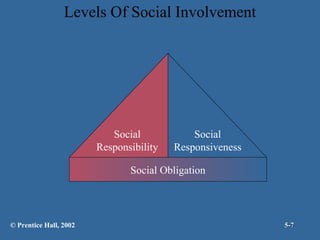
Levels Of Social Involvement

Social
Responsibility

Social
Responsiveness

Social Obligation

© Prentice Hall, 2002

5-7
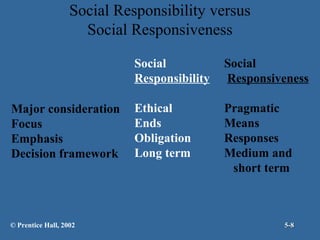
Social Responsibility versus
Social Responsiveness
Social
Responsibility
Major consideration
Focus
Emphasis
Decision framework

© Prentice Hall, 2002

Social
Responsiveness

Ethical
Ends
Obligation
Long term

Pragmatic
Means
Responses
Medium and
short term

5-8
Social Responsibility And Economic Performance
Most Research Shows a Positive Relationship
– methodological questions associated with trying to
measure “social responsibility” and “economic
performance”
– issue of causation

Evaluation of Socially Conscious Mutual Stock Funds
– social screening - applying social criteria to investment
• these funds often outperform the market average

Conclusion
– a company’s socially responsible actions do not hurt its
long-term economic performance
© Prentice Hall, 2002

5-9
Values-Based Management
Definition
– an approach to managing in which managers establish,
promote, and practice an organization’s shared values
• values reflect what it stands for and what it believes in

Purposes of Shared Values
– act as guideposts for managerial decisions and actions
• shape employee behavior by communicating what the
organization expects of its members
– influence marketing efforts
– build team spirit
• inspire greater commitment to work and responsibility
© Prentice Hall, 2002

5-10
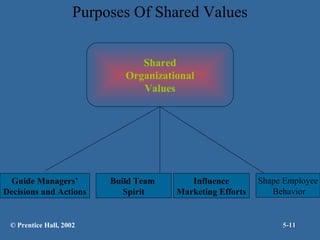
Purposes Of Shared Values
Shared
Organizational
Values

Guide Managers’
Decisions and Actions

© Prentice Hall, 2002

Build Team
Spirit

Influence
Marketing Efforts

Shape Employee
Behavior

5-11
Values-Based Management (cont.)
Developing Shared Values
– it is difficult to establish shared values
– managers are responsible for shaping the
organization so that its values, norms, and ideals
appeal strongly to employees
– companies that practice values-based
management have broad commitment to being
socially responsible and socially responsive

© Prentice Hall, 2002

5-12
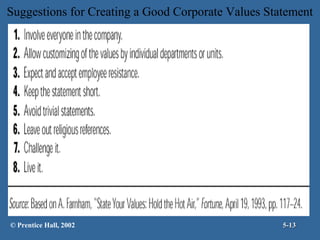
Suggestions for Creating a Good Corporate Values Statement

© Prentice Hall, 2002

5-13
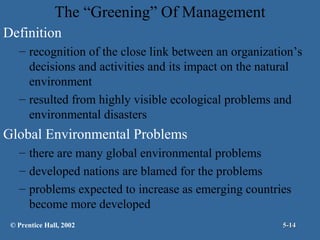
The “Greening” Of Management
Definition
– recognition of the close link between an organization’s
decisions and activities and its impact on the natural
environment
– resulted from highly visible ecological problems and
environmental disasters

Global Environmental Problems
– there are many global environmental problems
– developed nations are blamed for the problems
– problems expected to increase as emerging countries
become more developed
© Prentice Hall, 2002

5-14
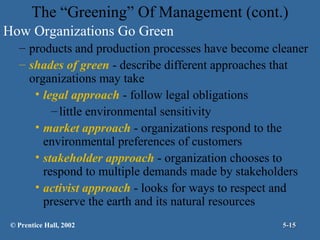
The “Greening” Of Management (cont.)
How Organizations Go Green
– products and production processes have become cleaner
– shades of green - describe different approaches that
organizations may take
• legal approach - follow legal obligations
– little environmental sensitivity
• market approach - organizations respond to the
environmental preferences of customers
• stakeholder approach - organization chooses to
respond to multiple demands made by stakeholders
• activist approach - looks for ways to respect and
preserve the earth and its natural resources
© Prentice Hall, 2002

5-15
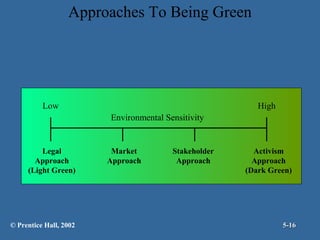
Approaches To Being Green

Low

High
Environmental Sensitivity

Legal
Approach
(Light Green)

© Prentice Hall, 2002

Market
Approach

Stakeholder
Approach

Activism
Approach
(Dark Green)

5-16
The “Greening” Of Management (cont.)
Summing Up Social Responsibility
– four-stage progression of an organization’s social
responsibility
• each stage implies an increasing level of managerial
discretion
• Stage 1 - promote stockholders’ interests by seeking
to minimize costs and maximize profits
– all laws and regulations are followed
– feel little obligation to satisfy other societal needs
• Stage 2 - managers accept their responsibility to
employees and focus on human resource concerns
– improve working conditions
© Prentice Hall, 2002

5-17
The “Greening” Of Management (cont.)
Summing Up Social Responsibility (cont.)
– four-stage progression (cont.)
• Stage 3 - expand responsibilities to other stakeholders
– actions include providing fair prices, high-quality
products and services, safe products, and good
supplier relations
• Stage 4 - managers feel responsibility to society as a
whole
– try to advance the public good
– promote social justice, preserve the environment,
and support social and cultural activities
© Prentice Hall, 2002

5-18
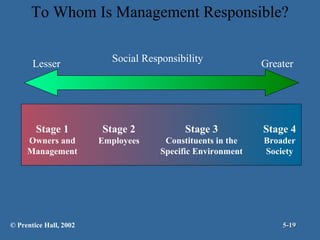
To Whom Is Management Responsible?
Lesser

Social Responsibility

Greater

Stage 1

Stage 2

Stage 3

Stage 4

Owners and
Management

Employees

Constituents in the
Specific Environment

Broader
Society

© Prentice Hall, 2002

5-19
Managerial Ethics
Ethics
– rules and principles that define right and wrong
conduct
Four Views of Ethics
– utilitarian view - ethical decisions are made on
the basis of their outcomes or consequences
• offers the greatest good for the greatest number
• encourages efficiency and productivity
• may ignore the rights of some stakeholders
• most businesspeople subscribe to this view
© Prentice Hall, 2002

5-20
Managerial Ethics (cont.)
Four Views of Ethics (cont.)
– rights view - respects and protects individual liberties and
privileges
• may present obstacles to high productivity and
efficiency
– theory of justice view - managers impose and enforce
rules fairly and impartially
• protect the interests of stakeholders who may be
underrepresented or lack power
• encourages a sense of entitlement that might make
employees reduce risk taking, innovation, and
productivity
© Prentice Hall, 2002

5-21
Managerial Ethics (cont.)
Four Views of Ethics (cont.)
– integrative social contracts theory - decisions
should be based on empirical and normative
factors
• based on integration of two “contracts’
– general social contract - allows businesses
to operate
» defines the acceptable ground rules
– specific contract - addresses acceptable
ways of behaving in a particular community
© Prentice Hall, 2002

5-22
Managerial Ethics (cont.)
Factors That Affect Managerial Ethics
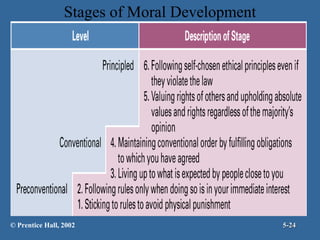
– Stage of moral development - at each successive stage,
moral judgment is less dependent on outside influences
• people proceed through the levels sequentially
• no guarantee of continued moral development
• majority of adults at Stage 4
– preconventional level - choice between right and
wrong is based on personal consequences
– conventional level - moral values reside in living
up to others’ expectations
– principled level - individual tries to define moral
principles apart from the authority of society
© Prentice Hall, 2002

5-23
Stages of Moral Development

© Prentice Hall, 2002

5-24
Managerial Ethics (cont.)
Factors That Affect Managerial Ethics (cont.)
– Individual characteristics
• values - basic convictions about right and wrong
• ego strength - strength of a person’s convictions
• locus of control - degree to which people believe that
they control their own fate
– internals - believe that they control their own
destinies
– externals - believe that what happens to them is
due to luck or chance
© Prentice Hall, 2002

5-25
Managerial Ethics (cont.)
Factors That Affect Managerial Ethics (cont.)
– Structural variables
• design of organization affects ethical behavior
– designs that minimize ambiguity and uncertainty
more likely to encourage ethical behavior
• rules and regulations
– written codes of ethics
• behavior of superiors
• performance appraisal systems that focus on means as
well as ends
• reward systems that punish failure to achieve ends is
likely to compromise ethics
© Prentice Hall, 2002

5-26
Managerial Ethics (cont.)
Factors That Affect Managerial Ethics (cont.)
– Organizational culture
• strong culture more influential than a weak
culture
• high ethical standards result from a culture that
is high in risk tolerance, control, and conflict
tolerance
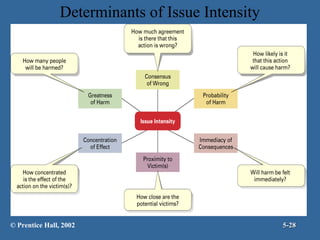
– Issue intensity
• importance of an ethical issue
• more intense issues prompt greater ethical
behavior
© Prentice Hall, 2002

5-27
Determinants of Issue Intensity

© Prentice Hall, 2002

5-28
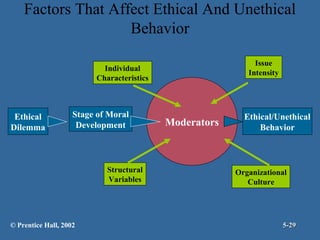
Factors That Affect Ethical And Unethical
Behavior
Issue
Intensity

Individual
Characteristics

Ethical
Dilemma

Stage of Moral
Development

Structural
Variables

© Prentice Hall, 2002

Moderators

Ethical/Unethical
Behavior

Organizational
Culture

5-29
Managerial Ethics (cont.)
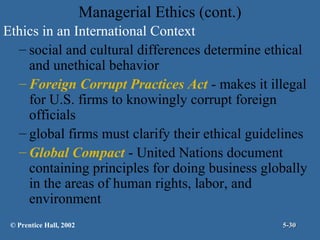
Ethics in an International Context
– social and cultural differences determine ethical
and unethical behavior
– Foreign Corrupt Practices Act - makes it illegal
for U.S. firms to knowingly corrupt foreign
officials
– global firms must clarify their ethical guidelines
– Global Compact - United Nations document
containing principles for doing business globally
in the areas of human rights, labor, and
environment
© Prentice Hall, 2002

5-30
Managerial Ethics (cont.)
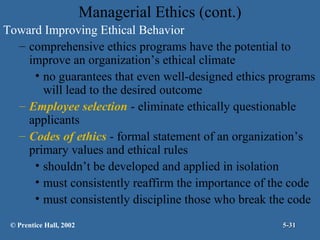
Toward Improving Ethical Behavior
– comprehensive ethics programs have the potential to
improve an organization’s ethical climate
• no guarantees that even well-designed ethics programs
will lead to the desired outcome
– Employee selection - eliminate ethically questionable
applicants
– Codes of ethics - formal statement of an organization’s
primary values and ethical rules
• shouldn’t be developed and applied in isolation
• must consistently reaffirm the importance of the code
• must consistently discipline those who break the code
© Prentice Hall, 2002

5-31
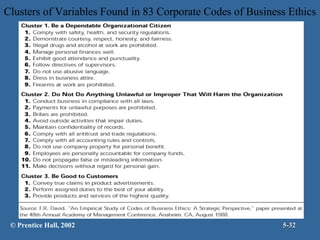
Clusters of Variables Found in 83 Corporate Codes of Business Ethics

© Prentice Hall, 2002

5-32
Managerial Ethics (cont.)
Toward Improving Ethical Behavior (cont.)
– Top management’s leadership - what they do is far more
important than what they say
• set the cultural tone by their reward and punishment
practices
– Job goals - goals should be clear and realistic
• reduce ambiguity
– Performance appraisal - must focus on ethical standards
– Ethics training - an increasing number of organizations
use training to encourage ethical behavior
• reinforce the organization’s standards of conduct
• clarify acceptable and unacceptable practices
© Prentice Hall, 2002

5-33
Managerial Ethics (cont.)
Toward Improving Ethical Behavior (cont.)
– Formal protective mechanisms - protect
employees who face ethical dilemmas
• can do what is right without fear of retribution
• ethical counselors - act as a sounding board
and provide guidance
• ethics officers - design, direct, and modify the
organization’s ethics program

© Prentice Hall, 2002

5-34

Chap05

  • 1.
    Chapter 5 © PrenticeHall, 2002 SOCIAL RESPONSIBILITY AND MANAGERIAL ETHICS 5-1
  • 2.
    Learning Objectives You shouldlearn to: – Explain the classical and socioeconomic views of social responsibility – List the arguments for and against business’s being socially responsible – Differentiate among social obligation, social responsiveness, and social responsibility – Explain the relationship between corporate social responsibility and economic performance – Describe values-based management and how it is related to organizational culture © Prentice Hall, 2002 5-2
  • 3.
    Learning Objectives (cont.) Youshould learn to: – Explain what the “greening” of management is and how organizations are “going green” – Differentiate among the four views of ethics – Identify the factors that affect ethical behavior – Discuss various ways organizations can improve the ethical behavior of their employees © Prentice Hall, 2002 5-3
  • 4.
    What Is SocialResponsibility? Two Opposing Views of Social Responsibility – Classical view - management’s only social responsibility is to maximize profits • Milton Friedman - managers’ primary responsibility is to serve the interests of the stockholders – doing “social good” adds to the cost of doing business – costs have to be passed on to consumers © Prentice Hall, 2002 5-4
  • 5.
    What is SocialResponsibility (cont.) Two Opposing Views of Social Responsibility (cont.) – Socioeconomic view - businesses are not just economic institutions • management’s social responsibility goes beyond making profits to include protecting and improving society’s welfare • businesses have responsibility to a society that: – endorses their creation through laws and regulations – supports them by buying their products/services • more organizations around the world have increased their social responsibility © Prentice Hall, 2002 5-5
  • 6.
    What Is SocialResponsibility (cont.) From Obligations to Responsiveness – social responsibility - a business’s obligation to pursue long-term goals that help society • goes beyond legal and economic requirements • views business as a moral agent – social obligation - obligation of a business to meet its economic and legal responsibilities • pursues social goals only when they contribute to economic goals – social responsiveness - capacity of a firm to adapt to changing societal conditions • tries to satisfy social needs in line with social norms © Prentice Hall, 2002 5-6
  • 7.
    Levels Of SocialInvolvement Social Responsibility Social Responsiveness Social Obligation © Prentice Hall, 2002 5-7
  • 8.
    Social Responsibility versus SocialResponsiveness Social Responsibility Major consideration Focus Emphasis Decision framework © Prentice Hall, 2002 Social Responsiveness Ethical Ends Obligation Long term Pragmatic Means Responses Medium and short term 5-8
  • 9.
    Social Responsibility AndEconomic Performance Most Research Shows a Positive Relationship – methodological questions associated with trying to measure “social responsibility” and “economic performance” – issue of causation Evaluation of Socially Conscious Mutual Stock Funds – social screening - applying social criteria to investment • these funds often outperform the market average Conclusion – a company’s socially responsible actions do not hurt its long-term economic performance © Prentice Hall, 2002 5-9
  • 10.
    Values-Based Management Definition – anapproach to managing in which managers establish, promote, and practice an organization’s shared values • values reflect what it stands for and what it believes in Purposes of Shared Values – act as guideposts for managerial decisions and actions • shape employee behavior by communicating what the organization expects of its members – influence marketing efforts – build team spirit • inspire greater commitment to work and responsibility © Prentice Hall, 2002 5-10
  • 11.
    Purposes Of SharedValues Shared Organizational Values Guide Managers’ Decisions and Actions © Prentice Hall, 2002 Build Team Spirit Influence Marketing Efforts Shape Employee Behavior 5-11
  • 12.
    Values-Based Management (cont.) DevelopingShared Values – it is difficult to establish shared values – managers are responsible for shaping the organization so that its values, norms, and ideals appeal strongly to employees – companies that practice values-based management have broad commitment to being socially responsible and socially responsive © Prentice Hall, 2002 5-12
  • 13.
    Suggestions for Creatinga Good Corporate Values Statement © Prentice Hall, 2002 5-13
  • 14.
    The “Greening” OfManagement Definition – recognition of the close link between an organization’s decisions and activities and its impact on the natural environment – resulted from highly visible ecological problems and environmental disasters Global Environmental Problems – there are many global environmental problems – developed nations are blamed for the problems – problems expected to increase as emerging countries become more developed © Prentice Hall, 2002 5-14
  • 15.
    The “Greening” OfManagement (cont.) How Organizations Go Green – products and production processes have become cleaner – shades of green - describe different approaches that organizations may take • legal approach - follow legal obligations – little environmental sensitivity • market approach - organizations respond to the environmental preferences of customers • stakeholder approach - organization chooses to respond to multiple demands made by stakeholders • activist approach - looks for ways to respect and preserve the earth and its natural resources © Prentice Hall, 2002 5-15
  • 16.
    Approaches To BeingGreen Low High Environmental Sensitivity Legal Approach (Light Green) © Prentice Hall, 2002 Market Approach Stakeholder Approach Activism Approach (Dark Green) 5-16
  • 17.
    The “Greening” OfManagement (cont.) Summing Up Social Responsibility – four-stage progression of an organization’s social responsibility • each stage implies an increasing level of managerial discretion • Stage 1 - promote stockholders’ interests by seeking to minimize costs and maximize profits – all laws and regulations are followed – feel little obligation to satisfy other societal needs • Stage 2 - managers accept their responsibility to employees and focus on human resource concerns – improve working conditions © Prentice Hall, 2002 5-17
  • 18.
    The “Greening” OfManagement (cont.) Summing Up Social Responsibility (cont.) – four-stage progression (cont.) • Stage 3 - expand responsibilities to other stakeholders – actions include providing fair prices, high-quality products and services, safe products, and good supplier relations • Stage 4 - managers feel responsibility to society as a whole – try to advance the public good – promote social justice, preserve the environment, and support social and cultural activities © Prentice Hall, 2002 5-18
  • 19.
    To Whom IsManagement Responsible? Lesser Social Responsibility Greater Stage 1 Stage 2 Stage 3 Stage 4 Owners and Management Employees Constituents in the Specific Environment Broader Society © Prentice Hall, 2002 5-19
  • 20.
    Managerial Ethics Ethics – rulesand principles that define right and wrong conduct Four Views of Ethics – utilitarian view - ethical decisions are made on the basis of their outcomes or consequences • offers the greatest good for the greatest number • encourages efficiency and productivity • may ignore the rights of some stakeholders • most businesspeople subscribe to this view © Prentice Hall, 2002 5-20
  • 21.
    Managerial Ethics (cont.) FourViews of Ethics (cont.) – rights view - respects and protects individual liberties and privileges • may present obstacles to high productivity and efficiency – theory of justice view - managers impose and enforce rules fairly and impartially • protect the interests of stakeholders who may be underrepresented or lack power • encourages a sense of entitlement that might make employees reduce risk taking, innovation, and productivity © Prentice Hall, 2002 5-21
  • 22.
    Managerial Ethics (cont.) FourViews of Ethics (cont.) – integrative social contracts theory - decisions should be based on empirical and normative factors • based on integration of two “contracts’ – general social contract - allows businesses to operate » defines the acceptable ground rules – specific contract - addresses acceptable ways of behaving in a particular community © Prentice Hall, 2002 5-22
  • 23.
    Managerial Ethics (cont.) FactorsThat Affect Managerial Ethics – Stage of moral development - at each successive stage, moral judgment is less dependent on outside influences • people proceed through the levels sequentially • no guarantee of continued moral development • majority of adults at Stage 4 – preconventional level - choice between right and wrong is based on personal consequences – conventional level - moral values reside in living up to others’ expectations – principled level - individual tries to define moral principles apart from the authority of society © Prentice Hall, 2002 5-23
  • 24.
    Stages of MoralDevelopment © Prentice Hall, 2002 5-24
  • 25.
    Managerial Ethics (cont.) FactorsThat Affect Managerial Ethics (cont.) – Individual characteristics • values - basic convictions about right and wrong • ego strength - strength of a person’s convictions • locus of control - degree to which people believe that they control their own fate – internals - believe that they control their own destinies – externals - believe that what happens to them is due to luck or chance © Prentice Hall, 2002 5-25
  • 26.
    Managerial Ethics (cont.) FactorsThat Affect Managerial Ethics (cont.) – Structural variables • design of organization affects ethical behavior – designs that minimize ambiguity and uncertainty more likely to encourage ethical behavior • rules and regulations – written codes of ethics • behavior of superiors • performance appraisal systems that focus on means as well as ends • reward systems that punish failure to achieve ends is likely to compromise ethics © Prentice Hall, 2002 5-26
  • 27.
    Managerial Ethics (cont.) FactorsThat Affect Managerial Ethics (cont.) – Organizational culture • strong culture more influential than a weak culture • high ethical standards result from a culture that is high in risk tolerance, control, and conflict tolerance – Issue intensity • importance of an ethical issue • more intense issues prompt greater ethical behavior © Prentice Hall, 2002 5-27
  • 28.
    Determinants of IssueIntensity © Prentice Hall, 2002 5-28
  • 29.
    Factors That AffectEthical And Unethical Behavior Issue Intensity Individual Characteristics Ethical Dilemma Stage of Moral Development Structural Variables © Prentice Hall, 2002 Moderators Ethical/Unethical Behavior Organizational Culture 5-29
  • 30.
    Managerial Ethics (cont.) Ethicsin an International Context – social and cultural differences determine ethical and unethical behavior – Foreign Corrupt Practices Act - makes it illegal for U.S. firms to knowingly corrupt foreign officials – global firms must clarify their ethical guidelines – Global Compact - United Nations document containing principles for doing business globally in the areas of human rights, labor, and environment © Prentice Hall, 2002 5-30
  • 31.
    Managerial Ethics (cont.) TowardImproving Ethical Behavior – comprehensive ethics programs have the potential to improve an organization’s ethical climate • no guarantees that even well-designed ethics programs will lead to the desired outcome – Employee selection - eliminate ethically questionable applicants – Codes of ethics - formal statement of an organization’s primary values and ethical rules • shouldn’t be developed and applied in isolation • must consistently reaffirm the importance of the code • must consistently discipline those who break the code © Prentice Hall, 2002 5-31
  • 32.
    Clusters of VariablesFound in 83 Corporate Codes of Business Ethics © Prentice Hall, 2002 5-32
  • 33.
    Managerial Ethics (cont.) TowardImproving Ethical Behavior (cont.) – Top management’s leadership - what they do is far more important than what they say • set the cultural tone by their reward and punishment practices – Job goals - goals should be clear and realistic • reduce ambiguity – Performance appraisal - must focus on ethical standards – Ethics training - an increasing number of organizations use training to encourage ethical behavior • reinforce the organization’s standards of conduct • clarify acceptable and unacceptable practices © Prentice Hall, 2002 5-33
  • 34.
    Managerial Ethics (cont.) TowardImproving Ethical Behavior (cont.) – Formal protective mechanisms - protect employees who face ethical dilemmas • can do what is right without fear of retribution • ethical counselors - act as a sounding board and provide guidance • ethics officers - design, direct, and modify the organization’s ethics program © Prentice Hall, 2002 5-34