Copyright © 2010 Pearson Education, Inc. Publishing as Prentice Hall 5–1
Social
Social
Responsibility and
Responsibility and
Managerial Ethics
Managerial Ethics
Chapter
Chapter
5
5
Management
Stephen P. Robbins Mary Coulter
tenth edition
Copyright © 2010 Pearson Education, Inc. Publishing as Prentice Hall 5–2
Learning Outcomes
Learning Outcomes
Follow this Learning Outline as you read and study
this chapter.
this chapter.
• 5.1 What Is Social Responsibility?
• Differentiate between social obligation, social
Differentiate between social obligation, social
responsiveness and social responsibility.
• Discuss whether organizations should be socially
Discuss whether organizations should be socially
involved.
involved.
• Describe what conclusion can be reached regarding
Describe what conclusion can be reached regarding
social involvement and economic importance.
Copyright © 2010 Pearson Education, Inc. Publishing as Prentice Hall 5–3
Learning Outcomes
Learning Outcomes
5.2 Green Management.
• Define green management.
Define green management.
• Describe how organizations can go green.
Describe how organizations can go green.
• Explain how green management can be evaluated.
Explain how green management can be evaluated.
5.3 Managers And Ethical Behavior
• Define ethics.
Define ethics.
• Discuss the factors that influence whether a person behave
Discuss the factors that influence whether a person behave
ethically or unethically.
• Describe what managers need to know about international
Describe what managers need to know about international
ethics.
ethics.
Copyright © 2010 Pearson Education, Inc. Publishing as Prentice Hall 5–4
Learning Outcomes
Learning Outcomes
5.4 Encouraging Ethical Behavior
• Describe manager’s important role in encouraging ethical
Describe manager’s important role in encouraging ethical
behavior.
behavior.
• Discuss specific ways managers can encourage ethical
Discuss specific ways managers can encourage ethical
behavior.
behavior.
5.5 Social Responsibility And Ethics Issues In Today’s
World.
• Discuss how managers can manage ethical lapses and social
Discuss how managers can manage ethical lapses and social
responsibility.
responsibility.
• Explain the role of social entrepreneurs.
Explain the role of social entrepreneurs.
• Discuss how businesses can promote positive social change.
Discuss how businesses can promote positive social change.
Copyright © 2010 Pearson Education, Inc. Publishing as Prentice Hall 5–5
Learning Outcomes
Learning Outcomes
5.5 Social Responsibility Issues In Today’s World.
• Discuss how managers and organizations can protect
Discuss how managers and organizations can protect
employees who raise ethical issues or concerns.
• Explain what role social entrepreneurs play.
Explain what role social entrepreneurs play.
• Discuss how businesses can promote positive social
Discuss how businesses can promote positive social
change.
change.
Copyright © 2010 Pearson Education, Inc. Publishing as Prentice Hall 5–6
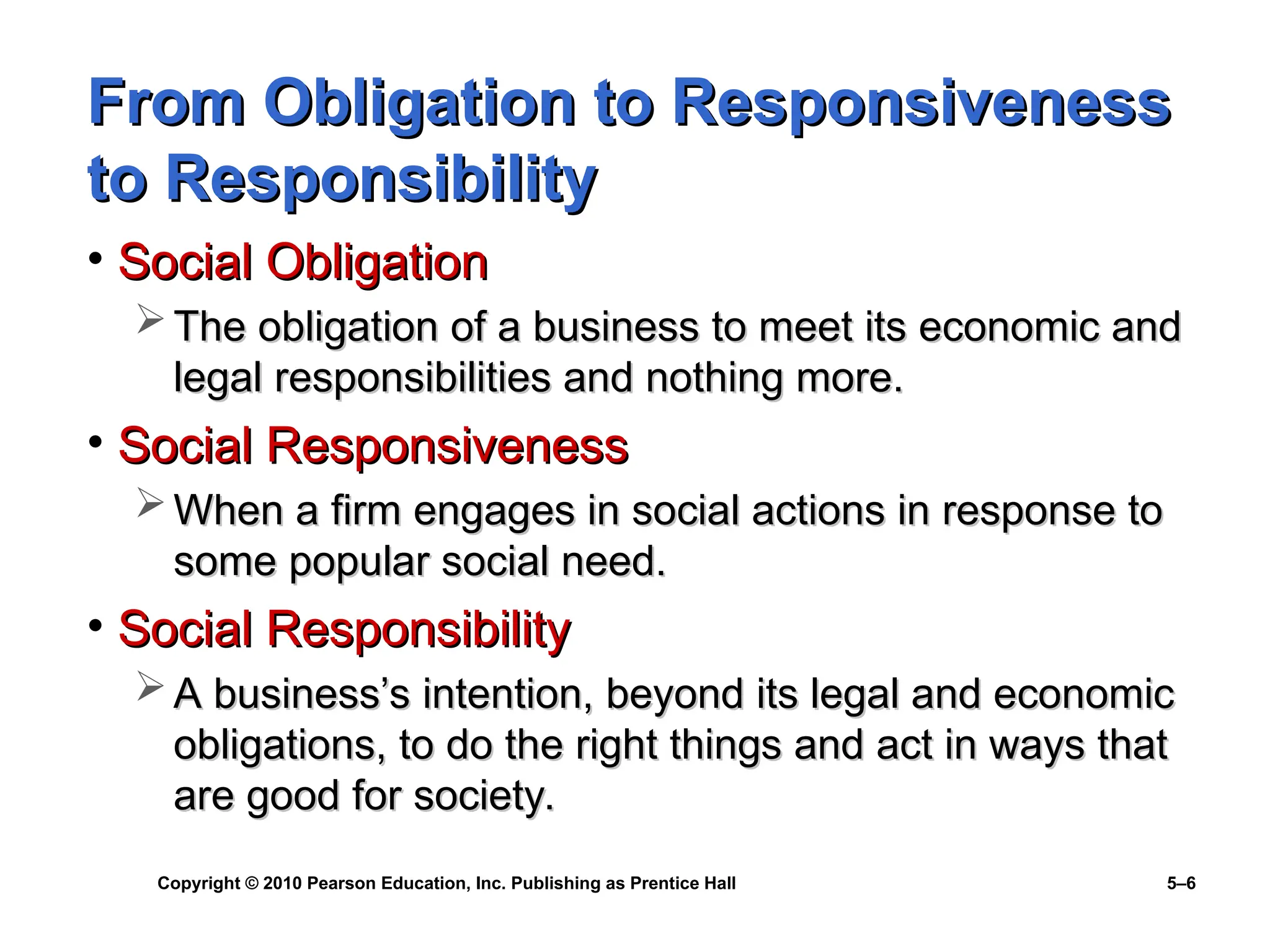
From Obligation to Responsiveness
to Responsibility
to Responsibility
• Social Obligation
Social Obligation
 The obligation of a business to meet its economic and
The obligation of a business to meet its economic and
legal responsibilities and nothing more.
• Social Responsiveness
Social Responsiveness
 When a firm engages in social actions in response to
When a firm engages in social actions in response to
some popular social need.
• Social Responsibility
Social Responsibility
 A business’s intention, beyond its legal and economic
A business’s intention, beyond its legal and economic
obligations, to do the right things and act in ways that
are good for society.
Copyright © 2010 Pearson Education, Inc. Publishing as Prentice Hall 5–7
How Organizations Go Green
• Legal (or Light Green) Approach
Legal (or Light Green) Approach
 Firms simply do what is legally required by obeying laws, rules,
Firms simply do what is legally required by obeying laws, rules,
and regulations willingly and without legal challenge.
• Market Approach
Market Approach
 Firms respond to the preferences of their customers for
Firms respond to the preferences of their customers for
environmentally friendly products.
• Stakeholder Approach
Stakeholder Approach
 Firms work to meet the environmental demands of multiple
Firms work to meet the environmental demands of multiple
stakeholders
stakeholders—
—employees, suppliers, and the community.
employees, suppliers, and the community.
• Activist Approach
Activist Approach
 Firms look for ways to respect and preserve environment and be
Firms look for ways to respect and preserve environment and be
actively socially responsible.
Copyright © 2010 Pearson Education, Inc. Publishing as Prentice Hall 5–8
Exhibit 5–4
Exhibit 5–4 Green Approaches
Green Approaches
Source: Based on R.E. Freeman. J. Pierce, and R. Dodd. Shades of Green:
Business Ethics and the Environment (New York: Oxford University Press, 1995).
Copyright © 2010 Pearson Education, Inc. Publishing as Prentice Hall 5–9
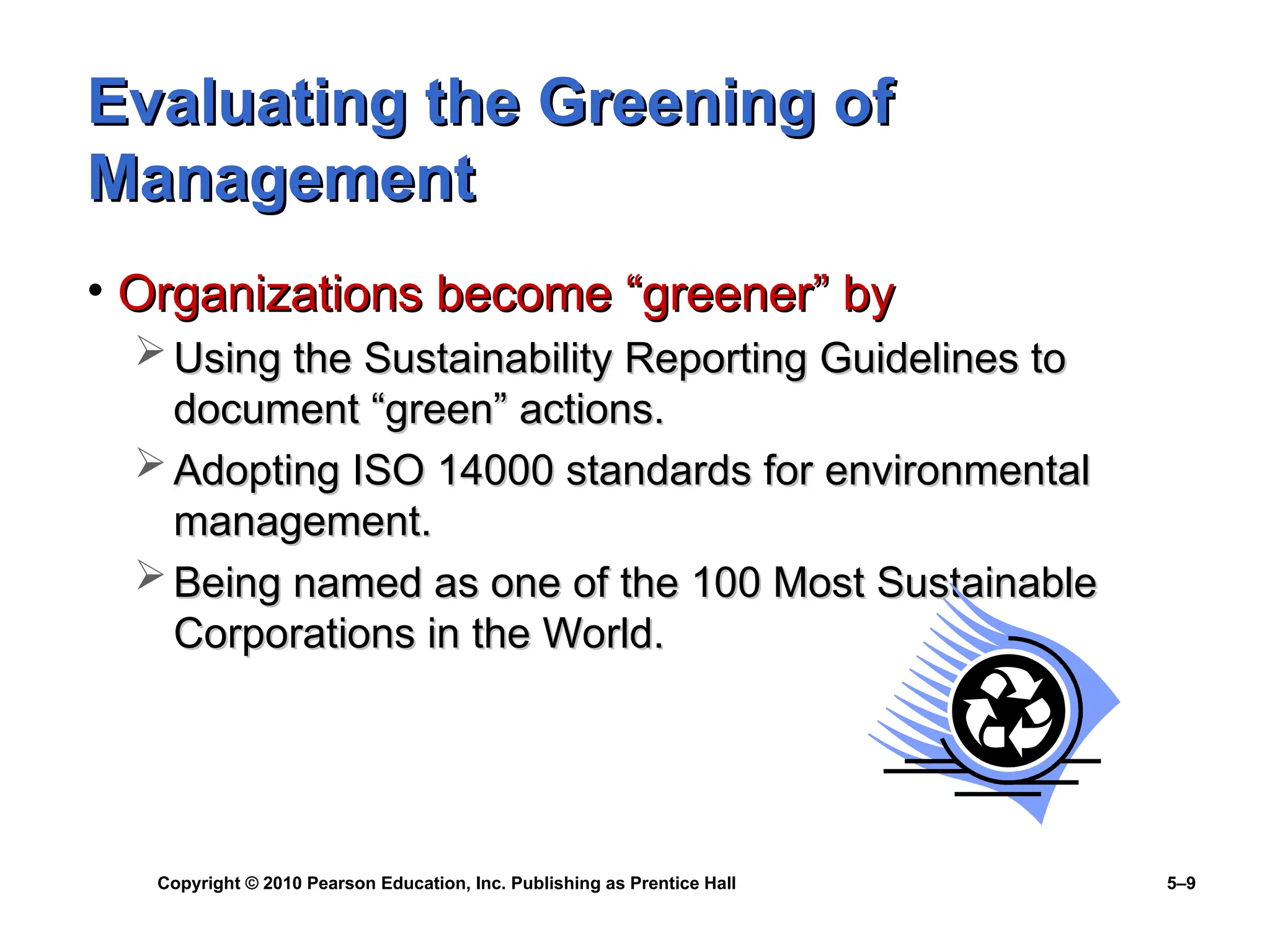
Evaluating the Greening of
Management
Management
• Organizations become “greener” by
Organizations become “greener” by
 Using the Sustainability Reporting Guidelines to
Using the Sustainability Reporting Guidelines to
document “green” actions.
 Adopting ISO 14000 standards for environmental
Adopting ISO 14000 standards for environmental
management.
management.
 Being named as one of the 100 Most Sustainable
Being named as one of the 100 Most Sustainable
Corporations in the World.
Copyright © 2010 Pearson Education, Inc. Publishing as Prentice Hall 5–10
Managerial Ethics
Managerial Ethics
Ethics Defined
Ethics Defined
 Principles, values, and beliefs that define what is right
Principles, values, and beliefs that define what is right
and wrong behavior.
and wrong behavior.
Copyright © 2010 Pearson Education, Inc. Publishing as Prentice Hall 5–11
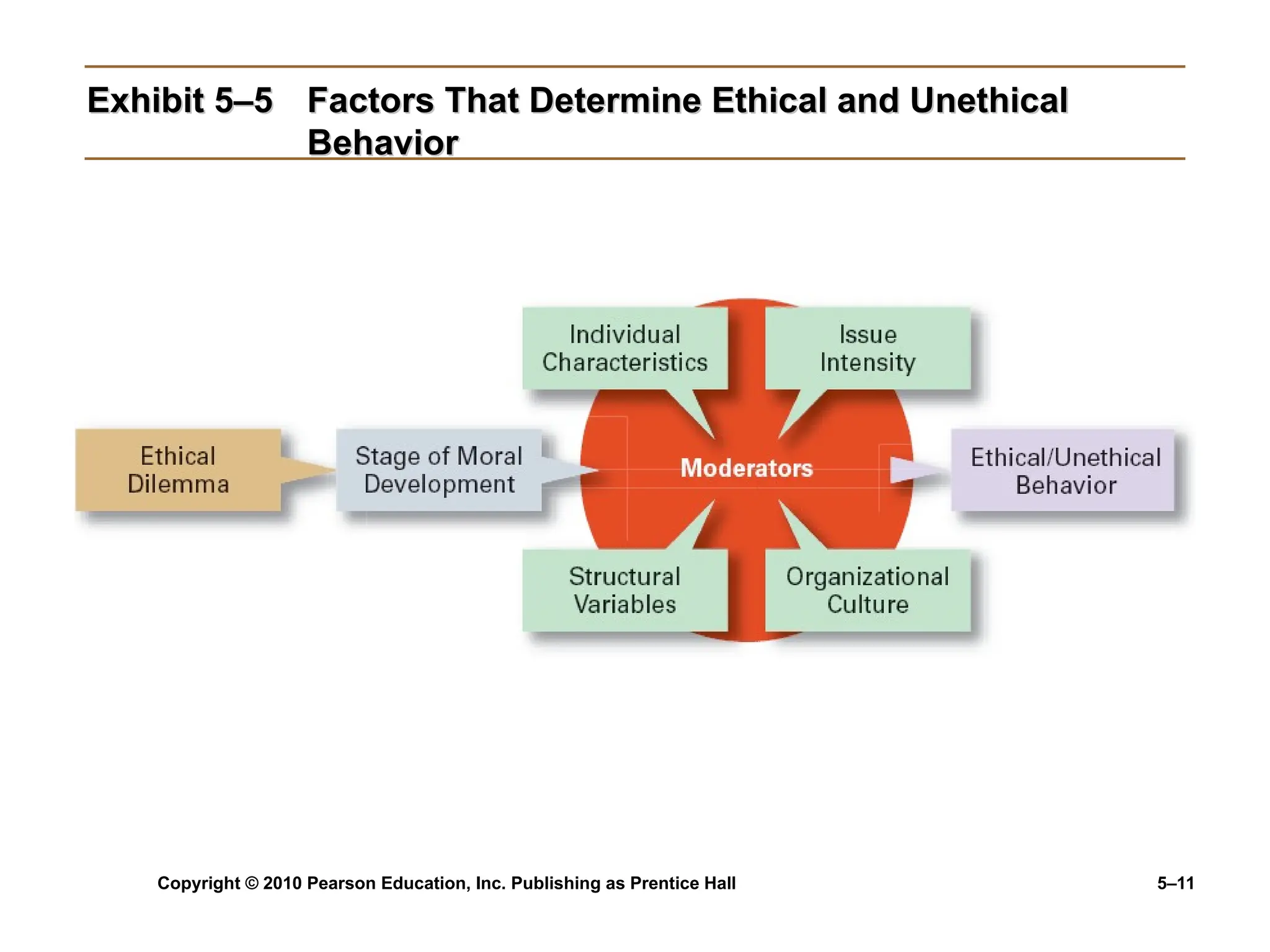
Exhibit 5–5
Exhibit 5–5 Factors That Determine Ethical and Unethical
Factors That Determine Ethical and Unethical
Behavior
Behavior
Copyright © 2010 Pearson Education, Inc. Publishing as Prentice Hall 5–12
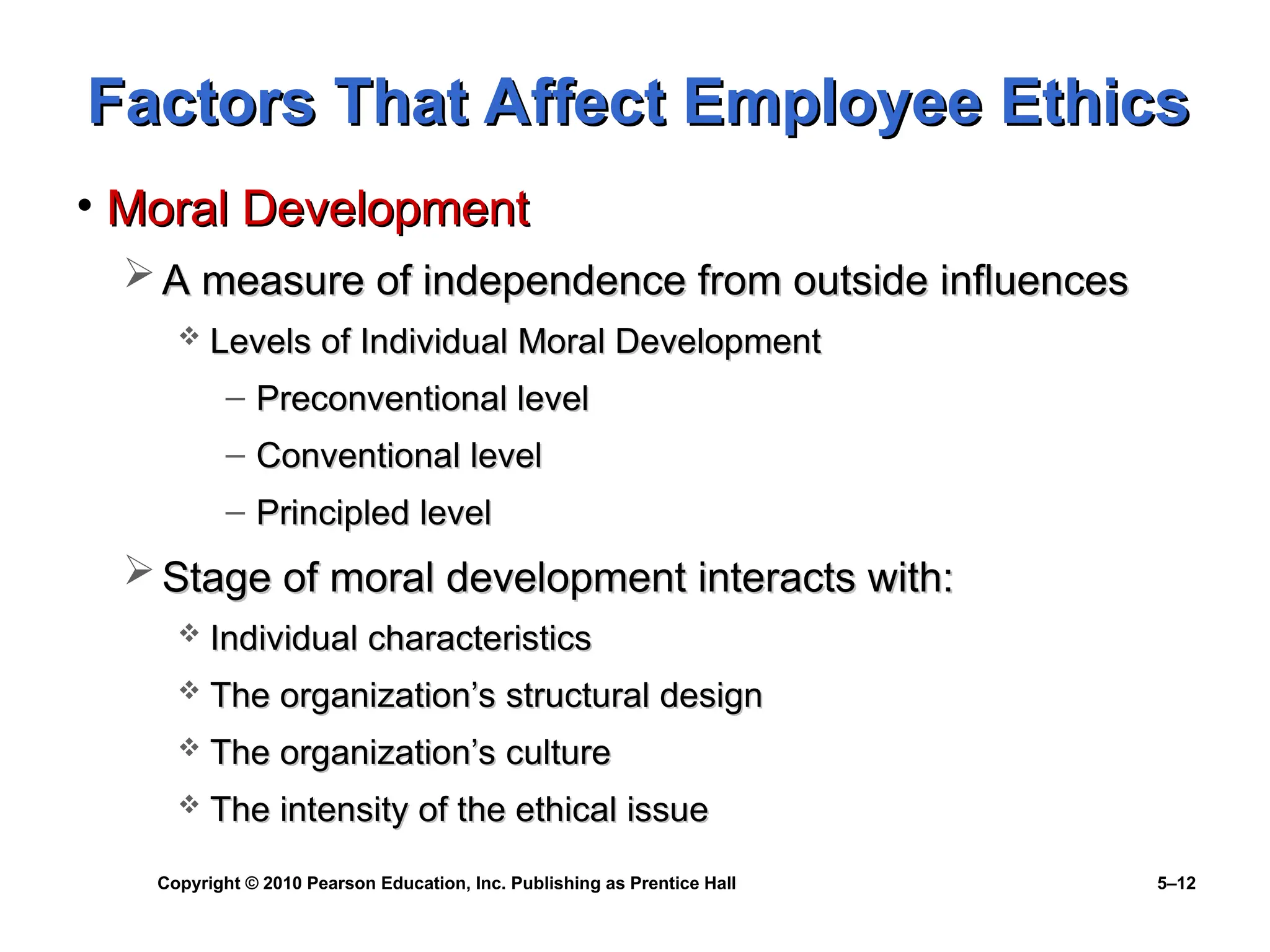
Factors That Affect Employee Ethics
• Moral Development
Moral Development
 A measure of independence from outside influences
A measure of independence from outside influences
 Levels of Individual Moral Development
Levels of Individual Moral Development
– Preconventional level
Preconventional level
– Conventional level
Conventional level
– Principled level
Principled level
 Stage of moral development interacts with:
Stage of moral development interacts with:
 Individual characteristics
Individual characteristics
 The organization’s structural design
The organization’s structural design
 The organization’s culture
The organization’s culture
 The intensity of the ethical issue
The intensity of the ethical issue
Copyright © 2010 Pearson Education, Inc. Publishing as Prentice Hall 5–13
Exhibit 5–6
Exhibit 5–6 Stages of Moral Development
Stages of Moral Development
Source: Based on L. Kohlberg, “Moral Stages and Moralization: The Cognitive-
Development Approach,” in T. Lickona (ed.). Moral Development and Behavior: Theory,
Research, and Social Issues (New York: Holt, Rinehart & Winston, 1976), pp. 34–35.
Copyright © 2010 Pearson Education, Inc. Publishing as Prentice Hall 5–14
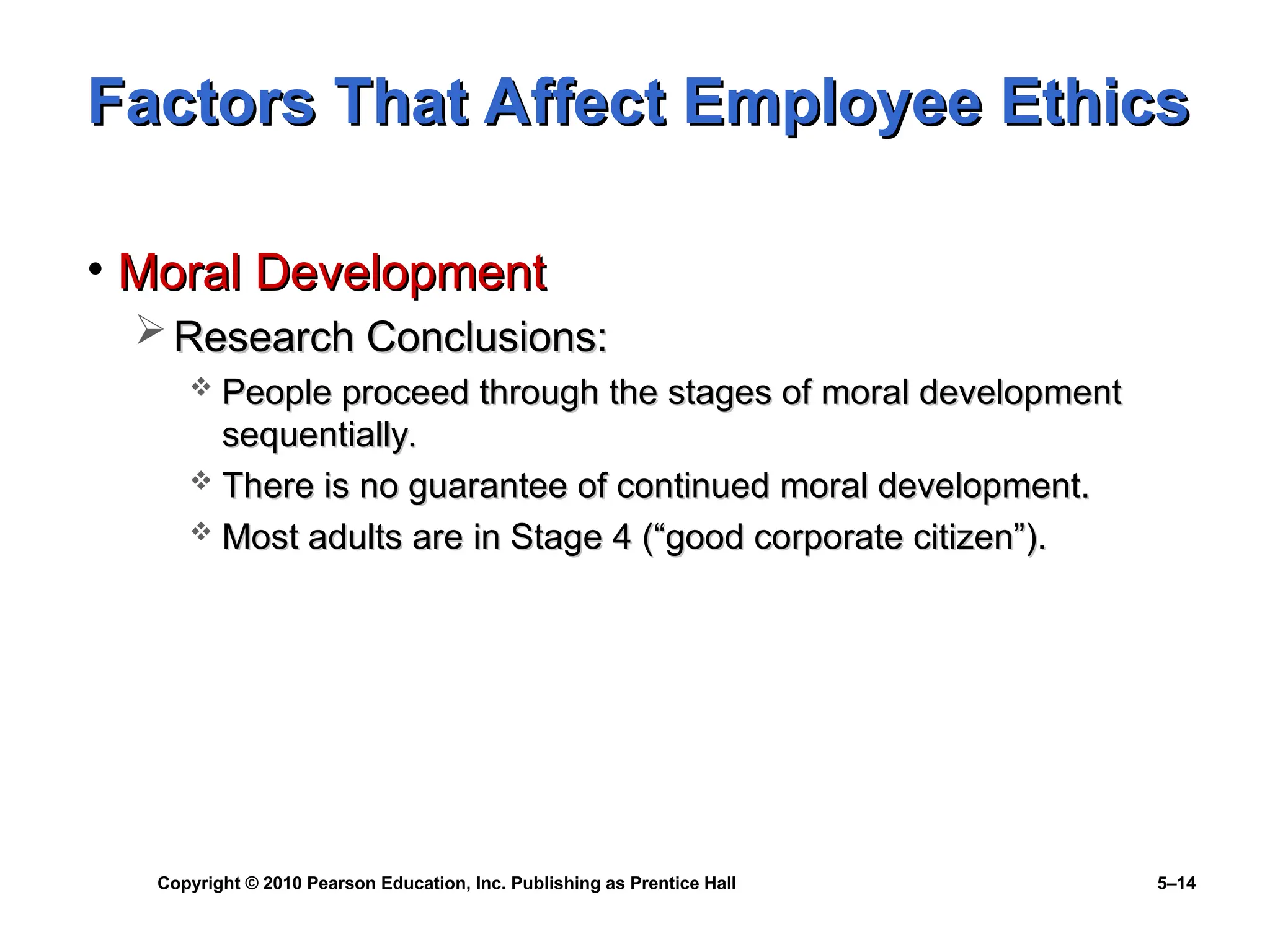
Factors That Affect Employee Ethics
• Moral Development
Moral Development
 Research Conclusions:
Research Conclusions:
 People proceed through the stages of moral development
People proceed through the stages of moral development
sequentially.
sequentially.
 There is no guarantee of continued moral development.
There is no guarantee of continued moral development.
 Most adults are in Stage 4 (“good corporate citizen”).
Most adults are in Stage 4 (“good corporate citizen”).
Copyright © 2010 Pearson Education, Inc. Publishing as Prentice Hall 5–15
Factors That Affect Employee Ethics
Individual Characteristics
 Values
Values
 Basic convictions about what is right or wrong.
Basic convictions about what is right or wrong.
 Personality
Personality
 Ego strength - A personality measure of the strength of a
Ego strength - A personality measure of the strength of a
person’s convictions
 Locus of Control
Locus of Control
– A personality attribute that measures the degree to which
A personality attribute that measures the degree to which
people believe they control their own life.
– Internal locus:
Internal locus: the belief that you control your destiny.
the belief that you control your destiny.
– External locus:
External locus: the belief that what happens to you is due
the belief that what happens to you is due
to luck or chance.
to luck or chance.
Copyright © 2010 Pearson Education, Inc. Publishing as Prentice Hall 5–16
Factors That Affect Employee Ethics
• Structural Variables
Structural Variables
 Organizational characteristics and mechanisms that
Organizational characteristics and mechanisms that
guide and influence individual ethics:
 Performance appraisal systems
Performance appraisal systems
 Reward allocation systems
Reward allocation systems
 Behaviors (ethical) of managers
Behaviors (ethical) of managers
Copyright © 2010 Pearson Education, Inc. Publishing as Prentice Hall 5–17
Factors That Affect Employee Ethics
• Organization’s Culture
Organization’s Culture
 Values-Based Management
Values-Based Management
 An approach to managing in which managers establish and
An approach to managing in which managers establish and
uphold an organization’s shared values.
 The Purposes of Shared Values
The Purposes of Shared Values
 Guiding managerial decisions
Guiding managerial decisions
 Shaping employee behavior
Shaping employee behavior
 Influencing the direction of marketing efforts
Influencing the direction of marketing efforts
 Building team spirit
Building team spirit
 The Bottom Line on Shared Corporate Values
The Bottom Line on Shared Corporate Values
 An organization’s values are reflected in the decisions and
An organization’s values are reflected in the decisions and
actions of its employees.
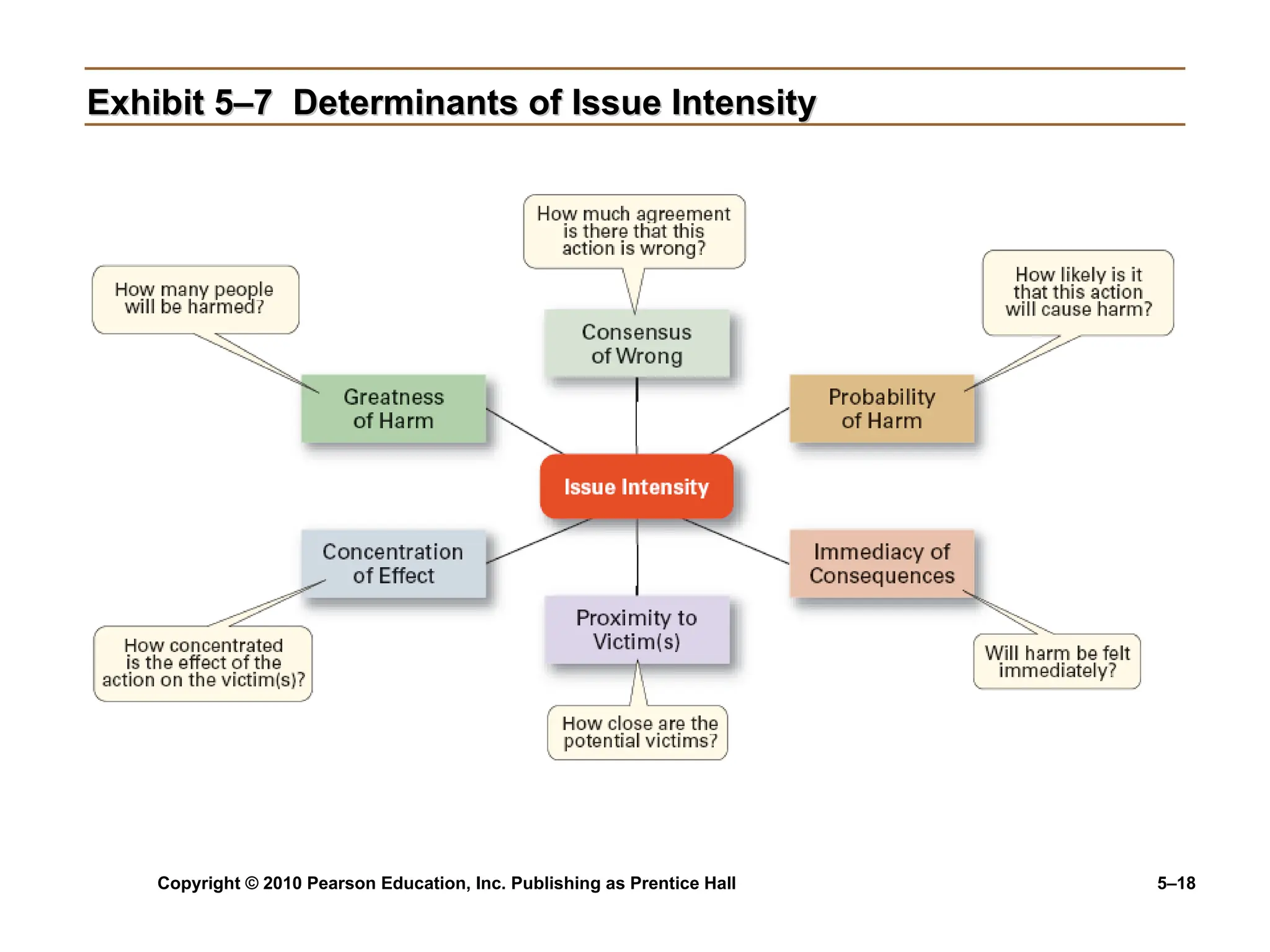
• Intensity of the Ethical Issue
Intensity of the Ethical Issue
Copyright © 2010 Pearson Education, Inc. Publishing as Prentice Hall 5–18
Exhibit 5–7
Exhibit 5–7 Determinants of Issue Intensity
Determinants of Issue Intensity
Copyright © 2010 Pearson Education, Inc. Publishing as Prentice Hall 5–19
Ethics in an International Context
• Ethical standards are not universal.
Ethical standards are not universal.
 Social and cultural differences determine acceptable
Social and cultural differences determine acceptable
behaviors.
behaviors.
• Foreign Corrupt Practices Act
Foreign Corrupt Practices Act
 Makes it illegal to corrupt a foreign official, yet “token”
Makes it illegal to corrupt a foreign official, yet “token”
payments to officials are permissible when doing so is
an accepted practice in that country.
• The Global Compact
The Global Compact
Copyright © 2010 Pearson Education, Inc. Publishing as Prentice Hall 5–20
Exhibit 5–8
Exhibit 5–8 Ten Principles of the United Nations
Ten Principles of the United Nations
Human Rights
Principle 1: Support and respect the protection of international human rights within their
sphere of influence.
Principle 2: Make sure business corporations are not complicit in human rights abuses.
Labor Standards
Principle 3: Freedom of association and the effective recognition of the right to collective
bargaining.
Principle 4: The elimination of all forms of forced and compulsory labor.
Principle 5: The effective abolition of child labor.
Principle 6: The elimination of discrimination in respect of employment and occupation.
Environment
Principle 7: Support a precautionary approach to environmental challenges.
Principle 8: Undertake initiatives to promote greater environmental responsibility.
Principle 9: Encourage the development and diffusion of environmentally friendly
technologies.
Principle 10: Businesses should work against corruption in all its forms, including extortion
and bribery.
Source: Courtesy of Global Compact.
Copyright © 2010 Pearson Education, Inc. Publishing as Prentice Hall 5–21
How Managers Can Improve Ethical
Behavior in An Organization
1.
1. Hire individuals with high ethical standards.
Hire individuals with high ethical standards.
2.
2. Establish codes of ethics and decision rules.
Establish codes of ethics and decision rules.
3.
3. Lead by example.
Lead by example.
4.
4. Set realistic job goals and include ethics in
Set realistic job goals and include ethics in
performance appraisals.
5.
5. Provide ethics training.
Provide ethics training.
6.
6. Conduct independent social audits.
Conduct independent social audits.
7.
7. Provide support for individuals facing ethical
Provide support for individuals facing ethical
dilemmas.
dilemmas.
Copyright © 2010 Pearson Education, Inc. Publishing as Prentice Hall 5–22
Exhibit 5–9
Exhibit 5–9 Codes of Ethics
Codes of Ethics
Cluster 1. Be a Dependable Organizational Citizen
1. Comply with safety, health, and security regulations.
2. Demonstrate courtesy, respect, honesty, and fairness.
3. Illegal drugs and alcohol at work are prohibited.
4. Manage personal finances well.
5. Exhibit good attendance and punctuality.
6. Follow directives of supervisors.
7. Do not use abusive language.
8. Dress in business attire.
9. Firearms at work are prohibited.
Cluster 2. Do Not Do Anything Unlawful or Improper That
Will Harm the Organization
1. Conduct business in compliance with all laws.
2. Payments for unlawful purposes are prohibited.
3. Bribes are prohibited.
4. Avoid outside activities that impair duties.
5. Maintain confidentiality of records.
6. Comply with all antitrust and trade regulations.
7. Comply with all accounting rules and controls.
8. Do not use company property for personal benefit.
9. Employees are personally accountable for company funds.
10. Do not propagate false or misleading information.
11. Make decisions without regard for personal gain.
Cluster 3. Be Good to Customers
1. Convey true claims in product advertisements.
2. Perform assigned duties to the best of your ability.
3. Provide products and services of the highest quality.
Source: F. R. David, “An Empirical Study of Codes of Business Ethics: A Strategic Perspective,” paper
presented at the 48th
Annual Academy of Management Conference, Anaheim, California, August 1988.
Copyright © 2010 Pearson Education, Inc. Publishing as Prentice Hall 5–23
Effective Use of a Code of Ethics
• Develop a code of ethics as a guide in handling
Develop a code of ethics as a guide in handling
ethical dilemmas in decision making.
• Communicate the code regularly to all
Communicate the code regularly to all
employees.
employees.
• Have all levels of management continually
Have all levels of management continually
reaffirm the importance of the ethics code and
the organization’s commitment to the code.
• Publicly reprimand and consistently discipline
Publicly reprimand and consistently discipline
those who break the code.
Copyright © 2010 Pearson Education, Inc. Publishing as Prentice Hall 5–24
Exhibit 5–10
Exhibit 5–10 Twelve Questions Approach
Twelve Questions Approach
1. Have you defined the problem accurately?
2. How would you define the problem if you stood on the other side of the fence?
3. How did this situation occur in the first place?
4. To whom and to what do you give your loyalty as a person and as a member of the
corporation?
5. What is your intention in making this decision?
6. How does this intention compare with the probable results?
7. Whom could your decision or action injure?
8. Can you discuss the problem with the affected parties before you make the decision?
9. Are you confident that your position will be as valid over a long period of time as it
seems now?
10. Could you disclose without qualm your decision or action to your boss, your chief
executive officer, the board of directors, your family, society as a whole?
11. What is the symbolic potential of your action if understood? If misunderstood?
12. Under what conditions would you allow exceptions to your stand?
Source: Reprinted by permission of Harvard Business Review. An exhibit from “Ethics Without the Sermon,” by L. L. Nash.
November–December 1981, p. 81. Copyright © 1981 by the President and Fellows of Harvard College. All rights reserved.
Copyright © 2010 Pearson Education, Inc. Publishing as Prentice Hall 5–25
The Value of Ethics Training
• Can make a difference in ethical behaviors.
Can make a difference in ethical behaviors.
• Increases employee awareness of ethical issues
Increases employee awareness of ethical issues
in business decisions.
• Clarifies and reinforces the organization’s
Clarifies and reinforces the organization’s
standards of conduct.
• Helps employees become more confident that
Helps employees become more confident that
they will have the organization’s support when
taking unpopular but ethically correct stances.
Copyright © 2010 Pearson Education, Inc. Publishing as Prentice Hall 5–26
Exhibit 5–11 Being an Ethical Leader
• Be a good role model by being ethical and honest.
° Tell the truth always.
° Don’t hide or manipulate information
° Be willing to admit your failures.
• Share your personal values by regularly communicating
them to employees.
• Stress the organization’s or team’s important shared
values.
• Use the reward system to hold everyone accountable to
the values.
Copyright © 2010 Pearson Education, Inc. Publishing as Prentice Hall 5–27
Managing Ethical Lapses and Social
Irresponsibility
Irresponsibility
• Provide ethical leadership
Provide ethical leadership
• Protect employees who raise ethical issues
Protect employees who raise ethical issues
(whistle-blowers)
(whistle-blowers)
Copyright © 2010 Pearson Education, Inc. Publishing as Prentice Hall 5–28
Awareness of Social Issues
• Social Entrepreneurs
Social Entrepreneurs
 Are individuals or organizations who seek out
Are individuals or organizations who seek out
opportunities to improve society by using practical,
innovative, and sustainable approaches.
 Want to make the world a better place and have a
Want to make the world a better place and have a
driving passion to make that happen.
Copyright © 2010 Pearson Education, Inc. Publishing as Prentice Hall 5–29
Businesses Promoting Positive
Social Change
Social Change
• Corporate Philanthropy
Corporate Philanthropy
 Campaigns
Campaigns
 Donations
Donations
 Funding own foundations
Funding own foundations
• Employee Volunteering Efforts
Employee Volunteering Efforts
 Team volunteering
Team volunteering
 Individual volunteering during work hours
Individual volunteering during work hours
Copyright © 2010 Pearson Education, Inc. Publishing as Prentice Hall 5–30
Terms to Know
Terms to Know
• classical view
classical view
• socioeconomic view
socioeconomic view
• social obligation
social obligation
• social responsiveness
social responsiveness
• social responsibility
social responsibility
• social screening
social screening
• greening of management
greening of management
• values-based
values-based
management
management
• ethics
ethics
• values
values
• ego strength
ego strength
• locus of control
locus of control
• code of ethics
code of ethics
• whistle-blower
whistle-blower
• social entrepreneur
social entrepreneur

Social-responsibility-and-managerial-ethics.ppt

  • 1.
    Copyright © 2010Pearson Education, Inc. Publishing as Prentice Hall 5–1 Social Social Responsibility and Responsibility and Managerial Ethics Managerial Ethics Chapter Chapter 5 5 Management Stephen P. Robbins Mary Coulter tenth edition
  • 2.
    Copyright © 2010Pearson Education, Inc. Publishing as Prentice Hall 5–2 Learning Outcomes Learning Outcomes Follow this Learning Outline as you read and study Follow this Learning Outline as you read and study this chapter. this chapter. • 5.1 What Is Social Responsibility? • Differentiate between social obligation, social Differentiate between social obligation, social responsiveness and social responsibility. responsiveness and social responsibility. • Discuss whether organizations should be socially Discuss whether organizations should be socially involved. involved. • Describe what conclusion can be reached regarding Describe what conclusion can be reached regarding social involvement and economic importance. social involvement and economic importance.
  • 3.
    Copyright © 2010Pearson Education, Inc. Publishing as Prentice Hall 5–3 Learning Outcomes Learning Outcomes 5.2 Green Management. • Define green management. Define green management. • Describe how organizations can go green. Describe how organizations can go green. • Explain how green management can be evaluated. Explain how green management can be evaluated. 5.3 Managers And Ethical Behavior • Define ethics. Define ethics. • Discuss the factors that influence whether a person behave Discuss the factors that influence whether a person behave ethically or unethically. ethically or unethically. • Describe what managers need to know about international Describe what managers need to know about international ethics. ethics.
  • 4.
    Copyright © 2010Pearson Education, Inc. Publishing as Prentice Hall 5–4 Learning Outcomes Learning Outcomes 5.4 Encouraging Ethical Behavior • Describe manager’s important role in encouraging ethical Describe manager’s important role in encouraging ethical behavior. behavior. • Discuss specific ways managers can encourage ethical Discuss specific ways managers can encourage ethical behavior. behavior. 5.5 Social Responsibility And Ethics Issues In Today’s World. • Discuss how managers can manage ethical lapses and social Discuss how managers can manage ethical lapses and social responsibility. responsibility. • Explain the role of social entrepreneurs. Explain the role of social entrepreneurs. • Discuss how businesses can promote positive social change. Discuss how businesses can promote positive social change.
  • 5.
    Copyright © 2010Pearson Education, Inc. Publishing as Prentice Hall 5–5 Learning Outcomes Learning Outcomes 5.5 Social Responsibility Issues In Today’s World. • Discuss how managers and organizations can protect Discuss how managers and organizations can protect employees who raise ethical issues or concerns. employees who raise ethical issues or concerns. • Explain what role social entrepreneurs play. Explain what role social entrepreneurs play. • Discuss how businesses can promote positive social Discuss how businesses can promote positive social change. change.
  • 6.
    Copyright © 2010Pearson Education, Inc. Publishing as Prentice Hall 5–6 From Obligation to Responsiveness From Obligation to Responsiveness to Responsibility to Responsibility • Social Obligation Social Obligation  The obligation of a business to meet its economic and The obligation of a business to meet its economic and legal responsibilities and nothing more. legal responsibilities and nothing more. • Social Responsiveness Social Responsiveness  When a firm engages in social actions in response to When a firm engages in social actions in response to some popular social need. some popular social need. • Social Responsibility Social Responsibility  A business’s intention, beyond its legal and economic A business’s intention, beyond its legal and economic obligations, to do the right things and act in ways that obligations, to do the right things and act in ways that are good for society. are good for society.
  • 7.
    Copyright © 2010Pearson Education, Inc. Publishing as Prentice Hall 5–7 How Organizations Go Green How Organizations Go Green • Legal (or Light Green) Approach Legal (or Light Green) Approach  Firms simply do what is legally required by obeying laws, rules, Firms simply do what is legally required by obeying laws, rules, and regulations willingly and without legal challenge. and regulations willingly and without legal challenge. • Market Approach Market Approach  Firms respond to the preferences of their customers for Firms respond to the preferences of their customers for environmentally friendly products. environmentally friendly products. • Stakeholder Approach Stakeholder Approach  Firms work to meet the environmental demands of multiple Firms work to meet the environmental demands of multiple stakeholders stakeholders— —employees, suppliers, and the community. employees, suppliers, and the community. • Activist Approach Activist Approach  Firms look for ways to respect and preserve environment and be Firms look for ways to respect and preserve environment and be actively socially responsible. actively socially responsible.
  • 8.
    Copyright © 2010Pearson Education, Inc. Publishing as Prentice Hall 5–8 Exhibit 5–4 Exhibit 5–4 Green Approaches Green Approaches Source: Based on R.E. Freeman. J. Pierce, and R. Dodd. Shades of Green: Business Ethics and the Environment (New York: Oxford University Press, 1995).
  • 9.
    Copyright © 2010Pearson Education, Inc. Publishing as Prentice Hall 5–9 Evaluating the Greening of Evaluating the Greening of Management Management • Organizations become “greener” by Organizations become “greener” by  Using the Sustainability Reporting Guidelines to Using the Sustainability Reporting Guidelines to document “green” actions. document “green” actions.  Adopting ISO 14000 standards for environmental Adopting ISO 14000 standards for environmental management. management.  Being named as one of the 100 Most Sustainable Being named as one of the 100 Most Sustainable Corporations in the World. Corporations in the World.
  • 10.
    Copyright © 2010Pearson Education, Inc. Publishing as Prentice Hall 5–10 Managerial Ethics Managerial Ethics Ethics Defined Ethics Defined  Principles, values, and beliefs that define what is right Principles, values, and beliefs that define what is right and wrong behavior. and wrong behavior.
  • 11.
    Copyright © 2010Pearson Education, Inc. Publishing as Prentice Hall 5–11 Exhibit 5–5 Exhibit 5–5 Factors That Determine Ethical and Unethical Factors That Determine Ethical and Unethical Behavior Behavior
  • 12.
    Copyright © 2010Pearson Education, Inc. Publishing as Prentice Hall 5–12 Factors That Affect Employee Ethics Factors That Affect Employee Ethics • Moral Development Moral Development  A measure of independence from outside influences A measure of independence from outside influences  Levels of Individual Moral Development Levels of Individual Moral Development – Preconventional level Preconventional level – Conventional level Conventional level – Principled level Principled level  Stage of moral development interacts with: Stage of moral development interacts with:  Individual characteristics Individual characteristics  The organization’s structural design The organization’s structural design  The organization’s culture The organization’s culture  The intensity of the ethical issue The intensity of the ethical issue
  • 13.
    Copyright © 2010Pearson Education, Inc. Publishing as Prentice Hall 5–13 Exhibit 5–6 Exhibit 5–6 Stages of Moral Development Stages of Moral Development Source: Based on L. Kohlberg, “Moral Stages and Moralization: The Cognitive- Development Approach,” in T. Lickona (ed.). Moral Development and Behavior: Theory, Research, and Social Issues (New York: Holt, Rinehart & Winston, 1976), pp. 34–35.
  • 14.
    Copyright © 2010Pearson Education, Inc. Publishing as Prentice Hall 5–14 Factors That Affect Employee Ethics Factors That Affect Employee Ethics • Moral Development Moral Development  Research Conclusions: Research Conclusions:  People proceed through the stages of moral development People proceed through the stages of moral development sequentially. sequentially.  There is no guarantee of continued moral development. There is no guarantee of continued moral development.  Most adults are in Stage 4 (“good corporate citizen”). Most adults are in Stage 4 (“good corporate citizen”).
  • 15.
    Copyright © 2010Pearson Education, Inc. Publishing as Prentice Hall 5–15 Factors That Affect Employee Ethics Factors That Affect Employee Ethics Individual Characteristics Individual Characteristics  Values Values  Basic convictions about what is right or wrong. Basic convictions about what is right or wrong.  Personality Personality  Ego strength - A personality measure of the strength of a Ego strength - A personality measure of the strength of a person’s convictions person’s convictions  Locus of Control Locus of Control – A personality attribute that measures the degree to which A personality attribute that measures the degree to which people believe they control their own life. people believe they control their own life. – Internal locus: Internal locus: the belief that you control your destiny. the belief that you control your destiny. – External locus: External locus: the belief that what happens to you is due the belief that what happens to you is due to luck or chance. to luck or chance.
  • 16.
    Copyright © 2010Pearson Education, Inc. Publishing as Prentice Hall 5–16 Factors That Affect Employee Ethics Factors That Affect Employee Ethics • Structural Variables Structural Variables  Organizational characteristics and mechanisms that Organizational characteristics and mechanisms that guide and influence individual ethics: guide and influence individual ethics:  Performance appraisal systems Performance appraisal systems  Reward allocation systems Reward allocation systems  Behaviors (ethical) of managers Behaviors (ethical) of managers
  • 17.
    Copyright © 2010Pearson Education, Inc. Publishing as Prentice Hall 5–17 Factors That Affect Employee Ethics Factors That Affect Employee Ethics • Organization’s Culture Organization’s Culture  Values-Based Management Values-Based Management  An approach to managing in which managers establish and An approach to managing in which managers establish and uphold an organization’s shared values. uphold an organization’s shared values.  The Purposes of Shared Values The Purposes of Shared Values  Guiding managerial decisions Guiding managerial decisions  Shaping employee behavior Shaping employee behavior  Influencing the direction of marketing efforts Influencing the direction of marketing efforts  Building team spirit Building team spirit  The Bottom Line on Shared Corporate Values The Bottom Line on Shared Corporate Values  An organization’s values are reflected in the decisions and An organization’s values are reflected in the decisions and actions of its employees. actions of its employees. • Intensity of the Ethical Issue Intensity of the Ethical Issue
  • 18.
    Copyright © 2010Pearson Education, Inc. Publishing as Prentice Hall 5–18 Exhibit 5–7 Exhibit 5–7 Determinants of Issue Intensity Determinants of Issue Intensity
  • 19.
    Copyright © 2010Pearson Education, Inc. Publishing as Prentice Hall 5–19 Ethics in an International Context Ethics in an International Context • Ethical standards are not universal. Ethical standards are not universal.  Social and cultural differences determine acceptable Social and cultural differences determine acceptable behaviors. behaviors. • Foreign Corrupt Practices Act Foreign Corrupt Practices Act  Makes it illegal to corrupt a foreign official, yet “token” Makes it illegal to corrupt a foreign official, yet “token” payments to officials are permissible when doing so is payments to officials are permissible when doing so is an accepted practice in that country. an accepted practice in that country. • The Global Compact The Global Compact
  • 20.
    Copyright © 2010Pearson Education, Inc. Publishing as Prentice Hall 5–20 Exhibit 5–8 Exhibit 5–8 Ten Principles of the United Nations Ten Principles of the United Nations Human Rights Principle 1: Support and respect the protection of international human rights within their sphere of influence. Principle 2: Make sure business corporations are not complicit in human rights abuses. Labor Standards Principle 3: Freedom of association and the effective recognition of the right to collective bargaining. Principle 4: The elimination of all forms of forced and compulsory labor. Principle 5: The effective abolition of child labor. Principle 6: The elimination of discrimination in respect of employment and occupation. Environment Principle 7: Support a precautionary approach to environmental challenges. Principle 8: Undertake initiatives to promote greater environmental responsibility. Principle 9: Encourage the development and diffusion of environmentally friendly technologies. Principle 10: Businesses should work against corruption in all its forms, including extortion and bribery. Source: Courtesy of Global Compact.
  • 21.
    Copyright © 2010Pearson Education, Inc. Publishing as Prentice Hall 5–21 How Managers Can Improve Ethical How Managers Can Improve Ethical Behavior in An Organization Behavior in An Organization 1. 1. Hire individuals with high ethical standards. Hire individuals with high ethical standards. 2. 2. Establish codes of ethics and decision rules. Establish codes of ethics and decision rules. 3. 3. Lead by example. Lead by example. 4. 4. Set realistic job goals and include ethics in Set realistic job goals and include ethics in performance appraisals. performance appraisals. 5. 5. Provide ethics training. Provide ethics training. 6. 6. Conduct independent social audits. Conduct independent social audits. 7. 7. Provide support for individuals facing ethical Provide support for individuals facing ethical dilemmas. dilemmas.
  • 22.
    Copyright © 2010Pearson Education, Inc. Publishing as Prentice Hall 5–22 Exhibit 5–9 Exhibit 5–9 Codes of Ethics Codes of Ethics Cluster 1. Be a Dependable Organizational Citizen 1. Comply with safety, health, and security regulations. 2. Demonstrate courtesy, respect, honesty, and fairness. 3. Illegal drugs and alcohol at work are prohibited. 4. Manage personal finances well. 5. Exhibit good attendance and punctuality. 6. Follow directives of supervisors. 7. Do not use abusive language. 8. Dress in business attire. 9. Firearms at work are prohibited. Cluster 2. Do Not Do Anything Unlawful or Improper That Will Harm the Organization 1. Conduct business in compliance with all laws. 2. Payments for unlawful purposes are prohibited. 3. Bribes are prohibited. 4. Avoid outside activities that impair duties. 5. Maintain confidentiality of records. 6. Comply with all antitrust and trade regulations. 7. Comply with all accounting rules and controls. 8. Do not use company property for personal benefit. 9. Employees are personally accountable for company funds. 10. Do not propagate false or misleading information. 11. Make decisions without regard for personal gain. Cluster 3. Be Good to Customers 1. Convey true claims in product advertisements. 2. Perform assigned duties to the best of your ability. 3. Provide products and services of the highest quality. Source: F. R. David, “An Empirical Study of Codes of Business Ethics: A Strategic Perspective,” paper presented at the 48th Annual Academy of Management Conference, Anaheim, California, August 1988.
  • 23.
    Copyright © 2010Pearson Education, Inc. Publishing as Prentice Hall 5–23 Effective Use of a Code of Ethics Effective Use of a Code of Ethics • Develop a code of ethics as a guide in handling Develop a code of ethics as a guide in handling ethical dilemmas in decision making. ethical dilemmas in decision making. • Communicate the code regularly to all Communicate the code regularly to all employees. employees. • Have all levels of management continually Have all levels of management continually reaffirm the importance of the ethics code and reaffirm the importance of the ethics code and the organization’s commitment to the code. the organization’s commitment to the code. • Publicly reprimand and consistently discipline Publicly reprimand and consistently discipline those who break the code. those who break the code.
  • 24.
    Copyright © 2010Pearson Education, Inc. Publishing as Prentice Hall 5–24 Exhibit 5–10 Exhibit 5–10 Twelve Questions Approach Twelve Questions Approach 1. Have you defined the problem accurately? 2. How would you define the problem if you stood on the other side of the fence? 3. How did this situation occur in the first place? 4. To whom and to what do you give your loyalty as a person and as a member of the corporation? 5. What is your intention in making this decision? 6. How does this intention compare with the probable results? 7. Whom could your decision or action injure? 8. Can you discuss the problem with the affected parties before you make the decision? 9. Are you confident that your position will be as valid over a long period of time as it seems now? 10. Could you disclose without qualm your decision or action to your boss, your chief executive officer, the board of directors, your family, society as a whole? 11. What is the symbolic potential of your action if understood? If misunderstood? 12. Under what conditions would you allow exceptions to your stand? Source: Reprinted by permission of Harvard Business Review. An exhibit from “Ethics Without the Sermon,” by L. L. Nash. November–December 1981, p. 81. Copyright © 1981 by the President and Fellows of Harvard College. All rights reserved.
  • 25.
    Copyright © 2010Pearson Education, Inc. Publishing as Prentice Hall 5–25 The Value of Ethics Training The Value of Ethics Training • Can make a difference in ethical behaviors. Can make a difference in ethical behaviors. • Increases employee awareness of ethical issues Increases employee awareness of ethical issues in business decisions. in business decisions. • Clarifies and reinforces the organization’s Clarifies and reinforces the organization’s standards of conduct. standards of conduct. • Helps employees become more confident that Helps employees become more confident that they will have the organization’s support when they will have the organization’s support when taking unpopular but ethically correct stances. taking unpopular but ethically correct stances.
  • 26.
    Copyright © 2010Pearson Education, Inc. Publishing as Prentice Hall 5–26 Exhibit 5–11 Being an Ethical Leader • Be a good role model by being ethical and honest. ° Tell the truth always. ° Don’t hide or manipulate information ° Be willing to admit your failures. • Share your personal values by regularly communicating them to employees. • Stress the organization’s or team’s important shared values. • Use the reward system to hold everyone accountable to the values.
  • 27.
    Copyright © 2010Pearson Education, Inc. Publishing as Prentice Hall 5–27 Managing Ethical Lapses and Social Managing Ethical Lapses and Social Irresponsibility Irresponsibility • Provide ethical leadership Provide ethical leadership • Protect employees who raise ethical issues Protect employees who raise ethical issues (whistle-blowers) (whistle-blowers)
  • 28.
    Copyright © 2010Pearson Education, Inc. Publishing as Prentice Hall 5–28 Awareness of Social Issues Awareness of Social Issues • Social Entrepreneurs Social Entrepreneurs  Are individuals or organizations who seek out Are individuals or organizations who seek out opportunities to improve society by using practical, opportunities to improve society by using practical, innovative, and sustainable approaches. innovative, and sustainable approaches.  Want to make the world a better place and have a Want to make the world a better place and have a driving passion to make that happen. driving passion to make that happen.
  • 29.
    Copyright © 2010Pearson Education, Inc. Publishing as Prentice Hall 5–29 Businesses Promoting Positive Businesses Promoting Positive Social Change Social Change • Corporate Philanthropy Corporate Philanthropy  Campaigns Campaigns  Donations Donations  Funding own foundations Funding own foundations • Employee Volunteering Efforts Employee Volunteering Efforts  Team volunteering Team volunteering  Individual volunteering during work hours Individual volunteering during work hours
  • 30.
    Copyright © 2010Pearson Education, Inc. Publishing as Prentice Hall 5–30 Terms to Know Terms to Know • classical view classical view • socioeconomic view socioeconomic view • social obligation social obligation • social responsiveness social responsiveness • social responsibility social responsibility • social screening social screening • greening of management greening of management • values-based values-based management management • ethics ethics • values values • ego strength ego strength • locus of control locus of control • code of ethics code of ethics • whistle-blower whistle-blower • social entrepreneur social entrepreneur