YORK SMALL BUSINESS ENTERPRISE CENTRE GREEN CONNECTIONSDecember 13, 2010Advantages and Disadvantages of Incorporating as a Not-for-profitBy Ryan M. Prendergast, B.A. LL.B. rprendergast@carters.ca© 2010 Carters Professional Corporation
2OVERVIEW OF TOPICS					IntroductionNature of Not-for-profit OrganizationsNon-profit Status Under the ITAMaintaining Non-profit StatusCharities and Not-for-profit OrganizationsNature of Unincorporated AssociationBenefits of IncorporationDisadvantages of Incorporation and LiabilitiesNew Federal and Provincial Corporate Legislation
NATURE OF NOT-FOR-PROFIT ORGANIZATIONSNot-for-profit Organizations – Key ConceptsWhat is a not-for-profit under the Income Tax Act (“ITA”)(technically a “non-profit organization”)?Club, society or associationIn the opinion of the Ministry was not a charityOrganized and operated exclusively for social welfare, civic improvement, pleasure or recreation, or any other purpose, except profitNo part of the income can be payable or available  for the personal benefit of any proprietor, member or shareholder3
What are the legal forms available for non-profit organizations?Corporation with share capitalCorporation without share capitalUnincorporated AssociationExamples would includeRecreational clubsService clubsTrade associationsProfessional associations4
NON-PROFIT STATUS UNDER THE ITAWhat are the tax advantages of being a non-profit organization under the ITA?A non-profit organization does not pay tax on income or capital gains, except income from property of an organization whose main purpose is to provide dining, recreation or sporting facilities However, a non-profit organization cannot issue charitable receipts for income tax purposes 5
MAINTAINING NON-PROFIT STATUSCannot have a profit-earning purpose, even if that profit is to be used for the not-for-profit purposes of the non-profit organizationIt is always a question of fact whether an organization is operating for the purpose of earning a profitProfit is generally considered to be the positive difference between an organization’s revenue and the expenses incurred to earn that revenue Important not to be considered a charity in the opinion of the Minister of RevenueNo appeal from Minister’s decision, it is therefore customary to include a purpose in the objects of the corporation that cannot be charitable at law6
Must meet the definition of a non-profit organization under the ITAon a yearly basisCannot maintain reserves in excess of a reasonable operational reserveMaintaining a large amount of capital solely for the purpose of generating income to support the organization will prevent the organization from being tax-exempt under paragraph 149(1)(l)Must file a T2 Return if incorporatedIf the organization has income greater than $10,000 or assets exceeding $200,000, it must file a T1044 NPO Return7
What happens in the corporation no longer qualifies for tax exempt status?Just because a non-profit organization was not reviewed for several years does not mean that CRA accepted that you were entitled to the exemptionIf audited, each year would be examined separately to determine whether the non-profit organization qualified for the exemption each yearA non-profit organization can be re-assessed 3 years in the past, or, if there has been a misrepresentation, the corporation can be reassessed at any time8
Subsection 149(10) of the ITA will apply at the time the corporation ceases to be a 149(1)(l) entity and provides that the non-profit organization’s taxation year will end immediately before that time A new taxation year of the corporation is deemed to have begun at that timeProperty of the corporation will be deemed to have been disposed of at fair market value149(10) applies only if the organization is incorporated9
IDENTIFYING THE DIFFERENCES BETWEEN CHARITIES AND NOT-FOR-PROFIT ORGANIZATIONSCharities  - Key ConceptsWhat is a charity?At common-law a charity includesRelief of povertyAdvancement of educationAdvancement of religionOther purposes beneficial to the community recognized by the courts10
What are the tax advantages of being a charity?A charity does not pay tax on income or capital gainsA charity can issue charitable receipts to donors as tax credits (for individuals) deductions (for corporations) for income tax purposesA gift for income tax purposes now permit consideration to be received back by the donor (split-receipting)What are the legal forms available for a charity?Unincorporated associations Charitable trustsNon-share capital corporations11
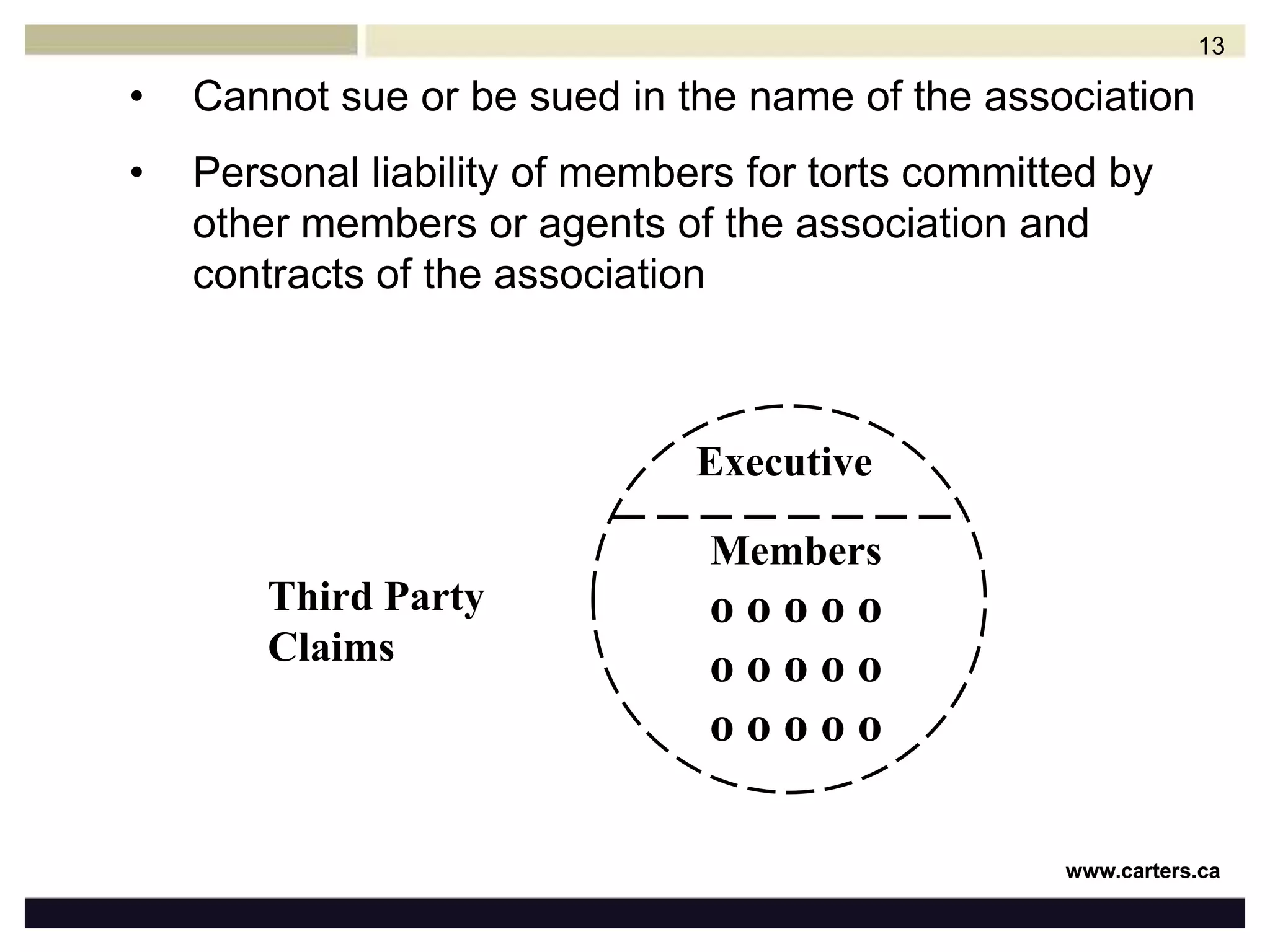
NATURE OF UNINCORPORATED ASSOCIATIONIt is not mandatory for a not-for-profit organization to incorporate to receive the exemption under paragraph 149(1)(l) of the ITAAn unincorporated association is a voluntary association of individualsNo separate existence apart from membersNot a legal personNo ability to own property in its nameNo separate protection from liability for members12
13ExecutiveMemberso o o o oo o o o oo o o o oThird Party ClaimsCannot sue or be sued in the name of the associationPersonal liability of members for torts committed by other members or agents of the association and contracts of the association
BENEFITS OF INCORPORATIONSeparate legal entity apart from its membersPerpetual existenceLimited liability of members (but does not obviate due diligence)Allows for indemnification of directors and officersCapacity to commence and defend legal actions in its own nameCan hold property in its own name14
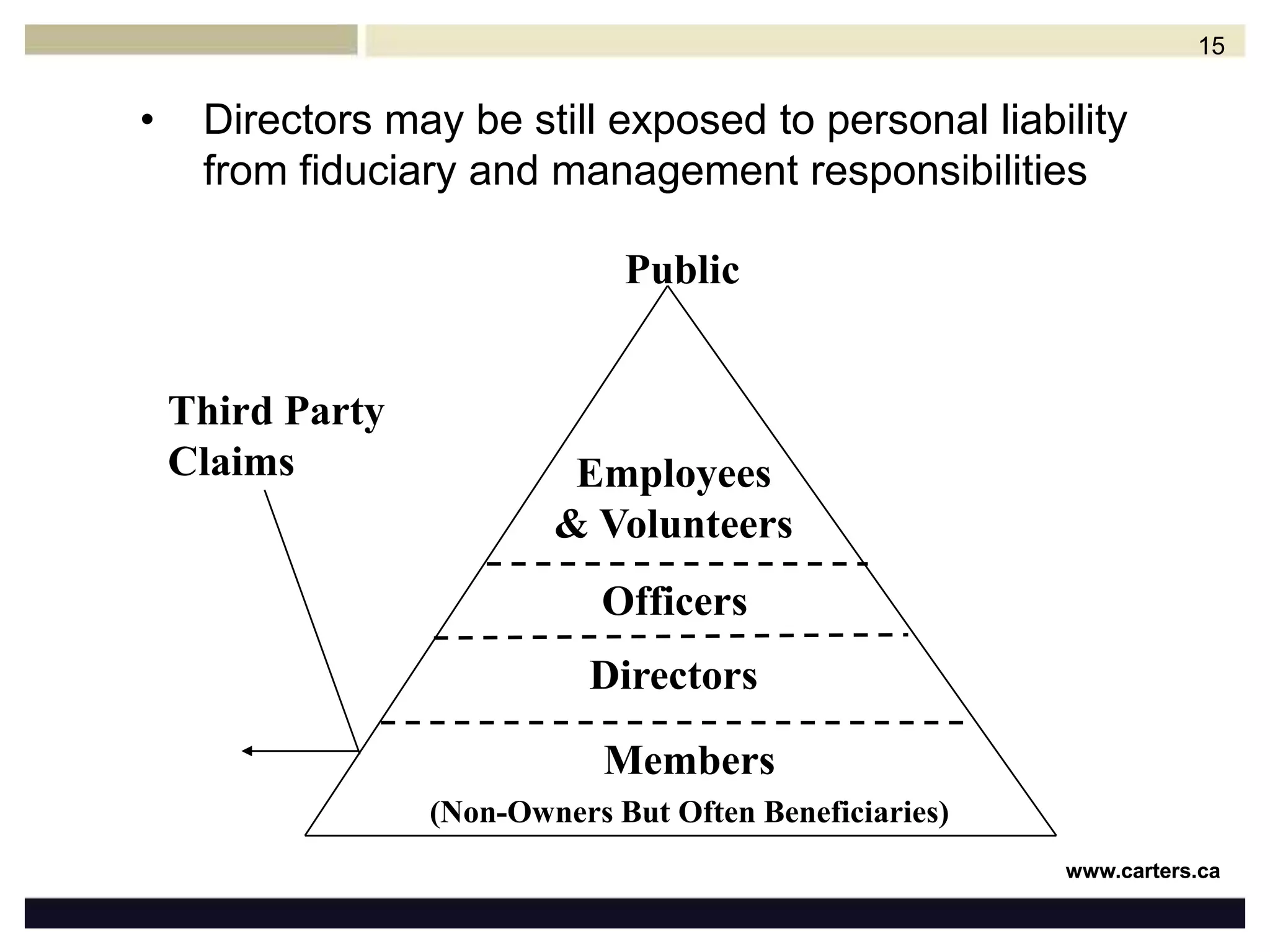
15Third Party ClaimsEmployees & VolunteersOfficersDirectorsMembers(Non-Owners But Often Beneficiaries)Directors may be still exposed to personal liability from fiduciary and management responsibilitiesPublic
PROCESS OF INCORPORATIONA note about incorporating under not-for-profit legislationWhether an entity qualifies for the tax exemption can only be determined once the entity is established, has been operating and has filed a tax returnAn organization can be incorporated under a federal or provincial statute that uses the term “not-for-profit” but still not qualify for the tax exemption16
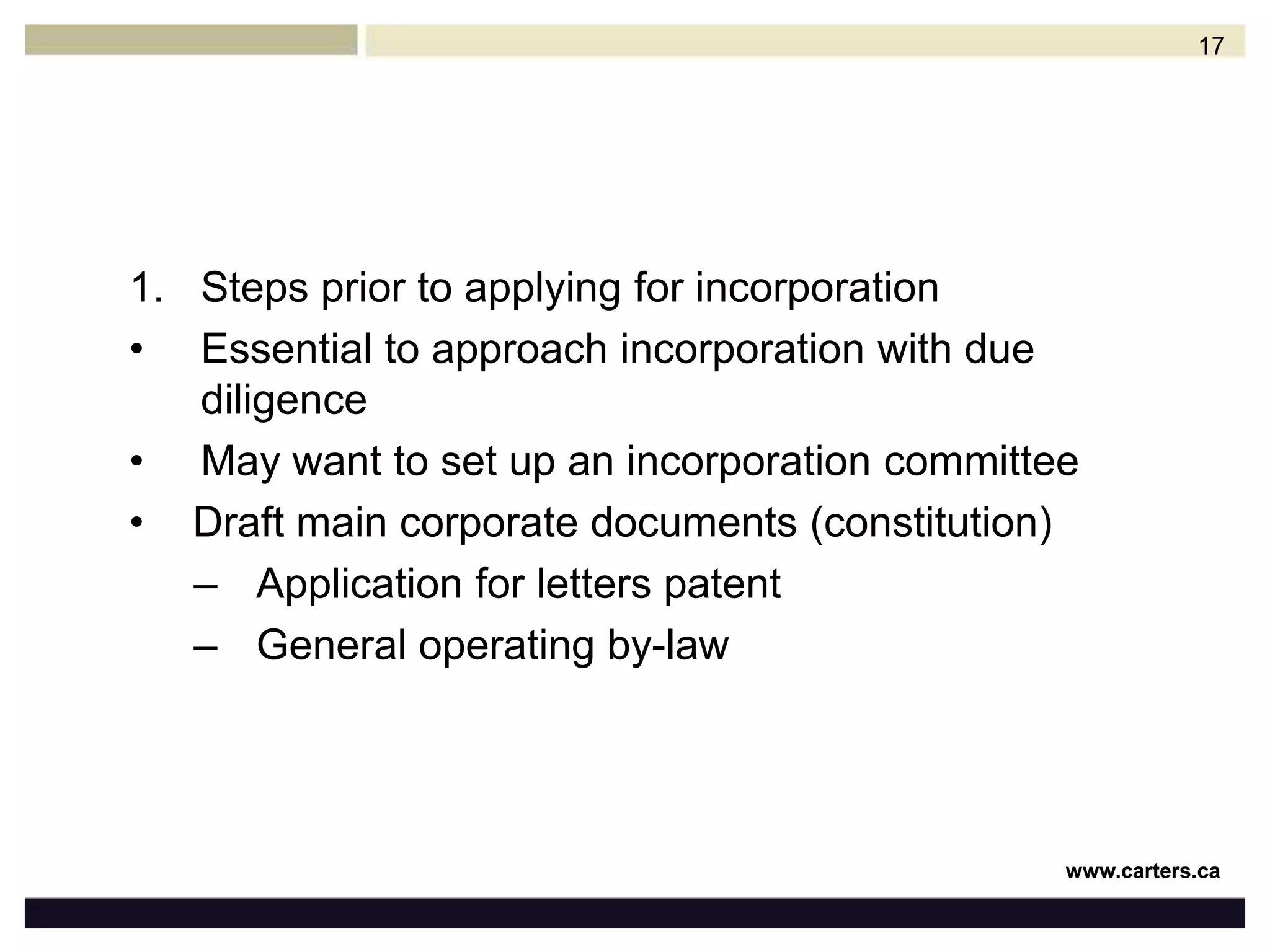
Steps prior to applying for incorporationEssential to approach incorporation with due diligence
May want to set up an incorporation committeeDraft main corporate documents (constitution)Application for letters patentGeneral operating by-law17
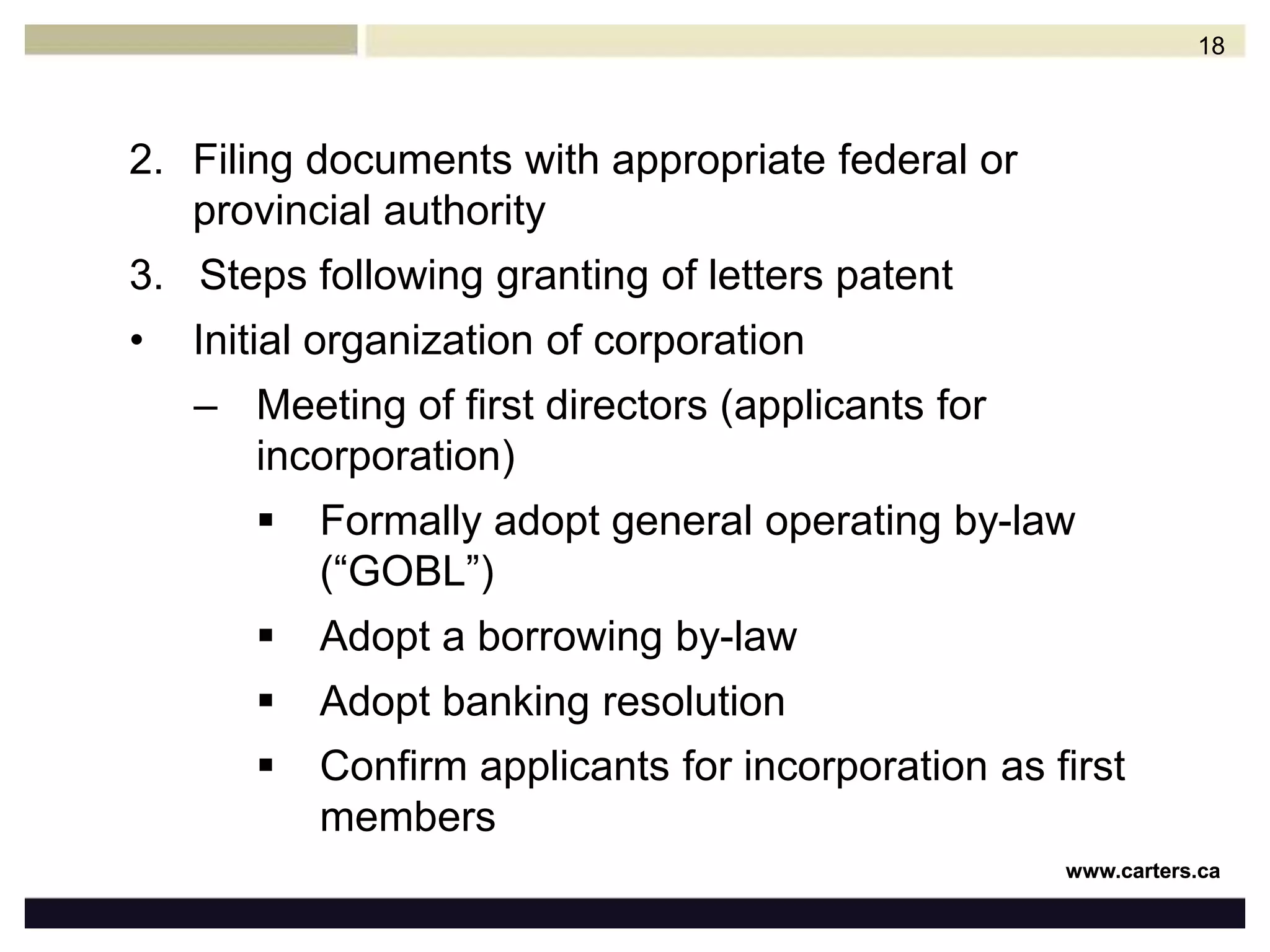
2. 	Filing documents with appropriate federal or provincial authority3.   Steps following granting of letters patentInitial organization of corporationMeeting of first directors (applicants for incorporation)Formally adopt general operating by-law (“GOBL”)Adopt a borrowing by-lawAdopt banking resolution Confirm applicants for incorporation as first members18
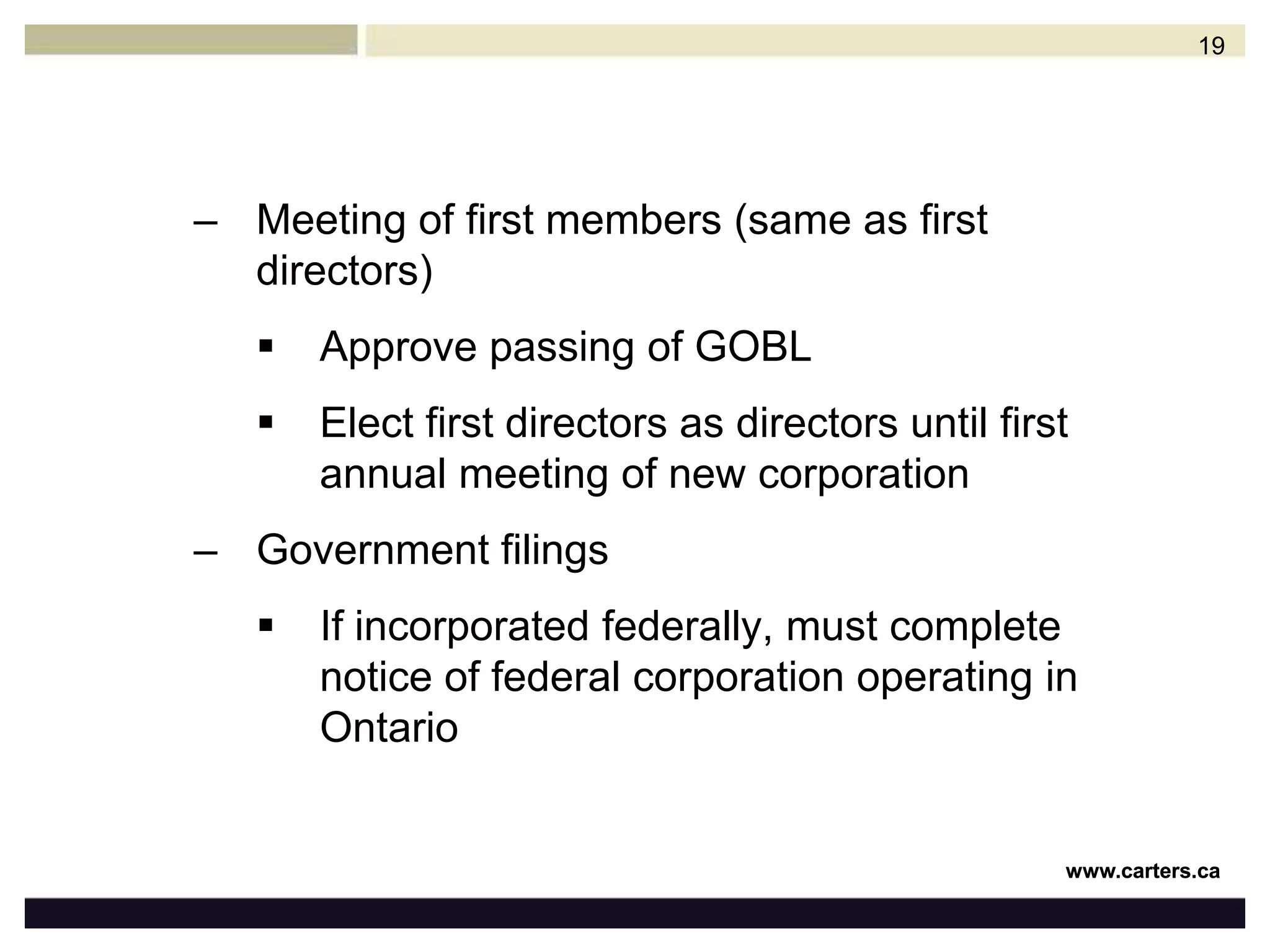
Meeting of first members (same as first directors)Approve passing of GOBLElect first directors as directors until first annual meeting of new corporationGovernment filingsIf incorporated federally, must complete notice of federal corporation operating in Ontario19
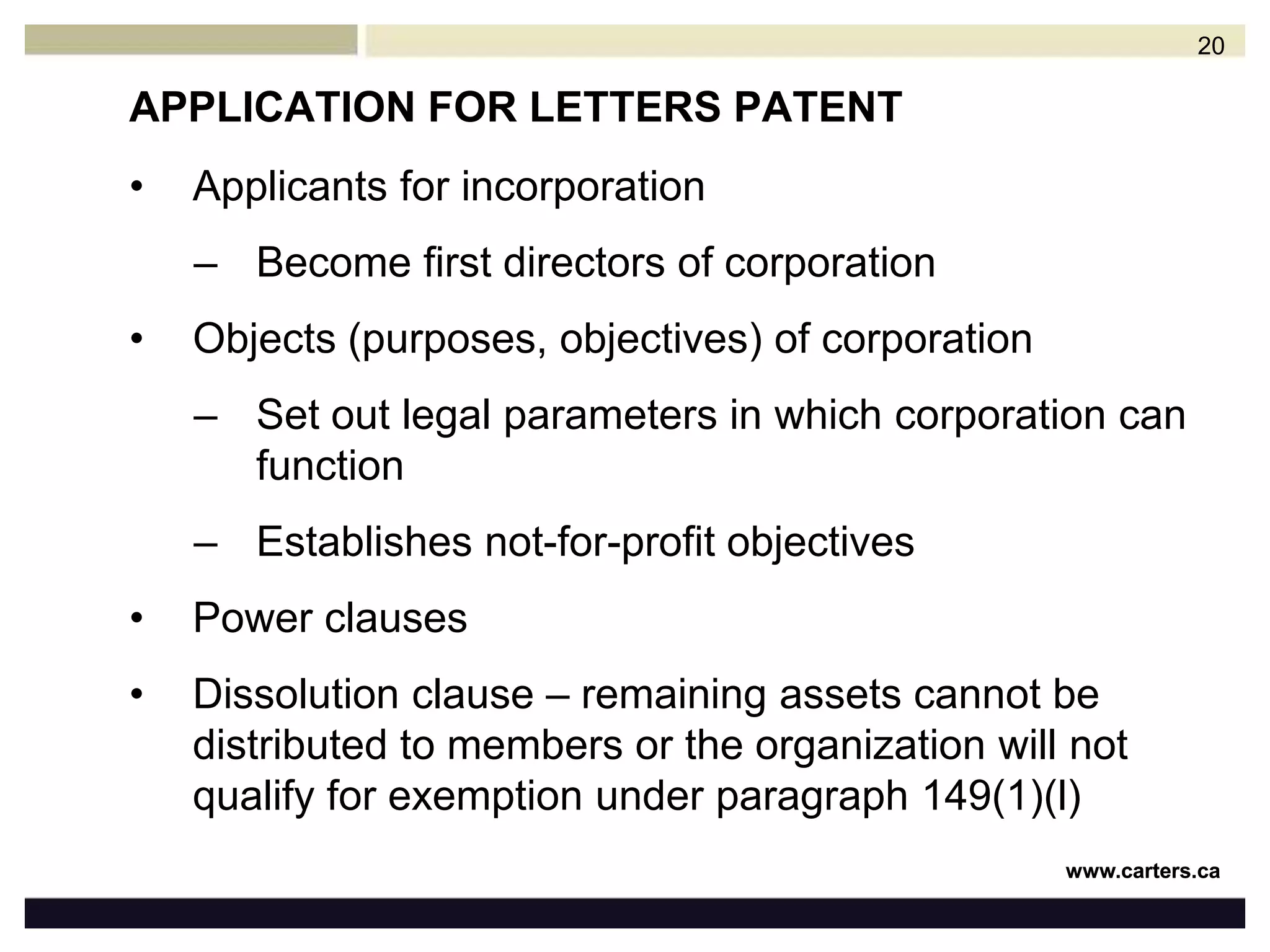
APPLICATION FOR LETTERS PATENTApplicants for incorporation Become first directors of corporationObjects (purposes, objectives) of corporationSet out legal parameters in which corporation can functionEstablishes not-for-profit objectivesPower clausesDissolution clause – remaining assets cannot be distributed to members or the organization will not qualify for exemption under paragraph 149(1)(l)20
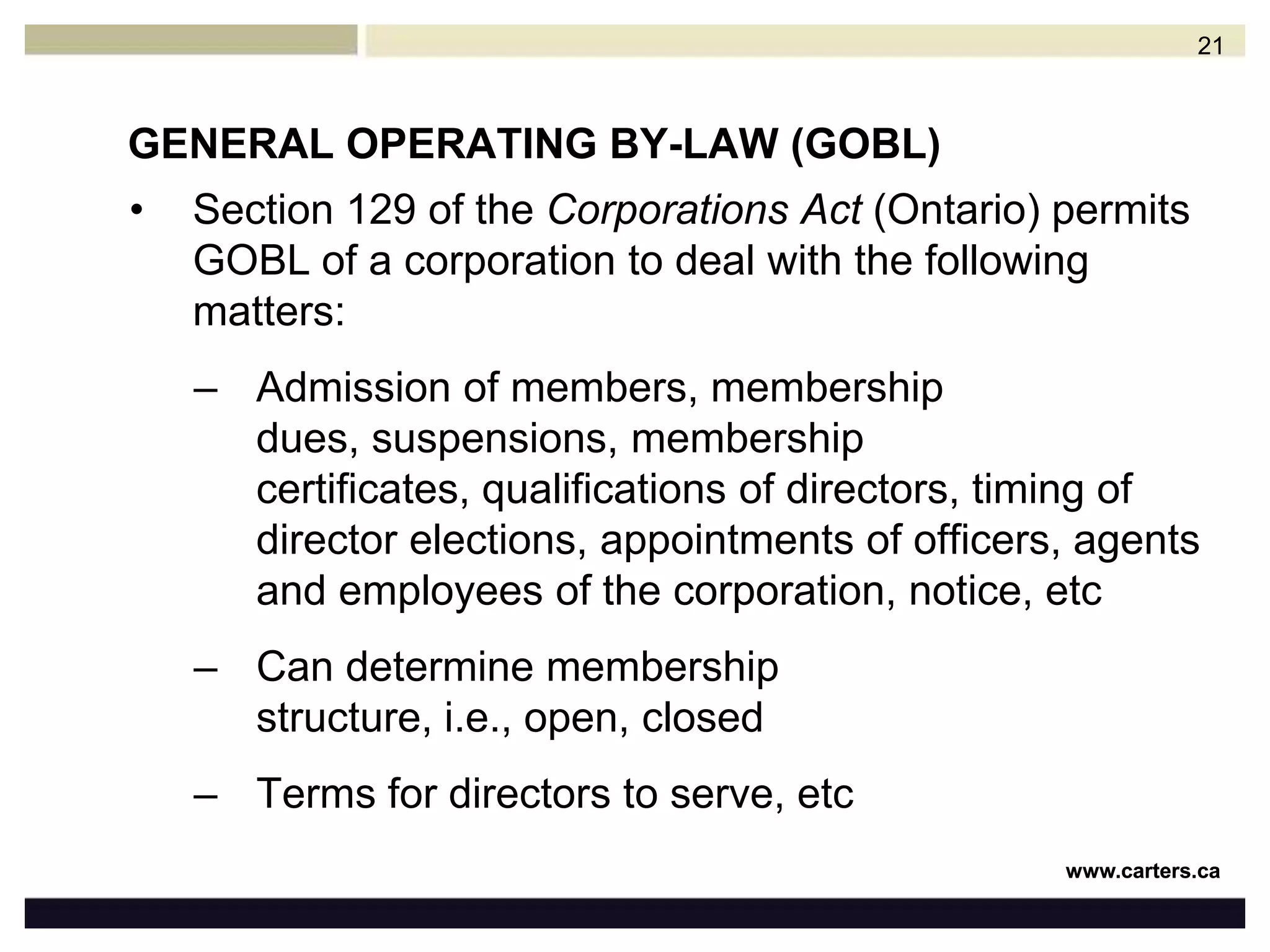
GENERAL OPERATING BY-LAW (GOBL)Section 129 of the Corporations Act (Ontario) permits GOBL of a corporation to deal with the following matters:Admission of members, membership dues, suspensions, membership certificates, qualifications of directors, timing of director elections, appointments of officers, agents and employees of the corporation, notice, etcCan determine membership structure, i.e., open, closedTerms for directors to serve, etc21
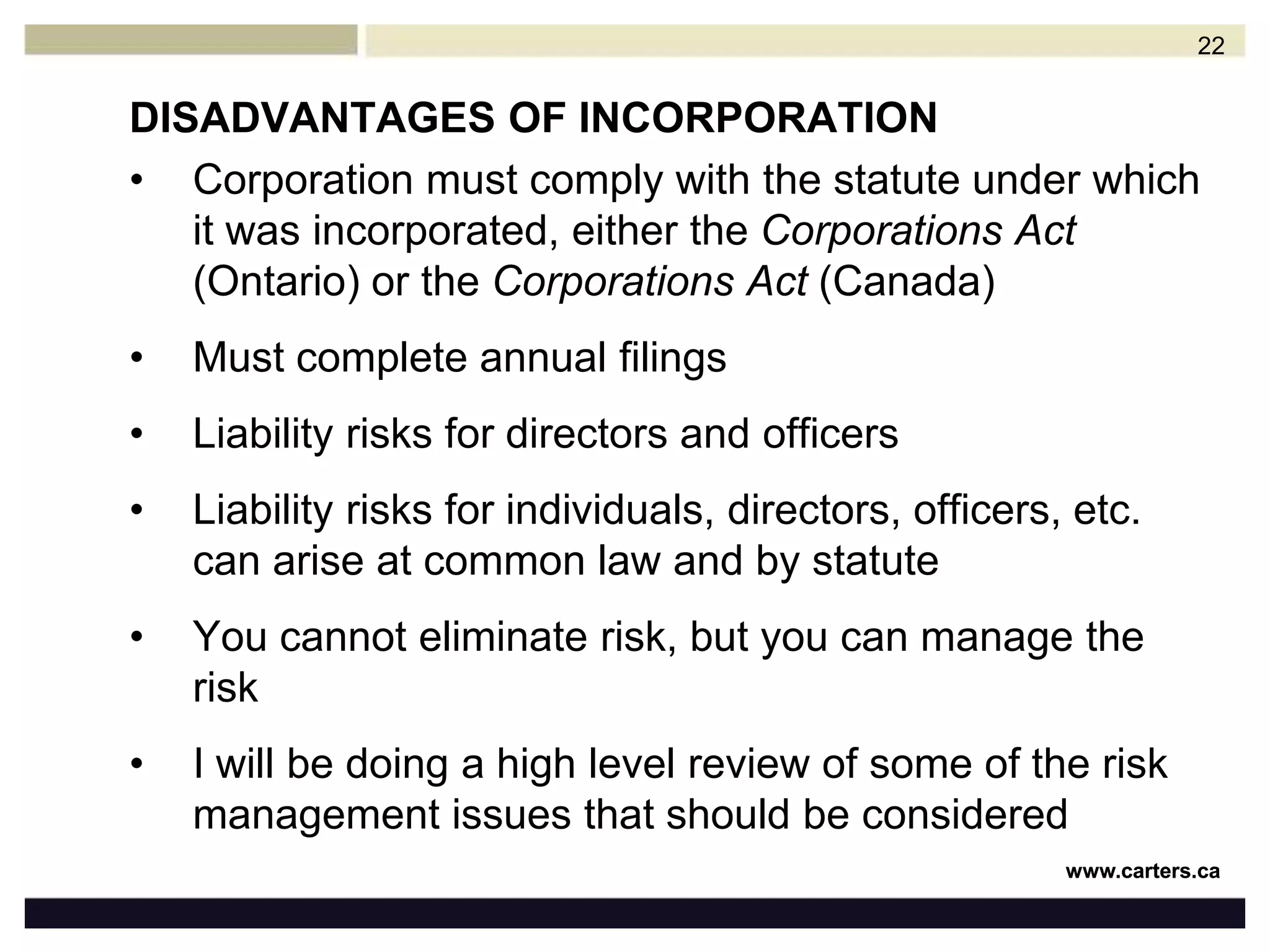
DISADVANTAGES OF INCORPORATIONCorporation must comply with the statute under which it was incorporated, either the Corporations Act (Ontario) or the Corporations Act (Canada)Must complete annual filingsLiability risks for directors and officersLiability risks for individuals, directors, officers, etc. can arise at common law and by statuteYou cannot eliminate risk, but you can manage the riskI will be doing a high level review of some of the risk management issues that should be considered 22
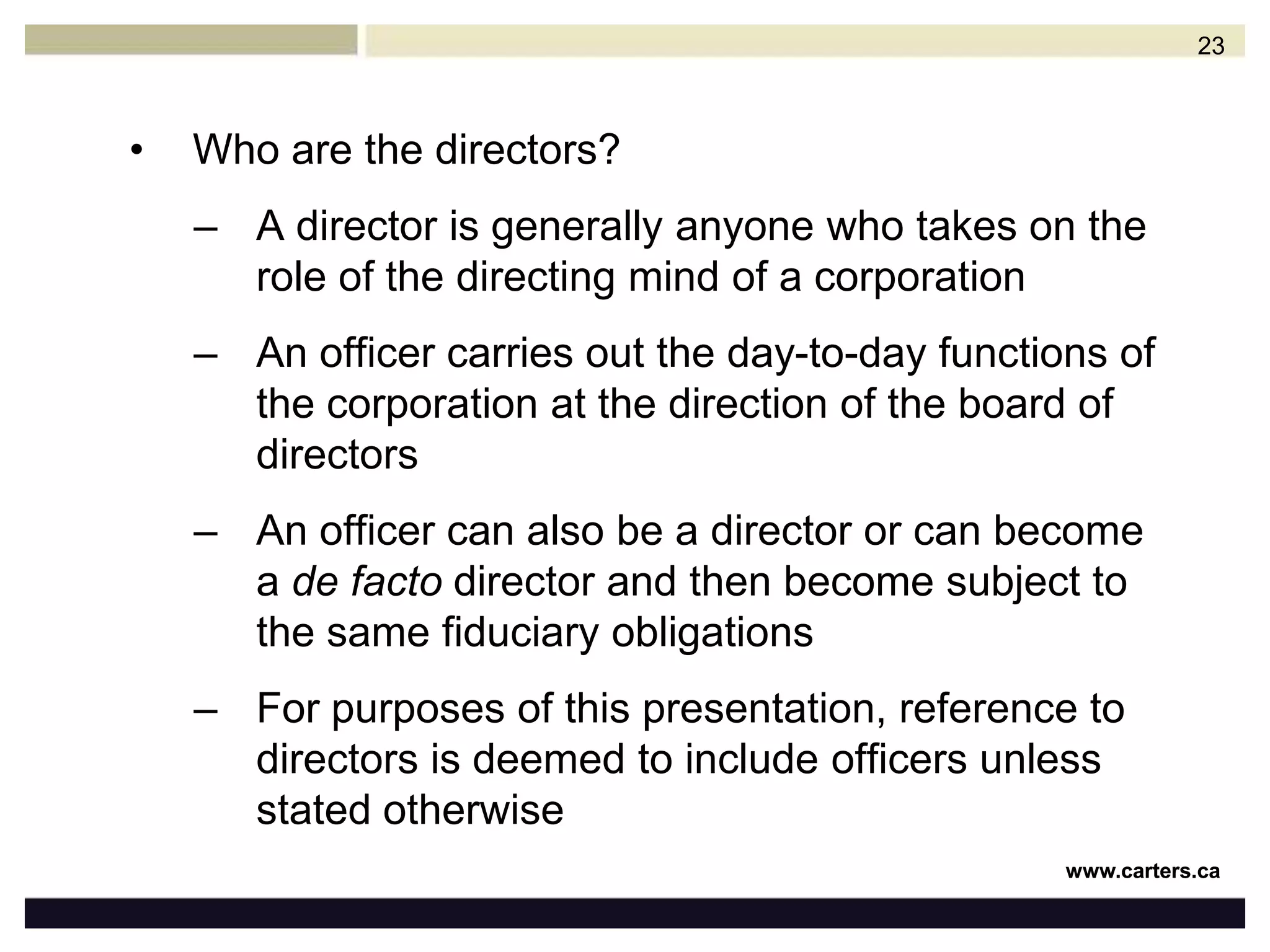
Who are the directors?A director is generally anyone who takes on the role of the directing mind of a corporationAn officer carries out the day-to-day functions of the corporation at the direction of the board of directorsAn officer can also be a director or can become a de facto director and then become subject to the same fiduciary obligationsFor purposes of this presentation, reference to directors is deemed to include officers unless stated otherwise23
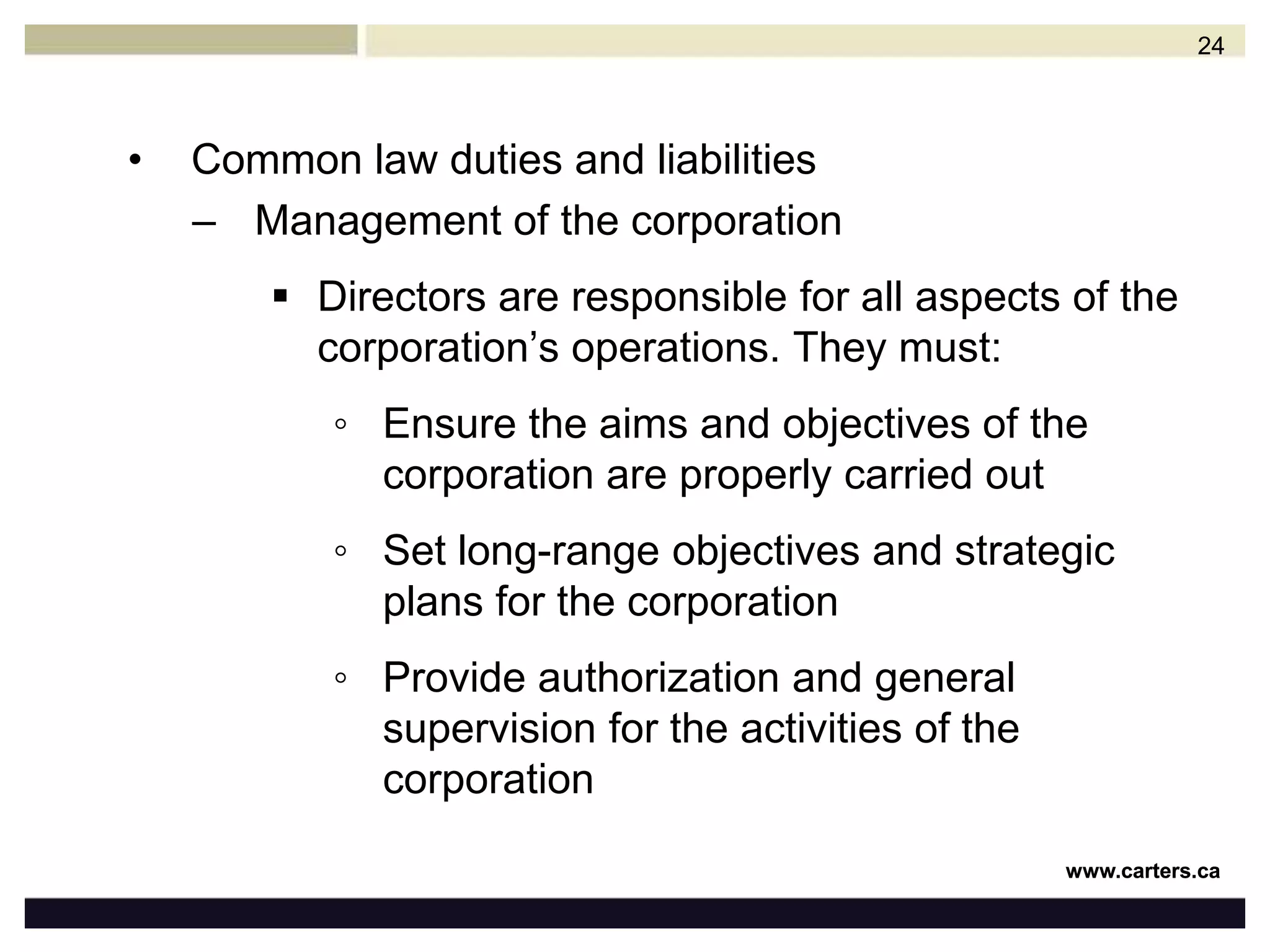
Common law duties and liabilitiesManagement of the corporationDirectors are responsible for all aspects of the corporation’s operations. They must:Ensure the aims and objectives of the corporation are properly carried outSet long-range objectives and strategic plans for the corporationProvide authorization and general supervision for the activities of the corporation 24
Ensure the corporation’s financial stability and overall performanceHire and supervise management and staff to do the day-to-day workDuty of CareDirectors of all corporations must exercise a certain standard of care in carrying out their dutiesMost corporate statutes set out this standard as the duty to exercise the “care, diligence and skill that a reasonably prudent person would exercise in comparable circumstances”25
“Business Judgment Rule”: protects directors and senior officers against hindsight and second guessing by members and other stakeholdersi.e. The court will defer to the business expertise of the directors and will not interfere with reasonable business decisionsDirectors therefore need to ask themselves:Have they analyzed and understood the issue before them?26
Have they retained independent advisors or advisors recommended by management and do the advisors have the requisite expertise and experience?Have they tested and challenged their advisors, or merely followed recommendations without question?Is the amount of time that they have spent on the issue proportionate to its importance and complexity?27
Liability Risk in ContractDirectors are generally not personally responsible for contracts they sign for the corporation, provided they have the proper authority to do so, which is determined by the corporation’s governing documents or by board resolutionsHowever, directors of corporations may face potential liability where:They enter into a contract lacking the necessary authority to do so 28
They do not properly identify the corporation in any contract or to the contracting partyThe other party believes the director is signing in his or her own nameThey are found to have induced a breach of contract prior to the signing of the contract They do not follow through to ensure that the corporation complies with a contractTo reduce liability exposure, directors should ensure contracts are duly authorized by the board before entering into them29
Continuation of DutiesDirectors have continuing obligations to the corporation which cannot be relieved by resignationResignation to avoid personal liability may be ineffective and constitute a breach of fiduciary duty where the director puts own interests ahead of those of the corporation 30
STATUTORY DUTIES & LIABILITIESMany federal and provincial statutes impose specific offences and penalties for acts and omissions committed by directorsPurpose of such liability on directors is that the corporation cannot be sufficiently punished itself, therefore its directors must be exposed to the same liability as the corporationLegislation imposes liability on directors and de facto directors31
Offences are strict liability offences, meaning it is immaterial whether or not the directors intended that the corporation violate the statutory provisions in questionOnly defence that can be established is one of “due diligence”, which requires that the directors be able to prove to the satisfaction of a court that the directors have taken reasonable steps in the circumstances to ensure that the provisions of the Act in question could have been complied with 32
Penalties for non-compliance with statutory requirements can result in directors being subject to fines, repayment of debt and even imprisonmentWhile the focus of this summary is the federal and Ontario jurisdictions, business corporations either located or operating in other provinces must also review the comparable provincial legislation and statutory obligations 33
Federal StatutesITADirectors jointly and severally liable for:Failure to remit employee deductionsFailure to comply with numerous reporting requirements under the ITAMaking false or deceptive statements in any return required under the ITA or wilfully evading compliance with the ITA34
Excise Tax ActCanada Pension PlanCanadian Environmental Protection ActCriminal CodeOntario StatutesCorporations ActEmployment Standards ActRetail Sales Tax ActWorkplace Safety and Insurance Act35
Pension Benefits ActHealth Insurance ActEmployer Health Tax ActOccupational Health and Safety ActEnvironmental Protection ActBusinesses need to determine what legislation applies to their industry and review the liability provisions36
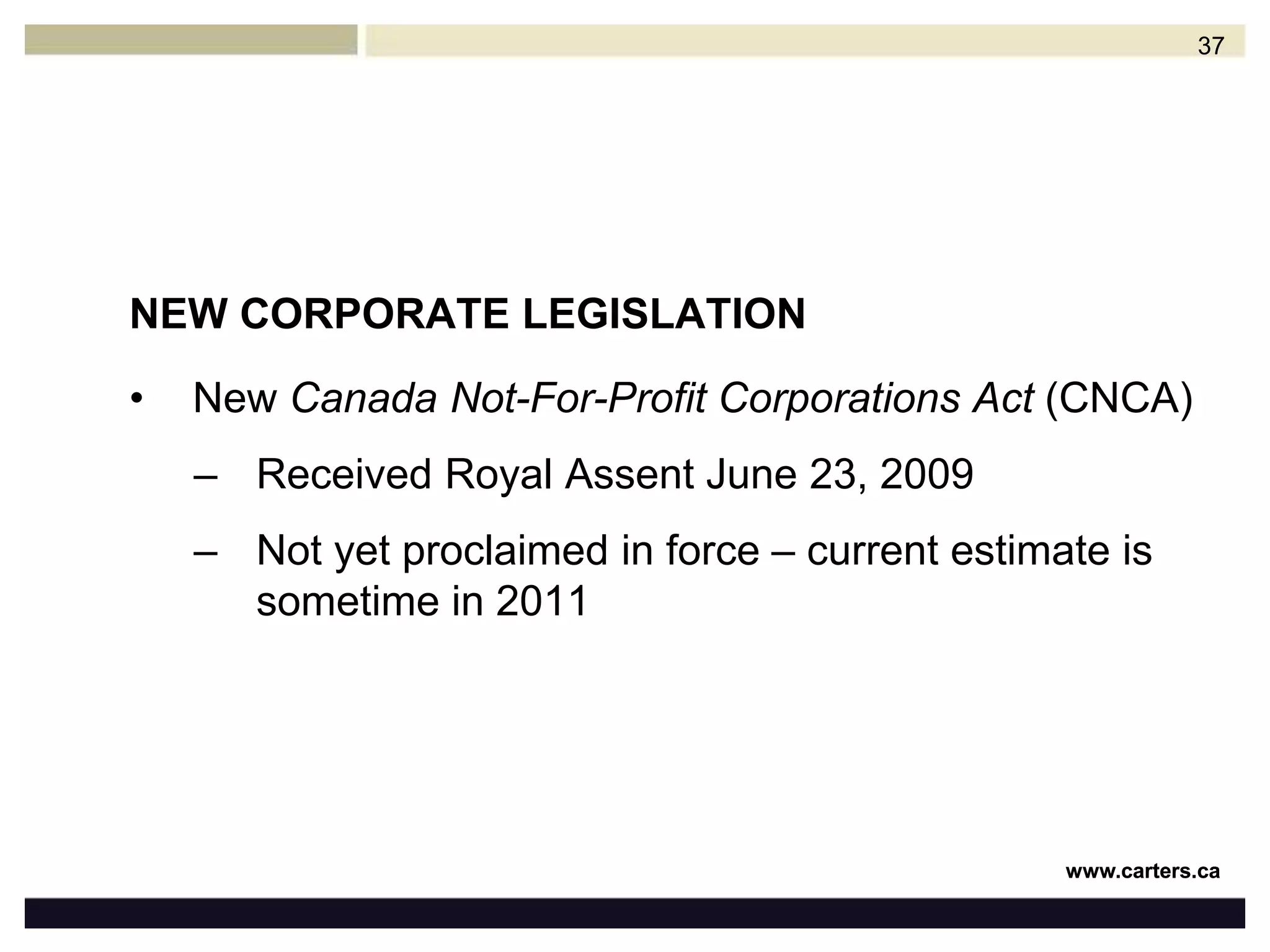
NEW CORPORATE LEGISLATIONNew Canada Not-For-Profit Corporations Act (CNCA)Received Royal Assent June 23, 2009 Not yet proclaimed in force – current estimate is sometime in 201137
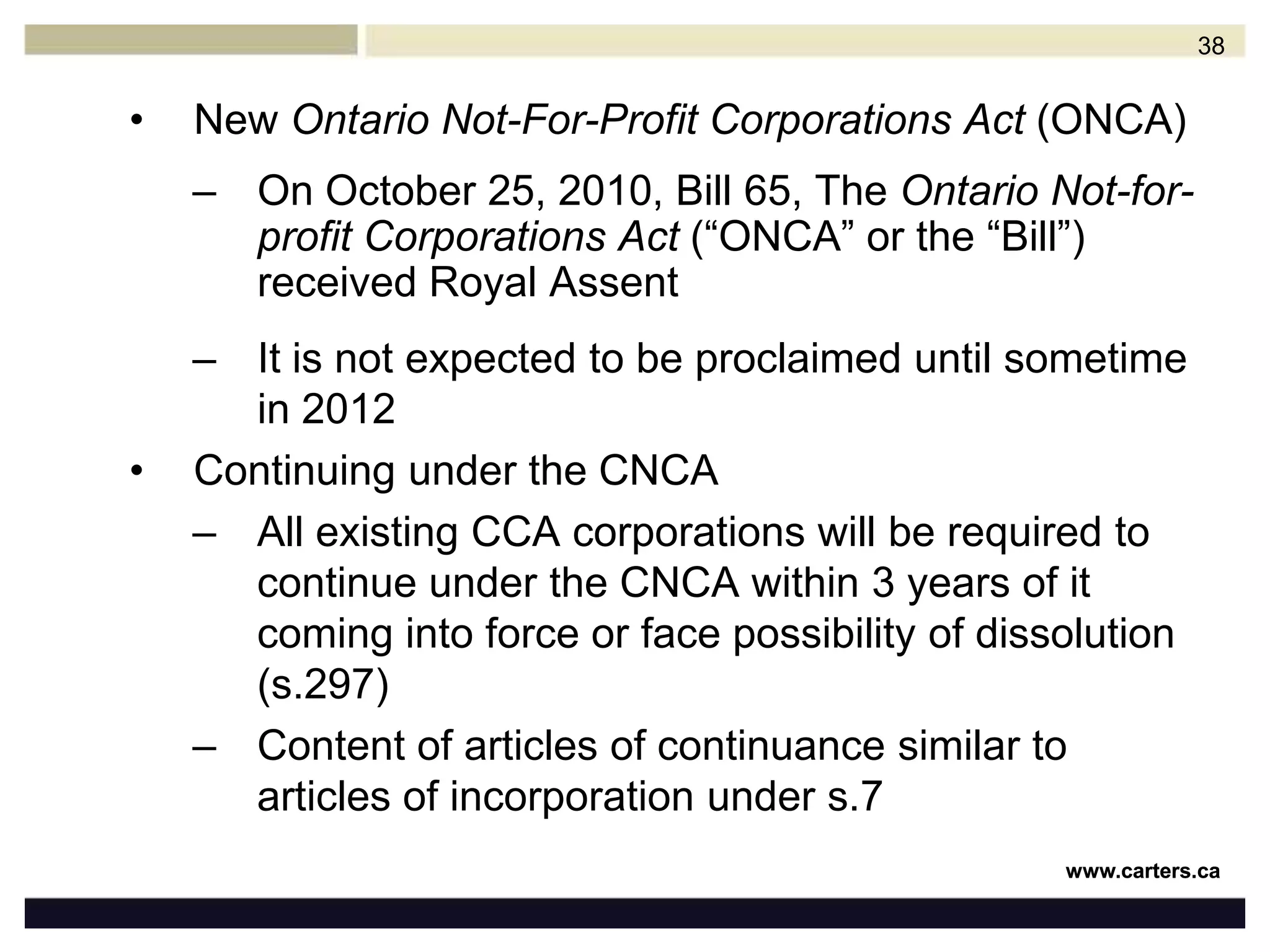
New Ontario Not-For-Profit Corporations Act (ONCA)On October 25, 2010, Bill 65, The Ontario Not-for-profit Corporations Act (“ONCA” or the “Bill”) received Royal Assent It is not expected to be proclaimed until sometime in 2012Continuing under the CNCAAll existing CCA corporations will be required to continue under the CNCA within 3 years of it coming into force or face possibility of dissolution (s.297)Content of articles of continuance similar to articles of incorporation under s.738
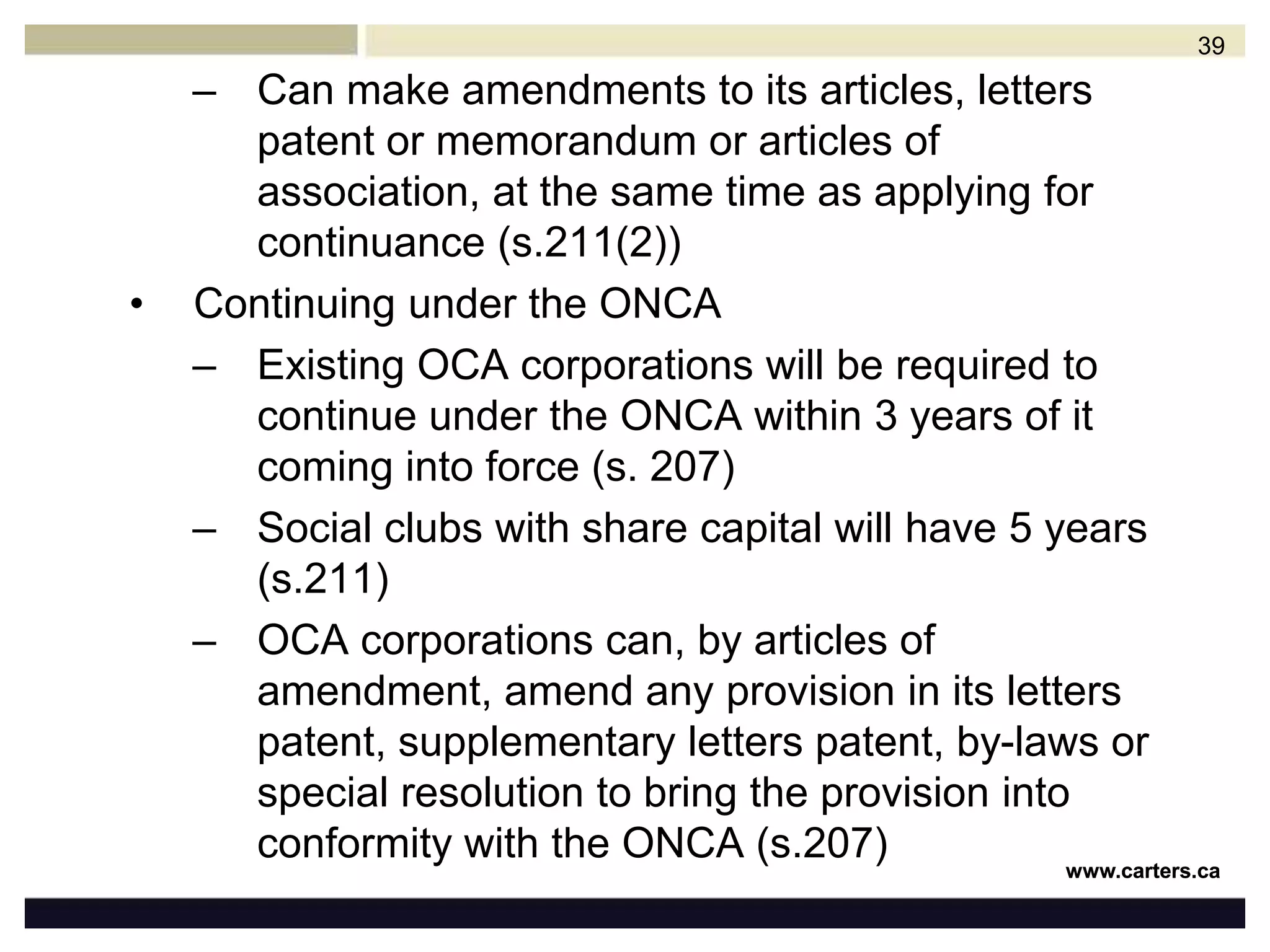
Can make amendments to its articles, letters patent or memorandum or articles of association, at the same time as applying for continuance (s.211(2))Continuing under the ONCAExisting OCA corporations will be required to continue under the ONCA within 3 years of it coming into force (s. 207)Social clubs with share capital will have 5 years (s.211)OCA corporations can, by articles of amendment, amend any provision in its letters patent, supplementary letters patent, by-laws or special resolution to bring the provision into conformity with the ONCA (s.207)39

Advantages and Disadvantages of Incorporating as a Not-for-profit

  • 1.
    YORK SMALL BUSINESSENTERPRISE CENTRE GREEN CONNECTIONSDecember 13, 2010Advantages and Disadvantages of Incorporating as a Not-for-profitBy Ryan M. Prendergast, B.A. LL.B. rprendergast@carters.ca© 2010 Carters Professional Corporation
  • 2.
    2OVERVIEW OF TOPICS IntroductionNatureof Not-for-profit OrganizationsNon-profit Status Under the ITAMaintaining Non-profit StatusCharities and Not-for-profit OrganizationsNature of Unincorporated AssociationBenefits of IncorporationDisadvantages of Incorporation and LiabilitiesNew Federal and Provincial Corporate Legislation
  • 3.
    NATURE OF NOT-FOR-PROFITORGANIZATIONSNot-for-profit Organizations – Key ConceptsWhat is a not-for-profit under the Income Tax Act (“ITA”)(technically a “non-profit organization”)?Club, society or associationIn the opinion of the Ministry was not a charityOrganized and operated exclusively for social welfare, civic improvement, pleasure or recreation, or any other purpose, except profitNo part of the income can be payable or available for the personal benefit of any proprietor, member or shareholder3
  • 4.
    What are thelegal forms available for non-profit organizations?Corporation with share capitalCorporation without share capitalUnincorporated AssociationExamples would includeRecreational clubsService clubsTrade associationsProfessional associations4
  • 5.
    NON-PROFIT STATUS UNDERTHE ITAWhat are the tax advantages of being a non-profit organization under the ITA?A non-profit organization does not pay tax on income or capital gains, except income from property of an organization whose main purpose is to provide dining, recreation or sporting facilities However, a non-profit organization cannot issue charitable receipts for income tax purposes 5
  • 6.
    MAINTAINING NON-PROFIT STATUSCannothave a profit-earning purpose, even if that profit is to be used for the not-for-profit purposes of the non-profit organizationIt is always a question of fact whether an organization is operating for the purpose of earning a profitProfit is generally considered to be the positive difference between an organization’s revenue and the expenses incurred to earn that revenue Important not to be considered a charity in the opinion of the Minister of RevenueNo appeal from Minister’s decision, it is therefore customary to include a purpose in the objects of the corporation that cannot be charitable at law6
  • 7.
    Must meet thedefinition of a non-profit organization under the ITAon a yearly basisCannot maintain reserves in excess of a reasonable operational reserveMaintaining a large amount of capital solely for the purpose of generating income to support the organization will prevent the organization from being tax-exempt under paragraph 149(1)(l)Must file a T2 Return if incorporatedIf the organization has income greater than $10,000 or assets exceeding $200,000, it must file a T1044 NPO Return7
  • 8.
    What happens inthe corporation no longer qualifies for tax exempt status?Just because a non-profit organization was not reviewed for several years does not mean that CRA accepted that you were entitled to the exemptionIf audited, each year would be examined separately to determine whether the non-profit organization qualified for the exemption each yearA non-profit organization can be re-assessed 3 years in the past, or, if there has been a misrepresentation, the corporation can be reassessed at any time8
  • 9.
    Subsection 149(10) ofthe ITA will apply at the time the corporation ceases to be a 149(1)(l) entity and provides that the non-profit organization’s taxation year will end immediately before that time A new taxation year of the corporation is deemed to have begun at that timeProperty of the corporation will be deemed to have been disposed of at fair market value149(10) applies only if the organization is incorporated9
  • 10.
    IDENTIFYING THE DIFFERENCESBETWEEN CHARITIES AND NOT-FOR-PROFIT ORGANIZATIONSCharities - Key ConceptsWhat is a charity?At common-law a charity includesRelief of povertyAdvancement of educationAdvancement of religionOther purposes beneficial to the community recognized by the courts10
  • 11.
    What are thetax advantages of being a charity?A charity does not pay tax on income or capital gainsA charity can issue charitable receipts to donors as tax credits (for individuals) deductions (for corporations) for income tax purposesA gift for income tax purposes now permit consideration to be received back by the donor (split-receipting)What are the legal forms available for a charity?Unincorporated associations Charitable trustsNon-share capital corporations11
  • 12.
    NATURE OF UNINCORPORATEDASSOCIATIONIt is not mandatory for a not-for-profit organization to incorporate to receive the exemption under paragraph 149(1)(l) of the ITAAn unincorporated association is a voluntary association of individualsNo separate existence apart from membersNot a legal personNo ability to own property in its nameNo separate protection from liability for members12
  • 13.
    13ExecutiveMemberso o oo oo o o o oo o o o oThird Party ClaimsCannot sue or be sued in the name of the associationPersonal liability of members for torts committed by other members or agents of the association and contracts of the association
  • 14.
    BENEFITS OF INCORPORATIONSeparatelegal entity apart from its membersPerpetual existenceLimited liability of members (but does not obviate due diligence)Allows for indemnification of directors and officersCapacity to commence and defend legal actions in its own nameCan hold property in its own name14
  • 15.
    15Third Party ClaimsEmployees& VolunteersOfficersDirectorsMembers(Non-Owners But Often Beneficiaries)Directors may be still exposed to personal liability from fiduciary and management responsibilitiesPublic
  • 16.
    PROCESS OF INCORPORATIONAnote about incorporating under not-for-profit legislationWhether an entity qualifies for the tax exemption can only be determined once the entity is established, has been operating and has filed a tax returnAn organization can be incorporated under a federal or provincial statute that uses the term “not-for-profit” but still not qualify for the tax exemption16
  • 17.
    Steps prior toapplying for incorporationEssential to approach incorporation with due diligence
  • 18.
    May want toset up an incorporation committeeDraft main corporate documents (constitution)Application for letters patentGeneral operating by-law17
  • 19.
    2. Filing documentswith appropriate federal or provincial authority3. Steps following granting of letters patentInitial organization of corporationMeeting of first directors (applicants for incorporation)Formally adopt general operating by-law (“GOBL”)Adopt a borrowing by-lawAdopt banking resolution Confirm applicants for incorporation as first members18
  • 20.
    Meeting of firstmembers (same as first directors)Approve passing of GOBLElect first directors as directors until first annual meeting of new corporationGovernment filingsIf incorporated federally, must complete notice of federal corporation operating in Ontario19
  • 21.
    APPLICATION FOR LETTERSPATENTApplicants for incorporation Become first directors of corporationObjects (purposes, objectives) of corporationSet out legal parameters in which corporation can functionEstablishes not-for-profit objectivesPower clausesDissolution clause – remaining assets cannot be distributed to members or the organization will not qualify for exemption under paragraph 149(1)(l)20
  • 22.
    GENERAL OPERATING BY-LAW(GOBL)Section 129 of the Corporations Act (Ontario) permits GOBL of a corporation to deal with the following matters:Admission of members, membership dues, suspensions, membership certificates, qualifications of directors, timing of director elections, appointments of officers, agents and employees of the corporation, notice, etcCan determine membership structure, i.e., open, closedTerms for directors to serve, etc21
  • 23.
    DISADVANTAGES OF INCORPORATIONCorporationmust comply with the statute under which it was incorporated, either the Corporations Act (Ontario) or the Corporations Act (Canada)Must complete annual filingsLiability risks for directors and officersLiability risks for individuals, directors, officers, etc. can arise at common law and by statuteYou cannot eliminate risk, but you can manage the riskI will be doing a high level review of some of the risk management issues that should be considered 22
  • 24.
    Who are thedirectors?A director is generally anyone who takes on the role of the directing mind of a corporationAn officer carries out the day-to-day functions of the corporation at the direction of the board of directorsAn officer can also be a director or can become a de facto director and then become subject to the same fiduciary obligationsFor purposes of this presentation, reference to directors is deemed to include officers unless stated otherwise23
  • 25.
    Common law dutiesand liabilitiesManagement of the corporationDirectors are responsible for all aspects of the corporation’s operations. They must:Ensure the aims and objectives of the corporation are properly carried outSet long-range objectives and strategic plans for the corporationProvide authorization and general supervision for the activities of the corporation 24
  • 26.
    Ensure the corporation’sfinancial stability and overall performanceHire and supervise management and staff to do the day-to-day workDuty of CareDirectors of all corporations must exercise a certain standard of care in carrying out their dutiesMost corporate statutes set out this standard as the duty to exercise the “care, diligence and skill that a reasonably prudent person would exercise in comparable circumstances”25
  • 27.
    “Business Judgment Rule”:protects directors and senior officers against hindsight and second guessing by members and other stakeholdersi.e. The court will defer to the business expertise of the directors and will not interfere with reasonable business decisionsDirectors therefore need to ask themselves:Have they analyzed and understood the issue before them?26
  • 28.
    Have they retainedindependent advisors or advisors recommended by management and do the advisors have the requisite expertise and experience?Have they tested and challenged their advisors, or merely followed recommendations without question?Is the amount of time that they have spent on the issue proportionate to its importance and complexity?27
  • 29.
    Liability Risk inContractDirectors are generally not personally responsible for contracts they sign for the corporation, provided they have the proper authority to do so, which is determined by the corporation’s governing documents or by board resolutionsHowever, directors of corporations may face potential liability where:They enter into a contract lacking the necessary authority to do so 28
  • 30.
    They do notproperly identify the corporation in any contract or to the contracting partyThe other party believes the director is signing in his or her own nameThey are found to have induced a breach of contract prior to the signing of the contract They do not follow through to ensure that the corporation complies with a contractTo reduce liability exposure, directors should ensure contracts are duly authorized by the board before entering into them29
  • 31.
    Continuation of DutiesDirectorshave continuing obligations to the corporation which cannot be relieved by resignationResignation to avoid personal liability may be ineffective and constitute a breach of fiduciary duty where the director puts own interests ahead of those of the corporation 30
  • 32.
    STATUTORY DUTIES &LIABILITIESMany federal and provincial statutes impose specific offences and penalties for acts and omissions committed by directorsPurpose of such liability on directors is that the corporation cannot be sufficiently punished itself, therefore its directors must be exposed to the same liability as the corporationLegislation imposes liability on directors and de facto directors31
  • 33.
    Offences are strictliability offences, meaning it is immaterial whether or not the directors intended that the corporation violate the statutory provisions in questionOnly defence that can be established is one of “due diligence”, which requires that the directors be able to prove to the satisfaction of a court that the directors have taken reasonable steps in the circumstances to ensure that the provisions of the Act in question could have been complied with 32
  • 34.
    Penalties for non-compliancewith statutory requirements can result in directors being subject to fines, repayment of debt and even imprisonmentWhile the focus of this summary is the federal and Ontario jurisdictions, business corporations either located or operating in other provinces must also review the comparable provincial legislation and statutory obligations 33
  • 35.
    Federal StatutesITADirectors jointlyand severally liable for:Failure to remit employee deductionsFailure to comply with numerous reporting requirements under the ITAMaking false or deceptive statements in any return required under the ITA or wilfully evading compliance with the ITA34
  • 36.
    Excise Tax ActCanadaPension PlanCanadian Environmental Protection ActCriminal CodeOntario StatutesCorporations ActEmployment Standards ActRetail Sales Tax ActWorkplace Safety and Insurance Act35
  • 37.
    Pension Benefits ActHealthInsurance ActEmployer Health Tax ActOccupational Health and Safety ActEnvironmental Protection ActBusinesses need to determine what legislation applies to their industry and review the liability provisions36
  • 38.
    NEW CORPORATE LEGISLATIONNewCanada Not-For-Profit Corporations Act (CNCA)Received Royal Assent June 23, 2009 Not yet proclaimed in force – current estimate is sometime in 201137
  • 39.
    New Ontario Not-For-ProfitCorporations Act (ONCA)On October 25, 2010, Bill 65, The Ontario Not-for-profit Corporations Act (“ONCA” or the “Bill”) received Royal Assent It is not expected to be proclaimed until sometime in 2012Continuing under the CNCAAll existing CCA corporations will be required to continue under the CNCA within 3 years of it coming into force or face possibility of dissolution (s.297)Content of articles of continuance similar to articles of incorporation under s.738
  • 40.
    Can make amendmentsto its articles, letters patent or memorandum or articles of association, at the same time as applying for continuance (s.211(2))Continuing under the ONCAExisting OCA corporations will be required to continue under the ONCA within 3 years of it coming into force (s. 207)Social clubs with share capital will have 5 years (s.211)OCA corporations can, by articles of amendment, amend any provision in its letters patent, supplementary letters patent, by-laws or special resolution to bring the provision into conformity with the ONCA (s.207)39
  • 41.
    DisclaimerThis handout isprovided as an information service by Carters Professional Corporation. It is current only as of the date of the handout and does not reflect subsequent changes in the law. This handout is distributed with the understanding that it does not constitute legal advice or establish a solicitor/client relationship by way of any information contained herein. The contents are intended for general information purposes only and under no circumstances can be relied upon for legal decision-making. Readers are advised to consult with a qualified lawyer and obtain a written opinion concerning the specifics of their particular situation. © 2010 Carters Professional Corporation