Mechanics of Futures Markets Chapter 2
Futures Contracts Available on a wide range of underlyings Exchange traded Specifications need to be defined: What can be delivered, Where it can be delivered, &  When it can be delivered Settled daily
Margins A margin is cash or marketable securities deposited by an investor with his or her broker The balance in the margin account is adjusted to reflect daily settlement Margins minimize the possibility of a loss through a default on a contract
Example of a Futures Trade  (page 27-28) An investor takes a long position in 2 December gold futures contracts on June 5 contract size is 100 oz. futures price is US$400 margin requirement is US$2,000/contract (US$4,000 in total) maintenance margin is US$1,500/contract (US$3,000 in total)
A Possible Outcome Table 2.1, Page 28 Daily Cumulative Margin Futures Gain Gain Account Margin Price (Loss) (Loss) Balance Call Day (US$) (US$) (US$) (US$) (US$) 400.00 4,000 5-Jun 397.00 (600) (600) 3,400 0 . . . . . . . . . . . . . . . . . . 13-Jun 393.30 (420) (1,340) 2,660 1,340 . . . . . . . . . . . . . . . . . 19-Jun 387.00 (1,140) (2,600) 2,740 1,260 . . . . . . . . . . . . . . . . . . 26-Jun 392.30 260 (1,540) 5,060 0 + = 4,000 3,000 + = 4,000 <
Other Key Points About Futures They are settled daily Closing out a futures position  involves entering into an offsetting trade Most contracts are closed out before maturity
Collateralization in OTC Markets It is becoming increasingly common for contracts to be collateralized in OTC markets They are then similar to futures contracts in that they are settled regularly (e.g. every day or every week)
Futures Prices for Gold on Feb 4, 2004: Prices Increase with Maturity   (Figure 2.2, page 35)
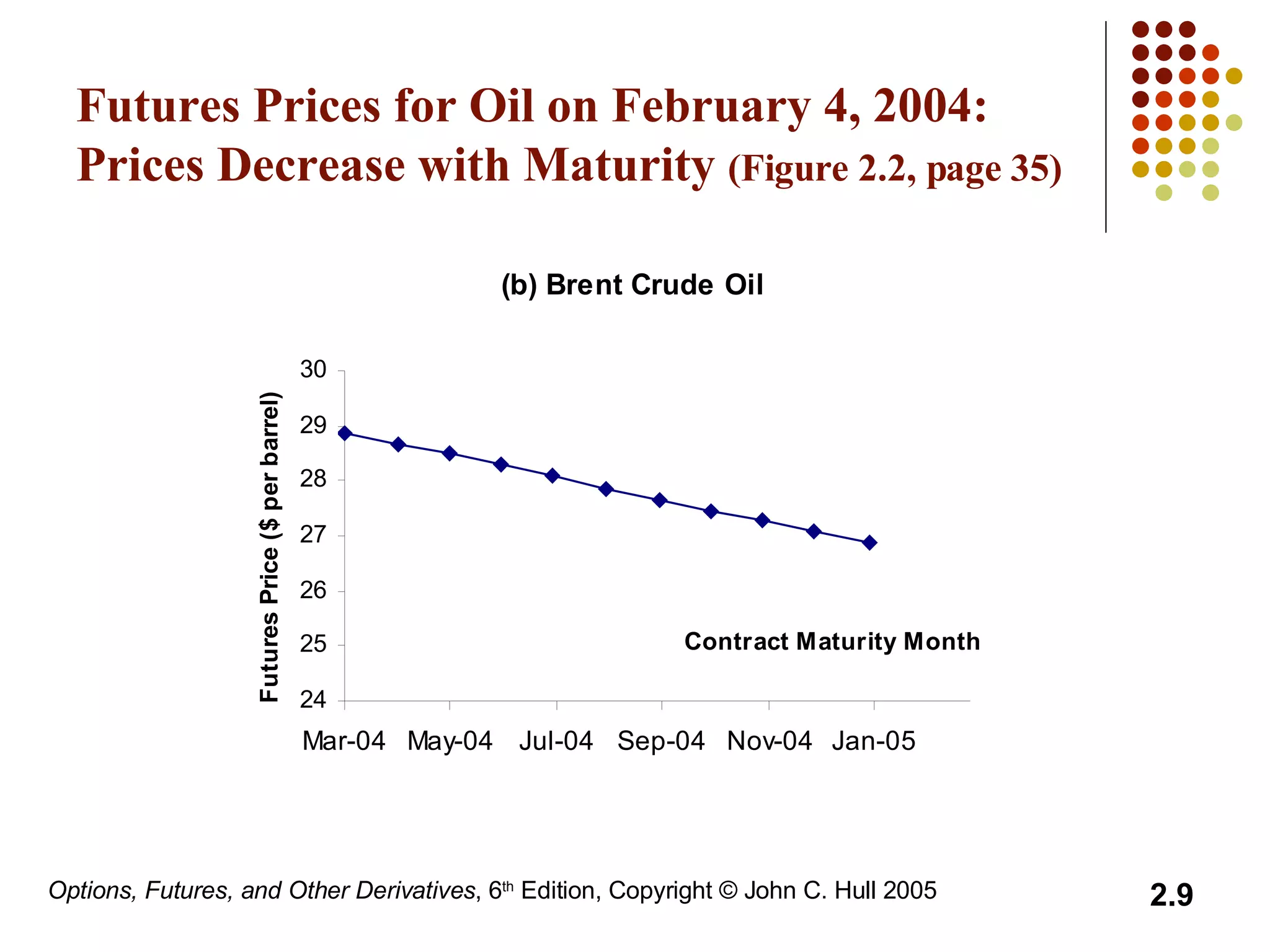
Futures Prices for Oil on February 4, 2004: Prices Decrease with Maturity  (Figure 2.2, page 35)
Delivery If a futures contract is not closed out before maturity, it is usually settled by delivering the assets underlying the contract. When there are alternatives about what is delivered, where it is delivered, and when it is delivered, the party with the short position chooses. A few contracts (for example, those on stock indices and Eurodollars) are settled in cash
Some Terminology Open interest:  the total number of contracts outstanding  equal to number of long positions or number of short positions Settlement price:  the price just before the final bell each day  used for the daily settlement process Volume of trading:  the number of trades in 1 day
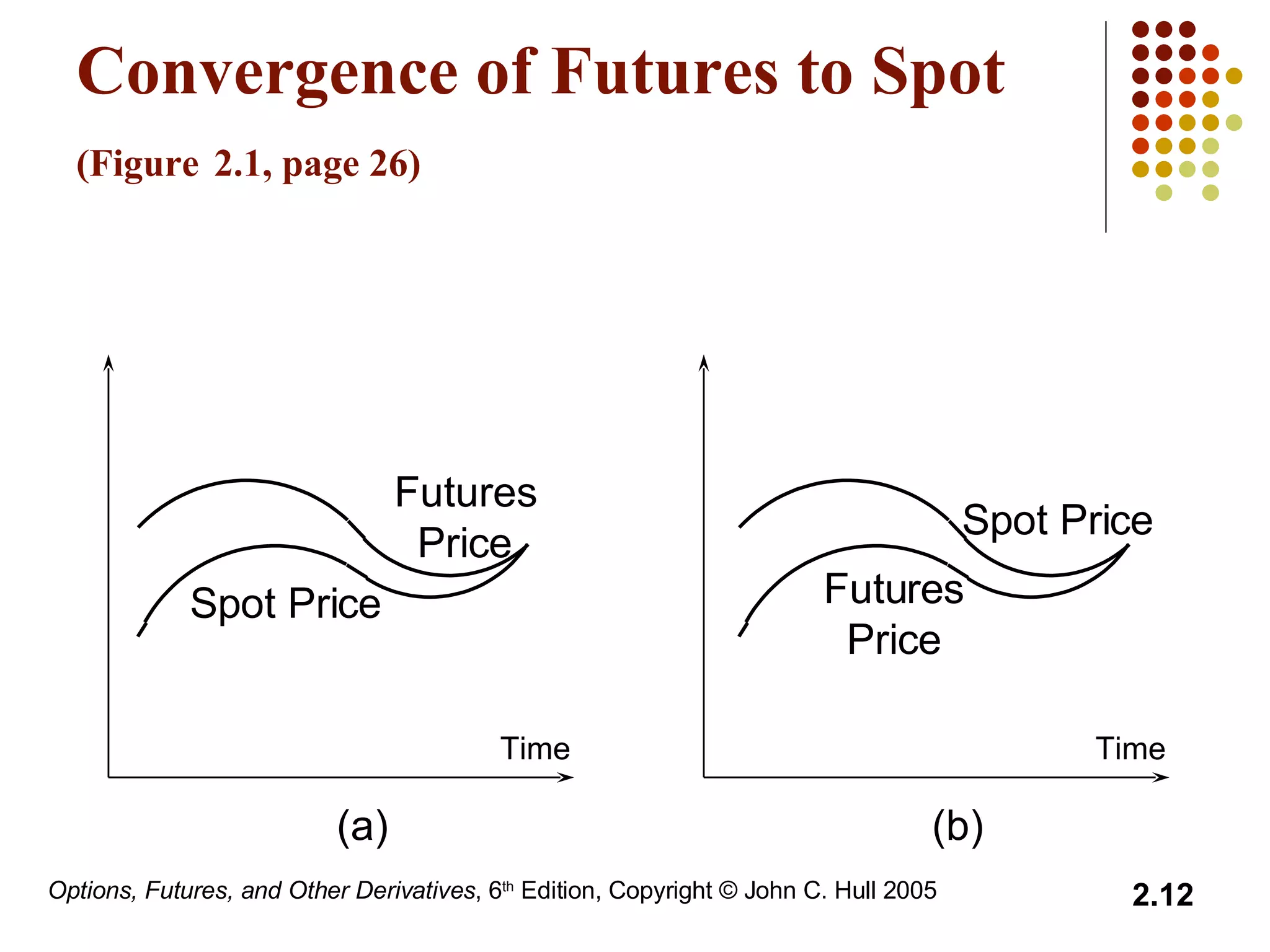
Convergence of Futures to Spot  (Figure   2.1, page 26) Time Time (a) (b) Futures Price Futures Price Spot Price Spot Price
Questions When a new trade is completed what are the possible effects on the open interest? Can the volume of trading in a day be greater than the open interest?
Regulation of Futures Regulation is designed to protect the public interest Regulators try to prevent questionable trading practices by either individuals on the floor of the exchange or outside groups
Accounting & Tax Ideally hedging  profits (losses) should be recognized at the same time as the losses (profits) on the item being hedged Ideally profits and losses from speculation should be recognized on a mark-to-market basis Roughly speaking, this is what the accounting and tax treatment of futures in the U.S.and many other countries attempts to achieve
Forward Contracts vs Futures Contracts Private contract between 2 parties Exchange traded Non-standard contract Standard contract Usually 1 specified delivery date Range of delivery dates Settled at end of contract Settled daily Delivery or final cash settlement usually occurs Contract usually closed out prior to maturity FORWARDS FUTURES TABLE 2.3 (p. 41) Some credit risk Virtually no credit risk
Foreign Exchange Quotes Futures exchange rates are quoted as the number of USD per unit of the foreign currency Forward exchange rates are quoted in the same way as spot exchange rates. This means that GBP, EUR, AUD, and NZD are quoted as USD per unit of foreign currency. Other currencies (e.g., CAD and JPY) are quoted as units of the foreign currency per USD.

Chap 2

  • 1.
    Mechanics of FuturesMarkets Chapter 2
  • 2.
    Futures Contracts Availableon a wide range of underlyings Exchange traded Specifications need to be defined: What can be delivered, Where it can be delivered, & When it can be delivered Settled daily
  • 3.
    Margins A marginis cash or marketable securities deposited by an investor with his or her broker The balance in the margin account is adjusted to reflect daily settlement Margins minimize the possibility of a loss through a default on a contract
  • 4.
    Example of aFutures Trade (page 27-28) An investor takes a long position in 2 December gold futures contracts on June 5 contract size is 100 oz. futures price is US$400 margin requirement is US$2,000/contract (US$4,000 in total) maintenance margin is US$1,500/contract (US$3,000 in total)
  • 5.
    A Possible OutcomeTable 2.1, Page 28 Daily Cumulative Margin Futures Gain Gain Account Margin Price (Loss) (Loss) Balance Call Day (US$) (US$) (US$) (US$) (US$) 400.00 4,000 5-Jun 397.00 (600) (600) 3,400 0 . . . . . . . . . . . . . . . . . . 13-Jun 393.30 (420) (1,340) 2,660 1,340 . . . . . . . . . . . . . . . . . 19-Jun 387.00 (1,140) (2,600) 2,740 1,260 . . . . . . . . . . . . . . . . . . 26-Jun 392.30 260 (1,540) 5,060 0 + = 4,000 3,000 + = 4,000 <
  • 6.
    Other Key PointsAbout Futures They are settled daily Closing out a futures position involves entering into an offsetting trade Most contracts are closed out before maturity
  • 7.
    Collateralization in OTCMarkets It is becoming increasingly common for contracts to be collateralized in OTC markets They are then similar to futures contracts in that they are settled regularly (e.g. every day or every week)
  • 8.
    Futures Prices forGold on Feb 4, 2004: Prices Increase with Maturity (Figure 2.2, page 35)
  • 9.
    Futures Prices forOil on February 4, 2004: Prices Decrease with Maturity (Figure 2.2, page 35)
  • 10.
    Delivery If afutures contract is not closed out before maturity, it is usually settled by delivering the assets underlying the contract. When there are alternatives about what is delivered, where it is delivered, and when it is delivered, the party with the short position chooses. A few contracts (for example, those on stock indices and Eurodollars) are settled in cash
  • 11.
    Some Terminology Openinterest: the total number of contracts outstanding equal to number of long positions or number of short positions Settlement price: the price just before the final bell each day used for the daily settlement process Volume of trading: the number of trades in 1 day
  • 12.
    Convergence of Futuresto Spot (Figure 2.1, page 26) Time Time (a) (b) Futures Price Futures Price Spot Price Spot Price
  • 13.
    Questions When anew trade is completed what are the possible effects on the open interest? Can the volume of trading in a day be greater than the open interest?
  • 14.
    Regulation of FuturesRegulation is designed to protect the public interest Regulators try to prevent questionable trading practices by either individuals on the floor of the exchange or outside groups
  • 15.
    Accounting & TaxIdeally hedging profits (losses) should be recognized at the same time as the losses (profits) on the item being hedged Ideally profits and losses from speculation should be recognized on a mark-to-market basis Roughly speaking, this is what the accounting and tax treatment of futures in the U.S.and many other countries attempts to achieve
  • 16.
    Forward Contracts vsFutures Contracts Private contract between 2 parties Exchange traded Non-standard contract Standard contract Usually 1 specified delivery date Range of delivery dates Settled at end of contract Settled daily Delivery or final cash settlement usually occurs Contract usually closed out prior to maturity FORWARDS FUTURES TABLE 2.3 (p. 41) Some credit risk Virtually no credit risk
  • 17.
    Foreign Exchange QuotesFutures exchange rates are quoted as the number of USD per unit of the foreign currency Forward exchange rates are quoted in the same way as spot exchange rates. This means that GBP, EUR, AUD, and NZD are quoted as USD per unit of foreign currency. Other currencies (e.g., CAD and JPY) are quoted as units of the foreign currency per USD.