Motivation Concepts
Chapter 7
Learning Outcomes of this Chapter:
Describe the three key elements of motivation
Compare the early theories of motivation
Contrast the elements of self-determination theory and goal-
setting theory
Demonstrate the self-efficacy theory from contemporary
theories
Topics of Today’s Lecture:
1. Motivation and early theories
2. Early theories of Motivation
 Hierarchy of Needs theory
 Two-Factor Theory
 McClelland’s Theory of Needs
3. Contemporary Theories of Motivation
 Self Determination Theory
 Goal-Setting Theory
4. Other Contemporary Theories of Motivation
 Self-Efficacy Theory
1. Motivation and early theories
• Intensity - how hard a person tries.
• Direction- effort should be channeled in a direction
that benefits the organization
• Persistence- how long a person can maintain effort
Motivation: The processes that account for an
individual’s intensity, direction, and persistence of
effort toward attaining a goal.
2. Early theories of Motivation
Hierarchy of Needs theory
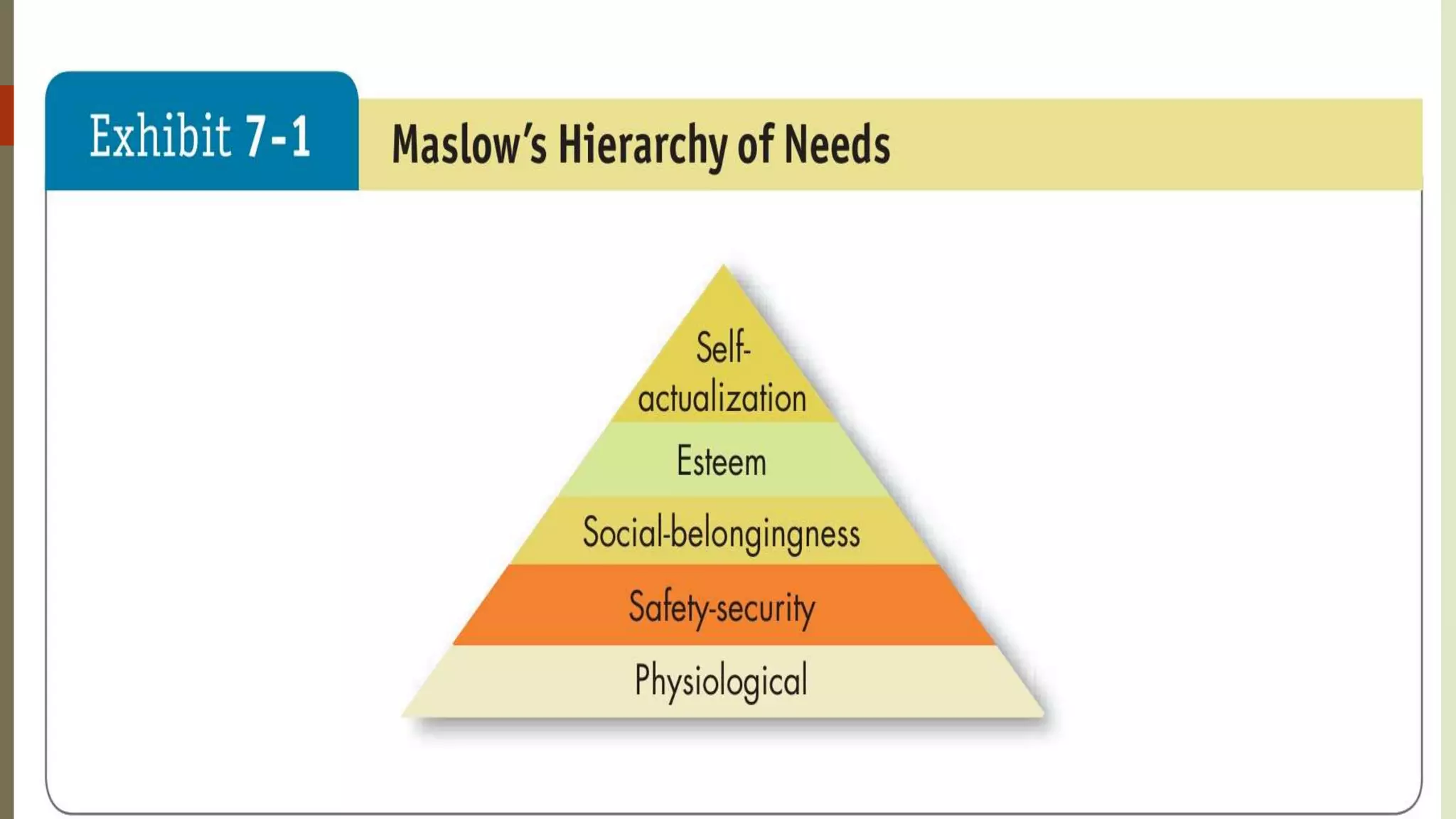
Abraham Maslow’s hierarchy of five needs—
physiological, safety, social, esteem, and self-
actualization—in which, as each need is substantially
satisfied, the next need becomes dominant
 This theory hypothesizes that within every human
being there is a hierarchy of five needs
 The theory is developed by Psychologist Abraham
Maslow in 1943.
Hierarchy of Needs theory
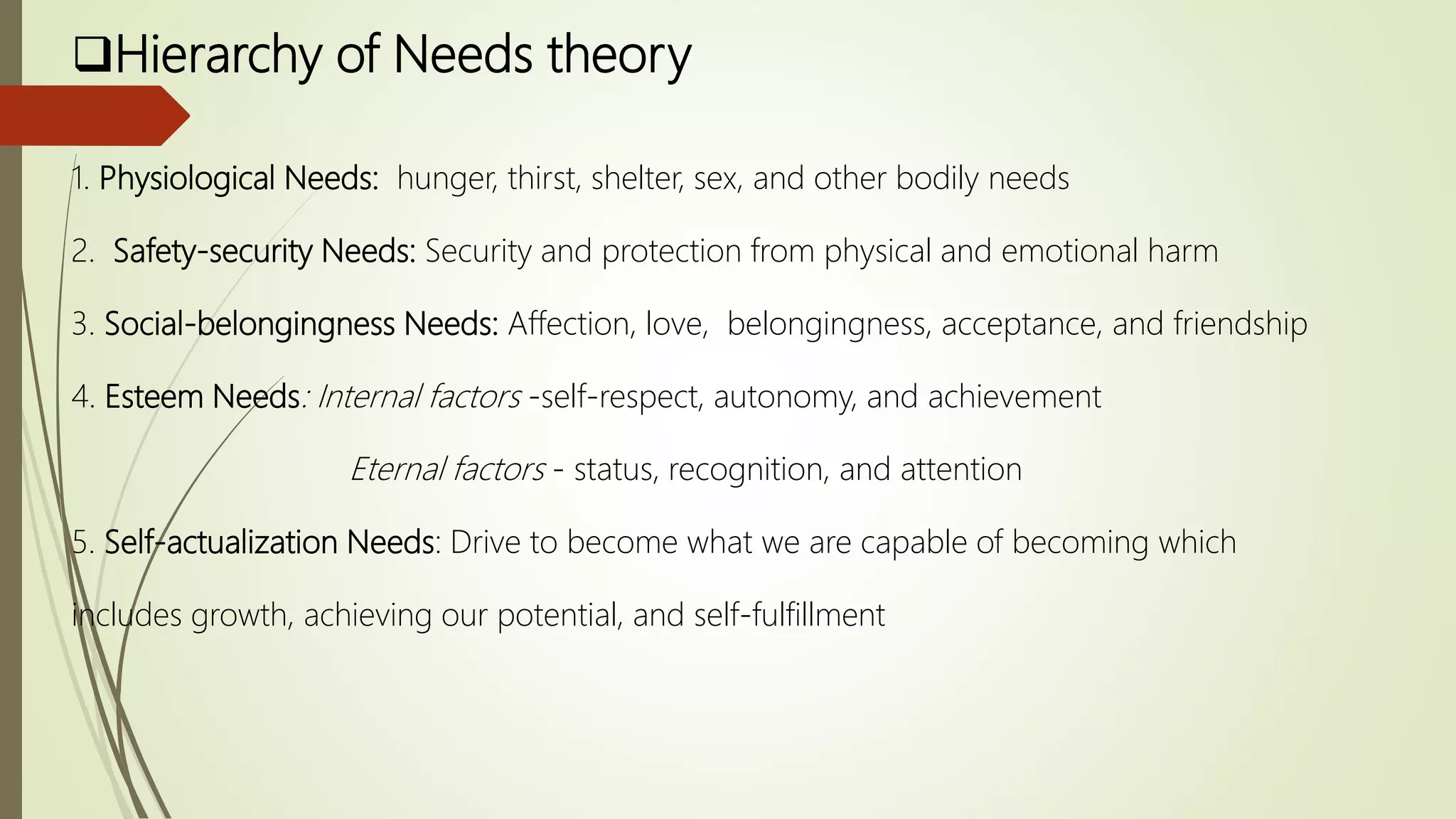
1. Physiological Needs: hunger, thirst, shelter, sex, and other bodily needs
2. Safety-security Needs: Security and protection from physical and emotional harm
3. Social-belongingness Needs: Affection, love, belongingness, acceptance, and friendship
4. Esteem Needs: Internal factors -self-respect, autonomy, and achievement
Eternal factors - status, recognition, and attention
5. Self-actualization Needs: Drive to become what we are capable of becoming which
includes growth, achieving our potential, and self-fulfillment
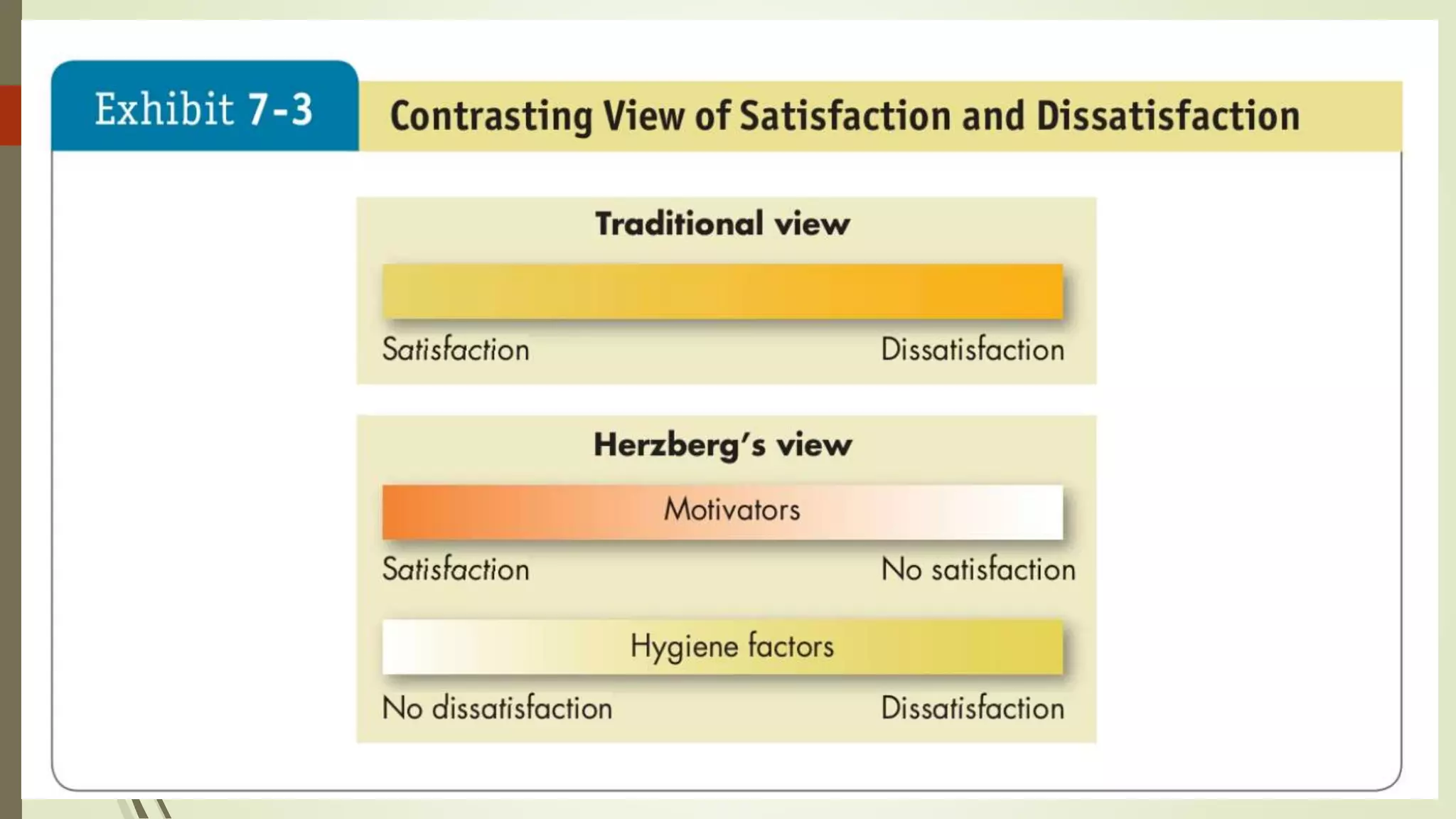
 Two-Factor Theory
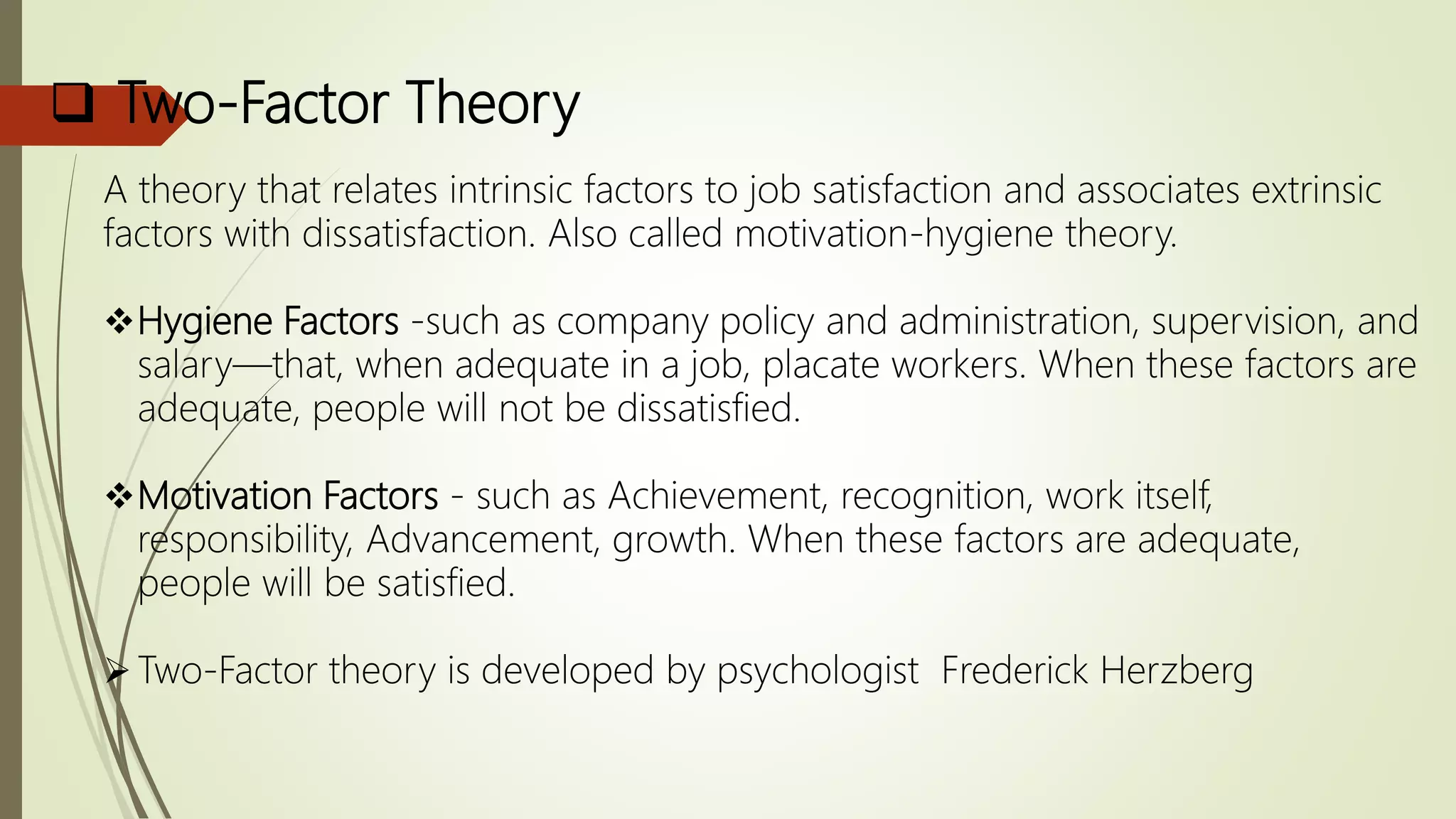
A theory that relates intrinsic factors to job satisfaction and associates extrinsic
factors with dissatisfaction. Also called motivation-hygiene theory.
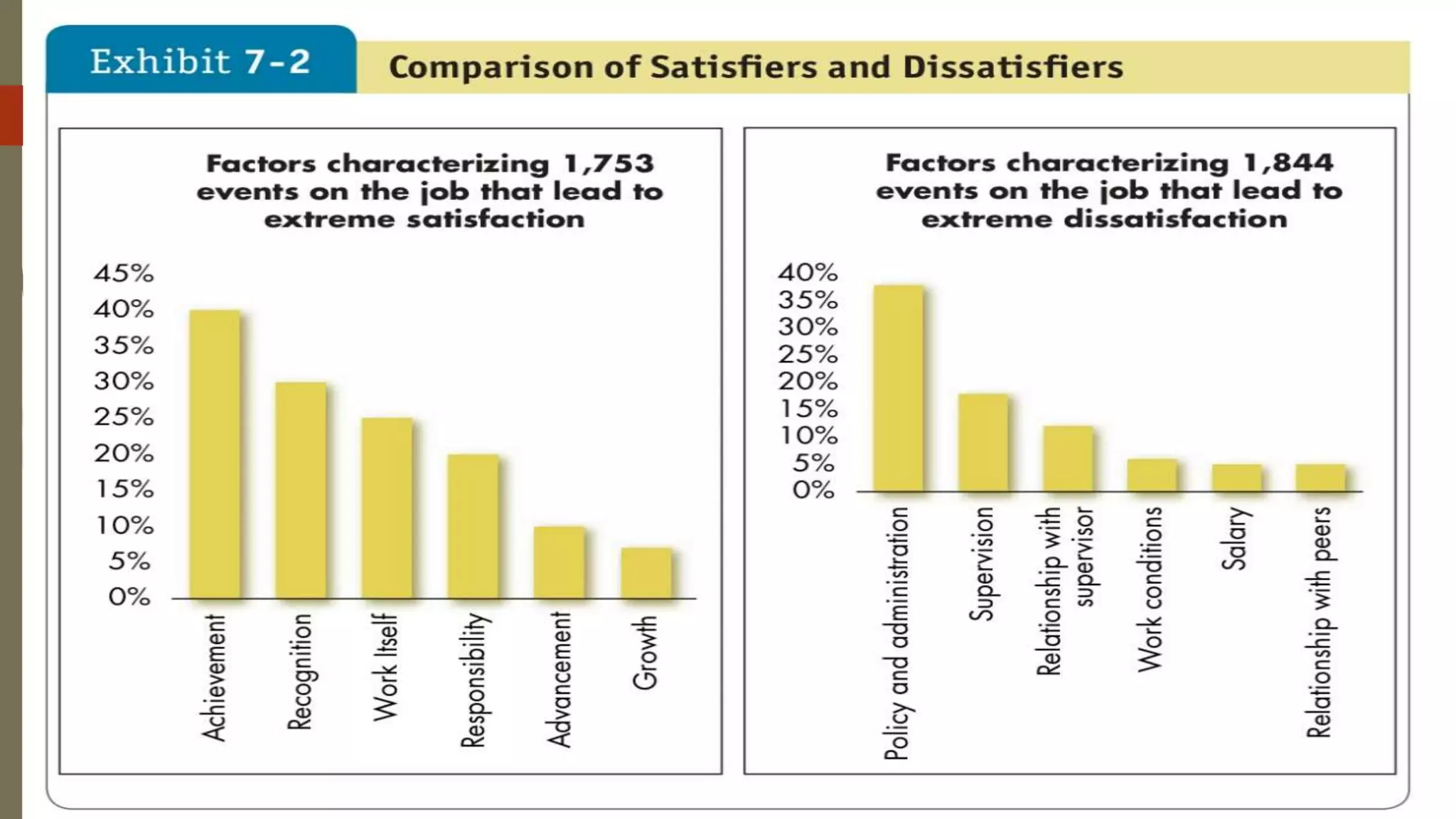
Hygiene Factors -such as company policy and administration, supervision, and
salary—that, when adequate in a job, placate workers. When these factors are
adequate, people will not be dissatisfied.
Motivation Factors - such as Achievement, recognition, work itself,
responsibility, Advancement, growth. When these factors are adequate,
people will be satisfied.
Two-Factor theory is developed by psychologist Frederick Herzberg
A theory that states achievement, power, and affiliation are three important needs
that help explain motivation.
• Need for achievement (nach): The drive to excel, to achieve in relationship to
a set of standards, and to strive to succeed
• Need for power (nPow): The need to make others behave in a way in which
they would not have behaved otherwise
• Need for affiliation (naff): The desire for friendly and close interpersonal
relationships
 McClelland’s Theory of Needs
 High achievers perform best when they perceive the probability of success is 0.5.
 Dislike gambling with high odds because no achievement satisfaction from success that comes by pure
chance.
 Similarly dislike low odds because there is no challenge to their skills.
 Like to set goals that require stretching themselves a little
 McClelland’s Theory of Needs
Relationships between achievement need and job performance:
1. When jobs have a high degree of personal responsibility, feedback, and an intermediate degree of risk, high
achievers are strongly motivated.
2. A high need to achievement does not necessarily make someone a good manager, especially in large
organizations.
3. Needs for affiliation and power tend to be closely related to managerial success. The best managers may be
high in their need for power and low in their need for affiliation.
3. Contemporary Theories of Motivation
Self Determination Theory
Self-determination theory A theory of motivation that is concerned with the
beneficial effects of intrinsic motivation and the harmful effects of extrinsic
motivation
• Cognitive evaluation theory: A version of self-determination theory that
holds that allocating extrinsic rewards for behavior that had been previously
intrinsically rewarding tends to decrease the overall level of motivation if the
rewards are seen as controlling
• Self-concordance: The degree to which people’s reasons for pursuing goals
are consistent with their interests and core values.
3. Contemporary Theories of Motivation
Goal-Setting Theory
A theory that says that specific and difficult goals, with feedback, lead to higher performance.
• Specific goals increase performance. Specificity itself seems to act as an internal stimulus.
• Difficult goals result in higher performance than do easy goals. If factors such as acceptance of
goals are held constant, the more difficult the goal, the higher the level of performance.
• Feedback leads to higher performance than does nonfeedback. People do better when they get
feedback on how well they are progressing toward their goals because it helps identify
discrepancies between what they have done and what they want to do next.
 Goal-Setting Theory
 Implementing Goal –Setting
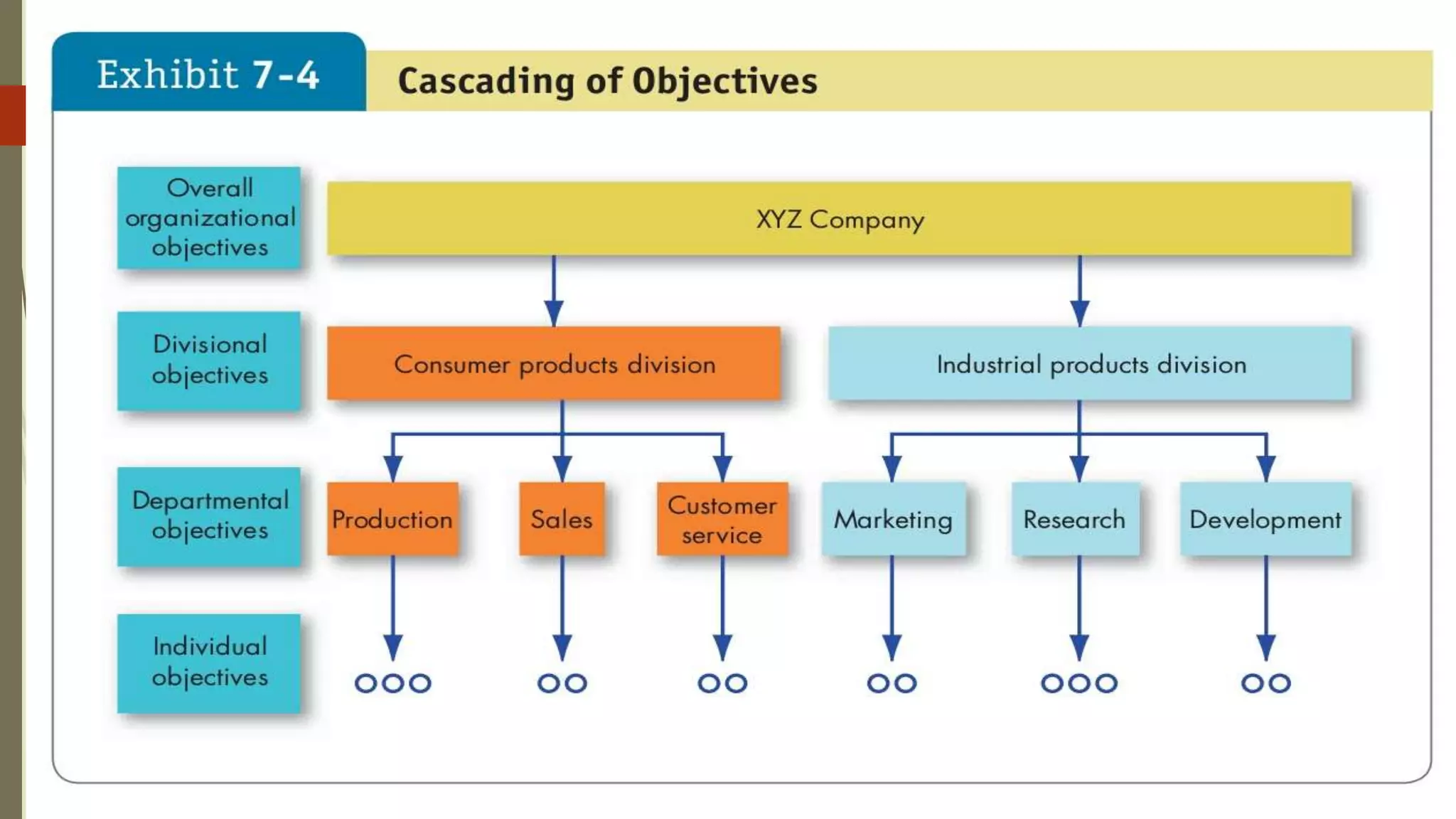
Management By Objectives (MBO): A program that encompasses specific goals,
participatively set for an explicit time period, with feedback on goal progress.
 MBO emphasizes participatively set goals that are
• tangible,
• Verifiable
• Measurable
 4 ingredients are common to MBO programs:
1. goal specificity
2. participation in decision making (including the setting of goals or objectives)
3. an explicit time period
4. performance feedback
4. Other Contemporary Theories of Motivation
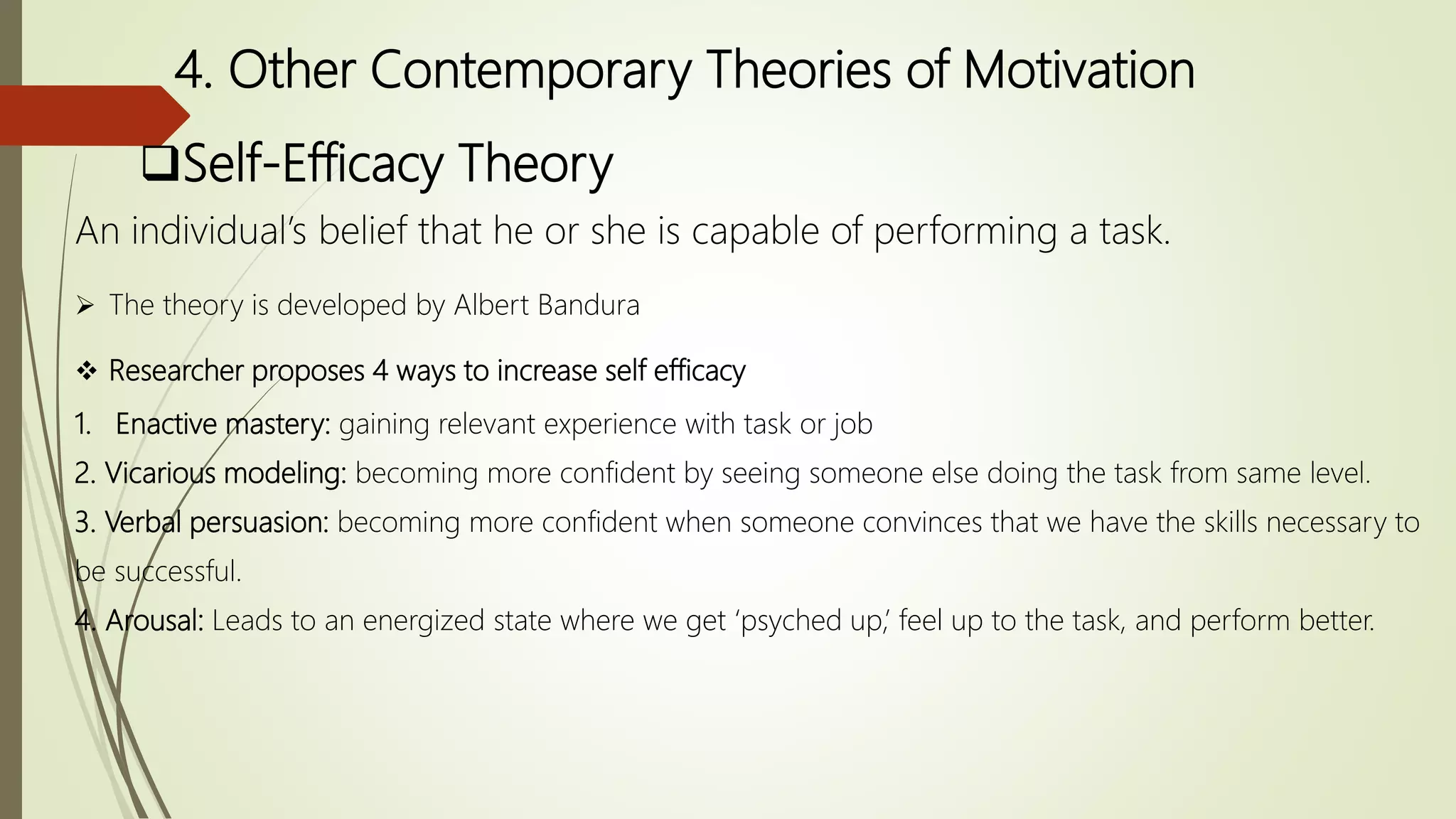
Self-Efficacy Theory
An individual’s belief that he or she is capable of performing a task.
 The theory is developed by Albert Bandura
 Researcher proposes 4 ways to increase self efficacy
1. Enactive mastery: gaining relevant experience with task or job
2. Vicarious modeling: becoming more confident by seeing someone else doing the task from same level.
3. Verbal persuasion: becoming more confident when someone convinces that we have the skills necessary to
be successful.
4. Arousal: Leads to an energized state where we get ‘psyched up,’ feel up to the task, and perform better.
Chap 7  motivation concepts

Chap 7 motivation concepts

  • 1.
  • 2.
    Learning Outcomes ofthis Chapter: Describe the three key elements of motivation Compare the early theories of motivation Contrast the elements of self-determination theory and goal- setting theory Demonstrate the self-efficacy theory from contemporary theories
  • 3.
    Topics of Today’sLecture: 1. Motivation and early theories 2. Early theories of Motivation  Hierarchy of Needs theory  Two-Factor Theory  McClelland’s Theory of Needs 3. Contemporary Theories of Motivation  Self Determination Theory  Goal-Setting Theory 4. Other Contemporary Theories of Motivation  Self-Efficacy Theory
  • 4.
    1. Motivation andearly theories • Intensity - how hard a person tries. • Direction- effort should be channeled in a direction that benefits the organization • Persistence- how long a person can maintain effort Motivation: The processes that account for an individual’s intensity, direction, and persistence of effort toward attaining a goal.
  • 5.
    2. Early theoriesof Motivation Hierarchy of Needs theory Abraham Maslow’s hierarchy of five needs— physiological, safety, social, esteem, and self- actualization—in which, as each need is substantially satisfied, the next need becomes dominant  This theory hypothesizes that within every human being there is a hierarchy of five needs  The theory is developed by Psychologist Abraham Maslow in 1943.
  • 6.
    Hierarchy of Needstheory 1. Physiological Needs: hunger, thirst, shelter, sex, and other bodily needs 2. Safety-security Needs: Security and protection from physical and emotional harm 3. Social-belongingness Needs: Affection, love, belongingness, acceptance, and friendship 4. Esteem Needs: Internal factors -self-respect, autonomy, and achievement Eternal factors - status, recognition, and attention 5. Self-actualization Needs: Drive to become what we are capable of becoming which includes growth, achieving our potential, and self-fulfillment
  • 8.
     Two-Factor Theory Atheory that relates intrinsic factors to job satisfaction and associates extrinsic factors with dissatisfaction. Also called motivation-hygiene theory. Hygiene Factors -such as company policy and administration, supervision, and salary—that, when adequate in a job, placate workers. When these factors are adequate, people will not be dissatisfied. Motivation Factors - such as Achievement, recognition, work itself, responsibility, Advancement, growth. When these factors are adequate, people will be satisfied. Two-Factor theory is developed by psychologist Frederick Herzberg
  • 11.
    A theory thatstates achievement, power, and affiliation are three important needs that help explain motivation. • Need for achievement (nach): The drive to excel, to achieve in relationship to a set of standards, and to strive to succeed • Need for power (nPow): The need to make others behave in a way in which they would not have behaved otherwise • Need for affiliation (naff): The desire for friendly and close interpersonal relationships  McClelland’s Theory of Needs
  • 12.
     High achieversperform best when they perceive the probability of success is 0.5.  Dislike gambling with high odds because no achievement satisfaction from success that comes by pure chance.  Similarly dislike low odds because there is no challenge to their skills.  Like to set goals that require stretching themselves a little  McClelland’s Theory of Needs Relationships between achievement need and job performance: 1. When jobs have a high degree of personal responsibility, feedback, and an intermediate degree of risk, high achievers are strongly motivated. 2. A high need to achievement does not necessarily make someone a good manager, especially in large organizations. 3. Needs for affiliation and power tend to be closely related to managerial success. The best managers may be high in their need for power and low in their need for affiliation.
  • 13.
    3. Contemporary Theoriesof Motivation Self Determination Theory Self-determination theory A theory of motivation that is concerned with the beneficial effects of intrinsic motivation and the harmful effects of extrinsic motivation • Cognitive evaluation theory: A version of self-determination theory that holds that allocating extrinsic rewards for behavior that had been previously intrinsically rewarding tends to decrease the overall level of motivation if the rewards are seen as controlling • Self-concordance: The degree to which people’s reasons for pursuing goals are consistent with their interests and core values.
  • 14.
    3. Contemporary Theoriesof Motivation Goal-Setting Theory A theory that says that specific and difficult goals, with feedback, lead to higher performance. • Specific goals increase performance. Specificity itself seems to act as an internal stimulus. • Difficult goals result in higher performance than do easy goals. If factors such as acceptance of goals are held constant, the more difficult the goal, the higher the level of performance. • Feedback leads to higher performance than does nonfeedback. People do better when they get feedback on how well they are progressing toward their goals because it helps identify discrepancies between what they have done and what they want to do next.
  • 15.
     Goal-Setting Theory Implementing Goal –Setting Management By Objectives (MBO): A program that encompasses specific goals, participatively set for an explicit time period, with feedback on goal progress.  MBO emphasizes participatively set goals that are • tangible, • Verifiable • Measurable  4 ingredients are common to MBO programs: 1. goal specificity 2. participation in decision making (including the setting of goals or objectives) 3. an explicit time period 4. performance feedback
  • 17.
    4. Other ContemporaryTheories of Motivation Self-Efficacy Theory An individual’s belief that he or she is capable of performing a task.  The theory is developed by Albert Bandura  Researcher proposes 4 ways to increase self efficacy 1. Enactive mastery: gaining relevant experience with task or job 2. Vicarious modeling: becoming more confident by seeing someone else doing the task from same level. 3. Verbal persuasion: becoming more confident when someone convinces that we have the skills necessary to be successful. 4. Arousal: Leads to an energized state where we get ‘psyched up,’ feel up to the task, and perform better.