Irwin/McGraw-Hill Copyright © 2001 by The McGraw-Hill Companies, Inc. All rights reserved.
1-1
Irwin/McGraw-Hill Copyright © 2001 by The McGraw-Hill Companies, Inc. All rights reserved.
1-2
McGraw-Hill/Irwin Copyright © 2004 by The McGraw-Hill Companies, Inc. All rights reserved.
Chapter 5
Business-to-Business Markets and Buying Behavior
Irwin/McGraw-Hill Copyright © 2001 by The McGraw-Hill Companies, Inc. All rights reserved.
1-3
After studying this chapter, you
should be able to:
 Define the nature of business-to-business
buying behavior and markets.
 Explain the differences between business-
to-business buying and consumer
purchase behavior.
 Recognize the different types of buying
decisions.
Irwin/McGraw-Hill Copyright © 2001 by The McGraw-Hill Companies, Inc. All rights reserved.
1-4
 Define the different stages of the business
buying process.
 Describe the buying-center concept and
the determinants of influence within the
buying center.
 Understand the nature of government,
reseller, and other institutional markets.
After studying this chapter, you
should be able to:
Irwin/McGraw-Hill Copyright © 2001 by The McGraw-Hill Companies, Inc. All rights reserved.
1-5
The Nature of Business-to-Business
Buying
 Business-to-
Business buying
behavior:
 Refers to decision
making and other
activities of
organizations as
buyers.
 Business-to-
Business buying is
the selection of
suppliers, sources,
or vendors.
Irwin/McGraw-Hill Copyright © 2001 by The McGraw-Hill Companies, Inc. All rights reserved.
1-6
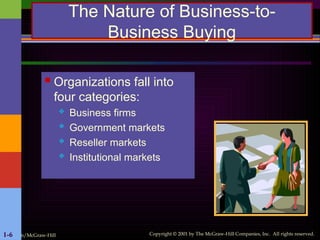
The Nature of Business-to-
Business Buying
 Organizations fall into
four categories:
 Business firms
 Government markets
 Reseller markets
 Institutional markets
Irwin/McGraw-Hill Copyright © 2001 by The McGraw-Hill Companies, Inc. All rights reserved.
1-7
Supply-Chain Management
 Supply-Chain
Management:
 “The integration of
business processes from
end user through original
suppliers that provides
products, services, and
information that add
value for customers.”
Irwin/McGraw-Hill Copyright © 2001 by The McGraw-Hill Companies, Inc. All rights reserved.
1-8
Supply Management
 Supply Management:
 “The identification, acquisition, access,
positioning, and management of resources
the organization needs or potentially needs
in the attainment of its strategic objectives.”
Irwin/McGraw-Hill Copyright © 2001 by The McGraw-Hill Companies, Inc. All rights reserved.
1-9
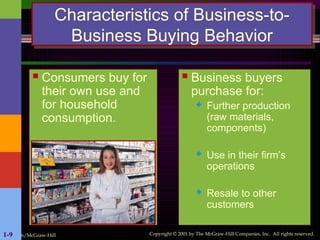
Characteristics of Business-to-
Business Buying Behavior
 Consumers buy for
their own use and
for household
consumption.
 Business buyers
purchase for:
 Further production
(raw materials,
components)
 Use in their firm’s
operations
 Resale to other
customers
Irwin/McGraw-Hill Copyright © 2001 by The McGraw-Hill Companies, Inc. All rights reserved.
1-10
Characteristics of Business-to-
Business Buying Behavior
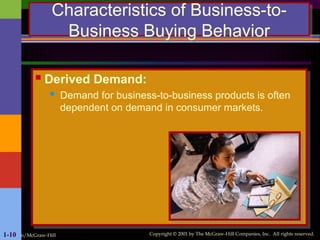
 Derived Demand:
 Demand for business-to-business products is often
dependent on demand in consumer markets.
Irwin/McGraw-Hill Copyright © 2001 by The McGraw-Hill Companies, Inc. All rights reserved.
1-11
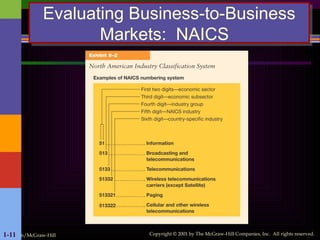
Evaluating Business-to-Business
Markets: NAICS
Irwin/McGraw-Hill Copyright © 2001 by The McGraw-Hill Companies, Inc. All rights reserved.
1-12
The Importance of Business-to-
Business Buying
 Two Key Reasons:
1. The size of business markets
offers many opportunities for
marketers.
2. Many firms are trying to increase
profits by improving purchasing
practices.
Irwin/McGraw-Hill Copyright © 2001 by The McGraw-Hill Companies, Inc. All rights reserved.
1-13
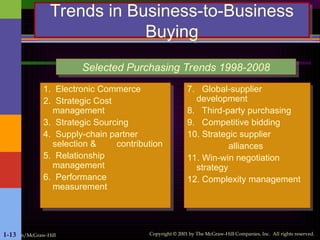
Trends in Business-to-Business
Buying
1. Electronic Commerce
2. Strategic Cost
management
3. Strategic Sourcing
4. Supply-chain partner
selection & contribution
5. Relationship
management
6. Performance
measurement
7. Global-supplier
development
8. Third-party purchasing
9. Competitive bidding
10. Strategic supplier
alliances
11. Win-win negotiation
strategy
12. Complexity management
Selected Purchasing Trends 1998-2008
Irwin/McGraw-Hill Copyright © 2001 by The McGraw-Hill Companies, Inc. All rights reserved.
1-14
Productivity Improvement
 Outsourcing
 Corporate downsizing
often involves downsizing
of the purchasing function
 Reducing cycle time
Irwin/McGraw-Hill Copyright © 2001 by The McGraw-Hill Companies, Inc. All rights reserved.
1-15
Use of Technology
 B2B Exchanges:
 Organizational buying via the Internet.
 Private Exchanges:
 Those that link invitation-only buyers
and sellers.
Irwin/McGraw-Hill Copyright © 2001 by The McGraw-Hill Companies, Inc. All rights reserved.
1-16
Electronic Commerce Applications
in Purchasing
 Requesting proposals and price quotes.
 Posting bids.
 Transmitting purchase orders.
 Using Electronic Data Interchanges.
 Ordering with electronic catalogs.
 Seeking suppliers.
 Tracking delivery schedules.
 Managing contracts.
 Managing inventory.
 Paying invoices/making payments.
Irwin/McGraw-Hill Copyright © 2001 by The McGraw-Hill Companies, Inc. All rights reserved.
1-17
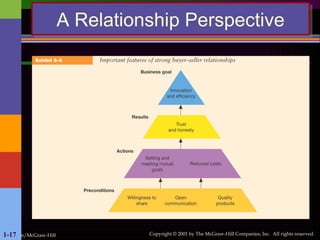
A Relationship Perspective
Irwin/McGraw-Hill Copyright © 2001 by The McGraw-Hill Companies, Inc. All rights reserved.
1-18
Customer Value Considerations
 Buyers are interested in suppliers that can add
value to their business by:
 Continually increasing quality
 Lowering costs
Irwin/McGraw-Hill Copyright © 2001 by The McGraw-Hill Companies, Inc. All rights reserved.
1-19
Environmental Impact
 Buyers emphasize an Ethics
Perspective by:
 Examining the costs associated with
product disposal.
 Looking for ways to recycle or reuse
products.
Irwin/McGraw-Hill Copyright © 2001 by The McGraw-Hill Companies, Inc. All rights reserved.
1-20
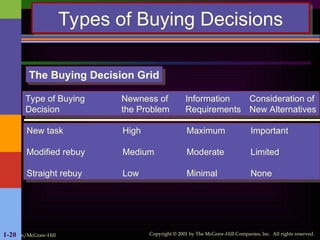
Types of Buying Decisions
Type of Buying Newness of Information Consideration of
Decision the Problem Requirements New Alternatives
New task High Maximum Important
Modified rebuy Medium Moderate Limited
Straight rebuy Low Minimal None
The Buying Decision Grid
Irwin/McGraw-Hill Copyright © 2001 by The McGraw-Hill Companies, Inc. All rights reserved.
1-21
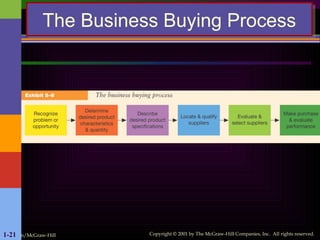
The Business Buying Process
Irwin/McGraw-Hill Copyright © 2001 by The McGraw-Hill Companies, Inc. All rights reserved.
1-22
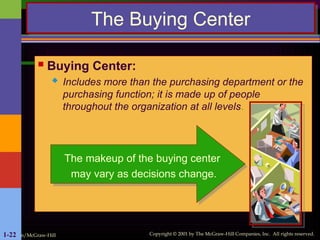
The Buying Center
 Buying Center:
 Includes more than the purchasing department or the
purchasing function; it is made up of people
throughout the organization at all levels.
The makeup of the buying center
may vary as decisions change.
Irwin/McGraw-Hill Copyright © 2001 by The McGraw-Hill Companies, Inc. All rights reserved.
1-23
The Buying Center
 Gatekeepers:
 Control the flow of information and
communication among the buying-center
participants.
 Sponsor:
 Advocates purchase of a particular product
of service.
Irwin/McGraw-Hill Copyright © 2001 by The McGraw-Hill Companies, Inc. All rights reserved.
1-24
Government Markets
 Government Market:
 Includes federal, state, and local government
organizations that purchase goods and services.
 The government market is the
largest in the world, with the United
States federal government the
largest customer in this market
Irwin/McGraw-Hill Copyright © 2001 by The McGraw-Hill Companies, Inc. All rights reserved.
1-25
Reseller Markets
 Reseller Market:
 Made up of firms that
purchase goods and in
turn sell them to others
at a gain.
 This market includes:
 Wholesalers
 Retailers
3.5 million companies with more
than 20 million employees make
up reseller markets.
Irwin/McGraw-Hill Copyright © 2001 by The McGraw-Hill Companies, Inc. All rights reserved.
1-26
Other Institutional Markets
 Nonprofit organizations
must also purchase goods
and services to support their
activities.
 These organizations include:
 Educational institutions
 Public & private hospitals
 Religious & charitable organizations
 Trade associations
Irwin/McGraw-Hill Copyright © 2001 by The McGraw-Hill Companies, Inc. All rights reserved.
1-27
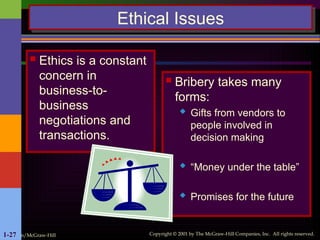
Ethical Issues
 Ethics is a constant
concern in
business-to-
business
negotiations and
transactions.
 Bribery takes many
forms:
 Gifts from vendors to
people involved in
decision making
 “Money under the table”
 Promises for the future
Irwin/McGraw-Hill Copyright © 2001 by The McGraw-Hill Companies, Inc. All rights reserved.
1-28
Ethical Issues
Reciprocity:
When firm A purchases from supplier B who
in turn buys A’s own products and services.
Fairness, honesty, and trust should influence all
negotiations and selection of suppliers or vendors.
Firms pursuing global markets
encounter ethical dilemmas.

chap005p.ppt this is the best note ever t

  • 1.
    Irwin/McGraw-Hill Copyright ©2001 by The McGraw-Hill Companies, Inc. All rights reserved. 1-1
  • 2.
    Irwin/McGraw-Hill Copyright ©2001 by The McGraw-Hill Companies, Inc. All rights reserved. 1-2 McGraw-Hill/Irwin Copyright © 2004 by The McGraw-Hill Companies, Inc. All rights reserved. Chapter 5 Business-to-Business Markets and Buying Behavior Business-to-Business Markets and Buying Behavior
  • 3.
    Irwin/McGraw-Hill Copyright ©2001 by The McGraw-Hill Companies, Inc. All rights reserved. 1-3 After studying this chapter, you should be able to:  Define the nature of business-to-business buying behavior and markets.  Explain the differences between business- to-business buying and consumer purchase behavior.  Recognize the different types of buying decisions.
  • 4.
    Irwin/McGraw-Hill Copyright ©2001 by The McGraw-Hill Companies, Inc. All rights reserved. 1-4  Define the different stages of the business buying process.  Describe the buying-center concept and the determinants of influence within the buying center.  Understand the nature of government, reseller, and other institutional markets. After studying this chapter, you should be able to:
  • 5.
    Irwin/McGraw-Hill Copyright ©2001 by The McGraw-Hill Companies, Inc. All rights reserved. 1-5 The Nature of Business-to-Business Buying  Business-to- Business buying behavior:  Refers to decision making and other activities of organizations as buyers.  Business-to- Business buying is the selection of suppliers, sources, or vendors.
  • 6.
    Irwin/McGraw-Hill Copyright ©2001 by The McGraw-Hill Companies, Inc. All rights reserved. 1-6 The Nature of Business-to- Business Buying  Organizations fall into four categories:  Business firms  Government markets  Reseller markets  Institutional markets
  • 7.
    Irwin/McGraw-Hill Copyright ©2001 by The McGraw-Hill Companies, Inc. All rights reserved. 1-7 Supply-Chain Management  Supply-Chain Management:  “The integration of business processes from end user through original suppliers that provides products, services, and information that add value for customers.”
  • 8.
    Irwin/McGraw-Hill Copyright ©2001 by The McGraw-Hill Companies, Inc. All rights reserved. 1-8 Supply Management  Supply Management:  “The identification, acquisition, access, positioning, and management of resources the organization needs or potentially needs in the attainment of its strategic objectives.”
  • 9.
    Irwin/McGraw-Hill Copyright ©2001 by The McGraw-Hill Companies, Inc. All rights reserved. 1-9 Characteristics of Business-to- Business Buying Behavior  Consumers buy for their own use and for household consumption.  Business buyers purchase for:  Further production (raw materials, components)  Use in their firm’s operations  Resale to other customers
  • 10.
    Irwin/McGraw-Hill Copyright ©2001 by The McGraw-Hill Companies, Inc. All rights reserved. 1-10 Characteristics of Business-to- Business Buying Behavior  Derived Demand:  Demand for business-to-business products is often dependent on demand in consumer markets.
  • 11.
    Irwin/McGraw-Hill Copyright ©2001 by The McGraw-Hill Companies, Inc. All rights reserved. 1-11 Evaluating Business-to-Business Markets: NAICS
  • 12.
    Irwin/McGraw-Hill Copyright ©2001 by The McGraw-Hill Companies, Inc. All rights reserved. 1-12 The Importance of Business-to- Business Buying  Two Key Reasons: 1. The size of business markets offers many opportunities for marketers. 2. Many firms are trying to increase profits by improving purchasing practices.
  • 13.
    Irwin/McGraw-Hill Copyright ©2001 by The McGraw-Hill Companies, Inc. All rights reserved. 1-13 Trends in Business-to-Business Buying 1. Electronic Commerce 2. Strategic Cost management 3. Strategic Sourcing 4. Supply-chain partner selection & contribution 5. Relationship management 6. Performance measurement 7. Global-supplier development 8. Third-party purchasing 9. Competitive bidding 10. Strategic supplier alliances 11. Win-win negotiation strategy 12. Complexity management Selected Purchasing Trends 1998-2008
  • 14.
    Irwin/McGraw-Hill Copyright ©2001 by The McGraw-Hill Companies, Inc. All rights reserved. 1-14 Productivity Improvement  Outsourcing  Corporate downsizing often involves downsizing of the purchasing function  Reducing cycle time
  • 15.
    Irwin/McGraw-Hill Copyright ©2001 by The McGraw-Hill Companies, Inc. All rights reserved. 1-15 Use of Technology  B2B Exchanges:  Organizational buying via the Internet.  Private Exchanges:  Those that link invitation-only buyers and sellers.
  • 16.
    Irwin/McGraw-Hill Copyright ©2001 by The McGraw-Hill Companies, Inc. All rights reserved. 1-16 Electronic Commerce Applications in Purchasing  Requesting proposals and price quotes.  Posting bids.  Transmitting purchase orders.  Using Electronic Data Interchanges.  Ordering with electronic catalogs.  Seeking suppliers.  Tracking delivery schedules.  Managing contracts.  Managing inventory.  Paying invoices/making payments.
  • 17.
    Irwin/McGraw-Hill Copyright ©2001 by The McGraw-Hill Companies, Inc. All rights reserved. 1-17 A Relationship Perspective
  • 18.
    Irwin/McGraw-Hill Copyright ©2001 by The McGraw-Hill Companies, Inc. All rights reserved. 1-18 Customer Value Considerations  Buyers are interested in suppliers that can add value to their business by:  Continually increasing quality  Lowering costs
  • 19.
    Irwin/McGraw-Hill Copyright ©2001 by The McGraw-Hill Companies, Inc. All rights reserved. 1-19 Environmental Impact  Buyers emphasize an Ethics Perspective by:  Examining the costs associated with product disposal.  Looking for ways to recycle or reuse products.
  • 20.
    Irwin/McGraw-Hill Copyright ©2001 by The McGraw-Hill Companies, Inc. All rights reserved. 1-20 Types of Buying Decisions Type of Buying Newness of Information Consideration of Decision the Problem Requirements New Alternatives New task High Maximum Important Modified rebuy Medium Moderate Limited Straight rebuy Low Minimal None The Buying Decision Grid
  • 21.
    Irwin/McGraw-Hill Copyright ©2001 by The McGraw-Hill Companies, Inc. All rights reserved. 1-21 The Business Buying Process
  • 22.
    Irwin/McGraw-Hill Copyright ©2001 by The McGraw-Hill Companies, Inc. All rights reserved. 1-22 The Buying Center  Buying Center:  Includes more than the purchasing department or the purchasing function; it is made up of people throughout the organization at all levels. The makeup of the buying center may vary as decisions change.
  • 23.
    Irwin/McGraw-Hill Copyright ©2001 by The McGraw-Hill Companies, Inc. All rights reserved. 1-23 The Buying Center  Gatekeepers:  Control the flow of information and communication among the buying-center participants.  Sponsor:  Advocates purchase of a particular product of service.
  • 24.
    Irwin/McGraw-Hill Copyright ©2001 by The McGraw-Hill Companies, Inc. All rights reserved. 1-24 Government Markets  Government Market:  Includes federal, state, and local government organizations that purchase goods and services.  The government market is the largest in the world, with the United States federal government the largest customer in this market
  • 25.
    Irwin/McGraw-Hill Copyright ©2001 by The McGraw-Hill Companies, Inc. All rights reserved. 1-25 Reseller Markets  Reseller Market:  Made up of firms that purchase goods and in turn sell them to others at a gain.  This market includes:  Wholesalers  Retailers 3.5 million companies with more than 20 million employees make up reseller markets.
  • 26.
    Irwin/McGraw-Hill Copyright ©2001 by The McGraw-Hill Companies, Inc. All rights reserved. 1-26 Other Institutional Markets  Nonprofit organizations must also purchase goods and services to support their activities.  These organizations include:  Educational institutions  Public & private hospitals  Religious & charitable organizations  Trade associations
  • 27.
    Irwin/McGraw-Hill Copyright ©2001 by The McGraw-Hill Companies, Inc. All rights reserved. 1-27 Ethical Issues  Ethics is a constant concern in business-to- business negotiations and transactions.  Bribery takes many forms:  Gifts from vendors to people involved in decision making  “Money under the table”  Promises for the future
  • 28.
    Irwin/McGraw-Hill Copyright ©2001 by The McGraw-Hill Companies, Inc. All rights reserved. 1-28 Ethical Issues Reciprocity: When firm A purchases from supplier B who in turn buys A’s own products and services. Fairness, honesty, and trust should influence all negotiations and selection of suppliers or vendors. Firms pursuing global markets encounter ethical dilemmas.