





INTRODUCTION
Labor Economics
Second Term, AY 2014-2015
Why study Labor Economics?
• Human resources allocate substantial time and energy to
labor markets
• Labor economics studies how labor markets work
• Labor economics helps us understand and address many
social and economic problems facing modern societies
Basics of the Labor Market
• Participants are assigned motives:
• Workers look for the best job
• Firms look for profits
• Government uses regulation to achieve goals of public policy
• Minimum wages
• Occupational safety
Three “Actors”
• Workers
• The most important actor; without workers, there is no “labor”
• Desire to optimize (to select the best option from available choices)
to maximize well-being
• Will want to supply more time and effort for higher payoffs, causing
an upward sloping labor supply curve
Three “Actors”
• Firms
• Decide who to hire and fire
• Motivated to maximize profits
• Relationship between price of labor and the number of workers a
firm is willing to hire generates the labor demand curve
Three “Actors”
• Government
• Imposes taxes, regulations
• Provides ground rules that guide exchanges made in labor markets
Summary: the Three “Actors”
T h re e A c to rs in th e L a b o r M a rk e t
W o rk e rs
S u p p ly la b o r fo r p a y o ff
F irm s
D e m a n d la b o r g iv e n p ric e o f la b o r
a n d d e s ire fo r p ro fits
G o v e rn m e n t
T a x e s
R e g u la tio n s
R u le s o f e x c h a n g e
L a b o r M a rk e t
Why Do We Need a Theory?
• Explain and understand how labor markets work
• Focus on the essential variables while leaving out other,
less crucial, factors
• Create a model that helps explain the theory
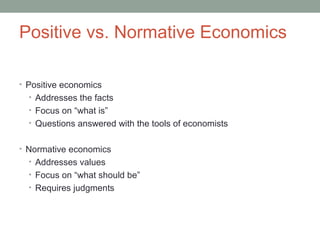
Positive vs. Normative Economics
• Positive economics
• Addresses the facts
• Focus on “what is”
• Questions answered with the tools of economists
• Normative economics
• Addresses values
• Focus on “what should be”
• Requires judgments
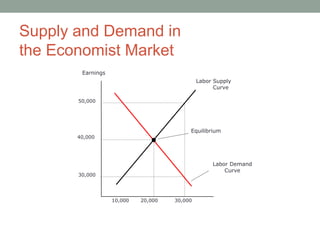
Supply and Demand in
the Economist Market
Equilibrium
50,000
40,000
30,000
20,00010,000 30,000
Labor Supply
Curve
Labor Demand
Curve
Earnings
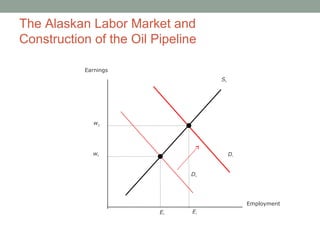
The Alaskan Labor Market and
Construction of the Oil Pipeline
D0
D1
S0
Earnings
Employment
w1
w0
E1E0
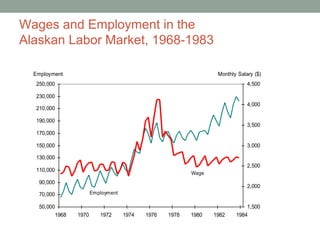
Wages and Employment in the
Alaskan Labor Market, 1968-1983
50,000
70,000
90,000
110,000
130,000
150,000
170,000
190,000
210,000
230,000
250,000
1968 1970 1972 1974 1976 1978 1980 1982 1984
1,500
2,000
2,500
3,000
3,500
4,000
4,500
Employment Monthly Salary ($)
Employment
Wage
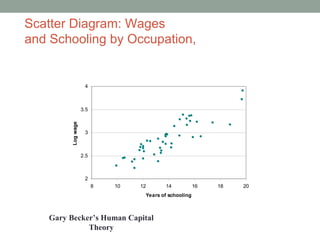
Scatter Diagram: Wages
and Schooling by Occupation,
2
2.5
3
3.5
4
8 10 12 14 16 18 20
Years of schooling
Logwage
Gary Becker’s Human Capital
Theory
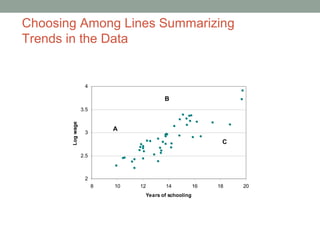
Choosing Among Lines Summarizing
Trends in the Data
2
2.5
3
3.5
4
8 10 12 14 16 18 20
Years of schooling
Logwage
A
B
C
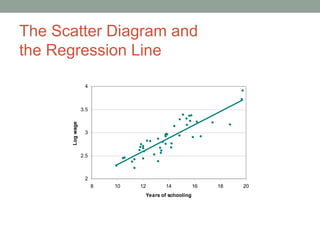
The Scatter Diagram and
the Regression Line
2
2.5
3
3.5
4
8 10 12 14 16 18 20
Years of schooling
Logwage
A Reminder :
• “It matters nothing to the seller of bricks
whether they are to be used in building a
palace or a sewer: but it matters a great deal
to the seller of labor, who undertakes to
perform a task of given difficulty, whether or
not the place in which it is to be done is a
wholesome and pleasant one, and whether or
not his associates will be such as he cares to
have.”
-- Alfred Marshall
End of Chapter 1

Chap 1 intro

  • 1.
  • 2.
    Why study LaborEconomics? • Human resources allocate substantial time and energy to labor markets • Labor economics studies how labor markets work • Labor economics helps us understand and address many social and economic problems facing modern societies
  • 3.
    Basics of theLabor Market • Participants are assigned motives: • Workers look for the best job • Firms look for profits • Government uses regulation to achieve goals of public policy • Minimum wages • Occupational safety
  • 4.
    Three “Actors” • Workers •The most important actor; without workers, there is no “labor” • Desire to optimize (to select the best option from available choices) to maximize well-being • Will want to supply more time and effort for higher payoffs, causing an upward sloping labor supply curve
  • 5.
    Three “Actors” • Firms •Decide who to hire and fire • Motivated to maximize profits • Relationship between price of labor and the number of workers a firm is willing to hire generates the labor demand curve
  • 6.
    Three “Actors” • Government •Imposes taxes, regulations • Provides ground rules that guide exchanges made in labor markets
  • 7.
    Summary: the Three“Actors” T h re e A c to rs in th e L a b o r M a rk e t W o rk e rs S u p p ly la b o r fo r p a y o ff F irm s D e m a n d la b o r g iv e n p ric e o f la b o r a n d d e s ire fo r p ro fits G o v e rn m e n t T a x e s R e g u la tio n s R u le s o f e x c h a n g e L a b o r M a rk e t
  • 8.
    Why Do WeNeed a Theory? • Explain and understand how labor markets work • Focus on the essential variables while leaving out other, less crucial, factors • Create a model that helps explain the theory
  • 9.
    Positive vs. NormativeEconomics • Positive economics • Addresses the facts • Focus on “what is” • Questions answered with the tools of economists • Normative economics • Addresses values • Focus on “what should be” • Requires judgments
  • 10.
    Supply and Demandin the Economist Market Equilibrium 50,000 40,000 30,000 20,00010,000 30,000 Labor Supply Curve Labor Demand Curve Earnings
  • 11.
    The Alaskan LaborMarket and Construction of the Oil Pipeline D0 D1 S0 Earnings Employment w1 w0 E1E0
  • 12.
    Wages and Employmentin the Alaskan Labor Market, 1968-1983 50,000 70,000 90,000 110,000 130,000 150,000 170,000 190,000 210,000 230,000 250,000 1968 1970 1972 1974 1976 1978 1980 1982 1984 1,500 2,000 2,500 3,000 3,500 4,000 4,500 Employment Monthly Salary ($) Employment Wage
  • 13.
    Scatter Diagram: Wages andSchooling by Occupation, 2 2.5 3 3.5 4 8 10 12 14 16 18 20 Years of schooling Logwage Gary Becker’s Human Capital Theory
  • 14.
    Choosing Among LinesSummarizing Trends in the Data 2 2.5 3 3.5 4 8 10 12 14 16 18 20 Years of schooling Logwage A B C
  • 15.
    The Scatter Diagramand the Regression Line 2 2.5 3 3.5 4 8 10 12 14 16 18 20 Years of schooling Logwage
  • 16.
    A Reminder : •“It matters nothing to the seller of bricks whether they are to be used in building a palace or a sewer: but it matters a great deal to the seller of labor, who undertakes to perform a task of given difficulty, whether or not the place in which it is to be done is a wholesome and pleasant one, and whether or not his associates will be such as he cares to have.” -- Alfred Marshall
  • 17.