International Journal of Fracture 66:155-164, 1994. 155
(~) 1994KluwerAcademic Publishers. Printed in the Netherlands.
Damage work as ductile fracture criterion
R. CHAOUADI1-2, E DE MEESTER2 and W. VANDERMEULEN3
ISCK/CEN, Reactor Materials Research Unit, Boeretang 200, 2400 Mol, Belgium.
2KUL, Metals and Materials Science Department, De Crooylaan 2, 3030 Heverlee, Belgium.
3VITO, Materials Department, Boeretang 200, 2400 Mol, Belgium.
Received29 October1993;acceptedin finalform28January 1994
Abstract. This paper treats the ductile failure initiation in circumferentially-notchedtension specimens and
explores the local damagemodelthat is ableto representthe continuousdegradationof the deformingmaterial.
Withthe aid of finiteelementcalculations,the notchedspecimenshavebeensimulatednumericallyandthe whole
strain-stress historyfor each geometryderived.This allowsdeterminationof the evolutionof strain-stress fields
until fractureoccurs.Two damagemodelswereevaluated:the RiceandTraceycavitygrowthmodeland a model
which combinesthe latter with the plastic strain work,to derive an intrinsic parametercalled 'damage work'.
These modelscouldpredictthe locationwherethe crack willinitiate as wellas the crackinitiation stepwhichis
reachedfor a relativelyconstantvalueof the criticaldamage.
1. Introduction
In the investigations dedicated to the prediction of ductile fracture initiation using local criteria,
the evolution of damage is related to the overall loading path, thus involving the knowledge
of the whole strain-stress history. Furthermore, ductile fracture being a local phenomenon, the
strains and stresses must also be known locally, in particular in the region of high strain-stress
concentration where cracks will initiate. Thus, finite element method is well indicated for such
calculations.
To be able to predict the moment and the location of the ductile crack initiation, a function
representing the damage evolution has been computed at the elements of the minimum section.
Experimental tests have been carried out on circumferentially-notched tensile specimens with
different notch radii. This geometry allows for varying the triaxiality rate and the material size
involved in the fracture process by simply changing the notch radius of curvature.
Using finite element calculations, the evolution of the stress and strain components have
been derived for each geometry. Different damage functions are then computed to represent
the continuous degradation of the material until the crack initiation occurs. These models are
then evaluated in view of the experimental results obtained.
2. Materials
Two materials used in the nuclear pressure vessel industry and having different chemical
composition have been used: 18MND5 and 22NiMoCr37 (see Table 1). The mechanical
properties of both materials are given in Table 2. Specimens of the 18MND5 steel have a
diameter at the minimum cross section at notch of 6 mm whereas for 22NiMoCr37 steel, this
diameter is 10 mm.
3. Experiments
The tests have been performed at room temperature for 18MND5 steel and at 100°C for
22NiMoCr37 steel. All tests have been carried out on a 100kN INSTRON tensile machine.
156 R. Chaouadi et al.
Table 1. Chemical composition (wt-%)
C Si Mn P S Cr Mo Ni
18MND5 0.18 0.26 1.55 0.007 0.002 0.18 0.50 0.65
22NiMoCr37 0.30 0.23 0.71 0.009 0.011 0.47 0.80 0.71
Table 2. Mechanicalproperties
0.2% yield stress Tensilestrength Elongation Reduction of area
#u(MPa) ~r~(MPa) ~% A%
18MND5(20°C) 525 670 22.5 70
22NiMoCr37(100°C) 517 670 19.8 61
Furthermore, all the tests have been performed under controlled displacement at a constant
crosshead speed. The load and the crosshead displacement are continuously recorded, as well
as the diameter contraction by an LVDT.
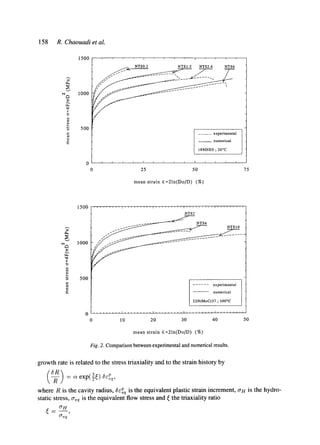
The specimens are identified by the notation NTSp for Notched Tensile Specimen followed
by the notch radius p. Typical mean strain-mean stress curves obtained from different notched
specimens are shown in Fig. 1. As can be seen, the sharpness of the notch drastically reduces
the ductility of the specimen because of the important role played by the hydrostatic component
of the stress tensor.
4. Finite element simulation
The stress-strain calculations are performed using the SYSTUS finite element code. Because
of the axial symmetry, only a quarter of the specimen is simulated using two dimension
isoparametric 8-node elements with reduced Gauss integration. The von Mises criterion for
plasticity is used with associated incremental flow rule.
The load application is simulated by a vertical displacement of the nodes situated at the
upper face. Because of the large strains and deformations, the updated Lagrangian procedure
is used. The BFGS algorithm is used to solve the constitutive equations.
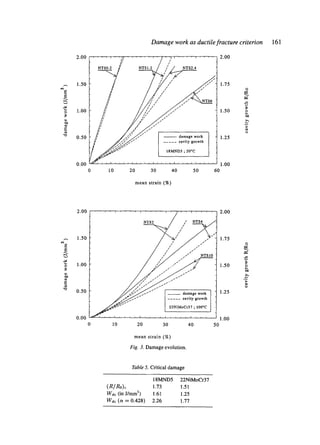
The comparison of experimental results with numerical calculations shows an overall good
agreement (Fig. 2).
The stress triaxiality ratio (O'H/O'eq),where O"n and Cr~qare respectively the hydrostatic
and equivalent stresses, at the centre of specimen calculated from the Bridgman [1] formula
is underestimated with regard to finite element calculations. However, the correlation is very
good in the early stage of loading, except the NTS 0.2 geometry (Table 3).
The triaxiality ratio is maximum at the centre of the specimen for all geometries, except
for NTS 0.2 where it is maximum in a region close to the notch (t0.5 mm from the notch).
Similarly, the crack initiates at the centre of each specimen except the NTS 0.2-specimen
where it cracks from the notch.
Damage work as ductile fracture criterion 157
II
r,
E
1500
1000
500
0
0 100
NTS0.2 NTS1.2 NTS2.4 NTS6 NTS12 NTS60
J ~ material: 18MND5
room temperature
NTSR Do=6mm
i i i I T i i i I r i i r t i r i I
25 50 75
mean strain E=21n(Do/D) (%)
Fig. 1. Strain-stress curves - influence of stress triaxiality.
Table 3. Stress triaxiality at the centre of specimen
NTS0.2 NTS1.2 NTS2.4 NTS6 NTS2 NTS4 NTS10
Bridgman 2.47 1.14 0.82 0.56 1.14 0.82 0.56
EE.M. (early stage) 1.35 1.07 0.81 0.54 1.08 0.80 0.54
EE.M. (mean) 1.28 1.39 1.12 0.86 1.37 1.07 0.80
5. Damage modelling
Physically, ductile damage is related to the nucleation, growth and coalescence of cavities. The
nucleation and coalescence phases are negligible compared to the growth phase, and therefore
are not taken into account in this model. Many authors [2-10] have shown the important role
played by the hydrostatic stress. Therefore, it is expected that this component will appear in the
damage function. In addition, because of the damage process which is a cumulative process,
the plastic strain increment will be the loading factor which represents the strain history.
5.1. CAVITY GROWTH MODEL
Rice and Tracey [11] have calculated the displacement field of a perfectly plastic material
containing a spherical cavity and subjected to remote stress and strain-rate fields. They derived
a relation between the cavity radius rate and the stress-strain field. The damage is then related
to the cavity radius, and crack initiation occurs for a critical radius of the cavity. This cavity
158 R. Chaouadi et al.
1500
t ~: ~TS0.
1000 ~ jl
¢~1 / t t "
g
500
0
0 25
I
NTS0.2 NTS 1.2 NTS2.4 NTS6
..... experimental
numerical
18/rIND5 ; 20°C
1 i ~ i i I
50
mean strain E=21n(Do/D) (%)
75
g~
1500
1000
500
NTS2
_~ - - - ~ ' ~ NTS4
...... experimental
numerical
22NiMoCr37 ; 100°C
i n i i i i i i , ~ i i i i i i i ~ i I . . . . . . . i i [ i i i i i . . . . I , , i i i i i , t
10 20 30 40 50
mean strain E=2ln(DolD) (%)
Fig. 2. Comparisonbetweenexperimentalandnumericalresults.
growth rate is related to the stress triaxiality and to the strain history by
where R is the cavity radius, t~e~qis the equivalent plastic strain increment, CrH is the hydro-
static stress, aeq is the equivalent flow stress and ~ the triaxiality ratio
t7H
O-eq
Damage work as ductilefracture criterion 159
a is a constant factor, and according to Rice and Tracey [11] for high triaxialities, a = 0.283.
However, this value has been corrected by Huang [12] who found a better approximation for
a = 0.427. Furthermore, Marini [13] has shown that a is actually proportional to the volume
fraction of second phase particles. Nevertheless, in this model, its value is not critical because
it appears as a proportional parameter that can be fitted experimentally.
Crack initiation occurs when R reaches its critical value Rc, which is an intrinsic property
of the material. This model has been successfully used by many authors [5, 6, 9, 10, 14].
5.2. DAMAGEWORKMODEL
Another way of characterizing the ductile damage is obtained from the expression giving the
plastic work per unit volume. Plastic strain work is given by
8WD = aij&r~j.
Using the deviatoric stress expressions, this equation can be written as
In plasticity problems, ~i = 0 to satisfy the incompressibility condition, and therefore, the
hydrostatic stress O'H does not contribute to plastic deformation. This is experimentally well
verified. However, locally, in particular for high plastic strains, this is no longer valid. Ductile
fracture is a cavitation process, and locally, the volume change should be taken into account
when evaluating the plastic strain work.
The volume change (~V/V) can be related to the cavity growth rate of Rice and Tracey by
~V 8R
V R
Therefore
(SR
~WD = Creq~CPeqq- 3(rH
R
Rearranging this equation leads to
~W~ = [1 + 3~¢ exp(3¢)] ~q~q.
As can be seen from this equation, there is a competition between plastic flow and cavity
growth. ~WD will be called 'damage work'. Fracture occurs when damage work reaches
a critical value noted WDC, characteristic of the material. The first term is related to the
dislocation creation process by plastic deformation whereas the second term is related to the
cavity creation process.
As before, the factor o~is an experimental fitting parameter. However, this factor could
be correlated to the microstructure of the material, in the sense that it will represent also the
distribution of the second phase particles in the material. So, any scattering in the data will be
reflected by a.
The damage model given here is very similar to the one proposed by Zhang et al. [15,
16]. However, the derivation is different although the conceptual idea of competition between
material flowing and cavitation is the same. Indeed, they combined the void multistage
nucleation model to the Gurson [17] potential for porous materials to derive what they called
the 'combinatory work density'.
160 R. Chaouadi et al.
Table4. Critical damage of the different specimens
eP~q(%) (R/Ro)c Wac(Jlmm3)
18MND5 --
NTS 1.2 21 1.63 1.61 (2.35)(*)
NTS2.4 37 1.74 1.67 (2.38)
NTS6 58 1.76 1.57 (2.13)
NTS0.2 64 1.80 1.61 (2.17)
22NiMoCr37
NTS2 18 1.47 1.28 (1.87)
NTS4 28 1.48 1.18 (1.67)
NTS10 50 1.59 1.30 (1.76)
* Values corresponding to ¢r --- 0.428.
6. Results and discussion
These two damage models, i.e. Rice and Tracey cavity growth and damage work have been
calculated in the meshes of the minimum cross section of the different notched tensile spec-
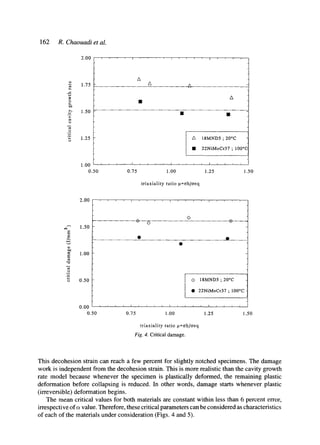
imens (Fig. 3). Their evolution in the minimum section clearly shows the expected critical
region of crack initiation. Thus, the crack initates at the centre of all specimens but at the notch
for NTS 0.2-specimen, as predicted by both models. Furthermore, at crack initiation, their
critical value is relatively constant, independent from the notch sharpness. In both models, the
finite element calculations have been performed assuming avon Mises material. This means
that the damage and the constitutive relations are non-coupled, whereas in the case of the
Gurson model [17], they are coupled.
The tensile properties of both steels being very similar (see Table 2), one would expect
quite similar critical damage values. The reason could be assigned to the factor, a, proportional
to the second phase particles. So, the main inclusions present in such steels being MnS-type,
according to Franklin [18], their density can be evaluated from the chemical composition
using the relation
0.001]
fMnS(%) = 5.4 %S %MnJ '
where, %S and %Mn are the weight-% of sulphur and manganese, respectively, and fMnSis the
volume fraction of MnS-inclusions. This relation agrees well with experimental measurements
for ferritic steels [6]. Given both compositions of the steels under consideration, this relation
gives fMnS = 0.007% for 18MND5 and fMnS = 0.05% for 22NiMoCr37. Therefore, the
factor ~ for 22NiMoCr37 should be higher than for 18MND5. Another possible reason for
the difference of critical damage values between these steels is the specimen size effect, as
suggested by Marini [13]. The critical cavity growth ratio and the critical damage work for
each material and geometry have been deduced and are given in Table 4. These values have
been obtained by integrating the damage functions from zero to the mean strain corresponding
to crack initiation derived from the experimental tests.
This table shows that (R/Ro)c increases with local plastic strain. Beremin [2, 3] showed
that this model should take into account the decohesion strain necessary to initiate a cavity.
E
ad
E
2.00
1.50
1.00
0.50
0.00
Damage work as ductilefracture criterion 161
....... 7 ........ / :, ..........NTS0.2 NTS 1.2 / / NTS2.4
I I
iII I ll I//l
rI I~ i I ///
Ill l Ill/ I
/ / ii //
I II // 1 1I ll/i ///
I/I ~///// ///
i //
2Y
" .'3.3 ""
i
0 10 20 30 40 50
2.00
1.75
1.50
1.25
1.00
60
O
2~0
¢.)
mean strain (%)
o
2.00
1.50
1.00
0.50
0.00
0
II/ //.
! /.s
Il/ ¢/I/
/ 1 t
1 i /
z i i//
i I I /
/I/~/// j¢
1111 I~ ~
10 20 30 40
2.00
1.75
1.50
1.25
1.00
50
mean strain (%)
Fig. 3. Damage evolution.
O
-.....
.o
°~
o
Table5. Critical damage
18MND5 22NiMoCr37
(R/Ro)c 1.73 1.51
Wac (in J/ram3) 1.61 1.25
Wd. (~ = 0.428) 2.26 1.77
162 R. Chaouadi et al.
2.00
1.75
0
em
1.50
>
"2.
"; 1.25
a
- A ~5~
A
1.00 ' ' : . . . . ~ ' ' '
0.50 0.75 1.00
A 18MND5 ; 20°C
• 22NiMoCr37 ; 100°(
1.25 1.50
triaxiality ratio p=ah/oeq
2.00
1.50
E
1.00
o 0.50
0.00
0.50
<>
................ e- O ~- ......
. . . . . . . . . . . . . . . . . . . . . . . . . . . . . . . . . . . . . . . . . . . . . . . . J . . . . . .
© 18MND5 ; 20°C
• 22NiMoCr37 ; 100°C
0.75 1.00 1.25 1.50
triaxiality ratio ~t=oh/creq
Fig. 4. Critical damage.
This decohesion strain can reach a few percent for slightly notched specimens. The damage
work is independent from the decohesion strain. This is more realistic than the cavity growth
rate model because whenever the specimen is plastically deformed, the remaining plastic
deformation before collapsing is reduced. In other words, damage starts whenever plastic
(irreversible) deformation begins.
The mean critical values for both materials are constant within less than 6 percent error,
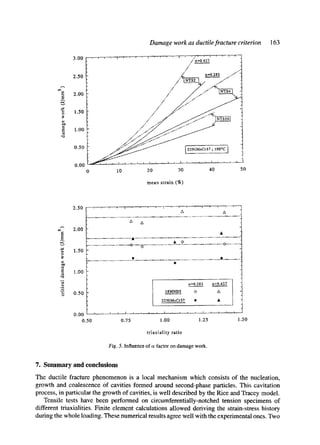
irrespective of a value. Therefore, these critical parameters can be considered as characteristics
of each of the materials under consideration (Figs. 4 and 5).
E
E
~O
3.00
2.50
2.00
1.50
1.00
0.50
0.00
Damage work as ductile fracture criterion
' ' ' " ' '' ' ' . . . . . /'~'.o/427 . . . . . t
/ q
a-0.283 /.-/"
/" I~"jlo~ I "~/'"
/,,/"'~/'~
/.'/" :,/.-/'"
0 10 20 30 40 50
mean strain (%)
163
2.50
2.00
E
1.50
1.00
0
0.50
0.00 ........
0.50
A A
A
. . . . . . . . . . . . . . . . 1It . . . . . . . . . . . . . . . . . . . . . . . . . . . . . . . . . . . . . .
. . . . . . . . . . . . . . . . .O. . . . . . . . . . . . . . . . . . . . . . . . . . . . . . . . 41~. . . . . .
@
a=0.283 a=0.427
18MND5 <> A
22NiMoCt37 @ •
1, r ~ l l l r l l l l l l I
0.75 1.00 1.25 1.50
triaxiality ratio
Fig. 5. Influence of cr factor on damage work.
7. Summary and conclusions
The ductile fracture phenomenon is a local mechanism which consists of the nucleation,
growth and coalescence of cavities formed around second-phase particles. This cavitation
process, in particular the growth of cavities, is well described by the Rice and Tracey model.
Tensile tests have been performed on circumferentially-notched tension specimens of
different triaxialities. Finite element calculations allowed deriving the strain-stress history
during the whole loading. These numerical results agree well with the experimental ones. Two
164 R. Chaouadi et al.
models have been evaluated using these numerical results: the Rice and Tracey cavity growth
model and the damage work model. The latter incorporates the hydrostatic stress and strain in
the expression of the plastic strain work. Both models represent well the ductile degradation
of the material. The region where crack initiates is well predicted and the critical damage has
a relatively constant value a crack initiation. Thus, these critical values can be considered as
material characteristics. However, in the cavity growth model, the decohesion strain should
be taken into account to be independent from the stress triaxiality. This is not the case in the
damage work model which considers that damage starts when irreversible deformation starts.
Acknowledgments
The authors gratefully acknowledge A. Fabry and E. van Walle for fruitful discussions and
their helpful comments in review.
References
1. P.W.Bddgman, Studies in Large Plastic Flow and Fracture, McGraw-Hill (1952).
2. K. Tanaka, T. Mori and T. Nakamura, PhilosophicaIMagazine 21 (1970) 267-279.
3. EM. Beremin, in Three-dimensional Constitutive Relations and Ductile Fracture, S. Nemat-Nasser (ed.)
North-Holland Publishing (1981) 185-205.
4. EM. Beremin, Metallurgical Transactions 12A (1981) 723-731.
5. J.W. Hancock and A.C. Mackenzie, Journal of the Mechanics and Physics of Solids 24 (1976) 147-169.
6. E Mudry: Etude de la rupture ductile et de la rupture par clivage d'aciers faiblement allies, Ph.D thesis,
Universit6 de Technologie de Compi~gne (1982).
7. G. LeRoy, J.D. Embury, G. Edward and M.F. Ashby,Acta Metallurgica 29 (1981) 1509-1522.
8. A. Brownrigg, W.A. Spitzig, O. Richmond, D. Teidinck and J.D. Embury, Acta MetaUurgica 31,8 (1983)
1141-1150.
9. W.H. Tai, Engineering Fracture Mechanics 37,4 (1990) 853-880.
10. Y.W.Shi, T.J. BarnyandA.S. Nadkami, Engineering Fracture Mechanics 39,1 (1991)37-44.
11. J.R. Rice and D.M. Tracey, Journal of the Mechanics and Physics of Solids 17 (1969) 201-217.
12. Y. Huang, Journalof Applied Mechanics, Transactions of the ASME 58 (1991) 1084-1086.
13. B. Madni: Croissance des cavit~s en plasticitY-Rupture sous chargements non radiaux et en mode mixte,
Ph.D thesis, Ecole de Mines de Paris (1984).
14. A. Halim, D.-Z. Sun and W. Dahl, in Proceedings of the 7th European Conference on Fracture, Budapest
(1987).
15. Zhang Keshi and Zheng Changquing, Engineering Fracture Mechanics 37,3 (1990) 621-629.
16. K.S. Zhang, C.Q. Zheng and N.S. Yang, in 6th International Conference on Mechanics (1990) 263-268.
17. A.L. Gurson, Journal of Engineering Materials and Technology, Transactions of the ASME 1 (1977) 2-15.
18. A.G. Franklin, Journalofthe Iron andSteel Institute 2 (1969) 181-186.

Chaouadi1994

  • 1.
    International Journal ofFracture 66:155-164, 1994. 155 (~) 1994KluwerAcademic Publishers. Printed in the Netherlands. Damage work as ductile fracture criterion R. CHAOUADI1-2, E DE MEESTER2 and W. VANDERMEULEN3 ISCK/CEN, Reactor Materials Research Unit, Boeretang 200, 2400 Mol, Belgium. 2KUL, Metals and Materials Science Department, De Crooylaan 2, 3030 Heverlee, Belgium. 3VITO, Materials Department, Boeretang 200, 2400 Mol, Belgium. Received29 October1993;acceptedin finalform28January 1994 Abstract. This paper treats the ductile failure initiation in circumferentially-notchedtension specimens and explores the local damagemodelthat is ableto representthe continuousdegradationof the deformingmaterial. Withthe aid of finiteelementcalculations,the notchedspecimenshavebeensimulatednumericallyandthe whole strain-stress historyfor each geometryderived.This allowsdeterminationof the evolutionof strain-stress fields until fractureoccurs.Two damagemodelswereevaluated:the RiceandTraceycavitygrowthmodeland a model which combinesthe latter with the plastic strain work,to derive an intrinsic parametercalled 'damage work'. These modelscouldpredictthe locationwherethe crack willinitiate as wellas the crackinitiation stepwhichis reachedfor a relativelyconstantvalueof the criticaldamage. 1. Introduction In the investigations dedicated to the prediction of ductile fracture initiation using local criteria, the evolution of damage is related to the overall loading path, thus involving the knowledge of the whole strain-stress history. Furthermore, ductile fracture being a local phenomenon, the strains and stresses must also be known locally, in particular in the region of high strain-stress concentration where cracks will initiate. Thus, finite element method is well indicated for such calculations. To be able to predict the moment and the location of the ductile crack initiation, a function representing the damage evolution has been computed at the elements of the minimum section. Experimental tests have been carried out on circumferentially-notched tensile specimens with different notch radii. This geometry allows for varying the triaxiality rate and the material size involved in the fracture process by simply changing the notch radius of curvature. Using finite element calculations, the evolution of the stress and strain components have been derived for each geometry. Different damage functions are then computed to represent the continuous degradation of the material until the crack initiation occurs. These models are then evaluated in view of the experimental results obtained. 2. Materials Two materials used in the nuclear pressure vessel industry and having different chemical composition have been used: 18MND5 and 22NiMoCr37 (see Table 1). The mechanical properties of both materials are given in Table 2. Specimens of the 18MND5 steel have a diameter at the minimum cross section at notch of 6 mm whereas for 22NiMoCr37 steel, this diameter is 10 mm. 3. Experiments The tests have been performed at room temperature for 18MND5 steel and at 100°C for 22NiMoCr37 steel. All tests have been carried out on a 100kN INSTRON tensile machine.
  • 2.
    156 R. Chaouadiet al. Table 1. Chemical composition (wt-%) C Si Mn P S Cr Mo Ni 18MND5 0.18 0.26 1.55 0.007 0.002 0.18 0.50 0.65 22NiMoCr37 0.30 0.23 0.71 0.009 0.011 0.47 0.80 0.71 Table 2. Mechanicalproperties 0.2% yield stress Tensilestrength Elongation Reduction of area #u(MPa) ~r~(MPa) ~% A% 18MND5(20°C) 525 670 22.5 70 22NiMoCr37(100°C) 517 670 19.8 61 Furthermore, all the tests have been performed under controlled displacement at a constant crosshead speed. The load and the crosshead displacement are continuously recorded, as well as the diameter contraction by an LVDT. The specimens are identified by the notation NTSp for Notched Tensile Specimen followed by the notch radius p. Typical mean strain-mean stress curves obtained from different notched specimens are shown in Fig. 1. As can be seen, the sharpness of the notch drastically reduces the ductility of the specimen because of the important role played by the hydrostatic component of the stress tensor. 4. Finite element simulation The stress-strain calculations are performed using the SYSTUS finite element code. Because of the axial symmetry, only a quarter of the specimen is simulated using two dimension isoparametric 8-node elements with reduced Gauss integration. The von Mises criterion for plasticity is used with associated incremental flow rule. The load application is simulated by a vertical displacement of the nodes situated at the upper face. Because of the large strains and deformations, the updated Lagrangian procedure is used. The BFGS algorithm is used to solve the constitutive equations. The comparison of experimental results with numerical calculations shows an overall good agreement (Fig. 2). The stress triaxiality ratio (O'H/O'eq),where O"n and Cr~qare respectively the hydrostatic and equivalent stresses, at the centre of specimen calculated from the Bridgman [1] formula is underestimated with regard to finite element calculations. However, the correlation is very good in the early stage of loading, except the NTS 0.2 geometry (Table 3). The triaxiality ratio is maximum at the centre of the specimen for all geometries, except for NTS 0.2 where it is maximum in a region close to the notch (t0.5 mm from the notch). Similarly, the crack initiates at the centre of each specimen except the NTS 0.2-specimen where it cracks from the notch.
  • 3.
    Damage work asductile fracture criterion 157 II r, E 1500 1000 500 0 0 100 NTS0.2 NTS1.2 NTS2.4 NTS6 NTS12 NTS60 J ~ material: 18MND5 room temperature NTSR Do=6mm i i i I T i i i I r i i r t i r i I 25 50 75 mean strain E=21n(Do/D) (%) Fig. 1. Strain-stress curves - influence of stress triaxiality. Table 3. Stress triaxiality at the centre of specimen NTS0.2 NTS1.2 NTS2.4 NTS6 NTS2 NTS4 NTS10 Bridgman 2.47 1.14 0.82 0.56 1.14 0.82 0.56 EE.M. (early stage) 1.35 1.07 0.81 0.54 1.08 0.80 0.54 EE.M. (mean) 1.28 1.39 1.12 0.86 1.37 1.07 0.80 5. Damage modelling Physically, ductile damage is related to the nucleation, growth and coalescence of cavities. The nucleation and coalescence phases are negligible compared to the growth phase, and therefore are not taken into account in this model. Many authors [2-10] have shown the important role played by the hydrostatic stress. Therefore, it is expected that this component will appear in the damage function. In addition, because of the damage process which is a cumulative process, the plastic strain increment will be the loading factor which represents the strain history. 5.1. CAVITY GROWTH MODEL Rice and Tracey [11] have calculated the displacement field of a perfectly plastic material containing a spherical cavity and subjected to remote stress and strain-rate fields. They derived a relation between the cavity radius rate and the stress-strain field. The damage is then related to the cavity radius, and crack initiation occurs for a critical radius of the cavity. This cavity
  • 4.
    158 R. Chaouadiet al. 1500 t ~: ~TS0. 1000 ~ jl ¢~1 / t t " g 500 0 0 25 I NTS0.2 NTS 1.2 NTS2.4 NTS6 ..... experimental numerical 18/rIND5 ; 20°C 1 i ~ i i I 50 mean strain E=21n(Do/D) (%) 75 g~ 1500 1000 500 NTS2 _~ - - - ~ ' ~ NTS4 ...... experimental numerical 22NiMoCr37 ; 100°C i n i i i i i i , ~ i i i i i i i ~ i I . . . . . . . i i [ i i i i i . . . . I , , i i i i i , t 10 20 30 40 50 mean strain E=2ln(DolD) (%) Fig. 2. Comparisonbetweenexperimentalandnumericalresults. growth rate is related to the stress triaxiality and to the strain history by where R is the cavity radius, t~e~qis the equivalent plastic strain increment, CrH is the hydro- static stress, aeq is the equivalent flow stress and ~ the triaxiality ratio t7H O-eq
  • 5.
    Damage work asductilefracture criterion 159 a is a constant factor, and according to Rice and Tracey [11] for high triaxialities, a = 0.283. However, this value has been corrected by Huang [12] who found a better approximation for a = 0.427. Furthermore, Marini [13] has shown that a is actually proportional to the volume fraction of second phase particles. Nevertheless, in this model, its value is not critical because it appears as a proportional parameter that can be fitted experimentally. Crack initiation occurs when R reaches its critical value Rc, which is an intrinsic property of the material. This model has been successfully used by many authors [5, 6, 9, 10, 14]. 5.2. DAMAGEWORKMODEL Another way of characterizing the ductile damage is obtained from the expression giving the plastic work per unit volume. Plastic strain work is given by 8WD = aij&r~j. Using the deviatoric stress expressions, this equation can be written as In plasticity problems, ~i = 0 to satisfy the incompressibility condition, and therefore, the hydrostatic stress O'H does not contribute to plastic deformation. This is experimentally well verified. However, locally, in particular for high plastic strains, this is no longer valid. Ductile fracture is a cavitation process, and locally, the volume change should be taken into account when evaluating the plastic strain work. The volume change (~V/V) can be related to the cavity growth rate of Rice and Tracey by ~V 8R V R Therefore (SR ~WD = Creq~CPeqq- 3(rH R Rearranging this equation leads to ~W~ = [1 + 3~¢ exp(3¢)] ~q~q. As can be seen from this equation, there is a competition between plastic flow and cavity growth. ~WD will be called 'damage work'. Fracture occurs when damage work reaches a critical value noted WDC, characteristic of the material. The first term is related to the dislocation creation process by plastic deformation whereas the second term is related to the cavity creation process. As before, the factor o~is an experimental fitting parameter. However, this factor could be correlated to the microstructure of the material, in the sense that it will represent also the distribution of the second phase particles in the material. So, any scattering in the data will be reflected by a. The damage model given here is very similar to the one proposed by Zhang et al. [15, 16]. However, the derivation is different although the conceptual idea of competition between material flowing and cavitation is the same. Indeed, they combined the void multistage nucleation model to the Gurson [17] potential for porous materials to derive what they called the 'combinatory work density'.
  • 6.
    160 R. Chaouadiet al. Table4. Critical damage of the different specimens eP~q(%) (R/Ro)c Wac(Jlmm3) 18MND5 -- NTS 1.2 21 1.63 1.61 (2.35)(*) NTS2.4 37 1.74 1.67 (2.38) NTS6 58 1.76 1.57 (2.13) NTS0.2 64 1.80 1.61 (2.17) 22NiMoCr37 NTS2 18 1.47 1.28 (1.87) NTS4 28 1.48 1.18 (1.67) NTS10 50 1.59 1.30 (1.76) * Values corresponding to ¢r --- 0.428. 6. Results and discussion These two damage models, i.e. Rice and Tracey cavity growth and damage work have been calculated in the meshes of the minimum cross section of the different notched tensile spec- imens (Fig. 3). Their evolution in the minimum section clearly shows the expected critical region of crack initiation. Thus, the crack initates at the centre of all specimens but at the notch for NTS 0.2-specimen, as predicted by both models. Furthermore, at crack initiation, their critical value is relatively constant, independent from the notch sharpness. In both models, the finite element calculations have been performed assuming avon Mises material. This means that the damage and the constitutive relations are non-coupled, whereas in the case of the Gurson model [17], they are coupled. The tensile properties of both steels being very similar (see Table 2), one would expect quite similar critical damage values. The reason could be assigned to the factor, a, proportional to the second phase particles. So, the main inclusions present in such steels being MnS-type, according to Franklin [18], their density can be evaluated from the chemical composition using the relation 0.001] fMnS(%) = 5.4 %S %MnJ ' where, %S and %Mn are the weight-% of sulphur and manganese, respectively, and fMnSis the volume fraction of MnS-inclusions. This relation agrees well with experimental measurements for ferritic steels [6]. Given both compositions of the steels under consideration, this relation gives fMnS = 0.007% for 18MND5 and fMnS = 0.05% for 22NiMoCr37. Therefore, the factor ~ for 22NiMoCr37 should be higher than for 18MND5. Another possible reason for the difference of critical damage values between these steels is the specimen size effect, as suggested by Marini [13]. The critical cavity growth ratio and the critical damage work for each material and geometry have been deduced and are given in Table 4. These values have been obtained by integrating the damage functions from zero to the mean strain corresponding to crack initiation derived from the experimental tests. This table shows that (R/Ro)c increases with local plastic strain. Beremin [2, 3] showed that this model should take into account the decohesion strain necessary to initiate a cavity.
  • 7.
    E ad E 2.00 1.50 1.00 0.50 0.00 Damage work asductilefracture criterion 161 ....... 7 ........ / :, ..........NTS0.2 NTS 1.2 / / NTS2.4 I I iII I ll I//l rI I~ i I /// Ill l Ill/ I / / ii // I II // 1 1I ll/i /// I/I ~///// /// i // 2Y " .'3.3 "" i 0 10 20 30 40 50 2.00 1.75 1.50 1.25 1.00 60 O 2~0 ¢.) mean strain (%) o 2.00 1.50 1.00 0.50 0.00 0 II/ //. ! /.s Il/ ¢/I/ / 1 t 1 i / z i i// i I I / /I/~/// j¢ 1111 I~ ~ 10 20 30 40 2.00 1.75 1.50 1.25 1.00 50 mean strain (%) Fig. 3. Damage evolution. O -..... .o °~ o Table5. Critical damage 18MND5 22NiMoCr37 (R/Ro)c 1.73 1.51 Wac (in J/ram3) 1.61 1.25 Wd. (~ = 0.428) 2.26 1.77
  • 8.
    162 R. Chaouadiet al. 2.00 1.75 0 em 1.50 > "2. "; 1.25 a - A ~5~ A 1.00 ' ' : . . . . ~ ' ' ' 0.50 0.75 1.00 A 18MND5 ; 20°C • 22NiMoCr37 ; 100°( 1.25 1.50 triaxiality ratio p=ah/oeq 2.00 1.50 E 1.00 o 0.50 0.00 0.50 <> ................ e- O ~- ...... . . . . . . . . . . . . . . . . . . . . . . . . . . . . . . . . . . . . . . . . . . . . . . . . J . . . . . . © 18MND5 ; 20°C • 22NiMoCr37 ; 100°C 0.75 1.00 1.25 1.50 triaxiality ratio ~t=oh/creq Fig. 4. Critical damage. This decohesion strain can reach a few percent for slightly notched specimens. The damage work is independent from the decohesion strain. This is more realistic than the cavity growth rate model because whenever the specimen is plastically deformed, the remaining plastic deformation before collapsing is reduced. In other words, damage starts whenever plastic (irreversible) deformation begins. The mean critical values for both materials are constant within less than 6 percent error, irrespective of a value. Therefore, these critical parameters can be considered as characteristics of each of the materials under consideration (Figs. 4 and 5).
  • 9.
    E E ~O 3.00 2.50 2.00 1.50 1.00 0.50 0.00 Damage work asductile fracture criterion ' ' ' " ' '' ' ' . . . . . /'~'.o/427 . . . . . t / q a-0.283 /.-/" /" I~"jlo~ I "~/'" /,,/"'~/'~ /.'/" :,/.-/'" 0 10 20 30 40 50 mean strain (%) 163 2.50 2.00 E 1.50 1.00 0 0.50 0.00 ........ 0.50 A A A . . . . . . . . . . . . . . . . 1It . . . . . . . . . . . . . . . . . . . . . . . . . . . . . . . . . . . . . . . . . . . . . . . . . . . . . . .O. . . . . . . . . . . . . . . . . . . . . . . . . . . . . . . . 41~. . . . . . @ a=0.283 a=0.427 18MND5 <> A 22NiMoCt37 @ • 1, r ~ l l l r l l l l l l I 0.75 1.00 1.25 1.50 triaxiality ratio Fig. 5. Influence of cr factor on damage work. 7. Summary and conclusions The ductile fracture phenomenon is a local mechanism which consists of the nucleation, growth and coalescence of cavities formed around second-phase particles. This cavitation process, in particular the growth of cavities, is well described by the Rice and Tracey model. Tensile tests have been performed on circumferentially-notched tension specimens of different triaxialities. Finite element calculations allowed deriving the strain-stress history during the whole loading. These numerical results agree well with the experimental ones. Two
  • 10.
    164 R. Chaouadiet al. models have been evaluated using these numerical results: the Rice and Tracey cavity growth model and the damage work model. The latter incorporates the hydrostatic stress and strain in the expression of the plastic strain work. Both models represent well the ductile degradation of the material. The region where crack initiates is well predicted and the critical damage has a relatively constant value a crack initiation. Thus, these critical values can be considered as material characteristics. However, in the cavity growth model, the decohesion strain should be taken into account to be independent from the stress triaxiality. This is not the case in the damage work model which considers that damage starts when irreversible deformation starts. Acknowledgments The authors gratefully acknowledge A. Fabry and E. van Walle for fruitful discussions and their helpful comments in review. References 1. P.W.Bddgman, Studies in Large Plastic Flow and Fracture, McGraw-Hill (1952). 2. K. Tanaka, T. Mori and T. Nakamura, PhilosophicaIMagazine 21 (1970) 267-279. 3. EM. Beremin, in Three-dimensional Constitutive Relations and Ductile Fracture, S. Nemat-Nasser (ed.) North-Holland Publishing (1981) 185-205. 4. EM. Beremin, Metallurgical Transactions 12A (1981) 723-731. 5. J.W. Hancock and A.C. Mackenzie, Journal of the Mechanics and Physics of Solids 24 (1976) 147-169. 6. E Mudry: Etude de la rupture ductile et de la rupture par clivage d'aciers faiblement allies, Ph.D thesis, Universit6 de Technologie de Compi~gne (1982). 7. G. LeRoy, J.D. Embury, G. Edward and M.F. Ashby,Acta Metallurgica 29 (1981) 1509-1522. 8. A. Brownrigg, W.A. Spitzig, O. Richmond, D. Teidinck and J.D. Embury, Acta MetaUurgica 31,8 (1983) 1141-1150. 9. W.H. Tai, Engineering Fracture Mechanics 37,4 (1990) 853-880. 10. Y.W.Shi, T.J. BarnyandA.S. Nadkami, Engineering Fracture Mechanics 39,1 (1991)37-44. 11. J.R. Rice and D.M. Tracey, Journal of the Mechanics and Physics of Solids 17 (1969) 201-217. 12. Y. Huang, Journalof Applied Mechanics, Transactions of the ASME 58 (1991) 1084-1086. 13. B. Madni: Croissance des cavit~s en plasticitY-Rupture sous chargements non radiaux et en mode mixte, Ph.D thesis, Ecole de Mines de Paris (1984). 14. A. Halim, D.-Z. Sun and W. Dahl, in Proceedings of the 7th European Conference on Fracture, Budapest (1987). 15. Zhang Keshi and Zheng Changquing, Engineering Fracture Mechanics 37,3 (1990) 621-629. 16. K.S. Zhang, C.Q. Zheng and N.S. Yang, in 6th International Conference on Mechanics (1990) 263-268. 17. A.L. Gurson, Journal of Engineering Materials and Technology, Transactions of the ASME 1 (1977) 2-15. 18. A.G. Franklin, Journalofthe Iron andSteel Institute 2 (1969) 181-186.