Changing Population Structure
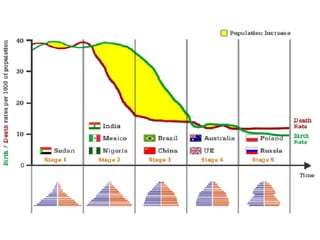
Learning Objectives Recap understanding of the DTM and its relationship to population pyramids of different shapes. Be able to describe and explain  spatial differences  in population structure Understand the consequences of changing population structures –  ageing population  in the MEDW and  youthful population  in LEDW
 
Why could population vary spatially? Different living standards / level of development between regions Different religious, racial or national groups.  Availability of jobs / types of jobs Uneven effects of migration. Effects of AIDS in some countries Decisions about availability of family planning
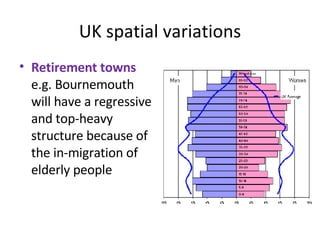
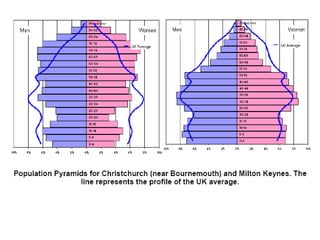
UK spatial variations Retirement towns  e.g. Bournemouth will have a regressive and top-heavy structure because of the in-migration of elderly people
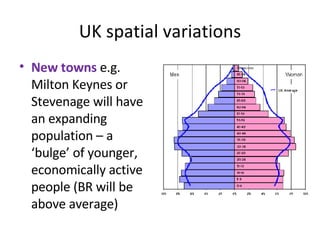
UK spatial variations New towns  e.g. Milton Keynes or Stevenage will have an expanding population – a ‘bulge’ of younger, economically active people (BR will be above average)
UK spatial variations University towns  e.g. Oxford or Cambridge will have higher proportions of young adults  Remote rural areas  e.g. central Wales will show the effects of the out-migration of young adults
 
Spatial variations in the LEDW Tanzania – Dar es Salem
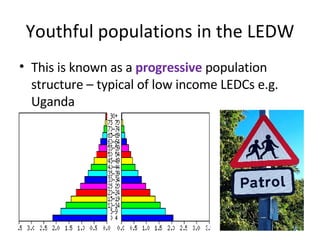
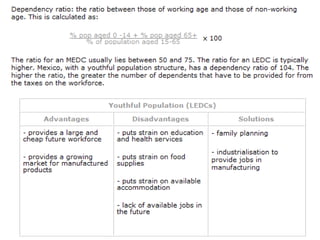
Youthful populations in the LEDW This is known as a  progressive  population structure – typical of low income LEDCs e.g. Uganda
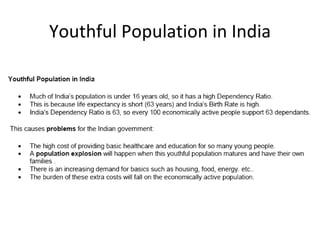
Youthful Population in India
 
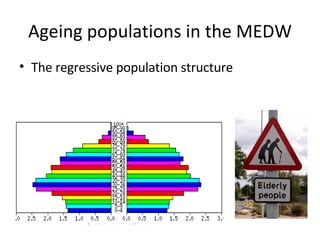
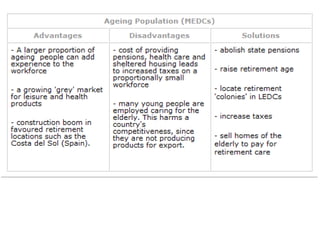
Ageing populations in the MEDW The regressive population structure
 
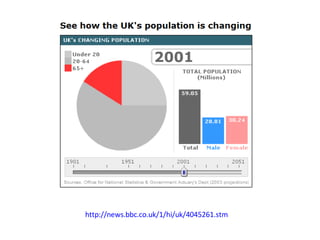
http://news.bbc.co.uk/1/hi/uk/4045261.stm
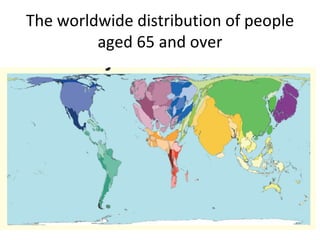
The worldwide distribution of people aged 65 and over
Outline the social, economic, demographic and political implications of an ageing population in the UK. Growing Grey article Bowen and Pallister P180-181 http://www.geographyinthenews.rgs.org/news/article/default.aspx?id=298 http://news.bbc.co.uk/1/hi/in_depth/uk/2004/ageing/default.stm Photocopied sheets

Changing Population Structure

  • 1.
  • 2.
    Learning Objectives Recapunderstanding of the DTM and its relationship to population pyramids of different shapes. Be able to describe and explain spatial differences in population structure Understand the consequences of changing population structures – ageing population in the MEDW and youthful population in LEDW
  • 3.
  • 4.
    Why could populationvary spatially? Different living standards / level of development between regions Different religious, racial or national groups. Availability of jobs / types of jobs Uneven effects of migration. Effects of AIDS in some countries Decisions about availability of family planning
  • 5.
    UK spatial variationsRetirement towns e.g. Bournemouth will have a regressive and top-heavy structure because of the in-migration of elderly people
  • 6.
    UK spatial variationsNew towns e.g. Milton Keynes or Stevenage will have an expanding population – a ‘bulge’ of younger, economically active people (BR will be above average)
  • 7.
    UK spatial variationsUniversity towns e.g. Oxford or Cambridge will have higher proportions of young adults Remote rural areas e.g. central Wales will show the effects of the out-migration of young adults
  • 8.
  • 9.
    Spatial variations inthe LEDW Tanzania – Dar es Salem
  • 10.
    Youthful populations inthe LEDW This is known as a progressive population structure – typical of low income LEDCs e.g. Uganda
  • 11.
  • 12.
  • 13.
    Ageing populations inthe MEDW The regressive population structure
  • 14.
  • 15.
  • 16.
    The worldwide distributionof people aged 65 and over
  • 17.
    Outline the social,economic, demographic and political implications of an ageing population in the UK. Growing Grey article Bowen and Pallister P180-181 http://www.geographyinthenews.rgs.org/news/article/default.aspx?id=298 http://news.bbc.co.uk/1/hi/in_depth/uk/2004/ageing/default.stm Photocopied sheets