Demographic change and 
inter-generational solidarity 
Challenges for urban management 
Prof. Dr. Dr. h.c. Bernhard Müller 
Leibniz Institute of Ecological Urban and Regional Development 
(IOER), Dresden, and Technische Universität Dresden 
International Smart Metropolis Congress 
AmberExpo Exhibition & Convention Centre 
Gdansk, Poland 
October 23, 2014
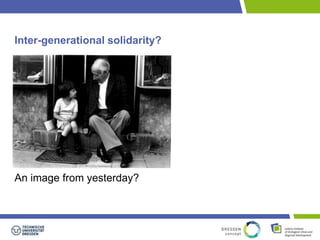
Inter-generational solidarity? 
An image from yesterday?
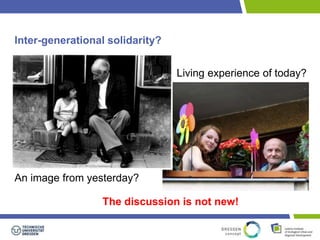
Inter-generational solidarity? 
An image from yesterday? 
Living experience of today? 
The discussion is not new!
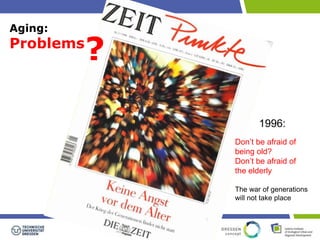
Aging: 
Problems 
Don’t be afraid of 
being old? 
Don’t be afraid of 
the elderly 
The war of generations 
will not take place 
? 
1996:
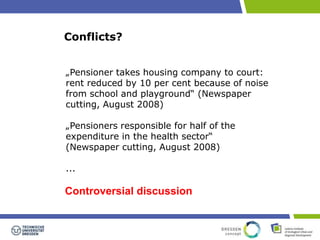
Conflicts? 
„Pensioner takes housing company to court: 
rent reduced by 10 per cent because of noise 
from school and playground“ (Newspaper 
cutting, August 2008) 
„Pensioners responsible for half of the 
expenditure in the health sector“ 
(Newspaper cutting, August 2008) 
... 
Controversial discussion
1. What do we know about 
demographic change?
1. What do we know about 
demographic change? 
2. What are the consequences 
for cities and regions?
1. What do we know about 
demographic change? 
2. What are the consequences 
for cities and regions? 
3. What are the policy responses 
regarding sustainable development?
1. What do we know about 
demographic change? 
2. What are the consequences 
for cities and regions? 
3. What are the policy responses 
regarding sustainable development?
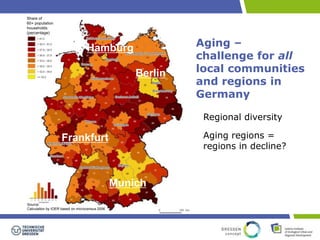
Aging – 
challenge for all 
local communities 
and regions in 
Germany 
Hamburg 
Source: 
Calculation by IOER based on microcensus 2006 
Regional diversity 
Aging regions = 
regions in decline? 
Berlin 
Frankfurt 
Munich 
Share of 
60+ population 
households 
(percentage)
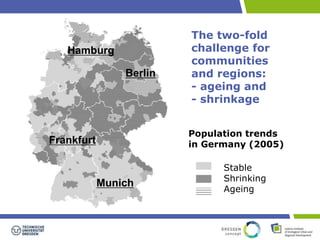
The two-fold 
challenge for 
communities 
and regions: 
- ageing and 
- shrinkage 
Population trends 
in Germany (2005) 
Stable 
Shrinking 
Ageing 
Berlin 
Hamburg 
Frankfurt 
Munich
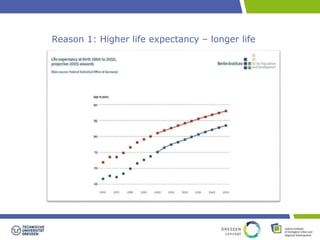
Reason 1: Higher life expectancy – longer life
4,5 
4 
3,5 
3 
2,5 
2 
1,5 
1 
0,5 
0 
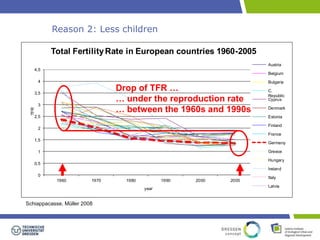
Reason 2: Less children 
Total Fertility Rate in European countries 1960-2005 
1960 1970 1980 1990 2000 2005 
TFR 
year 
Austria 
Belgium 
Bulgaria 
C. 
Republic 
Cyprus 
Denmark 
Estonia 
Finland 
France 
Germany 
Greece 
Hungary 
Ireland 
Italy 
Latvia 
Schiappacasse, Müller 2008 
Drop of TFR … 
… under the reproduction rate 
… between the 1960s and 1990s
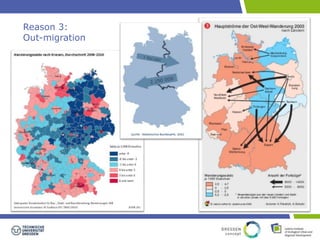
Reason 3: 
Out-migration
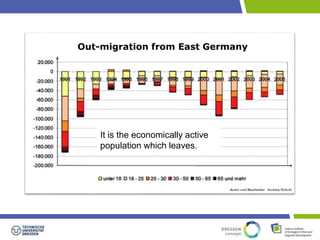
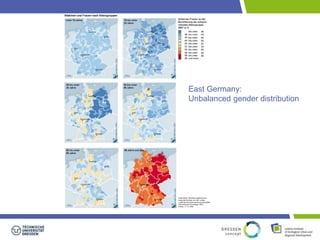
Out-migration from East Germany 
It is the economically active 
population which leaves.
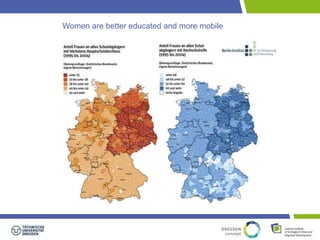
Women are better educated and more mobile
East Germany: 
Unbalanced gender distribution
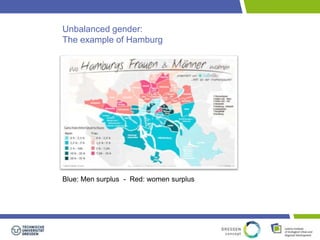
Unbalanced gender: 
The example of Hamburg 
Blue: Men surplus - Red: women surplus
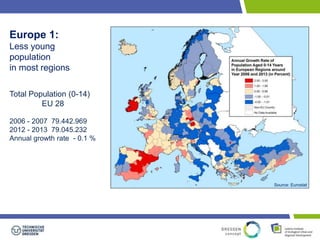
Europe 1: 
Less young 
population 
in most regions 
Total Population (0-14) 
EU 28 
2006 - 2007 79.442.969 
2012 - 2013 79.045.232 
Annual growth rate - 0.1 % 
Source: Eurostat
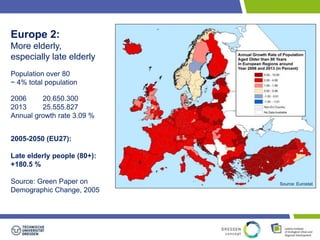
Europe 2: 
More elderly, 
especially late elderly 
Population over 80 
~ 4% total population 
2006 20.650.300 
2013 25.555.827 
Annual growth rate 3.09 % 
2005-2050 (EU27): 
Late elderly people (80+): 
+180.5 % 
Source: Green Paper on 
Demographic Change, 2005 
Source: Eurostat
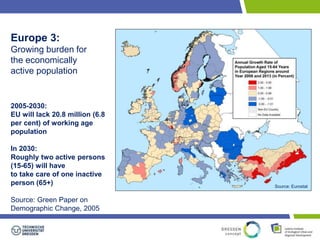
Europe 3: 
Growing burden for 
the economically 
active population 
2005-2030: 
EU will lack 20.8 million (6.8 
per cent) of working age 
population 
In 2030: 
Roughly two active persons 
(15-65) will have 
to take care of one inactive 
person (65+) 
Source: Green Paper on 
Demographic Change, 2005 
Source: Eurostat
1. What do we know about 
demographic change? 
2. What are the consequences 
for cities and regions? 
3. What are the policy responses 
regarding sustainable development?
Consequences: 
Changing housing markets
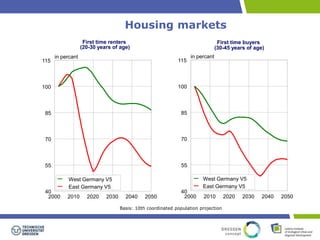
Housing markets 
First time renters 
(20-30 years of age) 
First time buyers 
(30-45 years of age) 
115 
100 
85 
70 
55 
2000 2010 2020 2030 2040 2050 
115 
100 
85 
70 
55 
40 
in percant 
West Germany V5 
East Germany V5 
Basis: 10th coordinated population projection 
40 
in percant 
West Germany V5 
East Germany V5 
2000 2010 2020 2030 2040 2050
175 
150 
125 
100 
75 
50 
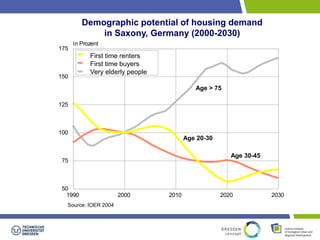
Demographic potential of housing demand 
in Prozent 
in Saxony, Germany (2000-2030) 
Ersthaushaltsgründungen 
Eigentumserwerb 
betreutes Wohnen 
First time renters 
First time buyers 
Very elderly people 
1990 2000 2010 2020 2030 
Source: IOER 2004 
Age > 75 
Age 20-30 
Age 30-45
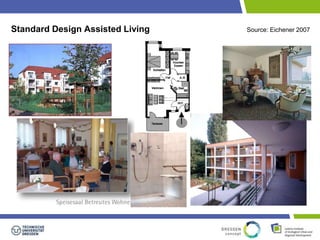
Standard Design Assisted Living Source: Eichener 2007
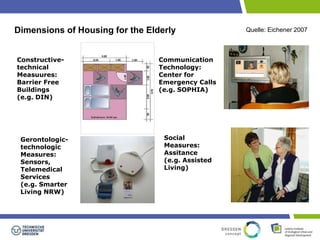
Dimensions of Housing for the Elderly 
Constructive-technical 
Measuures: 
Barrier Free 
Buildings 
(e.g. DIN) 
Communication 
Technology: 
Center for 
Emergency Calls 
(e.g. SOPHIA) 
Social 
Measures: 
Assitance 
(e.g. Assisted 
Living) 
Gerontologic-technologic 
Measures: 
Sensors, 
Telemedical 
Services 
(e.g. Smarter 
Living NRW) 
Quelle: Eichener 2007
Consequences: 
Changing housing markets 
Social infrastructure
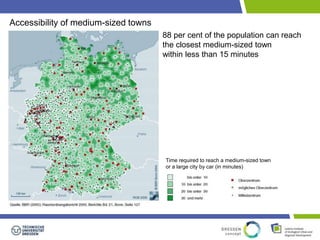
88 per cent of the population can reach 
the closest medium-sized town 
within less than 15 minutes 
Accessibility of medium-sized towns 
Time required to reach a medium-sized town 
or a large city by car (in minutes)
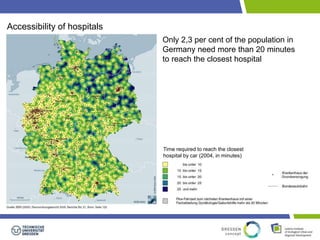
Only 2,3 per cent of the population in 
Germany need more than 20 minutes 
to reach the closest hospital 
Accessibility of hospitals 
Time required to reach the closest 
hospital by car (2004, in minutes)
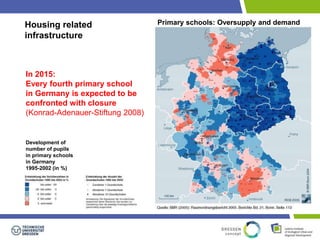
Housing related 
infrastructure 
Primary schools: Oversupply and demand 
In 2015: 
Every fourth primary school 
in Germany is expected to be 
confronted with closure 
(Konrad-Adenauer-Stiftung 2008) 
Development of 
number of pupils 
in primary schools 
in Germany 
1995-2002 (in %)
Consequences: 
Changing housing markets 
Social infrastructure 
Technical infrastructure 
Transportation (esp. low density areas)
Transportation and Mobility 
Drastic decrease of the number of school children has 
severe consequences for the decrease of service quality 
of public transport in rural areas
Consequences: 
Changing housing markets 
Social infrastructure 
Technical infrastructure 
Transportation (esp. low density areas) 
Employment (missing young population) 
and economic competitiveness in the future 
Gender imbalances (out-migration of women) 
and social consequences
1. What do we know about 
demographic change? 
2. What are the consequences 
for cities and regions? 
3. What are the policy responses 
regarding sustainable development?
For a long time
For a long time 
Reversing the trends ?
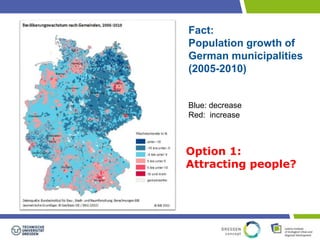
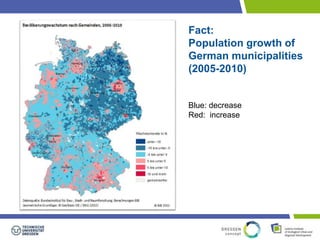
Fact: 
Population growth of 
German municipalities 
(2005-2010) 
Blue: decrease 
Red: increase
Fact: 
Population growth of 
German municipalities 
(2005-2010) 
Blue: decrease 
Red: increase 
Option 1: 
Attracting people?
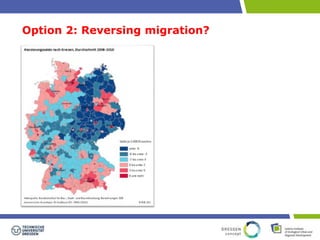
Option 2: Reversing migration?
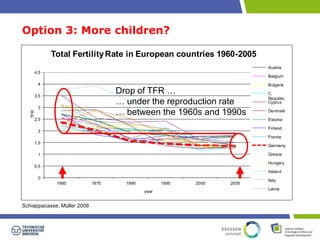
Option 3: More children? 
4,5 
4 
3,5 
3 
2,5 
2 
1,5 
1 
0,5 
0 
Total Fertility Rate in European countries 1960-2005 
1960 1970 1980 1990 2000 2005 
TFR 
year 
Austria 
Belgium 
Bulgaria 
C. 
Republic 
Cyprus 
Denmark 
Estonia 
Finland 
France 
Germany 
Greece 
Hungary 
Ireland 
Italy 
Latvia 
Schiappacasse, Müller 2008 
Drop of TFR … 
… under the reproduction rate 
… between the 1960s and 1990s
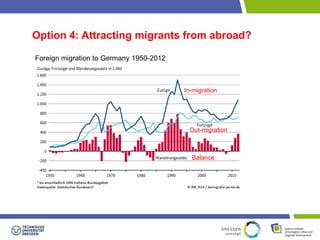
Option 4: Attracting migrants from abroad? 
Foreign migration to Germany 1950-2012 
In-migration 
Out-migration 
Balance
Option 5: 
Changing the pictures in our minds …
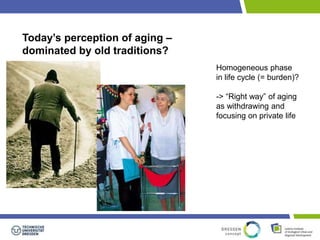
Today’s perception of aging – 
dominated by old traditions? 
Homogeneous phase 
in life cycle (= burden)? 
-> “Right way” of aging 
as withdrawing and 
focusing on private life
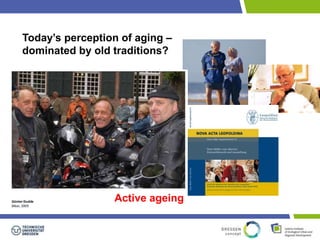
Today’s perception of aging – 
dominated by old traditions? 
Active ageing
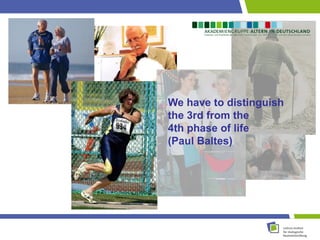
We have to distinguish 
the 3rd from the 
4th phase of life 
(Paul Baltes)
Option 5: 
Changing the pictures in our minds … 
… and adopting a new perspective 
on demographic change and the ageing society
Aging 
New challenges – new chances 
Akademiengruppe Altern in Deutschland 
(Academy Group on Aging in Germany): 
Productivity and life-long learning
Aging: New Challenges 
New Opportunities 
Higher life expectation - 
Differentiation between third and fourth phase of life 
Examples: 
• „Silver Economy“ – new market 
• Productivity – Extension and flexibility of 
work life span 
• Active aging and self-determined life – 
lifelong learning 
• Voluntarism - new fields of activities 
• Challenges – new solutions
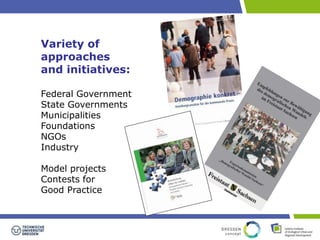
Variety of 
approaches 
and initiatives: 
Federal Government 
State Governments 
Municipalities 
Foundations 
NGOs 
Industry 
Model projects 
Contests for 
Good Practice
Reaction to aging 
Intergenerational housing, assisted living, 
ICT, aging in place, mobile services, 
modernization 
Residential environment, aging oriented open 
space planning 
Barrier-free accessibility, neighborhood shops, 
public transportation, ICT, mobile services 
Health care facilities, social infrastructure, 
retirement facilities 
Senior citizens’ councils, voluntarism
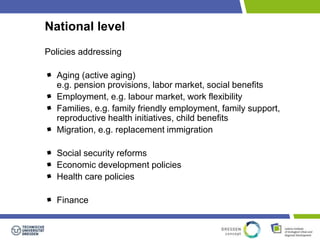
National level 
Policies addressing 
Aging (active aging) 
e.g. pension provisions, labor market, social benefits 
Employment, e.g. labour market, work flexibility 
Families, e.g. family friendly employment, family support, 
reproductive health initiatives, child benefits 
Migration, e.g. replacement immigration 
Social security reforms 
Economic development policies 
Health care policies 
Finance
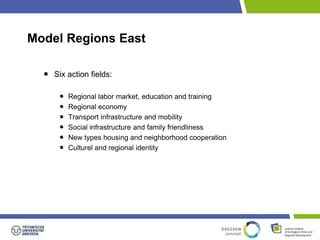
Model Regions East 
Six action fields: 
Regional labor market, education and training 
Regional economy 
Transport infrastructure and mobility 
Social infrastructure and family friendliness 
New types housing and neighborhood cooperation 
Culturel and regional identity
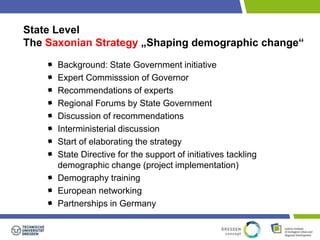
State Level 
The Saxonian Strategy „Shaping demographic change“ 
Background: State Government initiative 
Expert Commisssion of Governor 
Recommendations of experts 
Regional Forums by State Government 
Discussion of recommendations 
Interministerial discussion 
Start of elaborating the strategy 
State Directive for the support of initiatives tackling 
demographic change (project implementation) 
Demography training 
European networking 
Partnerships in Germany
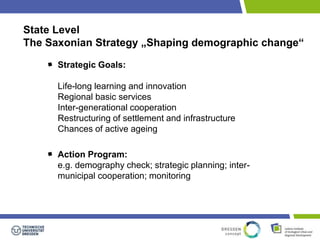
State Level 
The Saxonian Strategy „Shaping demographic change“ 
Strategic Goals: 
Life-long learning and innovation 
Regional basic services 
Inter-generational cooperation 
Restructuring of settlement and infrastructure 
Chances of active ageing 
Action Program: 
e.g. demography check; strategic planning; inter-municipal 
cooperation; monitoring
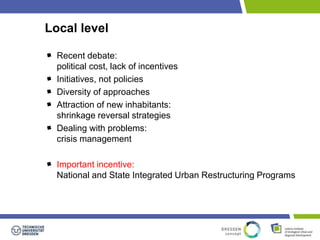
Local level 
Recent debate: 
political cost, lack of incentives 
Initiatives, not policies 
Diversity of approaches 
Attraction of new inhabitants: 
shrinkage reversal strategies 
Dealing with problems: 
crisis management 
Important incentive: 
National and State Integrated Urban Restructuring Programs
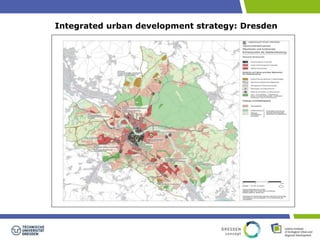
Integrated urban development strategy: Dresden
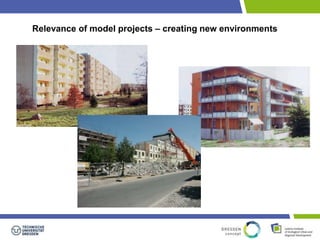
Relevance of model projects – creating new environments
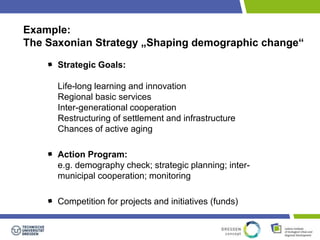
Example: 
The Saxonian Strategy „Shaping demographic change“ 
Strategic Goals: 
Life-long learning and innovation 
Regional basic services 
Inter-generational cooperation 
Restructuring of settlement and infrastructure 
Chances of active aging 
Action Program: 
e.g. demography check; strategic planning; inter-municipal 
cooperation; monitoring 
Competition for projects and initiatives (funds)
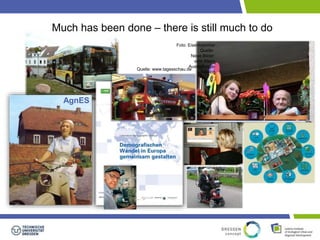
Much has been done – there is still much to do 
AgnES 
Foto: Eisenhammer 
Quelle: www.tagesschau.de 
Quelle: 
Neue Bilder 
vom Altern 
Ausstellungs-katalog
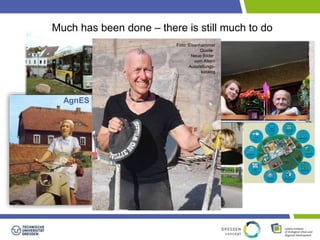
Much has been done – there is still much to do 
AgnES 
Foto: Eisenhammer 
Quelle: www.tagesschau.de 
Quelle: 
Neue Bilder 
vom Altern 
Ausstellungs-katalog
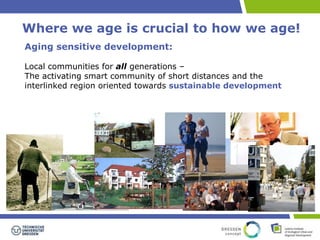
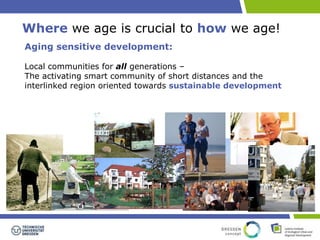
Where we age is crucial to how we age! 
Aging sensitive development: 
Local communities for all generations – 
The activating smart community of short distances and the 
interlinked region oriented towards sustainable development
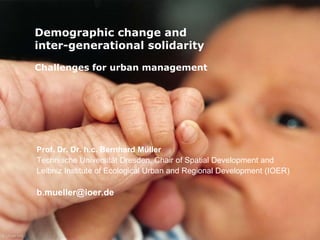
Demographic change and 
inter-generational solidarity 
Challenges for urban management 
Prof. Dr. Dr. h.c. Bernhard Müller 
Technische Universität Dresden, Chair of Spatial Development and 
Leibniz Institute of Ecological Urban and Regional Development (IOER) 
b.mueller@ioer.de
Where we age is crucial to how we age! 
Aging sensitive development: 
Local communities for all generations – 
The activating smart community of short distances and the 
interlinked region oriented towards sustainable development

Demographic change and inter-generational solidarity. Challenges for urban management. Prof. Dr. Dr. h.c. Bernhard Müller

  • 1.
    Demographic change and inter-generational solidarity Challenges for urban management Prof. Dr. Dr. h.c. Bernhard Müller Leibniz Institute of Ecological Urban and Regional Development (IOER), Dresden, and Technische Universität Dresden International Smart Metropolis Congress AmberExpo Exhibition & Convention Centre Gdansk, Poland October 23, 2014
  • 2.
    Inter-generational solidarity? Animage from yesterday?
  • 3.
    Inter-generational solidarity? Animage from yesterday? Living experience of today? The discussion is not new!
  • 4.
    Aging: Problems Don’tbe afraid of being old? Don’t be afraid of the elderly The war of generations will not take place ? 1996:
  • 5.
    Conflicts? „Pensioner takeshousing company to court: rent reduced by 10 per cent because of noise from school and playground“ (Newspaper cutting, August 2008) „Pensioners responsible for half of the expenditure in the health sector“ (Newspaper cutting, August 2008) ... Controversial discussion
  • 6.
    1. What dowe know about demographic change?
  • 7.
    1. What dowe know about demographic change? 2. What are the consequences for cities and regions?
  • 8.
    1. What dowe know about demographic change? 2. What are the consequences for cities and regions? 3. What are the policy responses regarding sustainable development?
  • 9.
    1. What dowe know about demographic change? 2. What are the consequences for cities and regions? 3. What are the policy responses regarding sustainable development?
  • 10.
    Aging – challengefor all local communities and regions in Germany Hamburg Source: Calculation by IOER based on microcensus 2006 Regional diversity Aging regions = regions in decline? Berlin Frankfurt Munich Share of 60+ population households (percentage)
  • 11.
    The two-fold challengefor communities and regions: - ageing and - shrinkage Population trends in Germany (2005) Stable Shrinking Ageing Berlin Hamburg Frankfurt Munich
  • 12.
    Reason 1: Higherlife expectancy – longer life
  • 13.
    4,5 4 3,5 3 2,5 2 1,5 1 0,5 0 Reason 2: Less children Total Fertility Rate in European countries 1960-2005 1960 1970 1980 1990 2000 2005 TFR year Austria Belgium Bulgaria C. Republic Cyprus Denmark Estonia Finland France Germany Greece Hungary Ireland Italy Latvia Schiappacasse, Müller 2008 Drop of TFR … … under the reproduction rate … between the 1960s and 1990s
  • 14.
  • 15.
    Out-migration from EastGermany It is the economically active population which leaves.
  • 16.
    Women are bettereducated and more mobile
  • 17.
    East Germany: Unbalancedgender distribution
  • 18.
    Unbalanced gender: Theexample of Hamburg Blue: Men surplus - Red: women surplus
  • 19.
    Europe 1: Lessyoung population in most regions Total Population (0-14) EU 28 2006 - 2007 79.442.969 2012 - 2013 79.045.232 Annual growth rate - 0.1 % Source: Eurostat
  • 20.
    Europe 2: Moreelderly, especially late elderly Population over 80 ~ 4% total population 2006 20.650.300 2013 25.555.827 Annual growth rate 3.09 % 2005-2050 (EU27): Late elderly people (80+): +180.5 % Source: Green Paper on Demographic Change, 2005 Source: Eurostat
  • 21.
    Europe 3: Growingburden for the economically active population 2005-2030: EU will lack 20.8 million (6.8 per cent) of working age population In 2030: Roughly two active persons (15-65) will have to take care of one inactive person (65+) Source: Green Paper on Demographic Change, 2005 Source: Eurostat
  • 22.
    1. What dowe know about demographic change? 2. What are the consequences for cities and regions? 3. What are the policy responses regarding sustainable development?
  • 23.
  • 24.
    Housing markets Firsttime renters (20-30 years of age) First time buyers (30-45 years of age) 115 100 85 70 55 2000 2010 2020 2030 2040 2050 115 100 85 70 55 40 in percant West Germany V5 East Germany V5 Basis: 10th coordinated population projection 40 in percant West Germany V5 East Germany V5 2000 2010 2020 2030 2040 2050
  • 25.
    175 150 125 100 75 50 Demographic potential of housing demand in Prozent in Saxony, Germany (2000-2030) Ersthaushaltsgründungen Eigentumserwerb betreutes Wohnen First time renters First time buyers Very elderly people 1990 2000 2010 2020 2030 Source: IOER 2004 Age > 75 Age 20-30 Age 30-45
  • 26.
    Standard Design AssistedLiving Source: Eichener 2007
  • 27.
    Dimensions of Housingfor the Elderly Constructive-technical Measuures: Barrier Free Buildings (e.g. DIN) Communication Technology: Center for Emergency Calls (e.g. SOPHIA) Social Measures: Assitance (e.g. Assisted Living) Gerontologic-technologic Measures: Sensors, Telemedical Services (e.g. Smarter Living NRW) Quelle: Eichener 2007
  • 28.
    Consequences: Changing housingmarkets Social infrastructure
  • 29.
    88 per centof the population can reach the closest medium-sized town within less than 15 minutes Accessibility of medium-sized towns Time required to reach a medium-sized town or a large city by car (in minutes)
  • 30.
    Only 2,3 percent of the population in Germany need more than 20 minutes to reach the closest hospital Accessibility of hospitals Time required to reach the closest hospital by car (2004, in minutes)
  • 31.
    Housing related infrastructure Primary schools: Oversupply and demand In 2015: Every fourth primary school in Germany is expected to be confronted with closure (Konrad-Adenauer-Stiftung 2008) Development of number of pupils in primary schools in Germany 1995-2002 (in %)
  • 32.
    Consequences: Changing housingmarkets Social infrastructure Technical infrastructure Transportation (esp. low density areas)
  • 33.
    Transportation and Mobility Drastic decrease of the number of school children has severe consequences for the decrease of service quality of public transport in rural areas
  • 34.
    Consequences: Changing housingmarkets Social infrastructure Technical infrastructure Transportation (esp. low density areas) Employment (missing young population) and economic competitiveness in the future Gender imbalances (out-migration of women) and social consequences
  • 35.
    1. What dowe know about demographic change? 2. What are the consequences for cities and regions? 3. What are the policy responses regarding sustainable development?
  • 36.
  • 37.
    For a longtime Reversing the trends ?
  • 38.
    Fact: Population growthof German municipalities (2005-2010) Blue: decrease Red: increase
  • 39.
    Fact: Population growthof German municipalities (2005-2010) Blue: decrease Red: increase Option 1: Attracting people?
  • 40.
  • 41.
    Option 3: Morechildren? 4,5 4 3,5 3 2,5 2 1,5 1 0,5 0 Total Fertility Rate in European countries 1960-2005 1960 1970 1980 1990 2000 2005 TFR year Austria Belgium Bulgaria C. Republic Cyprus Denmark Estonia Finland France Germany Greece Hungary Ireland Italy Latvia Schiappacasse, Müller 2008 Drop of TFR … … under the reproduction rate … between the 1960s and 1990s
  • 42.
    Option 4: Attractingmigrants from abroad? Foreign migration to Germany 1950-2012 In-migration Out-migration Balance
  • 43.
    Option 5: Changingthe pictures in our minds …
  • 44.
    Today’s perception ofaging – dominated by old traditions? Homogeneous phase in life cycle (= burden)? -> “Right way” of aging as withdrawing and focusing on private life
  • 45.
    Today’s perception ofaging – dominated by old traditions? Active ageing
  • 46.
    We have todistinguish the 3rd from the 4th phase of life (Paul Baltes)
  • 47.
    Option 5: Changingthe pictures in our minds … … and adopting a new perspective on demographic change and the ageing society
  • 48.
    Aging New challenges– new chances Akademiengruppe Altern in Deutschland (Academy Group on Aging in Germany): Productivity and life-long learning
  • 49.
    Aging: New Challenges New Opportunities Higher life expectation - Differentiation between third and fourth phase of life Examples: • „Silver Economy“ – new market • Productivity – Extension and flexibility of work life span • Active aging and self-determined life – lifelong learning • Voluntarism - new fields of activities • Challenges – new solutions
  • 50.
    Variety of approaches and initiatives: Federal Government State Governments Municipalities Foundations NGOs Industry Model projects Contests for Good Practice
  • 51.
    Reaction to aging Intergenerational housing, assisted living, ICT, aging in place, mobile services, modernization Residential environment, aging oriented open space planning Barrier-free accessibility, neighborhood shops, public transportation, ICT, mobile services Health care facilities, social infrastructure, retirement facilities Senior citizens’ councils, voluntarism
  • 52.
    National level Policiesaddressing Aging (active aging) e.g. pension provisions, labor market, social benefits Employment, e.g. labour market, work flexibility Families, e.g. family friendly employment, family support, reproductive health initiatives, child benefits Migration, e.g. replacement immigration Social security reforms Economic development policies Health care policies Finance
  • 53.
    Model Regions East Six action fields: Regional labor market, education and training Regional economy Transport infrastructure and mobility Social infrastructure and family friendliness New types housing and neighborhood cooperation Culturel and regional identity
  • 54.
    State Level TheSaxonian Strategy „Shaping demographic change“ Background: State Government initiative Expert Commisssion of Governor Recommendations of experts Regional Forums by State Government Discussion of recommendations Interministerial discussion Start of elaborating the strategy State Directive for the support of initiatives tackling demographic change (project implementation) Demography training European networking Partnerships in Germany
  • 55.
    State Level TheSaxonian Strategy „Shaping demographic change“ Strategic Goals: Life-long learning and innovation Regional basic services Inter-generational cooperation Restructuring of settlement and infrastructure Chances of active ageing Action Program: e.g. demography check; strategic planning; inter-municipal cooperation; monitoring
  • 56.
    Local level Recentdebate: political cost, lack of incentives Initiatives, not policies Diversity of approaches Attraction of new inhabitants: shrinkage reversal strategies Dealing with problems: crisis management Important incentive: National and State Integrated Urban Restructuring Programs
  • 57.
  • 58.
    Relevance of modelprojects – creating new environments
  • 59.
    Example: The SaxonianStrategy „Shaping demographic change“ Strategic Goals: Life-long learning and innovation Regional basic services Inter-generational cooperation Restructuring of settlement and infrastructure Chances of active aging Action Program: e.g. demography check; strategic planning; inter-municipal cooperation; monitoring Competition for projects and initiatives (funds)
  • 60.
    Much has beendone – there is still much to do AgnES Foto: Eisenhammer Quelle: www.tagesschau.de Quelle: Neue Bilder vom Altern Ausstellungs-katalog
  • 61.
    Much has beendone – there is still much to do AgnES Foto: Eisenhammer Quelle: www.tagesschau.de Quelle: Neue Bilder vom Altern Ausstellungs-katalog
  • 62.
    Where we ageis crucial to how we age! Aging sensitive development: Local communities for all generations – The activating smart community of short distances and the interlinked region oriented towards sustainable development
  • 63.
    Demographic change and inter-generational solidarity Challenges for urban management Prof. Dr. Dr. h.c. Bernhard Müller Technische Universität Dresden, Chair of Spatial Development and Leibniz Institute of Ecological Urban and Regional Development (IOER) b.mueller@ioer.de
  • 64.
    Where we ageis crucial to how we age! Aging sensitive development: Local communities for all generations – The activating smart community of short distances and the interlinked region oriented towards sustainable development