80 Gulf Marketing Review December 2008
Until recently, marketers could afford
to relegate the impact of digital media
on the larger media landscape to the
realm of long-term thinking, since so
few of their target consumers even had
access to the internet.
But times have changed.
While the UAE’s internet penetration
(at approximately 60 per cent) is already
comparable to many European coun-
tries, other GCC countries are catching
up quickly. A third of Saudi residents
are already online and Kuwait has one
of the region’s fastest growing broad-
band markets.
The growth of digital and interactive
media over the past few years in the GCC
has added a whole slew of new choices
for consumers. But is online changing
consumer habits in fundamental ways,
or has it merely added another dimension
to the media mix?
As internet penetration continues to
increase dramatically around the region,
how will these newly connected audiences
– soon to represent a majority in most
Gulf countries – change their usage and
consumption of traditional media?
These are the questions we undertook
to answer in a recent study of the media
GMR exclusive: Digital is changing the media landscape in the GCC. Published
for the first time, Maktoob Research examines the implications state by state.
Hold The Front PAge
INSIGHT
©Photolibrary
December 2008 Gulf Marketing Review 81
habits of online consumers conducted
specifically for GMR.
Clearly, connected consumers have
access to a vast number of media com-
peting for their attention, and so it is no
surprise that the study found a large level
of fragmentation in media habits.
On average, 3-4 different media channels
are being valued the most, trusted the
most, and would be missed the most.
However, the most striking pattern
across the board is how quickly the in-
ternet has supplanted such traditional
powerhouses as magazines, radio and
even local FTA TV.
For the connected GCC consumer,
only satellite TV and newspapers
consistently figure in the top five of
their media mix.
This is especially surprising consider­
ing the relatively slim breadth of digital
content and services currently on offer
in the Arabic language.
The only area where TV holds a
commanding lead is its perception by
consumers as a more credible source
for news.
Web and search trump TV and newspapers
as most valued by connected consumers
It is clear that online media is taking
in an increasing share of consumers’
daily media consumption – websites
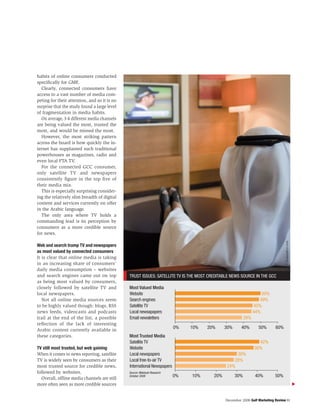
and search engines came out on top
as being most valued by consumers,
closely followed by satellite TV and
local newspapers.
Not all online media sources seem
to be highly valued though: blogs, RSS
news feeds, videocasts and podcasts
trail at the end of the list, a possible
reflection of the lack of interesting
Arabic content currently available in
these categories.
TV still most trusted, but web gaining
When it comes to news reporting, satellite
TV is widely seen by consumers as their
most trusted source for credible news,
followed by websites.
Overall, offline media channels are still
more often seen as more credible sources
Trust issues: satellite Tv is the most creditable news source in the gcc
Website
Search engines
Satellite TV
Local newsapapers
Email newsletters
50%
49%
39%
60%50%40%30%20%10%0%
45%
44%
Most Valued Media
Satellite TV
Website
Local newspapers
Local free-to-air TV
International Newspapers
42%
38%
30%
28%
24%
50%40%30%20%10%0%
Most Trusted Media
s
Source: Maktoob Research
October 2008
©ArabianEye.com
82 Gulf Marketing Review December 2008
than online media channels. Nevertheless,
it is striking that web­sites score on a
par with local newspapers for trust, and
quite a bit ahead of local TV, magazines
and international newspapers.
Another interesting finding is that word-
of-mouth scores extremely low, even though
these sources have the most influence on
consumers’ purchase decisions.
And, again, blogs, RSS news feeds,
videocasts, podcasts and celebrity endor-
sement come at the end of the list.
Nothing beats WoM
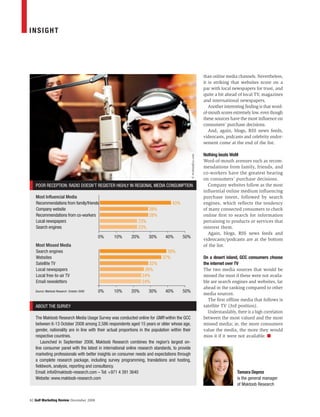
Word-of-mouth avenues such as recom-
mendations from family, friends, and
co-workers have the greatest bearing
on consumers’ purchase decisions.
Company websites follow as the most
influential online medium influencing
purchase intent, followed by search
engines, which reflects the tendency
of many connected consumers to check
online first to search for information
pertaining to products or services that
interest them.
Again, blogs, RSS news feeds and
videocasts/podcasts are at the bottom
of the list.
On a desert island, GCC consumers choose
the internet over TV
The two media sources that would be
missed the most if these were not availa-
ble are search engines and websites, far
ahead in the ranking compared to other
media sources.
The first offline media that follows is
satellite TV (3rd position).
Understandably, there is a high correlation
between the most valued and the most
missed media; ie, the more consumers
value the media, the more they would
miss it if it were not available. n
Recommendations from family/friends
Company website
Recommendations from co-workers
Local newspapers
Search engines
43%
28%
28%
23%
23%
50%40%30%20%10%0%
Most Influencial Media
Search engines
Websites
Satellite TV
Local newspapers
Local free-to-air TV
Email newsletters
39%
32%
26%
24%
24%
50%40%30%20%10%0%
Most Missed Media
37%
About the survey
The Maktoob Research Media Usage Survey was conducted online for GMR within the GCC
between 6-13 October 2008 among 2,586 respondents aged 15 years or older whose age,
gender, nationality are in line with their actual proportions in the population within their
respective countries.
Launched in September 2006, Maktoob Research combines the region’s largest on­
line consumer panel with the latest in international online research standards, to provide
marketing professionals with better insights on consumer needs and expectations through
a ­complete research package, including survey programming, translations and hosting,
­fieldwork, analysis, reporting and consultancy.
Email: info@maktoob-research.com – Tel: +971 4 391 3640
Website: www.maktoob-research.com
Tamara Deprez
is the general manager
of Maktoob Research
INSIGHT
Source: Maktoob Research October 2008
poor reception: radio doesn’t register highly in regional media consumption
©ArabianEye.com
84 Gulf Marketing Review December 2008
INSIGHT
©Corbis
December 2008 Gulf Marketing Review 85
Bahrain
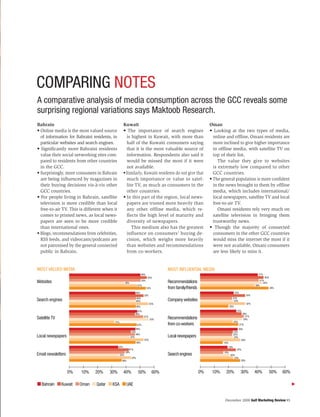
• Online media is the most valued source
of information for Bahraini residents, in
particular websites and search engines.
• Significantly more Bahraini residents
value their social networking sites com-
pared to residents from other countries
in the GCC.
• Surprisingly, more consumers in Bahrain
are being influenced by magazines in
their buying decisions vis-à-vis other
GCC countries.
• For people living in Bahrain, satellite
television is more credible than local
free-to-air TV. This is different when it
comes to printed news, as local news-
papers are seen to be more credible
than international ones.
• Blogs, recommendations from celebrities,
RSS feeds, and videocasts/podcasts are
not patronised by the general connected
public in Bahrain.
Kuwait
• The importance of search engines
is highest in Kuwait, with more than
half of the Kuwaiti consumers saying
that it is the most valuable source of
information. Respondents also said it
would be missed the most if it were
not available.
•Similarly, Kuwaiti residents do not give that
much importance or value to satel-
lite TV, as much as consumers in the
other countries.
• In this part of the region, local news-
papers are trusted more heavily than
any other offline media, which re-
flects the high level of maturity and
diversity of newspapers.
This medium also has the greatest
influence on consumers’ buying de-
cision, which weighs more heavily
than websites and recommendations
from co-workers.
Oman
• Looking at the two types of media,
online and offline, Omani residents are
more inclined to give higher importance
to offline media, with satellite TV on
top of their list.
The value they give to websites
is extremely low compared to other
GCC countries.
• The general population is more confident
in the news brought to them by offline
media, which includes international/
local newspapers, satellite TV and local
free-to-air TV.
Omani residents rely very much on
satellite television in bringing them
trustworthy news.
• Though the majority of connected
consumers in the other GCC countries
would miss the internet the most if it
were not available, Omani consumers
are less likely to miss it.
s
Websites
Search engines
Satellite TV
Local newspapers
Email newsletters
0% 10% 20% 30% 40% 50% 60%
46%
52%
46%
46%
55%
46%
47%
46%
51%
55%
31%
47%
46%
43%
46%
42%
52%
46%
34%
41%
39%
35%
43%
36%
49%
54%
50%
38%
47%
53%
Most Valued Media
Recommendations
fromfamily/friends
Companywebsites
Recommendations
fromco-workers
Localnewspapers
Searchengines
0% 10% 20% 30% 40% 50% 60%
41%
23%
19%
32%
25%
22%
16%
23%
20%
32%
23%
20%
25%
29%
31%
29%
23%
27%
26%
23%
22%
23%
28%
16%
28%
45%
41%
44%
38%
48%
Most INFLUENTIAL MEDIA
A comparative analysis of media consumption across the GCC reveals some
surprising regional variations says Maktoob Research.
Comparing Notes
Bahrain Kuwait Oman Qatar KSA UAE
86 Gulf Marketing Review December 2008
Qatar
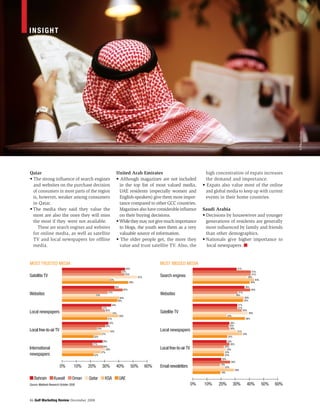
• The strong influence of search engines
and websites on the purchase decision
of consumers in most parts of the region
is, however, weaker among consumers
in Qatar.
•The media they said they value the
most are also the ones they will miss
the most if they were not available.
These are search engines and websites
for online media, as well as ­satellite
TV and local newspapers for offline
media.
United Arab Emirates
• Although magazines are not included
in the top list of most valued media,
UAE residents (especially women and
English-speakers) give them more impor-
tance compared to other GCC countries.
­Magazines also have considerable influence
on their buying decisions.
•Whiletheymay not give much importance
to blogs, the youth sees them as a very
valuable source of information.
• The older people get, the more they
value and trust satellite TV. Also, the
high concentration of expats increases
the demand and importance.
• Expats also value most of the online
and global media to keep up with current
events in their home countries.
Saudi Arabia
• Decisions by housewives and younger
generations of residents are generally
more influenced by family and friends
than other demographics.
• Nationals give higher importance to
local newspapers. n
INSIGHT
Satellite TV
Websites
Local newspapers
Localfree-to-airTV
International
newspapers
Source: Maktoob Research October 2008
0% 10% 20% 30% 40% 50% 60%
36%
42%
31%
23%
40%
38%
34%
27%
30%
34%
39%
31%
32%
30%
24%
33%
27%
22%
28%
21%
28%
30%
27%
22%
43%
41%
43%
52%
33%
46%
Most Trusted Media
Search engines
Websites
Satellite TV
Local newspapers
Localfree-to-airTV
Emailnewsletters
0% 10% 20% 30% 40% 50% 60%
31%
36%
31%
26%
24%
20%
40%
31%
25%
26%
26%
31%
34%
26%
22%
19%
29%
38%
31%
23%
22%
36%
24%
34%
22%
29%
35%
36%
24%
22%
19%
41%
41%
38%
43%
40%
Most Missed Media
Bahrain Kuwait Oman Qatar KSA UAE
©Photolibrary

Changing Media Landscape

  • 1.
    80 Gulf MarketingReview December 2008 Until recently, marketers could afford to relegate the impact of digital media on the larger media landscape to the realm of long-term thinking, since so few of their target consumers even had access to the internet. But times have changed. While the UAE’s internet penetration (at approximately 60 per cent) is already comparable to many European coun- tries, other GCC countries are catching up quickly. A third of Saudi residents are already online and Kuwait has one of the region’s fastest growing broad- band markets. The growth of digital and interactive media over the past few years in the GCC has added a whole slew of new choices for consumers. But is online changing consumer habits in fundamental ways, or has it merely added another dimension to the media mix? As internet penetration continues to increase dramatically around the region, how will these newly connected audiences – soon to represent a majority in most Gulf countries – change their usage and consumption of traditional media? These are the questions we undertook to answer in a recent study of the media GMR exclusive: Digital is changing the media landscape in the GCC. Published for the first time, Maktoob Research examines the implications state by state. Hold The Front PAge INSIGHT ©Photolibrary
  • 2.
    December 2008 GulfMarketing Review 81 habits of online consumers conducted specifically for GMR. Clearly, connected consumers have access to a vast number of media com- peting for their attention, and so it is no surprise that the study found a large level of fragmentation in media habits. On average, 3-4 different media channels are being valued the most, trusted the most, and would be missed the most. However, the most striking pattern across the board is how quickly the in- ternet has supplanted such traditional powerhouses as magazines, radio and even local FTA TV. For the connected GCC consumer, only satellite TV and newspapers consistently figure in the top five of their media mix. This is especially surprising consider­ ing the relatively slim breadth of digital content and services currently on offer in the Arabic language. The only area where TV holds a commanding lead is its perception by consumers as a more credible source for news. Web and search trump TV and newspapers as most valued by connected consumers It is clear that online media is taking in an increasing share of consumers’ daily media consumption – websites and search engines came out on top as being most valued by consumers, closely followed by satellite TV and local newspapers. Not all online media sources seem to be highly valued though: blogs, RSS news feeds, videocasts and podcasts trail at the end of the list, a possible reflection of the lack of interesting Arabic content currently available in these categories. TV still most trusted, but web gaining When it comes to news reporting, satellite TV is widely seen by consumers as their most trusted source for credible news, followed by websites. Overall, offline media channels are still more often seen as more credible sources Trust issues: satellite Tv is the most creditable news source in the gcc Website Search engines Satellite TV Local newsapapers Email newsletters 50% 49% 39% 60%50%40%30%20%10%0% 45% 44% Most Valued Media Satellite TV Website Local newspapers Local free-to-air TV International Newspapers 42% 38% 30% 28% 24% 50%40%30%20%10%0% Most Trusted Media s Source: Maktoob Research October 2008 ©ArabianEye.com
  • 3.
    82 Gulf MarketingReview December 2008 than online media channels. Nevertheless, it is striking that web­sites score on a par with local newspapers for trust, and quite a bit ahead of local TV, magazines and international newspapers. Another interesting finding is that word- of-mouth scores extremely low, even though these sources have the most influence on consumers’ purchase decisions. And, again, blogs, RSS news feeds, videocasts, podcasts and celebrity endor- sement come at the end of the list. Nothing beats WoM Word-of-mouth avenues such as recom- mendations from family, friends, and co-workers have the greatest bearing on consumers’ purchase decisions. Company websites follow as the most influential online medium influencing purchase intent, followed by search engines, which reflects the tendency of many connected consumers to check online first to search for information pertaining to products or services that interest them. Again, blogs, RSS news feeds and videocasts/podcasts are at the bottom of the list. On a desert island, GCC consumers choose the internet over TV The two media sources that would be missed the most if these were not availa- ble are search engines and websites, far ahead in the ranking compared to other media sources. The first offline media that follows is satellite TV (3rd position). Understandably, there is a high correlation between the most valued and the most missed media; ie, the more consumers value the media, the more they would miss it if it were not available. n Recommendations from family/friends Company website Recommendations from co-workers Local newspapers Search engines 43% 28% 28% 23% 23% 50%40%30%20%10%0% Most Influencial Media Search engines Websites Satellite TV Local newspapers Local free-to-air TV Email newsletters 39% 32% 26% 24% 24% 50%40%30%20%10%0% Most Missed Media 37% About the survey The Maktoob Research Media Usage Survey was conducted online for GMR within the GCC between 6-13 October 2008 among 2,586 respondents aged 15 years or older whose age, gender, nationality are in line with their actual proportions in the population within their respective countries. Launched in September 2006, Maktoob Research combines the region’s largest on­ line consumer panel with the latest in international online research standards, to provide marketing professionals with better insights on consumer needs and expectations through a ­complete research package, including survey programming, translations and hosting, ­fieldwork, analysis, reporting and consultancy. Email: info@maktoob-research.com – Tel: +971 4 391 3640 Website: www.maktoob-research.com Tamara Deprez is the general manager of Maktoob Research INSIGHT Source: Maktoob Research October 2008 poor reception: radio doesn’t register highly in regional media consumption ©ArabianEye.com
  • 4.
    84 Gulf MarketingReview December 2008 INSIGHT ©Corbis
  • 5.
    December 2008 GulfMarketing Review 85 Bahrain • Online media is the most valued source of information for Bahraini residents, in particular websites and search engines. • Significantly more Bahraini residents value their social networking sites com- pared to residents from other countries in the GCC. • Surprisingly, more consumers in Bahrain are being influenced by magazines in their buying decisions vis-à-vis other GCC countries. • For people living in Bahrain, satellite television is more credible than local free-to-air TV. This is different when it comes to printed news, as local news- papers are seen to be more credible than international ones. • Blogs, recommendations from celebrities, RSS feeds, and videocasts/podcasts are not patronised by the general connected public in Bahrain. Kuwait • The importance of search engines is highest in Kuwait, with more than half of the Kuwaiti consumers saying that it is the most valuable source of information. Respondents also said it would be missed the most if it were not available. •Similarly, Kuwaiti residents do not give that much importance or value to satel- lite TV, as much as consumers in the other countries. • In this part of the region, local news- papers are trusted more heavily than any other offline media, which re- flects the high level of maturity and diversity of newspapers. This medium also has the greatest influence on consumers’ buying de- cision, which weighs more heavily than websites and recommendations from co-workers. Oman • Looking at the two types of media, online and offline, Omani residents are more inclined to give higher importance to offline media, with satellite TV on top of their list. The value they give to websites is extremely low compared to other GCC countries. • The general population is more confident in the news brought to them by offline media, which includes international/ local newspapers, satellite TV and local free-to-air TV. Omani residents rely very much on satellite television in bringing them trustworthy news. • Though the majority of connected consumers in the other GCC countries would miss the internet the most if it were not available, Omani consumers are less likely to miss it. s Websites Search engines Satellite TV Local newspapers Email newsletters 0% 10% 20% 30% 40% 50% 60% 46% 52% 46% 46% 55% 46% 47% 46% 51% 55% 31% 47% 46% 43% 46% 42% 52% 46% 34% 41% 39% 35% 43% 36% 49% 54% 50% 38% 47% 53% Most Valued Media Recommendations fromfamily/friends Companywebsites Recommendations fromco-workers Localnewspapers Searchengines 0% 10% 20% 30% 40% 50% 60% 41% 23% 19% 32% 25% 22% 16% 23% 20% 32% 23% 20% 25% 29% 31% 29% 23% 27% 26% 23% 22% 23% 28% 16% 28% 45% 41% 44% 38% 48% Most INFLUENTIAL MEDIA A comparative analysis of media consumption across the GCC reveals some surprising regional variations says Maktoob Research. Comparing Notes Bahrain Kuwait Oman Qatar KSA UAE
  • 6.
    86 Gulf MarketingReview December 2008 Qatar • The strong influence of search engines and websites on the purchase decision of consumers in most parts of the region is, however, weaker among consumers in Qatar. •The media they said they value the most are also the ones they will miss the most if they were not available. These are search engines and websites for online media, as well as ­satellite TV and local newspapers for offline media. United Arab Emirates • Although magazines are not included in the top list of most valued media, UAE residents (especially women and English-speakers) give them more impor- tance compared to other GCC countries. ­Magazines also have considerable influence on their buying decisions. •Whiletheymay not give much importance to blogs, the youth sees them as a very valuable source of information. • The older people get, the more they value and trust satellite TV. Also, the high concentration of expats increases the demand and importance. • Expats also value most of the online and global media to keep up with current events in their home countries. Saudi Arabia • Decisions by housewives and younger generations of residents are generally more influenced by family and friends than other demographics. • Nationals give higher importance to local newspapers. n INSIGHT Satellite TV Websites Local newspapers Localfree-to-airTV International newspapers Source: Maktoob Research October 2008 0% 10% 20% 30% 40% 50% 60% 36% 42% 31% 23% 40% 38% 34% 27% 30% 34% 39% 31% 32% 30% 24% 33% 27% 22% 28% 21% 28% 30% 27% 22% 43% 41% 43% 52% 33% 46% Most Trusted Media Search engines Websites Satellite TV Local newspapers Localfree-to-airTV Emailnewsletters 0% 10% 20% 30% 40% 50% 60% 31% 36% 31% 26% 24% 20% 40% 31% 25% 26% 26% 31% 34% 26% 22% 19% 29% 38% 31% 23% 22% 36% 24% 34% 22% 29% 35% 36% 24% 22% 19% 41% 41% 38% 43% 40% Most Missed Media Bahrain Kuwait Oman Qatar KSA UAE ©Photolibrary