Furra College Hawassa Campus
Department Of Accounting and Finance
Entrepreneurship Module
Prepared By:
Kanbiro Orkaido (MBA)
March, 2020
Hawassa, Ethiopia
i
TABLE OF CONTENTS
Contents Pages
TABLE OF CONTENTS...............................................................................................................................i
Chapter One: Basic Concepts of Entrepreneurship.......................................................................................2
Chapter Two: Small Business:....................................................................................................................14
Chapter-Three: Business Planning..............................................................................................................24
Chapter Four: Product and Service Concept...............................................................................................33
Chapter Five: Marketing and new venture development ............................................................................42
Chapter Six: Organizing and Financing the New Venture..........................................................................50
chapter Seven: Growth Strategies for Small Firms………………………………………………..........54
Entrepreneurship Module Prepared by: Kanbiro Orkaido (2020) Page 2 of 60
Chapter One: Basic Concepts of Entrepreneurship
1.1 Introduction:
The word ‘entrepreneur’ is widely used, in everyday conversation and as a technical term in
management and economics. Its origin lies in seventieth century France, where an entrepreneur
was perceived as an individual commissioned to undertake a particular commercial project. The
word entrepreneur first appeared in the French language as ‘’entreprendre”, which means, “to
undertake”. A number of concepts have been derived from the idea of entrepreneur such as
entrepreneurial, entrepreneurship and entrepreneurial process. The idea is that entrepreneur is
someone who undertakes certain projects offers an opening to developing an understanding of the
nature of entrepreneurship. Undertaking particular projects demands that particular tasks be
engaged in with the objective of achieving specific outcomes and that an individual take charge of
the project. Entrepreneurship is then what the entrepreneur does. Entrepreneurial is an adjective
describing how the entrepreneur undertakes what he or she does. The entrepreneurial process in
which the entrepreneur engages is the means through which new value is created as a result of the
project: the entrepreneurial venture.
1.2 EVOLUTION OF ENTREPRENEURSHIP
Here let us discuss the historical development of entrepreneurship so as to grasp the meaning of
the word entrepreneurship. During the ancient period the word entrepreneur was used to refer to a
person managing large commercial projects through resources provided to him. In the 17th
Century
a person who has signed a contractual agreement with the government to provide stipulated
products or to perform service was considered as entrepreneur. In this case the contract price is
fixed so any resulting profit or loss reflects the effort of the entrepreneur. In the 18th
Century the
first theory of entrepreneur has been developed by Richard Cantillon. He argued that an
entrepreneur is a risk taker. If we consider the merchant, farmers and /or professionals they all
operate at risk. For example, the merchants buy products at a known price and sell it at unknown
price and this shows that they are operating at risk. In the late 19th
and early 20th
Century an
entrepreneur was viewed from economic perspectives. The entrepreneur organizes and operates
an enterprise for personal gain. In the middle of the 20th
Century the notion of an entrepreneur as
an inventor was established.
Definitions of Entrepreneurship and Entrepreneur
What is entrepreneurship? And who is an entrepreneur? These two questions are asked more
frequently reflecting the increasing demand in the field of entrepreneurship. Offering a specific
and unambiguous definition of the term entrepreneurship or entrepreneur presents a challenge.
This is not because definitions are not available, but because there are so many definitions. The
main difference between entrepreneur and entrepreneurship is their attachment. Entrepreneur is a
person while entrepreneurship is a process. When it is put in other way, entrepreneurship is a
process undertaken by entrepreneur to augment his/her business interest.
In broader sense entrepreneurship is a dynamic process undertaken by an entrepreneur to create
incremental value and wealth by discovering investment opportunities, organizing an enterprise,
undertaking risk and economic uncertainty and there by contributing to economic growth.
Entrepreneurship is the process of creating something different with value by devoting the
Entrepreneurship Module Prepared by: Kanbiro Orkaido (2020) Page 3 of 60
necessary time and effort, assuming the accompanying financial, psychic and social risks, and
receiving the resulting rewards of monetary and personal satisfaction and independence. When the
first definition is explained in other words, entrepreneurship is a function of seeing investment and
production opportunity, organizing an enterprise to undertake a new production process, raising
capital, hiring labour, arranging for the supply of raw materials and selecting managers for the day
to day operation of an enterprise (Higgins). I.e. through the process of entrepreneurship,
entrepreneur organizes an enterprise that is committed to undertake the basic activities essential in
making and selling entrepreneur’s product. So, entrepreneurship:
Is both a science and an art
Involves vision and passion of innovation and creation
Requires willingness to undertake calculated risk
Involves building a committed and dedicated team
Involves accepting challenges, managing skills and organization of resources
Entrepreneurship can also be defined as the ability of some people to bring the necessary inputs
together and produce something valuable. Note that resources will not be gathered and get
combined by themselves, somebody else should take the task of deciding, planning, mobilizing
the resources and make the actual production a reality; such people are called entrepreneurs. In
general the four key elements in entrepreneurship are:
a) Vision (Identifying emerging opportunities)
b) Innovation (Doing something new)
c) Risk taking (Assuming different types of risks: financial, psychological, social)
d) Organizing (Coordinating resources and creating enterprise)
Definitions of Entrepreneurship by Different People:
Adam smith: Describe enterpriser as an individual who undertook the formation of an
organization for commercial purposes. He viewed the entrepreneur as a person with
unusual foresight who could recognize potential demand for goods and services.
Carl: The entrepreneur becomes the change agent who transforms resource into useful
goods and services, often creating the circumstances that lead to industrial growth.
J. Schumpeter: The entrepreneur seek "to reform or revolutionize the pattern of
production by exploiting an invention or, more generally, an untried technological
possibility for producing a new commodity or producing an old one in a new way, by
opening up a new source of supply of materials or a new outlet for products.
Entrepreneurship essentially consists in doing things that are not generally done in the
ordinary course of business routine"
Peter Drucker: Entrepreneurs allocate resources "to opportunities rather than to
problems."
David Silver: An entrepreneur is "energetic, single-minded" person having a mission and
clear vision, he or she intends to create out of this vision a product or service in a field
many have determined is important to improve the lives of millions."
Entrepreneurship Module Prepared by: Kanbiro Orkaido (2020) Page 4 of 60
David Holt: Entrepreneurs are those who incubate new ideas, start enterprises based on
those ideas, and provide added value to society based on their independent initiative.
On the whole the process of entrepreneurship includes five critical elements.
 The ability to perceive an opportunity.
 The ability to commercialize the perceived opportunity i.e. innovation
 The ability to pursue it on a sustainable basis.
 The ability to pursue it through systematic means.
 The acceptance of risk or failure.
Based on the above concepts of entrepreneurship, an entrepreneur can be defined as follows: An
entrepreneur is someone who perceives an opportunity and creates an organization to pursue it
with the intention of being profitable.
THE PROCESS OF ENTREPRENEURSHIP
The decision about whether to start a new business is best considered in light of an understanding
of the entrepreneurial process. It involves finding, evaluating, and developing an opportunity by
overcoming the strong forces that resist the creation of something new. In general entrepreneurial
process has four interrelated parts;
a) Identifying and evaluating business opportunity
b) Developing Business plan
c) Determine the resource requirement
d) Manage the enterprise
PHASE 1: Identifying and Evaluating Business Opportunity
Most good business opportunities result from an entrepreneur being alert to possibilities. Some
sources are often fruitful, including consumers and business associates. Channel members of the
distribution system-retailers, wholesalers or manufacturer’s representatives are also helpful.
Technically-oriented individuals often identify business opportunities when working on other
projects. Each opportunity must be carefully screened and evaluated-this is the most critical
element of the entrepreneurial process. The evaluation process involves:
a) Its differential advantage in its competitive environment
b) It’s fit with the skills and goals of the entrepreneur
c) The creation and length of the opportunity
d) Its real and perceived value
e) Its risks and return.
It is important to understand the cause of the opportunity, as the resulting opportunity may have a
different market size and time dimension. The market size and the length of the window of
opportunity are the primarily bases for determining risks and rewards. The risks reflect the market,
competition, technology, and amount of capital involved. The amount of capital forms the basis
for the return and rewards. The return and reward of the present opportunity needs to be viewed in
light of any possible subsequent opportunities as well. The opportunity must fit the personal skills
Entrepreneurship Module Prepared by: Kanbiro Orkaido (2020) Page 5 of 60
and goals of the entrepreneur. The entrepreneur must be able to put forth the necessary time and
effort required for the venture to succeed. One must believe in the opportunity enough to make the
necessary sacrifices.
PHASE 2: Develop a Business Plan
A business plan is a document the entrepreneur prepares before going to the implementation stage.
It details every aspect of the business the entrepreneur aspires to establish: description of the
business and the marketing, financial, organizational and operational plans necessary for the
foundation of the venture. A good business plan is important in developing opportunity and also
important in determining the resource required, obtaining those resources and successfully
managing the resulting venture.
PHASE 3: Determining the Resources Required
Assessing the resources needed starts with an appraisal of the entrepreneur’s present resources.
Any resources that are critical must be distinguished from those that are just helpful. Care must be
taken not to underestimate the amount and variety of resources needed. The entrepreneur should
try to maintain as large an ownership position as possible, particularly in the start-up stage. As the
business develops, more funds will probably be needed, requiring more ownership be relinquished.
Alternative resource suppliers should be identified, along with their needs and desires, in order to
structure a deal with the lowest cost and loss of control. There are three sorts of resources that
entrepreneurs can call up on to build their ventures
a) Financial resources: Resources in the form of or can be readily converted to cash
b) Human resource: Employees who can accomplish the actual task
c) Operating Resources: The facilities which allow people to do their jobs such as buildings,
vehicles, office equipment, machinery, raw materials, etc.
PHASE 4: Managing the Enterprise
After resources are acquired entrepreneurs must employ them trough implementation of business
plan. The operational problem of the growing enterprise must also be dealt with. These involve
implementing a management style and structure, as well as determining the key variable for
success. A control system must be identified so that any problem areas can be carefully monitored.
Classifications of Entrepreneurs
There are so many ways of classifying entrepreneurs. The most important bases are;
According to types of business: Entrepreneurs are found in various types of business occupations
of various sizes. We may broadly classify them as follow;
Business entrepreneur: are individuals who conceive an idea for a new product or service
and then create a business on materializing their idea in to reality. They tap both
productions and marketing resource in their search to develop a new business opportunity.
They may set up a big establishment or a small business units such as printing press, textile
processing house, advertising agency & etc.
Entrepreneurship Module Prepared by: Kanbiro Orkaido (2020) Page 6 of 60
Trading entrepreneur: is one who undertakes trading activities and is not concerned with
the manufacturing desire and interest among buyer to go to in for his product. He is engaged
in both domestic and overseas trade.
Industrial entrepreneur: is essentially a manufacturer who identifies the potential needs
of customers and tailors product or service to meet the marketing needs. He is product
oriented man who starts in an industrial unit because of the possibility of marketing some
new product. Such entrepreneur has the ability to convert economic resources and
technology into a considerable profitable venture.
Corporate entrepreneur: is a person who demonstrate his innovative skill in organizing
and managing a corporate undertaking
Agricultural entrepreneur: are those entrepreneurs who undertake agricultural activities
as producing & marketing of crops, fertilizers, and other inputs of agriculture.
Classification by Danhof
Innovative Entrepreneurs: an innovating entrepreneur is the one who introduces new
goods, inaugurate new method of production discovers new market and organizes the
enterprise. It is important to note that such entrepreneur can work only certain level of
development is already achieved, and people look forward to change and improvement.
Imitative Entrepreneurs: imitative entrepreneurs do not innovate the change themselves,
they only imitate techniques and technology innovated by others. Such type of
entrepreneurs are particularly important for under developed region for bringing mushroom
drive of imitation of new combination of factors of production already available in
developed regions.
Fabian Entrepreneurs: Fabian entrepreneurs are characterized by very great caution and
scepticism in experimenting any change in their enterprises. They imitate only when it
becomes perfectly clear that failure to do so would result in a loss of the relative position
in the enterprise.
Drone Entrepreneurs: these are characterized by a refusal to adopt opportunity to make
change in production formulae even at the cost of severely reduced returns relative to other
producers.
Classification According to Motivation
Motivation is the force that influences the effect of the entrepreneur to achieve his or her objective.
Pure Entrepreneur: Is an individual who is motivated by psychological and economic
reward. The entrepreneur undertakes the enterprise for his personal satisfaction.
Induced Entrepreneur: is the one who is induced to take up entrepreneurial task due to
the policy measures of the government that provides assistance, incentive and necessary
overhead facilities to start a venture.
Motivated Entrepreneur: motivation is the desire for self-fulfilment. They come into
being because of the possibility of making and marketing some new product.
Spontaneous Entrepreneur: is one who is motivated by his/her natural talent to begin a
business. This kind of entrepreneurs is very confident in their natural blessings from God
and wants to undertake business because they believe their natural gifts will enable them
to do so.
Entrepreneurship Module Prepared by: Kanbiro Orkaido (2020) Page 7 of 60
ENTREPRENEURIAL TRAITS
A successful entrepreneur must be a person with the following traits:
Mental ability: It consists of intelligence and creative thinking. An entrepreneur must be
reasonably intelligent, and should have creative thinking and must be able to engage in the
analysis of various problems and situations in order to deal with them. The entrepreneur
should anticipate changes and must be able to study the various situations under which
decisions have to be made.
Clear objectives: An entrepreneur should have a clear objective as to the exact nature of
the business, the nature of the goods to be produced and subsidiary activities to be
undertaken. A successful entrepreneur may have the objective to establish the product, to
make profit or render service.
Business secrecy: An entrepreneur must be able to guard business secrets. Leakage of
business secrets to trade competitions is a serious matter, which should be carefully
guarded against by an entrepreneur. An entrepreneur should be able to make a proper
selection of his assistants.
Human relation ability: The most important personality factors contributing to the
success of an entrepreneur are emotional stability, personal relations, consideration and
tactfulness. An entrepreneur must maintain good relation with his/her customers if he/she
is to establish relations that will encourage them to continue to patronize his/her business.
He/she must also maintain good relations with his employees if he is to motivate them to
perform their jobs at a high level of efficiency. An entrepreneur who maintains good human
relation with customers, employees, suppliers, creditors and the community is much more
likely to succeed in his/her business than the individual who does not practice good human
relations.
Communication ability: Communication ability is the ability to communicate effectively.
Good communication also means that both the sender and the receiver understand each
other and are being understood. An entrepreneur who can effectively communicate with
customers, employees, suppliers and creditors will be more likely to succeed than the
entrepreneur who does not.
Technical knowledge: An entrepreneur must have a reasonable level of technical
knowledge. Technical knowledge is the one ability that most people are able to acquire if
they try hard enough.
An entrepreneur who has a high level of administrative ability, mental ability, human relations
ability, communication ability, and technical knowledge stands a much better chance of success
than his counterpart who possesses low levels of these basic qualities. Brilliant men/women with
first class degrees from university shy away from becoming entrepreneurs because one thing they
cannot be taught is coping with human emotions.
Robert D. Hisrich has identified a few more capabilities or personal characteristics that an
entrepreneur should possess. According to him, the entrepreneur must have an adequate
commitment, motivation, and skills to start and build a business. The entrepreneur must determine
Entrepreneurship Module Prepared by: Kanbiro Orkaido (2020) Page 8 of 60
if the management team has the necessary complementary skills to succeed. Some key
characteristics of successful entrepreneur are:
a) Motivator: An entrepreneur must build a team, keep it motivated, and provide an
environment for individual growth and career development.
b) Self-confidence: Entrepreneurs must have belief in themselves and the ability to achieve
their goals.
c) Long-term involvement: An entrepreneur must be committed to the project with a time
horizon of five to seven years. No ninety-day wonders are allowed.
d) High energy level: Success of an entrepreneur demands the ability to work long hours for
sustained periods of time.
e) Persistent problem-solver: An entrepreneur must have an intense desire to complete a task
or solve a problem. Creativity is an essential ingredient.
f) Initiative: An entrepreneur must have initiative, accepting personal responsibility for
actions and above all make well use of resources.
g) Goal setter: An entrepreneur must be able to set challenging but realistic goals.
h) Future Oriented: He plans and thinks in the future. He anticipates possibilities that lie
beyond the present
i) Moderate risk-taker: An entrepreneur must be a moderate risk-taker and learn from any
failures.
Types of Risks Assumed by Entrepreneurs
Financial Risk: Refers to the risk of loosing one’s own saving and entire capital that would
result from failures to repay loans and other financial requirements
Career Risk: If entrepreneurs fail to be successful, it would be difficult for them to easily
acquire another employment opportunity
Psychic Risk: The mind of entrepreneurs is subject to constant frustration and
psychological tensions as to the fate of their business
Family Risk: The spouses and offspring’s of entrepreneurs are also subject to certain
psychological frustrations in state being worried whether their business will fail or not.
MANAGER AND ENTREPRENEUR
Entrepreneurs take existing resources and redeploy them, often in a creative way, to give them
greater economic value. They are agent of change, innovators of new products, methods, or
markets. They are more involved in looking for and exploiting new opportunities. They are less
concerned with managing what exists in the most efficient manner. Managers may or may not be
entrepreneurs. There are a number of similarities and ambiguities between manager and
entrepreneur; and of course, in most small-scale businesses both refer to the same person.
However, each of the two concepts are distinct from the other.
Similarity:
Both managers and entrepreneur are answerable for producing results
Entrepreneurship Module Prepared by: Kanbiro Orkaido (2020) Page 9 of 60
Both have to produce results trough people working with them though they deal with
different set of people.
Both are decision makers but the decisions are different as their tasks vary.
Both have to operate under constraints.
The main points of difference between the two may be described as follows:
a) Primary Motive: The entrepreneur is primarily driven by innovation, profit and need for
independence. On the other hand, the manager is driven by power and compensation
b) Focus: Entrepreneurs focus more on exploiting new opportunities. But managers focus is
more on optimizing the existing resources
c) Risk taking: An entrepreneur takes calculated risks of a business venture. He may
jeopardize his own financial security for losses that may occur. By contrast, the manger
does not face the uncertainty of a new venture with its potential for failure and financial
loss. He does not share any business risks.
d) Reward: An entrepreneur is motivated by profits while the manger is motivated by
externally imposed goals and rewards. The gains of an entrepreneur are uncertain and
irregular and can at times be negative. The salary of a manger is on the contrary, fixed and
regular and can never be negative.
e) Skills: An entrepreneur needs intuition, creative thinking and innovative ability among
other skills. On the other hand, a manger depends more on human relations and conceptual
abilities.
f) Status: An entrepreneur is self employed and he is his own boss. On the contrary, a manger
is a salaried person and he is not independent of his employer, the entrepreneur.
Why do People Want to Become Entrepreneurs?
Today, people are becoming entrepreneurs at an alarming rate. The fact that the number of today’s
entrepreneurs when compared to the figure before ten years is almost quadruple tells too much
about the increasing number of entrepreneurs. These days, many people share a dream of becoming
entrepreneurs. This shows, there are a lot of factors that push ordinary people to become
entrepreneurs. This ranges from the tangible and psychological benefit of putting themselves in
the world of entrepreneurship. In brief these factors can be classified as pull and push factors;
Pull factor
a) Opportunity to gain control over your own destiny: owning a business gives the
entrepreneur the independence and the opportunity to achieve what is personally important.
b) Opportunity to reach your full potential: Business is an instrument for self-expression and
self-actualization. Many entrepreneurs don’t enjoy working for someone else. Nobody
limits you because you are independent and there is likely that you have challenging job.
c) Opportunity to reap unlimited profit: although money is not the only force driving most
entrepreneurs, their ability to keep the money their business earns certainly is a critical
factor in their decision to create companies. The promise of long term financial
independence can be a motive in starting a new firm.
d) Opportunity to contribute to the society: business owner enjoy the recognition they
received from customers whom they have served faithfully over the years.
e) Opportunity to turn previous work experience into business for self and family.
Push factor
Community attitude: this has proved a considerable push into entrepreneurship particularly
Entrepreneurship Module Prepared by: Kanbiro Orkaido (2020) Page 10 of 60
when accompanied by acceptance in a locality where other employment possibilities are
low.
Unemployment/underemployment: job insecurity and employment varies in significance
by region, and by prevailing economic climate. A study reported that 25% of business
founders in the late 1970s were pushed in this way.
Disagreement with employer: Uncomfortable relations at work have also pushed new
entrants in to small business. Many people considering an opportunity or having a desire
for independence still need some form of push to help them make their decision.
Retirement: Many realize their potential and able to own and run successful enterprises
even after retirement.
1.3 Role Of Entrepreneurship In Economic Development
Entrepreneurship is the life blood of any economy and it applies more to a developing economy
like Ethiopia. Developing economies need greater number of people possessing entrepreneurial
qualities and capable of taking decisions under conditions of uncertainties to transform their
underdeveloped economies into developed one. For this, well-developed institutional support is
important. The world is rapidly changing; and unless we are also able to change our attitudes and
approaches there is a real danger. The process of development includes creation of infrastructure
and setting up and management of public utilities. Non-conventional energy sources have to be
developed on a commercial scale. Similarly, application of modern scientific techniques in
agriculture and horticulture is essential for providing a sound base for a more rapid growth of
employment and incomes. There is also a need for rapid growth of industries well distributed and
in a multi-directional way. Apart from land, labour and capital, there is greater need for
entrepreneurs to strive for growth on an ongoing basis.
Entrepreneurs are innovators; they identify business opportunities, plan to address market needs,
gather resources, and manage the process of building business. Entrepreneurs create jobs, transfer
technology to the market and create value, adding immeasurably to our well being. Entrepreneurs
make unique contributions to a country's economy. Using innovations to grow their business, they
provide concrete benefits to the national economy. In general they play role in reducing
unemployment, stabilizing inflation, normalize balance of payment and so on. Generally, the
importance of entrepreneurship are:
A. Taking to higher rate of economic growth by creation of value.
B. Speed up the process of industrial use of the factors production.
C. Creation of employment opportunity
D. Dispersal of economic activities to different sectors of the economy & identifying a new
venue s of growth.
E. Develop technological knowhow
F. Improvement of the standard of living and bringing social and political change in the
society
G. Improve culture of business and expand commercial activities
Entrepreneurship Module Prepared by: Kanbiro Orkaido (2020) Page 11 of 60
H. Entrepreneurship acts as a change agent to meet the requirement of the change markets and
customer preferences
1.4. Entrepreneurship, Creativity and Innovation
creativity and innovation are the basic elements in entrepreneurship. Creativity implies the ability
to bring something new into existence, while innovation implies action, not just a new idea. When
people have passed through the process of creativity, they may have become inventors; but they
are not yet innovators. For an idea to have value, it must be proven useful or be marketable.
Innovation is the transition of creative idea into a useful commercial application.
Developing Creativity: Creativity is the ability to bring something new into existence. Here, there
is no action to make the idea a reality. It is the seed that inspires entrepreneurship and it is the
prerequisite to innovation. Developing creativity involves the following process. In creative
process, most social scientists agree on five stages. These stages are idea germination, preparation,
incubation, illumination and verification.
a) Idea Germination: It is a seeding process. For most entrepreneurs ideas begin with interest
in a subject or curiosity about finding a solution to a particular problem.
b) Preparation: Once a seed of curiosity has taken form as a focused idea, creative people
embark on a conscious search for answers. If it is a problem they are trying to solve, then
they begin an intellectual journey, seeking information about the problem and how others
have tried to solve it. If it is an idea of for new product or service, the business equivalent
is market research (i.e., for design, market.)
c) Incubation: It is the assimilation of information by the subconscious mind. In this stage,
the subconscious intellect assumes control of creative process. Conscious focus behaves
rationally to attempt to find systematic resolutions. Subconscious process minds are not
hampered by the limitations of human logic; and therefore open to unusual information and
knowledge that we cannot assimilate in a conscious state.
d) Illumination (enlightenment): It occurs when the idea resurfaces as a realistic creation.
This stage is critical for entrepreneurs because ideas, by themselves, have little meaning.
e) Verification: An idea once illuminated in the mind of an individual still has little meaning
until verified as a realistic and useful. Entrepreneurial effort is essential to translate an
illuminated idea into a verified, realistic and useful application. It is the development stage
of refining knowledge into Innovation.
Innovation: Is the process of doing new things. It is the transformation of creative ideas into
useful applications, which results in new products, services or processes. E.g. Thomas Edison's
light bulb was only a curiosity until he developed an electric system supplying power to consumers.
Innovation requires four things to be fulfilled.
a) Analytical planning: analytically working out the details of product design or service, to
develop marketing (i.e., marketing strategy) obtain finance and plan operation.
b) Organizing recourses: obtaining materials, technology human resource and capital.
Entrepreneurship Module Prepared by: Kanbiro Orkaido (2020) Page 12 of 60
c) Implementation: here the plan is changed to reality where accomplishment in establishing
organization, product design, manufacturing and services are achieved.
d) Commercial application: - it is the stage where creative idea transforms into application.
This commercial application provides value to customers (utility), reward for employees
(salary), revenue for investors (profit) and satisfaction for founders’ one quality of
entrepreneurs is innovation. Schumpeter has emphasized in his writings that innovation as
a step forward to shatter the status quo through new combination of resources and new
methods of commerce, Innovation lies at the heart of the entrepreneurial process & is a
means to the exploitation of opportunity.
Characteristics of Successful Entrepreneurs
Although there does not seem to be a single entrepreneurial type, there is a great deal of consistency
in the way in which entrepreneurs approach their task. Some of the characteristics, which are
exhibited by the successful entrepreneur, are discuss below. However, distinction should be made
between personality characteristics and the character somebody displays when working. Some of
these characteristics are discussed as follows:
a) Hard Work: Entrepreneur put a lot of physical and mental effort in to developing their
venture. They often work long and anti-social hours. Balancing the needs of the venture
with other life commitments such as family and friends is one of the great challenges, which
faces the entrepreneur.
b) Self-Starting: Entrepreneurs do not need to be told what to do. They identify tasks for
themselves & then follow them through without looking for encouragement or direction
from others.
c) Setting personal Goals: Entrepreneurs tend to set clear, and demanding, goals for
themselves. They benchmark their achievement against these personal goals. As a result,
entrepreneur tend to work to internal standards rather than look to others for assessment of
their performance.
d) Resilience: (Readily recovering from shock or depression): Not everything goes right all
the time. In fact, failure may be experienced more often than success. Entrepreneurs must
not only pick themselves up after things have gone wrong but must learn positively from
the experience and use that learning to increase the chances of success the next time around.
e) Confidence: Entrepreneur must demonstrate that they are not only believe in themselves
but also in the venture they are pursuing. After all if they don’t, who will?
f) Receptiveness to New Ideas: The entrepreneur must not be overly confident. They must
recognize their own limitations and the possibilities that they have to improve their skills.
They must be willing to revise their ideas in the light of new experience.
g) Assertiveness: Entrepreneurs are usually clear as to what they want to gain from a situation
and are not frightened to express their wishes. Assertiveness means a commitment to
outcomes, not means. True assertiveness relies on mutual understanding and is founded on
good communication skills.
h) Information Seeking: Entrepreneurs are not on average are more intelligent than any other
group. They are however characterized by inquisitiveness. They are never satisfied by the
information they have at any one time and constantly seek more. Good entrepreneurs tend
to question more than they make statements when communicating.
Entrepreneurship Module Prepared by: Kanbiro Orkaido (2020) Page 13 of 60
i) Eager to Learn: Entrepreneurs are always aware that they could do things better. They are
aware of both the skills they have and their limitations, and are always receptive to a chance
to improve their skills and to develop new ones.
j) Attuned to Opportunity: Entrepreneurs constantly search for new opportunities. In effect,
this means that he or she is never really satisfied with the way things are any moment in
time.
Individual Assignment I: (20 marks)
1. State the historical development of entrepreneurship?
2. What is the difference between Entrepreneurship, Entrepreneur and
enterprise?
3. Define micro and small scale enterprise according to FDRE (2011) micro
and small-scale developing strategy?
4. List Phase of Entrepreneurship development?
5. What is Entrepreneurial Traits?
6. Why small business enterprise is important for economy?
7. What are challenges of Entrepreneurship in present day business
environment?
The End of Chapter 1
Wish you success!
Entrepreneurship Module Prepared by: Kanbiro Orkaido (2020) Page 14 of 60
Chapter Two: Small Business:
2.1. Definition and importance
Recognizing that there are no standard definitions of Small Businesses and that their definitions
vary from country to country depending largely on the size of the economy, the levels of
development, culture and population size of a country involved the definition of small enterprises
varies from one country to another. Defining small business is not as easy as it looks: we have
different definitions depending on the size of the industry we are talking about, the purpose of the
definition, and the country the definition is applicable to. The variables writers use in defining
small businesses include: size of working capital, number of employees, asset size, annual sales,
market share, and operational domain.
For the sake of discussion, we adopt the following definition. Small business is a business
which employs less than 100 employees, is owned by one or few individuals, with the
exception of the marketing function, has geographically localized operations, and does not
dominate its industry.
In Ethiopia: Small enterprises are defined with an investment capital of Birr 20,000 – Birr
50,000. Micro enterprises are those with an investment paid up capital not exceeding Birr
20,000.
Ministry of Trade and Industry adopted official definition of Micro and a Small enterprise
in Ethiopia is as follow: Micro enterprises are business enterprises found in all sectors of
the Ethiopian economy with a paid-up capital (fixed assets) of not more than Birr 20,000,
but excluding high-tech consultancy firms and other high-tech establishments. Small
Enterprises are business enterprises with a paid-up capital of more than Birr 20,000
($2,500) but not more than Birr 500,000 ($62,500) but excluding high-tech consultancy
firms and other high-tech establishments.
Characteristic of small Businesses
1. Closely held: the unit is generally a one-man show. Even if a unit is run by a partnership
concern/company, the activities are mainly carried out by one of the partners/directors and
the others are merely sleeping partners/directors who generally assist in providing finance.
2. Personal character: there is close personal contract/supervision of all activities, say
purchase, production labor, and sale of products. The owner himself is generally the
manager. Therefore, these firms are generally managed in a personalized manner. The
owner has firsthand knowledge of whatever is going on in the business. He actively
participates in all aspects of business decision making.
Entrepreneurship Module Prepared by: Kanbiro Orkaido (2020) Page 15 of 60
3. Limited scale operations: A small business unit has a limited share of a given market. The
size of the firm in the industry is small. A small business unit has a lesser gestation period.
4. Indigenous resources: small business units use local resources and can be easily located
anywhere subject to availability of raw materials, labor, finance, etc. Therefore, they have
decentralized or dispersed location.
5. Labor intensive: they are generally more labor oriented with comparatively smaller capital
investment then the large units. The capital investment is limited due to the use of simple
technology. They require large amount of working capital to meet their day-to-day
expenses.
6. Local area of operation: the operations of a small business unit are generally localized.
However, market for its products need not be local. It may cater to local and regional
demands or its products may even be exported.
7. Simple organization: a small business unit has few or no layers of management. Division
of labor or specialization is low and the resources are limited.
In terms of entrepreneurship, small business is a very personal approach to creating new
enterprises. And small businesses usually have limited growth opportunities and operate in
a community atmosphere.
Why are small businesses Important to the economy?
Most small scale industries have a low capital intensity and high potential for employment
generation. They possess location flexibility which services as an effective instrument for
achieving a wide dispersal of industries. Small scale units serve as a means semi-urban and
rural areas. The small scale sector has a high potential for employment, dispersal of
industries, promoting entrepreneurship and earning foreign exchange to the country.
Let’s try to see why it is advisable for general advantages small businesses offer a country’s
economy:
1. Providing job opportunities: this is one way in which small businesses contribute to the
country’s economy. In fact, in most countries, the number of new jobs created by small
business is significantly higher than created by large businesses. For example, in the US,
50% the employment comes from small businesses and each year small businesses account
for about 80% of the new job created.
2. Introducing innovations: new products which originate in the research laboratories of big
businesses make a valuable contribution to our standard of living. There is a question,
however, as to the relative importance of big businesses in achieving the truly significant
innovations. Usually, the research departments of big businesses tend to emphasize the
improvement of existing products. Records show that many scientific breakthroughs
originate with independent inventors and small organizations.
3. Stimulating economic competition: small business by definition is one that does not
dominate its industry, and competition will be closer to perfection when the market price
and supply when operating individually.
4. Aiding big businesses: the fact that some functions are more expertly performed by small
businesses enables small businesses to contribute to the success for larger ones. Supply
functions, most small businesses act as suppliers and sub contractors for large firms.
Entrepreneurship Module Prepared by: Kanbiro Orkaido (2020) Page 16 of 60
5. Producing goods and services: we depend highly on small businesses for the provision
of most goods and services we need in our lives. In fact, if it was not for small businesses,
we would have not been able to find the goods and services we need at the time we need
them, in a convenient place, and at the quantity we prefer.
In addition to the above general advantages small businesses offer a country’s economy,
they have certain benefits to the individual entrepreneur. These include:
 Small businesses require less time, energy and financial resources to establish
 They also provide the entrepreneur with greater autonomy, and independence-because the
money needed to start small businesses is relatively small, the entrepreneur can raise most
of it by him/herself without relinquishing significant onrushing interest and control.
 In addition to these, small businesses help the entrepreneur develop his skill in running
organizations as he is expected to perform different kinds of activities concerning the
business. These include; business planning, investment and finance, customer relations,
personnel and human resources, cash control and book keeping, inventory control,
purchasing, marketing and sales, and leadership.
2.2. Economic, Social and Political Aspects of small business enterprise
Small businesses (enterprises) have to play a vital role in Ethiopian economy. They need a
strong support on socio-economic and political grounds.
a. Socialistic Idea (The equality Argument)
Our goal is being the establishment of a socialist pattern of society. Our objectives are
equitable distribution of wealth and decentralization of economic power. The benefits of
industrial growth should be shared by as many people as possible and should improve the
general standard of living. Proliferation of small enterprises will go a long way in achieving
these objectives.
According to this argument unregulated growth of large scale industries results in
concentration of economic power in a few hands and consequently grosses inequalities in
the distribution of income and wealth in the country. On the other hand, income generated
in large number of small enterprises is dispersed more widely and its benefit is derived by
a large population. This is due to wide spread ownership and decentralized location of
small scale units. In this way small scale enterprises bring about greater equality of income
distribution. It is also argued that most of the small scale units are either proprietary or
partnership concerns. As a result relations between workers and employers are more
harmonious in small enterprises than in large enterprises.
Critics of small business argue that due to absence of strong trade unions in small units,
the employer can more easily exploit workers. Wages and other benefits in the small firm
are lower than in large firms. By paying low wages, small business enterprises generate
less savings and less taxes and there by result in low growth potential.
However, in underdeveloped countries workers prefer a low paid job to no job at all. In the
absence of small enterprises workers may have to lose even the small wage which they
Entrepreneurship Module Prepared by: Kanbiro Orkaido (2020) Page 17 of 60
hope to get. Moreover, wage rates in small firms can be improved through labor laws and
trade unions. Small enterprises also encourage competitive spirit and generate the impulse
of self-development.
b. Less capital and more labor (The Employment Argument)
The main problem is that we have vast manpower but inadequate capital, which has
resulted in increasing unemployment. This is unlike in situation in western countries where
manpower is limited but capital resources are enormous. Planners have realized the
necessity of encouraging small industries because they require less capital but generate
more employment. The small-scale sector has the capacity to generate a much higher
degree of employment than the large-scale sector.
The argument is based on the assumption that small scale industries are labor intensive
and thus create more employment per unit of capital. It is said that employment generation
capacity of small sector is eight times that of the large scale sector.
c. Removing regional imbalance (The decentralization argument)
Another problem is the continuous shifting of people from rural to urban areas which
causes over-crowding in cities with slum conditions due to lack of social and medical
amenities which require heavy investment. This problem can be solved inducing people to
set up small industries in rural areas.
The prolific setting up of agro-based industries will go a long way in creating a balance in
our country’s economy. In order that industrialization may benefit the economy of the
country as a whole, it is important that disparities in the matter of development between
different regions should be progressively reduced.
Large scale industries have the tendency to concentrate in big cities. As a result semi urban
and rural areas remain deprived of the benefits of industrialization. Moreover, undue
concentration of large industries in urban areas creates several problems. E.g., pollution,
slums, shortage of civic facilities, etc. due to employment opportunities in the countryside,
people migrate in large number to big cities. Small scale units can be located in rural and
semi urban areas to reduce regional disparities.
d. Creating self-employment opportunities
In India, since independence it has had a steady rise in the number of qualified engineers
seeking suitable jobs. But having in adequate adventures, they can have self-employment
by setting up small industries with the help and expertise proved by the government and
other agencies. Main bank and have several industrial corporations, here, have arranged
special training programs for young entrepreneurs, who can easily set up their own units
with package assistance from the governments.
e. Ancillary Function
Many small-scale industries units supply and accessories bigger industries. This ancillary
function involves specialization in specific areas and results in greater profitability. The
government has, therefore, relaxed the ceiling of investment in plant and machinery for
ancillary unit.
f. Export promotion
Entrepreneurship Module Prepared by: Kanbiro Orkaido (2020) Page 18 of 60
Small-scale industries are now a day opening up fresh avenues in the export market in our
world. Realizing the importance of the small-scale sector in the economy the Ethiopian
government has adopted several measures to speed up the growth for small industries.
g. Supply of critical raw materials
The government has also liberalized the importer to ensure regular supply of raw materials
to small industrial units, and devised a more efficient and consistent system of distribution
of critical raw materials.
2.3 Small Business Failure factors
Although a lot of new small businesses are established in most countries, the success rate
is very minimal. This can be attributed to a lot of factors, which can be generally classified
in to two categories:
Internal factors of failure and personal factors of failure
Economic business cycles, fluctuating interest rates, interrupted suppliers, labor market
trends, inflation, government regulations and unstable financial markets are some of the
external factors that might bring about small business failure. Although all businesses
/small or big/ are subject to these risks, their effect on small businesses is far more serious
than any other business. This is because the resources a small business owner controls are
very limited which makes it very difficult to deal with these situations.
On the other hand there certain problems that can be attributed to personal weaknesses and
limitations of the entrepreneur. These include:
 Inexperience: too often, entrepreneurs launch their enterprises without having sufficient
experience to succeed. Inexperience can be translated to mean a lack of technical skills of
management acumen.
 Arrogance: many small business persons-particularly inventors and innovative
entrepreneurs with new products become consumed with their own brilliance, convinced
beyond reason (often without market research) that…
 Their bright idea will change the world: it is got to see! Their arrogance will not allow
them to take advice from others.
 Mismanagement: humble entrepreneurs steeped in experience can still go under simply
mismanagement of resources; they simply make bad decisions in critical situations. These
may include:
 Over investment on fixed assets: when starting or expanding a business, it is tempting to
buy facilities and equipments rather than lease or subcontract. Everyone likes to own assets,
but greater investment on fixed assets means less flexibility to adjust to adverse conditions.
 Poor inventory control: purchasing too much inventory increases the risk of low turnover
and obsolescence. Having too little inventory undermines customer satisfaction and sales.
Buying the wrong inventory, or buying at the wrong time, evaporates cash. In each
scenario, the business tries up high powered cash in non-earning assets, and the inventory
items can rarely by disposed of for more than a fraction of their costs in an emergency. The
result is that a business “purchases” itself in to insolvency.
Entrepreneurship Module Prepared by: Kanbiro Orkaido (2020) Page 19 of 60
 Poor business philosophy: an unfortunate aspect of many business failures is that too
often individual owner’s priorities get in the way of sound business practices. In the least
obtrusive way, entrepreneurs may not be fully committed to the long hours required to
make a venture success full.
 Lack of Planning: most entrepreneurs frequently underestimate the importance of
planning in business success. However,, not planning means not anticipating future
problems and challenges and not being prepared for them in advance. This surely leads the
entrepreneur in to making mistakes and facing problems which could have been easily
avoided though sound planning.
2.4. Problems in Ethiopia small business
Small scale industries have not been able to contribute substantially as needed to the
economic development particularly because of financial, production, and marketing
problems. These problems are still major handicaps to their development lack of adequate
finance and credit has always been a major problem of Ethiopian small business.
Small-scale units do not have easy access to the capital market because they mostly
organized on proprietary partnership basis and are of very small size. They do not have
access to industrial sources of finance partly because of their size and partly because of the
fact that their surpluses which can be utilized to repay loans are negligible. Because of their
size and partly because of the limited profit, they search for funds for investment purposes.
Consequently, the approach moneylenders who charge high rate of interest hence small
enterprises continue to be financially weak.
Small-scale enterprises find it difficult to get raw materials of good quality and at cheaper
rates in the field of production. Very often they do not get raw materials in time. As a
result, these enterprises very often fail to produce goods in requisite quantities and of good
quality of a low cost. Furthermore, the techniques of production, which these enterprises
have adopted, are usually outdated. Because of their poor financial position they are not
able to buy new equipment consequently their productivity suffers.
Besides, many small business enterprises are suffering with the problem of marketing their
products. It is only by overcoming all these constraints that small enterprises can hope to
make their enterprises successful.
2.2. Setting Small Business
Setting small business mainly shows how a new business/ venture is established and how
business idea is generated and evaluated for further development into real product and
service. In a competitive world the secret of success in business is selecting the right
product and service, but the problem is how to identify the right product or service. So,
how can an entrepreneur identify the best business idea and to select the right product and
service are briefly presented as follows.
2.2.1. Basic business idea
All business begins with a business idea. There are many ideas around, but they are not all
are business idea. A business idea has two defining characteristics, it meets an unmet need
and it drives transaction.
Entrepreneurship Module Prepared by: Kanbiro Orkaido (2020) Page 20 of 60
In the first, the product or service that we offer must satisfy a customer’s unmet need. This
may mean a brand-new product or service or it may mean finding a way to provide a
product or service at a lower price than currently available.
Second a good business idea drive transaction. Whatever the product we offer to customers they
must be willing to exchange their money for our product or service. A key point keep in mind is
that people do not buy products or services they buy the benefits they get from the product or
service. So what benefits are we providing that meet their needs and solve their problem.
The test of a good business atmosphere guides the choice of basic business idea. A basic business
idea results from the identification of business opportunities in market.
To be success in business consistently watches the opportunities to spot where the entrepreneur
has to be sensitive to the market changes. Watch demand and supply study consumer behavior and
grasp the business ideas.
Source of business ideas
Some of the more frequently used sources are:
1) Market characteristics / observing the market /
Careful observation of markets can reveal a business idea. Market can reveal the demand
and supply position for various products unfulfilled demand will open the door for new
product or service
2) Government organization: several government organizations nowadays assist
entrepreneurs in discovering and evaluating business ideas. Development bank, state
industrial development corporation, technical consultancy organization, etc. provide
assistance in technical, financial, marketing and other areas business. Government rule,
regulation and policy on import and export, research and training service etc encourage
entrepreneurs to think about the new option.
3) Development in other nation: people in under developed countries generally follow the
fashion trend of developed countries. Therefore an entrepreneur can discover good
business idea by keeping in touch with development in advanced nations. Sometimes,
entrepreneurs visit foreign countries in search of ideas for new product or service.
4) Social and economic trends
Social and economic status of people is always dynamic in nature and offer wide
opportunities. An entrepreneur should observe such change.
5) Emerging new technology.
Commercial exploitation of indigenous or imported technologies and know how is another
source of project idea.
6) Trade fairs and exhibitions: national and international trade fairs are very good sources
of business idea. At these fairs, producers and dealers in the concerned industry put up their
products for display and / for sale.
Magazines, journals, industries, trade fairs offer wide scope for business opportunities
Methods for generating business idea
The entrepreneur can use several methods including focus groups, brainstorming, and
problem inventory analysis to come up with and test new ideas.
Entrepreneurship Module Prepared by: Kanbiro Orkaido (2020) Page 21 of 60
A. Conducting research: an entrepreneur can primarily generate new business idea by
conducting a target research. It is necessary to estimate future demand and take in to account
anticipated change in fashion income levels, technology, etc.
B. Focus groups: is a group of individuals providing information in a structured format, a
moderator, often called a focal person leads a group of people through an open in depth
discussion rather than simply asking questions to solicit/seek participants’ response. For a new
product area, the moderator focuses the discussion of the group in either a directive or a non-
directive manner. The group of participants is stimulated by comments from other group
members in creativity conceptualizing and developing a new product idea.
C. Brainstorming: is a group method of obtaining new idea and solution. Brainstorming is
probably the most well-known and widely used techniques for both creative problem solving
and idea generation. It is an unstructured process for generating all possible ideas about a
problem within a limited frame though the spontaneous contributions of participants. It serves
to generate as many ideas as possible to screen out for further development. A good
brainstorming session starts with a problem statement that is neither too broad nor too narrow.
Once the problem statement is prepared, a group of individuals is to forward a wide range
of knowledge. The following rules should be followed while using this method.
 No criticism is allowed by anyone in the group –no negative comments.
 Freewheeling is encouraged –the wider the idea the better.
 Quality of ideas is desired- the greater the number of ideas, the greater the
likelihood of useful ideas emerging.
 Combinations and improvements of ideas are encouraged-ideas of others can be
used to produce –still another new idea.
 The brainstorming session is fun, not to be spoiled with seriousness.
D. Problem inventory Analysis: is a method for obtaining new ideas and solution by focusing
on problem. Problem inventory analysis uses individuals a manner analogous to focus groups
to generate new product ideas. However, instead of generating new ideas themselves,
consumers are provided a laundry list of problems in a general product category. They are then
asked to identify and discuss products in this category that have particular problem. This
method is often effective since it is easier to relate, known products to suggested problems and
arrive at a new product idea than to generate an entirely new product idea by itself. Problem
inventory analysis can also be used to test a new product idea.
2.2.2. What project an entrepreneur should have?
A project can be defined in different ways. A project is a complex of economic activity in
which the players commit scarce resources in the expectation that the benefits gained will
exceed these resources.
The project should have to consider the SWOT and should be designed accordingly.
SWOT is a series of steps one has to consider in evaluating a business opportunity and
arriving at a decision on starting a business or not.
The SWOT approach compels individuals to think or reason out systematically and
analytically the important factors strengths, weakness, opportunities, and threats.
a. Opportunity ;refers to any factor that offer promise or potential for moving closer
or more quickly towards the firms goal
Entrepreneurship Module Prepared by: Kanbiro Orkaido (2020) Page 22 of 60
b. Threat; is any factor that may limit or impede the business in the pursuit of its
goals
c. Strength; is an inherent capacity, which an organization can use to gain strategic
advantage over its competitors.
d. Weakness; is an inherent limitation or constraint, which creates a strategic disadvantage.
To be a successful an entrepreneur, one major determinant factor is the choice of a good
business idea. To select the best business idea, the following steps needs to be pursued.
A. Identifying your problem
B. Define your objectives
C. Identifying ,develop and analyze the possible alternative
D. Select the best alternative in light of the specific criteria set to the better fulfillment of
the objective.
2.5.3. Definition of industry and small scale industry
An industry is an institution where raw material is purchased from suppliers, converted in
to finished product using machinery and labor and sold to buyers. Conversation of raw
material means changing the size, shape, chemical properties, and assembling different
[parts, etc .For example, in shoe making unit, different type of leather are purchased, cut
in to different shapes and sizes and then stitched as shoes, etc. This is a simple conversion
of size and shape of raw material. In the case of cement plant the raw material used are
limestone, gypsum, etc. These materials are chemically processed, i.e. they are properly
mixed, heated and powdered to get cement as the final product.
Industries again are not the same. Some are big like steel plant and some are small like a
unit manufacturing of wooden furniture. Some industries make cycle tube and tires while
some other make radios and transistors. Thus, industries differ widely and can be classified
in different ways.
Small scale industry: Small business would include individuals and firms managing a
business enterprise e4stablished mainly for the purpose of providing any services other
than professional.
Small scale industries have been defined as industrial units engaged in
manufacturing/preservation activities or repairing/ servicing operations including such
operations as quarrying.
2.5.4. Steps in setting a small scale unit
The first key to success in any business activity is to select the right product. In the beginning,
information of possible lines of activity must be obtained, by taking to knowledgeable people,
from industrial publications, or from various organizations. The information available from these
sources may be supplemented by ones’ ideas and some alternative feasible lines of activity
identified. These lines of activity must necessarily be those, which are the consistent with one’s
own personal qualities and capacity. They must essentially be of interest to the entrepreneur.
These must be examined with a view to assess:
a. The marketing aspect-Published data, talks with people in the field etc., to obtain a
general idea of the marketing conditions.
Entrepreneurship Module Prepared by: Kanbiro Orkaido (2020) Page 23 of 60
b. Technical aspects-Detailed assessment of the goods and services needed for the
project, the type of technology to be adopted for the project.
c. Financial aspects-General idea of the overall investment and scale of operations,
sources and mode of financing it, etc. The product must be suitable for an
entrepreneur is to be identified from the above.
i. Having selected a product, a detailed project report needs to be prepared. This will cover the
following aspects:
a. A detailed estimate of demand is to be made. The total demand, existing suppliers
and the capacity of existing units, the demand gap remaining to be met , the
customers, the distribution channel required, have all to be studied. The required
information may be obtained from published data, literature available in some
organizations, through information gathered personally from persons already in the
field, users, dealers, etc, or by means of detailed market survey conducted by
government organizations, or by private organizations and consultants.
b. Technical specifications of the process should be carefully studied. The know- how
may be available with the person himself or may be obtained from literature, or
from others including government laboratories like the national laboratories.
c. The equipment required their sources are to be specified.
d. Requirements of space, land, shed etc. and other utilities like power and water are
to be assessed.
e. Man power requirements of direct and indirect personnel are to be determined and
their availability ensured.
ii. After the detailed project report having been prepared and availability of the enterprise
established, the action phase begins.
iii. Once all the required authorization and sanctions have been obtained, simultaneous action is
to be taken for the following:
 Ordering machinery from suppliers
 Obtaining utilities like power and water connections after construction of sheds, if
necessary
 Recruitment of staff
 Arranging supplies of materials
 Arranging for distribution of the product
iv. Once these are complete, the plant is ready for commissioning
v. The unit is then ready for commercial production.
The End of Chapter 2
Wish you success!
Entrepreneurship Module Prepared by: Kanbiro Orkaido (2020) Page 24 of 60
Chapter-Three: Business Planning
3.1.The Concept of Business Planning
The business plan is the most essential document involved when starting, building and managing
a successful business and it is an effective tool for raising the necessary capital as well as capturing
the interest of investors. The business plan is the document that clearly and concisely defines the
goals and objectives of a business, outlining the methods for achieving them. The business plan is
also an excellent communication instrument for investors and suppliers interested in understanding
the operations and goals of the business.
Many businesses fail due to the lack of planning and preparation. To help plan for a successful
business venture, guidelines in this publication would help an operator better understand what
information is needed in the business plan. The more complete and accurate the information, the
more promptly institutions, banks, investors, and suppliers will be able to respond to requests for
assistance. Generally, the operator himself would be responsible for preparing the business plan.
“Business don’t plan to fail, they just fail to plan”
Before we go into the nitty-gritty part of business plan, it is important that every individual
understand the importance of planning for the success of any venture. As the matter of fact, in
Ethiopia most of us are not used to the planning process. Planning which is the process of setting
objectives and devising actions to achieve those objectives, answers such as what business I have?
What is my sales strategy? Where I can found the needed personnel? How much profit can I
expect?
Planning is the process never ends for a business. It is extremely important in the early stage of
any new venture when the entrepreneur will need to prepare a preliminary business plan. The plan
will be finalized as the entrepreneur has a better sense of the market, the product or service to be
marketed, the management team, and the financial needs of the venture. For any given
organization, it is possible to find financial plan, marketing plan, and human resource plan,
production plan, and sale plan, etc.
For a business to be successful entrepreneur should have a clear idea about his strengths, of his
probable customers, their needs and expectations, and competitors in the market place. Before
setting up a business, a document is made for defining the steps or things required to be executed
to legally set up a business. This written document is called as business plan.
Entrepreneurship Module Prepared by: Kanbiro Orkaido (2020) Page 25 of 60
Business planning is the process of systematically thinking about one’s business, setting business
goals and objectives and planning for resources which will help him/her achieve the desired goals
and objectives.
Business plan helps us put our thoughts and ideas on paper in a clear, systematic and convincing
manner. It helps you to raise finance/capital for your business. Business plan should be complete,
well organized and should be based on facts. It helps focus on key points. Business plan is made
by the entrepreneur himself. However, outside consultants can be hired to set the plan in a
systematic written format.
3.2.Feasibility Planning
After identifying different business ideas, these ideas are then subjected to feasibility study for
deciding on whether the ideas are attractive/ profitable or not. At this stage, entrepreneurs evaluate
or test to prove that identified ideas are feasible from different dimensions (Technical, Socio-
economic, Commercial, Financial, Environmental and Managerial) and to choose the best business
idea among the available alternatives.
After a business idea has been developed it is evaluated to determine its likelihood of success. This
is called idea screening. In their evaluation, entrepreneur evaluates business ideas from each
function area perspectives described as in the following:
Operation: What are the production needs of the proposed new product and how do they
match our existing resources? Will we need new facilities and equipment? Do we have the
labor skills to make the product? Can the material for production be readily obtained?
Marketing: What is the potential size of the market for the proposed new product? How
much effort will be needed to develop a market for the product and what is the long-term
product potential?
Finance: The production of a new product is a financial investment like any other. What
are the proposed new product’s financial potential, cost, and return on investment?
Unfortunately, there is no magic formula for deciding whether or not to pursue a particular
product idea. Managerial skill and experience, however, are also key dimensions.
Feasibility study is basically an aid to decision making, and hence the deployment of time,
money, and other resources on it should never be allowed to outgrow the potential benefits
that it may hopefully yield.
In case a project idea is generally found to be feasible from all considerations, it is then
given a `go-ahead' signal which indicates a commitment on the part of the authority giving
the `go-ahead' signal to provide necessary resources for carrying the project through, to its
logical completion.
On the basis of feasibility study results the entrepreneur should be able to decide:
i. Whether the project can be straightaway accepted or rejected,
ii. The project requires a detailed analysis (i.e. a feasibility study), or
iii. Some aspects of the project need to be subjected to special investigations or studies
such as market research, physical or mathematical modeling (e.g. for a complex nuclear
plant), site surveys, laboratory tests, etc.
Entrepreneurship Module Prepared by: Kanbiro Orkaido (2020) Page 26 of 60
3.3.The Business Plan
A business plan is the written document that details the proposed venture. It must describe
current status, expected needs, and projected results of the new business. Every aspect of
the venture needs to be covered: the project, marketing, research and development,
manufacturing, management, critical risks, financing, and milestones or a timetable. A
description of all of these facets of the proposed venture is necessary to demonstrate a clear
picture of what that venture is, where it is projected to go, and how the entrepreneur
proposes it will get there. The business plan is the entrepreneur’s roadmap for a successful
enterprise. Whatever the name, it should lay out your idea, describe where you are, point
out where you want to go, and how you propose to go there. The business plan may present
a proposal for launching an entirely new business. More commonly, perhaps; present a plan
for a major explanation of a firm that has already started operation.
Benefits of a Business Plan
Specifically for the entrepreneur:
• The time, effort, research, and discipline needed to put together a formal business plan force
the entrepreneur to view the venture critically and objectively.
• The competitive, economic, and financial analysis included in the business plan subject the
entrepreneur to close scrutiny of his or her assumptions about the venture’s success.
• Since all aspects of the business venture must be addressed in the plan, the entrepreneur
develops and examines operating strategies and expected results for outside evaluators.
• The business plan quantifies objectives, providing measurable benchmarks for comparing
forecasts with actual results.
• The completed business plan provides the entrepreneur with a communication tool for outside
financial sources as well as an operational tool for guiding the venture towards success.
• Details of the market potential and plans for securing a share of that market.
• The venture’s ability to service debt or provide an adequate return on equity.
• Identifies critical risks and crucial events with a discussion of contingency plans.
• A clear, concise document that contains the necessary information for a thorough business and
financial evaluation.
The purpose of business plan
The most important steps in establishing any new business is the constructions of a business
plan. Business plan:
1. It can help the owner/manager crystallization and focus his/her idea.
2. Although planning is a mental process, it must go beyond the realm thought. Thinking
about a proposed business become more rigorous as rough ideas must be crystallized and
qualified on paper.
3. It can help the owner/manager set objectives and give him a yardstick against which to
monitor performance.
4. It can also as a vehicle to bother any external finance needed by the business.
5. It can convince investors that the owner has identified high growth opportunities.
6. It entails taking a long _term view of the business and its environment.
7. It emphasizes the strengths and recognizes the weaknesses of the proposed venture.
8. The plan can uncover weakness or alter the entrepreneur to sources of possible danger.
Entrepreneurship Module Prepared by: Kanbiro Orkaido (2020) Page 27 of 60
Users of business plan
A business plan has two primary functions:
 To provide clearly articulated statement of goals and strategies for internal use and,
 To serve a selling document to be shared to the outsiders.
Those who might have an interest in a business plan for a new venture consists of outsiders
who are critical to the firm’s success: customers, suppliers, and investors. The other group
is the internal users of the business plan: the new firm’s management. Let us consider the
internal users first.
Internal user of the business plan
Any activity without adequate preparation tends to be disorganized. This is particularly
true of such a complex process as initiating a new business. Although planning is a mental
process, it must go beyond the realm of speculation. Internal users are, firms management
and employees of the venture.
External users of the business plan
By enhancing a firm’s credibility, the business plan can serve as an effective selling tool
to use with prospective customers and suppliers, as well as investors. Suppliers for
example, extend credit, which is often an important part of a new firm’s financial plan. A
well prepared business plan may be helpful in gaining a supplier trust and securing
favorable credit terms. Both investors and lenders use the business plan to better understand
the new venture, the type of product/service it offers, the nature of the market, and the
qualification of the entrepreneur and the management team.
3.4. Developing Business Plan
When the business plans are produced?
At the startup of a new business: After the concept stage of initial ideas and feasibility
study, a new business startup may go through a more detailed planning stage of which the
main output is the business plan.
Business purchase: Buying an existing business does not neglect the need for an initial
business plan. A detailed plan, which tests the sensitivity of changes to key business
variables, greatly increases the prospective purchasers understanding of the level of risk
they will be accepting, and likelihood of rewards being available.
Ongoing: Ongoing review of progress, against the objectives of either a start up or small
business purchase, is important in a dynamic environment. An initial business plan is not
a document to be put in a drawer and forgotten.
Major decisions: Even if planning is not carried out on a regular basis, it is usually
investigated at a time of major change. For example, the need for major new investment in
equipment, or funds to open a new outlet, It may be linked to failure, such as a recovery
plan for an ailing (or in bad condition) business.
Who produced the business plan?
Three types of people will be interested in a business plan:
Managers: are involved in small business planning as both producers and recipients of the
plan. Business plans are written to aid small business managers.
Entrepreneurship Module Prepared by: Kanbiro Orkaido (2020) Page 28 of 60
Owners: the manager of a small enterprise may also be the owners and take a keen (eager)
interest in the planning process, wearing their shareholders hat.
Lenders: the major banks/lenders all encourage the production of business plans to justify
overdrafts and loans, offering literature and advice on putting together business plans.
Why the business plans are produced?
1. Assessing the feasibility and viable of the business plan/project: it is in every ones interests
to make mistakes on paper, hypothetically testing for feasibility, before trying the real
thing.
2. Setting objectives and budgets: having a clear financial vision will believable budgets is a
basic requirement of everyone involved in a plan.
3. Calculating how much money is needed: a detailed cash flow with assumptions is vital
ingredient to precisely quantify earlier the likely funds required.
The format of a business plan
The business plan needs to answer three –straight forward questions:
1. Where are we now?
An analysis of the current situations of the market place, the competitions, the business
concept and the people involved. It will include any historical background relevant to the
position to date.
2. Where do we intend going?
Qualitative expression of the objectives, quantifiable targets will clarify and measure
progress towards the intended goals.
3. How we get there?
Implementing of accepted aims is what all the parties to a plan are interested in as a final
result. Plans for marketing and managing the business, with detailed financial analysis are
the advisable preliminaries before putting it all in to practice.
Writing the business plan
The business plan could take much time to prepare, depending on the experience and
knowledge of the entrepreneur as well as the purpose it is intended to serve. It should be a
comprehensive enough to give any potential investor a complete understanding of the new
venture.
Introductory page
This is the title or cover page that provides a brief summary of the business plan’s contents.
The introductory page contains the following:
 The name and address of the company
 The name of entrepreneur(s) and telephone number
 A paragraph describing the company nature of the venture
 The amount of financing needed. The entrepreneur may offer a package that is
stock, debt and so on.
 A statement of the confidentiality of the report. This is for security purpose and it is
important for the entrepreneur.
This title page sets out the basic concept that the entrepreneur is attempting to develop.
Investors consider it important because they can determine the amount of investment
needed without having to read to the whole through the entire plan.
Entrepreneurship Module Prepared by: Kanbiro Orkaido (2020) Page 29 of 60
Executive summary
This section of the business plan is prepared after the total plan is written. About three to
four pages in length, the executive summary should stimulate the interest of the potential
investor. The investor uses the summary to determine if the business plan is worthy reading
in total. Thus, it would highlight concisely and convincingly the key points in the business
plan, that, is the nature of the venture, financing needed, market potential, and support as
to why it will succeed.
Industrial analysis
It is important to put the new venture in a proper context. In particular the potential
investors, while assessing the venture on a number of criteria, it needs to do an industry
analysis in order to know which industry an entrepreneur will be competing on it. The
entrepreneur should also provide insight on new product development in this industry.
Competitive analysis is also an important part of this section. Each major competitor should
be identified, with appropriate strengths and weakness described particularly as to how
they might affect the new venture’s success in the market.
Who is the customer? The market should be segmented and the target market of the
entrepreneur identified. Most new ventures are likely to compete effectively in only one or
few of the market segments.
Description of the venture
The description of the venture should be detailed in this section of the business plan. This
will enable the investor to ascertain the size and scope of the business. Key elements are
the product(s) or services(s), the location and size of the business, the personnel and office
equipment that will be needed, the background of the entrepreneur(s) and the history of the
venture. Location of any business may be vital to its success particularly if the business is
retail or involves a service. Thus, the emphasis on the location in the business plan is a
function of the type of business. In assessing the building or spaces the business will
occupy, the entrepreneur needs to evaluate such factors as parking, delivery rates, access
to customers, suppliers and distributer, and accommodating own regulation or zoning laws.
This simple assessment of the location, market and so on saved the entrepreneur from a
potential disaster.
Production plan
If a new venture is a manufacturing operation, a production plan is necessary. This plan
should describe the complete manufacturing process. If some or all of the manufacturing
process is subcontracted, the plan should describe the subcontractors(s), including location,
reasons for selection, costs, and any contracts that have been completed. If the
manufacturing is to be carried out the whole or in part by the entrepreneur(s), she will need
to describe the physical plant nay out; the machinery and equipment needed to perform the
manufacturing operation raw materials and suppliers’ names, address, and terms, cost of
manufacturing and any further capital requirement.
If the venture is not a manufacturing operation but a retail store or service, this section
would be titled ‘’merchandising plan’’ and purchase of merchandise, inventory control
system, and storage needs should be described.
Marketing plan
Entrepreneurship Module Prepared by: Kanbiro Orkaido (2020) Page 30 of 60
The marketing plan is an important part of the business plan since it describes how the
product(s) or service(s) will be priced, promoted and distributed. Specific forecasts for
products are indicated in order to project profitability of the venture. The budget and
appropriate controls needed for marketing strategy decision should be discussed.
Potential investors regard the market plan as critical to the success of the new venture .thus
the entrepreneur should make any effort to prepare as a comprehensive and detailed plan
as possible so that investors can be clear as to the goals and strategies of the venture.
Marketing planning will be an annual requirement (with careful monitoring and changes
made on weekly or monthly basis) for the entrepreneur and should be regarded as the road
map for short term decision making.
Organizational plan
The organizational plan describes the venture’s form of ownership –that is, proprietorship,
partnership, or corporation. For instance, if the venture is the partnership, the term of the
partnership should be included. If the venture is a corporation, it is important to detail the
share of the stock authorized, share options, names and address and resumes of the directors
and officers of the corporation.
Assessment of risk
Every new venture will be faced with some potential hazards, given the particular industry
and competitive environment. It is important that the entrepreneur makes an assessment of
risk and prepares an effective strategy to deal to them.
Major risk for a new venture could result from a competitor’s reaction; weakness in the
marketing or production, and new advances in technology that might render the new
product obsolete. It also important for the entrepreneur to provide alternative strategies
should any of the above risk factors occur.
Financial plan
The financial plan, like the marketing, production, organization plans, is an important part
of business plan. It determines the potential investment commitment needed for the new
venture and indicates whether the business plan is feasible.
Generally, three financial areas discussed in this section of the business plan. First, the
entrepreneur should summarize the forecasted sales and the appropriate expense at least
the first five years. It includes the forecasted sales, cost of good sales, and the general and
administrative expenses.
Second, cash flow figure must be presented for at least the first three years, with the first
year’s projection provided with monthly. The last financial item needed in this section of
the business plan is the projected balance sheet. This shows the financial condition of the
business at specific time. It summarizes the asset of a business, its liabilities, the investment
of the entrepreneur and any partners, and retained earnings or cumulative losses.
Appendix
The appendix of the business plan generally contains any back up material that is not
necessary in the text of the document. Reference of to any of the document in the appendix
should be made in the plan itself.
Using and implementing the business plan
Entrepreneurship Module Prepared by: Kanbiro Orkaido (2020) Page 31 of 60
The business plan is designed to guide the entrepreneur through the first three year of
operation. It is important that the implementation of the strategy contain control points to
ascertain progress and to initiate contingency plans, if necessary.
Many business fail because of the entrepreneur inability to plan effectively. Intelligent
planning is not difficult or impossible exercise for the inexperienced entrepreneur. With
the proper commitment and support from any outside resource, the entrepreneur can
prepare an effective business plan.
Why some business plan fails
Generally a poor prepared business plan can be blamed on one or more of the following
factors:
 Goals set by the entrepreneur are unreasonable
 Goals are not measurable
 The entrepreneur has not made a total commitment to the business.
The entrepreneur does not have experience in the planned business
Assignment II (30%):
Prepare Business Plan in group of 10 students
Please try to address the following components of business plan while you preparing
business plan!
1) Introductory page
A. Name and address of the business
B. Name(s) and address(s) of principals
C. Nature of business
D. Statement of financing needed
E. Statement of confidentiality of
report
2) Executive summary
3) Industry analysis
A. Future outlook and trends
B. Analysis of competitors
C. Market segmentation
D. Industry forecast
4) Description of venture
A. Product(s)
B. Service(S)
C. Size of business
D. Office equipment and
personnel
E. Background of entrepreneur
5) Production plan
A. Manufacturing process (amounts
sub contracted)
B. Physical plant
C. Machinery and equipment
D. Names of supplier of raw
material
6) Marketing plan
A. Pricing
B. Distribution
C. Promotion
D. Production forecast
E. Controls
7) Organizational plan
A. Form of owner ship
B. Identification of partners and
principal share holders
C. Authority of partners
D. Management team background
E. Roles and responsibility of
members of organization
8) Assessment of risks
Entrepreneurship Module Prepared by: Kanbiro Orkaido (2020) Page 32 of 60
A. Evaluation of weakness of
business
B. New technologies
C. Contingencies plan
9) Financial plan
A. Pro forma income statement
B. Cash flow projections
C. Pro forma balance sheet
D. Break even analysis
E. Source and application of funds
10) Appendix
A. letters
B. market research data
C. leases and contracts
D. price lists from suppliers
The End of Chapter 3
Wish you success!
Entrepreneurship Module Prepared by: Kanbiro Orkaido (2020) Page 33 of 60
Chapter Four: Product and Service Concept
4.1 Product technology
New products are the lifeblood of an organization. Once a company has carefully segmented the
market, chosen its target market or customers, identified their needs and determined its market
positioning, it is better able to develop new products. Marketers play a key role in the new-product
development process, by identifying and evaluating new product idea and working with R&D and
others in every stage of development.
New product development shapes the company’s future. Improved or replacement products must be
created to maintain or build sizes. Customers want new products, and competitors will do their best
to supply them.
New Product Defined
New product is a good, service, and idea that is perceived by some potential customers as a new.
Figure 4.1
By new products we mean original products, product improvement, product modifications, and new
brands that the firm develops through its own R&D departments.
Six categories of new products
Entrepreneurship Module Prepared by: Kanbiro Orkaido (2020) Page 34 of 60
Figure 4.2፡ Categories of New Products
1. New –to-the world product-: is a new product that creates totally new market or new to the
world or products that are technological innovative that creates a completely new market that
previously did not exist.
2. New product line (new category entries) – this is new products that allow a company to enter
an established market for the first time. These products are new to the company, but as a
category, the product is not new to the consumer. E.g. The entry of Kodak into the battery
market.
3. Line extension (additions to existing product lines) – is new products that supplements
Company’s established product lines. Line extension can be copies of existing product that
contain unique features of the original product do not have.
4. Product improvements (revision of existing product)-is a new products that provide improved
performance or greater perceived value or replace existing products or product improvements
are product entrancements that improve the product’s form or function.
5. Repositioned product (market extension) -is an existing products that are targeted to new
markets or market segments or original products positioned in new markets without any (with
minimal) changes to the product.
6. Lower priced product (Cost improvement or cost reduction)–this can be new products that
provide similar performance at lowest cost.
Rationale for New Product Development
Product innovation is essentially important for the following reasons:
1. Maximum use of resources
The fact that the supply of many of our natural resources are limited and irreplaceable points
out clearly the importance of careful new product development that requires efficient and
effective use of available resources
2. Product is a basic profit determinant
New products are essential of sustaining a firm’s expected rate of profit. As the product goes
through all four stages of its life cycle, the profit starts to decline in the late stages unit it
become zero.
Entrepreneurship Module Prepared by: Kanbiro Orkaido (2020) Page 35 of 60
3. New products are essential for growth
New products are designed not only to maintain the existing profit but also to increase their
profits and have greater market share.
Figure 4.3 - Why New Products Fail
4.2. Product development process
There are eight steps of new product development. These are:-
1. Idea generation,
2. Idea screening,
3. Concept development and
testing
4. Marketing Strategy,
5. Business analysis,
6. Product development,
7. Test Marketing &
8. Commercialization
Entrepreneurship Module Prepared by: Kanbiro Orkaido (2020) Page 36 of 60
1. Idea Generation
New product development starts with idea generation - the systematic search for new product
idea. A company typically has to generate many ideas in order to fine a new good one.
Figure 4.3 Sources of new idea generation
Sources of new product ideas can be:
 Internal sources
 External Sources
Internal Sources
Using internal sources, the company can find new ideas through formal R&D. It can pick the
brain of its executives, scientists, engineers, manufacturing staff, and sales people.
External Sources
Good new product ideas also can come from watching and listening to customers. In this case
the company can analyze customer questions and complaints to find new products that better
solve consumer problems. In generally, external sources are: Customers, competitors,
middlemen, private research organization and trade associations.
2. Idea Screening
The purpose of idea generation is to create a large number of ideas. The purpose of the
screening stage is to reduce the number of ideas. Idea screening helps to distinguish good ideas
and drop poor ones as soon as possible. A company should motivate its employees through
rewards to submit their new ideas.
Figure 4.4: Idea Screening
Entrepreneurship Module Prepared by: Kanbiro Orkaido (2020) Page 37 of 60
3. Concept development and Testing
Concept development
An attractive idea must be developed in to a product concept. It is important to distinguish
between a product idea, product concept and a product image. A product idea is an idea for a
possible product that the company can see itself offering to the market. A product concept is
a detailed description of the idea stated in the meaningful consumer terms.
Concept testing
Concept testing involves presenting the product concept to appropriate target consumers and
getting their reactions. The concept can be presented symbolically or physically. The more
tested concepts look like the final product or experience the more dependable concept testing.
A product image is the way consumers perceive an actual or potential product.
For example observe the following situation to understand concept development. A large food
processing company gets the idea of producing a powder to add to milk to increase its
nutritional value and taste. This is the product idea, consumers do not buy product idea; they
buy product concepts. A product idea can be turned into several concepts. E.g who will use
this product? (Infants, adults, young people etc), when will people consume this product?
(Breakfast, lunch, evening etc)
4. Marketing Strategy
Following a successful concept test the new product manager develops a preliminary marketing
strategy plan for introducing the new product into the market.
The plan consists of three parts. The first part describes the target market’s size, structure, and
behavior; the planned product positioning; and the sales, market share, and profit goals sought
in the first few years. The Second part outlines the planned price, distribution strategy, and
market budget for the first year. The third part of the marketing strategy plan describes the
long-run sales and profit goals and marketing mix strategy over time.
5. Business Analysis
After management develops the product concept and marketing strategy, it can evaluate the
proposal’s business attractiveness. Management needs to prepare sales; cost and profit
projections to determine whether they satisfy company objectives.
The simplest way to analyze business is break even analysis in which management estimates
how many units of the product the company would have to sell to break even with the given
price and cost structure.
6. Product Development
Up to now, the product has existed only as a word description, a drawing, or a prototype (trial
product). At this stage the company determines whether the product idea can be translated into
a technically and commercially feasible product.
7. Test marketing
After management is satisfied with functional and psychological performance, the product is
ready to be dressed up with a brand name and packaging and put into a market taste. The new
Entrepreneurship Module Prepared by: Kanbiro Orkaido (2020) Page 38 of 60
product is introduced into a real setting to learn how large the market is and how consumers
and dealers react to handling, using and repurchasing the product.
Pros are:
o Can reduce the risk of product failure.
o Reduces the risk of loss of credibility or undercutting a profitable product.
o Can determine the weaknesses in the marketing management and make adjustments.
Cons are:
o Test market is expensive.
o Firm's competitors may interfere.
o Competitors may copy the product and rush it out.
8. Commercialization
Commercialization is introducing a new product into the market. Here, firms fully promote,
distribute, and sell their new products. Thus, it is a passage of presenting to consumers tangibly
with high financial company expenditure cost and trying to reach at breakeven point
The Concept of Product Life Cycle
Product life cycle is the path of a product’s sales & profit take over its lifetime. Company’s
positioning and differentiation strategy must change as the product, market, and competitors
change over time.
The Life Cycle Concept provides a useful framework for looking at the development of either
products or services and a small business. A product or service has a life cycle of four stages.
Stage 1- Introduction
This is the stage where the product or service is introduced & encounters a certain amount of
consumer ignorance and resistance. Sales are low and growing slowly and profits are low or
negative because of the heavy expenses of product introduction. Promotional expenditures are
also highest ratio to sales because of the need to inform potential customers.
Stage 2- Growth
This is a period of rapid market acceptance and substantial profit improvement. New
competitors enter, attracted by the opportunities. Small firms maintain their promotional
expenditures at the same or slightly increased level to meet competition and to continue to
educate the market.
Stage 3 – Maturity
At some point, the rate of sales growth will slow, and the product will enter a stage of relative
maturity. In this stage; the market becomes saturated and slowdown in sales growth. Profits
stabilize or decline because of increased competition. Product sales may simply be for
replacement and customers begin switching to other products.
Stage 4 – Decline
After sometimes, sales will star to decline as substitute, improved products or services become
more attractive and the old product becomes obsolete. Sales decline for a number of reasons,
including technological advances, shifts in consumer tastes, and increased domestic and
foreign competition. Some firms withdraw from the market.
Entrepreneurship Module Prepared by: Kanbiro Orkaido (2020) Page 39 of 60
Figure 4.8 Product life cycle stage
The life-cycle concept helps small firms to interpret product and market dynamics. It can be
used for planning and control, although it is useful as a forecasting tool. It can also be a
competitive device, in the sense that it allows the firm to compare its sales performance to the
industry as a whole. For some products or services the life-cycle can be counted in days. For
others, it can span a number of years. It is usually possible to extend the life of a product or
service by developing it in some way or expending the market into which it is sold.
Characteristics
Introduction
Stage
Growth Stage Maturity Stage Decline Stage
Sales low sales rapidly rising
sales
high sales and
starts to decline
Declining sales
Costs high cost per
customer
average cost per
customer
low cost per
customers
low cost per-
customer
Profit Negative increasing profits high profits declining profits
Customers Innovators early adopters middle majority Laggards
Competitors few competitors growing
competitors
stable number
beginning to
decline
declining in
number
Objective create product
awareness
maximize market
share
maximize profit Reduce
expenditure and
milk the product
Product Offer basic
product
Offer product
extensions,
service, and
warranty
Diversity brands
and item models
Phase out weak
(remove)
Entrepreneurship Module Prepared by: Kanbiro Orkaido (2020) Page 40 of 60
Price Charge cost –
plus
Price to penetrate
market
Price to match
competitors’
Cut-price (reduce)
Distribution Selective
distribution
Intensive
distribution
More intensive
distribution
Go selective or
phase out
unprofitable outlets
Advertising Build product
awareness
Build awareness
and interest in the
mass market
Stress brand
differences and
benefits
Reduce advertising
cost to retain hard-
core loyal
Sales
promotion
Use heavy sales
promotion s
Reduce to take
advantage of
heavy consumer
demand
Increase to
encourage brand
switching
Reduce to minimal
level
4.3 Product protection
Most entrepreneurs will not be inventors, but all of them are concerned with protecting their
idea. When those ideas relate to new products, unusual processes, unique designs, or biological
innovations such as new plants, understanding patent law becomes paramount. When
entrepreneurs want to protect unusual brand names or establish ownership of intellectual
property, then understanding trademarks and copyrights is vital. Entrepreneurship has several
dimensions and an entrepreneur is expected to know them thoroughly. One such dimension is
a legal dimension. Thus conforming to legal requirements will be the first thing to start an
enterprise. Any enterprise (i.e., sole proprietorship, partnership or Joint Stock Company) has
to be run within the legal framework doing business according to commercial law, labour law,
etc. of the country. Therefore, an entrepreneur should be aware of such governmental
legislation. Moreover, it is important if entrepreneurs have well fledged information about the
characteristics, advantages and disadvantages of the different types of business organization.
4.3.1. Patent
Patents are exclusive property rights that can be sold, transferred, willed, licensed, or used as
collateral; much like other valuable assets. A utility patent is granted for new products,
processes, machines, methods, of manufacturing, and compositions of matter. This category
excludes most botanical creations related to plant and agricultural use. The utility patent is the
most common patent sought by inventors.
What can be patented?
 Process: - New method of manufacturing or new technological procedures that can be
validated as unique.
Entrepreneurship Module Prepared by: Kanbiro Orkaido (2020) Page 41 of 60
 Machine: - Products, instruments, machines and other physical objects that have proved
useful and unique.
 Manufacturers: - Refers to physical items that have been fabricated through new
combinations of materials or technical applications.
 Composition of Matter: - relates to chemical compounds, medicines... that do not exist in
nature in an uncultivated state.
4.3.2. Registered design
Registered design- is granted for any new or original decorative design for an article of
manufacture. A design patent protects the appearance of the article, not the article itself. An
inventor could easily register both a utility patent and a design patent, but the design patent has
a limited life. Entrepreneurs can select the period of time for protection in order to
commercialize designs and to realize the benefits of their ingenuity. The benefit of a design
patent is that the ornamental nature of the patent may be a distinguishing feature that allows an
individual to have exclusive use of visual imagery, thus enhancing sales or creating brand
identification. When registered, this allows the shape, design, or decorative features of a
commercial product to be protected from copying.
4.3.3. Copyright
A copyright is that the intellectual property is protected for the life of the originator plus 50
years. This protection affords an extraordinary property right and a substantial estate. A
copyright extends protection to authors, composers, and artists, and it relates to a form of
expression rather than the subject matter.
4.3.4. Trademarks
A trade mark includes any word name, symbol, or distinguishing device, or any combinations
thereof adopted and used by a manufacturer or merchant to identify their goods and distinguish
them from those manufactured or sold by others. A trade mark is granted thought the U.S patent
and trade mark office for a period of 20 years. Examples: coke (name) for Coca-Cola
corporation, (Symbol) apple with a bite in his side – apple Computer Corporation, Wild
mustang horse-ford automobile.
Implications for Entrepreneurs:
There are several excellent reasons why hopeful entrepreneurs should be well informed on
patents, trademarks, and copyrights. Aside from the obvious need to protect one's ideas, the
entrepreneurs must be careful not to violate on others. Being familiar with regulations is also
important for designing packaging, writing advertisement and distributing materials. But
perhaps most important, obtaining property rights (patents, trademarks, or copyrights) create
valuable assets. Patents can be sold, licensed assigned, or leveraged as assets of new enterprise.
Entrepreneurship Module Prepared by: Kanbiro Orkaido (2020) Page 42 of 60
Chapter Five: Marketing and new venture development
5.1 The Marketing Perspective
It is all well and good having a product or service idea, but will it prove to be a profitable
business? Too many businesses are set up without thinking about this essential question. The
answer revolves around the most important person in any business. The customer marketing is
the process of matching the needs of the consumer to the capabilities and resources of the firm.
Marketing is about making money from satisfied customers; without satisfied customers there
can be no more future for any commercial organization, though, marketing is an attitude of
mind about satisfying the customer rather than a set of sales techniques, and to understand the
customer you need to take what is called a marketing perspective. The customer is the buyer
of the product or service. Understanding customer and consumer needs and motivations in
central to marketing for small firms.
In marketing terms customers buy benefits. They do not buy features or characteristics of a
product or service. We do not buy oil for our cars because we like it, but because it makes the
engine run smoothly, extends the engine’s life and reduces our repair bills. What is more, the
benefits that customer’s value may be different to those valued by the consumers of a product
or service. Understanding the differences between the features of a product or service and the
benefits that it offers the customer is the cornerstone of marketing. The customer is really only
interested in benefits. The features simply prove to the customer that he will receive those
benefits. However, that customer is actually buying a whole package of benefits that the
product or service has to offer. That package can include things like after sales service, image,
reliability, ease of use, easy of availability, etc.
It is the value to the customer of the total package that the firm is seeking to maximize in
marketing. The higher the total value to the customer, the greater their loyalty to the product
or service and the higher the price they are likely to pay for it.
5.2 The Marketing Mix
Marketing mix consists of product, price, promotion and place (distribution) or 4P’S.
i) Product (Service)
This is often the heart of the marketing mix. However, the product or service must not be a
straight jacket constraining that mix. It must be flexible and capable of adoption to the changing
needs of the customer.
It is always important to know why customers buy products and what particular features and
benefits they value most. A particular product or service might include:- design and technical
features, performance, quality, range (size, color etc), maintenance and running cost, safety,
before and after sale, product availability and image (fashion).
Even a company selling products will have a strong service element to this component of the
marketing mix. Indeed, personal service is a vital way that any small firm can differentiate
itself from larger competitors. The personal service and personal relationship build up with
the customer is something that large firms find it difficult to replicate and offers one obvious
area in which small firms have a competitive advantage.
When translating the features of both the ‘core product’ and the ‘service’ element that
accompanies it into benefits, you may wonder whether they are real benefits of value to the
customer.
The more real, valued benefits that a firm offers, the more likely it is to attract buyers and
convert them into satisfied customers who may return for repeat purchase.
Entrepreneurship Module Prepared by: Kanbiro Orkaido (2020) Page 43 of 60
This also explains why customers may prefer a particular supplier of an apparently identical
product; despite the fact they are more expensive than Rivals. The other benefits offered, such
as service, add up to a more attractive and valued benefit package.
ii) Price
Pricing is of course, an important part of the marketing mix. Too many small firms, however,
compete primarily on price simply because the other elements in the marketing mix are
insufficiently different from their competitors. However, price is more usually a barrier to sales
rather than a positive inducement.
The price charged for a particular product or service ought to reflect the value of the ‘package
of benefits, to the customer, often the value to the customer for a product or service can be
different in different circumstances.
Many firms, of all sizes, use a ‘cost-plus’ pricing formula with this approach you simply add
up all the costs and add on a margin. The option of pricing high or ‘skimming may seem strange
at first, Higher prices implies lower volume of sales, unless you are able to offer something
that is uniquely different from the competition and highly valued by the customer.
However, for many smaller firms lower sales volume is not necessarily a bad thing. It means
that greater attention can be paid to quality, customer service and other elements of the
marketing mix, there by justifying the higher price. The price charged out to reflect what the
market will bear for that product or service. Normally, the market will bear arrange of prices,
reflecting different marketing mix offerings. The final decision on pricing, then, is a question
of judgment reflecting the value of that mix to consumers.
iii) Promotion
This is concerned with how well a firm communicates its sales message to existing and
potential customers. When products or services are very similar, this is often one of the few
ways that they can differentiated from the competition.
There are many ways of promoting a business. When a company promotes its products and
services directly to potential customers it is called direct promotion. Often this is undertaken
through the sales force. It includes:- direct face-to-face selling, telephone selling, direct mail,
exhibitions and special demonstrations but this method is expensive.
On the other hand indirect presentation is concerned with the mass techniques of
communication. One of these techniques is advertising, which seeks to inform, persuade and
remained (reinforce) messages to existing & potential customers. Most small firms start out
relying heavily on personal selling, but as they grow the real cost of this activity become more
apparent. However it is important that advertising campaigns are properly costed and planned
in advance.
Public relation, or PR, is a very good way of getting publicity without paying for it. Most firms
have news worthy things happening within them, such as contracts won, new plant or
equipment installed, expansion plans, new developments, awards or even local charity work.
The big advantage of this sort of publicity is that it is ‘editorial’ rather than advertising and
therefore has more credibility.
Another form of indirect promotion is the sales promotion. This is essentially a short term
campaign to influence customers to buy more or to motivate your sales force to sell more.
There is a wide range of sales promotions offering money, goods or services as inducements.
The essential element is that it is intended to give a short-term boost to sales.
iv) Place (distribution)
The place element of the marketing mix is about getting the goods or services to the right place
at the right time for the customer. For a shop that means location, frequently the most important
element of the mix for them. For other business it is about physical distribution (moving goods)
and distribution channels (which outlets to use).
Entrepreneurship Module Prepared by: Kanbiro Orkaido (2020) Page 44 of 60
Physical distribution is concerned with transport and it addresses the following questions.
 Should a small firm use vehicles or the train?
 Should it use its own vehicles or hire a carrier?
 How frequently should it deliver?
Distribution channel is concerned with the outlets you use for selling to customers. Ideally, you
would seek to have channels that give you maximum control at the most reasonable cost.
However, remember that the choice of distribution channel could create a very real competitive
advantage for you.
Many small firms sick to the distribution channels they have traditionally used or know best.
In doings so they may be losing out on new market opportunities. It pays to think creativity
about all elements of the marketing mix.
5.3 Marketing research
Marketing Research: is an indispensable marketing tool for assessing buyer wants and
behavior and market size. Marketing research is a formalized means of acquiring information
to assist in the making of marketing decisions. The American Marketing Association (AMA)
defines marketing research as the function that links the consumer, customer, and public to
the marketer through information--information used to identify and define marketing
opportunities and problems; generate, refine, and evaluate marketing actions; monitor
marketing performance; and improve understanding of marketing as a process. Marketing
research is the systematic design, collection, analysis, and reporting of data relevant to specific
marketing situation facing an organization.
Market research is the first activity of marketing management process. The American
marketing association defined market research as the systematic gathering, recording and
analyzing of data about problems relating to the markets of goods and services. “The essence
of marketing research is to provide information used in decision making, and for the
entrepreneur, there are fundamental differences between market information needed prior to
start up and after a firm is established.
Prior to opening for business, the entrepreneur wants to know whether a market exists for a
new product or service, who is likely to be a primary customer, how to position the enterprise
in the market, and how the product or service is priced, promoted and distributed. Addressing
these issues becomes part of the pre-start-up planning process. Once a firm has become
established, much of this information is authenticated through actual experience, and market
research expands to include a continuous competitive analysis.
We study the market because; it can considerably reduce the risk involved in making decisions.
Facts identified from marketing research can forms the basis of planning, sales, sales
promotion, advertising and etc.
Sources of information
A low-cost approach to marketing research and data collection begins with desk research.
Personal files, company or public libraries, on-line databases, government records, and trade
associations are just a few of the data sources that can be tapped with minimal effort and often
at no cost. Data from these sources already exist. When data are not available through published
statistics or studies, direct collection is necessary. Survey research, interviews, and focus
groups are some of the tools used to collect primary market data.
By analyzing the collected data a company can gain a better picture of the size of each market
opportunities.
Marketing research gathers information about the marketing environment that is micro and
macro environment.
Understanding consumer markets
 How many households plan to buy products?
Entrepreneurship Module Prepared by: Kanbiro Orkaido (2020) Page 45 of 60
 Who buys and why do they buy?
 What are they looking for in the way of features and prices?
 Where do they shop?
 What are their images of different brands?
Methods of collecting market information
1. Personal interviews – these are for collecting qualitative data particularly on attitudes,
behavior and even the language the customer might use. However, interviews are time
consuming and expensive.
2. Telephone interview – there are increasingly being used simply because they are for
cheaper than personal interviews. However, the sample may be biased by considering only
telephone owners and it is difficult to contain ‘body language’ that is possible on interview.
3. Postal questionnaires – these are quick & low cost. However, it is easy for the
respondent to refuse or forget to respond. Questionnaires are used to collect simple, factual
information.
Attention to competitors
Anticipating in competitors’ moves and knowing how to react quickly and decisively. It may
want to initiate some surprise moves; in which case it needs to anticipate how its competitors
will respond.
5.4. The Marketing Intelligence System
Whereas the internal records system supplies results data, the marketing intelligence system
supplies happenings data. A marketing intelligence system is a set of procedures and sources
used by managers to obtain everyday information about developments in the marketing
environment. Marketing intelligence refers to any useful information that could be used by
marketing managers to enhance their competitive positions.
Marketing managers collect marketing intelligence by reading books, newspapers, and trade
publications, talking to customers, suppliers and distributors, and meeting with other company
managers.
Marketing intelligence is systematic collection and analysis of available information about
competitors and developments in the market place (marketing environment).
Marketing intelligence can collected from people inside the company (executives, engineers,
and scientists, purchasing agents, and sales force,) and outside the company (suppliers, resellers
and key customers) or it can be get good information by observing competitors and also by
buying and analyzing competitors’ products, monitor their sales, check for new patents and
examine various types of physical evidence.
5.5. Industry and Competitive analysis
A. Industry Analysis
An industry is a group of firms producing a similar product or services. Such as soft drink or
financial services.
Porter’s Approach to Industry Analysis (The Five-Force Model of Competition)
Michael porter, in his book on competitive advantage provides a structural analysis of
industries that he claims goes some ways towards profitability.
Porter claims that five forces determine competitiveness.
a) Threat of new entrant
b) Competitive rivalry
c) Threat of substitute products
d) The bargaining power of suppliers
e) The bargaining power of buyers (customers)
Entrepreneurship Module Prepared by: Kanbiro Orkaido (2020) Page 46 of 60
a. Threat of new entrant
Entry barrier: - is an obstruction that makes it difficult for a company to enter an industry. New
entry to an industry brings new capacity, the desire to gain market and usually substantial
resource. The seriousness of the treat of an entry mainly depends on the barriers present and
on actions from existing competitors that the entrant can expect.
Some of the major barriers of entry include:
 Higher capital requirement
 Problems in getting distribution channels: A new entrant will likely face a problem of
getting a proper distribution channel. Since the company is new wholesalers, retailers
and other distributors may not be interested to take the responsibility the new
company’s product.
 Economic of scale- indicates how the total cost per unit produced changes as more
units are produced. Economies of scale make entry difficult because it forces potential
competitors either to enter on a large-scale basis (and costly method) or to accept a cost
disadvantage (and lower profitability). Besides, the average size of business varies from
industry to industry. For example, the average size of chemical firm is very large;
whereas the average size of retail firms is relatively small. The most fundamental reason
for these differences in the extent of economies of scale in an industry: that’s how the
total cost per unit produced changes as more units produced. Generally, this can be
expected to decline up to some point.
 Government policy: in some industries the government may not allow companies to
join some industries because of many reasons. For instance, in our country the banking
and insurance is totally reserved for local investors and a foreigner is not allowed to
involve in this industry.
 Customer loyalty-buyers are often attached to established brands. High brand loyalty
means that a potential entrant is expected to work hard to build a network of distributors
and dealer, and then be prepared to spend enough money for promotion to overcome
customer loyalties and build its own customers.
 Product Differentiation - create high entry barriers through their high level of adverting
and promotion.
b. Competitive rivalry
Competition is normally a game in which one player loses at the expense of the other. A move
on the part of a player may cause other players to make countermoves, or initiate efforts to
protect themselves from the danger posed by the initial move.
The competition among companies in an industry will tend to be high in the following
conditions:
 When there are many competitors (compared to other industries)
 When competitors are equal in size and/or very large.
 When there is slow growth in demand.
 When the products are similar in features.
 When there are high exit barriers.
c. Threat of substitutes products
Substitute products or services are those that apparently are different but satisfy the same set
of customers’ needs. Coffee and tea are substitute products because they satisfy similar desire.
Those industries that have no close substitutes are more attractive than those that have one or
more of such substitutes. Obviously, firms in an industry having no close substitutes can change
a higher price and earn higher returns.
Entrepreneurship Module Prepared by: Kanbiro Orkaido (2020) Page 47 of 60
d. The power suppliers /Bargaining power of suppliers/ The bargaining power of
suppliers constitutes their ability, individually or collectively, to force an increase in the price
of the products or service, or make the buyers accept a lower quality of products or service, A
high supplier bargaining power constitutes a negative impact feature for existing firms or new
entrants of an industry. A low supplier bargaining power enables a firm to negotiate price
increase in its favor or to make the suppliers offer higher quality of inputs at a lower price.
The bargaining power of suppliers is high under these conditions
 When the suppliers are few and the buyers are many.
 When the products or services are unique and are not commonly available.
 When the switching costs of a supplier from one buyer to the other is low.
 When the supplier is not critically dependent on the products or services supplied.
e. The power of Buyers (Bargaining power of buyers)
The bargaining power of buyers in an industry constitute the ability of the buyers, individually
or collectively, to force a reduction in the prices of product or services, demand a higher quality
or better services, or to seek more value for their purchase in any way. Monopsony: - a market
in which there are many suppliers and one buyer.
The bargaining power of buyers is high under the following conditions:
 When the buyers are few in number.
 When the buyers place large orders.
 When alternative suppliers are present and are willing to supply at a lower price.
 When the switching costs of buyers from one supplier to other is low.
 When the buyer itself charges a low price for its products and is sensitive to price
increases.
2. Competitors Analysis
We must consider the strategies of the firms’ competitors. A competitor analysis becomes a
vital part of strategic planning. The goals of competitors’ analysis are to understand.
 With which competitors to compete.
 Competitors’ strategies and planned actions.
 How competitors might react to firms’ actions.
Competitor analysis is the process of identifying key competitors; assessing their objectives,
strategies, strength and weaknesses, and reaction patterns; and selecting which competitors to
attack or avoid.
Steps in analyzing competitors
i. Identifying the company’s competitors
ii. Assessing competitors’ objectives, Strategies, Strength and weakness and
Reaction patterns.
iii. Selecting which competitors to attack or avoid.
5.6 Marketing strategies and Market Segmentation
Market segmentation is breaking down a market into groups of customers with similar
characteristics. The key for most small firms is to concentrate their efforts and resources on
one-or at most two or three-clearly defined markets. In this way resources can be focused on
the needs of that group.
The purpose of segmentation is to find a way of describing groups of customers so that the firm
can better communicate with them. This allows the firm to tailor the marketing mix to the needs
of that segment and communicate the offering in an appropriate way, through an appropriate
medium.
Entrepreneurship Module Prepared by: Kanbiro Orkaido (2020) Page 48 of 60
There are many ways of breaking down a market in to segments. For consumer markets the
most likely way of segmenting a market will be personal characteristics, called demography
such as sex, age, socio-economic group, occupation, location etc. For industrial markets, the
most useful forms of classification are likely to be the type of industry, size of business,
location nature of technology, etc,..
1. Niche marketing
The policy differentiation can be followed most effectively if the product offering is focused
on a specific, narrowly defined market segment, thus allowing the elements of differentiation
to be greatest and resources to be focused on that target. This focused differentiation is called
niche marketing. It involves filling or creating markets that larger firms would find un suitable
because of their large investment capacity. It involves creating barriers to entry in that market
segment through the reputation or brand loyalty of the firm. The key to successful segmentation
is the ability to identify the unique benefits that a product or service offers to potential
customers.
One apparent problem with niche strategy is that it is based on a limited market. Frequently,
entrepreneur’s pursuing niche strategies find further growth by diversification. This
diversification is particularly effective if it pursues further niche opportunities.
2. Diversification Strategies
Diversification is the process of entry in a field of business which is new to an enterprise either
in terms of the market or the technology or both. It is a strategy in which the growth objective
is sought to be achieved by adding new products or services to the existing ones.
Diversification is possible along two separate paths, first, we can diversify the product (i.e.,
introduce new products). Second, we can diversify the market (i.e., go in to new markets). In
doing so, it is important to bear in mind the risks involved.
For example, we could introduce a new product or service related to our existing product lines,
this is a low-risk strategy. Similarly, we may decide to diversify in to completely new markets,
either geographically or by type of customer. This would be a major risk, since the business
has no experience in this area.
In search for further growth, a business has four options:
1. It can stay with its base product or service and its existing market, and simply try to
penetrate the market further. This dealing very much with the familiar and normally
the lowest risk option.
2. It can develop related or new products for its existing market and this is called product
development.
3. It can develop related or new markets for its existing products. This is called market
development.
4. It might try moving into related or new markets with related or new products this
strategy involves unfamiliar products & unfamiliar markets with high risk.
Market and product development should be incremental from the familiar to the unfamiliar.
Further it is claimed that market developments are to be preferred to product development
because new customers is less risky than developing new products. The strategies discussed
above are called ‘horizontal’ strategies. Two further strategies for growth are open to the small
firm:
First, ‘Backward Vertical integration’ – the firm becomes its own supplier of some basic
raw materials or services.
Secondly, ‘forward vertical integration’ – the firm becomes its own distributor or retailer. Both
strategies entail new product or service technologies and new customers and are therefore
relatively risky. It is generally accepted the vertical integration is not successful, for small firms
Entrepreneurship Module Prepared by: Kanbiro Orkaido (2020) Page 49 of 60
and that vertical integration should only be a reaction to competitor’s activities, for example,
to prevent them from controlling raw materials and services.
Developing marketing strategy for business organization includes:
i. Target market selection strategy
ii. Product positioning strategy
iii. Price setting strategy
iv. Distributions channels strategy
v. Promotion strategy
1. Target market selection strategy
Strategic decisions involving target markets includes:
I. Follow mass marketing approach:-
This is the method of producing a product in bulk amount and supply to the whole market. This
approach sometimes does not work for small business enterprises, as they do not have financial
strength to manufacture goods and services in bulk.
II. Concentrate only on the portion of the market:-
In this case a business organization produces a limited amount of product and supplies it to a
specified market segment. Compared with mass marketing, this strategy does not require large
amount of money and that is why most small business enterprises prefer this strategies.
2. Product positioning strategy:-
Following production, the product will be introduced or offered to the market for the first time.
At this stage, the product may not be known and wanted by the customer. Thus, the product
should be promoted to get the attention of customers. In short, business enterprises should have
clear cut product positioning strategy that makes the product alive and profitable, and attract,
satisfy and retain customers at different stages of product life cycle.
3. Price setting strategy:-
The third component of business enterprise strategy is price setting. Once the product is
positioned, the next step is to set the price based on different price setting strategies.
4. Distribution channel strategy:-
It is clear that, a product of any enterprises does not have value unless it is taken to the market
and reached customers. Thus, business enterprises should design and exercise a distribution
strategy that could allow them to make available their products at the right time and place.
5. Promotional strategy:-
A quality product will not be sold unless a customer knows about its benefits and usage.
Nowadays, promotion is becoming vital for the success of business organization. Therefore,
business organizations should have to design promotional strategy that enables them to
introduce their product, services and their enterprise.
Z End of Chapter 5
Entrepreneurship Module Prepared by: Kanbiro Orkaido (2020) Page 50 of 60
Chapter Six: Organizing and Financing the New Venture
7.1. Entrepreneurial team and Business Formation
At the top of the success factor list is the entrepreneurial team. The term team is used because
more often entrepreneurs do not start business by themselves; they have teams, partners, close
associates, or extensive networks of advisers. In major studies of entrepreneurs in the United
States, Canada, and Europe, between 60 and 70 percent of all technology based ventures were
started by founders with at least one partner or cofounder. An entrepreneurial team is usually
headed by an individual who provides the critical profile for success. This focal entrepreneur
typically has an above average education, with about 35 percent of technical entrepreneurs
holding graduate degrees. Most entrepreneurs started their business when they were in their
30s, and they had solid job experience.
6.2. Financial Requirements
Small business needs money to finance a host of requirements. In looking at the types and
adequacy of funds available, it is important to match the use of the funds with appropriate
funding methods.
1. Permanent Capital (equity capital)
The permanent capital base of a small firm usually comes from some form of equity investment
in shares in a limited company, or personal loans to or from partner or sale traders. It is used
to finance the start-up costs of an enterprise, or major development and expansion in its life
cycle.
Ideally, permanent capital is the only serviced when the firm can afford it; investment in equity
is rewarded by dividends from profits, or a capital gain when shares are sold. It is not therefore,
a continual drain from the cash flow of a company, such as a loan, which needs interest and
capital repayments on a regular basis.
2. Working capital (short-term finance)
Most small firms need working capital to bridge the gap between when they get paid and when
they have to pay their suppliers and their overhead costs. Requirements of this kind of short
term finance will vary considerably by business type. For example, a manufacturer or small
Entrepreneurship Module Prepared by: Kanbiro Orkaido (2020) Page 51 of 60
firm selling to other businesses will have to offer credit terms, and the resulting debtors will
need to be financed; the faster the growth ,the more the debtors, and the larger the financial
requirement. Although short term finance is normally used to fund the trading of business, it is
also sometimes needed to purchase assets which are short lived, may be changed every 2 or 3
years.
3. Asset finance - medium to long term finance
The purchase of tangible assets is usually financed on a long term basis, from 3 to 10 years, or
more depending on the useful life of the assets. Plant, machinery, equipment, fixtures and
fittings, company vehicle and buildings may all be financed by medium or long term loans
from a variety of lending bodies.
4. International trade finance
Exporting brings its own set of money problems. Currency fluctuations, lengthy payment terms
and security of payment all give rise to the need for some kind of specialist or export finance.
6.2. Sources of Financing
The financing of your business is the most fundamental aspect of its management. Get the
financing right and you will have a healthy business, positive cash flows and ultimately a
profitable enterprise. The financing can happen at any stage of a business’s development. On
commencement of your enterprise you will need finance to start up and, later on, finance to
expand. Finance can be obtained from many different sources.
The following are just some of the means of financing of your business:
A. Personal investment by owner managers
The most important source of start-up capital comes from owner manager themselves.
B. Equity Financing
Equity financing involves sharing of business ownership in exchange of money. In this case
money is not needed to be repaid over a specific period of time. Equity can be obtained through
non-professionals like family, friends, colleagues etc. The major disadvantage of equity
financing is possible loss of control over a business.
This is way of introducing funds to your corporate business is to issue more shares. This is
always a welcome addition to business funds and is also helpful in giving additional strength
Entrepreneurship Module Prepared by: Kanbiro Orkaido (2020) Page 52 of 60
to the company’s balance sheet. However, you need to consider where the finance is coming
from to subscribe for the new shares. If the original proprietor of the business wishes to
subscribe for these shares, then he or she may have to borrow money. Typically, however,
shareholders in this position are often at the limit of funds that they can borrow. Therefore, it
may be necessary to have a third party buy those shares. This may mean a loss of either control
or influence on how the business is run. An issue of shares in this situation can be a very
difficult decision to make.
A share is a part ownership of a company. Shares relate to companies set up as private limited
companies or public limited companies (PLCs).
Preference shares have a fixed percentage dividend before any dividend is paid to the ordinary
shareholders. As with ordinary shares a preference dividend can only be paid if sufficient
distributable profits are available, although with 'cumulative' preference shares the right to an
unpaid dividend is carried forward to later years. The arrears of dividend on cumulative
preference shares must be paid before any dividend is paid to the ordinary shareholders.
C. Venture capital
Some people are endowed with good product ideas, but lack the necessary funds to translate
these ideas in to production. The concept of venture capital was evolved to help such persons.
Venture capital is a form of equity financing of projects with high risk and high return. It is
means for financing high technology projects. Besides financing high technology, venture
capital fosters the growth and development of industries. It helps to convert research and
development projects into commercial production.
Approaching venture capital houses for finance will also mean an issue of new shares. The
advantage of going to such institutions is the amount of capital they can introduce into the
business. Because of the size of their investment, you can expect them to want a seat on your
Board. They will also make available their business expertise which will also help to strengthen
your business, although inevitably this will come with an additional pressure for growth and
profits.
Venture capital is money put into an enterprise which may all be lost if the enterprise fails. A
businessman starting up a new business will invest venture capital of his own, but he will
probably need extra funding from a source other than his own pocket. However, the term
Entrepreneurship Module Prepared by: Kanbiro Orkaido (2020) Page 53 of 60
'venture capital' is more specifically associated with putting money, usually in return for an
equity stake, into a new business, a management buy-out or a major expansion scheme. The
institution that puts in the money recognizes the gamble inherent in the funding.
A venture capital organization will not want to retain its investment in a business indefinitely,
and when it considers putting money into a business venture, it will also consider its "exit",
that is, how it will be able to pull out of the business eventually (after five to seven years, say)
and realize its profits.
D. Debt financing
Debt – borrowing money from an outside source with the promise to return the principal, in
addition to an agreed-upon level of interest.
Debt is borrowing money and repaying it with some interest over a period of time. In debt
financing, the only liability of the borrower is repayment of loan on and the lender does not get
any ownership. Lenders generally require the guarantee before providing loan. Debt is usually
given to a company which offers some asset that may be pledged by the lender in case of non-
repayment of loan.
 Debt is also referred to as” leverage” in finance.
 The interest rate reflects the level of risk that the lender undertakes by providing the
money.
 Debt financing entails less risk than equity financing, thus it is usually cheaper.
E. Government Programs
The government provides finance to companies in cash grants and other forms of direct
assistance, as part of its policy of helping to develop the national economy, especially in small
and micro enterprises currently in Ethiopia. Government of Ethiopia having recognized the
importance of small scale industries in the overall industrial development as also overall
economic development of the country, has been engaged in formulating suitable policies and
active programs from time to time with a view to assisting small scale units in meeting their
credit requirements. Some firms might be eligible to get funds from the government.
Entrepreneurship Module Prepared by: Kanbiro Orkaido (2020) Page 54 of 60
CHAPTER SEVEN
GROWTH STRATEGIES FOR SMALL FIRMS
7.1 Introduction
The growth of small business is similar to that of a human being who passes through the stages
of infancy, childhood, adulthood and old age. An enterprise may be considered growing when
there is a permanent increase in its sales turn over, assets, volume of output, etc. Business
growth is a natural and on -going process. Many business firms started small and have become
big through continuous growth. But growth may be restricted by constraints of market demand,
finance, technology, management skills etc. a successful new entry provides the opportunity
for the entrepreneur to grow his/her business. For example, introducing a new product into an
existing market provides the opportunity to take market share from competitors; entry into a
new market provides the opportunity to service a new group of customers, and a new
organization has a chance to make and built upon its first sales. Because growth makes a firm
bigger, the firm begins to benefit from the advantages of size. So, higher volume increases
production efficiency, makes the firm more attractive to suppliers, and therefore increases its
bargaining power. Size also enhances, the legitimacy of firms, because those firms are often
perceived by customers, financiers, and other stake holders as being more stable and
prestigious.
7.2 Need for growth
In modern business, very few firms remain static for long. Most of the firms are in a state of
continued flux, either expanding or contracting but always changing like time. Business firms
grow on account of several factors. The important motives which drive business firms towards
growth are the advantages of growth which are;
i. Survival
Severe competition forces a firm to grow and gain competitive strength. Any business firms
that fail to grow cannot survive for long. With increasing competition and shrinking profit
margins, firms have to grow in order to maintain their existence. In a growing industry, a firm
has to grow just to retain its present position. A growing firm tends to be an innovator and it
can easily face business risks. It can easily absorb the shocks of market forces. Growth provides
protection or security against period’s adversity such as depression. By diversifying the range
of its products and markets, a firm can meet competition in the market and minimizes its risks.
Thus, growth is a means of survival in a challenging and turbulent environment.
ii. Economies of scale
Large scale operations provide several economies in production, marketing, finance, and
management. A large firm enjoys the advantages of bulk purchase of materials, strong
bargaining power, spreading of overheads, well organized promotion campaigns, cheaper
finance, automation, expert management, etc. These economies result in reduction in per unit
cost of operations and increase in profits.
iii. Expansion of market
Increase in demand for goods and services have led business firms to expand in size. Population
explosion and transportation led to widening of markets which in turn resulted in mass
production. Business firms grow to cater to larger markets and to meet the increasing demand.
Expanding markets provide opportunities for business growth.
iv. Owners mandate
Entrepreneurship Module Prepared by: Kanbiro Orkaido (2020) Page 55 of 60
The owner of a company gets the ultimate benefit of growth in the form higher dividends and
rise in the market value of shareholdings. Therefore, they may direct the management to ensure
growth of the company through continuous ploughing back of profits instead of distributing
the entire earnings. Capable management may on its own like to take carefully calculated risks
and expand the size of the company.
v. Technology
Business firms also grow in order to reap the benefits of modern technology. Many firms invest
in research and development to develop new products and new techniques. Only a large firm
can take full advantage sophisticated machinery and equipment. Rationalization and
automation result in more efficient use of craze for power by building business enterprise. They
take pride in the growth of firms established by them. Other personal factors such as personal
ambition, exceptional organizing ability, strategic genius, etc also lead to growth of firms.
vi. Government policy
Generally, business firms operate under a plethora of government controls. Government may
provide several incentives in the form of subsidies and tax concessions to industrial units in
backward areas and those producing goods for export purposes. A firm may grow to face
government controls or to secure these incentives.
vii. Self sufficiency
Some firms grow to become independent in terms of marketing raw materials or marketing of
products. They integrate the various stages of industry or acquire other firms to gain control
over the supply of raw materials and marketing of finished products.
7.3 TYPES OF GROWTH STRATEGIES
The main strategies for growth are as follows
1. Expansion 3. Mergers and
2. Diversification 4. Sub – contracting
1. Expansion
Expansion and diversification are forms of internal growth. Internal growth implies increase in
the scale of operations without joining hands to the other firms. The firm expands its product
market scope.
Expansion may take place in the following forms;
i. Market penetration- is increasing the sale of existing products in the existing markets.
ii. Market development- is exploring new markets for existing products.
iii. Product development- is developing new or modified products for sale in the existing
markets.
Advantages of expansion
1) Expansion can be financed from the firm’s own funds.
2) No major changes are required in the organization structure and management
system of firms.
3) Better utilization of existing resources becomes possible.
4) The expanding firm can better face competition in the market.
5) Expansion provides economies of largo scale operations.
Limitations of expansion
1) Growth is slow and takes time
2) It is not always possible in the present product market
3) A business firm may not be able to exploit many business opportunities by
confining its operations to the existing products and markets.
Practical problems in expansion include scarcity of funds, marketing and risk.
2. Diversification
Entrepreneurship Module Prepared by: Kanbiro Orkaido (2020) Page 56 of 60
Diversification is the process of entry in the field of business which is new to an
enterprise either in terms of markets or technology or both.
Advantages of diversification
i. Reduction in risk due to spreading
ii. Stability through capacity to absorb shocks of business cycle
iii. Wide scope for growth and profitability
iv. Better use of existing facility
v. Competitiveness
Disadvantages
i. Reorganization is necessary
ii. Difficulty in coordinating diverse businesses.
Diversification is suitable for the following reasons
 When the firm can’t attain its growth strategies by expansion alone.
 When diversification promises greater profitability than expansion.
 When the financial resources of the firm are much or excess of the requirement of
expansion.
Types of Diversification
There are four types of diversification
i. Horizontal integration
ii. Vertical integration
iii. Concentric diversification
iv. Conglomerate diversification
i. Horizontal integration
In this type of diversification, a company adds up some type of products at the same level of
production and marketing processes. It may happen internally or externally. Internally, a
company may decide to enter a parallel product market in addition to the existing product line.
Externally, a company may combine with competing firms. Two or more competing firms are
brought together under single ownership and control.
ii. Vertical integration
In this type of growth strategy new products and services are added which are
complementary to the existing product or service line. It may be two types: Backward
integration and Forward integration.
a. Backward integration
It implies moving towards the source of raw materials. Also called upstream
development, it is aimed at moving lower on the production process so that the firm is
able to supply all raw materials or basic components.
b. Forward Integration
It involves the entry of a firm into the business of finishing, distributing, or selling its
existing products. It is also known as downstream expansion. It refers to moving higher
up in the production or distributing processes towards the ultimate consumer. The firm
develops outlets for the use or sale of its own products.
iii. Concentric diversification
When a firm enters into some businesses, which is related with its present business in terms of
technology, marketing or both, it is called concentric diversification.
In technology related concentric diversification new product or service is provided with the
help of existing technology. In marketing related concentric diversification, new product or
service is sold through the existing distributing system. In technology and marketing related
Entrepreneurship Module Prepared by: Kanbiro Orkaido (2020) Page 57 of 60
concentric diversification, both existing technology and distributing system are used for the
new product or service.
Concentric diversification may be employed for the following purposes;
 To counteract cyclical fluctuations in the present products or services.
 To utilize the cash flows generated by the existing products or services.
 To face saturation of demand for present product or services.
 To gain managerial expertise in the new field of business and
 To capitalize on the reputation of present product or services.
iv. Conglomerate Diversification
In this growth strategy a firm enters into business, which is unrelated to its existing business
both in terms of technology and marketing. For example, Shri Ram Fibers Ltd. (Indian) is a
conglomerate carrying on business in nylon industrial yarns, synthetic industrial fabrics,
engineering plastics, flow carbon, refrigerance, ball and needle bearings, auto electrical, hire-
purchase and leasing, and financial services.
Conglomerate diversification strategy may be adopted for the following reasons:
 To achieve a growth rate higher than what can be realized through expansion.
 To make better use of financial resources with retained profits exceeding immediate
investment needs.
 To avail of potential opportunities for profitable investment.
 To achieve distinctive competitive advantage and greater stability.
 To spread the risk, and
 To improve the price earnings ratio and market price of the company’s shares.
External Growth Strategy (Joint Ventures, Mergers, or Takeovers)
External growth occurs when two or more firms combine together in one firm. It is also
called integrate growth strategy. Integrated growth strategy may take the form of Joint-
venture, merger or takeover.
i. Joint Ventures
When two or more independent firms together establish a new enterprise, contribute to the total
equity capital and participate in its business operations, it is known as a joint venture. A joint
venture is a temporary partnership or consortium between two or more companies for a
specified purpose. Firms within a country as well as firms in different countries may participate
in a joint venture.
Advantages
Joint ventures are set up for the following reasons:
a) A joint venture between two or more companies within the same country helps to
reduce competition or influence suppliers.
b) High risks involved in new ventures can be reduced through joint ventures.
c) Small firms can compete with large firms by joining hands.
d) The foreign partner in a joint venture can provide advanced technology and technical
knowhow not available within the country, Maruti Udyog Ltd.
e) The import content of a project can easily be financed through equity participation by
the foreign company.
f) Multinational corporations can enter a country more easily through joint ventures than
by setting up branches or subsidiaries.
g) Joint ventures help reduce production and marketing costs through higher sales
volume.
Entrepreneurship Module Prepared by: Kanbiro Orkaido (2020) Page 58 of 60
h) Risk of business is shared among partners. Many joint ventures have been set up in
construction industry for this purpose.
i) A joint venture can provide the benefit of synergy. According to Grucker, joint
venture is the most flexible instrument for making the fits out of misfits. The
distinctive competence of two or more independent firms can be pooled together.
j) The amount of investment in joint venture is contributed by two or more firms. As a
result each partner has to contribute less than when he has to set up the venture alone
Disadvantages
The main problems of joint ventures are as follows:
a) Problems often arise in equity participation because both the local partner and the
foreign partner desire to have majority stake in the joint venture.
b) Often there are legal restrictions on foreign investment. Some countries set a limit of
permissible foreign shareholding in the local companies.
c) Differences in cultures and stages of economic development of the countries to which
the parties belong often create conflicts.
d) Joint ventures between unequal partners often tantamount to quasi mergers and may
attract anti-monopoly regulations.
e) Lack of proper coordination among partners may affect the efficient functioning of a
joint venture.
Joint ventures are likely to be more appropriate under the following conditions:
1. When an activity is uneconomical for a single firm.
2. When the risk of business has to be shared and reduced for the participating firms.
3. When the distinctive competence of two or more firms can be brought together.
4. When setting up a venture requires overcoming hurdles such as import quotas, tariffs,
nationalistic political interests, and cultural roadblocks.
Thus joint ventures are an effective growth strategy when development costs have to be
shared, risks are to be spread out and expertise has to be combined to make effective use of
resources.
Strategic issues in joint ventures
The major decisions that should be carefully taken in a joint venture are given below:
1) Objectives of joint venture: first of all the basic objective of joint venture should
be spelled out clearly. The interests of two partners may not be identical and
compatible. Therefore, basic differences in their objectives should be stated in
advance. A way to break the disagreement should be built into the joint venture
from the very start. Even provision can be made for arbitration and arbitrator
acceptable to both the parties can be named.
2) Choice of partner: several criteria may be used to select a partner for the joint
venture. These are: financial capacity, technical capacity, management
competence, etc. in addition the intention and sincerity of the partners should be
considered.
3) Pattern of shareholding: an explicit provision should also be made for
disinvestment of shareholding by the government/foreign party after certain period
of time. Key consideration in dividing foreign equity participation is the inflow of
foreign technology on continuous basis and discharge of export obligation and the
government policy.
4) Management pattern: the joint venture should be autonomous. The composition
of the board of directors may be decided in the light of choice of partners,
shareholders pattern, etc.
Entrepreneurship Module Prepared by: Kanbiro Orkaido (2020) Page 59 of 60
ii. Merger
Merger is an external growth strategy. A merger means a combination of two or more firms
into one. It may occur in two ways:
a) Takeover or acquisition of one company by another(absorption), and
b) Creation of new company by complete consolidation of two or more units
(amalgamation).
Types of Mergers
Mergers are of four types:
1. Horizontal mergers: these take place when there is a combination of two or more firms
engaged in the same production or marketing process. For instance, Brook Bond and
Lipton India Ltd. Merged together and formed a new company. ‘Brook Bond and
Lipton India Ltd.’ (BBIL).
2. Vertical Mergers: It takes place when the combining firms are complementary to each
other either in terms of supply of inputs pr marketing of output. For example, a footwear
company may take over a leather tannery.
3. Concentric mergers: when the combining firms are similar either in terms of
technology or marketing system there is concentric merger.
4. Conglomerate mergers :it occurs when two unrelated firms combine together, i.e., a
footwear company combining with a cement firm.
Why Mergers?
Buying Firm’s view point Selling Firm’s View Point
1. To gain quick entry into new markets
and industries.
2. To achieve faster rate of growth
3. To diversify quickly
4. To reduce competition and avoid
dependence
5. To gain tax benefits
6. To achieve synergistic advantages
7. To have quick access to research and
development and other facilities.
8. To fill the gap in the existing product
line.
9. To stabilize sales and profits
10. To increase the value of company’s
shares.
1. To turn around a sick unit.
2. To increase the value of the owner’s
stock.
3. To increase the growth rate.
4. To acquire resources for stability
operations.
5. To deal with problem of top
management succession.
6. To reduce tax burden.
Advantages
Mergers are used due to the following reasons:
a. A merger provides economies of large-scale operations.
b. Better utilization of funds can be made to increase profits.
c. There is possibility of diversification.
d. More efficient use of resources can be made.
e. Sick firms can be rehabilitated by merging them with strong and efficient concerns.
f. It is often cheaper to acquire an existing unit than to set up a new one.
g. It is possible to gain quick entry into new lines of business.
h. It can provide access to scarce raw materials and distribution network and managerial
expertise.
Entrepreneurship Module Prepared by: Kanbiro Orkaido (2020) Page 60 of 60
Disadvantages
Mergers are not always successful due to the following drawbacks:
a. The combined enterprise may be unwieldy. Effective coordination and control becomes
difficult. As a result efficiency and profitability may decline.
b. Mergers give rise to monopoly and concentration of economic power, which often
operate against the interest of the society and the country.
Sub-Contracting
Sub-contracting hiring another firm to perform some of the manufacturing process or to give
sub-assemblies that will be included in the finished product. Such contracting is also used t
describe contractual arrangements between government agencies and industrial concerns. For
example, civic authorities enter into sub-contracts with business concerns. Under such contract
business firms carry out the specified work on roads, parks, etc. civic authorities in exchanging
of specified fee.
Large business firms similarly assign some of the jobs to small scale units. These jobs may
involve some manufacturing or office work. In case of manufacturing work, it may be industrial
sub-contracting while in the other cases it is known as commercial sub-contracting. Small-scale
firms play an important role in sub-contracting and thereby serve as feeders to large-scale
industries.
Sub-contracting has several advantages. First, it is the fastest method of increasing output. It
enables the contractor to use technical and managerial skills already existing with the sub-
contractor. It avoids the need of setting up new plants and equipment, which involves time and
expense. Secondly, sub-contracting saves the buyer from incurring investment in specialized
machinery and equipment, which may not be required for regular production. Thirdly, sub-
contracting may enable the contractor to buy the components at a cost lesser than that of
manufacturing. Lastly, sub-contracting, checks over-expansion of productive facilities in case
of temporary demand.
Sub-contracting May, however, is unsuitable in case contractor requires the inputs on a large
scale and on regular basis. Same is the case when the contractor can manufacture the
component at a cost lesser than the price charged by the sub-contractor. Sub-contracting
provides business to small-scale firms and helps in their development.

Entrepurnership module. pdf

  • 1.
    Furra College HawassaCampus Department Of Accounting and Finance Entrepreneurship Module Prepared By: Kanbiro Orkaido (MBA) March, 2020 Hawassa, Ethiopia
  • 2.
    i TABLE OF CONTENTS ContentsPages TABLE OF CONTENTS...............................................................................................................................i Chapter One: Basic Concepts of Entrepreneurship.......................................................................................2 Chapter Two: Small Business:....................................................................................................................14 Chapter-Three: Business Planning..............................................................................................................24 Chapter Four: Product and Service Concept...............................................................................................33 Chapter Five: Marketing and new venture development ............................................................................42 Chapter Six: Organizing and Financing the New Venture..........................................................................50 chapter Seven: Growth Strategies for Small Firms………………………………………………..........54
  • 3.
    Entrepreneurship Module Preparedby: Kanbiro Orkaido (2020) Page 2 of 60 Chapter One: Basic Concepts of Entrepreneurship 1.1 Introduction: The word ‘entrepreneur’ is widely used, in everyday conversation and as a technical term in management and economics. Its origin lies in seventieth century France, where an entrepreneur was perceived as an individual commissioned to undertake a particular commercial project. The word entrepreneur first appeared in the French language as ‘’entreprendre”, which means, “to undertake”. A number of concepts have been derived from the idea of entrepreneur such as entrepreneurial, entrepreneurship and entrepreneurial process. The idea is that entrepreneur is someone who undertakes certain projects offers an opening to developing an understanding of the nature of entrepreneurship. Undertaking particular projects demands that particular tasks be engaged in with the objective of achieving specific outcomes and that an individual take charge of the project. Entrepreneurship is then what the entrepreneur does. Entrepreneurial is an adjective describing how the entrepreneur undertakes what he or she does. The entrepreneurial process in which the entrepreneur engages is the means through which new value is created as a result of the project: the entrepreneurial venture. 1.2 EVOLUTION OF ENTREPRENEURSHIP Here let us discuss the historical development of entrepreneurship so as to grasp the meaning of the word entrepreneurship. During the ancient period the word entrepreneur was used to refer to a person managing large commercial projects through resources provided to him. In the 17th Century a person who has signed a contractual agreement with the government to provide stipulated products or to perform service was considered as entrepreneur. In this case the contract price is fixed so any resulting profit or loss reflects the effort of the entrepreneur. In the 18th Century the first theory of entrepreneur has been developed by Richard Cantillon. He argued that an entrepreneur is a risk taker. If we consider the merchant, farmers and /or professionals they all operate at risk. For example, the merchants buy products at a known price and sell it at unknown price and this shows that they are operating at risk. In the late 19th and early 20th Century an entrepreneur was viewed from economic perspectives. The entrepreneur organizes and operates an enterprise for personal gain. In the middle of the 20th Century the notion of an entrepreneur as an inventor was established. Definitions of Entrepreneurship and Entrepreneur What is entrepreneurship? And who is an entrepreneur? These two questions are asked more frequently reflecting the increasing demand in the field of entrepreneurship. Offering a specific and unambiguous definition of the term entrepreneurship or entrepreneur presents a challenge. This is not because definitions are not available, but because there are so many definitions. The main difference between entrepreneur and entrepreneurship is their attachment. Entrepreneur is a person while entrepreneurship is a process. When it is put in other way, entrepreneurship is a process undertaken by entrepreneur to augment his/her business interest. In broader sense entrepreneurship is a dynamic process undertaken by an entrepreneur to create incremental value and wealth by discovering investment opportunities, organizing an enterprise, undertaking risk and economic uncertainty and there by contributing to economic growth. Entrepreneurship is the process of creating something different with value by devoting the
  • 4.
    Entrepreneurship Module Preparedby: Kanbiro Orkaido (2020) Page 3 of 60 necessary time and effort, assuming the accompanying financial, psychic and social risks, and receiving the resulting rewards of monetary and personal satisfaction and independence. When the first definition is explained in other words, entrepreneurship is a function of seeing investment and production opportunity, organizing an enterprise to undertake a new production process, raising capital, hiring labour, arranging for the supply of raw materials and selecting managers for the day to day operation of an enterprise (Higgins). I.e. through the process of entrepreneurship, entrepreneur organizes an enterprise that is committed to undertake the basic activities essential in making and selling entrepreneur’s product. So, entrepreneurship: Is both a science and an art Involves vision and passion of innovation and creation Requires willingness to undertake calculated risk Involves building a committed and dedicated team Involves accepting challenges, managing skills and organization of resources Entrepreneurship can also be defined as the ability of some people to bring the necessary inputs together and produce something valuable. Note that resources will not be gathered and get combined by themselves, somebody else should take the task of deciding, planning, mobilizing the resources and make the actual production a reality; such people are called entrepreneurs. In general the four key elements in entrepreneurship are: a) Vision (Identifying emerging opportunities) b) Innovation (Doing something new) c) Risk taking (Assuming different types of risks: financial, psychological, social) d) Organizing (Coordinating resources and creating enterprise) Definitions of Entrepreneurship by Different People: Adam smith: Describe enterpriser as an individual who undertook the formation of an organization for commercial purposes. He viewed the entrepreneur as a person with unusual foresight who could recognize potential demand for goods and services. Carl: The entrepreneur becomes the change agent who transforms resource into useful goods and services, often creating the circumstances that lead to industrial growth. J. Schumpeter: The entrepreneur seek "to reform or revolutionize the pattern of production by exploiting an invention or, more generally, an untried technological possibility for producing a new commodity or producing an old one in a new way, by opening up a new source of supply of materials or a new outlet for products. Entrepreneurship essentially consists in doing things that are not generally done in the ordinary course of business routine" Peter Drucker: Entrepreneurs allocate resources "to opportunities rather than to problems." David Silver: An entrepreneur is "energetic, single-minded" person having a mission and clear vision, he or she intends to create out of this vision a product or service in a field many have determined is important to improve the lives of millions."
  • 5.
    Entrepreneurship Module Preparedby: Kanbiro Orkaido (2020) Page 4 of 60 David Holt: Entrepreneurs are those who incubate new ideas, start enterprises based on those ideas, and provide added value to society based on their independent initiative. On the whole the process of entrepreneurship includes five critical elements.  The ability to perceive an opportunity.  The ability to commercialize the perceived opportunity i.e. innovation  The ability to pursue it on a sustainable basis.  The ability to pursue it through systematic means.  The acceptance of risk or failure. Based on the above concepts of entrepreneurship, an entrepreneur can be defined as follows: An entrepreneur is someone who perceives an opportunity and creates an organization to pursue it with the intention of being profitable. THE PROCESS OF ENTREPRENEURSHIP The decision about whether to start a new business is best considered in light of an understanding of the entrepreneurial process. It involves finding, evaluating, and developing an opportunity by overcoming the strong forces that resist the creation of something new. In general entrepreneurial process has four interrelated parts; a) Identifying and evaluating business opportunity b) Developing Business plan c) Determine the resource requirement d) Manage the enterprise PHASE 1: Identifying and Evaluating Business Opportunity Most good business opportunities result from an entrepreneur being alert to possibilities. Some sources are often fruitful, including consumers and business associates. Channel members of the distribution system-retailers, wholesalers or manufacturer’s representatives are also helpful. Technically-oriented individuals often identify business opportunities when working on other projects. Each opportunity must be carefully screened and evaluated-this is the most critical element of the entrepreneurial process. The evaluation process involves: a) Its differential advantage in its competitive environment b) It’s fit with the skills and goals of the entrepreneur c) The creation and length of the opportunity d) Its real and perceived value e) Its risks and return. It is important to understand the cause of the opportunity, as the resulting opportunity may have a different market size and time dimension. The market size and the length of the window of opportunity are the primarily bases for determining risks and rewards. The risks reflect the market, competition, technology, and amount of capital involved. The amount of capital forms the basis for the return and rewards. The return and reward of the present opportunity needs to be viewed in light of any possible subsequent opportunities as well. The opportunity must fit the personal skills
  • 6.
    Entrepreneurship Module Preparedby: Kanbiro Orkaido (2020) Page 5 of 60 and goals of the entrepreneur. The entrepreneur must be able to put forth the necessary time and effort required for the venture to succeed. One must believe in the opportunity enough to make the necessary sacrifices. PHASE 2: Develop a Business Plan A business plan is a document the entrepreneur prepares before going to the implementation stage. It details every aspect of the business the entrepreneur aspires to establish: description of the business and the marketing, financial, organizational and operational plans necessary for the foundation of the venture. A good business plan is important in developing opportunity and also important in determining the resource required, obtaining those resources and successfully managing the resulting venture. PHASE 3: Determining the Resources Required Assessing the resources needed starts with an appraisal of the entrepreneur’s present resources. Any resources that are critical must be distinguished from those that are just helpful. Care must be taken not to underestimate the amount and variety of resources needed. The entrepreneur should try to maintain as large an ownership position as possible, particularly in the start-up stage. As the business develops, more funds will probably be needed, requiring more ownership be relinquished. Alternative resource suppliers should be identified, along with their needs and desires, in order to structure a deal with the lowest cost and loss of control. There are three sorts of resources that entrepreneurs can call up on to build their ventures a) Financial resources: Resources in the form of or can be readily converted to cash b) Human resource: Employees who can accomplish the actual task c) Operating Resources: The facilities which allow people to do their jobs such as buildings, vehicles, office equipment, machinery, raw materials, etc. PHASE 4: Managing the Enterprise After resources are acquired entrepreneurs must employ them trough implementation of business plan. The operational problem of the growing enterprise must also be dealt with. These involve implementing a management style and structure, as well as determining the key variable for success. A control system must be identified so that any problem areas can be carefully monitored. Classifications of Entrepreneurs There are so many ways of classifying entrepreneurs. The most important bases are; According to types of business: Entrepreneurs are found in various types of business occupations of various sizes. We may broadly classify them as follow; Business entrepreneur: are individuals who conceive an idea for a new product or service and then create a business on materializing their idea in to reality. They tap both productions and marketing resource in their search to develop a new business opportunity. They may set up a big establishment or a small business units such as printing press, textile processing house, advertising agency & etc.
  • 7.
    Entrepreneurship Module Preparedby: Kanbiro Orkaido (2020) Page 6 of 60 Trading entrepreneur: is one who undertakes trading activities and is not concerned with the manufacturing desire and interest among buyer to go to in for his product. He is engaged in both domestic and overseas trade. Industrial entrepreneur: is essentially a manufacturer who identifies the potential needs of customers and tailors product or service to meet the marketing needs. He is product oriented man who starts in an industrial unit because of the possibility of marketing some new product. Such entrepreneur has the ability to convert economic resources and technology into a considerable profitable venture. Corporate entrepreneur: is a person who demonstrate his innovative skill in organizing and managing a corporate undertaking Agricultural entrepreneur: are those entrepreneurs who undertake agricultural activities as producing & marketing of crops, fertilizers, and other inputs of agriculture. Classification by Danhof Innovative Entrepreneurs: an innovating entrepreneur is the one who introduces new goods, inaugurate new method of production discovers new market and organizes the enterprise. It is important to note that such entrepreneur can work only certain level of development is already achieved, and people look forward to change and improvement. Imitative Entrepreneurs: imitative entrepreneurs do not innovate the change themselves, they only imitate techniques and technology innovated by others. Such type of entrepreneurs are particularly important for under developed region for bringing mushroom drive of imitation of new combination of factors of production already available in developed regions. Fabian Entrepreneurs: Fabian entrepreneurs are characterized by very great caution and scepticism in experimenting any change in their enterprises. They imitate only when it becomes perfectly clear that failure to do so would result in a loss of the relative position in the enterprise. Drone Entrepreneurs: these are characterized by a refusal to adopt opportunity to make change in production formulae even at the cost of severely reduced returns relative to other producers. Classification According to Motivation Motivation is the force that influences the effect of the entrepreneur to achieve his or her objective. Pure Entrepreneur: Is an individual who is motivated by psychological and economic reward. The entrepreneur undertakes the enterprise for his personal satisfaction. Induced Entrepreneur: is the one who is induced to take up entrepreneurial task due to the policy measures of the government that provides assistance, incentive and necessary overhead facilities to start a venture. Motivated Entrepreneur: motivation is the desire for self-fulfilment. They come into being because of the possibility of making and marketing some new product. Spontaneous Entrepreneur: is one who is motivated by his/her natural talent to begin a business. This kind of entrepreneurs is very confident in their natural blessings from God and wants to undertake business because they believe their natural gifts will enable them to do so.
  • 8.
    Entrepreneurship Module Preparedby: Kanbiro Orkaido (2020) Page 7 of 60 ENTREPRENEURIAL TRAITS A successful entrepreneur must be a person with the following traits: Mental ability: It consists of intelligence and creative thinking. An entrepreneur must be reasonably intelligent, and should have creative thinking and must be able to engage in the analysis of various problems and situations in order to deal with them. The entrepreneur should anticipate changes and must be able to study the various situations under which decisions have to be made. Clear objectives: An entrepreneur should have a clear objective as to the exact nature of the business, the nature of the goods to be produced and subsidiary activities to be undertaken. A successful entrepreneur may have the objective to establish the product, to make profit or render service. Business secrecy: An entrepreneur must be able to guard business secrets. Leakage of business secrets to trade competitions is a serious matter, which should be carefully guarded against by an entrepreneur. An entrepreneur should be able to make a proper selection of his assistants. Human relation ability: The most important personality factors contributing to the success of an entrepreneur are emotional stability, personal relations, consideration and tactfulness. An entrepreneur must maintain good relation with his/her customers if he/she is to establish relations that will encourage them to continue to patronize his/her business. He/she must also maintain good relations with his employees if he is to motivate them to perform their jobs at a high level of efficiency. An entrepreneur who maintains good human relation with customers, employees, suppliers, creditors and the community is much more likely to succeed in his/her business than the individual who does not practice good human relations. Communication ability: Communication ability is the ability to communicate effectively. Good communication also means that both the sender and the receiver understand each other and are being understood. An entrepreneur who can effectively communicate with customers, employees, suppliers and creditors will be more likely to succeed than the entrepreneur who does not. Technical knowledge: An entrepreneur must have a reasonable level of technical knowledge. Technical knowledge is the one ability that most people are able to acquire if they try hard enough. An entrepreneur who has a high level of administrative ability, mental ability, human relations ability, communication ability, and technical knowledge stands a much better chance of success than his counterpart who possesses low levels of these basic qualities. Brilliant men/women with first class degrees from university shy away from becoming entrepreneurs because one thing they cannot be taught is coping with human emotions. Robert D. Hisrich has identified a few more capabilities or personal characteristics that an entrepreneur should possess. According to him, the entrepreneur must have an adequate commitment, motivation, and skills to start and build a business. The entrepreneur must determine
  • 9.
    Entrepreneurship Module Preparedby: Kanbiro Orkaido (2020) Page 8 of 60 if the management team has the necessary complementary skills to succeed. Some key characteristics of successful entrepreneur are: a) Motivator: An entrepreneur must build a team, keep it motivated, and provide an environment for individual growth and career development. b) Self-confidence: Entrepreneurs must have belief in themselves and the ability to achieve their goals. c) Long-term involvement: An entrepreneur must be committed to the project with a time horizon of five to seven years. No ninety-day wonders are allowed. d) High energy level: Success of an entrepreneur demands the ability to work long hours for sustained periods of time. e) Persistent problem-solver: An entrepreneur must have an intense desire to complete a task or solve a problem. Creativity is an essential ingredient. f) Initiative: An entrepreneur must have initiative, accepting personal responsibility for actions and above all make well use of resources. g) Goal setter: An entrepreneur must be able to set challenging but realistic goals. h) Future Oriented: He plans and thinks in the future. He anticipates possibilities that lie beyond the present i) Moderate risk-taker: An entrepreneur must be a moderate risk-taker and learn from any failures. Types of Risks Assumed by Entrepreneurs Financial Risk: Refers to the risk of loosing one’s own saving and entire capital that would result from failures to repay loans and other financial requirements Career Risk: If entrepreneurs fail to be successful, it would be difficult for them to easily acquire another employment opportunity Psychic Risk: The mind of entrepreneurs is subject to constant frustration and psychological tensions as to the fate of their business Family Risk: The spouses and offspring’s of entrepreneurs are also subject to certain psychological frustrations in state being worried whether their business will fail or not. MANAGER AND ENTREPRENEUR Entrepreneurs take existing resources and redeploy them, often in a creative way, to give them greater economic value. They are agent of change, innovators of new products, methods, or markets. They are more involved in looking for and exploiting new opportunities. They are less concerned with managing what exists in the most efficient manner. Managers may or may not be entrepreneurs. There are a number of similarities and ambiguities between manager and entrepreneur; and of course, in most small-scale businesses both refer to the same person. However, each of the two concepts are distinct from the other. Similarity: Both managers and entrepreneur are answerable for producing results
  • 10.
    Entrepreneurship Module Preparedby: Kanbiro Orkaido (2020) Page 9 of 60 Both have to produce results trough people working with them though they deal with different set of people. Both are decision makers but the decisions are different as their tasks vary. Both have to operate under constraints. The main points of difference between the two may be described as follows: a) Primary Motive: The entrepreneur is primarily driven by innovation, profit and need for independence. On the other hand, the manager is driven by power and compensation b) Focus: Entrepreneurs focus more on exploiting new opportunities. But managers focus is more on optimizing the existing resources c) Risk taking: An entrepreneur takes calculated risks of a business venture. He may jeopardize his own financial security for losses that may occur. By contrast, the manger does not face the uncertainty of a new venture with its potential for failure and financial loss. He does not share any business risks. d) Reward: An entrepreneur is motivated by profits while the manger is motivated by externally imposed goals and rewards. The gains of an entrepreneur are uncertain and irregular and can at times be negative. The salary of a manger is on the contrary, fixed and regular and can never be negative. e) Skills: An entrepreneur needs intuition, creative thinking and innovative ability among other skills. On the other hand, a manger depends more on human relations and conceptual abilities. f) Status: An entrepreneur is self employed and he is his own boss. On the contrary, a manger is a salaried person and he is not independent of his employer, the entrepreneur. Why do People Want to Become Entrepreneurs? Today, people are becoming entrepreneurs at an alarming rate. The fact that the number of today’s entrepreneurs when compared to the figure before ten years is almost quadruple tells too much about the increasing number of entrepreneurs. These days, many people share a dream of becoming entrepreneurs. This shows, there are a lot of factors that push ordinary people to become entrepreneurs. This ranges from the tangible and psychological benefit of putting themselves in the world of entrepreneurship. In brief these factors can be classified as pull and push factors; Pull factor a) Opportunity to gain control over your own destiny: owning a business gives the entrepreneur the independence and the opportunity to achieve what is personally important. b) Opportunity to reach your full potential: Business is an instrument for self-expression and self-actualization. Many entrepreneurs don’t enjoy working for someone else. Nobody limits you because you are independent and there is likely that you have challenging job. c) Opportunity to reap unlimited profit: although money is not the only force driving most entrepreneurs, their ability to keep the money their business earns certainly is a critical factor in their decision to create companies. The promise of long term financial independence can be a motive in starting a new firm. d) Opportunity to contribute to the society: business owner enjoy the recognition they received from customers whom they have served faithfully over the years. e) Opportunity to turn previous work experience into business for self and family. Push factor Community attitude: this has proved a considerable push into entrepreneurship particularly
  • 11.
    Entrepreneurship Module Preparedby: Kanbiro Orkaido (2020) Page 10 of 60 when accompanied by acceptance in a locality where other employment possibilities are low. Unemployment/underemployment: job insecurity and employment varies in significance by region, and by prevailing economic climate. A study reported that 25% of business founders in the late 1970s were pushed in this way. Disagreement with employer: Uncomfortable relations at work have also pushed new entrants in to small business. Many people considering an opportunity or having a desire for independence still need some form of push to help them make their decision. Retirement: Many realize their potential and able to own and run successful enterprises even after retirement. 1.3 Role Of Entrepreneurship In Economic Development Entrepreneurship is the life blood of any economy and it applies more to a developing economy like Ethiopia. Developing economies need greater number of people possessing entrepreneurial qualities and capable of taking decisions under conditions of uncertainties to transform their underdeveloped economies into developed one. For this, well-developed institutional support is important. The world is rapidly changing; and unless we are also able to change our attitudes and approaches there is a real danger. The process of development includes creation of infrastructure and setting up and management of public utilities. Non-conventional energy sources have to be developed on a commercial scale. Similarly, application of modern scientific techniques in agriculture and horticulture is essential for providing a sound base for a more rapid growth of employment and incomes. There is also a need for rapid growth of industries well distributed and in a multi-directional way. Apart from land, labour and capital, there is greater need for entrepreneurs to strive for growth on an ongoing basis. Entrepreneurs are innovators; they identify business opportunities, plan to address market needs, gather resources, and manage the process of building business. Entrepreneurs create jobs, transfer technology to the market and create value, adding immeasurably to our well being. Entrepreneurs make unique contributions to a country's economy. Using innovations to grow their business, they provide concrete benefits to the national economy. In general they play role in reducing unemployment, stabilizing inflation, normalize balance of payment and so on. Generally, the importance of entrepreneurship are: A. Taking to higher rate of economic growth by creation of value. B. Speed up the process of industrial use of the factors production. C. Creation of employment opportunity D. Dispersal of economic activities to different sectors of the economy & identifying a new venue s of growth. E. Develop technological knowhow F. Improvement of the standard of living and bringing social and political change in the society G. Improve culture of business and expand commercial activities
  • 12.
    Entrepreneurship Module Preparedby: Kanbiro Orkaido (2020) Page 11 of 60 H. Entrepreneurship acts as a change agent to meet the requirement of the change markets and customer preferences 1.4. Entrepreneurship, Creativity and Innovation creativity and innovation are the basic elements in entrepreneurship. Creativity implies the ability to bring something new into existence, while innovation implies action, not just a new idea. When people have passed through the process of creativity, they may have become inventors; but they are not yet innovators. For an idea to have value, it must be proven useful or be marketable. Innovation is the transition of creative idea into a useful commercial application. Developing Creativity: Creativity is the ability to bring something new into existence. Here, there is no action to make the idea a reality. It is the seed that inspires entrepreneurship and it is the prerequisite to innovation. Developing creativity involves the following process. In creative process, most social scientists agree on five stages. These stages are idea germination, preparation, incubation, illumination and verification. a) Idea Germination: It is a seeding process. For most entrepreneurs ideas begin with interest in a subject or curiosity about finding a solution to a particular problem. b) Preparation: Once a seed of curiosity has taken form as a focused idea, creative people embark on a conscious search for answers. If it is a problem they are trying to solve, then they begin an intellectual journey, seeking information about the problem and how others have tried to solve it. If it is an idea of for new product or service, the business equivalent is market research (i.e., for design, market.) c) Incubation: It is the assimilation of information by the subconscious mind. In this stage, the subconscious intellect assumes control of creative process. Conscious focus behaves rationally to attempt to find systematic resolutions. Subconscious process minds are not hampered by the limitations of human logic; and therefore open to unusual information and knowledge that we cannot assimilate in a conscious state. d) Illumination (enlightenment): It occurs when the idea resurfaces as a realistic creation. This stage is critical for entrepreneurs because ideas, by themselves, have little meaning. e) Verification: An idea once illuminated in the mind of an individual still has little meaning until verified as a realistic and useful. Entrepreneurial effort is essential to translate an illuminated idea into a verified, realistic and useful application. It is the development stage of refining knowledge into Innovation. Innovation: Is the process of doing new things. It is the transformation of creative ideas into useful applications, which results in new products, services or processes. E.g. Thomas Edison's light bulb was only a curiosity until he developed an electric system supplying power to consumers. Innovation requires four things to be fulfilled. a) Analytical planning: analytically working out the details of product design or service, to develop marketing (i.e., marketing strategy) obtain finance and plan operation. b) Organizing recourses: obtaining materials, technology human resource and capital.
  • 13.
    Entrepreneurship Module Preparedby: Kanbiro Orkaido (2020) Page 12 of 60 c) Implementation: here the plan is changed to reality where accomplishment in establishing organization, product design, manufacturing and services are achieved. d) Commercial application: - it is the stage where creative idea transforms into application. This commercial application provides value to customers (utility), reward for employees (salary), revenue for investors (profit) and satisfaction for founders’ one quality of entrepreneurs is innovation. Schumpeter has emphasized in his writings that innovation as a step forward to shatter the status quo through new combination of resources and new methods of commerce, Innovation lies at the heart of the entrepreneurial process & is a means to the exploitation of opportunity. Characteristics of Successful Entrepreneurs Although there does not seem to be a single entrepreneurial type, there is a great deal of consistency in the way in which entrepreneurs approach their task. Some of the characteristics, which are exhibited by the successful entrepreneur, are discuss below. However, distinction should be made between personality characteristics and the character somebody displays when working. Some of these characteristics are discussed as follows: a) Hard Work: Entrepreneur put a lot of physical and mental effort in to developing their venture. They often work long and anti-social hours. Balancing the needs of the venture with other life commitments such as family and friends is one of the great challenges, which faces the entrepreneur. b) Self-Starting: Entrepreneurs do not need to be told what to do. They identify tasks for themselves & then follow them through without looking for encouragement or direction from others. c) Setting personal Goals: Entrepreneurs tend to set clear, and demanding, goals for themselves. They benchmark their achievement against these personal goals. As a result, entrepreneur tend to work to internal standards rather than look to others for assessment of their performance. d) Resilience: (Readily recovering from shock or depression): Not everything goes right all the time. In fact, failure may be experienced more often than success. Entrepreneurs must not only pick themselves up after things have gone wrong but must learn positively from the experience and use that learning to increase the chances of success the next time around. e) Confidence: Entrepreneur must demonstrate that they are not only believe in themselves but also in the venture they are pursuing. After all if they don’t, who will? f) Receptiveness to New Ideas: The entrepreneur must not be overly confident. They must recognize their own limitations and the possibilities that they have to improve their skills. They must be willing to revise their ideas in the light of new experience. g) Assertiveness: Entrepreneurs are usually clear as to what they want to gain from a situation and are not frightened to express their wishes. Assertiveness means a commitment to outcomes, not means. True assertiveness relies on mutual understanding and is founded on good communication skills. h) Information Seeking: Entrepreneurs are not on average are more intelligent than any other group. They are however characterized by inquisitiveness. They are never satisfied by the information they have at any one time and constantly seek more. Good entrepreneurs tend to question more than they make statements when communicating.
  • 14.
    Entrepreneurship Module Preparedby: Kanbiro Orkaido (2020) Page 13 of 60 i) Eager to Learn: Entrepreneurs are always aware that they could do things better. They are aware of both the skills they have and their limitations, and are always receptive to a chance to improve their skills and to develop new ones. j) Attuned to Opportunity: Entrepreneurs constantly search for new opportunities. In effect, this means that he or she is never really satisfied with the way things are any moment in time. Individual Assignment I: (20 marks) 1. State the historical development of entrepreneurship? 2. What is the difference between Entrepreneurship, Entrepreneur and enterprise? 3. Define micro and small scale enterprise according to FDRE (2011) micro and small-scale developing strategy? 4. List Phase of Entrepreneurship development? 5. What is Entrepreneurial Traits? 6. Why small business enterprise is important for economy? 7. What are challenges of Entrepreneurship in present day business environment? The End of Chapter 1 Wish you success!
  • 15.
    Entrepreneurship Module Preparedby: Kanbiro Orkaido (2020) Page 14 of 60 Chapter Two: Small Business: 2.1. Definition and importance Recognizing that there are no standard definitions of Small Businesses and that their definitions vary from country to country depending largely on the size of the economy, the levels of development, culture and population size of a country involved the definition of small enterprises varies from one country to another. Defining small business is not as easy as it looks: we have different definitions depending on the size of the industry we are talking about, the purpose of the definition, and the country the definition is applicable to. The variables writers use in defining small businesses include: size of working capital, number of employees, asset size, annual sales, market share, and operational domain. For the sake of discussion, we adopt the following definition. Small business is a business which employs less than 100 employees, is owned by one or few individuals, with the exception of the marketing function, has geographically localized operations, and does not dominate its industry. In Ethiopia: Small enterprises are defined with an investment capital of Birr 20,000 – Birr 50,000. Micro enterprises are those with an investment paid up capital not exceeding Birr 20,000. Ministry of Trade and Industry adopted official definition of Micro and a Small enterprise in Ethiopia is as follow: Micro enterprises are business enterprises found in all sectors of the Ethiopian economy with a paid-up capital (fixed assets) of not more than Birr 20,000, but excluding high-tech consultancy firms and other high-tech establishments. Small Enterprises are business enterprises with a paid-up capital of more than Birr 20,000 ($2,500) but not more than Birr 500,000 ($62,500) but excluding high-tech consultancy firms and other high-tech establishments. Characteristic of small Businesses 1. Closely held: the unit is generally a one-man show. Even if a unit is run by a partnership concern/company, the activities are mainly carried out by one of the partners/directors and the others are merely sleeping partners/directors who generally assist in providing finance. 2. Personal character: there is close personal contract/supervision of all activities, say purchase, production labor, and sale of products. The owner himself is generally the manager. Therefore, these firms are generally managed in a personalized manner. The owner has firsthand knowledge of whatever is going on in the business. He actively participates in all aspects of business decision making.
  • 16.
    Entrepreneurship Module Preparedby: Kanbiro Orkaido (2020) Page 15 of 60 3. Limited scale operations: A small business unit has a limited share of a given market. The size of the firm in the industry is small. A small business unit has a lesser gestation period. 4. Indigenous resources: small business units use local resources and can be easily located anywhere subject to availability of raw materials, labor, finance, etc. Therefore, they have decentralized or dispersed location. 5. Labor intensive: they are generally more labor oriented with comparatively smaller capital investment then the large units. The capital investment is limited due to the use of simple technology. They require large amount of working capital to meet their day-to-day expenses. 6. Local area of operation: the operations of a small business unit are generally localized. However, market for its products need not be local. It may cater to local and regional demands or its products may even be exported. 7. Simple organization: a small business unit has few or no layers of management. Division of labor or specialization is low and the resources are limited. In terms of entrepreneurship, small business is a very personal approach to creating new enterprises. And small businesses usually have limited growth opportunities and operate in a community atmosphere. Why are small businesses Important to the economy? Most small scale industries have a low capital intensity and high potential for employment generation. They possess location flexibility which services as an effective instrument for achieving a wide dispersal of industries. Small scale units serve as a means semi-urban and rural areas. The small scale sector has a high potential for employment, dispersal of industries, promoting entrepreneurship and earning foreign exchange to the country. Let’s try to see why it is advisable for general advantages small businesses offer a country’s economy: 1. Providing job opportunities: this is one way in which small businesses contribute to the country’s economy. In fact, in most countries, the number of new jobs created by small business is significantly higher than created by large businesses. For example, in the US, 50% the employment comes from small businesses and each year small businesses account for about 80% of the new job created. 2. Introducing innovations: new products which originate in the research laboratories of big businesses make a valuable contribution to our standard of living. There is a question, however, as to the relative importance of big businesses in achieving the truly significant innovations. Usually, the research departments of big businesses tend to emphasize the improvement of existing products. Records show that many scientific breakthroughs originate with independent inventors and small organizations. 3. Stimulating economic competition: small business by definition is one that does not dominate its industry, and competition will be closer to perfection when the market price and supply when operating individually. 4. Aiding big businesses: the fact that some functions are more expertly performed by small businesses enables small businesses to contribute to the success for larger ones. Supply functions, most small businesses act as suppliers and sub contractors for large firms.
  • 17.
    Entrepreneurship Module Preparedby: Kanbiro Orkaido (2020) Page 16 of 60 5. Producing goods and services: we depend highly on small businesses for the provision of most goods and services we need in our lives. In fact, if it was not for small businesses, we would have not been able to find the goods and services we need at the time we need them, in a convenient place, and at the quantity we prefer. In addition to the above general advantages small businesses offer a country’s economy, they have certain benefits to the individual entrepreneur. These include:  Small businesses require less time, energy and financial resources to establish  They also provide the entrepreneur with greater autonomy, and independence-because the money needed to start small businesses is relatively small, the entrepreneur can raise most of it by him/herself without relinquishing significant onrushing interest and control.  In addition to these, small businesses help the entrepreneur develop his skill in running organizations as he is expected to perform different kinds of activities concerning the business. These include; business planning, investment and finance, customer relations, personnel and human resources, cash control and book keeping, inventory control, purchasing, marketing and sales, and leadership. 2.2. Economic, Social and Political Aspects of small business enterprise Small businesses (enterprises) have to play a vital role in Ethiopian economy. They need a strong support on socio-economic and political grounds. a. Socialistic Idea (The equality Argument) Our goal is being the establishment of a socialist pattern of society. Our objectives are equitable distribution of wealth and decentralization of economic power. The benefits of industrial growth should be shared by as many people as possible and should improve the general standard of living. Proliferation of small enterprises will go a long way in achieving these objectives. According to this argument unregulated growth of large scale industries results in concentration of economic power in a few hands and consequently grosses inequalities in the distribution of income and wealth in the country. On the other hand, income generated in large number of small enterprises is dispersed more widely and its benefit is derived by a large population. This is due to wide spread ownership and decentralized location of small scale units. In this way small scale enterprises bring about greater equality of income distribution. It is also argued that most of the small scale units are either proprietary or partnership concerns. As a result relations between workers and employers are more harmonious in small enterprises than in large enterprises. Critics of small business argue that due to absence of strong trade unions in small units, the employer can more easily exploit workers. Wages and other benefits in the small firm are lower than in large firms. By paying low wages, small business enterprises generate less savings and less taxes and there by result in low growth potential. However, in underdeveloped countries workers prefer a low paid job to no job at all. In the absence of small enterprises workers may have to lose even the small wage which they
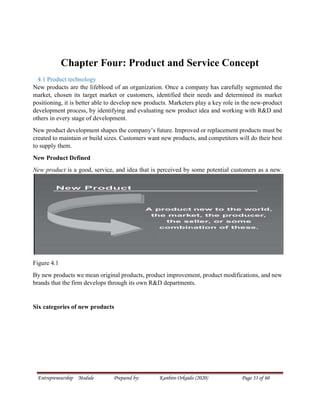
  • 18.
    Entrepreneurship Module Preparedby: Kanbiro Orkaido (2020) Page 17 of 60 hope to get. Moreover, wage rates in small firms can be improved through labor laws and trade unions. Small enterprises also encourage competitive spirit and generate the impulse of self-development. b. Less capital and more labor (The Employment Argument) The main problem is that we have vast manpower but inadequate capital, which has resulted in increasing unemployment. This is unlike in situation in western countries where manpower is limited but capital resources are enormous. Planners have realized the necessity of encouraging small industries because they require less capital but generate more employment. The small-scale sector has the capacity to generate a much higher degree of employment than the large-scale sector. The argument is based on the assumption that small scale industries are labor intensive and thus create more employment per unit of capital. It is said that employment generation capacity of small sector is eight times that of the large scale sector. c. Removing regional imbalance (The decentralization argument) Another problem is the continuous shifting of people from rural to urban areas which causes over-crowding in cities with slum conditions due to lack of social and medical amenities which require heavy investment. This problem can be solved inducing people to set up small industries in rural areas. The prolific setting up of agro-based industries will go a long way in creating a balance in our country’s economy. In order that industrialization may benefit the economy of the country as a whole, it is important that disparities in the matter of development between different regions should be progressively reduced. Large scale industries have the tendency to concentrate in big cities. As a result semi urban and rural areas remain deprived of the benefits of industrialization. Moreover, undue concentration of large industries in urban areas creates several problems. E.g., pollution, slums, shortage of civic facilities, etc. due to employment opportunities in the countryside, people migrate in large number to big cities. Small scale units can be located in rural and semi urban areas to reduce regional disparities. d. Creating self-employment opportunities In India, since independence it has had a steady rise in the number of qualified engineers seeking suitable jobs. But having in adequate adventures, they can have self-employment by setting up small industries with the help and expertise proved by the government and other agencies. Main bank and have several industrial corporations, here, have arranged special training programs for young entrepreneurs, who can easily set up their own units with package assistance from the governments. e. Ancillary Function Many small-scale industries units supply and accessories bigger industries. This ancillary function involves specialization in specific areas and results in greater profitability. The government has, therefore, relaxed the ceiling of investment in plant and machinery for ancillary unit. f. Export promotion
  • 19.
    Entrepreneurship Module Preparedby: Kanbiro Orkaido (2020) Page 18 of 60 Small-scale industries are now a day opening up fresh avenues in the export market in our world. Realizing the importance of the small-scale sector in the economy the Ethiopian government has adopted several measures to speed up the growth for small industries. g. Supply of critical raw materials The government has also liberalized the importer to ensure regular supply of raw materials to small industrial units, and devised a more efficient and consistent system of distribution of critical raw materials. 2.3 Small Business Failure factors Although a lot of new small businesses are established in most countries, the success rate is very minimal. This can be attributed to a lot of factors, which can be generally classified in to two categories: Internal factors of failure and personal factors of failure Economic business cycles, fluctuating interest rates, interrupted suppliers, labor market trends, inflation, government regulations and unstable financial markets are some of the external factors that might bring about small business failure. Although all businesses /small or big/ are subject to these risks, their effect on small businesses is far more serious than any other business. This is because the resources a small business owner controls are very limited which makes it very difficult to deal with these situations. On the other hand there certain problems that can be attributed to personal weaknesses and limitations of the entrepreneur. These include:  Inexperience: too often, entrepreneurs launch their enterprises without having sufficient experience to succeed. Inexperience can be translated to mean a lack of technical skills of management acumen.  Arrogance: many small business persons-particularly inventors and innovative entrepreneurs with new products become consumed with their own brilliance, convinced beyond reason (often without market research) that…  Their bright idea will change the world: it is got to see! Their arrogance will not allow them to take advice from others.  Mismanagement: humble entrepreneurs steeped in experience can still go under simply mismanagement of resources; they simply make bad decisions in critical situations. These may include:  Over investment on fixed assets: when starting or expanding a business, it is tempting to buy facilities and equipments rather than lease or subcontract. Everyone likes to own assets, but greater investment on fixed assets means less flexibility to adjust to adverse conditions.  Poor inventory control: purchasing too much inventory increases the risk of low turnover and obsolescence. Having too little inventory undermines customer satisfaction and sales. Buying the wrong inventory, or buying at the wrong time, evaporates cash. In each scenario, the business tries up high powered cash in non-earning assets, and the inventory items can rarely by disposed of for more than a fraction of their costs in an emergency. The result is that a business “purchases” itself in to insolvency.
  • 20.
    Entrepreneurship Module Preparedby: Kanbiro Orkaido (2020) Page 19 of 60  Poor business philosophy: an unfortunate aspect of many business failures is that too often individual owner’s priorities get in the way of sound business practices. In the least obtrusive way, entrepreneurs may not be fully committed to the long hours required to make a venture success full.  Lack of Planning: most entrepreneurs frequently underestimate the importance of planning in business success. However,, not planning means not anticipating future problems and challenges and not being prepared for them in advance. This surely leads the entrepreneur in to making mistakes and facing problems which could have been easily avoided though sound planning. 2.4. Problems in Ethiopia small business Small scale industries have not been able to contribute substantially as needed to the economic development particularly because of financial, production, and marketing problems. These problems are still major handicaps to their development lack of adequate finance and credit has always been a major problem of Ethiopian small business. Small-scale units do not have easy access to the capital market because they mostly organized on proprietary partnership basis and are of very small size. They do not have access to industrial sources of finance partly because of their size and partly because of the fact that their surpluses which can be utilized to repay loans are negligible. Because of their size and partly because of the limited profit, they search for funds for investment purposes. Consequently, the approach moneylenders who charge high rate of interest hence small enterprises continue to be financially weak. Small-scale enterprises find it difficult to get raw materials of good quality and at cheaper rates in the field of production. Very often they do not get raw materials in time. As a result, these enterprises very often fail to produce goods in requisite quantities and of good quality of a low cost. Furthermore, the techniques of production, which these enterprises have adopted, are usually outdated. Because of their poor financial position they are not able to buy new equipment consequently their productivity suffers. Besides, many small business enterprises are suffering with the problem of marketing their products. It is only by overcoming all these constraints that small enterprises can hope to make their enterprises successful. 2.2. Setting Small Business Setting small business mainly shows how a new business/ venture is established and how business idea is generated and evaluated for further development into real product and service. In a competitive world the secret of success in business is selecting the right product and service, but the problem is how to identify the right product or service. So, how can an entrepreneur identify the best business idea and to select the right product and service are briefly presented as follows. 2.2.1. Basic business idea All business begins with a business idea. There are many ideas around, but they are not all are business idea. A business idea has two defining characteristics, it meets an unmet need and it drives transaction.
  • 21.
    Entrepreneurship Module Preparedby: Kanbiro Orkaido (2020) Page 20 of 60 In the first, the product or service that we offer must satisfy a customer’s unmet need. This may mean a brand-new product or service or it may mean finding a way to provide a product or service at a lower price than currently available. Second a good business idea drive transaction. Whatever the product we offer to customers they must be willing to exchange their money for our product or service. A key point keep in mind is that people do not buy products or services they buy the benefits they get from the product or service. So what benefits are we providing that meet their needs and solve their problem. The test of a good business atmosphere guides the choice of basic business idea. A basic business idea results from the identification of business opportunities in market. To be success in business consistently watches the opportunities to spot where the entrepreneur has to be sensitive to the market changes. Watch demand and supply study consumer behavior and grasp the business ideas. Source of business ideas Some of the more frequently used sources are: 1) Market characteristics / observing the market / Careful observation of markets can reveal a business idea. Market can reveal the demand and supply position for various products unfulfilled demand will open the door for new product or service 2) Government organization: several government organizations nowadays assist entrepreneurs in discovering and evaluating business ideas. Development bank, state industrial development corporation, technical consultancy organization, etc. provide assistance in technical, financial, marketing and other areas business. Government rule, regulation and policy on import and export, research and training service etc encourage entrepreneurs to think about the new option. 3) Development in other nation: people in under developed countries generally follow the fashion trend of developed countries. Therefore an entrepreneur can discover good business idea by keeping in touch with development in advanced nations. Sometimes, entrepreneurs visit foreign countries in search of ideas for new product or service. 4) Social and economic trends Social and economic status of people is always dynamic in nature and offer wide opportunities. An entrepreneur should observe such change. 5) Emerging new technology. Commercial exploitation of indigenous or imported technologies and know how is another source of project idea. 6) Trade fairs and exhibitions: national and international trade fairs are very good sources of business idea. At these fairs, producers and dealers in the concerned industry put up their products for display and / for sale. Magazines, journals, industries, trade fairs offer wide scope for business opportunities Methods for generating business idea The entrepreneur can use several methods including focus groups, brainstorming, and problem inventory analysis to come up with and test new ideas.
  • 22.
    Entrepreneurship Module Preparedby: Kanbiro Orkaido (2020) Page 21 of 60 A. Conducting research: an entrepreneur can primarily generate new business idea by conducting a target research. It is necessary to estimate future demand and take in to account anticipated change in fashion income levels, technology, etc. B. Focus groups: is a group of individuals providing information in a structured format, a moderator, often called a focal person leads a group of people through an open in depth discussion rather than simply asking questions to solicit/seek participants’ response. For a new product area, the moderator focuses the discussion of the group in either a directive or a non- directive manner. The group of participants is stimulated by comments from other group members in creativity conceptualizing and developing a new product idea. C. Brainstorming: is a group method of obtaining new idea and solution. Brainstorming is probably the most well-known and widely used techniques for both creative problem solving and idea generation. It is an unstructured process for generating all possible ideas about a problem within a limited frame though the spontaneous contributions of participants. It serves to generate as many ideas as possible to screen out for further development. A good brainstorming session starts with a problem statement that is neither too broad nor too narrow. Once the problem statement is prepared, a group of individuals is to forward a wide range of knowledge. The following rules should be followed while using this method.  No criticism is allowed by anyone in the group –no negative comments.  Freewheeling is encouraged –the wider the idea the better.  Quality of ideas is desired- the greater the number of ideas, the greater the likelihood of useful ideas emerging.  Combinations and improvements of ideas are encouraged-ideas of others can be used to produce –still another new idea.  The brainstorming session is fun, not to be spoiled with seriousness. D. Problem inventory Analysis: is a method for obtaining new ideas and solution by focusing on problem. Problem inventory analysis uses individuals a manner analogous to focus groups to generate new product ideas. However, instead of generating new ideas themselves, consumers are provided a laundry list of problems in a general product category. They are then asked to identify and discuss products in this category that have particular problem. This method is often effective since it is easier to relate, known products to suggested problems and arrive at a new product idea than to generate an entirely new product idea by itself. Problem inventory analysis can also be used to test a new product idea. 2.2.2. What project an entrepreneur should have? A project can be defined in different ways. A project is a complex of economic activity in which the players commit scarce resources in the expectation that the benefits gained will exceed these resources. The project should have to consider the SWOT and should be designed accordingly. SWOT is a series of steps one has to consider in evaluating a business opportunity and arriving at a decision on starting a business or not. The SWOT approach compels individuals to think or reason out systematically and analytically the important factors strengths, weakness, opportunities, and threats. a. Opportunity ;refers to any factor that offer promise or potential for moving closer or more quickly towards the firms goal
  • 23.
    Entrepreneurship Module Preparedby: Kanbiro Orkaido (2020) Page 22 of 60 b. Threat; is any factor that may limit or impede the business in the pursuit of its goals c. Strength; is an inherent capacity, which an organization can use to gain strategic advantage over its competitors. d. Weakness; is an inherent limitation or constraint, which creates a strategic disadvantage. To be a successful an entrepreneur, one major determinant factor is the choice of a good business idea. To select the best business idea, the following steps needs to be pursued. A. Identifying your problem B. Define your objectives C. Identifying ,develop and analyze the possible alternative D. Select the best alternative in light of the specific criteria set to the better fulfillment of the objective. 2.5.3. Definition of industry and small scale industry An industry is an institution where raw material is purchased from suppliers, converted in to finished product using machinery and labor and sold to buyers. Conversation of raw material means changing the size, shape, chemical properties, and assembling different [parts, etc .For example, in shoe making unit, different type of leather are purchased, cut in to different shapes and sizes and then stitched as shoes, etc. This is a simple conversion of size and shape of raw material. In the case of cement plant the raw material used are limestone, gypsum, etc. These materials are chemically processed, i.e. they are properly mixed, heated and powdered to get cement as the final product. Industries again are not the same. Some are big like steel plant and some are small like a unit manufacturing of wooden furniture. Some industries make cycle tube and tires while some other make radios and transistors. Thus, industries differ widely and can be classified in different ways. Small scale industry: Small business would include individuals and firms managing a business enterprise e4stablished mainly for the purpose of providing any services other than professional. Small scale industries have been defined as industrial units engaged in manufacturing/preservation activities or repairing/ servicing operations including such operations as quarrying. 2.5.4. Steps in setting a small scale unit The first key to success in any business activity is to select the right product. In the beginning, information of possible lines of activity must be obtained, by taking to knowledgeable people, from industrial publications, or from various organizations. The information available from these sources may be supplemented by ones’ ideas and some alternative feasible lines of activity identified. These lines of activity must necessarily be those, which are the consistent with one’s own personal qualities and capacity. They must essentially be of interest to the entrepreneur. These must be examined with a view to assess: a. The marketing aspect-Published data, talks with people in the field etc., to obtain a general idea of the marketing conditions.
  • 24.
    Entrepreneurship Module Preparedby: Kanbiro Orkaido (2020) Page 23 of 60 b. Technical aspects-Detailed assessment of the goods and services needed for the project, the type of technology to be adopted for the project. c. Financial aspects-General idea of the overall investment and scale of operations, sources and mode of financing it, etc. The product must be suitable for an entrepreneur is to be identified from the above. i. Having selected a product, a detailed project report needs to be prepared. This will cover the following aspects: a. A detailed estimate of demand is to be made. The total demand, existing suppliers and the capacity of existing units, the demand gap remaining to be met , the customers, the distribution channel required, have all to be studied. The required information may be obtained from published data, literature available in some organizations, through information gathered personally from persons already in the field, users, dealers, etc, or by means of detailed market survey conducted by government organizations, or by private organizations and consultants. b. Technical specifications of the process should be carefully studied. The know- how may be available with the person himself or may be obtained from literature, or from others including government laboratories like the national laboratories. c. The equipment required their sources are to be specified. d. Requirements of space, land, shed etc. and other utilities like power and water are to be assessed. e. Man power requirements of direct and indirect personnel are to be determined and their availability ensured. ii. After the detailed project report having been prepared and availability of the enterprise established, the action phase begins. iii. Once all the required authorization and sanctions have been obtained, simultaneous action is to be taken for the following:  Ordering machinery from suppliers  Obtaining utilities like power and water connections after construction of sheds, if necessary  Recruitment of staff  Arranging supplies of materials  Arranging for distribution of the product iv. Once these are complete, the plant is ready for commissioning v. The unit is then ready for commercial production. The End of Chapter 2 Wish you success!
  • 25.
    Entrepreneurship Module Preparedby: Kanbiro Orkaido (2020) Page 24 of 60 Chapter-Three: Business Planning 3.1.The Concept of Business Planning The business plan is the most essential document involved when starting, building and managing a successful business and it is an effective tool for raising the necessary capital as well as capturing the interest of investors. The business plan is the document that clearly and concisely defines the goals and objectives of a business, outlining the methods for achieving them. The business plan is also an excellent communication instrument for investors and suppliers interested in understanding the operations and goals of the business. Many businesses fail due to the lack of planning and preparation. To help plan for a successful business venture, guidelines in this publication would help an operator better understand what information is needed in the business plan. The more complete and accurate the information, the more promptly institutions, banks, investors, and suppliers will be able to respond to requests for assistance. Generally, the operator himself would be responsible for preparing the business plan. “Business don’t plan to fail, they just fail to plan” Before we go into the nitty-gritty part of business plan, it is important that every individual understand the importance of planning for the success of any venture. As the matter of fact, in Ethiopia most of us are not used to the planning process. Planning which is the process of setting objectives and devising actions to achieve those objectives, answers such as what business I have? What is my sales strategy? Where I can found the needed personnel? How much profit can I expect? Planning is the process never ends for a business. It is extremely important in the early stage of any new venture when the entrepreneur will need to prepare a preliminary business plan. The plan will be finalized as the entrepreneur has a better sense of the market, the product or service to be marketed, the management team, and the financial needs of the venture. For any given organization, it is possible to find financial plan, marketing plan, and human resource plan, production plan, and sale plan, etc. For a business to be successful entrepreneur should have a clear idea about his strengths, of his probable customers, their needs and expectations, and competitors in the market place. Before setting up a business, a document is made for defining the steps or things required to be executed to legally set up a business. This written document is called as business plan.
  • 26.
    Entrepreneurship Module Preparedby: Kanbiro Orkaido (2020) Page 25 of 60 Business planning is the process of systematically thinking about one’s business, setting business goals and objectives and planning for resources which will help him/her achieve the desired goals and objectives. Business plan helps us put our thoughts and ideas on paper in a clear, systematic and convincing manner. It helps you to raise finance/capital for your business. Business plan should be complete, well organized and should be based on facts. It helps focus on key points. Business plan is made by the entrepreneur himself. However, outside consultants can be hired to set the plan in a systematic written format. 3.2.Feasibility Planning After identifying different business ideas, these ideas are then subjected to feasibility study for deciding on whether the ideas are attractive/ profitable or not. At this stage, entrepreneurs evaluate or test to prove that identified ideas are feasible from different dimensions (Technical, Socio- economic, Commercial, Financial, Environmental and Managerial) and to choose the best business idea among the available alternatives. After a business idea has been developed it is evaluated to determine its likelihood of success. This is called idea screening. In their evaluation, entrepreneur evaluates business ideas from each function area perspectives described as in the following: Operation: What are the production needs of the proposed new product and how do they match our existing resources? Will we need new facilities and equipment? Do we have the labor skills to make the product? Can the material for production be readily obtained? Marketing: What is the potential size of the market for the proposed new product? How much effort will be needed to develop a market for the product and what is the long-term product potential? Finance: The production of a new product is a financial investment like any other. What are the proposed new product’s financial potential, cost, and return on investment? Unfortunately, there is no magic formula for deciding whether or not to pursue a particular product idea. Managerial skill and experience, however, are also key dimensions. Feasibility study is basically an aid to decision making, and hence the deployment of time, money, and other resources on it should never be allowed to outgrow the potential benefits that it may hopefully yield. In case a project idea is generally found to be feasible from all considerations, it is then given a `go-ahead' signal which indicates a commitment on the part of the authority giving the `go-ahead' signal to provide necessary resources for carrying the project through, to its logical completion. On the basis of feasibility study results the entrepreneur should be able to decide: i. Whether the project can be straightaway accepted or rejected, ii. The project requires a detailed analysis (i.e. a feasibility study), or iii. Some aspects of the project need to be subjected to special investigations or studies such as market research, physical or mathematical modeling (e.g. for a complex nuclear plant), site surveys, laboratory tests, etc.
  • 27.
    Entrepreneurship Module Preparedby: Kanbiro Orkaido (2020) Page 26 of 60 3.3.The Business Plan A business plan is the written document that details the proposed venture. It must describe current status, expected needs, and projected results of the new business. Every aspect of the venture needs to be covered: the project, marketing, research and development, manufacturing, management, critical risks, financing, and milestones or a timetable. A description of all of these facets of the proposed venture is necessary to demonstrate a clear picture of what that venture is, where it is projected to go, and how the entrepreneur proposes it will get there. The business plan is the entrepreneur’s roadmap for a successful enterprise. Whatever the name, it should lay out your idea, describe where you are, point out where you want to go, and how you propose to go there. The business plan may present a proposal for launching an entirely new business. More commonly, perhaps; present a plan for a major explanation of a firm that has already started operation. Benefits of a Business Plan Specifically for the entrepreneur: • The time, effort, research, and discipline needed to put together a formal business plan force the entrepreneur to view the venture critically and objectively. • The competitive, economic, and financial analysis included in the business plan subject the entrepreneur to close scrutiny of his or her assumptions about the venture’s success. • Since all aspects of the business venture must be addressed in the plan, the entrepreneur develops and examines operating strategies and expected results for outside evaluators. • The business plan quantifies objectives, providing measurable benchmarks for comparing forecasts with actual results. • The completed business plan provides the entrepreneur with a communication tool for outside financial sources as well as an operational tool for guiding the venture towards success. • Details of the market potential and plans for securing a share of that market. • The venture’s ability to service debt or provide an adequate return on equity. • Identifies critical risks and crucial events with a discussion of contingency plans. • A clear, concise document that contains the necessary information for a thorough business and financial evaluation. The purpose of business plan The most important steps in establishing any new business is the constructions of a business plan. Business plan: 1. It can help the owner/manager crystallization and focus his/her idea. 2. Although planning is a mental process, it must go beyond the realm thought. Thinking about a proposed business become more rigorous as rough ideas must be crystallized and qualified on paper. 3. It can help the owner/manager set objectives and give him a yardstick against which to monitor performance. 4. It can also as a vehicle to bother any external finance needed by the business. 5. It can convince investors that the owner has identified high growth opportunities. 6. It entails taking a long _term view of the business and its environment. 7. It emphasizes the strengths and recognizes the weaknesses of the proposed venture. 8. The plan can uncover weakness or alter the entrepreneur to sources of possible danger.
  • 28.
    Entrepreneurship Module Preparedby: Kanbiro Orkaido (2020) Page 27 of 60 Users of business plan A business plan has two primary functions:  To provide clearly articulated statement of goals and strategies for internal use and,  To serve a selling document to be shared to the outsiders. Those who might have an interest in a business plan for a new venture consists of outsiders who are critical to the firm’s success: customers, suppliers, and investors. The other group is the internal users of the business plan: the new firm’s management. Let us consider the internal users first. Internal user of the business plan Any activity without adequate preparation tends to be disorganized. This is particularly true of such a complex process as initiating a new business. Although planning is a mental process, it must go beyond the realm of speculation. Internal users are, firms management and employees of the venture. External users of the business plan By enhancing a firm’s credibility, the business plan can serve as an effective selling tool to use with prospective customers and suppliers, as well as investors. Suppliers for example, extend credit, which is often an important part of a new firm’s financial plan. A well prepared business plan may be helpful in gaining a supplier trust and securing favorable credit terms. Both investors and lenders use the business plan to better understand the new venture, the type of product/service it offers, the nature of the market, and the qualification of the entrepreneur and the management team. 3.4. Developing Business Plan When the business plans are produced? At the startup of a new business: After the concept stage of initial ideas and feasibility study, a new business startup may go through a more detailed planning stage of which the main output is the business plan. Business purchase: Buying an existing business does not neglect the need for an initial business plan. A detailed plan, which tests the sensitivity of changes to key business variables, greatly increases the prospective purchasers understanding of the level of risk they will be accepting, and likelihood of rewards being available. Ongoing: Ongoing review of progress, against the objectives of either a start up or small business purchase, is important in a dynamic environment. An initial business plan is not a document to be put in a drawer and forgotten. Major decisions: Even if planning is not carried out on a regular basis, it is usually investigated at a time of major change. For example, the need for major new investment in equipment, or funds to open a new outlet, It may be linked to failure, such as a recovery plan for an ailing (or in bad condition) business. Who produced the business plan? Three types of people will be interested in a business plan: Managers: are involved in small business planning as both producers and recipients of the plan. Business plans are written to aid small business managers.
  • 29.
    Entrepreneurship Module Preparedby: Kanbiro Orkaido (2020) Page 28 of 60 Owners: the manager of a small enterprise may also be the owners and take a keen (eager) interest in the planning process, wearing their shareholders hat. Lenders: the major banks/lenders all encourage the production of business plans to justify overdrafts and loans, offering literature and advice on putting together business plans. Why the business plans are produced? 1. Assessing the feasibility and viable of the business plan/project: it is in every ones interests to make mistakes on paper, hypothetically testing for feasibility, before trying the real thing. 2. Setting objectives and budgets: having a clear financial vision will believable budgets is a basic requirement of everyone involved in a plan. 3. Calculating how much money is needed: a detailed cash flow with assumptions is vital ingredient to precisely quantify earlier the likely funds required. The format of a business plan The business plan needs to answer three –straight forward questions: 1. Where are we now? An analysis of the current situations of the market place, the competitions, the business concept and the people involved. It will include any historical background relevant to the position to date. 2. Where do we intend going? Qualitative expression of the objectives, quantifiable targets will clarify and measure progress towards the intended goals. 3. How we get there? Implementing of accepted aims is what all the parties to a plan are interested in as a final result. Plans for marketing and managing the business, with detailed financial analysis are the advisable preliminaries before putting it all in to practice. Writing the business plan The business plan could take much time to prepare, depending on the experience and knowledge of the entrepreneur as well as the purpose it is intended to serve. It should be a comprehensive enough to give any potential investor a complete understanding of the new venture. Introductory page This is the title or cover page that provides a brief summary of the business plan’s contents. The introductory page contains the following:  The name and address of the company  The name of entrepreneur(s) and telephone number  A paragraph describing the company nature of the venture  The amount of financing needed. The entrepreneur may offer a package that is stock, debt and so on.  A statement of the confidentiality of the report. This is for security purpose and it is important for the entrepreneur. This title page sets out the basic concept that the entrepreneur is attempting to develop. Investors consider it important because they can determine the amount of investment needed without having to read to the whole through the entire plan.
  • 30.
    Entrepreneurship Module Preparedby: Kanbiro Orkaido (2020) Page 29 of 60 Executive summary This section of the business plan is prepared after the total plan is written. About three to four pages in length, the executive summary should stimulate the interest of the potential investor. The investor uses the summary to determine if the business plan is worthy reading in total. Thus, it would highlight concisely and convincingly the key points in the business plan, that, is the nature of the venture, financing needed, market potential, and support as to why it will succeed. Industrial analysis It is important to put the new venture in a proper context. In particular the potential investors, while assessing the venture on a number of criteria, it needs to do an industry analysis in order to know which industry an entrepreneur will be competing on it. The entrepreneur should also provide insight on new product development in this industry. Competitive analysis is also an important part of this section. Each major competitor should be identified, with appropriate strengths and weakness described particularly as to how they might affect the new venture’s success in the market. Who is the customer? The market should be segmented and the target market of the entrepreneur identified. Most new ventures are likely to compete effectively in only one or few of the market segments. Description of the venture The description of the venture should be detailed in this section of the business plan. This will enable the investor to ascertain the size and scope of the business. Key elements are the product(s) or services(s), the location and size of the business, the personnel and office equipment that will be needed, the background of the entrepreneur(s) and the history of the venture. Location of any business may be vital to its success particularly if the business is retail or involves a service. Thus, the emphasis on the location in the business plan is a function of the type of business. In assessing the building or spaces the business will occupy, the entrepreneur needs to evaluate such factors as parking, delivery rates, access to customers, suppliers and distributer, and accommodating own regulation or zoning laws. This simple assessment of the location, market and so on saved the entrepreneur from a potential disaster. Production plan If a new venture is a manufacturing operation, a production plan is necessary. This plan should describe the complete manufacturing process. If some or all of the manufacturing process is subcontracted, the plan should describe the subcontractors(s), including location, reasons for selection, costs, and any contracts that have been completed. If the manufacturing is to be carried out the whole or in part by the entrepreneur(s), she will need to describe the physical plant nay out; the machinery and equipment needed to perform the manufacturing operation raw materials and suppliers’ names, address, and terms, cost of manufacturing and any further capital requirement. If the venture is not a manufacturing operation but a retail store or service, this section would be titled ‘’merchandising plan’’ and purchase of merchandise, inventory control system, and storage needs should be described. Marketing plan
  • 31.
    Entrepreneurship Module Preparedby: Kanbiro Orkaido (2020) Page 30 of 60 The marketing plan is an important part of the business plan since it describes how the product(s) or service(s) will be priced, promoted and distributed. Specific forecasts for products are indicated in order to project profitability of the venture. The budget and appropriate controls needed for marketing strategy decision should be discussed. Potential investors regard the market plan as critical to the success of the new venture .thus the entrepreneur should make any effort to prepare as a comprehensive and detailed plan as possible so that investors can be clear as to the goals and strategies of the venture. Marketing planning will be an annual requirement (with careful monitoring and changes made on weekly or monthly basis) for the entrepreneur and should be regarded as the road map for short term decision making. Organizational plan The organizational plan describes the venture’s form of ownership –that is, proprietorship, partnership, or corporation. For instance, if the venture is the partnership, the term of the partnership should be included. If the venture is a corporation, it is important to detail the share of the stock authorized, share options, names and address and resumes of the directors and officers of the corporation. Assessment of risk Every new venture will be faced with some potential hazards, given the particular industry and competitive environment. It is important that the entrepreneur makes an assessment of risk and prepares an effective strategy to deal to them. Major risk for a new venture could result from a competitor’s reaction; weakness in the marketing or production, and new advances in technology that might render the new product obsolete. It also important for the entrepreneur to provide alternative strategies should any of the above risk factors occur. Financial plan The financial plan, like the marketing, production, organization plans, is an important part of business plan. It determines the potential investment commitment needed for the new venture and indicates whether the business plan is feasible. Generally, three financial areas discussed in this section of the business plan. First, the entrepreneur should summarize the forecasted sales and the appropriate expense at least the first five years. It includes the forecasted sales, cost of good sales, and the general and administrative expenses. Second, cash flow figure must be presented for at least the first three years, with the first year’s projection provided with monthly. The last financial item needed in this section of the business plan is the projected balance sheet. This shows the financial condition of the business at specific time. It summarizes the asset of a business, its liabilities, the investment of the entrepreneur and any partners, and retained earnings or cumulative losses. Appendix The appendix of the business plan generally contains any back up material that is not necessary in the text of the document. Reference of to any of the document in the appendix should be made in the plan itself. Using and implementing the business plan
  • 32.
    Entrepreneurship Module Preparedby: Kanbiro Orkaido (2020) Page 31 of 60 The business plan is designed to guide the entrepreneur through the first three year of operation. It is important that the implementation of the strategy contain control points to ascertain progress and to initiate contingency plans, if necessary. Many business fail because of the entrepreneur inability to plan effectively. Intelligent planning is not difficult or impossible exercise for the inexperienced entrepreneur. With the proper commitment and support from any outside resource, the entrepreneur can prepare an effective business plan. Why some business plan fails Generally a poor prepared business plan can be blamed on one or more of the following factors:  Goals set by the entrepreneur are unreasonable  Goals are not measurable  The entrepreneur has not made a total commitment to the business. The entrepreneur does not have experience in the planned business Assignment II (30%): Prepare Business Plan in group of 10 students Please try to address the following components of business plan while you preparing business plan! 1) Introductory page A. Name and address of the business B. Name(s) and address(s) of principals C. Nature of business D. Statement of financing needed E. Statement of confidentiality of report 2) Executive summary 3) Industry analysis A. Future outlook and trends B. Analysis of competitors C. Market segmentation D. Industry forecast 4) Description of venture A. Product(s) B. Service(S) C. Size of business D. Office equipment and personnel E. Background of entrepreneur 5) Production plan A. Manufacturing process (amounts sub contracted) B. Physical plant C. Machinery and equipment D. Names of supplier of raw material 6) Marketing plan A. Pricing B. Distribution C. Promotion D. Production forecast E. Controls 7) Organizational plan A. Form of owner ship B. Identification of partners and principal share holders C. Authority of partners D. Management team background E. Roles and responsibility of members of organization 8) Assessment of risks
  • 33.
    Entrepreneurship Module Preparedby: Kanbiro Orkaido (2020) Page 32 of 60 A. Evaluation of weakness of business B. New technologies C. Contingencies plan 9) Financial plan A. Pro forma income statement B. Cash flow projections C. Pro forma balance sheet D. Break even analysis E. Source and application of funds 10) Appendix A. letters B. market research data C. leases and contracts D. price lists from suppliers The End of Chapter 3 Wish you success!
  • 34.
    Entrepreneurship Module Preparedby: Kanbiro Orkaido (2020) Page 33 of 60 Chapter Four: Product and Service Concept 4.1 Product technology New products are the lifeblood of an organization. Once a company has carefully segmented the market, chosen its target market or customers, identified their needs and determined its market positioning, it is better able to develop new products. Marketers play a key role in the new-product development process, by identifying and evaluating new product idea and working with R&D and others in every stage of development. New product development shapes the company’s future. Improved or replacement products must be created to maintain or build sizes. Customers want new products, and competitors will do their best to supply them. New Product Defined New product is a good, service, and idea that is perceived by some potential customers as a new. Figure 4.1 By new products we mean original products, product improvement, product modifications, and new brands that the firm develops through its own R&D departments. Six categories of new products
  • 35.
    Entrepreneurship Module Preparedby: Kanbiro Orkaido (2020) Page 34 of 60 Figure 4.2፡ Categories of New Products 1. New –to-the world product-: is a new product that creates totally new market or new to the world or products that are technological innovative that creates a completely new market that previously did not exist. 2. New product line (new category entries) – this is new products that allow a company to enter an established market for the first time. These products are new to the company, but as a category, the product is not new to the consumer. E.g. The entry of Kodak into the battery market. 3. Line extension (additions to existing product lines) – is new products that supplements Company’s established product lines. Line extension can be copies of existing product that contain unique features of the original product do not have. 4. Product improvements (revision of existing product)-is a new products that provide improved performance or greater perceived value or replace existing products or product improvements are product entrancements that improve the product’s form or function. 5. Repositioned product (market extension) -is an existing products that are targeted to new markets or market segments or original products positioned in new markets without any (with minimal) changes to the product. 6. Lower priced product (Cost improvement or cost reduction)–this can be new products that provide similar performance at lowest cost. Rationale for New Product Development Product innovation is essentially important for the following reasons: 1. Maximum use of resources The fact that the supply of many of our natural resources are limited and irreplaceable points out clearly the importance of careful new product development that requires efficient and effective use of available resources 2. Product is a basic profit determinant New products are essential of sustaining a firm’s expected rate of profit. As the product goes through all four stages of its life cycle, the profit starts to decline in the late stages unit it become zero.
  • 36.
    Entrepreneurship Module Preparedby: Kanbiro Orkaido (2020) Page 35 of 60 3. New products are essential for growth New products are designed not only to maintain the existing profit but also to increase their profits and have greater market share. Figure 4.3 - Why New Products Fail 4.2. Product development process There are eight steps of new product development. These are:- 1. Idea generation, 2. Idea screening, 3. Concept development and testing 4. Marketing Strategy, 5. Business analysis, 6. Product development, 7. Test Marketing & 8. Commercialization
  • 37.
    Entrepreneurship Module Preparedby: Kanbiro Orkaido (2020) Page 36 of 60 1. Idea Generation New product development starts with idea generation - the systematic search for new product idea. A company typically has to generate many ideas in order to fine a new good one. Figure 4.3 Sources of new idea generation Sources of new product ideas can be:  Internal sources  External Sources Internal Sources Using internal sources, the company can find new ideas through formal R&D. It can pick the brain of its executives, scientists, engineers, manufacturing staff, and sales people. External Sources Good new product ideas also can come from watching and listening to customers. In this case the company can analyze customer questions and complaints to find new products that better solve consumer problems. In generally, external sources are: Customers, competitors, middlemen, private research organization and trade associations. 2. Idea Screening The purpose of idea generation is to create a large number of ideas. The purpose of the screening stage is to reduce the number of ideas. Idea screening helps to distinguish good ideas and drop poor ones as soon as possible. A company should motivate its employees through rewards to submit their new ideas. Figure 4.4: Idea Screening
  • 38.
    Entrepreneurship Module Preparedby: Kanbiro Orkaido (2020) Page 37 of 60 3. Concept development and Testing Concept development An attractive idea must be developed in to a product concept. It is important to distinguish between a product idea, product concept and a product image. A product idea is an idea for a possible product that the company can see itself offering to the market. A product concept is a detailed description of the idea stated in the meaningful consumer terms. Concept testing Concept testing involves presenting the product concept to appropriate target consumers and getting their reactions. The concept can be presented symbolically or physically. The more tested concepts look like the final product or experience the more dependable concept testing. A product image is the way consumers perceive an actual or potential product. For example observe the following situation to understand concept development. A large food processing company gets the idea of producing a powder to add to milk to increase its nutritional value and taste. This is the product idea, consumers do not buy product idea; they buy product concepts. A product idea can be turned into several concepts. E.g who will use this product? (Infants, adults, young people etc), when will people consume this product? (Breakfast, lunch, evening etc) 4. Marketing Strategy Following a successful concept test the new product manager develops a preliminary marketing strategy plan for introducing the new product into the market. The plan consists of three parts. The first part describes the target market’s size, structure, and behavior; the planned product positioning; and the sales, market share, and profit goals sought in the first few years. The Second part outlines the planned price, distribution strategy, and market budget for the first year. The third part of the marketing strategy plan describes the long-run sales and profit goals and marketing mix strategy over time. 5. Business Analysis After management develops the product concept and marketing strategy, it can evaluate the proposal’s business attractiveness. Management needs to prepare sales; cost and profit projections to determine whether they satisfy company objectives. The simplest way to analyze business is break even analysis in which management estimates how many units of the product the company would have to sell to break even with the given price and cost structure. 6. Product Development Up to now, the product has existed only as a word description, a drawing, or a prototype (trial product). At this stage the company determines whether the product idea can be translated into a technically and commercially feasible product. 7. Test marketing After management is satisfied with functional and psychological performance, the product is ready to be dressed up with a brand name and packaging and put into a market taste. The new
  • 39.
    Entrepreneurship Module Preparedby: Kanbiro Orkaido (2020) Page 38 of 60 product is introduced into a real setting to learn how large the market is and how consumers and dealers react to handling, using and repurchasing the product. Pros are: o Can reduce the risk of product failure. o Reduces the risk of loss of credibility or undercutting a profitable product. o Can determine the weaknesses in the marketing management and make adjustments. Cons are: o Test market is expensive. o Firm's competitors may interfere. o Competitors may copy the product and rush it out. 8. Commercialization Commercialization is introducing a new product into the market. Here, firms fully promote, distribute, and sell their new products. Thus, it is a passage of presenting to consumers tangibly with high financial company expenditure cost and trying to reach at breakeven point The Concept of Product Life Cycle Product life cycle is the path of a product’s sales & profit take over its lifetime. Company’s positioning and differentiation strategy must change as the product, market, and competitors change over time. The Life Cycle Concept provides a useful framework for looking at the development of either products or services and a small business. A product or service has a life cycle of four stages. Stage 1- Introduction This is the stage where the product or service is introduced & encounters a certain amount of consumer ignorance and resistance. Sales are low and growing slowly and profits are low or negative because of the heavy expenses of product introduction. Promotional expenditures are also highest ratio to sales because of the need to inform potential customers. Stage 2- Growth This is a period of rapid market acceptance and substantial profit improvement. New competitors enter, attracted by the opportunities. Small firms maintain their promotional expenditures at the same or slightly increased level to meet competition and to continue to educate the market. Stage 3 – Maturity At some point, the rate of sales growth will slow, and the product will enter a stage of relative maturity. In this stage; the market becomes saturated and slowdown in sales growth. Profits stabilize or decline because of increased competition. Product sales may simply be for replacement and customers begin switching to other products. Stage 4 – Decline After sometimes, sales will star to decline as substitute, improved products or services become more attractive and the old product becomes obsolete. Sales decline for a number of reasons, including technological advances, shifts in consumer tastes, and increased domestic and foreign competition. Some firms withdraw from the market.
  • 40.
    Entrepreneurship Module Preparedby: Kanbiro Orkaido (2020) Page 39 of 60 Figure 4.8 Product life cycle stage The life-cycle concept helps small firms to interpret product and market dynamics. It can be used for planning and control, although it is useful as a forecasting tool. It can also be a competitive device, in the sense that it allows the firm to compare its sales performance to the industry as a whole. For some products or services the life-cycle can be counted in days. For others, it can span a number of years. It is usually possible to extend the life of a product or service by developing it in some way or expending the market into which it is sold. Characteristics Introduction Stage Growth Stage Maturity Stage Decline Stage Sales low sales rapidly rising sales high sales and starts to decline Declining sales Costs high cost per customer average cost per customer low cost per customers low cost per- customer Profit Negative increasing profits high profits declining profits Customers Innovators early adopters middle majority Laggards Competitors few competitors growing competitors stable number beginning to decline declining in number Objective create product awareness maximize market share maximize profit Reduce expenditure and milk the product Product Offer basic product Offer product extensions, service, and warranty Diversity brands and item models Phase out weak (remove)
  • 41.
    Entrepreneurship Module Preparedby: Kanbiro Orkaido (2020) Page 40 of 60 Price Charge cost – plus Price to penetrate market Price to match competitors’ Cut-price (reduce) Distribution Selective distribution Intensive distribution More intensive distribution Go selective or phase out unprofitable outlets Advertising Build product awareness Build awareness and interest in the mass market Stress brand differences and benefits Reduce advertising cost to retain hard- core loyal Sales promotion Use heavy sales promotion s Reduce to take advantage of heavy consumer demand Increase to encourage brand switching Reduce to minimal level 4.3 Product protection Most entrepreneurs will not be inventors, but all of them are concerned with protecting their idea. When those ideas relate to new products, unusual processes, unique designs, or biological innovations such as new plants, understanding patent law becomes paramount. When entrepreneurs want to protect unusual brand names or establish ownership of intellectual property, then understanding trademarks and copyrights is vital. Entrepreneurship has several dimensions and an entrepreneur is expected to know them thoroughly. One such dimension is a legal dimension. Thus conforming to legal requirements will be the first thing to start an enterprise. Any enterprise (i.e., sole proprietorship, partnership or Joint Stock Company) has to be run within the legal framework doing business according to commercial law, labour law, etc. of the country. Therefore, an entrepreneur should be aware of such governmental legislation. Moreover, it is important if entrepreneurs have well fledged information about the characteristics, advantages and disadvantages of the different types of business organization. 4.3.1. Patent Patents are exclusive property rights that can be sold, transferred, willed, licensed, or used as collateral; much like other valuable assets. A utility patent is granted for new products, processes, machines, methods, of manufacturing, and compositions of matter. This category excludes most botanical creations related to plant and agricultural use. The utility patent is the most common patent sought by inventors. What can be patented?  Process: - New method of manufacturing or new technological procedures that can be validated as unique.
  • 42.
    Entrepreneurship Module Preparedby: Kanbiro Orkaido (2020) Page 41 of 60  Machine: - Products, instruments, machines and other physical objects that have proved useful and unique.  Manufacturers: - Refers to physical items that have been fabricated through new combinations of materials or technical applications.  Composition of Matter: - relates to chemical compounds, medicines... that do not exist in nature in an uncultivated state. 4.3.2. Registered design Registered design- is granted for any new or original decorative design for an article of manufacture. A design patent protects the appearance of the article, not the article itself. An inventor could easily register both a utility patent and a design patent, but the design patent has a limited life. Entrepreneurs can select the period of time for protection in order to commercialize designs and to realize the benefits of their ingenuity. The benefit of a design patent is that the ornamental nature of the patent may be a distinguishing feature that allows an individual to have exclusive use of visual imagery, thus enhancing sales or creating brand identification. When registered, this allows the shape, design, or decorative features of a commercial product to be protected from copying. 4.3.3. Copyright A copyright is that the intellectual property is protected for the life of the originator plus 50 years. This protection affords an extraordinary property right and a substantial estate. A copyright extends protection to authors, composers, and artists, and it relates to a form of expression rather than the subject matter. 4.3.4. Trademarks A trade mark includes any word name, symbol, or distinguishing device, or any combinations thereof adopted and used by a manufacturer or merchant to identify their goods and distinguish them from those manufactured or sold by others. A trade mark is granted thought the U.S patent and trade mark office for a period of 20 years. Examples: coke (name) for Coca-Cola corporation, (Symbol) apple with a bite in his side – apple Computer Corporation, Wild mustang horse-ford automobile. Implications for Entrepreneurs: There are several excellent reasons why hopeful entrepreneurs should be well informed on patents, trademarks, and copyrights. Aside from the obvious need to protect one's ideas, the entrepreneurs must be careful not to violate on others. Being familiar with regulations is also important for designing packaging, writing advertisement and distributing materials. But perhaps most important, obtaining property rights (patents, trademarks, or copyrights) create valuable assets. Patents can be sold, licensed assigned, or leveraged as assets of new enterprise.
  • 43.
    Entrepreneurship Module Preparedby: Kanbiro Orkaido (2020) Page 42 of 60 Chapter Five: Marketing and new venture development 5.1 The Marketing Perspective It is all well and good having a product or service idea, but will it prove to be a profitable business? Too many businesses are set up without thinking about this essential question. The answer revolves around the most important person in any business. The customer marketing is the process of matching the needs of the consumer to the capabilities and resources of the firm. Marketing is about making money from satisfied customers; without satisfied customers there can be no more future for any commercial organization, though, marketing is an attitude of mind about satisfying the customer rather than a set of sales techniques, and to understand the customer you need to take what is called a marketing perspective. The customer is the buyer of the product or service. Understanding customer and consumer needs and motivations in central to marketing for small firms. In marketing terms customers buy benefits. They do not buy features or characteristics of a product or service. We do not buy oil for our cars because we like it, but because it makes the engine run smoothly, extends the engine’s life and reduces our repair bills. What is more, the benefits that customer’s value may be different to those valued by the consumers of a product or service. Understanding the differences between the features of a product or service and the benefits that it offers the customer is the cornerstone of marketing. The customer is really only interested in benefits. The features simply prove to the customer that he will receive those benefits. However, that customer is actually buying a whole package of benefits that the product or service has to offer. That package can include things like after sales service, image, reliability, ease of use, easy of availability, etc. It is the value to the customer of the total package that the firm is seeking to maximize in marketing. The higher the total value to the customer, the greater their loyalty to the product or service and the higher the price they are likely to pay for it. 5.2 The Marketing Mix Marketing mix consists of product, price, promotion and place (distribution) or 4P’S. i) Product (Service) This is often the heart of the marketing mix. However, the product or service must not be a straight jacket constraining that mix. It must be flexible and capable of adoption to the changing needs of the customer. It is always important to know why customers buy products and what particular features and benefits they value most. A particular product or service might include:- design and technical features, performance, quality, range (size, color etc), maintenance and running cost, safety, before and after sale, product availability and image (fashion). Even a company selling products will have a strong service element to this component of the marketing mix. Indeed, personal service is a vital way that any small firm can differentiate itself from larger competitors. The personal service and personal relationship build up with the customer is something that large firms find it difficult to replicate and offers one obvious area in which small firms have a competitive advantage. When translating the features of both the ‘core product’ and the ‘service’ element that accompanies it into benefits, you may wonder whether they are real benefits of value to the customer. The more real, valued benefits that a firm offers, the more likely it is to attract buyers and convert them into satisfied customers who may return for repeat purchase.
  • 44.
    Entrepreneurship Module Preparedby: Kanbiro Orkaido (2020) Page 43 of 60 This also explains why customers may prefer a particular supplier of an apparently identical product; despite the fact they are more expensive than Rivals. The other benefits offered, such as service, add up to a more attractive and valued benefit package. ii) Price Pricing is of course, an important part of the marketing mix. Too many small firms, however, compete primarily on price simply because the other elements in the marketing mix are insufficiently different from their competitors. However, price is more usually a barrier to sales rather than a positive inducement. The price charged for a particular product or service ought to reflect the value of the ‘package of benefits, to the customer, often the value to the customer for a product or service can be different in different circumstances. Many firms, of all sizes, use a ‘cost-plus’ pricing formula with this approach you simply add up all the costs and add on a margin. The option of pricing high or ‘skimming may seem strange at first, Higher prices implies lower volume of sales, unless you are able to offer something that is uniquely different from the competition and highly valued by the customer. However, for many smaller firms lower sales volume is not necessarily a bad thing. It means that greater attention can be paid to quality, customer service and other elements of the marketing mix, there by justifying the higher price. The price charged out to reflect what the market will bear for that product or service. Normally, the market will bear arrange of prices, reflecting different marketing mix offerings. The final decision on pricing, then, is a question of judgment reflecting the value of that mix to consumers. iii) Promotion This is concerned with how well a firm communicates its sales message to existing and potential customers. When products or services are very similar, this is often one of the few ways that they can differentiated from the competition. There are many ways of promoting a business. When a company promotes its products and services directly to potential customers it is called direct promotion. Often this is undertaken through the sales force. It includes:- direct face-to-face selling, telephone selling, direct mail, exhibitions and special demonstrations but this method is expensive. On the other hand indirect presentation is concerned with the mass techniques of communication. One of these techniques is advertising, which seeks to inform, persuade and remained (reinforce) messages to existing & potential customers. Most small firms start out relying heavily on personal selling, but as they grow the real cost of this activity become more apparent. However it is important that advertising campaigns are properly costed and planned in advance. Public relation, or PR, is a very good way of getting publicity without paying for it. Most firms have news worthy things happening within them, such as contracts won, new plant or equipment installed, expansion plans, new developments, awards or even local charity work. The big advantage of this sort of publicity is that it is ‘editorial’ rather than advertising and therefore has more credibility. Another form of indirect promotion is the sales promotion. This is essentially a short term campaign to influence customers to buy more or to motivate your sales force to sell more. There is a wide range of sales promotions offering money, goods or services as inducements. The essential element is that it is intended to give a short-term boost to sales. iv) Place (distribution) The place element of the marketing mix is about getting the goods or services to the right place at the right time for the customer. For a shop that means location, frequently the most important element of the mix for them. For other business it is about physical distribution (moving goods) and distribution channels (which outlets to use).
  • 45.
    Entrepreneurship Module Preparedby: Kanbiro Orkaido (2020) Page 44 of 60 Physical distribution is concerned with transport and it addresses the following questions.  Should a small firm use vehicles or the train?  Should it use its own vehicles or hire a carrier?  How frequently should it deliver? Distribution channel is concerned with the outlets you use for selling to customers. Ideally, you would seek to have channels that give you maximum control at the most reasonable cost. However, remember that the choice of distribution channel could create a very real competitive advantage for you. Many small firms sick to the distribution channels they have traditionally used or know best. In doings so they may be losing out on new market opportunities. It pays to think creativity about all elements of the marketing mix. 5.3 Marketing research Marketing Research: is an indispensable marketing tool for assessing buyer wants and behavior and market size. Marketing research is a formalized means of acquiring information to assist in the making of marketing decisions. The American Marketing Association (AMA) defines marketing research as the function that links the consumer, customer, and public to the marketer through information--information used to identify and define marketing opportunities and problems; generate, refine, and evaluate marketing actions; monitor marketing performance; and improve understanding of marketing as a process. Marketing research is the systematic design, collection, analysis, and reporting of data relevant to specific marketing situation facing an organization. Market research is the first activity of marketing management process. The American marketing association defined market research as the systematic gathering, recording and analyzing of data about problems relating to the markets of goods and services. “The essence of marketing research is to provide information used in decision making, and for the entrepreneur, there are fundamental differences between market information needed prior to start up and after a firm is established. Prior to opening for business, the entrepreneur wants to know whether a market exists for a new product or service, who is likely to be a primary customer, how to position the enterprise in the market, and how the product or service is priced, promoted and distributed. Addressing these issues becomes part of the pre-start-up planning process. Once a firm has become established, much of this information is authenticated through actual experience, and market research expands to include a continuous competitive analysis. We study the market because; it can considerably reduce the risk involved in making decisions. Facts identified from marketing research can forms the basis of planning, sales, sales promotion, advertising and etc. Sources of information A low-cost approach to marketing research and data collection begins with desk research. Personal files, company or public libraries, on-line databases, government records, and trade associations are just a few of the data sources that can be tapped with minimal effort and often at no cost. Data from these sources already exist. When data are not available through published statistics or studies, direct collection is necessary. Survey research, interviews, and focus groups are some of the tools used to collect primary market data. By analyzing the collected data a company can gain a better picture of the size of each market opportunities. Marketing research gathers information about the marketing environment that is micro and macro environment. Understanding consumer markets  How many households plan to buy products?
  • 46.
    Entrepreneurship Module Preparedby: Kanbiro Orkaido (2020) Page 45 of 60  Who buys and why do they buy?  What are they looking for in the way of features and prices?  Where do they shop?  What are their images of different brands? Methods of collecting market information 1. Personal interviews – these are for collecting qualitative data particularly on attitudes, behavior and even the language the customer might use. However, interviews are time consuming and expensive. 2. Telephone interview – there are increasingly being used simply because they are for cheaper than personal interviews. However, the sample may be biased by considering only telephone owners and it is difficult to contain ‘body language’ that is possible on interview. 3. Postal questionnaires – these are quick & low cost. However, it is easy for the respondent to refuse or forget to respond. Questionnaires are used to collect simple, factual information. Attention to competitors Anticipating in competitors’ moves and knowing how to react quickly and decisively. It may want to initiate some surprise moves; in which case it needs to anticipate how its competitors will respond. 5.4. The Marketing Intelligence System Whereas the internal records system supplies results data, the marketing intelligence system supplies happenings data. A marketing intelligence system is a set of procedures and sources used by managers to obtain everyday information about developments in the marketing environment. Marketing intelligence refers to any useful information that could be used by marketing managers to enhance their competitive positions. Marketing managers collect marketing intelligence by reading books, newspapers, and trade publications, talking to customers, suppliers and distributors, and meeting with other company managers. Marketing intelligence is systematic collection and analysis of available information about competitors and developments in the market place (marketing environment). Marketing intelligence can collected from people inside the company (executives, engineers, and scientists, purchasing agents, and sales force,) and outside the company (suppliers, resellers and key customers) or it can be get good information by observing competitors and also by buying and analyzing competitors’ products, monitor their sales, check for new patents and examine various types of physical evidence. 5.5. Industry and Competitive analysis A. Industry Analysis An industry is a group of firms producing a similar product or services. Such as soft drink or financial services. Porter’s Approach to Industry Analysis (The Five-Force Model of Competition) Michael porter, in his book on competitive advantage provides a structural analysis of industries that he claims goes some ways towards profitability. Porter claims that five forces determine competitiveness. a) Threat of new entrant b) Competitive rivalry c) Threat of substitute products d) The bargaining power of suppliers e) The bargaining power of buyers (customers)
  • 47.
    Entrepreneurship Module Preparedby: Kanbiro Orkaido (2020) Page 46 of 60 a. Threat of new entrant Entry barrier: - is an obstruction that makes it difficult for a company to enter an industry. New entry to an industry brings new capacity, the desire to gain market and usually substantial resource. The seriousness of the treat of an entry mainly depends on the barriers present and on actions from existing competitors that the entrant can expect. Some of the major barriers of entry include:  Higher capital requirement  Problems in getting distribution channels: A new entrant will likely face a problem of getting a proper distribution channel. Since the company is new wholesalers, retailers and other distributors may not be interested to take the responsibility the new company’s product.  Economic of scale- indicates how the total cost per unit produced changes as more units are produced. Economies of scale make entry difficult because it forces potential competitors either to enter on a large-scale basis (and costly method) or to accept a cost disadvantage (and lower profitability). Besides, the average size of business varies from industry to industry. For example, the average size of chemical firm is very large; whereas the average size of retail firms is relatively small. The most fundamental reason for these differences in the extent of economies of scale in an industry: that’s how the total cost per unit produced changes as more units produced. Generally, this can be expected to decline up to some point.  Government policy: in some industries the government may not allow companies to join some industries because of many reasons. For instance, in our country the banking and insurance is totally reserved for local investors and a foreigner is not allowed to involve in this industry.  Customer loyalty-buyers are often attached to established brands. High brand loyalty means that a potential entrant is expected to work hard to build a network of distributors and dealer, and then be prepared to spend enough money for promotion to overcome customer loyalties and build its own customers.  Product Differentiation - create high entry barriers through their high level of adverting and promotion. b. Competitive rivalry Competition is normally a game in which one player loses at the expense of the other. A move on the part of a player may cause other players to make countermoves, or initiate efforts to protect themselves from the danger posed by the initial move. The competition among companies in an industry will tend to be high in the following conditions:  When there are many competitors (compared to other industries)  When competitors are equal in size and/or very large.  When there is slow growth in demand.  When the products are similar in features.  When there are high exit barriers. c. Threat of substitutes products Substitute products or services are those that apparently are different but satisfy the same set of customers’ needs. Coffee and tea are substitute products because they satisfy similar desire. Those industries that have no close substitutes are more attractive than those that have one or more of such substitutes. Obviously, firms in an industry having no close substitutes can change a higher price and earn higher returns.
  • 48.
    Entrepreneurship Module Preparedby: Kanbiro Orkaido (2020) Page 47 of 60 d. The power suppliers /Bargaining power of suppliers/ The bargaining power of suppliers constitutes their ability, individually or collectively, to force an increase in the price of the products or service, or make the buyers accept a lower quality of products or service, A high supplier bargaining power constitutes a negative impact feature for existing firms or new entrants of an industry. A low supplier bargaining power enables a firm to negotiate price increase in its favor or to make the suppliers offer higher quality of inputs at a lower price. The bargaining power of suppliers is high under these conditions  When the suppliers are few and the buyers are many.  When the products or services are unique and are not commonly available.  When the switching costs of a supplier from one buyer to the other is low.  When the supplier is not critically dependent on the products or services supplied. e. The power of Buyers (Bargaining power of buyers) The bargaining power of buyers in an industry constitute the ability of the buyers, individually or collectively, to force a reduction in the prices of product or services, demand a higher quality or better services, or to seek more value for their purchase in any way. Monopsony: - a market in which there are many suppliers and one buyer. The bargaining power of buyers is high under the following conditions:  When the buyers are few in number.  When the buyers place large orders.  When alternative suppliers are present and are willing to supply at a lower price.  When the switching costs of buyers from one supplier to other is low.  When the buyer itself charges a low price for its products and is sensitive to price increases. 2. Competitors Analysis We must consider the strategies of the firms’ competitors. A competitor analysis becomes a vital part of strategic planning. The goals of competitors’ analysis are to understand.  With which competitors to compete.  Competitors’ strategies and planned actions.  How competitors might react to firms’ actions. Competitor analysis is the process of identifying key competitors; assessing their objectives, strategies, strength and weaknesses, and reaction patterns; and selecting which competitors to attack or avoid. Steps in analyzing competitors i. Identifying the company’s competitors ii. Assessing competitors’ objectives, Strategies, Strength and weakness and Reaction patterns. iii. Selecting which competitors to attack or avoid. 5.6 Marketing strategies and Market Segmentation Market segmentation is breaking down a market into groups of customers with similar characteristics. The key for most small firms is to concentrate their efforts and resources on one-or at most two or three-clearly defined markets. In this way resources can be focused on the needs of that group. The purpose of segmentation is to find a way of describing groups of customers so that the firm can better communicate with them. This allows the firm to tailor the marketing mix to the needs of that segment and communicate the offering in an appropriate way, through an appropriate medium.
  • 49.
    Entrepreneurship Module Preparedby: Kanbiro Orkaido (2020) Page 48 of 60 There are many ways of breaking down a market in to segments. For consumer markets the most likely way of segmenting a market will be personal characteristics, called demography such as sex, age, socio-economic group, occupation, location etc. For industrial markets, the most useful forms of classification are likely to be the type of industry, size of business, location nature of technology, etc,.. 1. Niche marketing The policy differentiation can be followed most effectively if the product offering is focused on a specific, narrowly defined market segment, thus allowing the elements of differentiation to be greatest and resources to be focused on that target. This focused differentiation is called niche marketing. It involves filling or creating markets that larger firms would find un suitable because of their large investment capacity. It involves creating barriers to entry in that market segment through the reputation or brand loyalty of the firm. The key to successful segmentation is the ability to identify the unique benefits that a product or service offers to potential customers. One apparent problem with niche strategy is that it is based on a limited market. Frequently, entrepreneur’s pursuing niche strategies find further growth by diversification. This diversification is particularly effective if it pursues further niche opportunities. 2. Diversification Strategies Diversification is the process of entry in a field of business which is new to an enterprise either in terms of the market or the technology or both. It is a strategy in which the growth objective is sought to be achieved by adding new products or services to the existing ones. Diversification is possible along two separate paths, first, we can diversify the product (i.e., introduce new products). Second, we can diversify the market (i.e., go in to new markets). In doing so, it is important to bear in mind the risks involved. For example, we could introduce a new product or service related to our existing product lines, this is a low-risk strategy. Similarly, we may decide to diversify in to completely new markets, either geographically or by type of customer. This would be a major risk, since the business has no experience in this area. In search for further growth, a business has four options: 1. It can stay with its base product or service and its existing market, and simply try to penetrate the market further. This dealing very much with the familiar and normally the lowest risk option. 2. It can develop related or new products for its existing market and this is called product development. 3. It can develop related or new markets for its existing products. This is called market development. 4. It might try moving into related or new markets with related or new products this strategy involves unfamiliar products & unfamiliar markets with high risk. Market and product development should be incremental from the familiar to the unfamiliar. Further it is claimed that market developments are to be preferred to product development because new customers is less risky than developing new products. The strategies discussed above are called ‘horizontal’ strategies. Two further strategies for growth are open to the small firm: First, ‘Backward Vertical integration’ – the firm becomes its own supplier of some basic raw materials or services. Secondly, ‘forward vertical integration’ – the firm becomes its own distributor or retailer. Both strategies entail new product or service technologies and new customers and are therefore relatively risky. It is generally accepted the vertical integration is not successful, for small firms
  • 50.
    Entrepreneurship Module Preparedby: Kanbiro Orkaido (2020) Page 49 of 60 and that vertical integration should only be a reaction to competitor’s activities, for example, to prevent them from controlling raw materials and services. Developing marketing strategy for business organization includes: i. Target market selection strategy ii. Product positioning strategy iii. Price setting strategy iv. Distributions channels strategy v. Promotion strategy 1. Target market selection strategy Strategic decisions involving target markets includes: I. Follow mass marketing approach:- This is the method of producing a product in bulk amount and supply to the whole market. This approach sometimes does not work for small business enterprises, as they do not have financial strength to manufacture goods and services in bulk. II. Concentrate only on the portion of the market:- In this case a business organization produces a limited amount of product and supplies it to a specified market segment. Compared with mass marketing, this strategy does not require large amount of money and that is why most small business enterprises prefer this strategies. 2. Product positioning strategy:- Following production, the product will be introduced or offered to the market for the first time. At this stage, the product may not be known and wanted by the customer. Thus, the product should be promoted to get the attention of customers. In short, business enterprises should have clear cut product positioning strategy that makes the product alive and profitable, and attract, satisfy and retain customers at different stages of product life cycle. 3. Price setting strategy:- The third component of business enterprise strategy is price setting. Once the product is positioned, the next step is to set the price based on different price setting strategies. 4. Distribution channel strategy:- It is clear that, a product of any enterprises does not have value unless it is taken to the market and reached customers. Thus, business enterprises should design and exercise a distribution strategy that could allow them to make available their products at the right time and place. 5. Promotional strategy:- A quality product will not be sold unless a customer knows about its benefits and usage. Nowadays, promotion is becoming vital for the success of business organization. Therefore, business organizations should have to design promotional strategy that enables them to introduce their product, services and their enterprise. Z End of Chapter 5
  • 51.
    Entrepreneurship Module Preparedby: Kanbiro Orkaido (2020) Page 50 of 60 Chapter Six: Organizing and Financing the New Venture 7.1. Entrepreneurial team and Business Formation At the top of the success factor list is the entrepreneurial team. The term team is used because more often entrepreneurs do not start business by themselves; they have teams, partners, close associates, or extensive networks of advisers. In major studies of entrepreneurs in the United States, Canada, and Europe, between 60 and 70 percent of all technology based ventures were started by founders with at least one partner or cofounder. An entrepreneurial team is usually headed by an individual who provides the critical profile for success. This focal entrepreneur typically has an above average education, with about 35 percent of technical entrepreneurs holding graduate degrees. Most entrepreneurs started their business when they were in their 30s, and they had solid job experience. 6.2. Financial Requirements Small business needs money to finance a host of requirements. In looking at the types and adequacy of funds available, it is important to match the use of the funds with appropriate funding methods. 1. Permanent Capital (equity capital) The permanent capital base of a small firm usually comes from some form of equity investment in shares in a limited company, or personal loans to or from partner or sale traders. It is used to finance the start-up costs of an enterprise, or major development and expansion in its life cycle. Ideally, permanent capital is the only serviced when the firm can afford it; investment in equity is rewarded by dividends from profits, or a capital gain when shares are sold. It is not therefore, a continual drain from the cash flow of a company, such as a loan, which needs interest and capital repayments on a regular basis. 2. Working capital (short-term finance) Most small firms need working capital to bridge the gap between when they get paid and when they have to pay their suppliers and their overhead costs. Requirements of this kind of short term finance will vary considerably by business type. For example, a manufacturer or small
  • 52.
    Entrepreneurship Module Preparedby: Kanbiro Orkaido (2020) Page 51 of 60 firm selling to other businesses will have to offer credit terms, and the resulting debtors will need to be financed; the faster the growth ,the more the debtors, and the larger the financial requirement. Although short term finance is normally used to fund the trading of business, it is also sometimes needed to purchase assets which are short lived, may be changed every 2 or 3 years. 3. Asset finance - medium to long term finance The purchase of tangible assets is usually financed on a long term basis, from 3 to 10 years, or more depending on the useful life of the assets. Plant, machinery, equipment, fixtures and fittings, company vehicle and buildings may all be financed by medium or long term loans from a variety of lending bodies. 4. International trade finance Exporting brings its own set of money problems. Currency fluctuations, lengthy payment terms and security of payment all give rise to the need for some kind of specialist or export finance. 6.2. Sources of Financing The financing of your business is the most fundamental aspect of its management. Get the financing right and you will have a healthy business, positive cash flows and ultimately a profitable enterprise. The financing can happen at any stage of a business’s development. On commencement of your enterprise you will need finance to start up and, later on, finance to expand. Finance can be obtained from many different sources. The following are just some of the means of financing of your business: A. Personal investment by owner managers The most important source of start-up capital comes from owner manager themselves. B. Equity Financing Equity financing involves sharing of business ownership in exchange of money. In this case money is not needed to be repaid over a specific period of time. Equity can be obtained through non-professionals like family, friends, colleagues etc. The major disadvantage of equity financing is possible loss of control over a business. This is way of introducing funds to your corporate business is to issue more shares. This is always a welcome addition to business funds and is also helpful in giving additional strength
  • 53.
    Entrepreneurship Module Preparedby: Kanbiro Orkaido (2020) Page 52 of 60 to the company’s balance sheet. However, you need to consider where the finance is coming from to subscribe for the new shares. If the original proprietor of the business wishes to subscribe for these shares, then he or she may have to borrow money. Typically, however, shareholders in this position are often at the limit of funds that they can borrow. Therefore, it may be necessary to have a third party buy those shares. This may mean a loss of either control or influence on how the business is run. An issue of shares in this situation can be a very difficult decision to make. A share is a part ownership of a company. Shares relate to companies set up as private limited companies or public limited companies (PLCs). Preference shares have a fixed percentage dividend before any dividend is paid to the ordinary shareholders. As with ordinary shares a preference dividend can only be paid if sufficient distributable profits are available, although with 'cumulative' preference shares the right to an unpaid dividend is carried forward to later years. The arrears of dividend on cumulative preference shares must be paid before any dividend is paid to the ordinary shareholders. C. Venture capital Some people are endowed with good product ideas, but lack the necessary funds to translate these ideas in to production. The concept of venture capital was evolved to help such persons. Venture capital is a form of equity financing of projects with high risk and high return. It is means for financing high technology projects. Besides financing high technology, venture capital fosters the growth and development of industries. It helps to convert research and development projects into commercial production. Approaching venture capital houses for finance will also mean an issue of new shares. The advantage of going to such institutions is the amount of capital they can introduce into the business. Because of the size of their investment, you can expect them to want a seat on your Board. They will also make available their business expertise which will also help to strengthen your business, although inevitably this will come with an additional pressure for growth and profits. Venture capital is money put into an enterprise which may all be lost if the enterprise fails. A businessman starting up a new business will invest venture capital of his own, but he will probably need extra funding from a source other than his own pocket. However, the term
  • 54.
    Entrepreneurship Module Preparedby: Kanbiro Orkaido (2020) Page 53 of 60 'venture capital' is more specifically associated with putting money, usually in return for an equity stake, into a new business, a management buy-out or a major expansion scheme. The institution that puts in the money recognizes the gamble inherent in the funding. A venture capital organization will not want to retain its investment in a business indefinitely, and when it considers putting money into a business venture, it will also consider its "exit", that is, how it will be able to pull out of the business eventually (after five to seven years, say) and realize its profits. D. Debt financing Debt – borrowing money from an outside source with the promise to return the principal, in addition to an agreed-upon level of interest. Debt is borrowing money and repaying it with some interest over a period of time. In debt financing, the only liability of the borrower is repayment of loan on and the lender does not get any ownership. Lenders generally require the guarantee before providing loan. Debt is usually given to a company which offers some asset that may be pledged by the lender in case of non- repayment of loan.  Debt is also referred to as” leverage” in finance.  The interest rate reflects the level of risk that the lender undertakes by providing the money.  Debt financing entails less risk than equity financing, thus it is usually cheaper. E. Government Programs The government provides finance to companies in cash grants and other forms of direct assistance, as part of its policy of helping to develop the national economy, especially in small and micro enterprises currently in Ethiopia. Government of Ethiopia having recognized the importance of small scale industries in the overall industrial development as also overall economic development of the country, has been engaged in formulating suitable policies and active programs from time to time with a view to assisting small scale units in meeting their credit requirements. Some firms might be eligible to get funds from the government.
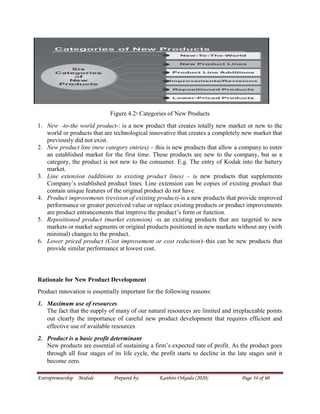
  • 55.
    Entrepreneurship Module Preparedby: Kanbiro Orkaido (2020) Page 54 of 60 CHAPTER SEVEN GROWTH STRATEGIES FOR SMALL FIRMS 7.1 Introduction The growth of small business is similar to that of a human being who passes through the stages of infancy, childhood, adulthood and old age. An enterprise may be considered growing when there is a permanent increase in its sales turn over, assets, volume of output, etc. Business growth is a natural and on -going process. Many business firms started small and have become big through continuous growth. But growth may be restricted by constraints of market demand, finance, technology, management skills etc. a successful new entry provides the opportunity for the entrepreneur to grow his/her business. For example, introducing a new product into an existing market provides the opportunity to take market share from competitors; entry into a new market provides the opportunity to service a new group of customers, and a new organization has a chance to make and built upon its first sales. Because growth makes a firm bigger, the firm begins to benefit from the advantages of size. So, higher volume increases production efficiency, makes the firm more attractive to suppliers, and therefore increases its bargaining power. Size also enhances, the legitimacy of firms, because those firms are often perceived by customers, financiers, and other stake holders as being more stable and prestigious. 7.2 Need for growth In modern business, very few firms remain static for long. Most of the firms are in a state of continued flux, either expanding or contracting but always changing like time. Business firms grow on account of several factors. The important motives which drive business firms towards growth are the advantages of growth which are; i. Survival Severe competition forces a firm to grow and gain competitive strength. Any business firms that fail to grow cannot survive for long. With increasing competition and shrinking profit margins, firms have to grow in order to maintain their existence. In a growing industry, a firm has to grow just to retain its present position. A growing firm tends to be an innovator and it can easily face business risks. It can easily absorb the shocks of market forces. Growth provides protection or security against period’s adversity such as depression. By diversifying the range of its products and markets, a firm can meet competition in the market and minimizes its risks. Thus, growth is a means of survival in a challenging and turbulent environment. ii. Economies of scale Large scale operations provide several economies in production, marketing, finance, and management. A large firm enjoys the advantages of bulk purchase of materials, strong bargaining power, spreading of overheads, well organized promotion campaigns, cheaper finance, automation, expert management, etc. These economies result in reduction in per unit cost of operations and increase in profits. iii. Expansion of market Increase in demand for goods and services have led business firms to expand in size. Population explosion and transportation led to widening of markets which in turn resulted in mass production. Business firms grow to cater to larger markets and to meet the increasing demand. Expanding markets provide opportunities for business growth. iv. Owners mandate
  • 56.
    Entrepreneurship Module Preparedby: Kanbiro Orkaido (2020) Page 55 of 60 The owner of a company gets the ultimate benefit of growth in the form higher dividends and rise in the market value of shareholdings. Therefore, they may direct the management to ensure growth of the company through continuous ploughing back of profits instead of distributing the entire earnings. Capable management may on its own like to take carefully calculated risks and expand the size of the company. v. Technology Business firms also grow in order to reap the benefits of modern technology. Many firms invest in research and development to develop new products and new techniques. Only a large firm can take full advantage sophisticated machinery and equipment. Rationalization and automation result in more efficient use of craze for power by building business enterprise. They take pride in the growth of firms established by them. Other personal factors such as personal ambition, exceptional organizing ability, strategic genius, etc also lead to growth of firms. vi. Government policy Generally, business firms operate under a plethora of government controls. Government may provide several incentives in the form of subsidies and tax concessions to industrial units in backward areas and those producing goods for export purposes. A firm may grow to face government controls or to secure these incentives. vii. Self sufficiency Some firms grow to become independent in terms of marketing raw materials or marketing of products. They integrate the various stages of industry or acquire other firms to gain control over the supply of raw materials and marketing of finished products. 7.3 TYPES OF GROWTH STRATEGIES The main strategies for growth are as follows 1. Expansion 3. Mergers and 2. Diversification 4. Sub – contracting 1. Expansion Expansion and diversification are forms of internal growth. Internal growth implies increase in the scale of operations without joining hands to the other firms. The firm expands its product market scope. Expansion may take place in the following forms; i. Market penetration- is increasing the sale of existing products in the existing markets. ii. Market development- is exploring new markets for existing products. iii. Product development- is developing new or modified products for sale in the existing markets. Advantages of expansion 1) Expansion can be financed from the firm’s own funds. 2) No major changes are required in the organization structure and management system of firms. 3) Better utilization of existing resources becomes possible. 4) The expanding firm can better face competition in the market. 5) Expansion provides economies of largo scale operations. Limitations of expansion 1) Growth is slow and takes time 2) It is not always possible in the present product market 3) A business firm may not be able to exploit many business opportunities by confining its operations to the existing products and markets. Practical problems in expansion include scarcity of funds, marketing and risk. 2. Diversification
  • 57.
    Entrepreneurship Module Preparedby: Kanbiro Orkaido (2020) Page 56 of 60 Diversification is the process of entry in the field of business which is new to an enterprise either in terms of markets or technology or both. Advantages of diversification i. Reduction in risk due to spreading ii. Stability through capacity to absorb shocks of business cycle iii. Wide scope for growth and profitability iv. Better use of existing facility v. Competitiveness Disadvantages i. Reorganization is necessary ii. Difficulty in coordinating diverse businesses. Diversification is suitable for the following reasons  When the firm can’t attain its growth strategies by expansion alone.  When diversification promises greater profitability than expansion.  When the financial resources of the firm are much or excess of the requirement of expansion. Types of Diversification There are four types of diversification i. Horizontal integration ii. Vertical integration iii. Concentric diversification iv. Conglomerate diversification i. Horizontal integration In this type of diversification, a company adds up some type of products at the same level of production and marketing processes. It may happen internally or externally. Internally, a company may decide to enter a parallel product market in addition to the existing product line. Externally, a company may combine with competing firms. Two or more competing firms are brought together under single ownership and control. ii. Vertical integration In this type of growth strategy new products and services are added which are complementary to the existing product or service line. It may be two types: Backward integration and Forward integration. a. Backward integration It implies moving towards the source of raw materials. Also called upstream development, it is aimed at moving lower on the production process so that the firm is able to supply all raw materials or basic components. b. Forward Integration It involves the entry of a firm into the business of finishing, distributing, or selling its existing products. It is also known as downstream expansion. It refers to moving higher up in the production or distributing processes towards the ultimate consumer. The firm develops outlets for the use or sale of its own products. iii. Concentric diversification When a firm enters into some businesses, which is related with its present business in terms of technology, marketing or both, it is called concentric diversification. In technology related concentric diversification new product or service is provided with the help of existing technology. In marketing related concentric diversification, new product or service is sold through the existing distributing system. In technology and marketing related
  • 58.
    Entrepreneurship Module Preparedby: Kanbiro Orkaido (2020) Page 57 of 60 concentric diversification, both existing technology and distributing system are used for the new product or service. Concentric diversification may be employed for the following purposes;  To counteract cyclical fluctuations in the present products or services.  To utilize the cash flows generated by the existing products or services.  To face saturation of demand for present product or services.  To gain managerial expertise in the new field of business and  To capitalize on the reputation of present product or services. iv. Conglomerate Diversification In this growth strategy a firm enters into business, which is unrelated to its existing business both in terms of technology and marketing. For example, Shri Ram Fibers Ltd. (Indian) is a conglomerate carrying on business in nylon industrial yarns, synthetic industrial fabrics, engineering plastics, flow carbon, refrigerance, ball and needle bearings, auto electrical, hire- purchase and leasing, and financial services. Conglomerate diversification strategy may be adopted for the following reasons:  To achieve a growth rate higher than what can be realized through expansion.  To make better use of financial resources with retained profits exceeding immediate investment needs.  To avail of potential opportunities for profitable investment.  To achieve distinctive competitive advantage and greater stability.  To spread the risk, and  To improve the price earnings ratio and market price of the company’s shares. External Growth Strategy (Joint Ventures, Mergers, or Takeovers) External growth occurs when two or more firms combine together in one firm. It is also called integrate growth strategy. Integrated growth strategy may take the form of Joint- venture, merger or takeover. i. Joint Ventures When two or more independent firms together establish a new enterprise, contribute to the total equity capital and participate in its business operations, it is known as a joint venture. A joint venture is a temporary partnership or consortium between two or more companies for a specified purpose. Firms within a country as well as firms in different countries may participate in a joint venture. Advantages Joint ventures are set up for the following reasons: a) A joint venture between two or more companies within the same country helps to reduce competition or influence suppliers. b) High risks involved in new ventures can be reduced through joint ventures. c) Small firms can compete with large firms by joining hands. d) The foreign partner in a joint venture can provide advanced technology and technical knowhow not available within the country, Maruti Udyog Ltd. e) The import content of a project can easily be financed through equity participation by the foreign company. f) Multinational corporations can enter a country more easily through joint ventures than by setting up branches or subsidiaries. g) Joint ventures help reduce production and marketing costs through higher sales volume.
  • 59.
    Entrepreneurship Module Preparedby: Kanbiro Orkaido (2020) Page 58 of 60 h) Risk of business is shared among partners. Many joint ventures have been set up in construction industry for this purpose. i) A joint venture can provide the benefit of synergy. According to Grucker, joint venture is the most flexible instrument for making the fits out of misfits. The distinctive competence of two or more independent firms can be pooled together. j) The amount of investment in joint venture is contributed by two or more firms. As a result each partner has to contribute less than when he has to set up the venture alone Disadvantages The main problems of joint ventures are as follows: a) Problems often arise in equity participation because both the local partner and the foreign partner desire to have majority stake in the joint venture. b) Often there are legal restrictions on foreign investment. Some countries set a limit of permissible foreign shareholding in the local companies. c) Differences in cultures and stages of economic development of the countries to which the parties belong often create conflicts. d) Joint ventures between unequal partners often tantamount to quasi mergers and may attract anti-monopoly regulations. e) Lack of proper coordination among partners may affect the efficient functioning of a joint venture. Joint ventures are likely to be more appropriate under the following conditions: 1. When an activity is uneconomical for a single firm. 2. When the risk of business has to be shared and reduced for the participating firms. 3. When the distinctive competence of two or more firms can be brought together. 4. When setting up a venture requires overcoming hurdles such as import quotas, tariffs, nationalistic political interests, and cultural roadblocks. Thus joint ventures are an effective growth strategy when development costs have to be shared, risks are to be spread out and expertise has to be combined to make effective use of resources. Strategic issues in joint ventures The major decisions that should be carefully taken in a joint venture are given below: 1) Objectives of joint venture: first of all the basic objective of joint venture should be spelled out clearly. The interests of two partners may not be identical and compatible. Therefore, basic differences in their objectives should be stated in advance. A way to break the disagreement should be built into the joint venture from the very start. Even provision can be made for arbitration and arbitrator acceptable to both the parties can be named. 2) Choice of partner: several criteria may be used to select a partner for the joint venture. These are: financial capacity, technical capacity, management competence, etc. in addition the intention and sincerity of the partners should be considered. 3) Pattern of shareholding: an explicit provision should also be made for disinvestment of shareholding by the government/foreign party after certain period of time. Key consideration in dividing foreign equity participation is the inflow of foreign technology on continuous basis and discharge of export obligation and the government policy. 4) Management pattern: the joint venture should be autonomous. The composition of the board of directors may be decided in the light of choice of partners, shareholders pattern, etc.
  • 60.
    Entrepreneurship Module Preparedby: Kanbiro Orkaido (2020) Page 59 of 60 ii. Merger Merger is an external growth strategy. A merger means a combination of two or more firms into one. It may occur in two ways: a) Takeover or acquisition of one company by another(absorption), and b) Creation of new company by complete consolidation of two or more units (amalgamation). Types of Mergers Mergers are of four types: 1. Horizontal mergers: these take place when there is a combination of two or more firms engaged in the same production or marketing process. For instance, Brook Bond and Lipton India Ltd. Merged together and formed a new company. ‘Brook Bond and Lipton India Ltd.’ (BBIL). 2. Vertical Mergers: It takes place when the combining firms are complementary to each other either in terms of supply of inputs pr marketing of output. For example, a footwear company may take over a leather tannery. 3. Concentric mergers: when the combining firms are similar either in terms of technology or marketing system there is concentric merger. 4. Conglomerate mergers :it occurs when two unrelated firms combine together, i.e., a footwear company combining with a cement firm. Why Mergers? Buying Firm’s view point Selling Firm’s View Point 1. To gain quick entry into new markets and industries. 2. To achieve faster rate of growth 3. To diversify quickly 4. To reduce competition and avoid dependence 5. To gain tax benefits 6. To achieve synergistic advantages 7. To have quick access to research and development and other facilities. 8. To fill the gap in the existing product line. 9. To stabilize sales and profits 10. To increase the value of company’s shares. 1. To turn around a sick unit. 2. To increase the value of the owner’s stock. 3. To increase the growth rate. 4. To acquire resources for stability operations. 5. To deal with problem of top management succession. 6. To reduce tax burden. Advantages Mergers are used due to the following reasons: a. A merger provides economies of large-scale operations. b. Better utilization of funds can be made to increase profits. c. There is possibility of diversification. d. More efficient use of resources can be made. e. Sick firms can be rehabilitated by merging them with strong and efficient concerns. f. It is often cheaper to acquire an existing unit than to set up a new one. g. It is possible to gain quick entry into new lines of business. h. It can provide access to scarce raw materials and distribution network and managerial expertise.
  • 61.
    Entrepreneurship Module Preparedby: Kanbiro Orkaido (2020) Page 60 of 60 Disadvantages Mergers are not always successful due to the following drawbacks: a. The combined enterprise may be unwieldy. Effective coordination and control becomes difficult. As a result efficiency and profitability may decline. b. Mergers give rise to monopoly and concentration of economic power, which often operate against the interest of the society and the country. Sub-Contracting Sub-contracting hiring another firm to perform some of the manufacturing process or to give sub-assemblies that will be included in the finished product. Such contracting is also used t describe contractual arrangements between government agencies and industrial concerns. For example, civic authorities enter into sub-contracts with business concerns. Under such contract business firms carry out the specified work on roads, parks, etc. civic authorities in exchanging of specified fee. Large business firms similarly assign some of the jobs to small scale units. These jobs may involve some manufacturing or office work. In case of manufacturing work, it may be industrial sub-contracting while in the other cases it is known as commercial sub-contracting. Small-scale firms play an important role in sub-contracting and thereby serve as feeders to large-scale industries. Sub-contracting has several advantages. First, it is the fastest method of increasing output. It enables the contractor to use technical and managerial skills already existing with the sub- contractor. It avoids the need of setting up new plants and equipment, which involves time and expense. Secondly, sub-contracting saves the buyer from incurring investment in specialized machinery and equipment, which may not be required for regular production. Thirdly, sub- contracting may enable the contractor to buy the components at a cost lesser than that of manufacturing. Lastly, sub-contracting, checks over-expansion of productive facilities in case of temporary demand. Sub-contracting May, however, is unsuitable in case contractor requires the inputs on a large scale and on regular basis. Same is the case when the contractor can manufacture the component at a cost lesser than the price charged by the sub-contractor. Sub-contracting provides business to small-scale firms and helps in their development.