Chapter 23: Administering Medications
Legal Considerations   U.S. Drug Legislation Sets official drug standards Defines prescription drugs Regulates controlled substances Improves safety Requires proof of efficacy Nurse Practice Acts Identify nursing responsibilities for administration and client monitoring
Medication Systems Stock Supply Bulk quantity Central location Not client-specific Unit Dose Individually packaged Client-specific drawers 24-hour supply
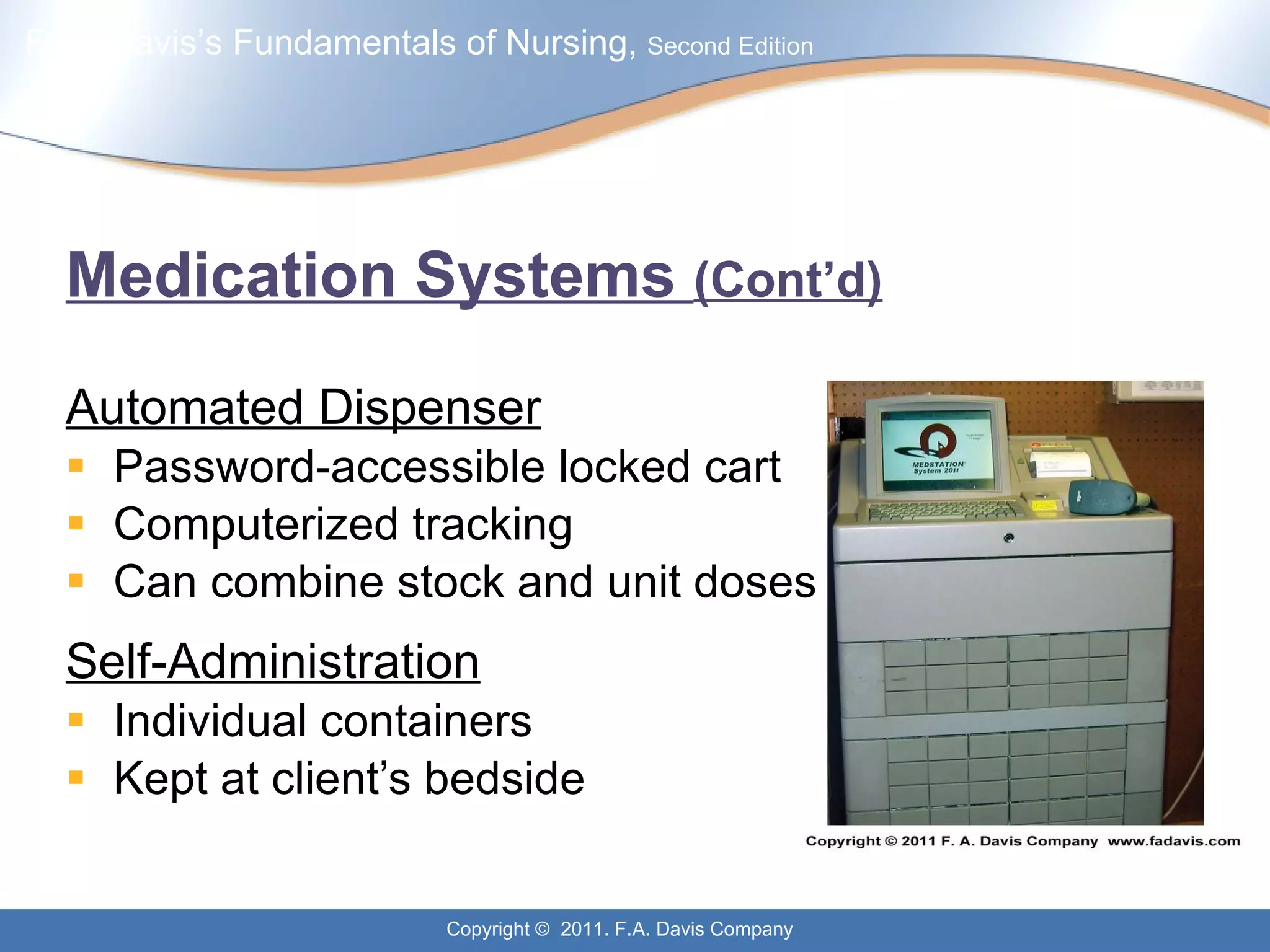
Automated Dispenser Password-accessible locked cart Computerized tracking Can combine stock and unit doses Self-Administration Individual containers Kept at client’s bedside Medication Systems  (Cont’d)
Pharmacological Considerations Pharmacokinetics What happens to the drug in the body Pharmacodynamics How the drug affects the body
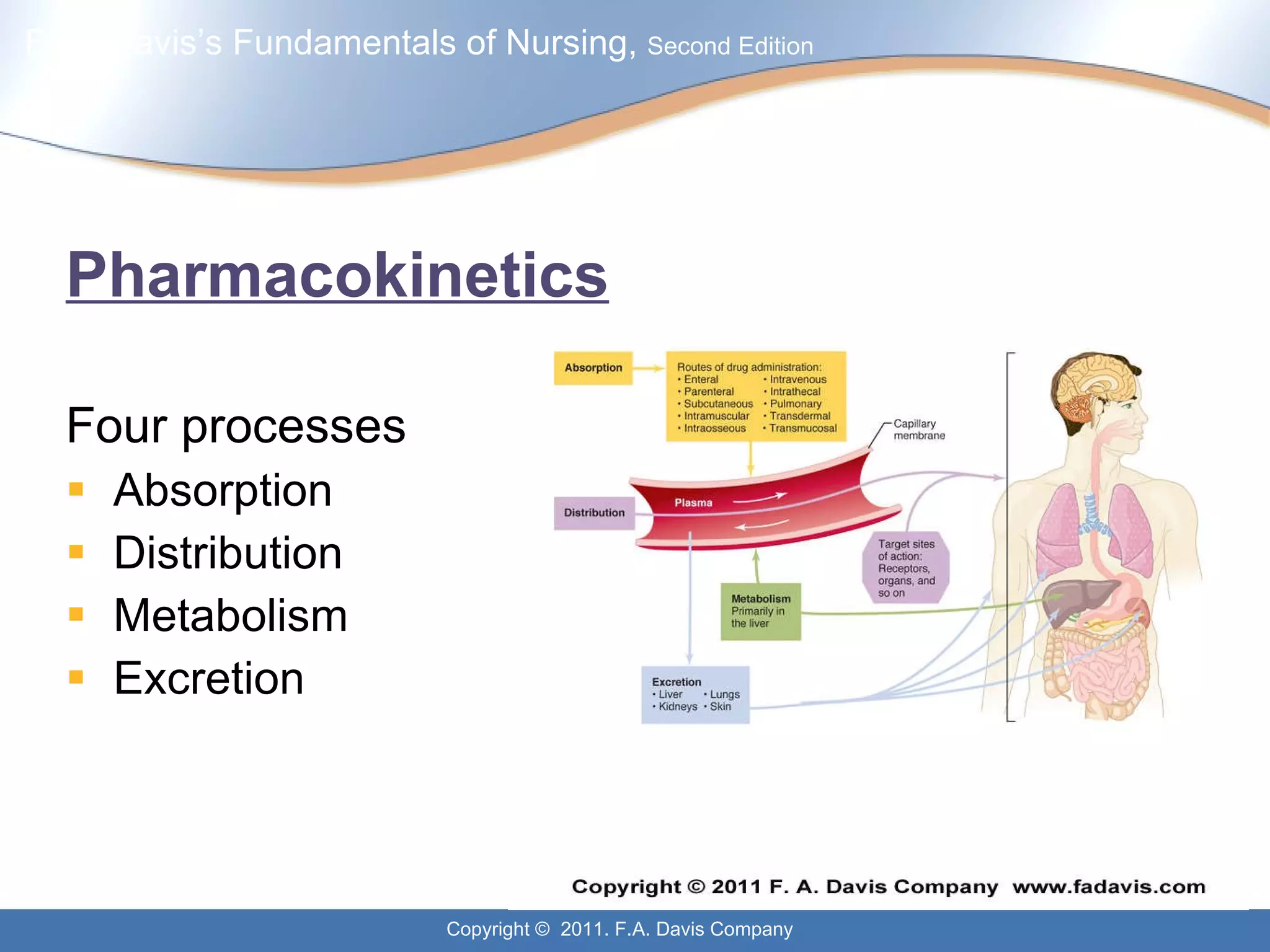
Pharmacokinetics Four processes Absorption Distribution Metabolism Excretion
Absorption Movement of drug into the bloodstream Factors affecting absorption Route of administration Drug solubility pH/ionization Blood flow
Distribution Drug transport to tissues and organs Factors affecting distribution Local blood flow Membrane permeability Protein-binding capacity
Metabolism Biotransformation: chemical conversion of drug Factors affecting metabolism Liver function Health/disease status First-pass effect
Excretion Elimination of the drug Factors affecting excretion Organ function, especially the kidneys, liver, and lungs Exocrine glands
ClickerCheck The client has been on a low-protein diet. This will most likely affect which pharmacokinetic process? a. Absorption b. Excretion c. Distribution d. Metabolism
Correct answer:  C A low-protein diet may lead to an inadequate level of plasma proteins, which will affect availability of “free” drug.
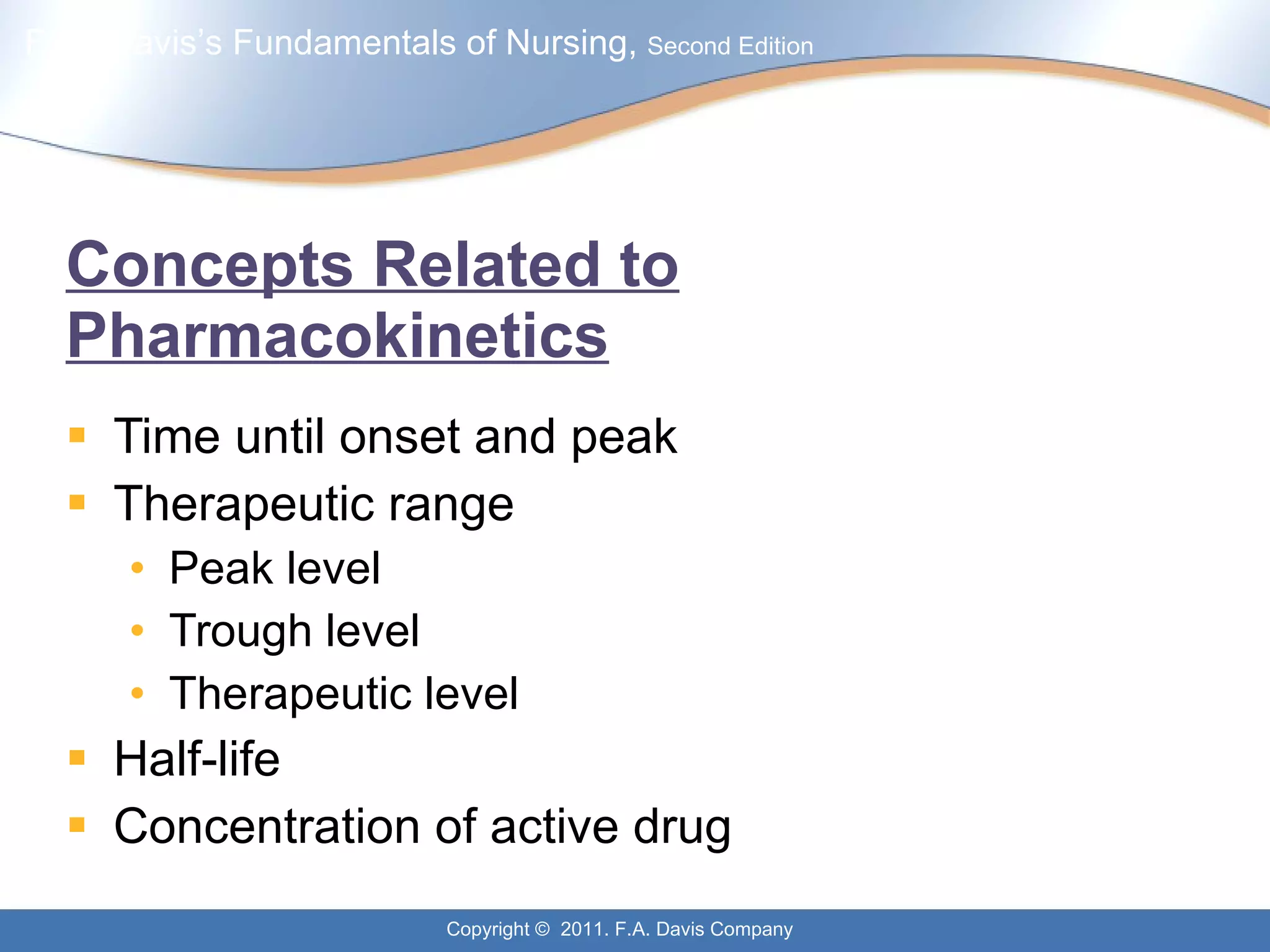
Concepts Related to Pharmacokinetics Time until onset and peak Therapeutic range Peak level Trough level Therapeutic level Half-life Concentration of active drug
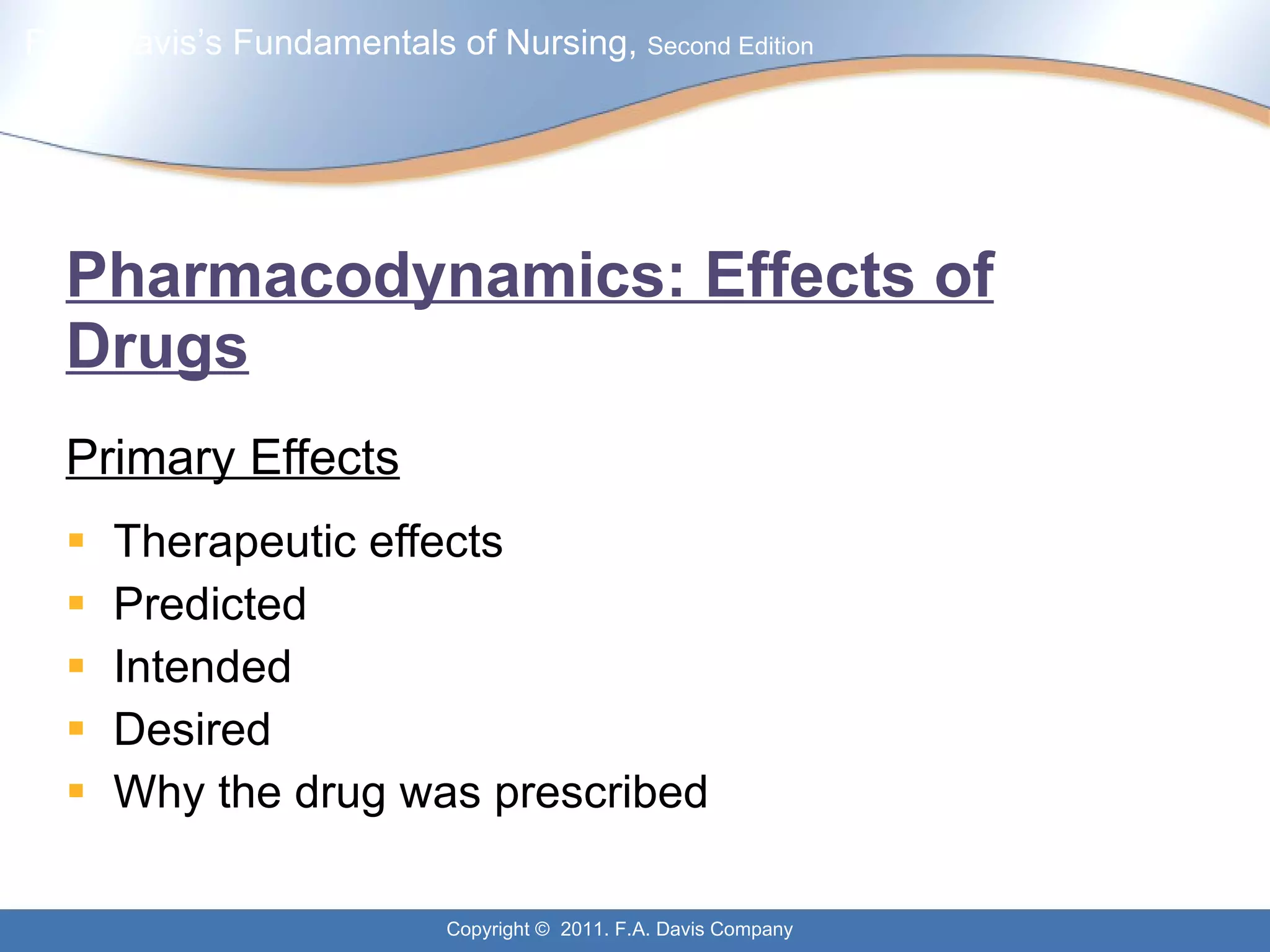
Pharmacodynamics: Effects of Drugs Primary Effects Therapeutic effects Predicted Intended Desired Why the drug was prescribed
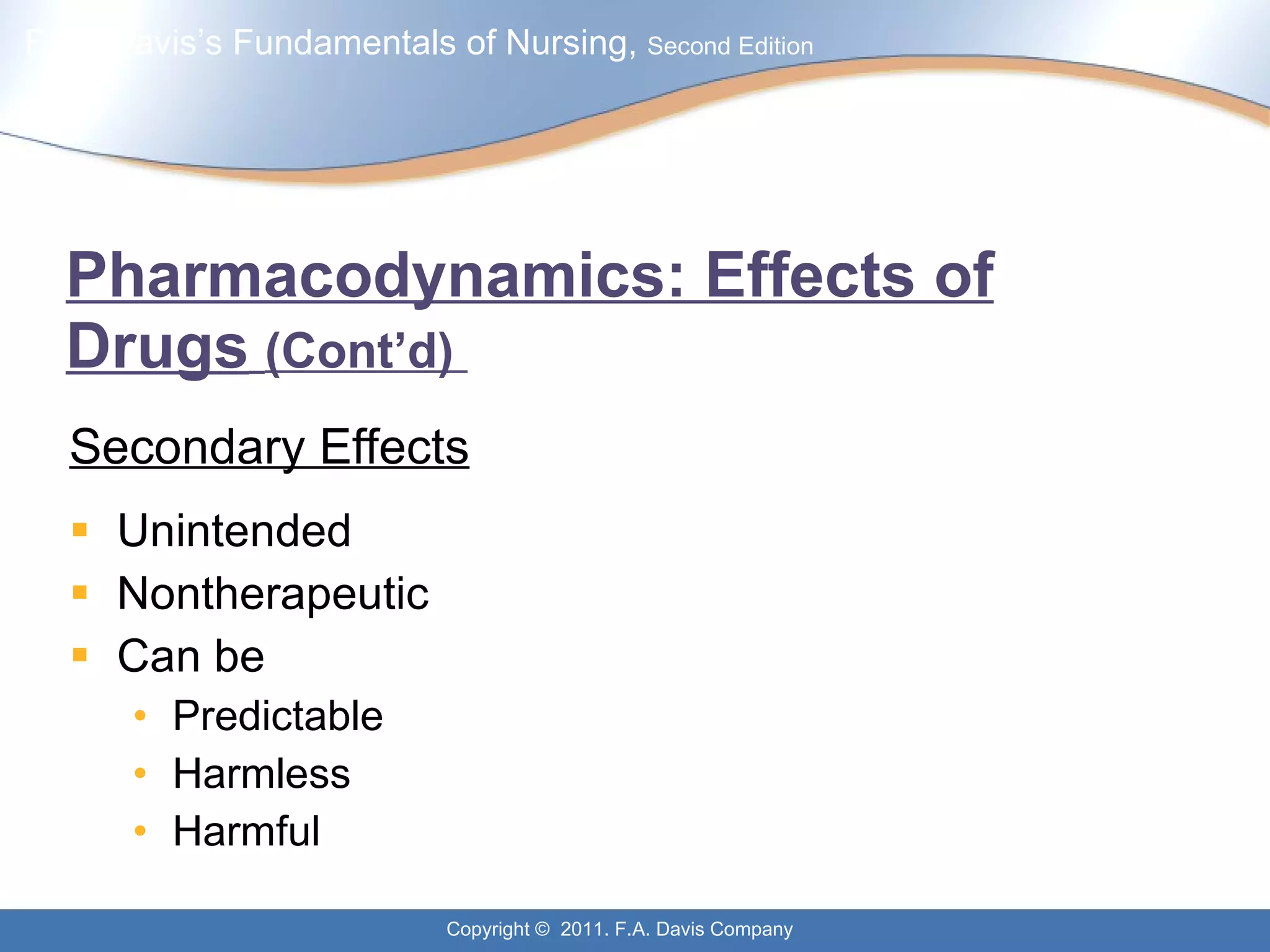
Pharmacodynamics: Effects of Drugs   (Cont’d)  Secondary Effects Unintended Nontherapeutic Can be Predictable Harmless Harmful
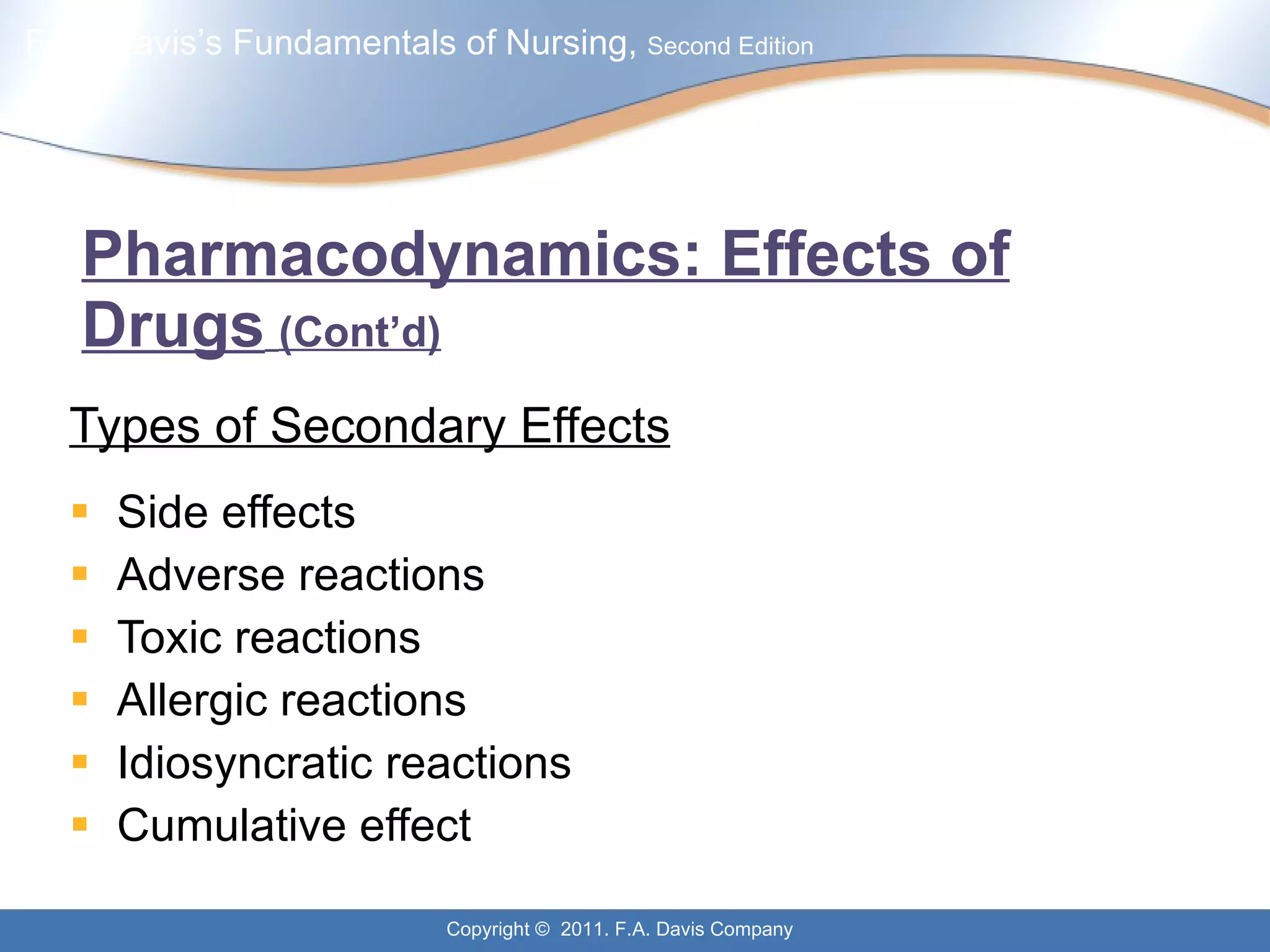
Pharmacodynamics: Effects of Drugs   (Cont’d) Types of Secondary Effects Side effects Adverse reactions Toxic reactions Allergic reactions Idiosyncratic reactions Cumulative effect
Drug Interactions Antagonistic Synergistic Incompatibilities
Nursing Considerations: The Medication Order Types of Medication Orders Written order Automatic “stop” date STAT order Standing order PRN order
Nursing Considerations: The Medication Order  (Cont’d) Communication of Orders Handwritten  Preprinted Orally Telephone
ClickerCheck The primary provider has written a medication prescription. The nurse is having difficulty deciphering what has been written. The best strategy to clarify the information is a. Ask the patient what medication the provider prescribed. b. Call the pharmacist and ask her to read the  prescription. c. Ask the nurse who knows the provider’s handwriting to  read the prescription. d. Call the provider and ask him to clarify the prescription.
Correct answer:  D All other answers increase the risk of a medication error.
Components of the Medication Order/Prescription Client’s full name (some locales require address) Date and time Name of medication Dosage size, frequency, number of doses Route of administration Printed name and signature of prescriber, including relevant credentials and legal registration number
Nursing Considerations: Medication Administration Safety Three Checks Before you pour Check the medication label against the MAR After you pour Verify the label against the MAR At the bedside Check the medication again
Nursing Considerations: Medication Administration Safety  (Cont’d) Six Rights Right drug Right client Right dose Right time Right route Right documentation Other Rights Right reason Right to know Right to refuse
Routes of Administration  Tablets, pills, capsules Liquids Buccal Sublingual Enteral medications Oral Medications Most commonly used route Includes
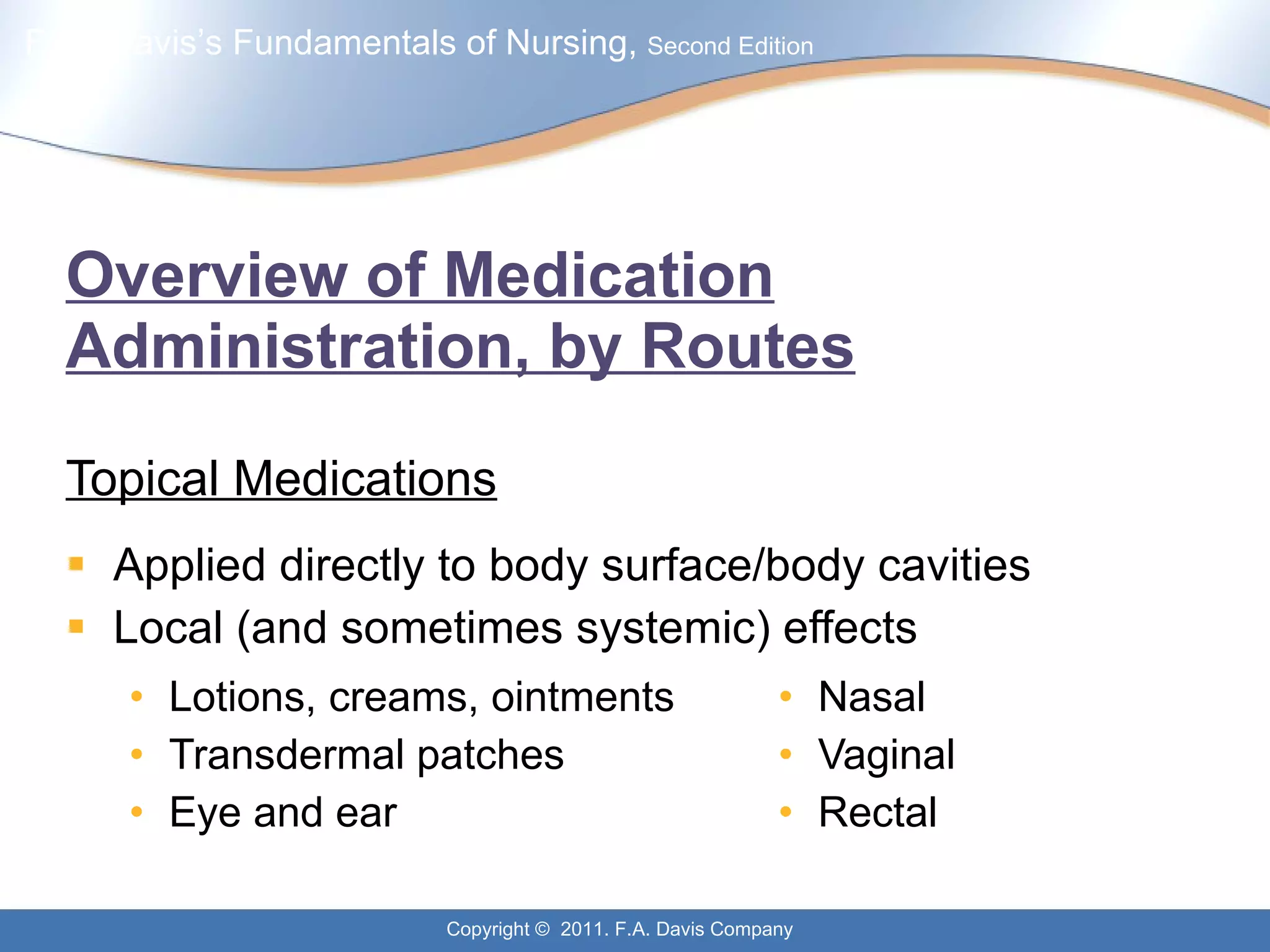
Overview of Medication Administration, by Routes Lotions, creams, ointments Transdermal patches Eye and ear Nasal Vaginal  Rectal Topical Medications Applied directly to body surface/body cavities Local (and sometimes systemic) effects
Routes of Administration Respiratory Inhalations Use concept of nebulization Absorption via alveoli and blood supply Atomizers Aerosol Metered dose inhaler
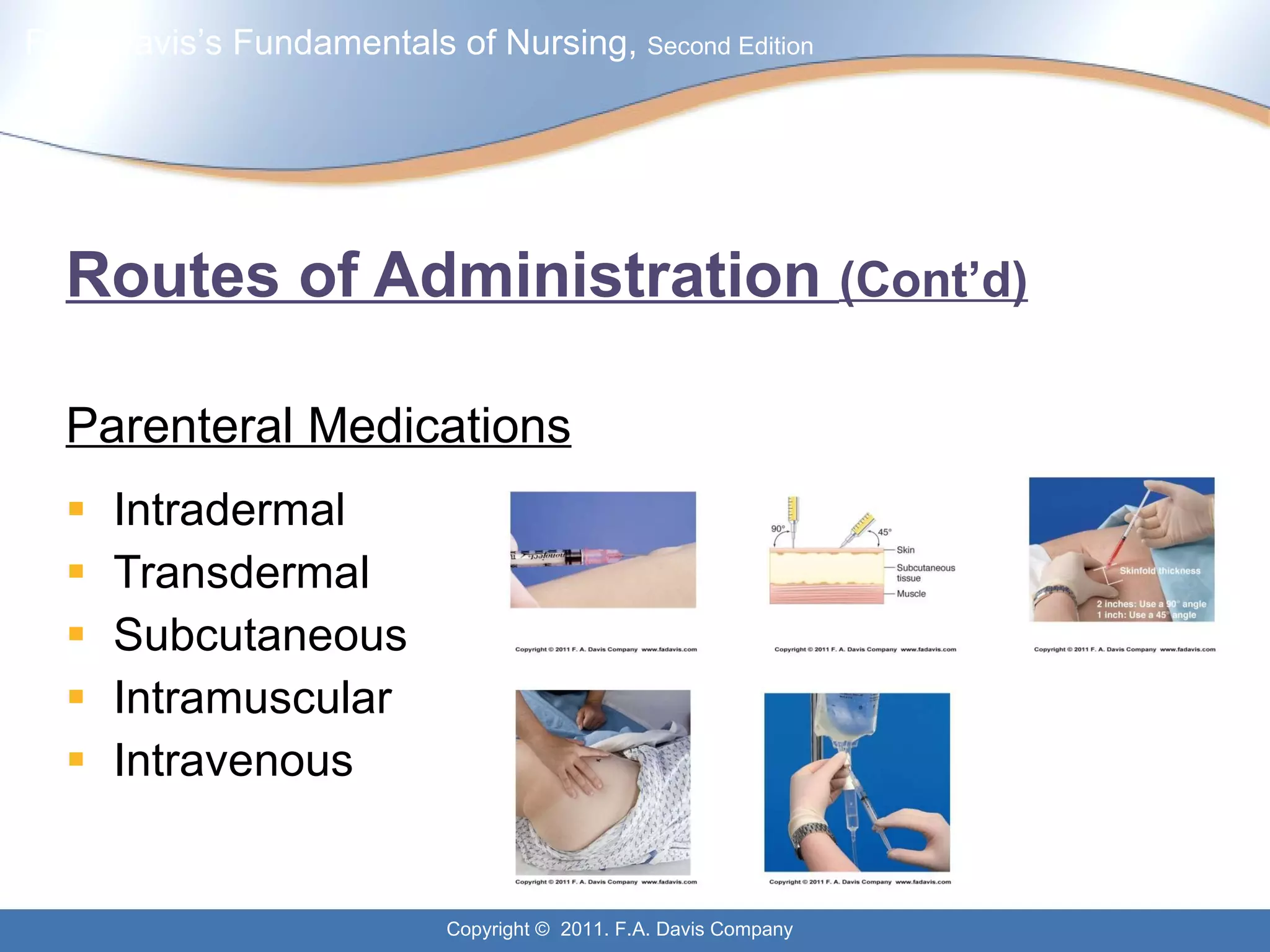
Routes of Administration  (Cont’d) Parenteral Medications Intradermal Transdermal Subcutaneous Intramuscular Intravenous
Parenteral Medication Administration Equipment Preparation Syringe/needle (size, gauge) Medication Preparation Vials and ampules Reconstituting from powder Two medications in one syringe
Parenteral Medication Administration  (Cont’d) Safety Issues Use sharps containers Avoid recapping a dirty needle
Parenteral Medication Administration  (Cont’d) Use the correct site Wrong site could mean wrong route Be familiar with the technique required for the medication (e.g., heparin, insulin)
Parenteral Medication Administration  (Cont’d) Intravenous Medications IV push IV piggyback Medicated drips
ClickerCheck When administering a drug via a parenteral routes, the drug would be absorbed fastest if given per the IM route. a. True b.  False
Correct answer:  B, false Absorption refers to the “movement” of the drug from the site of administration into the blood stream. Therefore, the intravenous, parenteral route leads to “instant” absorption.
Avoiding Medication Errors Arrive to work well rested and undistracted. Use the six rights. Calculate doses carefully; double-check with a second RN. Watch for drugs with similar names. Watch for clients with the same last names.
Avoiding Medication Errors  (Cont’d) Clarify unfamiliar drug names and dosages or illegible orders. Avoid abbreviations.  Know and use your resources. Keep up with changes in medication orders.
What Should I Do If I Commit a Medication Error? Immediately assess the patient’s vital signs and physical status. Report findings to the primary care provider. Notify the nurse manager of your unit and report the event surrounding the event. Check with your institution for agency-specific policy regarding incident reporting.
Critical Thinking You have checked the medication record (MAR) for Margaret Marks (“Meet Your Patients,” in Volume 1) and prepared her next dose of antibiotic for intravenous administration. The MAR also indicates that she is receiving morphine for pain and that her last dose was given 1 hour ago. When you enter the room, you find her apparently sleeping. You are not able to awaken her to verify her identity. What do you suspect is happening, and how should you respond?

Ch23

  • 1.
  • 2.
    Legal Considerations U.S. Drug Legislation Sets official drug standards Defines prescription drugs Regulates controlled substances Improves safety Requires proof of efficacy Nurse Practice Acts Identify nursing responsibilities for administration and client monitoring
  • 3.
    Medication Systems StockSupply Bulk quantity Central location Not client-specific Unit Dose Individually packaged Client-specific drawers 24-hour supply
  • 4.
    Automated Dispenser Password-accessiblelocked cart Computerized tracking Can combine stock and unit doses Self-Administration Individual containers Kept at client’s bedside Medication Systems (Cont’d)
  • 5.
    Pharmacological Considerations PharmacokineticsWhat happens to the drug in the body Pharmacodynamics How the drug affects the body
  • 6.
    Pharmacokinetics Four processesAbsorption Distribution Metabolism Excretion
  • 7.
    Absorption Movement ofdrug into the bloodstream Factors affecting absorption Route of administration Drug solubility pH/ionization Blood flow
  • 8.
    Distribution Drug transportto tissues and organs Factors affecting distribution Local blood flow Membrane permeability Protein-binding capacity
  • 9.
    Metabolism Biotransformation: chemicalconversion of drug Factors affecting metabolism Liver function Health/disease status First-pass effect
  • 10.
    Excretion Elimination ofthe drug Factors affecting excretion Organ function, especially the kidneys, liver, and lungs Exocrine glands
  • 11.
    ClickerCheck The clienthas been on a low-protein diet. This will most likely affect which pharmacokinetic process? a. Absorption b. Excretion c. Distribution d. Metabolism
  • 12.
    Correct answer: C A low-protein diet may lead to an inadequate level of plasma proteins, which will affect availability of “free” drug.
  • 13.
    Concepts Related toPharmacokinetics Time until onset and peak Therapeutic range Peak level Trough level Therapeutic level Half-life Concentration of active drug
  • 14.
    Pharmacodynamics: Effects ofDrugs Primary Effects Therapeutic effects Predicted Intended Desired Why the drug was prescribed
  • 15.
    Pharmacodynamics: Effects ofDrugs (Cont’d) Secondary Effects Unintended Nontherapeutic Can be Predictable Harmless Harmful
  • 16.
    Pharmacodynamics: Effects ofDrugs (Cont’d) Types of Secondary Effects Side effects Adverse reactions Toxic reactions Allergic reactions Idiosyncratic reactions Cumulative effect
  • 17.
    Drug Interactions AntagonisticSynergistic Incompatibilities
  • 18.
    Nursing Considerations: TheMedication Order Types of Medication Orders Written order Automatic “stop” date STAT order Standing order PRN order
  • 19.
    Nursing Considerations: TheMedication Order (Cont’d) Communication of Orders Handwritten Preprinted Orally Telephone
  • 20.
    ClickerCheck The primaryprovider has written a medication prescription. The nurse is having difficulty deciphering what has been written. The best strategy to clarify the information is a. Ask the patient what medication the provider prescribed. b. Call the pharmacist and ask her to read the prescription. c. Ask the nurse who knows the provider’s handwriting to read the prescription. d. Call the provider and ask him to clarify the prescription.
  • 21.
    Correct answer: D All other answers increase the risk of a medication error.
  • 22.
    Components of theMedication Order/Prescription Client’s full name (some locales require address) Date and time Name of medication Dosage size, frequency, number of doses Route of administration Printed name and signature of prescriber, including relevant credentials and legal registration number
  • 23.
    Nursing Considerations: MedicationAdministration Safety Three Checks Before you pour Check the medication label against the MAR After you pour Verify the label against the MAR At the bedside Check the medication again
  • 24.
    Nursing Considerations: MedicationAdministration Safety (Cont’d) Six Rights Right drug Right client Right dose Right time Right route Right documentation Other Rights Right reason Right to know Right to refuse
  • 25.
    Routes of Administration Tablets, pills, capsules Liquids Buccal Sublingual Enteral medications Oral Medications Most commonly used route Includes
  • 26.
    Overview of MedicationAdministration, by Routes Lotions, creams, ointments Transdermal patches Eye and ear Nasal Vaginal Rectal Topical Medications Applied directly to body surface/body cavities Local (and sometimes systemic) effects
  • 27.
    Routes of AdministrationRespiratory Inhalations Use concept of nebulization Absorption via alveoli and blood supply Atomizers Aerosol Metered dose inhaler
  • 28.
    Routes of Administration (Cont’d) Parenteral Medications Intradermal Transdermal Subcutaneous Intramuscular Intravenous
  • 29.
    Parenteral Medication AdministrationEquipment Preparation Syringe/needle (size, gauge) Medication Preparation Vials and ampules Reconstituting from powder Two medications in one syringe
  • 30.
    Parenteral Medication Administration (Cont’d) Safety Issues Use sharps containers Avoid recapping a dirty needle
  • 31.
    Parenteral Medication Administration (Cont’d) Use the correct site Wrong site could mean wrong route Be familiar with the technique required for the medication (e.g., heparin, insulin)
  • 32.
    Parenteral Medication Administration (Cont’d) Intravenous Medications IV push IV piggyback Medicated drips
  • 33.
    ClickerCheck When administeringa drug via a parenteral routes, the drug would be absorbed fastest if given per the IM route. a. True b. False
  • 34.
    Correct answer: B, false Absorption refers to the “movement” of the drug from the site of administration into the blood stream. Therefore, the intravenous, parenteral route leads to “instant” absorption.
  • 35.
    Avoiding Medication ErrorsArrive to work well rested and undistracted. Use the six rights. Calculate doses carefully; double-check with a second RN. Watch for drugs with similar names. Watch for clients with the same last names.
  • 36.
    Avoiding Medication Errors (Cont’d) Clarify unfamiliar drug names and dosages or illegible orders. Avoid abbreviations. Know and use your resources. Keep up with changes in medication orders.
  • 37.
    What Should IDo If I Commit a Medication Error? Immediately assess the patient’s vital signs and physical status. Report findings to the primary care provider. Notify the nurse manager of your unit and report the event surrounding the event. Check with your institution for agency-specific policy regarding incident reporting.
  • 38.
    Critical Thinking Youhave checked the medication record (MAR) for Margaret Marks (“Meet Your Patients,” in Volume 1) and prepared her next dose of antibiotic for intravenous administration. The MAR also indicates that she is receiving morphine for pain and that her last dose was given 1 hour ago. When you enter the room, you find her apparently sleeping. You are not able to awaken her to verify her identity. What do you suspect is happening, and how should you respond?