A First Book of ANSI C Fourth Edition Chapter 13 Dynamic Data Structures
Objectives Introduction to Linked Lists Dynamic Memory Allocation Stacks Queues Dynamically Linked Lists Common Programming and Compiler Errors
Introduction Dynamic memory allocation : an alternative to fixed memory allocation in which memory space grows or diminishes during program execution Dynamic memory allocation   makes it unnecessary to reserve a fixed amount of memory for a scalar, array, or structure variable in advance Also known as  run-time allocation Requests are made for allocation and release of memory space while the program is running
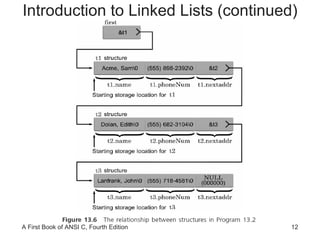
Introduction to Linked Lists An array of structures can be used to insert and delete ordered structures, but this is not an efficient use of memory Better alternative: a linked list Linked list:  set of structures, each containing at least one member whose value is the address of the next logically ordered structure in the list Also known as  self-referencing structures
Introduction to Linked Lists (continued)
Introduction to Linked Lists (continued) A NULL acts as a sentinel or flag to indicate when the last structure has been processed In addition to an end-of-list sentinel value, we must provide a special pointer for storing the address of the first structure in the list
Introduction to Linked Lists (continued)
A structure can contain any data type, including a pointer. A pointer member of a structure is used like any other pointer variable. Introduction to Linked Lists (continued)
is evaluated as  (t1.nextaddr)->name it can be replaced by  (*t1.nextaddr).name Introduction to Linked Lists (continued)
Introduction to Linked Lists (continued)
Introduction to Linked Lists (continued) Disadvantage: exactly three structures are defined in  main()  by name, and storage for them is reserved at compile time
Introduction to Linked Lists (continued) can  be replaced by  while(!contents)
Dynamic Memory Allocation
Dynamic Memory Allocation (continued) The  malloc()  and  calloc()  functions can frequently be used interchangeably The advantage of  calloc()  is that it initializes all newly allocated numeric memory to 0 and character allocated memory to NULL We use  malloc()  because it is the more general purpose of the two functions malloc(10*sizeof(char))  or  calloc(10,sizeof(char))  requests enough memory to store 10 characters The space allocated by  malloc()  comes from the computer’s  heap
Necessary because  malloc()  returns  void Dynamic Memory Allocation (continued) …
Dynamic Memory Allocation (continued) malloc()  is more typically used for dynamically allocating memory for structures struct OfficeInfo *Off; /* request space for one structure */ Off = (struct OfficeInfo *) malloc(sizeof(struct OfficeInfo)); /* check that space was allocated */ if (Off == (struct OfficeInfo*) NULL) { printf("\nAllocation failed\n"); exit(1); }
Stacks Stack: special type of linked list in which objects can only be added to and removed from the top of the list Last-in, first-out (LIFO) list In a true stack, the only item that can be seen and accessed is the top item
Stacks (continued)
Stack Implementation Creating a stack requires the following four components: A structure definition A method of designating the current top stack structure An operation for placing a new structure on the stack An operation for removing a structure from the stack
PUSH and POP PUSH (add a new structure to the stack) Dynamically create a new structure Put the address in the top-of-stack pointer into the address field of the new structure Fill in the remaining fields of the new structure Put the address of the new structure into the top-of-stack pointer POP (remove a structure from the top of the stack) Move the structure contents pointed to by the top-of-stack pointer into a work area Free the structure pointed to by the top-of-stack pointer Move the address in the work area address field into the top-of-stack pointer
PUSH and POP (continued)
PUSH and POP (continued) A sample run using Program 13.5 produced the following: Enter as many names as you wish, one per line To stop entering names, enter a single x Enter a name: Jane Jones Enter a name: Bill Smith Enter a name: Jim Robinson Enter a name: x The names popped from the stack are: Jim Robinson Bill Smith Jane Jones
Queues A second important data structure that relies on linked structures is called a  queue Items are removed from a queue in the order in which they were entered It is a first in, first out (FIFO) structure
Queues (continued)
Queues (continued)
Enque and Serve Enqueueing:  placing a new item on top of the queue  Serving:  removing an item from a queue
Enque and Serve (continued)
Enque and Serve (continued) Enqueue (add a new structure to an existing queue) Dynamically create a new a structure Set the address field of the new structure to a NULL Fill in the remaining fields of the new structure Set the address field of the prior structure (which is pointed to by the queueIn pointer) to the address of the newly created structure Update the address in the queueIn pointer with the address of the newly created structure
Enque and Serve (continued)
Enque and Serve (continued) Serve (remove a structure from an existing queue) Move the contents of the structure pointed to by the queueOut pointer into a work area Free the structure pointed to by the queueOut pointer Move the address in the work area address field into the queueOut pointer
Enque and Serve (continued)
Enque and Serve (continued) A sample run using Program 13.6 produced the following: Enter as many names as you wish, one per line To stop entering names, enter a single x Enter a name: Jane Jones Enter a name: Bill Smith Enter a name: Jim Robinson Enter a name: x The names served from the queue are: Jane Jones Bill Smith Jim Robinson
Dynamically Linked Lists Both stacks and queues are examples of linked lists in which elements can only be added to and removed from the ends of the list In a dynamically linked list, this capability is extended to permit adding or deleting a structure from anywhere within the list Such a capability is extremely useful when structures must be kept within a specified order
INSERT and DELETE Key field
INSERT and DELETE (continued) INSERT (add a new structure into a linked list) Dynamically allocate space for a new structure If no structures exist in the list Set the address field of the new structure to a NULL Set address in the first structure pointer to address of newly created structure Else /* we are working with an existing list */ Locate where this new structure should be placed If this structure should be the new first structure in the list Copy current contents of first structure pointer into address field of newly created structure Set address in the first structure pointer to address of newly created structure Else Copy the address in the prior structure’s address member into the address field of the newly created structure Set address of prior structure’s address member to address of newly created structure EndIf EndIf
INSERT and DELETE (continued)
INSERT and DELETE (continued) LINEAR LOCATION for INSERTING a NEW STRUCTURE If the key field of the new structure is less than the first structure’s key field the new structure should be the new first structure Else While there are still more structures in the list Compare the new structure’s key value to each structure key Stop the comparison when the new structure key either falls between two existing structures or belongs at the end of the existing list EndWhile EndIf
See  Slide 50 See  Slide 50 INSERT and DELETE (continued)
INSERT and DELETE (continued)
INSERT and DELETE (continued) ...(code for  insert()  and  locate()  goes here)…
INSERT and DELETE (continued) The following sample run shows the results of these tests: Enter as many names as you wish, one per line To stop entering names, enter a single x Enter a name: Binstock Enter a name: Arnold Enter a name: Duberry Enter a name: Carter Enter a name: x The names currently in the list, in alphabetical order, are: Arnold Binstock Carter Duberry
Common Programming Errors Not checking the return codes provided by  malloc()  and  realloc() Not correctly updating all relevant pointer addresses when adding or removing structures from dynamically created stacks, queues, and linked lists Forgetting to free previously allocated memory space when the space is no longer needed
Common Programming Errors (continued) Not preserving the integrity of the addresses contained in the top-of-stack pointer, queue-in, queue-out, and list pointer when dealing with a stack, queue, and dynamically linked list, respectively Related to the previous error is the equally disastrous one of not correctly updating internal structure pointers when inserting and removing structures from a stack, queue, or dynamically linked list
Common Compiler Errors
Common Compiler Errors (continued)
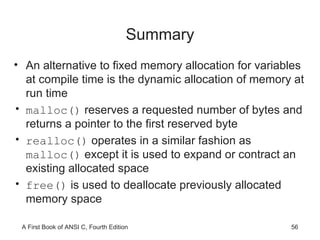
Summary An alternative to fixed memory allocation for variables at compile time is the dynamic allocation of memory at run time malloc()  reserves a requested number of bytes and returns a pointer to the first reserved byte realloc()  operates in a similar fashion as  malloc()  except it is used to expand or contract an existing allocated space free()  is used to deallocate previously allocated memory space
Summary (continued) A stack is a list consisting of structures that can only be added and removed from the top of the list A queue is a list consisting of structures that are added to the top of the list and removed from the bottom of the list A dynamically linked list consists of structures that can be added or removed from any position in the list

Ch13

  • 1.
    A First Bookof ANSI C Fourth Edition Chapter 13 Dynamic Data Structures
  • 2.
    Objectives Introduction toLinked Lists Dynamic Memory Allocation Stacks Queues Dynamically Linked Lists Common Programming and Compiler Errors
  • 3.
    Introduction Dynamic memoryallocation : an alternative to fixed memory allocation in which memory space grows or diminishes during program execution Dynamic memory allocation makes it unnecessary to reserve a fixed amount of memory for a scalar, array, or structure variable in advance Also known as run-time allocation Requests are made for allocation and release of memory space while the program is running
  • 4.
    Introduction to LinkedLists An array of structures can be used to insert and delete ordered structures, but this is not an efficient use of memory Better alternative: a linked list Linked list: set of structures, each containing at least one member whose value is the address of the next logically ordered structure in the list Also known as self-referencing structures
  • 5.
    Introduction to LinkedLists (continued)
  • 6.
    Introduction to LinkedLists (continued)
  • 7.
    Introduction to LinkedLists (continued) A NULL acts as a sentinel or flag to indicate when the last structure has been processed In addition to an end-of-list sentinel value, we must provide a special pointer for storing the address of the first structure in the list
  • 8.
    Introduction to LinkedLists (continued)
  • 9.
    Introduction to LinkedLists (continued)
  • 10.
    A structure cancontain any data type, including a pointer. A pointer member of a structure is used like any other pointer variable. Introduction to Linked Lists (continued)
  • 11.
    is evaluated as (t1.nextaddr)->name it can be replaced by (*t1.nextaddr).name Introduction to Linked Lists (continued)
  • 12.
    Introduction to LinkedLists (continued)
  • 13.
    Introduction to LinkedLists (continued) Disadvantage: exactly three structures are defined in main() by name, and storage for them is reserved at compile time
  • 14.
    Introduction to LinkedLists (continued) can be replaced by while(!contents)
  • 15.
  • 16.
    Dynamic Memory Allocation(continued) The malloc() and calloc() functions can frequently be used interchangeably The advantage of calloc() is that it initializes all newly allocated numeric memory to 0 and character allocated memory to NULL We use malloc() because it is the more general purpose of the two functions malloc(10*sizeof(char)) or calloc(10,sizeof(char)) requests enough memory to store 10 characters The space allocated by malloc() comes from the computer’s heap
  • 17.
    Necessary because malloc() returns void Dynamic Memory Allocation (continued) …
  • 18.
    Dynamic Memory Allocation(continued) malloc() is more typically used for dynamically allocating memory for structures struct OfficeInfo *Off; /* request space for one structure */ Off = (struct OfficeInfo *) malloc(sizeof(struct OfficeInfo)); /* check that space was allocated */ if (Off == (struct OfficeInfo*) NULL) { printf("\nAllocation failed\n"); exit(1); }
  • 19.
    Stacks Stack: specialtype of linked list in which objects can only be added to and removed from the top of the list Last-in, first-out (LIFO) list In a true stack, the only item that can be seen and accessed is the top item
  • 20.
  • 21.
    Stack Implementation Creatinga stack requires the following four components: A structure definition A method of designating the current top stack structure An operation for placing a new structure on the stack An operation for removing a structure from the stack
  • 22.
    PUSH and POPPUSH (add a new structure to the stack) Dynamically create a new structure Put the address in the top-of-stack pointer into the address field of the new structure Fill in the remaining fields of the new structure Put the address of the new structure into the top-of-stack pointer POP (remove a structure from the top of the stack) Move the structure contents pointed to by the top-of-stack pointer into a work area Free the structure pointed to by the top-of-stack pointer Move the address in the work area address field into the top-of-stack pointer
  • 23.
    PUSH and POP(continued)
  • 24.
    PUSH and POP(continued)
  • 25.
    PUSH and POP(continued)
  • 26.
    PUSH and POP(continued)
  • 27.
    PUSH and POP(continued) A sample run using Program 13.5 produced the following: Enter as many names as you wish, one per line To stop entering names, enter a single x Enter a name: Jane Jones Enter a name: Bill Smith Enter a name: Jim Robinson Enter a name: x The names popped from the stack are: Jim Robinson Bill Smith Jane Jones
  • 28.
    Queues A secondimportant data structure that relies on linked structures is called a queue Items are removed from a queue in the order in which they were entered It is a first in, first out (FIFO) structure
  • 29.
  • 30.
  • 31.
    Enque and ServeEnqueueing: placing a new item on top of the queue Serving: removing an item from a queue
  • 32.
    Enque and Serve(continued)
  • 33.
    Enque and Serve(continued) Enqueue (add a new structure to an existing queue) Dynamically create a new a structure Set the address field of the new structure to a NULL Fill in the remaining fields of the new structure Set the address field of the prior structure (which is pointed to by the queueIn pointer) to the address of the newly created structure Update the address in the queueIn pointer with the address of the newly created structure
  • 34.
    Enque and Serve(continued)
  • 35.
    Enque and Serve(continued) Serve (remove a structure from an existing queue) Move the contents of the structure pointed to by the queueOut pointer into a work area Free the structure pointed to by the queueOut pointer Move the address in the work area address field into the queueOut pointer
  • 36.
    Enque and Serve(continued)
  • 37.
    Enque and Serve(continued)
  • 38.
    Enque and Serve(continued)
  • 39.
    Enque and Serve(continued)
  • 40.
    Enque and Serve(continued)
  • 41.
    Enque and Serve(continued) A sample run using Program 13.6 produced the following: Enter as many names as you wish, one per line To stop entering names, enter a single x Enter a name: Jane Jones Enter a name: Bill Smith Enter a name: Jim Robinson Enter a name: x The names served from the queue are: Jane Jones Bill Smith Jim Robinson
  • 42.
    Dynamically Linked ListsBoth stacks and queues are examples of linked lists in which elements can only be added to and removed from the ends of the list In a dynamically linked list, this capability is extended to permit adding or deleting a structure from anywhere within the list Such a capability is extremely useful when structures must be kept within a specified order
  • 43.
  • 44.
    INSERT and DELETE(continued) INSERT (add a new structure into a linked list) Dynamically allocate space for a new structure If no structures exist in the list Set the address field of the new structure to a NULL Set address in the first structure pointer to address of newly created structure Else /* we are working with an existing list */ Locate where this new structure should be placed If this structure should be the new first structure in the list Copy current contents of first structure pointer into address field of newly created structure Set address in the first structure pointer to address of newly created structure Else Copy the address in the prior structure’s address member into the address field of the newly created structure Set address of prior structure’s address member to address of newly created structure EndIf EndIf
  • 45.
    INSERT and DELETE(continued)
  • 46.
    INSERT and DELETE(continued) LINEAR LOCATION for INSERTING a NEW STRUCTURE If the key field of the new structure is less than the first structure’s key field the new structure should be the new first structure Else While there are still more structures in the list Compare the new structure’s key value to each structure key Stop the comparison when the new structure key either falls between two existing structures or belongs at the end of the existing list EndWhile EndIf
  • 47.
    See Slide50 See Slide 50 INSERT and DELETE (continued)
  • 48.
    INSERT and DELETE(continued)
  • 49.
    INSERT and DELETE(continued)
  • 50.
    INSERT and DELETE(continued) ...(code for insert() and locate() goes here)…
  • 51.
    INSERT and DELETE(continued) The following sample run shows the results of these tests: Enter as many names as you wish, one per line To stop entering names, enter a single x Enter a name: Binstock Enter a name: Arnold Enter a name: Duberry Enter a name: Carter Enter a name: x The names currently in the list, in alphabetical order, are: Arnold Binstock Carter Duberry
  • 52.
    Common Programming ErrorsNot checking the return codes provided by malloc() and realloc() Not correctly updating all relevant pointer addresses when adding or removing structures from dynamically created stacks, queues, and linked lists Forgetting to free previously allocated memory space when the space is no longer needed
  • 53.
    Common Programming Errors(continued) Not preserving the integrity of the addresses contained in the top-of-stack pointer, queue-in, queue-out, and list pointer when dealing with a stack, queue, and dynamically linked list, respectively Related to the previous error is the equally disastrous one of not correctly updating internal structure pointers when inserting and removing structures from a stack, queue, or dynamically linked list
  • 54.
  • 55.
  • 56.
    Summary An alternativeto fixed memory allocation for variables at compile time is the dynamic allocation of memory at run time malloc() reserves a requested number of bytes and returns a pointer to the first reserved byte realloc() operates in a similar fashion as malloc() except it is used to expand or contract an existing allocated space free() is used to deallocate previously allocated memory space
  • 57.
    Summary (continued) Astack is a list consisting of structures that can only be added and removed from the top of the list A queue is a list consisting of structures that are added to the top of the list and removed from the bottom of the list A dynamically linked list consists of structures that can be added or removed from any position in the list