Thomson Learning
© 2004 13-1
Chapter Thirteen
Conflict, Power and Politics
Thomson Learning
© 2004 13-2
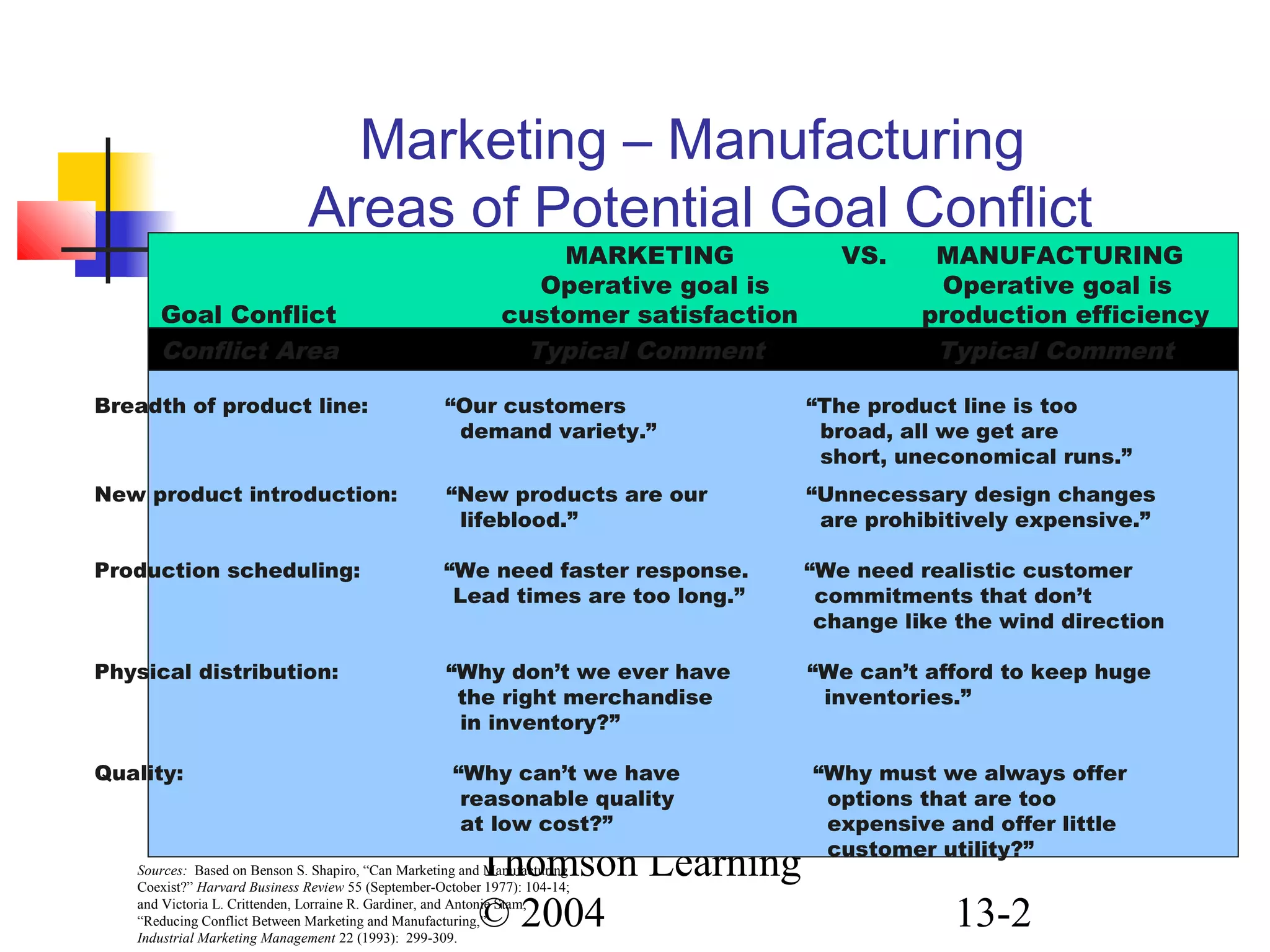
Marketing – Manufacturing
Areas of Potential Goal Conflict
MARKETING VS. MANUFACTURING
Operative goal is Operative goal is
Goal Conflict customer satisfaction production efficiency
Conflict Area Typical Comment Typical Comment
Breadth of product line: “Our customers “The product line is too
demand variety.” broad, all we get are
short, uneconomical runs.”
New product introduction: “New products are our “Unnecessary design changes
lifeblood.” are prohibitively expensive.”
Production scheduling: “We need faster response. “We need realistic customer
Lead times are too long.” commitments that don’t
change like the wind direction
Physical distribution: “Why don’t we ever have “We can’t afford to keep huge
the right merchandise inventories.”
in inventory?”
Quality: “Why can’t we have “Why must we always offer
reasonable quality options that are too
at low cost?” expensive and offer little
customer utility?”
Sources: Based on Benson S. Shapiro, “Can Marketing and Manufacturing
Coexist?” Harvard Business Review 55 (September-October 1977): 104-14;
and Victoria L. Crittenden, Lorraine R. Gardiner, and Antonie Stam,
“Reducing Conflict Between Marketing and Manufacturing,”
Industrial Marketing Management 22 (1993): 299-309.
Thomson Learning
© 2004 13-3
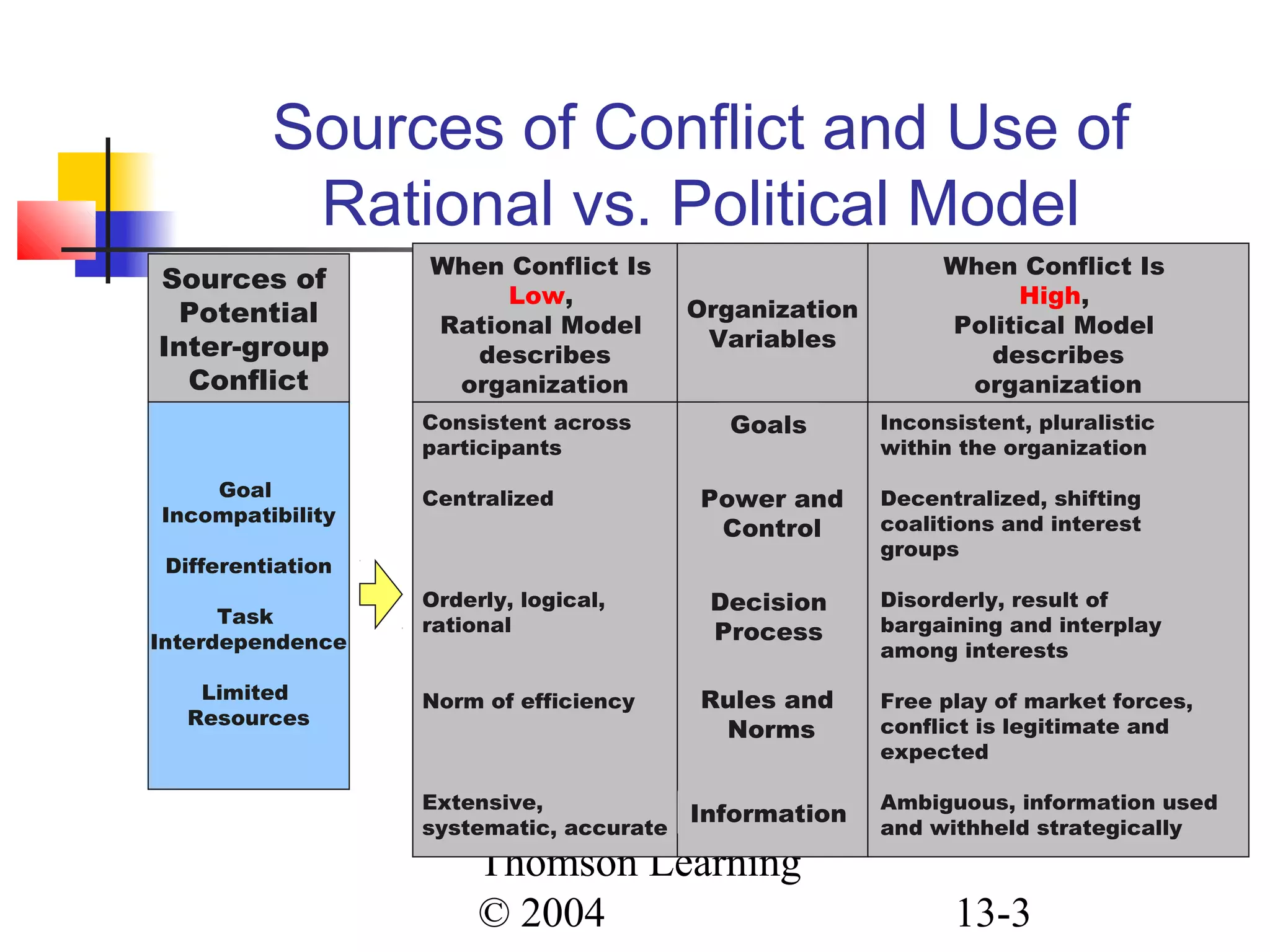
Sources of Conflict and Use of
Rational vs. Political Model
Sources of
Potential
Inter-group
Conflict
Goal
Incompatibility
Differentiation
Task
Interdependence
Limited
Resources
Consistent across
participants
Centralized
Orderly, logical,
rational
Norm of efficiency
Extensive,
systematic, accurate
When Conflict Is
Low,
Rational Model
describes
organization
Inconsistent, pluralistic
within the organization
Decentralized, shifting
coalitions and interest
groups
Disorderly, result of
bargaining and interplay
among interests
Free play of market forces,
conflict is legitimate and
expected
Ambiguous, information used
and withheld strategically
When Conflict Is
High,
Political Model
describes
organization
Goals
Power and
Control
Decision
Process
Rules and
Norms
Information
Organization
Variables
Thomson Learning
© 2004 13-4
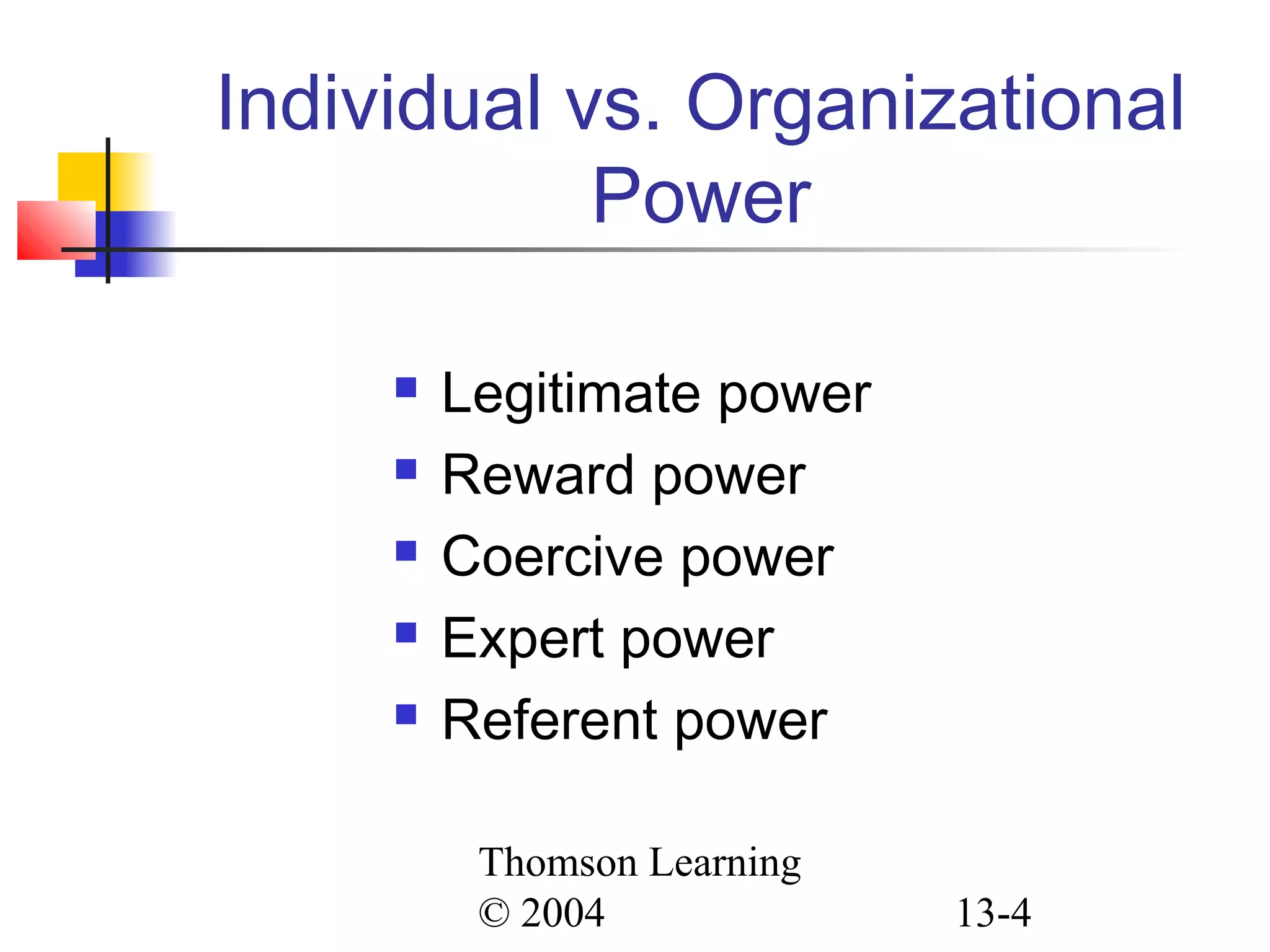
Individual vs. Organizational
Power
 Legitimate power
 Reward power
 Coercive power
 Expert power
 Referent power
Thomson Learning
© 2004 13-5
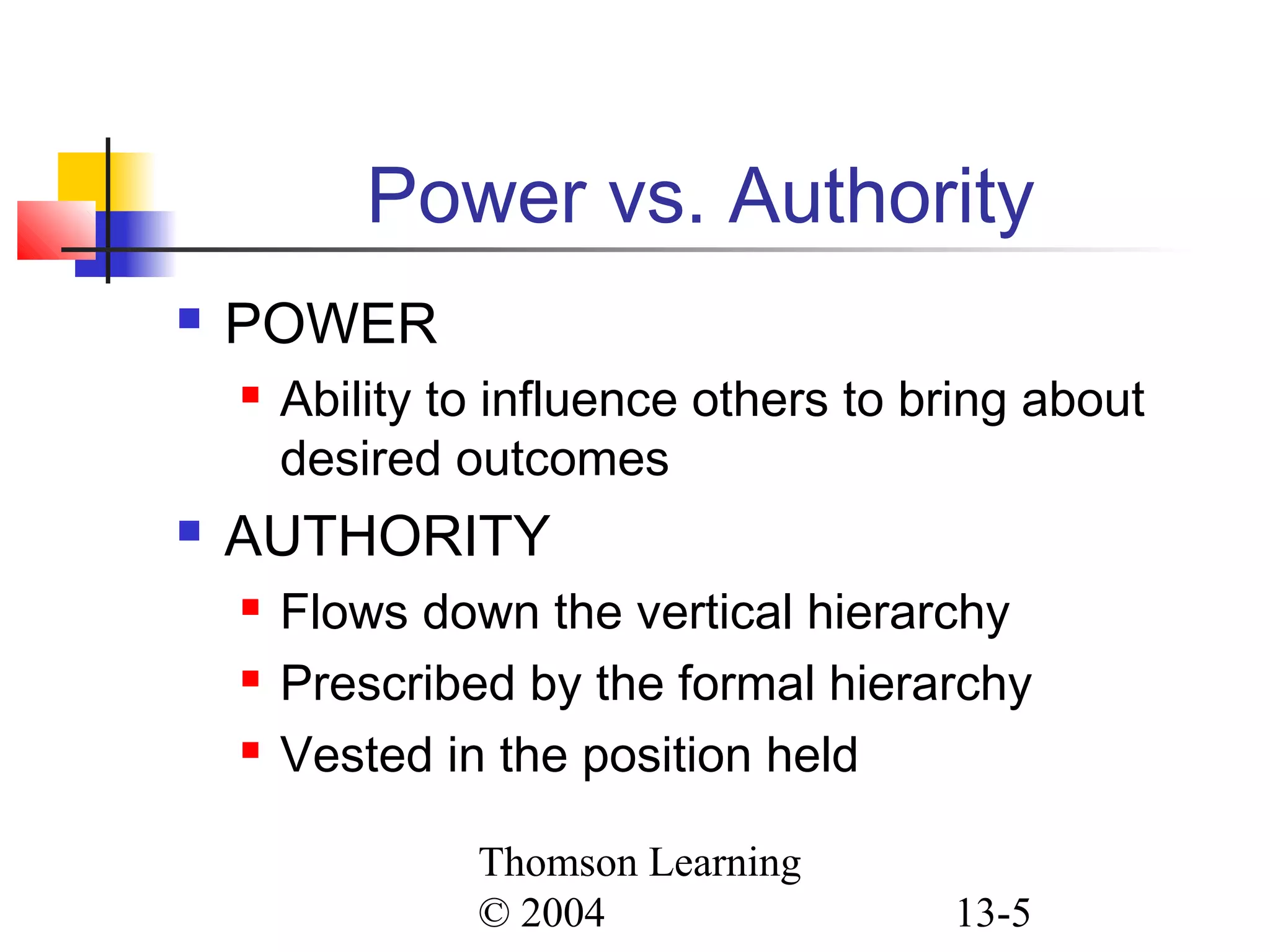
Power vs. Authority
 POWER
 Ability to influence others to bring about
desired outcomes
 AUTHORITY
 Flows down the vertical hierarchy
 Prescribed by the formal hierarchy
 Vested in the position held
Thomson Learning
© 2004 13-6
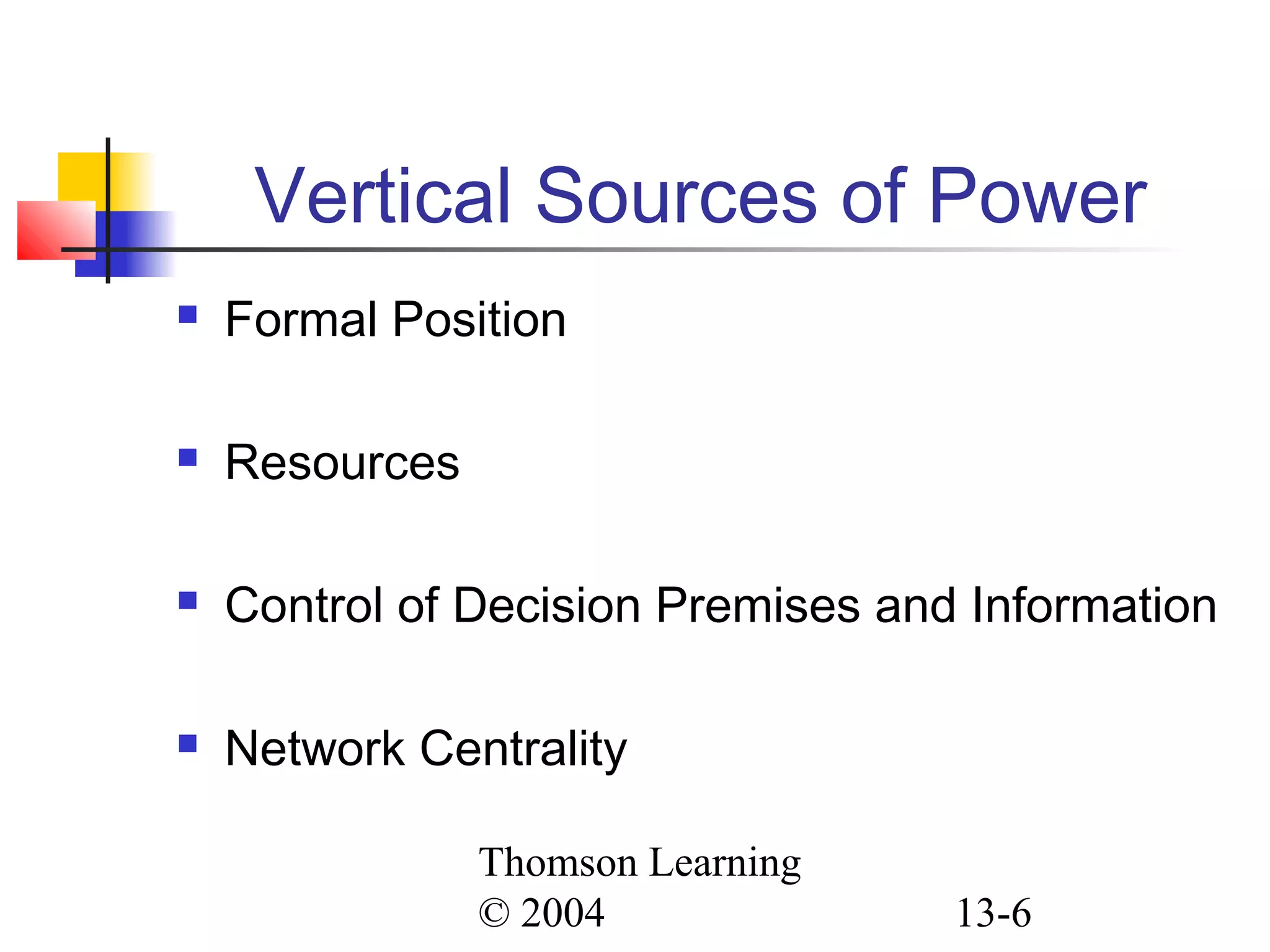
Vertical Sources of Power
 Formal Position
 Resources
 Control of Decision Premises and Information
 Network Centrality
Thomson Learning
© 2004 13-7
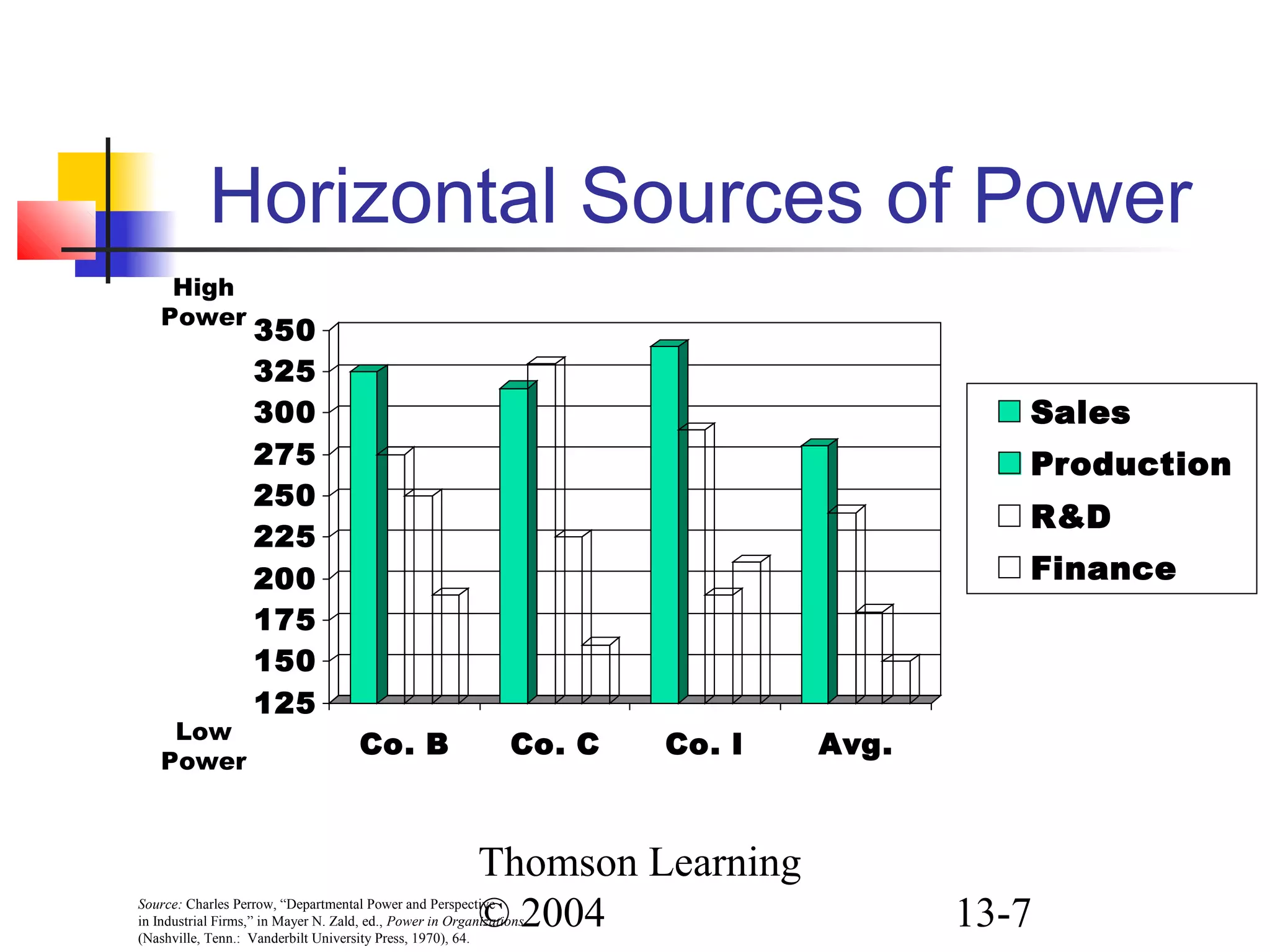
125
150
175
200
225
250
275
300
325
350
Co. B Co. C Co. I Avg.
Sales
Production
R&D
Finance
Horizontal Sources of Power
High
Power
Low
Power
Source: Charles Perrow, “Departmental Power and Perspective
in Industrial Firms,” in Mayer N. Zald, ed., Power in Organizations
(Nashville, Tenn.: Vanderbilt University Press, 1970), 64.
Thomson Learning
© 2004 13-8
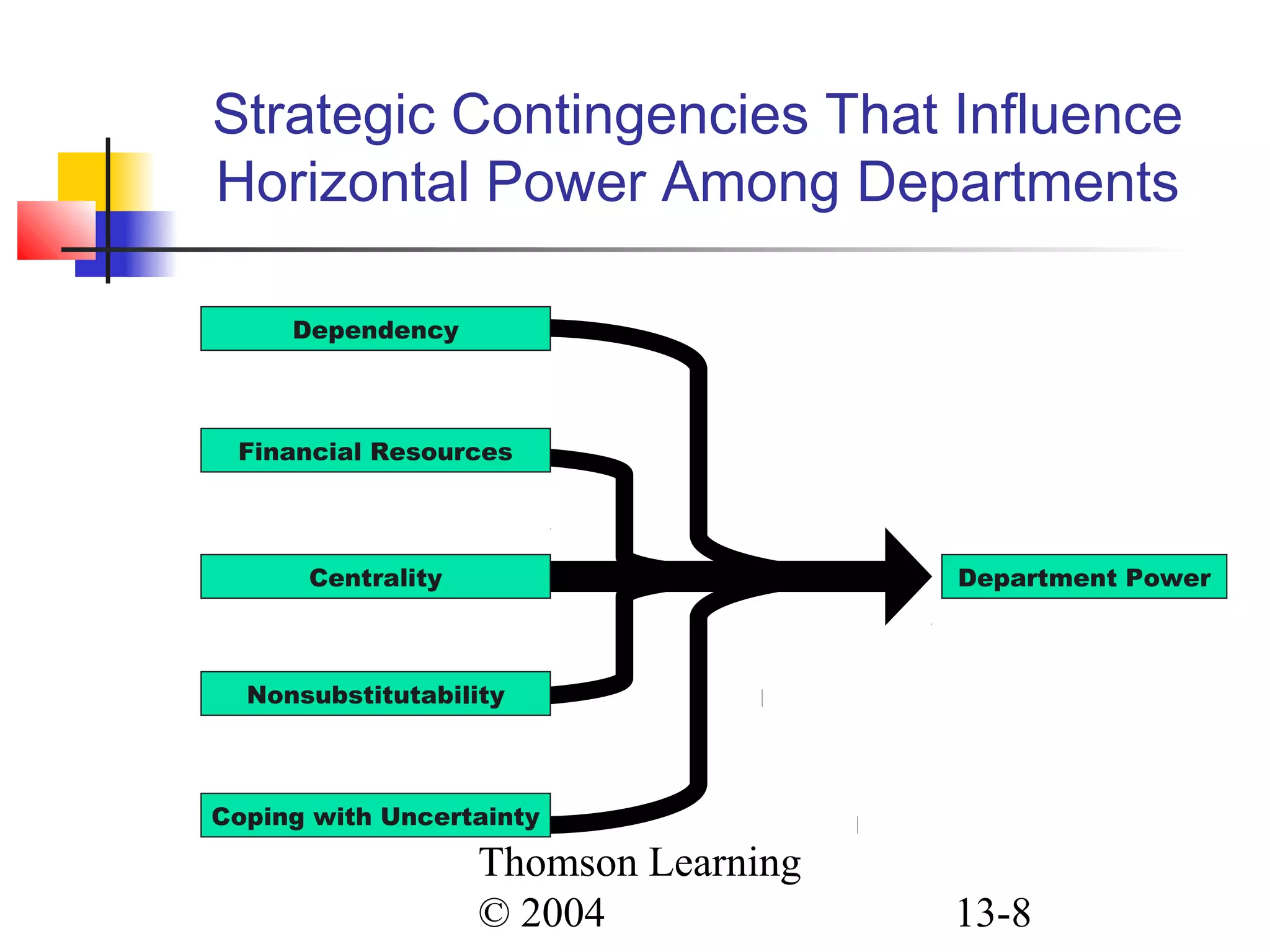
Strategic Contingencies That Influence
Horizontal Power Among Departments
Dependency
Financial Resources
Centrality
Nonsubstitutability
Coping with Uncertainty
Department Power
Thomson Learning
© 2004 13-9
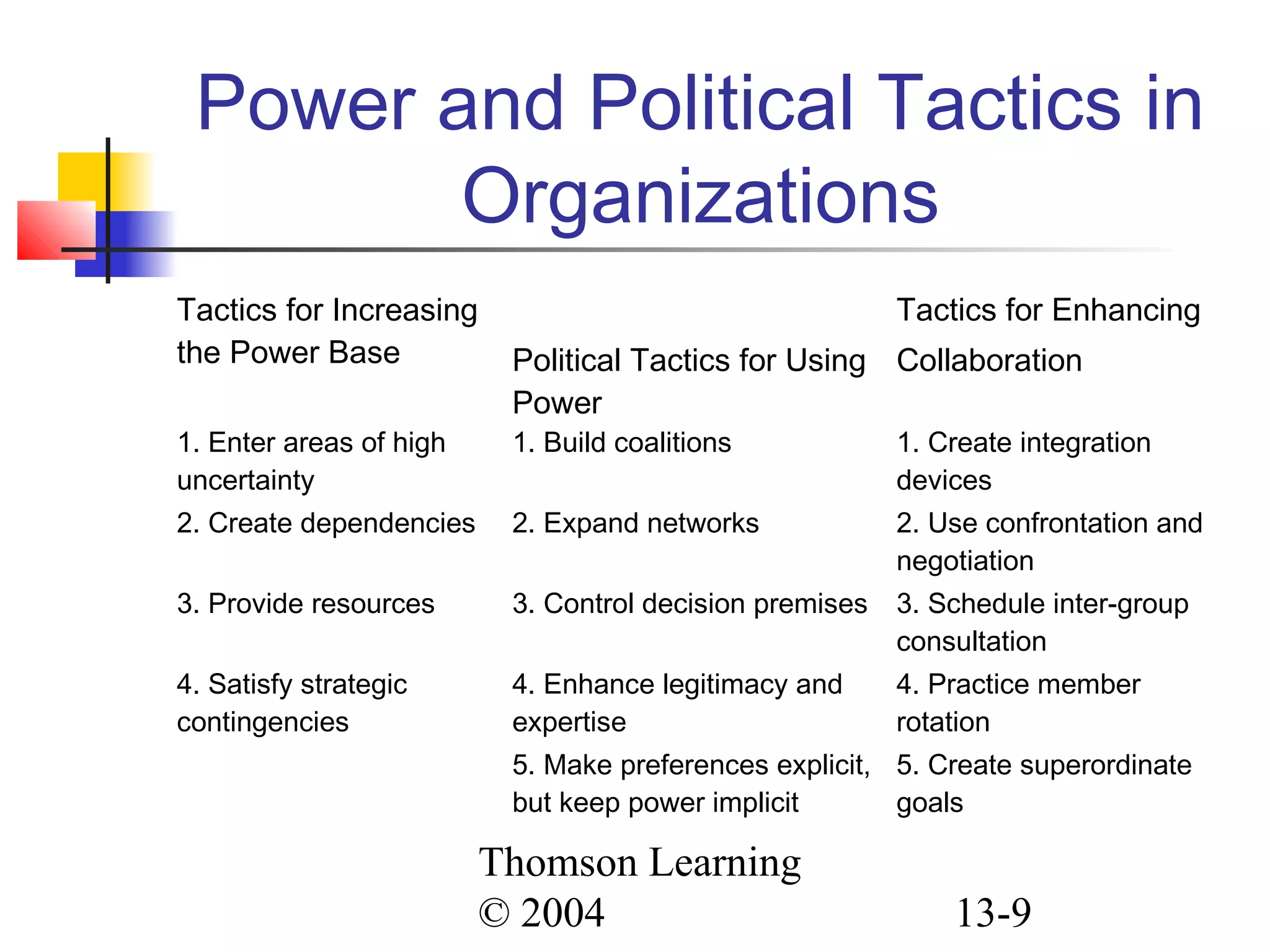
Power and Political Tactics in
Organizations
Tactics for Increasing
the Power Base Political Tactics for Using
Power
Tactics for Enhancing
Collaboration
1. Enter areas of high
uncertainty
1. Build coalitions 1. Create integration
devices
2. Create dependencies 2. Expand networks 2. Use confrontation and
negotiation
3. Provide resources 3. Control decision premises 3. Schedule inter-group
consultation
4. Satisfy strategic
contingencies
4. Enhance legitimacy and
expertise
4. Practice member
rotation
5. Make preferences explicit,
but keep power implicit
5. Create superordinate
goals
Thomson Learning
© 2004 13-10
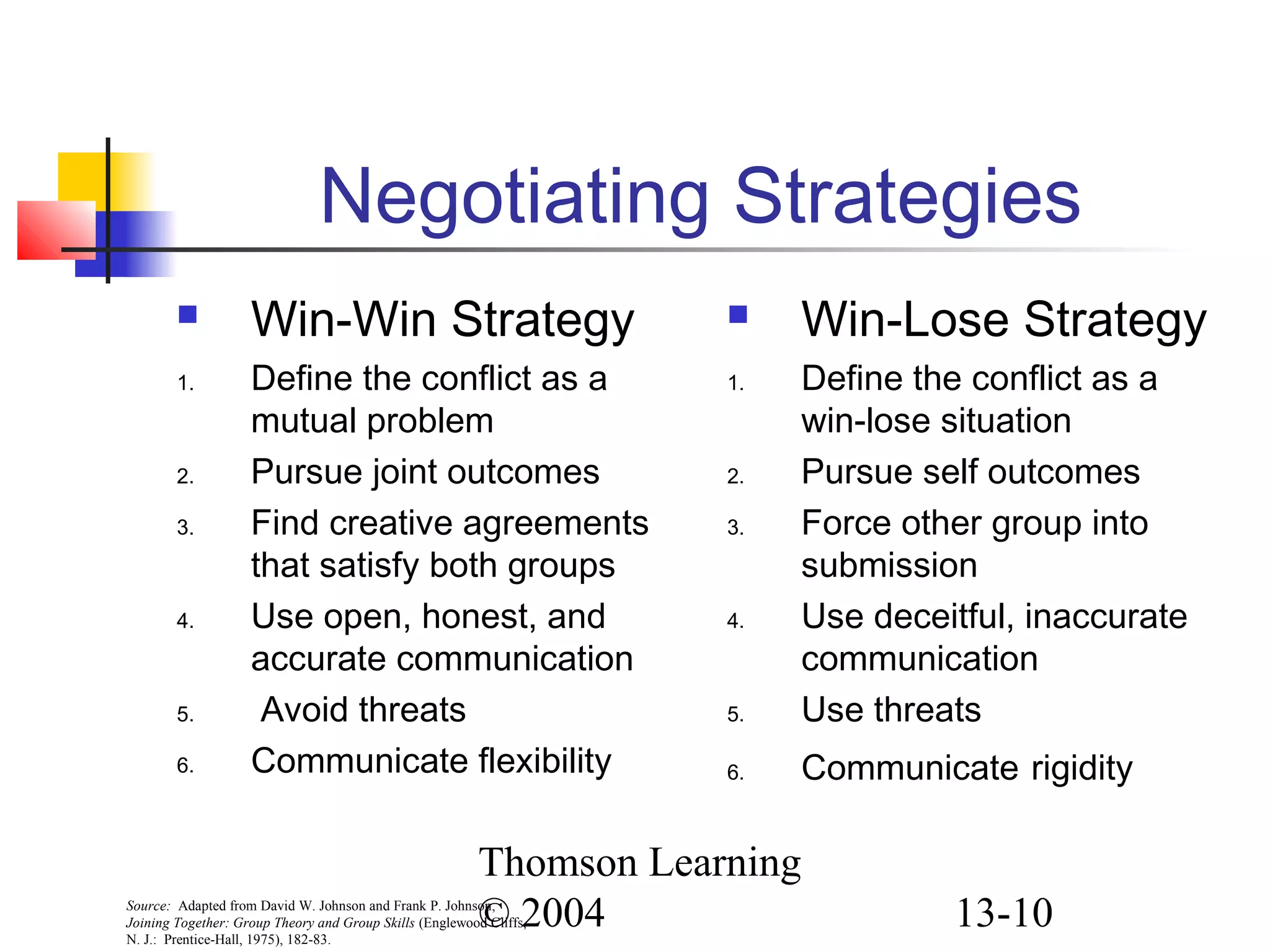
 Win-Win Strategy
1. Define the conflict as a
mutual problem
2. Pursue joint outcomes
3. Find creative agreements
that satisfy both groups
4. Use open, honest, and
accurate communication
5. Avoid threats
6. Communicate flexibility
 Win-Lose Strategy
1. Define the conflict as a
win-lose situation
2. Pursue self outcomes
3. Force other group into
submission
4. Use deceitful, inaccurate
communication
5. Use threats
6. Communicate rigidity
Negotiating Strategies
Source: Adapted from David W. Johnson and Frank P. Johnson,
Joining Together: Group Theory and Group Skills (Englewood Cliffs,
N. J.: Prentice-Hall, 1975), 182-83.

Ch13

  • 1.
    Thomson Learning © 200413-1 Chapter Thirteen Conflict, Power and Politics
  • 2.
    Thomson Learning © 200413-2 Marketing – Manufacturing Areas of Potential Goal Conflict MARKETING VS. MANUFACTURING Operative goal is Operative goal is Goal Conflict customer satisfaction production efficiency Conflict Area Typical Comment Typical Comment Breadth of product line: “Our customers “The product line is too demand variety.” broad, all we get are short, uneconomical runs.” New product introduction: “New products are our “Unnecessary design changes lifeblood.” are prohibitively expensive.” Production scheduling: “We need faster response. “We need realistic customer Lead times are too long.” commitments that don’t change like the wind direction Physical distribution: “Why don’t we ever have “We can’t afford to keep huge the right merchandise inventories.” in inventory?” Quality: “Why can’t we have “Why must we always offer reasonable quality options that are too at low cost?” expensive and offer little customer utility?” Sources: Based on Benson S. Shapiro, “Can Marketing and Manufacturing Coexist?” Harvard Business Review 55 (September-October 1977): 104-14; and Victoria L. Crittenden, Lorraine R. Gardiner, and Antonie Stam, “Reducing Conflict Between Marketing and Manufacturing,” Industrial Marketing Management 22 (1993): 299-309.
  • 3.
    Thomson Learning © 200413-3 Sources of Conflict and Use of Rational vs. Political Model Sources of Potential Inter-group Conflict Goal Incompatibility Differentiation Task Interdependence Limited Resources Consistent across participants Centralized Orderly, logical, rational Norm of efficiency Extensive, systematic, accurate When Conflict Is Low, Rational Model describes organization Inconsistent, pluralistic within the organization Decentralized, shifting coalitions and interest groups Disorderly, result of bargaining and interplay among interests Free play of market forces, conflict is legitimate and expected Ambiguous, information used and withheld strategically When Conflict Is High, Political Model describes organization Goals Power and Control Decision Process Rules and Norms Information Organization Variables
  • 4.
    Thomson Learning © 200413-4 Individual vs. Organizational Power  Legitimate power  Reward power  Coercive power  Expert power  Referent power
  • 5.
    Thomson Learning © 200413-5 Power vs. Authority  POWER  Ability to influence others to bring about desired outcomes  AUTHORITY  Flows down the vertical hierarchy  Prescribed by the formal hierarchy  Vested in the position held
  • 6.
    Thomson Learning © 200413-6 Vertical Sources of Power  Formal Position  Resources  Control of Decision Premises and Information  Network Centrality
  • 7.
    Thomson Learning © 200413-7 125 150 175 200 225 250 275 300 325 350 Co. B Co. C Co. I Avg. Sales Production R&D Finance Horizontal Sources of Power High Power Low Power Source: Charles Perrow, “Departmental Power and Perspective in Industrial Firms,” in Mayer N. Zald, ed., Power in Organizations (Nashville, Tenn.: Vanderbilt University Press, 1970), 64.
  • 8.
    Thomson Learning © 200413-8 Strategic Contingencies That Influence Horizontal Power Among Departments Dependency Financial Resources Centrality Nonsubstitutability Coping with Uncertainty Department Power
  • 9.
    Thomson Learning © 200413-9 Power and Political Tactics in Organizations Tactics for Increasing the Power Base Political Tactics for Using Power Tactics for Enhancing Collaboration 1. Enter areas of high uncertainty 1. Build coalitions 1. Create integration devices 2. Create dependencies 2. Expand networks 2. Use confrontation and negotiation 3. Provide resources 3. Control decision premises 3. Schedule inter-group consultation 4. Satisfy strategic contingencies 4. Enhance legitimacy and expertise 4. Practice member rotation 5. Make preferences explicit, but keep power implicit 5. Create superordinate goals
  • 10.
    Thomson Learning © 200413-10  Win-Win Strategy 1. Define the conflict as a mutual problem 2. Pursue joint outcomes 3. Find creative agreements that satisfy both groups 4. Use open, honest, and accurate communication 5. Avoid threats 6. Communicate flexibility  Win-Lose Strategy 1. Define the conflict as a win-lose situation 2. Pursue self outcomes 3. Force other group into submission 4. Use deceitful, inaccurate communication 5. Use threats 6. Communicate rigidity Negotiating Strategies Source: Adapted from David W. Johnson and Frank P. Johnson, Joining Together: Group Theory and Group Skills (Englewood Cliffs, N. J.: Prentice-Hall, 1975), 182-83.