Module 1
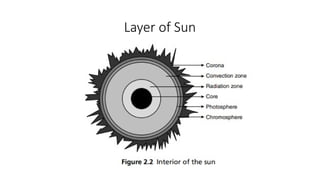
LAYER OF THE SUN
Layer of Sun
Layer of Sun- Core
• The innermost layer of the sun is called the core.
• With a density of 160 g/cm3, which is 10 times that of lead
• The core might be expected to be solid. But The core’s temperature
of 1,50,00,000°C keeps it in a gaseous state.
• In the core, fusion reactions produce energy in the form of gamma
rays and neutrinos.
• Gamma rays are photons with high energy and high frequency.
• The gamma rays are absorbed and re-emitted by many atoms on
their journey from the envelope to the outside of the sun.
• When gamma rays leave atoms, their average energy is reduced.
Layer of Sun- Core
• However, the first law of thermodynamics (which states that
energy can neither be created nor be destroyed) plays an important
role and the number of photons increases.
• Each high-energy gamma ray that leaves the solar envelope will
eventually become one thousand low-energy photons.
• The neutrinos are extremely nonreactive.
• Several experiments are being performed to measure the neutrino
output from the sun.
• Chemicals containing elements with which neutrinos react are put
in large pools in mines, and the neutrinos’ passages through the
pools can be measured by the rare changes they cause in the nuclei
in the pools.
Layer of Sun – Solar Envelope
• Outside of the core is the radiate envelope, which is surrounded
by a convective envelope.
• The temperature is 4 million kelvin (7 million degrees F).
• The density of the solar envelope is much less than that of the
core.
• The core contains 40% of the sun’s mass in 10% of the volume,
whereas the solar envelope has 60% of the mass in 90% of the
volume.
• The solar envelope puts pressure on the core and maintains the
core’s temperature.
• The hotter a gas is, the more transparent it is.
Layer of Sun – Solar Envelope
• The solar envelope is cooler and more opaque than the core.
• It becomes less efficient for energy to move by radiation, and as a
result, heat energy starts to build up at the outside of the
radioactive zone.
• The energy begins to move by convection in huge cells of
circulating gas with several hundred kilometers in diameter.
• Convection cells nearer to the outside are smaller than the inner
cells.
• The top of each cell is called a granule.
• These granules, when observed through a telescope, look like tiny
specks of light. Variations in the velocity of particles in granules
cause slight wavelength changes in the spectra emitted by the sun.
Layer of Sun – Photosphere
• The photosphere is the zone from which the sunlight is both seen
and emitted.
• The photosphere is a comparatively thin layer of low-pressure
gasses surrounding the envelope.
• It is only a few hundred kilometers thick with a temperature of
6,000°C.
• The composition, temperature, and pressure of the photosphere
are revealed by the spectrum of sunlight.
• When analyzing the solar spectrum, William Ramsey discovered
helium in 1896 and found that features of the gas did not belong
to any gas known on earth. Hence, the newly discovered gas was
named as helium in honour of Helios, the mythological Greek god
of the sun.
Layer of Sun – Chromospheres
• During an eclipse, a red circle can sometimes be seen outside the
sun.
• This circle is called the chromospheres.
• Its red coloring is caused by the abundance of hydrogen.
• From the center of the sun to the chromospheres, the
temperature decreases proportionally as the distance from the
core increases.
• The chromospheres’ temperature, however, is 7,000 K, which is
hotter than that of the photosphere.
• Temperatures continue to increase through the corona
Layer of Sun – Corona
• The outermost layer of the sun is called the corona or the crown.
• The corona is very thin and faint and is, therefore, very difficult to
observe from the earth.
• Typically, we can observe the corona during a total solar eclipse or
by using a coronagraph telescope, which simulates an eclipse by
covering the bright solar disk.
• This outer layer is very dim—a million times dimmer than the
photosphere and oddly enough, it is the hottest.
• At 106 K, it would seem that the heat would be unbearable for us,
but remember in Physics, heat is a measure of molecular energy,
that is, the movement of molecules within a space
Layer of Sun – Corona
• Because the Corona extends several million kilometers into space,
there is a lot of room for molecules to move.
• It is this movement that forms the source of the solar winds.
• The high temperature of the corona can force ions to move as fast
as a million kilometers per hour
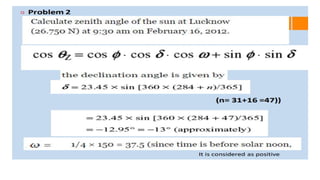
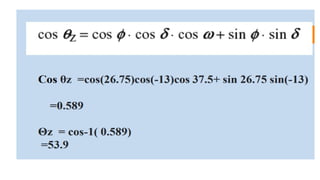
ω = [Solar Time-12:00] hrs x 15
degrees
Layer of the sun ppt presentation document

Layer of the sun ppt presentation document

  • 1.
  • 2.
  • 3.
    Layer of Sun-Core • The innermost layer of the sun is called the core. • With a density of 160 g/cm3, which is 10 times that of lead • The core might be expected to be solid. But The core’s temperature of 1,50,00,000°C keeps it in a gaseous state. • In the core, fusion reactions produce energy in the form of gamma rays and neutrinos. • Gamma rays are photons with high energy and high frequency. • The gamma rays are absorbed and re-emitted by many atoms on their journey from the envelope to the outside of the sun. • When gamma rays leave atoms, their average energy is reduced.
  • 4.
    Layer of Sun-Core • However, the first law of thermodynamics (which states that energy can neither be created nor be destroyed) plays an important role and the number of photons increases. • Each high-energy gamma ray that leaves the solar envelope will eventually become one thousand low-energy photons. • The neutrinos are extremely nonreactive. • Several experiments are being performed to measure the neutrino output from the sun. • Chemicals containing elements with which neutrinos react are put in large pools in mines, and the neutrinos’ passages through the pools can be measured by the rare changes they cause in the nuclei in the pools.
  • 5.
    Layer of Sun– Solar Envelope • Outside of the core is the radiate envelope, which is surrounded by a convective envelope. • The temperature is 4 million kelvin (7 million degrees F). • The density of the solar envelope is much less than that of the core. • The core contains 40% of the sun’s mass in 10% of the volume, whereas the solar envelope has 60% of the mass in 90% of the volume. • The solar envelope puts pressure on the core and maintains the core’s temperature. • The hotter a gas is, the more transparent it is.
  • 6.
    Layer of Sun– Solar Envelope • The solar envelope is cooler and more opaque than the core. • It becomes less efficient for energy to move by radiation, and as a result, heat energy starts to build up at the outside of the radioactive zone. • The energy begins to move by convection in huge cells of circulating gas with several hundred kilometers in diameter. • Convection cells nearer to the outside are smaller than the inner cells. • The top of each cell is called a granule. • These granules, when observed through a telescope, look like tiny specks of light. Variations in the velocity of particles in granules cause slight wavelength changes in the spectra emitted by the sun.
  • 7.
    Layer of Sun– Photosphere • The photosphere is the zone from which the sunlight is both seen and emitted. • The photosphere is a comparatively thin layer of low-pressure gasses surrounding the envelope. • It is only a few hundred kilometers thick with a temperature of 6,000°C. • The composition, temperature, and pressure of the photosphere are revealed by the spectrum of sunlight. • When analyzing the solar spectrum, William Ramsey discovered helium in 1896 and found that features of the gas did not belong to any gas known on earth. Hence, the newly discovered gas was named as helium in honour of Helios, the mythological Greek god of the sun.
  • 8.
    Layer of Sun– Chromospheres • During an eclipse, a red circle can sometimes be seen outside the sun. • This circle is called the chromospheres. • Its red coloring is caused by the abundance of hydrogen. • From the center of the sun to the chromospheres, the temperature decreases proportionally as the distance from the core increases. • The chromospheres’ temperature, however, is 7,000 K, which is hotter than that of the photosphere. • Temperatures continue to increase through the corona
  • 9.
    Layer of Sun– Corona • The outermost layer of the sun is called the corona or the crown. • The corona is very thin and faint and is, therefore, very difficult to observe from the earth. • Typically, we can observe the corona during a total solar eclipse or by using a coronagraph telescope, which simulates an eclipse by covering the bright solar disk. • This outer layer is very dim—a million times dimmer than the photosphere and oddly enough, it is the hottest. • At 106 K, it would seem that the heat would be unbearable for us, but remember in Physics, heat is a measure of molecular energy, that is, the movement of molecules within a space
  • 10.
    Layer of Sun– Corona • Because the Corona extends several million kilometers into space, there is a lot of room for molecules to move. • It is this movement that forms the source of the solar winds. • The high temperature of the corona can force ions to move as fast as a million kilometers per hour

  • 12.
    ω = [SolarTime-12:00] hrs x 15 degrees