Module 10
10.3.1  Classes of network IP addresses  EG: An IP address 172.32.65.13 and a  default  subnet mask, the host belongs to the 172.32.0.0 network.
10.3.2  Introduction to and reason for subnetting  The benefits of Subnetting 1. smaller broadcast domains  2. low-level security provided  3. increased address flexibility  EG: In a class C network a subnet mask of 255.255.255.224 will create 6 useable subnets each with 32 useable hosts.
10.3.2  Introduction to and reason for subnetting  Host bits are reassigned as network bits.  Host bits of the network address are all equal to 0.  Host bits of the broadcast address are all equal to 1.
10.3.2  Introduction to and reason for subnetting
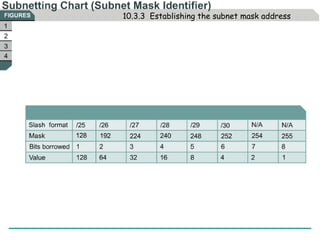
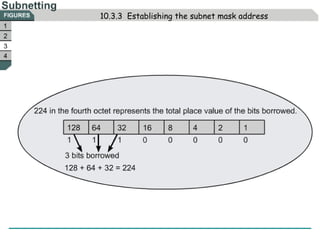
10.3.3  Establishing the subnet mask address
10.3.4  Applying the subnet mask
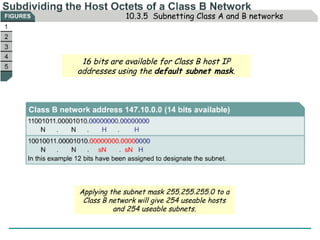
10.3.5  Subnetting Class A and B networks  16 bits are available for Class B host IP addresses using the  default subnet mask . Applying the subnet mask 255.255.255.0 to a Class B network will give 254 useable hosts and 254 useable subnets.
10.3.5  Subnetting Class A and B networks
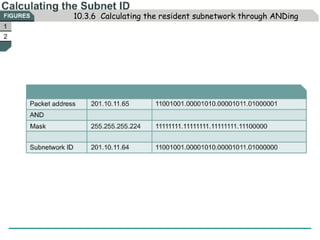
10.3.6  Calculating the resident subnetwork through ANDing

Ch10 Subnetting Class