Chapter 3: The AccountingChapter 3: The Accounting
Information SystemsInformation Systems
Intermediate Accounting, 11th ed.
Kieso, Weygandt, and Warfield
Prepared by
Jep Robertson
New Mexico State University
1. Understand basic accounting terminology.
2. Explain double entry rules.
3. Identify steps in the accounting cycle.
4. Record transactions in journals, post to
ledger accounts, and prepare a trial
balance.
After studying this chapter, you should be
able to:
Chapter 3: The AccountingChapter 3: The Accounting
Information SystemsInformation Systems
5. Explain the reasons for preparing
adjusting entries.
6. Prepare closing entries.
7. Explain how inventory accounts are
adjusted at year-end.
8. Prepare a 10-column work sheet.
Chapter 3: The AccountingChapter 3: The Accounting
Information SystemsInformation Systems
• Accounting data is represented by the
following relationship among the
assets, liabilities and owners’ equity of
a business:
Assets = Liabilities + Owners’ Equity
• The equation must be in balance after
every recorded transaction in the
system.
The Basic Accounting EquationThe Basic Accounting Equation
• Accounting information is based on the
double entry system.
• An account is an arrangement of transactions
affecting a given asset, liability or other
element.
• Under this system, the two-sided effect of a
transaction is recorded in the appropriate
accounts.
• The recording is done by means of a “debit-
credit” convention (set of rules) applying to
all accounts.
The Double Entry SystemThe Double Entry System
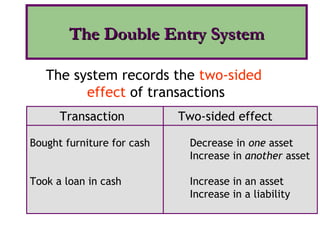
The system records the two-sided
effect of transactions
Transaction Two-sided effect
Bought furniture for cash Decrease in one asset
Increase in another asset
Took a loan in cash Increase in an asset
Increase in a liability
The Double Entry SystemThe Double Entry System
Note that the accounting equation equality is
maintained after recording
each transaction.
The Double Entry SystemThe Double Entry System
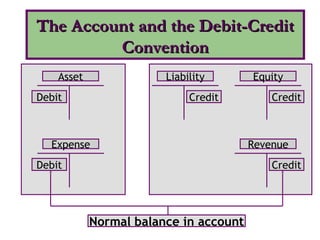
Asset
Expense
Debit
Debit
Revenue
Liability Equity
Credit Credit
Credit
Normal balance in account
The Account and the Debit-CreditThe Account and the Debit-Credit
ConventionConvention
Expanded Basic Equation andExpanded Basic Equation and
Debit/Credit Rules and EffectsDebit/Credit Rules and Effects
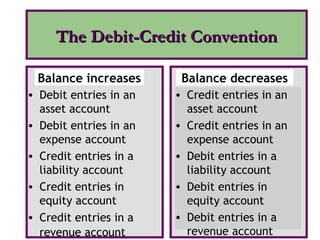
• Debit entries in an
asset account
• Debit entries in an
expense account
• Credit entries in a
liability account
• Credit entries in
equity account
• Credit entries in a
revenue account
• Credit entries in an
asset account
• Credit entries in an
expense account
• Debit entries in a
liability account
• Debit entries in
equity account
• Debit entries in a
revenue account
Balance increases Balance decreases
The Debit-Credit ConventionThe Debit-Credit Convention
Owners’ Equity
Net Income
Investments
by Owners
+
Net Loss
Dividends or
Withdrawals
-
Ownership (Equity) StructureOwnership (Equity) Structure
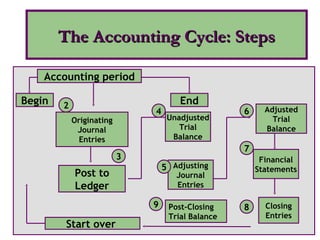
1. Analyze the transaction
2. Journalize the transaction
3. Post the transaction to accounts in ledger
4. Prepare the (unadjusted) trial balance
5. Prepare necessary adjusting journal entries
6. Prepare the adjusted trial balance
7. Prepare financial statements
8. Prepare closing journal entries for the year
9. Prepare the post-closing trial balance
The Accounting Cycle: StepsThe Accounting Cycle: Steps
EndBegin
Accounting period
Adjusting
Journal
Entries
Financial
Statements
Closing
Entries
Start over
7
6
5
Unadjusted
Trial
Balance
4
Originating
Journal
Entries
2
8
Adjusted
Trial
Balance
Post to
Ledger
3
Post-Closing
Trial Balance
9
The Accounting Cycle: StepsThe Accounting Cycle: Steps
Adjusting entries are needed for:
• Recognizing revenue for the period.
• Matching expenses with revenues they
helped generate.
• Adjusting entries are required every time
financial statements are prepared.
Adjusting Journal EntriesAdjusting Journal Entries
Adjusting
Unearned Revenue
Recording
Accrued Revenue
Revenues received
in cash
and
recorded as liabilities
Revenues earned
but not yet
recorded
in books
Adjusting Entries: RecognizingAdjusting Entries: Recognizing
RevenueRevenue
Adjusting
Prepayments for
Expenses
Recording
Accrued Expense
Prepayments made
in cash
and
recorded as assets
Expense incurred
but not yet
recorded
in books
Adjusting Entries: MatchingAdjusting Entries: Matching
ExpensesExpenses
• Closing entries are made to close all nominal
accounts (revenue and expense accounts) for
the year.
• Real (or Permanent) accounts (balance sheet
accounts) are not closed.
• Dividend account is closed to Retained
Earnings account.
Closing Journal EntriesClosing Journal Entries
Dividends
4
Ret. Earnings
Revenue
2
Income Summary
Expense
1
Scheme of Closing EntriesScheme of Closing Entries
3
• In a periodic inventory system, closing
entries are made to record cost of goods sold
and ending inventory.
• In a perpetual inventory system, such entries
are not required.
Closing Entries: Periodic InventoryClosing Entries: Periodic Inventory
SystemSystem
• A worksheet is a multiple column form that
may be used in the adjustment process and
in preparing financial statements.
• The use of a worksheet is optional and not a
permanent accounting record.
• The worksheet does not replace the financial
statements.
Using a WorksheetUsing a Worksheet
• Prepare a trial balance on the worksheet.
• Enter the adjustments in the adjustments
column.
• Enter adjusted balances in the adjusted
trial balance columns.
• Extend adjusted trial balance amounts to
appropriate financial statement columns.
• Total the statement columns, compute net
income (loss), and complete the
worksheet.
Steps in Preparing a WorksheetSteps in Preparing a Worksheet
COPYRIGHTCOPYRIGHT
Copyright © 2004 John Wiley & Sons, Inc. All rights reserved.
Reproduction or translation of this work beyond that permitted
in Section 117 of the 1976 United States Copyright Act without
the express written permission of the copyright owner is
unlawful. Request for further information should be addressed
to the Permissions Department, John Wiley & Sons, Inc. The
purchaser may make back-up copies for his/her own use only
and not for distribution or resale. The Publisher assumes no
responsibility for errors, omissions, or damages, caused by the
use of these programs or from the use of the information
contained herein.

Ch03

  • 1.
    Chapter 3: TheAccountingChapter 3: The Accounting Information SystemsInformation Systems Intermediate Accounting, 11th ed. Kieso, Weygandt, and Warfield Prepared by Jep Robertson New Mexico State University
  • 2.
    1. Understand basicaccounting terminology. 2. Explain double entry rules. 3. Identify steps in the accounting cycle. 4. Record transactions in journals, post to ledger accounts, and prepare a trial balance. After studying this chapter, you should be able to: Chapter 3: The AccountingChapter 3: The Accounting Information SystemsInformation Systems
  • 3.
    5. Explain thereasons for preparing adjusting entries. 6. Prepare closing entries. 7. Explain how inventory accounts are adjusted at year-end. 8. Prepare a 10-column work sheet. Chapter 3: The AccountingChapter 3: The Accounting Information SystemsInformation Systems
  • 4.
    • Accounting datais represented by the following relationship among the assets, liabilities and owners’ equity of a business: Assets = Liabilities + Owners’ Equity • The equation must be in balance after every recorded transaction in the system. The Basic Accounting EquationThe Basic Accounting Equation
  • 5.
    • Accounting informationis based on the double entry system. • An account is an arrangement of transactions affecting a given asset, liability or other element. • Under this system, the two-sided effect of a transaction is recorded in the appropriate accounts. • The recording is done by means of a “debit- credit” convention (set of rules) applying to all accounts. The Double Entry SystemThe Double Entry System
  • 6.
    The system recordsthe two-sided effect of transactions Transaction Two-sided effect Bought furniture for cash Decrease in one asset Increase in another asset Took a loan in cash Increase in an asset Increase in a liability The Double Entry SystemThe Double Entry System
  • 7.
    Note that theaccounting equation equality is maintained after recording each transaction. The Double Entry SystemThe Double Entry System
  • 8.
    Asset Expense Debit Debit Revenue Liability Equity Credit Credit Credit Normalbalance in account The Account and the Debit-CreditThe Account and the Debit-Credit ConventionConvention
  • 9.
    Expanded Basic EquationandExpanded Basic Equation and Debit/Credit Rules and EffectsDebit/Credit Rules and Effects
  • 10.
    • Debit entriesin an asset account • Debit entries in an expense account • Credit entries in a liability account • Credit entries in equity account • Credit entries in a revenue account • Credit entries in an asset account • Credit entries in an expense account • Debit entries in a liability account • Debit entries in equity account • Debit entries in a revenue account Balance increases Balance decreases The Debit-Credit ConventionThe Debit-Credit Convention
  • 11.
    Owners’ Equity Net Income Investments byOwners + Net Loss Dividends or Withdrawals - Ownership (Equity) StructureOwnership (Equity) Structure
  • 12.
    1. Analyze thetransaction 2. Journalize the transaction 3. Post the transaction to accounts in ledger 4. Prepare the (unadjusted) trial balance 5. Prepare necessary adjusting journal entries 6. Prepare the adjusted trial balance 7. Prepare financial statements 8. Prepare closing journal entries for the year 9. Prepare the post-closing trial balance The Accounting Cycle: StepsThe Accounting Cycle: Steps
  • 13.
  • 14.
    Adjusting entries areneeded for: • Recognizing revenue for the period. • Matching expenses with revenues they helped generate. • Adjusting entries are required every time financial statements are prepared. Adjusting Journal EntriesAdjusting Journal Entries
  • 15.
    Adjusting Unearned Revenue Recording Accrued Revenue Revenuesreceived in cash and recorded as liabilities Revenues earned but not yet recorded in books Adjusting Entries: RecognizingAdjusting Entries: Recognizing RevenueRevenue
  • 16.
    Adjusting Prepayments for Expenses Recording Accrued Expense Prepaymentsmade in cash and recorded as assets Expense incurred but not yet recorded in books Adjusting Entries: MatchingAdjusting Entries: Matching ExpensesExpenses
  • 17.
    • Closing entriesare made to close all nominal accounts (revenue and expense accounts) for the year. • Real (or Permanent) accounts (balance sheet accounts) are not closed. • Dividend account is closed to Retained Earnings account. Closing Journal EntriesClosing Journal Entries
  • 18.
    Dividends 4 Ret. Earnings Revenue 2 Income Summary Expense 1 Schemeof Closing EntriesScheme of Closing Entries 3
  • 19.
    • In aperiodic inventory system, closing entries are made to record cost of goods sold and ending inventory. • In a perpetual inventory system, such entries are not required. Closing Entries: Periodic InventoryClosing Entries: Periodic Inventory SystemSystem
  • 20.
    • A worksheetis a multiple column form that may be used in the adjustment process and in preparing financial statements. • The use of a worksheet is optional and not a permanent accounting record. • The worksheet does not replace the financial statements. Using a WorksheetUsing a Worksheet
  • 21.
    • Prepare atrial balance on the worksheet. • Enter the adjustments in the adjustments column. • Enter adjusted balances in the adjusted trial balance columns. • Extend adjusted trial balance amounts to appropriate financial statement columns. • Total the statement columns, compute net income (loss), and complete the worksheet. Steps in Preparing a WorksheetSteps in Preparing a Worksheet
  • 22.
    COPYRIGHTCOPYRIGHT Copyright © 2004John Wiley & Sons, Inc. All rights reserved. Reproduction or translation of this work beyond that permitted in Section 117 of the 1976 United States Copyright Act without the express written permission of the copyright owner is unlawful. Request for further information should be addressed to the Permissions Department, John Wiley & Sons, Inc. The purchaser may make back-up copies for his/her own use only and not for distribution or resale. The Publisher assumes no responsibility for errors, omissions, or damages, caused by the use of these programs or from the use of the information contained herein.