Origin, Nature and Basis of
International Law
I
Origin of International Law
 International Law of Antiquity
 Classical International Law
 Modern International law
International Law
of Antiquity
No precise date or period
Started with the formation of politically organized
groups
Rules may be found existing 5,000 years before
These rules were peculiar to the unique setup of
those communities
These rules were relating to peace, boarders,
extradition, reprisals, diplomatic relationships etc.
 Origin
International Law of
Antiquity
Home
Definitions
Gen. Sylbs
Cases
Part Intro
HEC Sylbs
Treaties
1-4
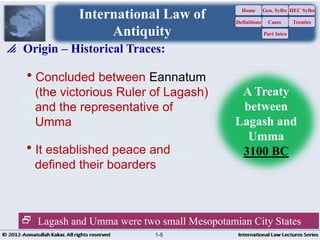
Concluded between Eannatum
(the victorious Ruler of Lagash)
and the representative of
Umma
It established peace and
defined their boarders
 Origin – Historical Traces:
 Lagash and Umma were two small Mesopotamian City States
International Law of
Antiquity
A Treaty
between
Lagash and
Umma
3100 BC
Home
Definitions
Gen. Sylbs
Cases
Part Intro
HEC Sylbs
Treaties
1-5
A Treaty
between
Egypt and
Cheta
1400 BC
International Law of
Antiquity
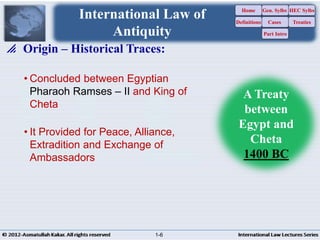
• It Provided for Peace, Alliance,
Extradition and Exchange of
Ambassadors
• Concluded between Egyptian
Pharaoh Ramses – II and King of
Cheta
 Origin – Historical Traces:
Home
Definitions
Gen. Sylbs
Cases
Part Intro
HEC Sylbs
Treaties
1-6
 Developments
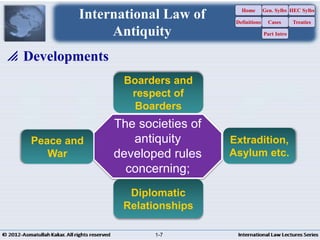
Peace and
War
Diplomatic
Relationships
Boarders and
respect of
Boarders
Extradition,
Asylum etc.
The societies of
antiquity
developed rules
concerning;
International Law of
Antiquity
Home
Definitions
Gen. Sylbs
Cases
Part Intro
HEC Sylbs
Treaties
1-7
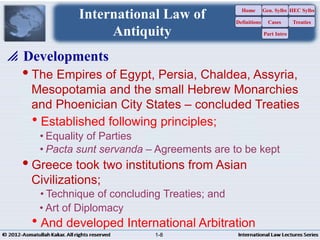
The Empires of Egypt, Persia, Chaldea, Assyria,
Mesopotamia and the small Hebrew Monarchies
and Phoenician City States – concluded Treaties
Established following principles;
• Equality of Parties
• Pacta sunt servanda – Agreements are to be kept
Greece took two institutions from Asian
Civilizations;
• Technique of concluding Treaties; and
• Art of Diplomacy
And developed International Arbitration
 Developments
1-8
International Law of
Antiquity
Home
Definitions
Gen. Sylbs
Cases
Part Intro
HEC Sylbs
Treaties
1-8
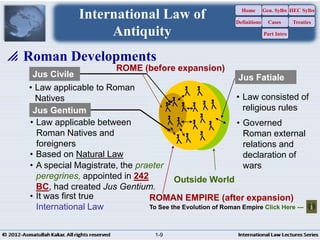
ROME (before expansion)
Jus Civile
• Law applicable to Roman
Natives
ROMAN EMPIRE (after expansion)
Jus Gentium
• Law applicable between
Roman Natives and
foreigners
• Based on Natural Law
Jus Fatiale
• Law consisted of
religious rules
• Governed
Roman external
relations and
declaration of
wars
• A special Magistrate, the praeter
peregrines, appointed in 242
BC, had created Jus Gentium.
Outside World
• It was first true
International Law To See the Evolution of Roman Empire Click Here ---
 Roman Developments
International Law of
Antiquity
Home
Definitions
Gen. Sylbs
Cases
Part Intro
HEC Sylbs
Treaties
1-9
10
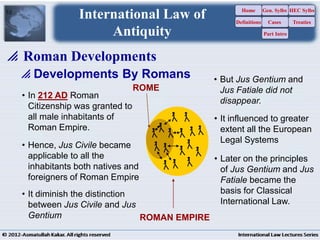
 Developments By Romans
ROME
ROMAN EMPIRE
• In 212 AD Roman
Citizenship was granted to
all male inhabitants of
Roman Empire.
• It diminish the distinction
between Jus Civile and Jus
Gentium
• Later on the principles
of Jus Gentium and Jus
Fatiale became the
basis for Classical
International Law.
• It influenced to greater
extent all the European
Legal Systems
• Hence, Jus Civile became
applicable to all the
inhabitants both natives and
foreigners of Roman Empire
• But Jus Gentium and
Jus Fatiale did not
disappear.
 Roman Developments
International Law of
Antiquity
Home
Definitions
Gen. Sylbs
Cases
Part Intro
HEC Sylbs
Treaties
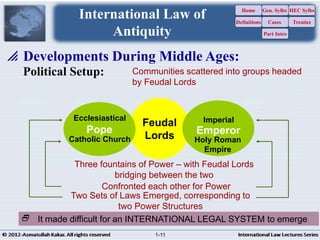
Feudal
Lords Emperor
Pope
Political Setup:
Three fountains of Power – with Feudal Lords
bridging between the two
Communities scattered into groups headed
by Feudal Lords
Confronted each other for Power
Catholic Church Holy Roman
Empire
Two Sets of Laws Emerged, corresponding to
two Power Structures
Ecclesiastical Imperial
 It made difficult for an INTERNATIONAL LEGAL SYSTEM to emerge
 Developments During Middle Ages:
International Law of
Antiquity
Home
Definitions
Gen. Sylbs
Cases
Part Intro
HEC Sylbs
Treaties
1-11
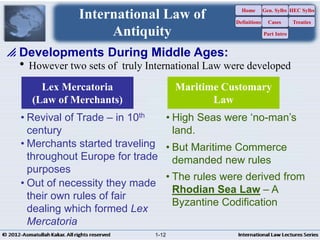
 Developments During Middle Ages:
However two sets of truly International Law were developed
Lex Mercatoria
(Law of Merchants)
Maritime Customary
Law
• Revival of Trade – in 10th
century
• High Seas were ‘no-man’s
land.
• Merchants started traveling
throughout Europe for trade
purposes
• Out of necessity they made
their own rules of fair
dealing which formed Lex
Mercatoria
• But Maritime Commerce
demanded new rules
• The rules were derived from
Rhodian Sea Law – A
Byzantine Codification
International Law of
Antiquity
Home
Definitions
Gen. Sylbs
Cases
Part Intro
HEC Sylbs
Treaties
1-12
The main credit of the Medieval Period is the
emergence of Modern Sate.
In the beginning it was in the shape of
microscopic Italian City States
These were wealthy city States
Trying to justify their demands for independence
Later on with the birth of Social Contract Theory
Modern States Emerged gradually in Europe.
Particularly, in reaction against religious monopolistic
trends in political affairs
 Developments During Middle Ages:
International Law of
Antiquity
Home
Definitions
Gen. Sylbs
Cases
Part Intro
HEC Sylbs
Treaties
1-13
Some Schools of International Law During Medieval Period
 Developments During Middle Ages:
International Law of
Antiquity
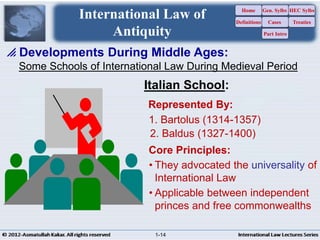
Italian School:
Represented By:
1. Bartolus (1314-1357)
2. Baldus (1327-1400)
• They advocated the universality of
International Law
• Applicable between independent
princes and free commonwealths
Core Principles:
Home
Definitions
Gen. Sylbs
Cases
Part Intro
HEC Sylbs
Treaties
1-14
Some Schools of International Law During Medieval Period
 Developments During Middle Ages:
International Law of
Antiquity
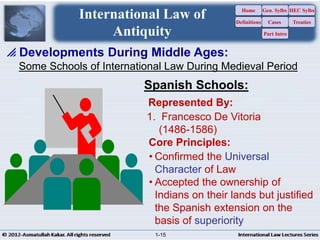
Spanish Schools:
Represented By:
1. Francesco De Vitoria
(1486-1586)
• Confirmed the Universal
Character of Law
• Accepted the ownership of
Indians on their lands but justified
the Spanish extension on the
basis of superiority
Core Principles:
Home
Definitions
Gen. Sylbs
Cases
Part Intro
HEC Sylbs
Treaties
1-15
 There is a debate as to
when Modern
International Law
originated.
 Generally – There are
Four Views as to its origin
 Origin:
Modern International Law
Home
Definitions
Gen. Sylbs
Cases
Part Intro
HEC Sylbs
Treaties
1-16
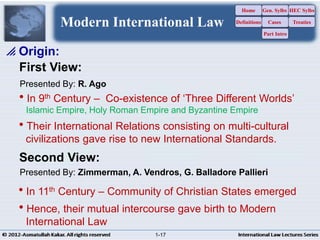
In 9th Century – Co-existence of ‘Three Different Worlds’
Islamic Empire, Holy Roman Empire and Byzantine Empire
Their International Relations consisting on multi-cultural
civilizations gave rise to new International Standards.
 Origin:
Presented By: R. Ago
First View:
In 11th Century – Community of Christian States emerged
Hence, their mutual intercourse gave birth to Modern
International Law
Second View:
Presented By: Zimmerman, A. Vendros, G. Balladore Pallieri
Modern International Law
Home
Definitions
Gen. Sylbs
Cases
Part Intro
HEC Sylbs
Treaties
1-17

Ch.01 historical development

  • 2.
    Origin, Nature andBasis of International Law I Origin of International Law  International Law of Antiquity  Classical International Law  Modern International law
  • 3.
  • 4.
    No precise dateor period Started with the formation of politically organized groups Rules may be found existing 5,000 years before These rules were peculiar to the unique setup of those communities These rules were relating to peace, boarders, extradition, reprisals, diplomatic relationships etc.  Origin International Law of Antiquity Home Definitions Gen. Sylbs Cases Part Intro HEC Sylbs Treaties 1-4
  • 5.
    Concluded between Eannatum (thevictorious Ruler of Lagash) and the representative of Umma It established peace and defined their boarders  Origin – Historical Traces:  Lagash and Umma were two small Mesopotamian City States International Law of Antiquity A Treaty between Lagash and Umma 3100 BC Home Definitions Gen. Sylbs Cases Part Intro HEC Sylbs Treaties 1-5
  • 6.
    A Treaty between Egypt and Cheta 1400BC International Law of Antiquity • It Provided for Peace, Alliance, Extradition and Exchange of Ambassadors • Concluded between Egyptian Pharaoh Ramses – II and King of Cheta  Origin – Historical Traces: Home Definitions Gen. Sylbs Cases Part Intro HEC Sylbs Treaties 1-6
  • 7.
     Developments Peace and War Diplomatic Relationships Boardersand respect of Boarders Extradition, Asylum etc. The societies of antiquity developed rules concerning; International Law of Antiquity Home Definitions Gen. Sylbs Cases Part Intro HEC Sylbs Treaties 1-7
  • 8.
    The Empires ofEgypt, Persia, Chaldea, Assyria, Mesopotamia and the small Hebrew Monarchies and Phoenician City States – concluded Treaties Established following principles; • Equality of Parties • Pacta sunt servanda – Agreements are to be kept Greece took two institutions from Asian Civilizations; • Technique of concluding Treaties; and • Art of Diplomacy And developed International Arbitration  Developments 1-8 International Law of Antiquity Home Definitions Gen. Sylbs Cases Part Intro HEC Sylbs Treaties 1-8
  • 9.
    ROME (before expansion) JusCivile • Law applicable to Roman Natives ROMAN EMPIRE (after expansion) Jus Gentium • Law applicable between Roman Natives and foreigners • Based on Natural Law Jus Fatiale • Law consisted of religious rules • Governed Roman external relations and declaration of wars • A special Magistrate, the praeter peregrines, appointed in 242 BC, had created Jus Gentium. Outside World • It was first true International Law To See the Evolution of Roman Empire Click Here ---  Roman Developments International Law of Antiquity Home Definitions Gen. Sylbs Cases Part Intro HEC Sylbs Treaties 1-9
  • 10.
    10  Developments ByRomans ROME ROMAN EMPIRE • In 212 AD Roman Citizenship was granted to all male inhabitants of Roman Empire. • It diminish the distinction between Jus Civile and Jus Gentium • Later on the principles of Jus Gentium and Jus Fatiale became the basis for Classical International Law. • It influenced to greater extent all the European Legal Systems • Hence, Jus Civile became applicable to all the inhabitants both natives and foreigners of Roman Empire • But Jus Gentium and Jus Fatiale did not disappear.  Roman Developments International Law of Antiquity Home Definitions Gen. Sylbs Cases Part Intro HEC Sylbs Treaties
  • 11.
    Feudal Lords Emperor Pope Political Setup: Threefountains of Power – with Feudal Lords bridging between the two Communities scattered into groups headed by Feudal Lords Confronted each other for Power Catholic Church Holy Roman Empire Two Sets of Laws Emerged, corresponding to two Power Structures Ecclesiastical Imperial  It made difficult for an INTERNATIONAL LEGAL SYSTEM to emerge  Developments During Middle Ages: International Law of Antiquity Home Definitions Gen. Sylbs Cases Part Intro HEC Sylbs Treaties 1-11
  • 12.
     Developments DuringMiddle Ages: However two sets of truly International Law were developed Lex Mercatoria (Law of Merchants) Maritime Customary Law • Revival of Trade – in 10th century • High Seas were ‘no-man’s land. • Merchants started traveling throughout Europe for trade purposes • Out of necessity they made their own rules of fair dealing which formed Lex Mercatoria • But Maritime Commerce demanded new rules • The rules were derived from Rhodian Sea Law – A Byzantine Codification International Law of Antiquity Home Definitions Gen. Sylbs Cases Part Intro HEC Sylbs Treaties 1-12
  • 13.
    The main creditof the Medieval Period is the emergence of Modern Sate. In the beginning it was in the shape of microscopic Italian City States These were wealthy city States Trying to justify their demands for independence Later on with the birth of Social Contract Theory Modern States Emerged gradually in Europe. Particularly, in reaction against religious monopolistic trends in political affairs  Developments During Middle Ages: International Law of Antiquity Home Definitions Gen. Sylbs Cases Part Intro HEC Sylbs Treaties 1-13
  • 14.
    Some Schools ofInternational Law During Medieval Period  Developments During Middle Ages: International Law of Antiquity Italian School: Represented By: 1. Bartolus (1314-1357) 2. Baldus (1327-1400) • They advocated the universality of International Law • Applicable between independent princes and free commonwealths Core Principles: Home Definitions Gen. Sylbs Cases Part Intro HEC Sylbs Treaties 1-14
  • 15.
    Some Schools ofInternational Law During Medieval Period  Developments During Middle Ages: International Law of Antiquity Spanish Schools: Represented By: 1. Francesco De Vitoria (1486-1586) • Confirmed the Universal Character of Law • Accepted the ownership of Indians on their lands but justified the Spanish extension on the basis of superiority Core Principles: Home Definitions Gen. Sylbs Cases Part Intro HEC Sylbs Treaties 1-15
  • 16.
     There isa debate as to when Modern International Law originated.  Generally – There are Four Views as to its origin  Origin: Modern International Law Home Definitions Gen. Sylbs Cases Part Intro HEC Sylbs Treaties 1-16
  • 17.
    In 9th Century– Co-existence of ‘Three Different Worlds’ Islamic Empire, Holy Roman Empire and Byzantine Empire Their International Relations consisting on multi-cultural civilizations gave rise to new International Standards.  Origin: Presented By: R. Ago First View: In 11th Century – Community of Christian States emerged Hence, their mutual intercourse gave birth to Modern International Law Second View: Presented By: Zimmerman, A. Vendros, G. Balladore Pallieri Modern International Law Home Definitions Gen. Sylbs Cases Part Intro HEC Sylbs Treaties 1-17