
LECTURE:1
INTRODUCTION TO
INTERNATIONAL LAW
BY
DR. SHEIKH MUHAMMAD
ADNAN
Dr. Sheikh Muhammad Adnan
INTRODUCTION TO
INTERNATIONAL LAW
What is international law?
Set of rules generally regarded and accepted as binding in relations between states and
between nations
international law serves as a framework for the practice of stable and organized
international relations.
The definition of ‘nations’ or ‘states’
• political bodies
• societies of men
• who have united together and combined their forces
• in order to procure their mutual welfare and security
Dr. Sheikh Muhammad Adnan
NATURE OF INTERNATIONAL LAW
DEFINITION OF INTERNATIONAL LAW:
International law is a collection of rules governing relations between states. It is a
mark of how far international law has evolved that this original definition omits
individuals and international organizations—two of the most dynamic and vital
elements of modern international law. Furthermore, it is no longer accurate to view
international law as simply a collection of rules; rather, it is a rapidly developing
complex of rules and influential—though not directly binding—principles,
practices, and assertions coupled with increasingly sophisticated structures and
processes.
Dr. Sheikh Muhammad Adnan
SUBJECTS OF INTERNATIONAL
LAW
• International personality
• criteria of statehood
• recognition – constitutive theory – declaratory theory
• other subjects of international law – international
organization – liberation movement and insurgent group –
individual
Dr. Sheikh Muhammad Adnan
WHAT IS MEANT BY THE LAW OF
NATIONS?
• The law of nations is the science of the rights exist between nations and
states, and of the obligations corresponding to these rights.
The meaning of international law
• modern approach: “the body of law that regulates the activities of entities
possessing international personality” • traditional approach: “the conduct
and relationships of states”
Dr. Sheikh Muhammad Adnan
INTERNATIONAL LAW
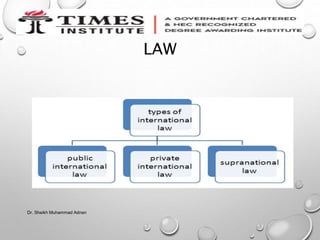
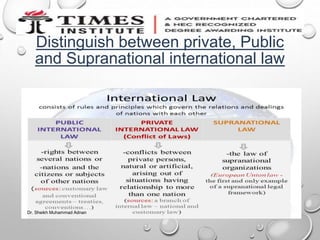
Basically defined, international law is simply the set of rules that countries
follow in dealing with each other. There are three distinct legal processes that
can be identified in international law that include public international law (the
relationship between sovereign states and international entities such as
international criminal court), private international law
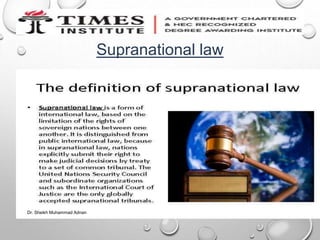
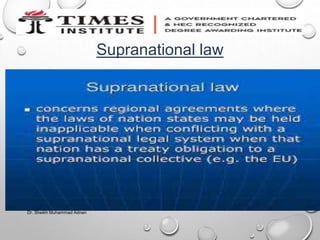
• (addressing questions of jurisdiction in conflict), and supranational law (the
set of collective laws that sovereign states voluntarily yield to). But this basic
definition must be supplemented with three more- complex explanations—is
international law really law, the way the laws of the united states, enforced by
courts and police, are? Where do we find the rules of international law? Are
they written down somewhere? Finally, how is international law enforced, if
there is no world government?
Dr. Sheikh Muhammad Adnan
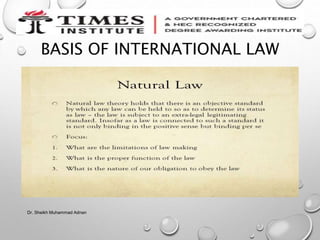
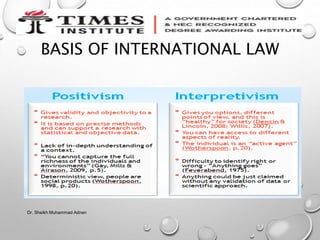
BASIS OF INTERNATIONAL LAW
Dr. Sheikh Muhammad Adnan
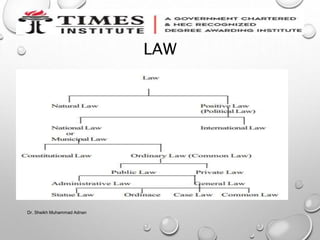
BASIS OF LAW
Dr. Sheikh Muhammad Adnan
BASIS OF INTERNATIONAL LAW
Dr. Sheikh Muhammad Adnan
LAW
Dr. Sheikh Muhammad Adnan
LAW
Dr. Sheikh Muhammad Adnan
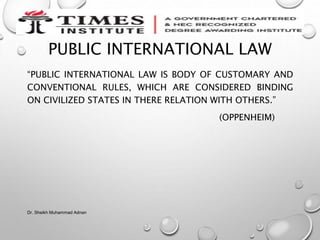
PUBLIC INTERNATIONAL LAW
“PUBLIC INTERNATIONAL LAW IS BODY OF CUSTOMARY AND
CONVENTIONAL RULES, WHICH ARE CONSIDERED BINDING
ON CIVILIZED STATES IN THERE RELATION WITH OTHERS.”
(OPPENHEIM)
Dr. Sheikh Muhammad Adnan
PRIVATE INTERNATIONAL LAW
• Private international law describes the body of law surrounding which law
governs when there is a conflict between citizens of different countries. In
common law jurisdictions, it is sometimes known as "conflict of laws."
• Typically, one will be asking one or more of three questions when
researching a private international law problem:
• In which jurisdiction should the dispute be decided?
• Which law should be applied?
• How should a foreign judgment be enforced?
Dr. Sheikh Muhammad Adnan
Supranational law
Dr. Sheikh Muhammad Adnan
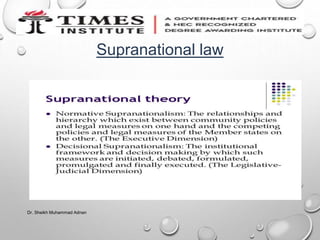
Supranational law
Dr. Sheikh Muhammad Adnan
Supranational law
Dr. Sheikh Muhammad Adnan
Distinguish between private, Public
and Supranational international law
Dr. Sheikh Muhammad Adnan

Introduction to international law.ppt

  • 1.
    LECTURE:1 INTRODUCTION TO INTERNATIONAL LAW BY DR.SHEIKH MUHAMMAD ADNAN Dr. Sheikh Muhammad Adnan
  • 2.
    INTRODUCTION TO INTERNATIONAL LAW Whatis international law? Set of rules generally regarded and accepted as binding in relations between states and between nations international law serves as a framework for the practice of stable and organized international relations. The definition of ‘nations’ or ‘states’ • political bodies • societies of men • who have united together and combined their forces • in order to procure their mutual welfare and security Dr. Sheikh Muhammad Adnan
  • 3.
    NATURE OF INTERNATIONALLAW DEFINITION OF INTERNATIONAL LAW: International law is a collection of rules governing relations between states. It is a mark of how far international law has evolved that this original definition omits individuals and international organizations—two of the most dynamic and vital elements of modern international law. Furthermore, it is no longer accurate to view international law as simply a collection of rules; rather, it is a rapidly developing complex of rules and influential—though not directly binding—principles, practices, and assertions coupled with increasingly sophisticated structures and processes. Dr. Sheikh Muhammad Adnan
  • 4.
    SUBJECTS OF INTERNATIONAL LAW •International personality • criteria of statehood • recognition – constitutive theory – declaratory theory • other subjects of international law – international organization – liberation movement and insurgent group – individual Dr. Sheikh Muhammad Adnan
  • 5.
    WHAT IS MEANTBY THE LAW OF NATIONS? • The law of nations is the science of the rights exist between nations and states, and of the obligations corresponding to these rights. The meaning of international law • modern approach: “the body of law that regulates the activities of entities possessing international personality” • traditional approach: “the conduct and relationships of states” Dr. Sheikh Muhammad Adnan
  • 6.
    INTERNATIONAL LAW Basically defined,international law is simply the set of rules that countries follow in dealing with each other. There are three distinct legal processes that can be identified in international law that include public international law (the relationship between sovereign states and international entities such as international criminal court), private international law • (addressing questions of jurisdiction in conflict), and supranational law (the set of collective laws that sovereign states voluntarily yield to). But this basic definition must be supplemented with three more- complex explanations—is international law really law, the way the laws of the united states, enforced by courts and police, are? Where do we find the rules of international law? Are they written down somewhere? Finally, how is international law enforced, if there is no world government? Dr. Sheikh Muhammad Adnan
  • 7.
    BASIS OF INTERNATIONALLAW Dr. Sheikh Muhammad Adnan
  • 8.
    BASIS OF LAW Dr.Sheikh Muhammad Adnan
  • 9.
    BASIS OF INTERNATIONALLAW Dr. Sheikh Muhammad Adnan
  • 10.
  • 11.
  • 12.
    PUBLIC INTERNATIONAL LAW “PUBLICINTERNATIONAL LAW IS BODY OF CUSTOMARY AND CONVENTIONAL RULES, WHICH ARE CONSIDERED BINDING ON CIVILIZED STATES IN THERE RELATION WITH OTHERS.” (OPPENHEIM) Dr. Sheikh Muhammad Adnan
  • 13.
    PRIVATE INTERNATIONAL LAW •Private international law describes the body of law surrounding which law governs when there is a conflict between citizens of different countries. In common law jurisdictions, it is sometimes known as "conflict of laws." • Typically, one will be asking one or more of three questions when researching a private international law problem: • In which jurisdiction should the dispute be decided? • Which law should be applied? • How should a foreign judgment be enforced? Dr. Sheikh Muhammad Adnan
  • 14.
  • 15.
  • 16.
  • 17.
    Distinguish between private,Public and Supranational international law Dr. Sheikh Muhammad Adnan