Global Marketing Management, 5e
Chapter 1Copyright (c) 2009 John Wiley & Sons, Inc.
1
Chapter 1
Globalization
Imperative
Chapter Overview
Chapter 1Copyright (c) 2009 John Wiley & Sons, Inc.
2
1. Why Global Marketing is Imperative
2. Globalization of Markets: Convergence
and Divergence
3. Evolution of Global Marketing
4. Appendix: Theories of International Trade
and the Multinational Enterprise
Introduction
Chapter 1Copyright (c) 2009 John Wiley & Sons, Inc.
3
 Products have been traded across borders
throughout recorded civilization, extending back
beyond the SilkRoadthat once connected East
with West from Xian (China) to Rome (Italy).
 Total world merchandise trade volume grew from
$7.6 trillion in 2000 to $16.3 trillion in 2008.
Introduction
Chapter 1Copyright (c) 2009 John Wiley & Sons, Inc.
4
 Big Emerging Markets (BEMs): In the next ten to
twenty years, BEMs such as the Chinese
Economic Area (CEA: including China, Hong Kong
Region, and Taiwan), India, South Korea, Mexico,
Brazil, Argentina, South Africa, Poland, Turkey,
and the Association of Southeast Asian Nations
(ASEAN: including Indonesia, Brunei, Malaysia,
Thailand, the Philippines, and Vietnam) will
provide many opportunities in global business.
1. Why Global Marketing is Imperative
Chapter 1Copyright (c) 2009 John Wiley & Sons, Inc.
5
 Saturationof domestic markets: Domestic-market
saturation in the industrialized parts of the world
and marketing opportunities overseas are
evident in global marketing.
 Globalcompetition: Competition around the
world and proliferation of the Internet have been
on the rise and are now intensifying.
 Needforglobalcooperation: Global competition
brings global cooperation.
1. Why Global Marketing is Imperative
Chapter 1Copyright (c) 2009 John Wiley & Sons, Inc.
6
 Internet revolution: The Internet and electronic
commerce (e-commerce) are bringing major
structural changes to the way companies
operate worldwide.
 The term global epitomizes both the competitive
pressure and expanding market opportunities.
 Whether a company operates domestically or
across national boundaries, it can no longer
avoid competitive pressures from around the
world.
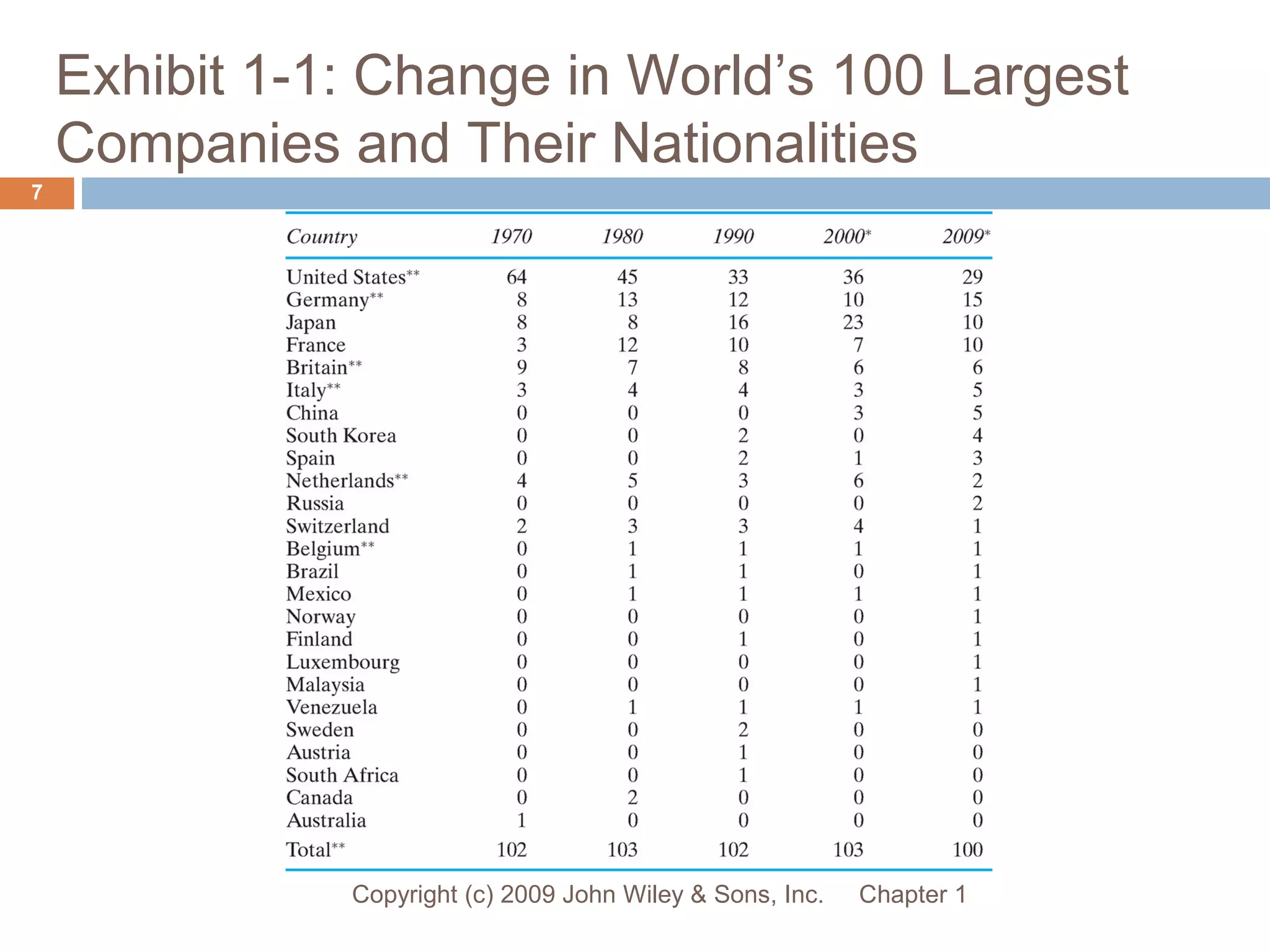
Exhibit 1-1: Change in World’s 100 Largest
Companies and Their Nationalities
Chapter 1Copyright (c) 2009 John Wiley & Sons, Inc.
7
2. Globalization of Markets: Convergence
and Divergence
Chapter 1Copyright (c) 2009 John Wiley & Sons, Inc.
8
 Per capita income is an important determinant
of consumer buying behavior.
 When a country’s per capita income is less than
$10,000, much of the income is spent on food
and other necessities, and very little disposable
income remains.
 As a country’s per capita incomes reaches
$20,000, the disposable portion of income
increases dramatically.
 This increased disposable income level results
in increased convergent pressures on consumer
buying behavior.
2. Globalization of Markets: Convergence
and Divergence
Chapter 1Copyright (c) 2009 John Wiley & Sons, Inc.
9
 People with higher incomes tend to enjoy similar
educational levels, desires for material
positions, ways of spending leisure time, and
aspirations for the future.
 Globalization does not suffocate local cultures,
but rather liberates them from the ideological
conformity of nationalism, with consumers
becoming more receptive to new things.
 Consumers also have a wider, more divergent
“choice set” of goods and services to choose
from.
 In other words, the divergence of consumer
needs is taking place at the same time.
2. Globalization of Markets: Convergence
and Divergence
Chapter 1Copyright (c) 2009 John Wiley & Sons, Inc.
10
 International trade consists of exports and
imports.
 International business includes international
trade and foreign production.
 Extensive international penetration of
companies is called global reach.
 International trade and foreign production
activities are managed on a global basis.
 Growth of Multinational Corporations (MNCs)
and intra-firm trade is a major aspect of global
markets.
2. Globalization of Markets: Convergence
and Divergence
Chapter 1Copyright (c) 2009 John Wiley & Sons, Inc.
11
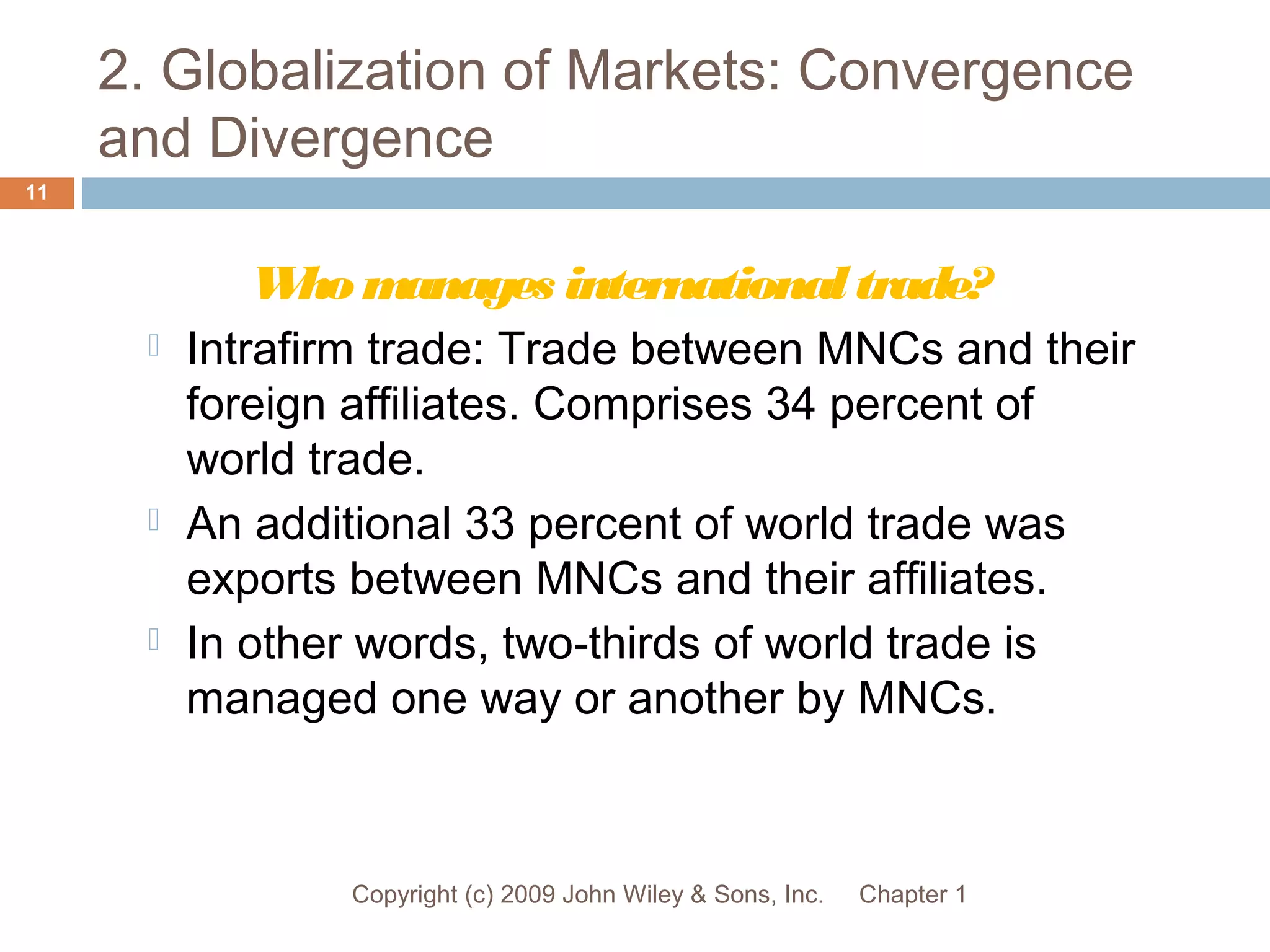
Whomanages internationaltrade?
 Intrafirm trade: Trade between MNCs and their
foreign affiliates. Comprises 34 percent of
world trade.
 An additional 33 percent of world trade was
exports between MNCs and their affiliates.
 In other words, two-thirds of world trade is
managed one way or another by MNCs.
3. Evolution of Global Marketing
Chapter 1Copyright (c) 2009 John Wiley & Sons, Inc.
12
What is marketing?
 Marketing involves the planning and execution
of the conception, pricing, promotion, and
distribution of ideas, products, and services.
 Marketing involves customer satisfaction and
their current and future needs.
 Marketing is much more than selling and
involves the entire company.
 Within marketing strategies, companies are
always under competitive pressure to move
forward both re active ly and pro active ly.
3. Evolution of Global Marketing
Chapter 1Copyright (c) 2009 John Wiley & Sons, Inc.
13
 Fivestages intheevolutionof globalmarketing
(see Exhibit 1-2):
1. Domestic Marketing (domestic focus; home country
customers; ethnocentric orientation).
2. Export Marketing (indirect vs. direct exporting; country
choice, exports; ethnocentric orientation; home country
customers).
3. International Marketing (markets in many countries;
polycentric orientation; use of multidomestic marketing
when customer needs are different across national
markets).
3. Evolution of Global Marketing
Chapter 1Copyright (c) 2009 John Wiley & Sons, Inc.
14
4. Multinational Marketing (many markets; consolidation on
regional basis; regiocentric orientation; standardization
within regions).
5. Global Marketing (international, multinational & geocentric
orientation; company’s willingness to adopt a global
perspective; global products with local variations).
Exhibit 1-2: Evolution of Global
Marketing
Chapter 1Copyright (c) 2009 John Wiley & Sons, Inc.
15
3. Evolution of Global Marketing
Chapter 1Copyright (c) 2009 John Wiley & Sons, Inc.
16
 GlobalMarketingrefers to marketing activities
that emphasize the following:
1. Standardization efforts.
2. Coordination across markets.
3. Global integration.
3. Evolution of Global Marketing
Chapter 1Copyright (c) 2009 John Wiley & Sons, Inc.
17
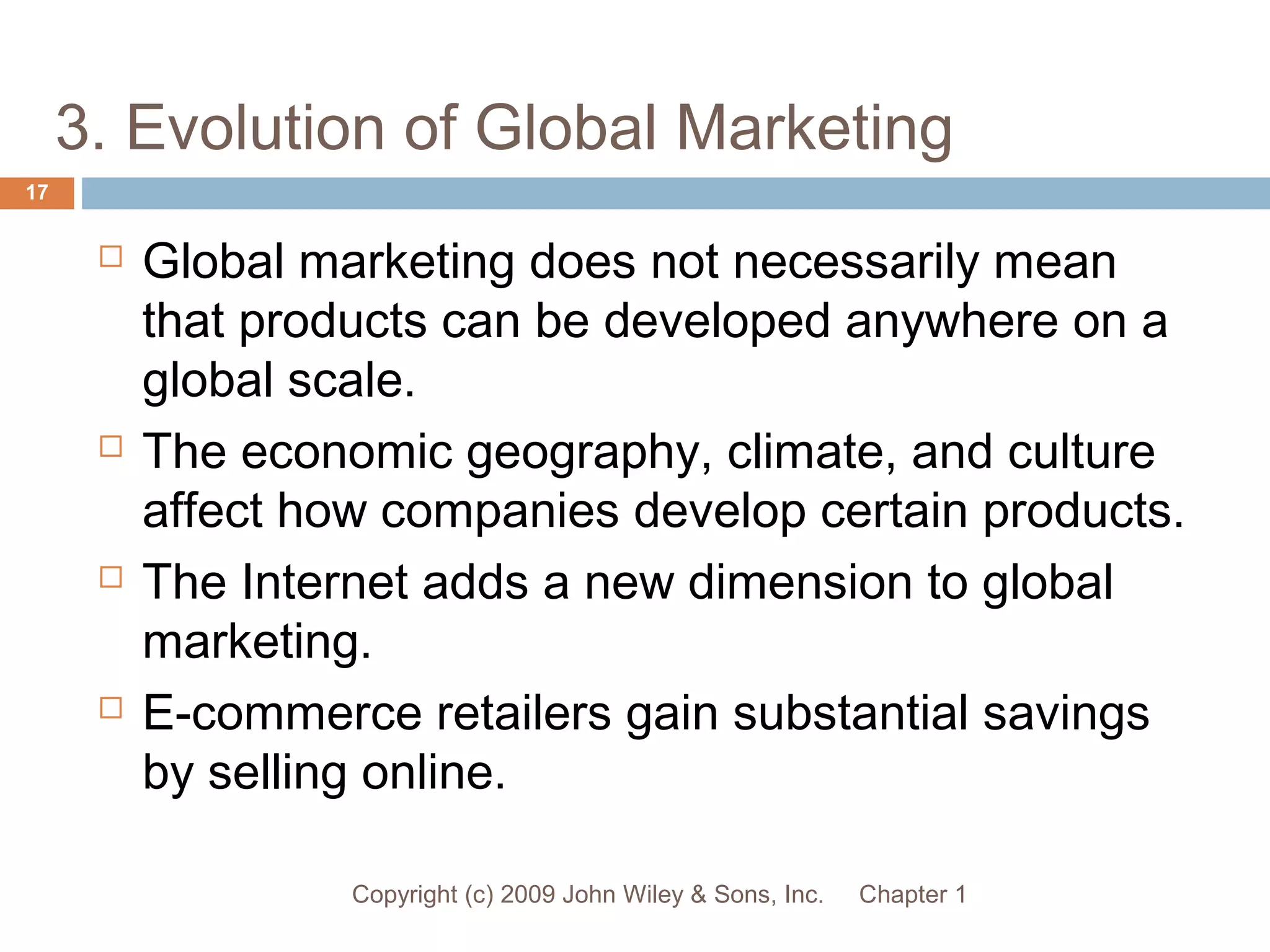
 Global marketing does not necessarily mean
that products can be developed anywhere on a
global scale.
 The economic geography, climate, and culture
affect how companies develop certain products.
 The Internet adds a new dimension to global
marketing.
 E-commerce retailers gain substantial savings
by selling online.
4. Appendix: Theories of International
Trade & the Multinational Enterprise
Chapter 1Copyright (c) 2009 John Wiley & Sons, Inc.
18
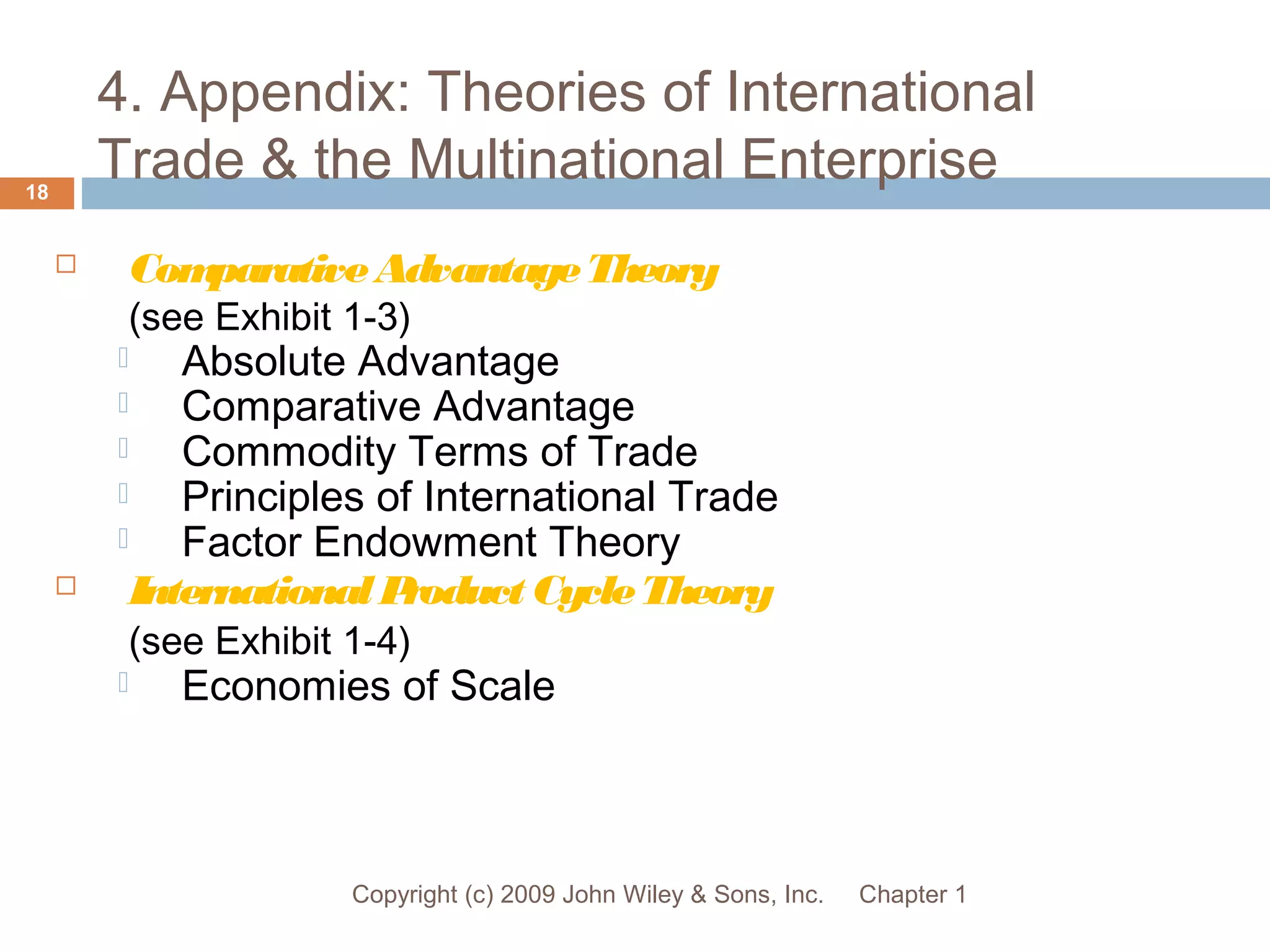
 ComparativeAdvantageTheory
(see Exhibit 1-3)
 Absolute Advantage
 Comparative Advantage
 Commodity Terms of Trade
 Principles of International Trade
 Factor Endowment Theory
 InternationalProduct CycleTheory
(see Exhibit 1-4)
 Economies of Scale
Exhibit 1-3:
Comparative Advantage at Work
Chapter 1Copyright (c) 2009 John Wiley & Sons, Inc.
19
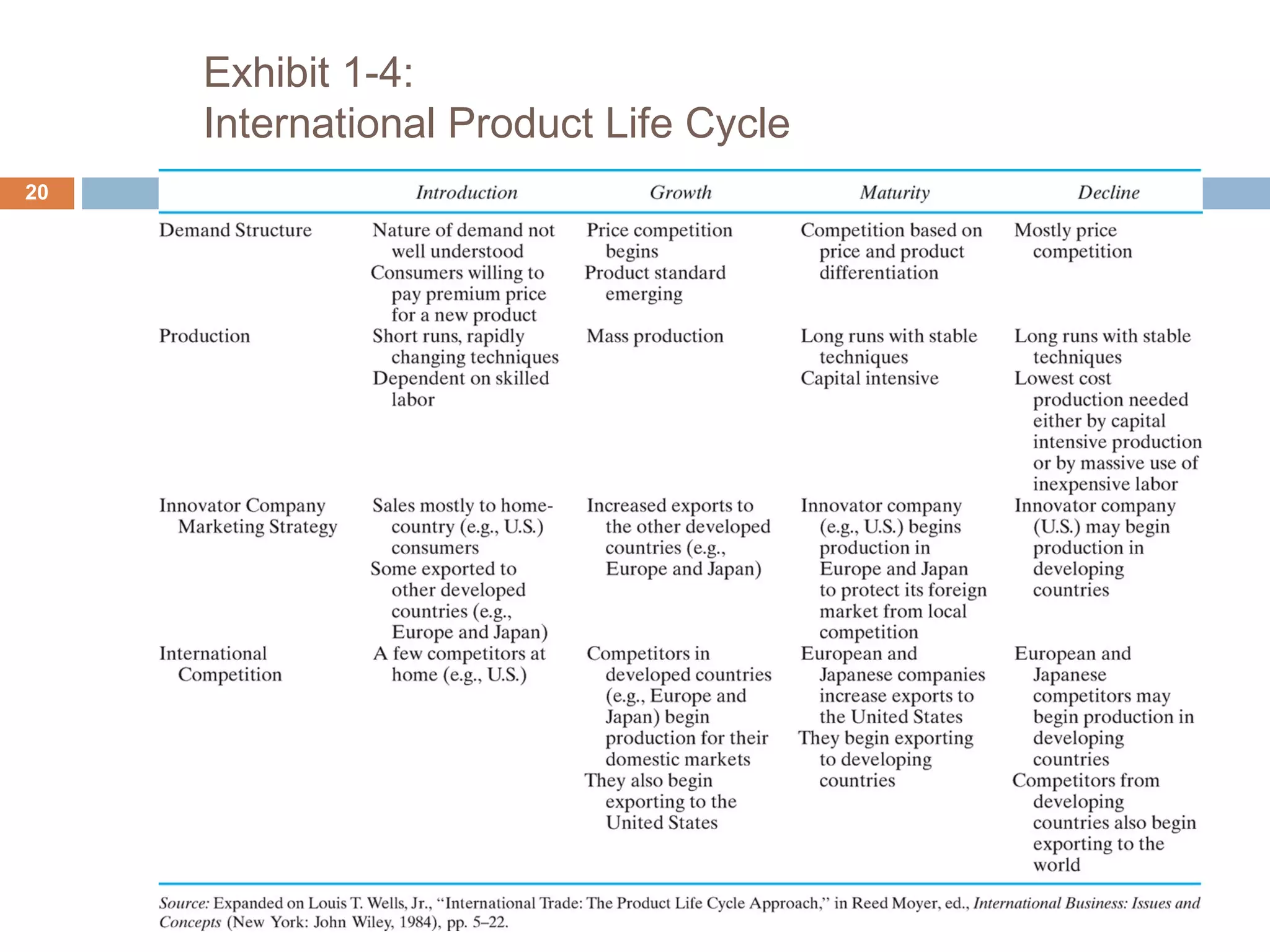
Exhibit 1-4:
International Product Life Cycle
Chapter 1Copyright (c) 2009 John Wiley & Sons, Inc.
20
4. Appendix: Theories of International Trade
& the Multinational Enterprise
Chapter 1Copyright (c) 2009 John Wiley & Sons, Inc.
21
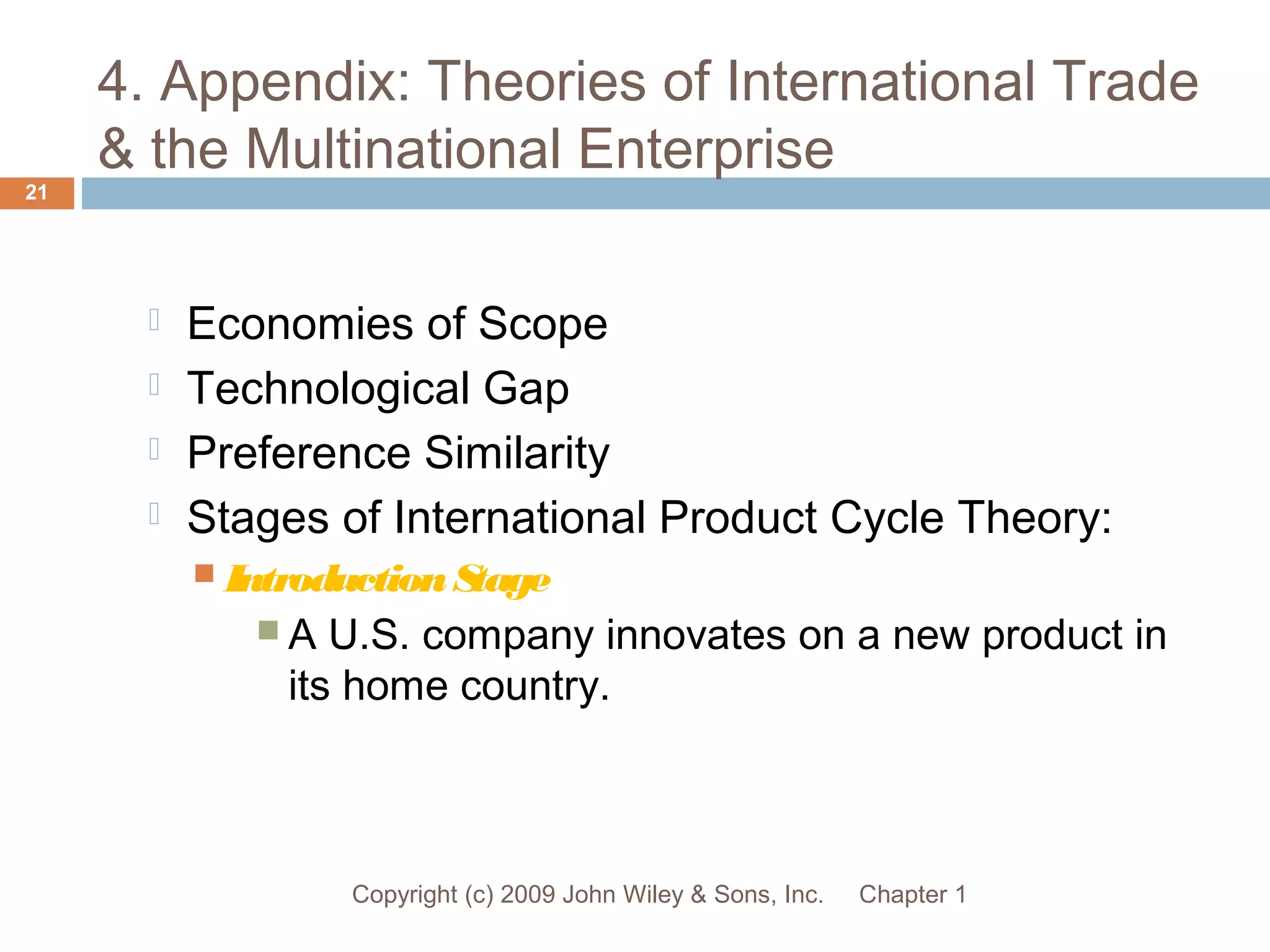
 Economies of Scope
 Technological Gap
 Preference Similarity
 Stages of International Product Cycle Theory:
 IntroductionStage
 A U.S. company innovates on a new product in
its home country.
4. Appendix: Theories of International Trade
& the Multinational Enterprise
Chapter 1Copyright (c) 2009 John Wiley & Sons, Inc.
22
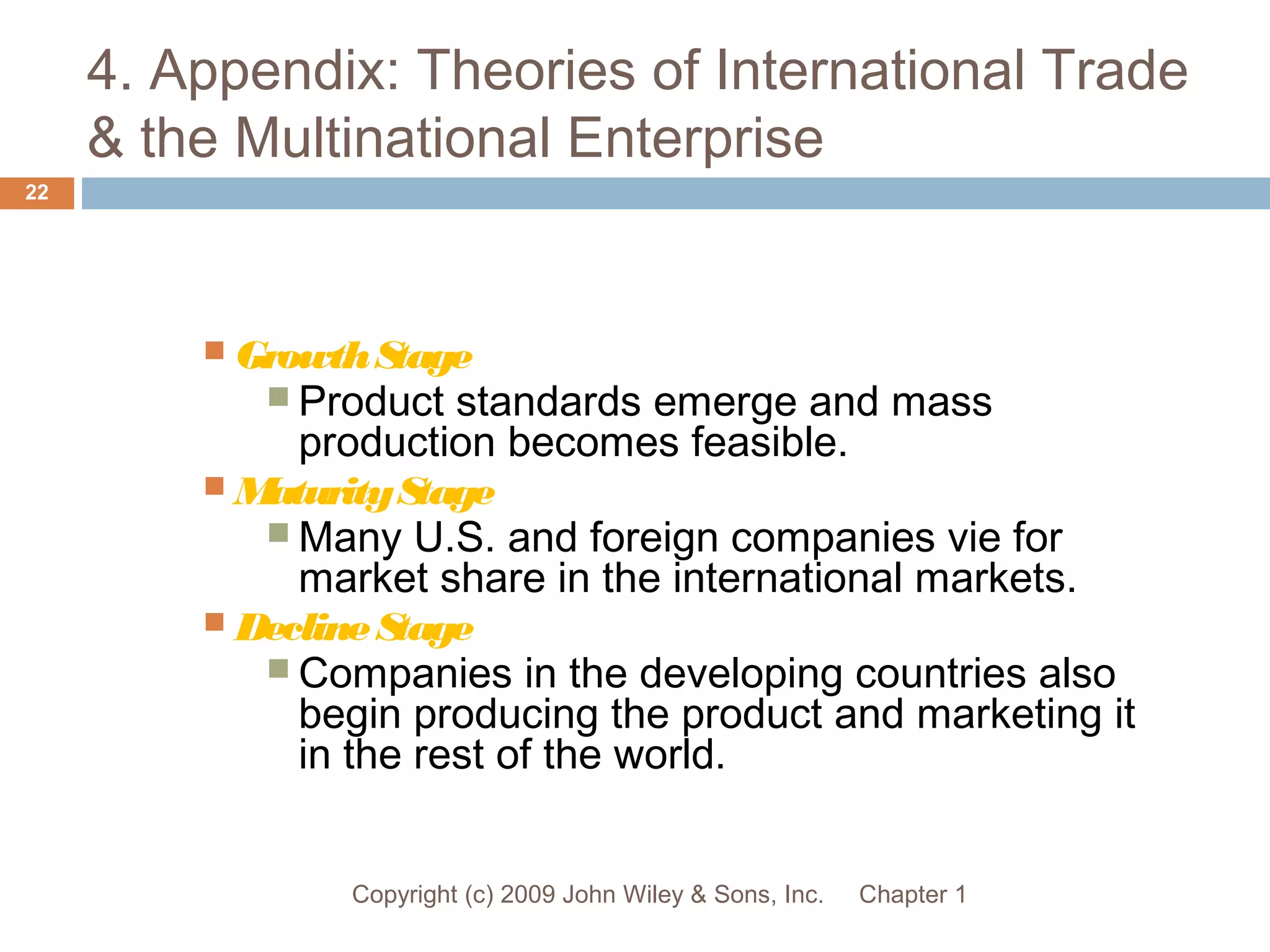
 GrowthStage
 Product standards emerge and mass
production becomes feasible.
 MaturityStage
 Many U.S. and foreign companies vie for
market share in the international markets.
 DeclineStage
 Companies in the developing countries also
begin producing the product and marketing it
in the rest of the world.
4. Appendix: Theories of International Trade
& the Multinational Enterprise
Chapter 1Copyright (c) 2009 John Wiley & Sons, Inc.
23
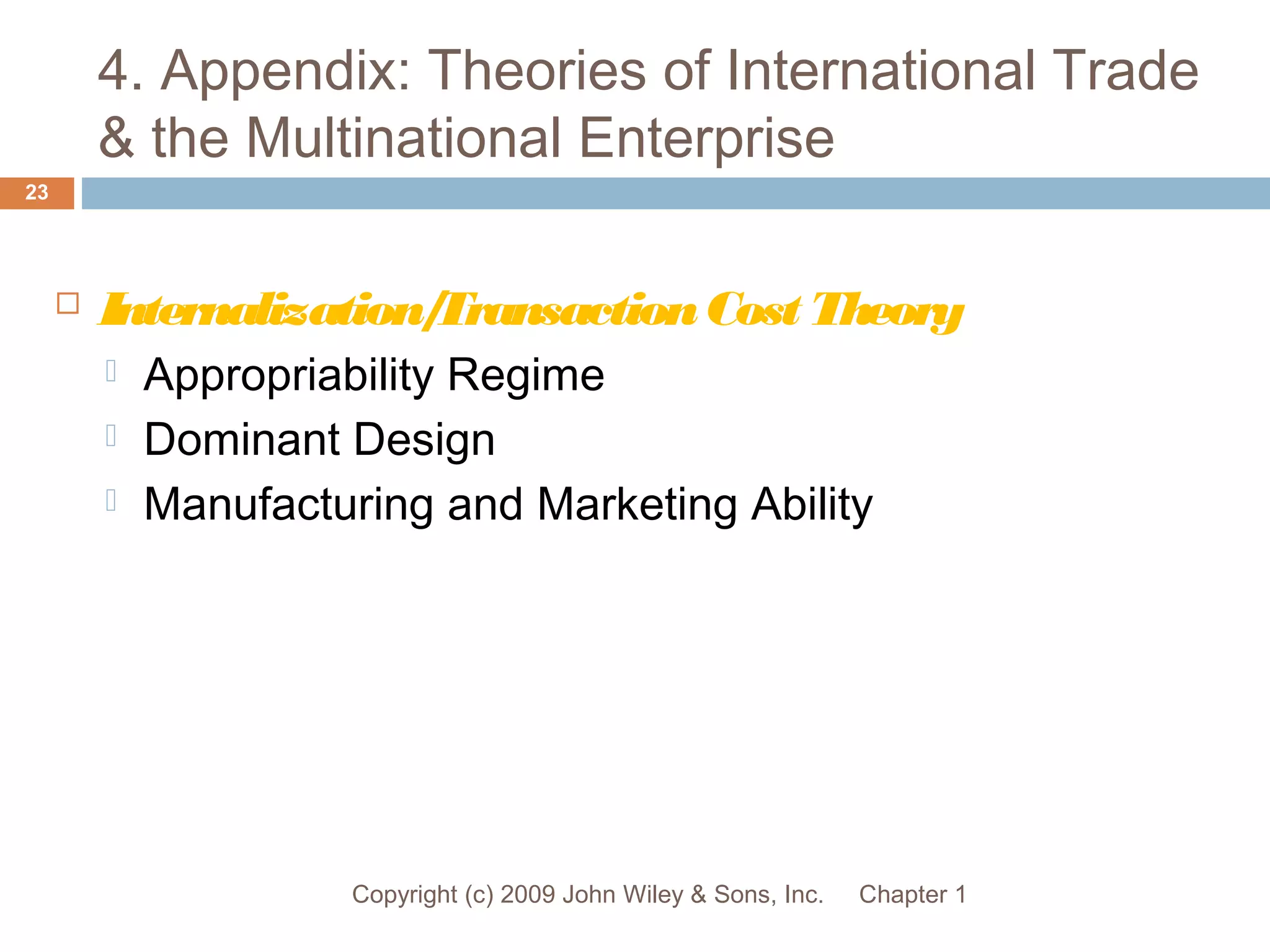
 Internalization/TransactionCost Theory
 Appropriability Regime
 Dominant Design
 Manufacturing and Marketing Ability

Ch01

  • 1.
    Global Marketing Management,5e Chapter 1Copyright (c) 2009 John Wiley & Sons, Inc. 1 Chapter 1 Globalization Imperative
  • 2.
    Chapter Overview Chapter 1Copyright(c) 2009 John Wiley & Sons, Inc. 2 1. Why Global Marketing is Imperative 2. Globalization of Markets: Convergence and Divergence 3. Evolution of Global Marketing 4. Appendix: Theories of International Trade and the Multinational Enterprise
  • 3.
    Introduction Chapter 1Copyright (c)2009 John Wiley & Sons, Inc. 3  Products have been traded across borders throughout recorded civilization, extending back beyond the SilkRoadthat once connected East with West from Xian (China) to Rome (Italy).  Total world merchandise trade volume grew from $7.6 trillion in 2000 to $16.3 trillion in 2008.
  • 4.
    Introduction Chapter 1Copyright (c)2009 John Wiley & Sons, Inc. 4  Big Emerging Markets (BEMs): In the next ten to twenty years, BEMs such as the Chinese Economic Area (CEA: including China, Hong Kong Region, and Taiwan), India, South Korea, Mexico, Brazil, Argentina, South Africa, Poland, Turkey, and the Association of Southeast Asian Nations (ASEAN: including Indonesia, Brunei, Malaysia, Thailand, the Philippines, and Vietnam) will provide many opportunities in global business.
  • 5.
    1. Why GlobalMarketing is Imperative Chapter 1Copyright (c) 2009 John Wiley & Sons, Inc. 5  Saturationof domestic markets: Domestic-market saturation in the industrialized parts of the world and marketing opportunities overseas are evident in global marketing.  Globalcompetition: Competition around the world and proliferation of the Internet have been on the rise and are now intensifying.  Needforglobalcooperation: Global competition brings global cooperation.
  • 6.
    1. Why GlobalMarketing is Imperative Chapter 1Copyright (c) 2009 John Wiley & Sons, Inc. 6  Internet revolution: The Internet and electronic commerce (e-commerce) are bringing major structural changes to the way companies operate worldwide.  The term global epitomizes both the competitive pressure and expanding market opportunities.  Whether a company operates domestically or across national boundaries, it can no longer avoid competitive pressures from around the world.
  • 7.
    Exhibit 1-1: Changein World’s 100 Largest Companies and Their Nationalities Chapter 1Copyright (c) 2009 John Wiley & Sons, Inc. 7
  • 8.
    2. Globalization ofMarkets: Convergence and Divergence Chapter 1Copyright (c) 2009 John Wiley & Sons, Inc. 8  Per capita income is an important determinant of consumer buying behavior.  When a country’s per capita income is less than $10,000, much of the income is spent on food and other necessities, and very little disposable income remains.  As a country’s per capita incomes reaches $20,000, the disposable portion of income increases dramatically.  This increased disposable income level results in increased convergent pressures on consumer buying behavior.
  • 9.
    2. Globalization ofMarkets: Convergence and Divergence Chapter 1Copyright (c) 2009 John Wiley & Sons, Inc. 9  People with higher incomes tend to enjoy similar educational levels, desires for material positions, ways of spending leisure time, and aspirations for the future.  Globalization does not suffocate local cultures, but rather liberates them from the ideological conformity of nationalism, with consumers becoming more receptive to new things.  Consumers also have a wider, more divergent “choice set” of goods and services to choose from.  In other words, the divergence of consumer needs is taking place at the same time.
  • 10.
    2. Globalization ofMarkets: Convergence and Divergence Chapter 1Copyright (c) 2009 John Wiley & Sons, Inc. 10  International trade consists of exports and imports.  International business includes international trade and foreign production.  Extensive international penetration of companies is called global reach.  International trade and foreign production activities are managed on a global basis.  Growth of Multinational Corporations (MNCs) and intra-firm trade is a major aspect of global markets.
  • 11.
    2. Globalization ofMarkets: Convergence and Divergence Chapter 1Copyright (c) 2009 John Wiley & Sons, Inc. 11 Whomanages internationaltrade?  Intrafirm trade: Trade between MNCs and their foreign affiliates. Comprises 34 percent of world trade.  An additional 33 percent of world trade was exports between MNCs and their affiliates.  In other words, two-thirds of world trade is managed one way or another by MNCs.
  • 12.
    3. Evolution ofGlobal Marketing Chapter 1Copyright (c) 2009 John Wiley & Sons, Inc. 12 What is marketing?  Marketing involves the planning and execution of the conception, pricing, promotion, and distribution of ideas, products, and services.  Marketing involves customer satisfaction and their current and future needs.  Marketing is much more than selling and involves the entire company.  Within marketing strategies, companies are always under competitive pressure to move forward both re active ly and pro active ly.
  • 13.
    3. Evolution ofGlobal Marketing Chapter 1Copyright (c) 2009 John Wiley & Sons, Inc. 13  Fivestages intheevolutionof globalmarketing (see Exhibit 1-2): 1. Domestic Marketing (domestic focus; home country customers; ethnocentric orientation). 2. Export Marketing (indirect vs. direct exporting; country choice, exports; ethnocentric orientation; home country customers). 3. International Marketing (markets in many countries; polycentric orientation; use of multidomestic marketing when customer needs are different across national markets).
  • 14.
    3. Evolution ofGlobal Marketing Chapter 1Copyright (c) 2009 John Wiley & Sons, Inc. 14 4. Multinational Marketing (many markets; consolidation on regional basis; regiocentric orientation; standardization within regions). 5. Global Marketing (international, multinational & geocentric orientation; company’s willingness to adopt a global perspective; global products with local variations).
  • 15.
    Exhibit 1-2: Evolutionof Global Marketing Chapter 1Copyright (c) 2009 John Wiley & Sons, Inc. 15
  • 16.
    3. Evolution ofGlobal Marketing Chapter 1Copyright (c) 2009 John Wiley & Sons, Inc. 16  GlobalMarketingrefers to marketing activities that emphasize the following: 1. Standardization efforts. 2. Coordination across markets. 3. Global integration.
  • 17.
    3. Evolution ofGlobal Marketing Chapter 1Copyright (c) 2009 John Wiley & Sons, Inc. 17  Global marketing does not necessarily mean that products can be developed anywhere on a global scale.  The economic geography, climate, and culture affect how companies develop certain products.  The Internet adds a new dimension to global marketing.  E-commerce retailers gain substantial savings by selling online.
  • 18.
    4. Appendix: Theoriesof International Trade & the Multinational Enterprise Chapter 1Copyright (c) 2009 John Wiley & Sons, Inc. 18  ComparativeAdvantageTheory (see Exhibit 1-3)  Absolute Advantage  Comparative Advantage  Commodity Terms of Trade  Principles of International Trade  Factor Endowment Theory  InternationalProduct CycleTheory (see Exhibit 1-4)  Economies of Scale
  • 19.
    Exhibit 1-3: Comparative Advantageat Work Chapter 1Copyright (c) 2009 John Wiley & Sons, Inc. 19
  • 20.
    Exhibit 1-4: International ProductLife Cycle Chapter 1Copyright (c) 2009 John Wiley & Sons, Inc. 20
  • 21.
    4. Appendix: Theoriesof International Trade & the Multinational Enterprise Chapter 1Copyright (c) 2009 John Wiley & Sons, Inc. 21  Economies of Scope  Technological Gap  Preference Similarity  Stages of International Product Cycle Theory:  IntroductionStage  A U.S. company innovates on a new product in its home country.
  • 22.
    4. Appendix: Theoriesof International Trade & the Multinational Enterprise Chapter 1Copyright (c) 2009 John Wiley & Sons, Inc. 22  GrowthStage  Product standards emerge and mass production becomes feasible.  MaturityStage  Many U.S. and foreign companies vie for market share in the international markets.  DeclineStage  Companies in the developing countries also begin producing the product and marketing it in the rest of the world.
  • 23.
    4. Appendix: Theoriesof International Trade & the Multinational Enterprise Chapter 1Copyright (c) 2009 John Wiley & Sons, Inc. 23  Internalization/TransactionCost Theory  Appropriability Regime  Dominant Design  Manufacturing and Marketing Ability