
Heating & Cooling
Introduction to
Heating & Cooling
Starter
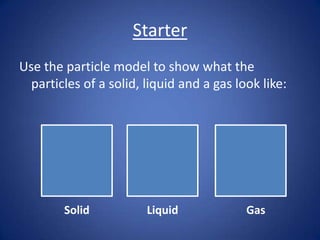
Use the particle model to show what the
particles of a solid, liquid and a gas look like:
Solid Liquid Gas
Learning Objectives
• Know that all objects absorb and emit heat
energy
• Describe how particles move and transfer
energy in solids, liquids and gases
• Explain the process of conduction
Particle Simulation
• http://phet.colorado.edu/en/simulation/state
s-of-matter
Heat Energy
Heat Energy
• Infra-red radiation
• All objects absorb and emit heat energy
Kinetic theory
• Kinetic theory describes how particles move in
solids liquids and gases
In your books
– Explain how the movement of particles is different
in solids liquids and gases.
– Discuss how materials change between the 3
states of matter
Methods of Heat Transfer
• Conduction
• Convection
• Radiation
Conduction
Conduction
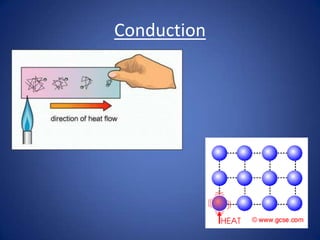
• Type of thermal energy transfer which occurs
in solids
• Vibrating particles pass on extra kinetic energy
(or heat) to neighbouring particles.
• This eventually results in a rise in temperature
at the other side of the solid.
Thermochromic paper
• Make a prediction as to which metal will be the
best conductor and why
• Describe how thermochromic paper works
• Explain why the different pieces of paper
changed colour at different rates
• Explain the process of conduction
• Which metal do you conclude was the best
conductor? Why?
Homework
• Outline what happens in conduction
• Prediction & explanation
• Method
• Conclusion
Methods of Heat Transfer
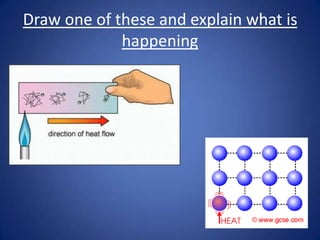
Draw one of these and explain what is
happening
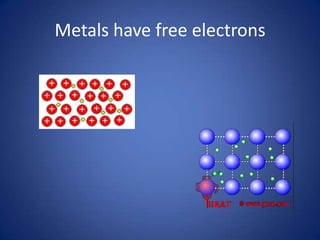
Why do metals feel cold?
Metals have free electrons
Starter
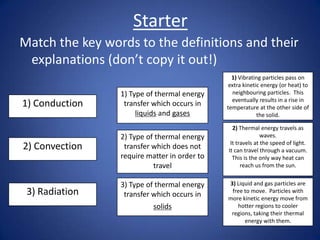
Match the key words to the definitions and their
explanations (don’t copy it out!)
1) Conduction
2) Convection
3) Radiation
3) Type of thermal energy
transfer which occurs in
solids
1) Type of thermal energy
transfer which occurs in
liquids and gases
2) Type of thermal energy
transfer which does not
require matter in order to
travel
1) Vibrating particles pass on
extra kinetic energy (or heat) to
neighbouring particles. This
eventually results in a rise in
temperature at the other side of
the solid.
3) Liquid and gas particles are
free to move. Particles with
more kinetic energy move from
hotter regions to cooler
regions, taking their thermal
energy with them.
2) Thermal energy travels as
waves.
It travels at the speed of light.
It can travel through a vacuum.
This is the only way heat can
reach us from the sun.
Learning Objectives
• Understand how heat is transferred in liquids
and gases
• Explain how heat can be transferred in terms
of convection currents
• Apply your knowledge of the 3 methods of
heat transfer to exam style questions
Convection
• Type of thermal energy transfer which occurs
in liquids and gases
• Liquid and gas particles are free to move.
• Particles with more kinetic energy move from
hotter regions to cooler regions, taking their
thermal energy with them.
Convection Currents
• Hot air/liquid is less dense than cooler air/
liquid so it rises
• Cool air/liquid is more dense so it falls/sinks
• The rising and falling of particles with
more/less thermal energy results in a
convection current
• http://www.bbc.co.uk/schools/gcsebitesize/sc
ience/aqa/energy/heatrev1.shtml
Radiation
• Method of heat transfer which does not
require particles
• Heat energy travels as waves
• This is how heat from the sun reaches Earth
Remember! Not all radiation is dangerous!
Exam style questions
Starter
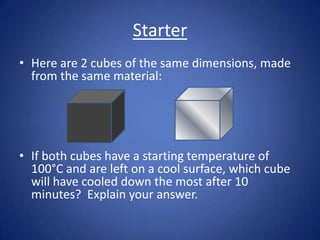
• Here are 2 cubes of the same dimensions, made
from the same material:
• If both cubes have a starting temperature of
100°C and are left on a cool surface, which cube
will have cooled down the most after 10
minutes? Explain your answer.
Learning Objectives
• Know that all surfaces emit and absorb some
thermal radiation
• Explain why surfaces emit and absorb
radiation at different rates
• Predict the rate at which objects will cool
compared to others based on their surfaces
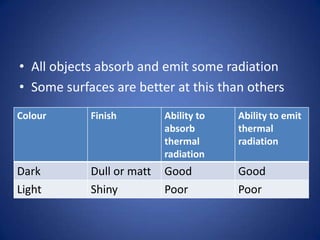
• All objects absorb and emit some radiation
• Some surfaces are better at this than others
Colour Finish Ability to
absorb
thermal
radiation
Ability to emit
thermal
radiation
Dark Dull or matt Good Good
Light Shiny Poor Poor
Drawing tables
• Independent variable
• Dependent variable
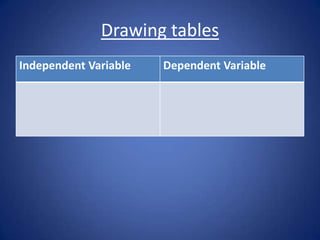
Drawing tables
Independent Variable Dependent Variable
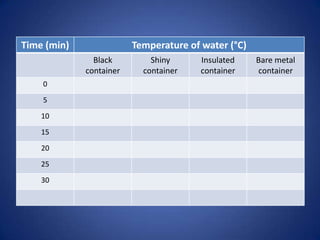
Time (min) Temperature of water (°C)
Black
container
Shiny
container
Insulated
container
Bare metal
container
0
5
10
15
20
25
30
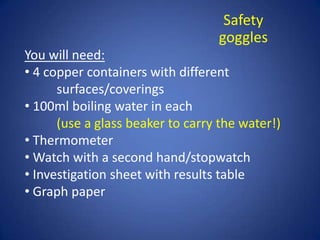
Safety
goggles
You will need:
• 4 copper containers with different
surfaces/coverings
• 100ml boiling water in each
(use a glass beaker to carry the water!)
• Thermometer
• Watch with a second hand/stopwatch
• Investigation sheet with results table
• Graph paper
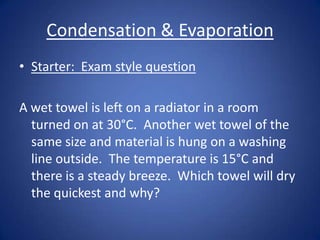
Condensation & Evaporation
• Starter: Exam style question
A wet towel is left on a radiator in a room
turned on at 30°C. Another wet towel of the
same size and material is hung on a washing
line outside. The temperature is 15°C and
there is a steady breeze. Which towel will dry
the quickest and why?
Learning objectives
• Define what is meant by evaporation and
condensation
• Explain how the 2 processes occur in terms of
particles and kinetic energy
• Tackle some exam style questions on heat
transfers
Evaporation & Condensation
Evaporation
Process by which a liquid becomes a gas.
Evaporation takes thermal energy away from the surface on
which it is occurring.
Particles move further appart due to more kinetic energy
Condensation
Process by which a gas becomes a liquid.
Particles move closer together as they have less kinetic energy
Insulation
Starter
• What do we mean by insulation?
• List as many ways as you can think of in which
we can insulate our homes
Learning objectives
• List some examples of how we could insulate
our homes
• Explain how each of these methods reduces
heat transfer and cuts energy costs
• Understand what is meant by a U-value
Cavity wall insulation
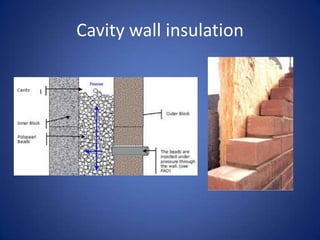
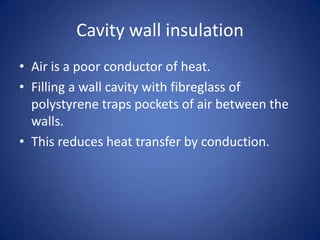
• Air is a poor conductor of heat.
• Filling a wall cavity with fibreglass of
polystyrene traps pockets of air between the
walls.
• This reduces heat transfer by conduction.
Double glazing
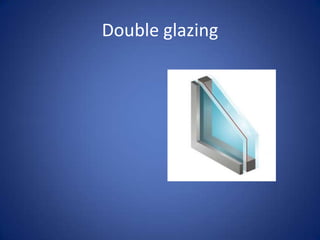
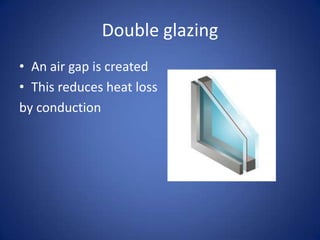
Double glazing
• An air gap is created
• This reduces heat loss
by conduction
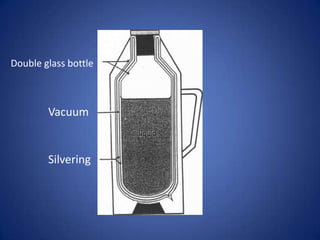
Double glass bottle
Vacuum
Silvering
U-values
U-values
• A measure of heat loss.
• The ‘overall heat transfer coefficient’
• The lower the U-value, the better the insulation
provided by the material.
• The U-valure currently required for a new-build
external wall is approx. 0.25.
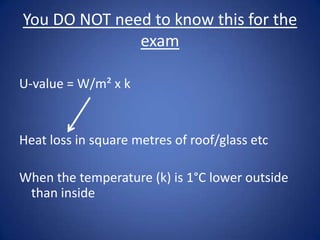
You DO NOT need to know this for the
exam
U-value = W/m² x k
Heat loss in square metres of roof/glass etc
When the temperature (k) is 1°C lower outside
than inside
Questions
1. What does a U-value measure?
2. Why would a U-value be relevant to someone living in a
warm climate?
3. Give 2 advantages of using materials with a low
U-value in a building.
4. Will a building that loses less energy have a low or a
high U-value?
5. Describe the effect adding insulation to a building has
on its U-value and heat loss to the surroundings.
IN FULL SENTENCES PLEASE!
Payback Time
Starter
Last lesson we talked about ways of insulating
buildings.
List as many ways of doing this as you can
remember.
Learning Objectives
• Understand what is meant by the term
‘payback time’
• Start to tackle some exam-style calculations
on payback time.
Effectiveness
Effectiveness
• The more effective a method of insulation, the
better it is at conserving heat energy.
• What does this tell you about its U-value?
Payback Time
Payback Time
• The time taken to recoup an investment
Payback time = Cost of insulator ÷ annual fuel saving

Ch heat transfer,_kinetic_theory,_insulation,_uvalues

  • 1.
  • 2.
  • 3.
    Starter Use the particlemodel to show what the particles of a solid, liquid and a gas look like: Solid Liquid Gas
  • 4.
    Learning Objectives • Knowthat all objects absorb and emit heat energy • Describe how particles move and transfer energy in solids, liquids and gases • Explain the process of conduction
  • 5.
  • 6.
  • 7.
    Heat Energy • Infra-redradiation • All objects absorb and emit heat energy
  • 8.
    Kinetic theory • Kinetictheory describes how particles move in solids liquids and gases In your books – Explain how the movement of particles is different in solids liquids and gases. – Discuss how materials change between the 3 states of matter
  • 9.
    Methods of HeatTransfer • Conduction • Convection • Radiation
  • 10.
  • 11.
    Conduction • Type ofthermal energy transfer which occurs in solids • Vibrating particles pass on extra kinetic energy (or heat) to neighbouring particles. • This eventually results in a rise in temperature at the other side of the solid.
  • 12.
    Thermochromic paper • Makea prediction as to which metal will be the best conductor and why • Describe how thermochromic paper works • Explain why the different pieces of paper changed colour at different rates • Explain the process of conduction • Which metal do you conclude was the best conductor? Why?
  • 13.
    Homework • Outline whathappens in conduction • Prediction & explanation • Method • Conclusion
  • 14.
  • 15.
    Draw one ofthese and explain what is happening
  • 16.
    Why do metalsfeel cold?
  • 17.
  • 18.
    Starter Match the keywords to the definitions and their explanations (don’t copy it out!) 1) Conduction 2) Convection 3) Radiation 3) Type of thermal energy transfer which occurs in solids 1) Type of thermal energy transfer which occurs in liquids and gases 2) Type of thermal energy transfer which does not require matter in order to travel 1) Vibrating particles pass on extra kinetic energy (or heat) to neighbouring particles. This eventually results in a rise in temperature at the other side of the solid. 3) Liquid and gas particles are free to move. Particles with more kinetic energy move from hotter regions to cooler regions, taking their thermal energy with them. 2) Thermal energy travels as waves. It travels at the speed of light. It can travel through a vacuum. This is the only way heat can reach us from the sun.
  • 19.
    Learning Objectives • Understandhow heat is transferred in liquids and gases • Explain how heat can be transferred in terms of convection currents • Apply your knowledge of the 3 methods of heat transfer to exam style questions
  • 20.
    Convection • Type ofthermal energy transfer which occurs in liquids and gases • Liquid and gas particles are free to move. • Particles with more kinetic energy move from hotter regions to cooler regions, taking their thermal energy with them.
  • 21.
    Convection Currents • Hotair/liquid is less dense than cooler air/ liquid so it rises • Cool air/liquid is more dense so it falls/sinks • The rising and falling of particles with more/less thermal energy results in a convection current • http://www.bbc.co.uk/schools/gcsebitesize/sc ience/aqa/energy/heatrev1.shtml
  • 22.
    Radiation • Method ofheat transfer which does not require particles • Heat energy travels as waves • This is how heat from the sun reaches Earth Remember! Not all radiation is dangerous!
  • 23.
  • 24.
    Starter • Here are2 cubes of the same dimensions, made from the same material: • If both cubes have a starting temperature of 100°C and are left on a cool surface, which cube will have cooled down the most after 10 minutes? Explain your answer.
  • 25.
    Learning Objectives • Knowthat all surfaces emit and absorb some thermal radiation • Explain why surfaces emit and absorb radiation at different rates • Predict the rate at which objects will cool compared to others based on their surfaces
  • 26.
    • All objectsabsorb and emit some radiation • Some surfaces are better at this than others Colour Finish Ability to absorb thermal radiation Ability to emit thermal radiation Dark Dull or matt Good Good Light Shiny Poor Poor
  • 27.
    Drawing tables • Independentvariable • Dependent variable
  • 28.
  • 29.
    Time (min) Temperatureof water (°C) Black container Shiny container Insulated container Bare metal container 0 5 10 15 20 25 30
  • 30.
    Safety goggles You will need: •4 copper containers with different surfaces/coverings • 100ml boiling water in each (use a glass beaker to carry the water!) • Thermometer • Watch with a second hand/stopwatch • Investigation sheet with results table • Graph paper
  • 31.
    Condensation & Evaporation •Starter: Exam style question A wet towel is left on a radiator in a room turned on at 30°C. Another wet towel of the same size and material is hung on a washing line outside. The temperature is 15°C and there is a steady breeze. Which towel will dry the quickest and why?
  • 32.
    Learning objectives • Definewhat is meant by evaporation and condensation • Explain how the 2 processes occur in terms of particles and kinetic energy • Tackle some exam style questions on heat transfers
  • 33.
  • 34.
    Evaporation & Condensation Evaporation Processby which a liquid becomes a gas. Evaporation takes thermal energy away from the surface on which it is occurring. Particles move further appart due to more kinetic energy Condensation Process by which a gas becomes a liquid. Particles move closer together as they have less kinetic energy
  • 35.
    Insulation Starter • What dowe mean by insulation? • List as many ways as you can think of in which we can insulate our homes
  • 36.
    Learning objectives • Listsome examples of how we could insulate our homes • Explain how each of these methods reduces heat transfer and cuts energy costs • Understand what is meant by a U-value
  • 37.
  • 38.
  • 39.
    Cavity wall insulation •Air is a poor conductor of heat. • Filling a wall cavity with fibreglass of polystyrene traps pockets of air between the walls. • This reduces heat transfer by conduction.
  • 40.
  • 41.
    Double glazing • Anair gap is created • This reduces heat loss by conduction
  • 42.
  • 43.
  • 44.
    U-values • A measureof heat loss. • The ‘overall heat transfer coefficient’ • The lower the U-value, the better the insulation provided by the material. • The U-valure currently required for a new-build external wall is approx. 0.25.
  • 45.
    You DO NOTneed to know this for the exam U-value = W/m² x k Heat loss in square metres of roof/glass etc When the temperature (k) is 1°C lower outside than inside
  • 46.
    Questions 1. What doesa U-value measure? 2. Why would a U-value be relevant to someone living in a warm climate? 3. Give 2 advantages of using materials with a low U-value in a building. 4. Will a building that loses less energy have a low or a high U-value? 5. Describe the effect adding insulation to a building has on its U-value and heat loss to the surroundings. IN FULL SENTENCES PLEASE!
  • 47.
    Payback Time Starter Last lessonwe talked about ways of insulating buildings. List as many ways of doing this as you can remember.
  • 48.
    Learning Objectives • Understandwhat is meant by the term ‘payback time’ • Start to tackle some exam-style calculations on payback time.
  • 49.
  • 50.
    Effectiveness • The moreeffective a method of insulation, the better it is at conserving heat energy. • What does this tell you about its U-value?
  • 51.
  • 52.
    Payback Time • Thetime taken to recoup an investment Payback time = Cost of insulator ÷ annual fuel saving