THE 301
Chapters 9 & 10 – Florenz Ziegfeld, Jerome Kern
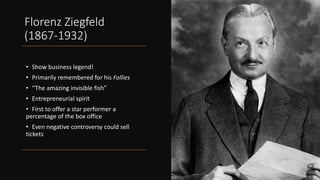
Florenz Ziegfeld
(1867-1932)
• Show business legend!
• Primarily remembered for his Follies
• “The amazing invisible fish”
• Entrepreneurial spirit
• First to offer a star performer a
percentage of the box office
• Even negative controversy could sell
tickets
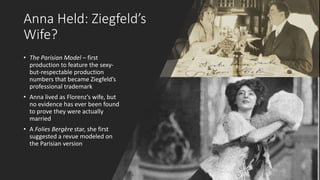
Anna Held: Ziegfeld’s
Wife?
• The Parisian Model – first
production to feature the sexy-
but-respectable production
numbers that became Ziegfeld’s
professional trademark
• Anna lived as Florenz’s wife, but
no evidence has ever been found
to prove they were actually
married
• A Folies Bergère star, she first
suggested a revue modeled on
the Parisian version
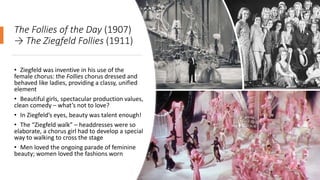
The Follies of the Day (1907)
→ The Ziegfeld Follies (1911)
• Ziegfeld was inventive in his use of the
female chorus: the Follies chorus dressed and
behaved like ladies, providing a classy, unified
element
• Beautiful girls, spectacular production values,
clean comedy – what’s not to love?
• In Ziegfeld’s eyes, beauty was talent enough!
• The “Ziegfeld walk” – headdresses were so
elaborate, a chorus girl had to develop a special
way to walking to cross the stage
• Men loved the ongoing parade of feminine
beauty; women loved the fashions worn
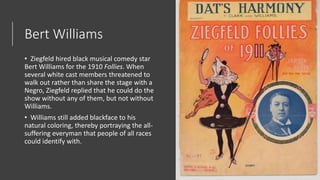
Bert Williams
• Ziegfeld hired black musical comedy star
Bert Williams for the 1910 Follies. When
several white cast members threatened to
walk out rather than share the stage with a
Negro, Ziegfeld replied that he could do the
show without any of them, but not without
Williams.
• Williams still added blackface to his
natural coloring, thereby portraying the all-
suffering everyman that people of all races
could identify with.
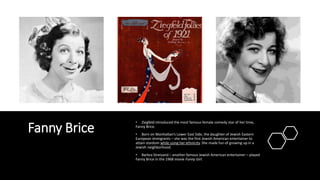
Fanny Brice
• Ziegfeld introduced the most famous female comedy star of her time,
Fanny Brice.
• Born on Manhattan’s Lower East Side, the daughter of Jewish Eastern
European immigrants – she was the first Jewish American entertainer to
attain stardom while using her ethnicity. She made fun of growing up in a
Jewish neighborhood.
• Barbra Streisand – another famous Jewish American entertainer – played
Fanny Brice in the 1968 movie Funny Girl.
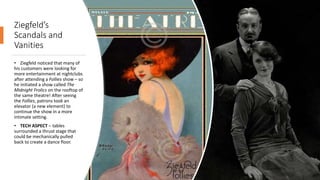
Ziegfeld’s
Scandals and
Vanities
• Ziegfeld noticed that many of
his customers were looking for
more entertainment at nightclubs
after attending a Follies show – so
he initiated a show called The
Midnight Frolics on the rooftop of
the same theatre! After seeing
the Follies, patrons took an
elevator (a new element) to
continue the show in a more
intimate setting.
• TECH ASPECT – tables
surrounded a thrust stage that
could be mechanically pulled
back to create a dance floor.
Ziegfeld’s Contribution to Musical Theatre
• Showmanship based on taking risks – he had taste and flair, raising the
bar for Broadway
• Elevated the place of the showgirl in Broadway entertainment, giving
them glamour and dignity
• Glorified the American comic, making them show biz legends
• Refined production values
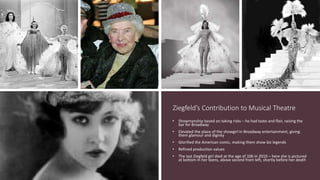
• The last Ziegfeld girl died at the age of 106 in 2010 – here she is pictured
at bottom in her teens, above second from left, shortly before her death
Jerome Kern and American
Ascendance (1914-1919)
Jerome Kern (1885-1945)
• His songs combined forthright
sentiment with refined romance – this
became Broadway’s future!
• His lyrics had the easy flow of
conversation and still sound fresh today
• He found a new way of expression
human emotion in song
The Princess Theatre
and its contribution to
successful shows
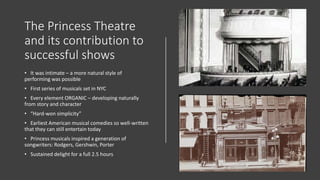
• It was intimate – a more natural style of
performing was possible
• First series of musicals set in NYC
• Every element ORGANIC – developing naturally
from story and character
• “Hard-won simplicity”
• Earliest American musical comedies so well-written
that they can still entertain today
• Princess musicals inspired a generation of
songwriters: Rodgers, Gershwin, Porter
• Sustained delight for a full 2.5 hours
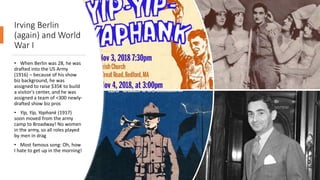
Irving Berlin
(again) and World
War I
• When Berlin was 28, he was
drafted into the US Army
(1916) – because of his show
biz background, he was
assigned to raise $35K to build
a visitor's center, and he was
assigned a team of <300 newly-
drafted show biz pros
• Yip, Yip, Yaphank (1917)
soon moved from the army
camp to Broadway! No women
in the army, so all roles played
by men in drag
• Most famous song: Oh, how
I hate to get up in the morning!

Ch. 9 10 - ziegfeld and kern

  • 1.
    THE 301 Chapters 9& 10 – Florenz Ziegfeld, Jerome Kern
  • 2.
    Florenz Ziegfeld (1867-1932) • Showbusiness legend! • Primarily remembered for his Follies • “The amazing invisible fish” • Entrepreneurial spirit • First to offer a star performer a percentage of the box office • Even negative controversy could sell tickets
  • 3.
    Anna Held: Ziegfeld’s Wife? •The Parisian Model – first production to feature the sexy- but-respectable production numbers that became Ziegfeld’s professional trademark • Anna lived as Florenz’s wife, but no evidence has ever been found to prove they were actually married • A Folies Bergère star, she first suggested a revue modeled on the Parisian version
  • 4.
    The Follies ofthe Day (1907) → The Ziegfeld Follies (1911) • Ziegfeld was inventive in his use of the female chorus: the Follies chorus dressed and behaved like ladies, providing a classy, unified element • Beautiful girls, spectacular production values, clean comedy – what’s not to love? • In Ziegfeld’s eyes, beauty was talent enough! • The “Ziegfeld walk” – headdresses were so elaborate, a chorus girl had to develop a special way to walking to cross the stage • Men loved the ongoing parade of feminine beauty; women loved the fashions worn
  • 5.
    Bert Williams • Ziegfeldhired black musical comedy star Bert Williams for the 1910 Follies. When several white cast members threatened to walk out rather than share the stage with a Negro, Ziegfeld replied that he could do the show without any of them, but not without Williams. • Williams still added blackface to his natural coloring, thereby portraying the all- suffering everyman that people of all races could identify with.
  • 6.
    Fanny Brice • Ziegfeldintroduced the most famous female comedy star of her time, Fanny Brice. • Born on Manhattan’s Lower East Side, the daughter of Jewish Eastern European immigrants – she was the first Jewish American entertainer to attain stardom while using her ethnicity. She made fun of growing up in a Jewish neighborhood. • Barbra Streisand – another famous Jewish American entertainer – played Fanny Brice in the 1968 movie Funny Girl.
  • 7.
    Ziegfeld’s Scandals and Vanities • Ziegfeldnoticed that many of his customers were looking for more entertainment at nightclubs after attending a Follies show – so he initiated a show called The Midnight Frolics on the rooftop of the same theatre! After seeing the Follies, patrons took an elevator (a new element) to continue the show in a more intimate setting. • TECH ASPECT – tables surrounded a thrust stage that could be mechanically pulled back to create a dance floor.
  • 8.
    Ziegfeld’s Contribution toMusical Theatre • Showmanship based on taking risks – he had taste and flair, raising the bar for Broadway • Elevated the place of the showgirl in Broadway entertainment, giving them glamour and dignity • Glorified the American comic, making them show biz legends • Refined production values • The last Ziegfeld girl died at the age of 106 in 2010 – here she is pictured at bottom in her teens, above second from left, shortly before her death
  • 9.
    Jerome Kern andAmerican Ascendance (1914-1919)
  • 10.
    Jerome Kern (1885-1945) •His songs combined forthright sentiment with refined romance – this became Broadway’s future! • His lyrics had the easy flow of conversation and still sound fresh today • He found a new way of expression human emotion in song
  • 11.
    The Princess Theatre andits contribution to successful shows • It was intimate – a more natural style of performing was possible • First series of musicals set in NYC • Every element ORGANIC – developing naturally from story and character • “Hard-won simplicity” • Earliest American musical comedies so well-written that they can still entertain today • Princess musicals inspired a generation of songwriters: Rodgers, Gershwin, Porter • Sustained delight for a full 2.5 hours
  • 12.
    Irving Berlin (again) andWorld War I • When Berlin was 28, he was drafted into the US Army (1916) – because of his show biz background, he was assigned to raise $35K to build a visitor's center, and he was assigned a team of <300 newly- drafted show biz pros • Yip, Yip, Yaphank (1917) soon moved from the army camp to Broadway! No women in the army, so all roles played by men in drag • Most famous song: Oh, how I hate to get up in the morning!