CHAPTER 2:
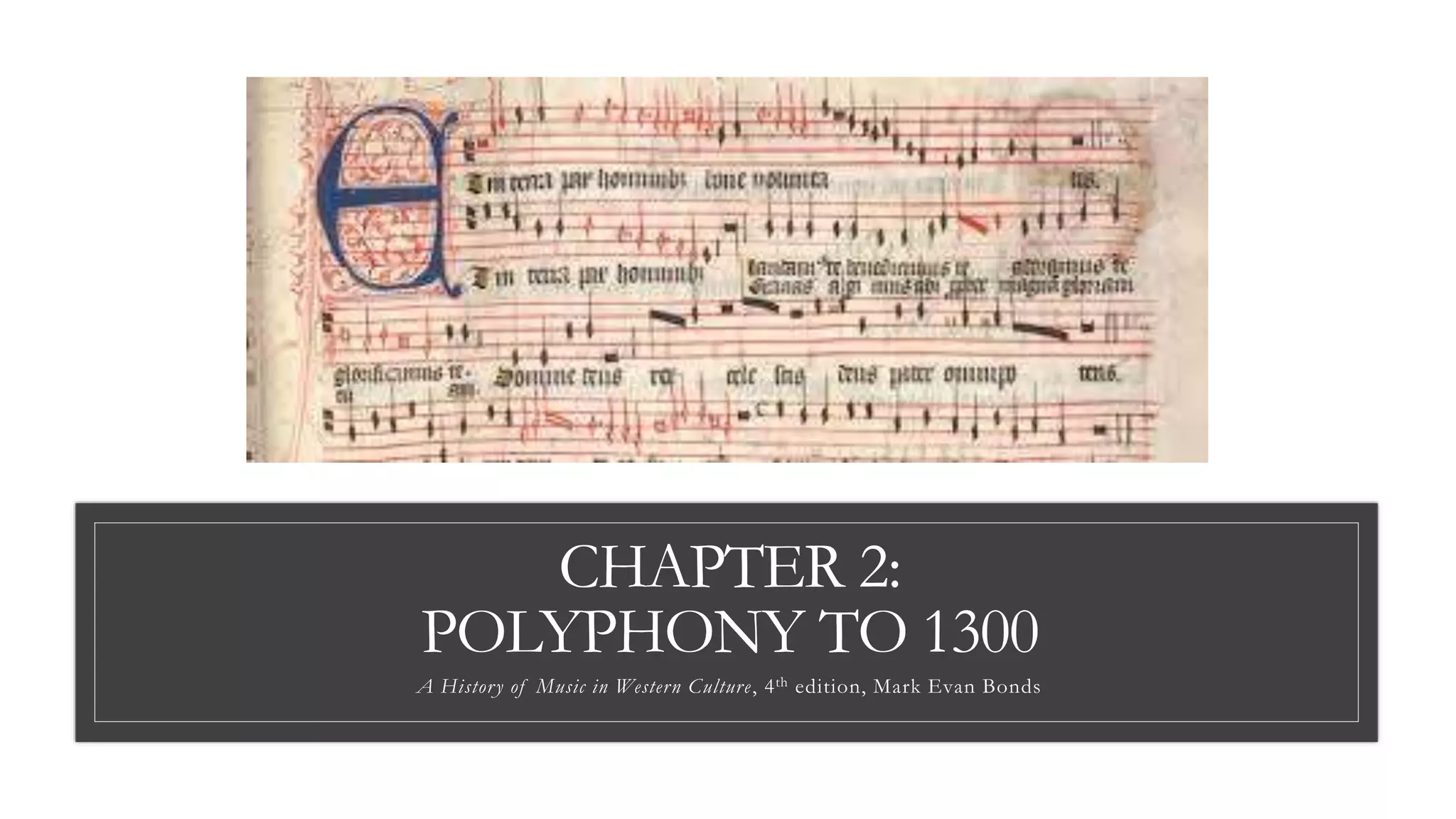
POLYPHONY TO 1300
A History of Music in Western Culture, 4th edition, Mark Evan Bonds
Organum
This Photo by Unknown Author is licensed under CC BY-SA
• Polyphonic work consisting of an original
plainchant melody in ONE voice, plus at
least one additional voice above or below
~850 AD
• Additional voice runs parallel to the
plainchant melody at a constant interval
Parallel organum
• The simultaneous combination of
independent musical lines
Counterpoint
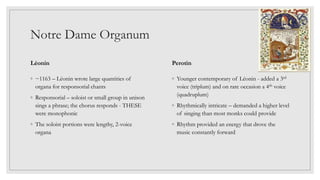
Notre Dame Organum
Léonin
◦ ~1163 – Léonin wrote large quantities of
organa for responsorial chants
◦ Responsorial – soloist or small group in unison
sings a phrase; the chorus responds - THESE
were monophonic
◦ The soloist portions were lengthy, 2-voice
organa
Perotin
◦ Younger contemporary of Léonin - added a 3rd
voice (triplum) and on rare occasion a 4th voice
(quadruplum)
◦ Rhythmically intricate – demanded a higher level
of singing than most monks could provide
◦ Rhythm provided an energy that drove the
music constantly forward
Clausula and Motet
◦ Clausulae – brief polyphonic sections of
measured organum that could be substituted at
will into a larger piece
◦ A clausula is NOT an independent composition
◦ Very much like tropes, but inserted into a
composition, not a plainchant
◦ Impetus comes from the desire to write new
music by adding layers of musical
“commentary” above the plainchant
◦ No text included!
◦ Motet – added SECULAR TEXT
◦ ~1185-1250: new text added to an existing
clausula to be performed outside the church
◦ Sung in the vernacular, not liturgical Latin
◦ Texted duplum = motet because it had words
(Fr. mot = word)
◦ Polytextual motet = different voices sing
different text simultaneously (<1250 AD)
◦ Multiple repetition of rhythmic and melodic
ideas – isorhythm
Conductus
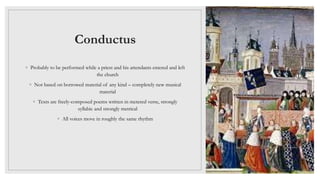
◦ Probably to be performed while a priest and his attendants entered and left
the church
◦ Not based on borrowed material of any kind – completely new musical
material
◦ Texts are freely-composed poems written in metered verse, strongly
syllabic and strongly metrical
◦ All voices move in roughly the same rhythm
MENSURAL NOTATION
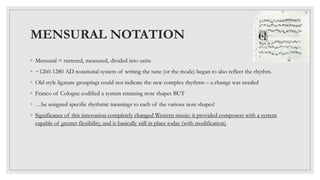
◦ Mensural = metered, measured, divided into units
◦ ~1260-1280 AD notational system of writing the tune (or the mode) began to also reflect the rhythm.
◦ Old style ligature groupings could not indicate the new complex rhythms – a change was needed
◦ Franco of Cologne codified a system retaining note shapes BUT
◦ …he assigned specific rhythmic meanings to each of the various note shapes!
◦ Significance of this innovation completely changed Western music: it provided composers with a system
capable of greater flexibility, and is basically still in place today (with modification)

Chapter 2 polyphony to 1300

  • 1.
    CHAPTER 2: POLYPHONY TO1300 A History of Music in Western Culture, 4th edition, Mark Evan Bonds
  • 2.
    Organum This Photo byUnknown Author is licensed under CC BY-SA • Polyphonic work consisting of an original plainchant melody in ONE voice, plus at least one additional voice above or below ~850 AD • Additional voice runs parallel to the plainchant melody at a constant interval Parallel organum • The simultaneous combination of independent musical lines Counterpoint
  • 3.
    Notre Dame Organum Léonin ◦~1163 – Léonin wrote large quantities of organa for responsorial chants ◦ Responsorial – soloist or small group in unison sings a phrase; the chorus responds - THESE were monophonic ◦ The soloist portions were lengthy, 2-voice organa Perotin ◦ Younger contemporary of Léonin - added a 3rd voice (triplum) and on rare occasion a 4th voice (quadruplum) ◦ Rhythmically intricate – demanded a higher level of singing than most monks could provide ◦ Rhythm provided an energy that drove the music constantly forward
  • 4.
    Clausula and Motet ◦Clausulae – brief polyphonic sections of measured organum that could be substituted at will into a larger piece ◦ A clausula is NOT an independent composition ◦ Very much like tropes, but inserted into a composition, not a plainchant ◦ Impetus comes from the desire to write new music by adding layers of musical “commentary” above the plainchant ◦ No text included! ◦ Motet – added SECULAR TEXT ◦ ~1185-1250: new text added to an existing clausula to be performed outside the church ◦ Sung in the vernacular, not liturgical Latin ◦ Texted duplum = motet because it had words (Fr. mot = word) ◦ Polytextual motet = different voices sing different text simultaneously (<1250 AD) ◦ Multiple repetition of rhythmic and melodic ideas – isorhythm
  • 5.
    Conductus ◦ Probably tobe performed while a priest and his attendants entered and left the church ◦ Not based on borrowed material of any kind – completely new musical material ◦ Texts are freely-composed poems written in metered verse, strongly syllabic and strongly metrical ◦ All voices move in roughly the same rhythm
  • 6.
    MENSURAL NOTATION ◦ Mensural= metered, measured, divided into units ◦ ~1260-1280 AD notational system of writing the tune (or the mode) began to also reflect the rhythm. ◦ Old style ligature groupings could not indicate the new complex rhythms – a change was needed ◦ Franco of Cologne codified a system retaining note shapes BUT ◦ …he assigned specific rhythmic meanings to each of the various note shapes! ◦ Significance of this innovation completely changed Western music: it provided composers with a system capable of greater flexibility, and is basically still in place today (with modification)