Chapter Seven
Controlling
1
Introduction
• Controlling is the last management function and
it affects or is affected by the other four
functions.
• Planning, organizing, staffing & directing must
be monitored to maintain their effectiveness &
efficiency.
• Efficiency and effectiveness are the measures of
performance.
• Mangers review performances of employees
daily, weekly, and monthly to determine actual
performances.
2
Cont’d
• In the past managers believed that the necessity of
control arose only when something went wrong.
• Then, the objective of control was to find out the
persons responsibility and take actions against
him/her. This is only negative view of control.
• In modern management, take steps to prevent
mistakes or variations in future.
• Only a continuous control can achieve the
objective. Controlling is not occasional and
emergency.
3
Cont’d
• The concept of controlling is often confused
with lack of freedom.
• The opposite of control is not freedom but
chaos or anarchy.
• Control is fully consistent with freedom.
• Without control freedom cannot be sustained
for long. Without freedom control becomes
ineffective.
• Both autonomy (freedom) and accountability
are embedded in the concept of control.
4
The purpose of controlling
• Management control is a systematic effort
 To design information feedback systems.
 To set performance standards with planning
objectives
 To compare actual performances with
standards
 To determine whether there are any
deviations.
 To take any action required
 To assure that all organizational resources
are being used in the most effective &
efficient way.
5
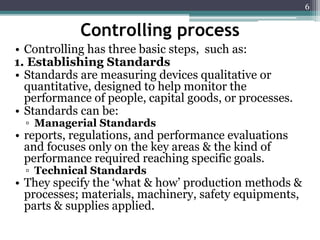
Controlling process
• Controlling has three basic steps, such as:
1. Establishing Standards
• Standards are measuring devices qualitative or
quantitative, designed to help monitor the
performance of people, capital goods, or processes.
• Standards can be:
▫ Managerial Standards
• reports, regulations, and performance evaluations
and focuses only on the key areas & the kind of
performance required reaching specific goals.
▫ Technical Standards
• They specify the ‘what & how’ production methods &
processes; materials, machinery, safety equipments,
parts & supplies applied.
6
Cont’d
2. Measuring Performance
• It is measuring the performance & determining if the
performance is in line with the set of standards. It is
comparison between ‘what is’ & ‘what should be’. It is
discovering the deviation.
3. Taking corrective action
• Determining precise action to be taken depends on three
things.
The standard
Accuracy of the measurements
The diagnosis of the person or device and causes of
deviation.
• Corrective action can be arranged by management in advance through
policies, procedure & practices. It is sometimes automatic.
7
Essentials of a Sound Controlling System
• The essentials of a sound control system are as
follows:
Suitable: The control system should be appropriate
to the nature and needs of the activity. For example, a
machine based method of production requires
control system which is different from the system that
is used in labor intensive methods of production.
Timely and forward looking: The control system
should be directed towards future. It should report all
the deviations from the standards quickly in order to
safeguard the future. The feedback system should be
as short and as quick as possible.
8
Cont’d
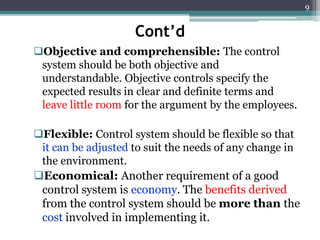
Objective and comprehensible: The control
system should be both objective and
understandable. Objective controls specify the
expected results in clear and definite terms and
leave little room for the argument by the employees.
Flexible: Control system should be flexible so that
it can be adjusted to suit the needs of any change in
the environment.
Economical: Another requirement of a good
control system is economy. The benefits derived
from the control system should be more than the
cost involved in implementing it.
9
Cont’d
Control by exceptions: This is also known as “management
by exception” according to this principle, consider only
significant deviations from standards. An attempt to go
through all deviations tends to increase unnecessary work and
decrease attention on important problems.
In other words, the system should be prescriptive and
operational. It must disclose where failures are occurring, who
is responsible for them and what should be done about them. It
must focus more on action than on information.
Acceptable to organization members: The system should be
acceptable to organization members. When standards are set
unilaterally by upper level managers, there is a danger that
employees will regard those standards of unreasonable or
unrealistic. They may then refuse to meet them.
10
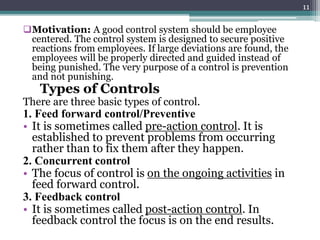
Motivation: A good control system should be employee
centered. The control system is designed to secure positive
reactions from employees. If large deviations are found, the
employees will be properly directed and guided instead of
being punished. The very purpose of a control is prevention
and not punishing.
Types of Controls
There are three basic types of control.
1. Feed forward control/Preventive
• It is sometimes called pre-action control. It is
established to prevent problems from occurring
rather than to fix them after they happen.
2. Concurrent control
• The focus of control is on the ongoing activities in
feed forward control.
3. Feedback control
• It is sometimes called post-action control. In
feedback control the focus is on the end results.
11
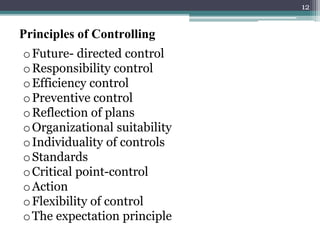
Principles of Controlling
oFuture- directed control
oResponsibility control
oEfficiency control
oPreventive control
oReflection of plans
oOrganizational suitability
oIndividuality of controls
oStandards
oCritical point-control
oAction
oFlexibility of control
oThe expectation principle
12
Yes!!
We have
Finished
13
Quiz 1
1. List and discuss about types of controlling
2. What is the purpose of controlling?
14

CH - 7 Controlling.pptx

  • 1.
  • 2.
    Introduction • Controlling isthe last management function and it affects or is affected by the other four functions. • Planning, organizing, staffing & directing must be monitored to maintain their effectiveness & efficiency. • Efficiency and effectiveness are the measures of performance. • Mangers review performances of employees daily, weekly, and monthly to determine actual performances. 2
  • 3.
    Cont’d • In thepast managers believed that the necessity of control arose only when something went wrong. • Then, the objective of control was to find out the persons responsibility and take actions against him/her. This is only negative view of control. • In modern management, take steps to prevent mistakes or variations in future. • Only a continuous control can achieve the objective. Controlling is not occasional and emergency. 3
  • 4.
    Cont’d • The conceptof controlling is often confused with lack of freedom. • The opposite of control is not freedom but chaos or anarchy. • Control is fully consistent with freedom. • Without control freedom cannot be sustained for long. Without freedom control becomes ineffective. • Both autonomy (freedom) and accountability are embedded in the concept of control. 4
  • 5.
    The purpose ofcontrolling • Management control is a systematic effort  To design information feedback systems.  To set performance standards with planning objectives  To compare actual performances with standards  To determine whether there are any deviations.  To take any action required  To assure that all organizational resources are being used in the most effective & efficient way. 5
  • 6.
    Controlling process • Controllinghas three basic steps, such as: 1. Establishing Standards • Standards are measuring devices qualitative or quantitative, designed to help monitor the performance of people, capital goods, or processes. • Standards can be: ▫ Managerial Standards • reports, regulations, and performance evaluations and focuses only on the key areas & the kind of performance required reaching specific goals. ▫ Technical Standards • They specify the ‘what & how’ production methods & processes; materials, machinery, safety equipments, parts & supplies applied. 6
  • 7.
    Cont’d 2. Measuring Performance •It is measuring the performance & determining if the performance is in line with the set of standards. It is comparison between ‘what is’ & ‘what should be’. It is discovering the deviation. 3. Taking corrective action • Determining precise action to be taken depends on three things. The standard Accuracy of the measurements The diagnosis of the person or device and causes of deviation. • Corrective action can be arranged by management in advance through policies, procedure & practices. It is sometimes automatic. 7
  • 8.
    Essentials of aSound Controlling System • The essentials of a sound control system are as follows: Suitable: The control system should be appropriate to the nature and needs of the activity. For example, a machine based method of production requires control system which is different from the system that is used in labor intensive methods of production. Timely and forward looking: The control system should be directed towards future. It should report all the deviations from the standards quickly in order to safeguard the future. The feedback system should be as short and as quick as possible. 8
  • 9.
    Cont’d Objective and comprehensible:The control system should be both objective and understandable. Objective controls specify the expected results in clear and definite terms and leave little room for the argument by the employees. Flexible: Control system should be flexible so that it can be adjusted to suit the needs of any change in the environment. Economical: Another requirement of a good control system is economy. The benefits derived from the control system should be more than the cost involved in implementing it. 9
  • 10.
    Cont’d Control by exceptions:This is also known as “management by exception” according to this principle, consider only significant deviations from standards. An attempt to go through all deviations tends to increase unnecessary work and decrease attention on important problems. In other words, the system should be prescriptive and operational. It must disclose where failures are occurring, who is responsible for them and what should be done about them. It must focus more on action than on information. Acceptable to organization members: The system should be acceptable to organization members. When standards are set unilaterally by upper level managers, there is a danger that employees will regard those standards of unreasonable or unrealistic. They may then refuse to meet them. 10
  • 11.
    Motivation: A goodcontrol system should be employee centered. The control system is designed to secure positive reactions from employees. If large deviations are found, the employees will be properly directed and guided instead of being punished. The very purpose of a control is prevention and not punishing. Types of Controls There are three basic types of control. 1. Feed forward control/Preventive • It is sometimes called pre-action control. It is established to prevent problems from occurring rather than to fix them after they happen. 2. Concurrent control • The focus of control is on the ongoing activities in feed forward control. 3. Feedback control • It is sometimes called post-action control. In feedback control the focus is on the end results. 11
  • 12.
    Principles of Controlling oFuture-directed control oResponsibility control oEfficiency control oPreventive control oReflection of plans oOrganizational suitability oIndividuality of controls oStandards oCritical point-control oAction oFlexibility of control oThe expectation principle 12
  • 13.
  • 14.
    Quiz 1 1. Listand discuss about types of controlling 2. What is the purpose of controlling? 14