Chapters 5 & 6
Describe the characteristics of successful
entrepreneurs
Discuss responsibilities of owning your
own business
Explain advantages/disadvantages of
partnerships
Describe the types of businesses suited to
the partnership form of business
Recall: A person who assumes the risk of
starting, owning, and operating a business
for PROFIT
Often invest months/years before earning
profit
½ of all new business end within the first
five to six years
How many people own businesses?
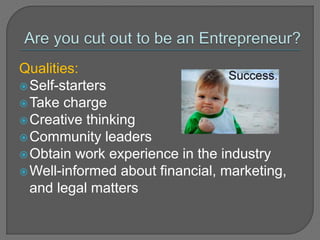
Qualities:
Self-starters
Take charge
Creative thinking
Community leaders
Obtain work experience in the industry
Well-informed about financial, marketing,
and legal matters
To start your own business you need:
• Adequate funds
• General knowledge about business
• Some work experience
• A business opportunity
• A BUSINESS PLAN - written document that
describes the nature of the business, its goals and
objectives and how they will be achieved
• **most important step in starting a business
Page 114 in textbook
Sole Proprietorship:
 Most common form of business organization
 Owned and managed by 1 person – the “Proprietor”
• Performs day-to-day tasks with help of hired
employees
• Furnishes expertise, $, and management
• Is entitled to ALL PROFIT
• Creditors have full claim to the assets/property if
business is in debt
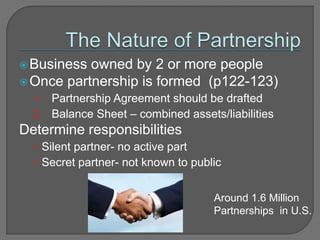
Business owned by 2 or more people
Once partnership is formed (p122-123)
1. Partnership Agreement should be drafted
2. Balance Sheet – combined assets/liabilities
Determine responsibilities
• Silent partner- no active part
• Secret partner- not known to public
Around 1.6 Million
Partnerships in U.S.
Sole Proprietorship vs.
Partnership
Owner is Boss
Owner receives all PROFITS
Owner personally knows employees and
customers – develops close relationships
Owner can make quick decisions
Owner is free from ‘red tape’ – lots of legal
documents or gov’t restrictions
Pay LESS income tax than Corporation
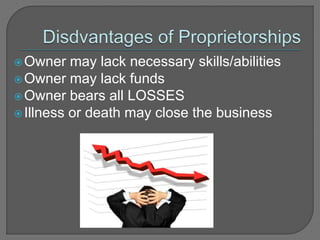
Owner may lack necessary skills/abilities
Owner may lack funds
Owner bears all LOSSES
Illness or death may close the business
 Personal services
• Dentists
• Barbers
• Landscapers
• Carpenters
 Those which sell merchandise/services on a
small scale
• Family restaurants
• Newspaper stands
• Small grocery stores
 Do not require a large amount of CAPITAL
Business owned by 2 or more people
Once partnership is formed (p122-123)
1. Partnership Agreement should be drafted
2. Balance Sheet – combined assets/liabilities
Determine responsibilities
• Silent partner- no active part
• Secret partner- not known to public
Around 1.6 Million
Partnerships in U.S.
Skills & abilities are pooled together
More Capital
Credit position improved
Contribution of Goodwill improved
↑ed concern in business management
Lower tax burden than corporations
Reduced competition
Operating more efficiently by
combining 2 or more businesses
Unlimited financial liability
Disagreement among partners
Each partner bound by contract of others
Uncertain life
Limited sources of capital
Unsatisfactory division of profits
Difficulty withdrawing from partnership
More than one kind of product or service
• Car dealership- sales / service depts
Operates in more than 1 location
Operates more than 8 hours/day
Popular with professional services
• Lawyers (Schwebel, Goetz & Seiben)
• Doctors
• Accountants
• Financial consultants

Ch 5 proprietorship & partnerships

  • 1.
  • 2.
    Describe the characteristicsof successful entrepreneurs Discuss responsibilities of owning your own business Explain advantages/disadvantages of partnerships Describe the types of businesses suited to the partnership form of business
  • 3.
    Recall: A personwho assumes the risk of starting, owning, and operating a business for PROFIT Often invest months/years before earning profit ½ of all new business end within the first five to six years How many people own businesses?
  • 4.
    Qualities: Self-starters Take charge Creative thinking Communityleaders Obtain work experience in the industry Well-informed about financial, marketing, and legal matters
  • 5.
    To start yourown business you need: • Adequate funds • General knowledge about business • Some work experience • A business opportunity • A BUSINESS PLAN - written document that describes the nature of the business, its goals and objectives and how they will be achieved • **most important step in starting a business
  • 6.
  • 7.
    Sole Proprietorship:  Mostcommon form of business organization  Owned and managed by 1 person – the “Proprietor” • Performs day-to-day tasks with help of hired employees • Furnishes expertise, $, and management • Is entitled to ALL PROFIT • Creditors have full claim to the assets/property if business is in debt
  • 8.
    Business owned by2 or more people Once partnership is formed (p122-123) 1. Partnership Agreement should be drafted 2. Balance Sheet – combined assets/liabilities Determine responsibilities • Silent partner- no active part • Secret partner- not known to public Around 1.6 Million Partnerships in U.S.
  • 9.
  • 10.
    Owner is Boss Ownerreceives all PROFITS Owner personally knows employees and customers – develops close relationships Owner can make quick decisions Owner is free from ‘red tape’ – lots of legal documents or gov’t restrictions Pay LESS income tax than Corporation
  • 11.
    Owner may lacknecessary skills/abilities Owner may lack funds Owner bears all LOSSES Illness or death may close the business
  • 12.
     Personal services •Dentists • Barbers • Landscapers • Carpenters  Those which sell merchandise/services on a small scale • Family restaurants • Newspaper stands • Small grocery stores  Do not require a large amount of CAPITAL
  • 13.
    Business owned by2 or more people Once partnership is formed (p122-123) 1. Partnership Agreement should be drafted 2. Balance Sheet – combined assets/liabilities Determine responsibilities • Silent partner- no active part • Secret partner- not known to public Around 1.6 Million Partnerships in U.S.
  • 14.
    Skills & abilitiesare pooled together More Capital Credit position improved Contribution of Goodwill improved ↑ed concern in business management Lower tax burden than corporations Reduced competition Operating more efficiently by combining 2 or more businesses
  • 15.
    Unlimited financial liability Disagreementamong partners Each partner bound by contract of others Uncertain life Limited sources of capital Unsatisfactory division of profits Difficulty withdrawing from partnership
  • 16.
    More than onekind of product or service • Car dealership- sales / service depts Operates in more than 1 location Operates more than 8 hours/day Popular with professional services • Lawyers (Schwebel, Goetz & Seiben) • Doctors • Accountants • Financial consultants