Sole Proprietorships and
Partnerships
Characteristics of Entrepreneurs
□ Entrepreneur – person who assumes
the risk of starting, owning, and
operating a business for the purpose of
making a profit
□ Half of all businesses end within the first
five or six years
□ Self-starters, enjoy working on their
own
□ Obtain work experience in the field
before starting businesses of their own
Preparing a Business Plan
□ Should be done before starting a business
□ Business plan
□ Written document that describes the nature of
the business, the company’s goals and
objectives, and how they will be achieved
□ Helps lay out the risks and responsibilities involved
in starting a business; helps decide if you should
really go into business
Reasons for Failure
□ Did not prepare a business plan
□ Unrealistic plan
□ Plan is just prepared because the bank
required it
*Plan needs to be realistic and well-
designed*
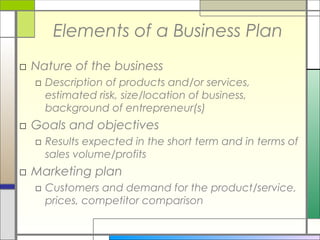
Elements of a Business Plan
□ Nature of the business
□ Description of products and/or services,
estimated risk, size/location of business,
background of entrepreneur(s)
□ Goals and objectives
□ Results expected in the short term and in terms of
sales volume/profits
□ Marketing plan
□ Customers and demand for the product/service,
prices, competitor comparison
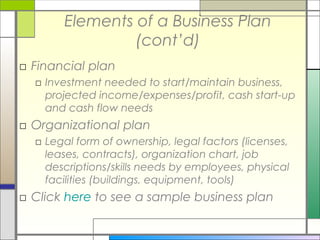
Elements of a Business Plan
(cont’d)
□ Financial plan
□ Investment needed to start/maintain business,
projected income/expenses/profit, cash start-up
and cash flow needs
□ Organizational plan
□ Legal form of ownership, legal factors (licenses,
leases, contracts), organization chart, job
descriptions/skills needs by employees, physical
facilities (buildings, equipment, tools)
□ Click here to see a sample business plan
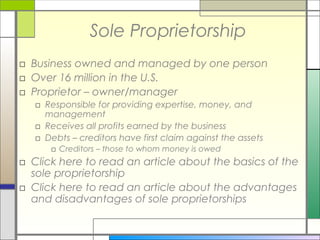
Sole Proprietorship
□ Business owned and managed by one person
□ Over 16 million in the U.S.
□ Proprietor – owner/manager
□ Responsible for providing expertise, money, and
management
□ Receives all profits earned by the business
□ Debts – creditors have first claim against the assets
□ Creditors – those to whom money is owed
□ Click here to read an article about the basics of the
sole proprietorship
□ Click here to read an article about the advantages
and disadvantages of sole proprietorships
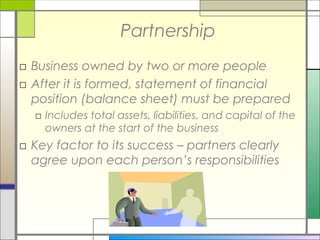
Partnership
□ Business owned by two or more people
□ After it is formed, statement of financial
position (balance sheet) must be prepared
□ Includes total assets, liabilities, and capital of the
owners at the start of the business
□ Key factor to its success – partners clearly
agree upon each person’s responsibilities
Partnership (cont’d)
□ Partnership – learn more by clicking
here (often referred to as a general
partnership)
□ Click here to read an article about the
advantages and disadvantages of
partnerships
□ Limited partnership – learn more by
clicking here
Businesses Suited for Partnerships
□ Sell more than one product or service
□ Each partner handles a specialized phase
of the business
□Example – restaurant where one partner
focuses on food preparation while the other
one is in charge of customer service
□ Also common for businesses that form
as sole proprietorships
□ Example – accountants, financial
consultants, lawyers
Business Name
□ Can do business under the name or names
of the owner or owners
□ Many states prohibit using and Company or
& Co., unless it identifies additional partners
□ “Company” must be identified by registration at
a public recording office (ex. county clerk’s
office)
□ Can do business under a trade name, but
creditors must know all those responsible for the
business
Reference
□ Evarard, Kenneth E., Burrow, James L.
(2001). Business Principles and
Management. Mason, OH: South-
Western.

Unit 3 business mangement

  • 1.
  • 2.
    Characteristics of Entrepreneurs □Entrepreneur – person who assumes the risk of starting, owning, and operating a business for the purpose of making a profit □ Half of all businesses end within the first five or six years □ Self-starters, enjoy working on their own □ Obtain work experience in the field before starting businesses of their own
  • 3.
    Preparing a BusinessPlan □ Should be done before starting a business □ Business plan □ Written document that describes the nature of the business, the company’s goals and objectives, and how they will be achieved □ Helps lay out the risks and responsibilities involved in starting a business; helps decide if you should really go into business
  • 4.
    Reasons for Failure □Did not prepare a business plan □ Unrealistic plan □ Plan is just prepared because the bank required it *Plan needs to be realistic and well- designed*
  • 5.
    Elements of aBusiness Plan □ Nature of the business □ Description of products and/or services, estimated risk, size/location of business, background of entrepreneur(s) □ Goals and objectives □ Results expected in the short term and in terms of sales volume/profits □ Marketing plan □ Customers and demand for the product/service, prices, competitor comparison
  • 6.
    Elements of aBusiness Plan (cont’d) □ Financial plan □ Investment needed to start/maintain business, projected income/expenses/profit, cash start-up and cash flow needs □ Organizational plan □ Legal form of ownership, legal factors (licenses, leases, contracts), organization chart, job descriptions/skills needs by employees, physical facilities (buildings, equipment, tools) □ Click here to see a sample business plan
  • 7.
    Sole Proprietorship □ Businessowned and managed by one person □ Over 16 million in the U.S. □ Proprietor – owner/manager □ Responsible for providing expertise, money, and management □ Receives all profits earned by the business □ Debts – creditors have first claim against the assets □ Creditors – those to whom money is owed □ Click here to read an article about the basics of the sole proprietorship □ Click here to read an article about the advantages and disadvantages of sole proprietorships
  • 8.
    Partnership □ Business ownedby two or more people □ After it is formed, statement of financial position (balance sheet) must be prepared □ Includes total assets, liabilities, and capital of the owners at the start of the business □ Key factor to its success – partners clearly agree upon each person’s responsibilities
  • 9.
    Partnership (cont’d) □ Partnership– learn more by clicking here (often referred to as a general partnership) □ Click here to read an article about the advantages and disadvantages of partnerships □ Limited partnership – learn more by clicking here
  • 10.
    Businesses Suited forPartnerships □ Sell more than one product or service □ Each partner handles a specialized phase of the business □Example – restaurant where one partner focuses on food preparation while the other one is in charge of customer service □ Also common for businesses that form as sole proprietorships □ Example – accountants, financial consultants, lawyers
  • 11.
    Business Name □ Cando business under the name or names of the owner or owners □ Many states prohibit using and Company or & Co., unless it identifies additional partners □ “Company” must be identified by registration at a public recording office (ex. county clerk’s office) □ Can do business under a trade name, but creditors must know all those responsible for the business
  • 12.
    Reference □ Evarard, KennethE., Burrow, James L. (2001). Business Principles and Management. Mason, OH: South- Western.