THE 2nd ANNUAL INVESTING  IN CHINA & INDIA SUMMIT Beyond the Capital Rush —Exploring Sector-by-Sector Investment Strategies in this Exploding Market June 19th - 20th, 2006 The Hyatt Regency, San Francisco, CA Seth R. Freeman, CIRA, CEO EM Capital Management, LLC EM Capital, Inc.
Intro Background of EM Capital Management, LLC and EM Capital India Strategies to complete an effective restructuring for key participants in the capital structure Unique considerations of Cross-Border & Cross-Cultural Issues  Role of turnaround management to provide the operational and strategic process necessary to execute a restructuring plan Finding and structuring capital needed to successfully execute turnaround and restructuring plan? Need for cross-border turnaround and restructuring expertise in a global business environment
Workouts versus Turnarounds Financial restructuring or just fixing the problems  Forces of globalization & regionalization on domestic companies and banks Next generation of managers and shareholders borrowing internationally NPL/NPA resolution creating new professional turnaround managers in India Growing impact of institutional investors-domestic & foreign Role of Creditor rights in emerging markets
The strategies are determined by the type and objectives of the parties Shareholders Major Customers Secured Creditors Unsecured Creditors Regulators Management Employees Board Members Prospective acquirers Politicians Restructure, Cash-out, Sell, Merge or Liquidate?
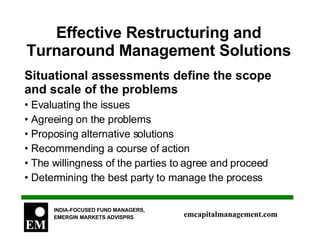
Effective Restructuring and Turnaround Management Solutions Situational assessments define the scope and scale of the problems Evaluating the issues Agreeing on the problems Proposing alternative solutions Recommending a course of action The willingness of the parties to agree and proceed Determining the best party to manage the process
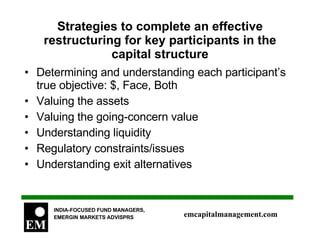
Strategies to complete an effective restructuring for key participants in the capital structure Determining and understanding each participant’s true objective: $, Face, Both Valuing the assets Valuing the going-concern value Understanding liquidity Regulatory constraints/issues Understanding exit alternatives
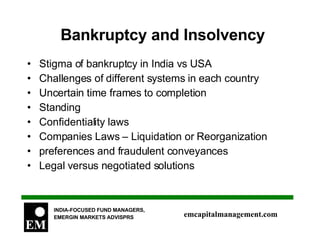
Bankruptcy and Insolvency Stigma of bankruptcy in India vs USA Challenges of different systems in each country Uncertain time frames to completion Standing Confidentiality laws Companies Laws – Liquidation or Reorganization preferences and fraudulent conveyances Legal versus negotiated solutions
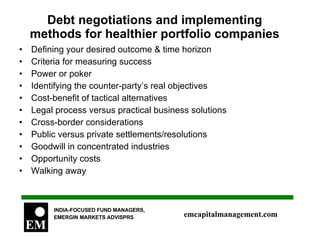
Debt negotiations and implementing methods for healthier portfolio companies Defining your desired outcome & time horizon Criteria for measuring success Power or poker Identifying the counter-party’s real objectives Cost-benefit of tactical alternatives Legal process versus practical business solutions Cross-border considerations Public versus private settlements/resolutions Goodwill in concentrated industries Opportunity costs Walking away
Management & Employees Role, duties and  liabilities  of company directors in a workout or restructuring Role of investors and creditors – domestic and foreign participants Is current board/management the problem or the solution? Retaining key staff during the work-out Union issues - Legacy liabilities Attracting new management
What to expect: managing uncertainty Establishing and maintaining a pace of urgency Crucial communication/reporting protocols  Dynamic business  & legal environment Exogenous factors impact success Discovering fraud++ in the organization New conflicts requiring resolution Using turnaround professionals proactively
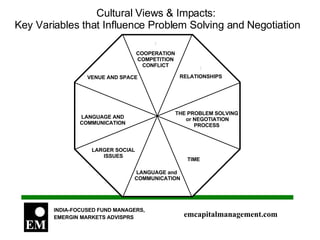
Cultural Views & Impacts:  Key Variables that Influence Problem Solving and Negotiation VENUE AND SPACE : COOPERATION COMPETITION CONFLICT : RELATIONSHIPS THE PROBLEM SOLVING or NEGOTIATION PROCESS TIME LANGUAGE and  COMMUNICATION LARGER SOCIAL ISSUES LANGUAGE AND COMMUNICATION
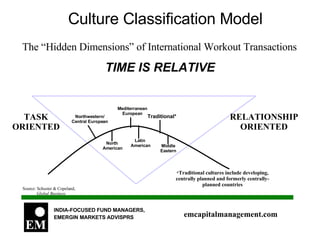
Culture Classification Model TIME IS RELATIVE TASK ORIENTED RELATIONSHIP ORIENTED Northwestern/ Central European North American Mediterranean European Latin American Traditional* Middle Eastern Source: Schuster & Copeland,  Global Business The “Hidden Dimensions” of International Workout Transactions  * Traditional cultures include developing, centrally planned and formerly centrally-planned countries
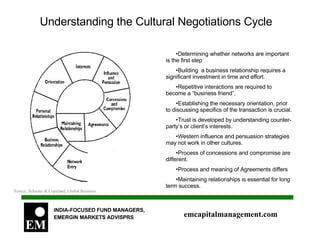
Understanding the Cultural Negotiations Cycle Source: Schuster & Copeland, Global Business Determining whether networks are important is the first step Building  a business relationship requires a significant investment in time and effort. Repetitive interactions are required to become a “business friend”. Establishing the necessary orientation, prior to discussing specifics of the transaction is crucial. Trust is developed by understanding counter-party’s or client’s interests. Western influence and persuasion strategies may not work in other cultures. Process of concessions and compromise are different. Process and meaning of Agreements differs Maintaining relationships is essential for long term success.
Finding fresh capital to successfully execute turnaround and restructuring plan? Dedicated debt funds seeking yield in Indian distressed assets and portfolios Private equity funds and specialized restructuring focused equity funds Establishing credibility - management & reporting A U.S. Chapter 11 or off-shore equivalent to prevent local enforcement and to secure new debt Analyzing and leveraging asset classes Monetizing the  new asset class: IP Obtaining liquidity from the major fixed asset: real estate International capital sources - asset-based finance Creative strategies and overlooked sources of capital
New role of distressed debt buying in a turnaround and restructuring process International “opportunity funds” purchase distressed ”fulcrum” debt seeking to influence restructuring plan Debt investors’ interests generally not aligned with management or equity shareholders However, nimble Indian equity holders employ strategies and tactics to retain stake Unsecured creditors may seek to influence secured creditors May be a source of additional capital in a workout Distressed debt investors are significantly more sophisticated and decisive than traditional bank lenders Distressed debt investors have 3 to 5 year horizons
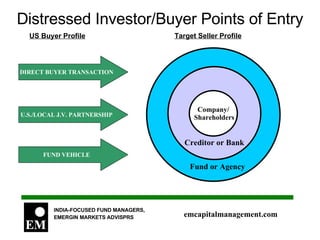
Company/ Shareholders Distressed Investor/Buyer Points of Entry Company/ Shareholders FUND VEHICLE U.S./LOCAL J.V. PARTNERSHIP DIRECT BUYER TRANSACTION Target Seller Profile US Buyer Profile Creditor or Bank Fund or Agency
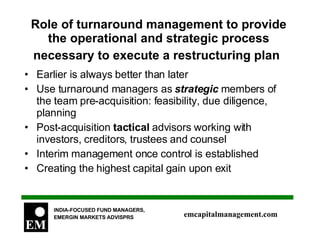
Role of turnaround management to provide the operational and strategic process necessary to execute a restructuring plan   Earlier is always better than later Use turnaround managers as  strategic  members of the team pre-acquisition: feasibility, due diligence, planning Post-acquisition  tactical  advisors working with investors, creditors, trustees and counsel Interim management once control is established Creating the highest capital gain upon exit
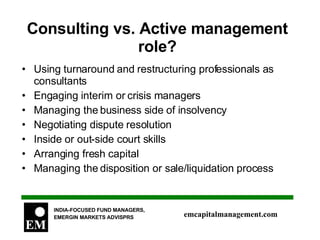
Consulting vs. Active management role? Using turnaround and restructuring professionals as consultants Engaging interim or crisis managers Managing the business side of insolvency Negotiating dispute resolution Inside or out-side court skills Arranging fresh capital Managing the disposition or sale/liquidation process
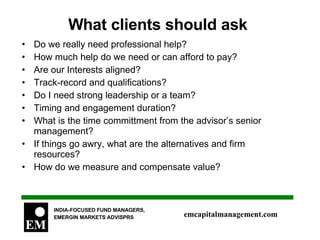
What clients should ask  Do we really need professional help? How much help do we need or can afford to pay? Are our Interests aligned? Track-record and qualifications? Do I need strong leadership or a team? Timing and engagement duration? What is the time committment from the advisor’s senior management? If things go awry, what are the alternatives and firm resources? How do we measure and compensate value?
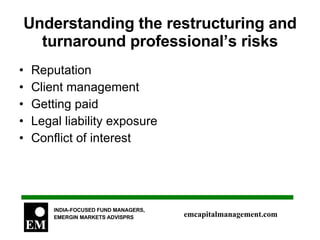
Understanding the restructuring and turnaround professional’s risks Reputation  Client management Getting paid Legal liability exposure Conflict of interest
The Future Domestic firms with expanding foreign debt Multinationals with foreign subs and JV’s in India Impact of foreign-owned banks in India $Billions of NPL’s / NPA’s requiring resolution/capital Cross-border insolvency & creditor rights Cultural and language barriers Fraud & corruption Speed in decision-making Impact of China and competing markets
Turnaround & Restructuring Resources www.airacira.org www.abiworld.org www.turnaround.org www.insol.org

India China 06 20 06

  • 1.
    THE 2nd ANNUALINVESTING IN CHINA & INDIA SUMMIT Beyond the Capital Rush —Exploring Sector-by-Sector Investment Strategies in this Exploding Market June 19th - 20th, 2006 The Hyatt Regency, San Francisco, CA Seth R. Freeman, CIRA, CEO EM Capital Management, LLC EM Capital, Inc.
  • 2.
    Intro Background ofEM Capital Management, LLC and EM Capital India Strategies to complete an effective restructuring for key participants in the capital structure Unique considerations of Cross-Border & Cross-Cultural Issues Role of turnaround management to provide the operational and strategic process necessary to execute a restructuring plan Finding and structuring capital needed to successfully execute turnaround and restructuring plan? Need for cross-border turnaround and restructuring expertise in a global business environment
  • 3.
    Workouts versus TurnaroundsFinancial restructuring or just fixing the problems Forces of globalization & regionalization on domestic companies and banks Next generation of managers and shareholders borrowing internationally NPL/NPA resolution creating new professional turnaround managers in India Growing impact of institutional investors-domestic & foreign Role of Creditor rights in emerging markets
  • 4.
    The strategies aredetermined by the type and objectives of the parties Shareholders Major Customers Secured Creditors Unsecured Creditors Regulators Management Employees Board Members Prospective acquirers Politicians Restructure, Cash-out, Sell, Merge or Liquidate?
  • 5.
    Effective Restructuring andTurnaround Management Solutions Situational assessments define the scope and scale of the problems Evaluating the issues Agreeing on the problems Proposing alternative solutions Recommending a course of action The willingness of the parties to agree and proceed Determining the best party to manage the process
  • 6.
    Strategies to completean effective restructuring for key participants in the capital structure Determining and understanding each participant’s true objective: $, Face, Both Valuing the assets Valuing the going-concern value Understanding liquidity Regulatory constraints/issues Understanding exit alternatives
  • 7.
    Bankruptcy and InsolvencyStigma of bankruptcy in India vs USA Challenges of different systems in each country Uncertain time frames to completion Standing Confidentiality laws Companies Laws – Liquidation or Reorganization preferences and fraudulent conveyances Legal versus negotiated solutions
  • 8.
    Debt negotiations andimplementing methods for healthier portfolio companies Defining your desired outcome & time horizon Criteria for measuring success Power or poker Identifying the counter-party’s real objectives Cost-benefit of tactical alternatives Legal process versus practical business solutions Cross-border considerations Public versus private settlements/resolutions Goodwill in concentrated industries Opportunity costs Walking away
  • 9.
    Management & EmployeesRole, duties and liabilities of company directors in a workout or restructuring Role of investors and creditors – domestic and foreign participants Is current board/management the problem or the solution? Retaining key staff during the work-out Union issues - Legacy liabilities Attracting new management
  • 10.
    What to expect:managing uncertainty Establishing and maintaining a pace of urgency Crucial communication/reporting protocols Dynamic business & legal environment Exogenous factors impact success Discovering fraud++ in the organization New conflicts requiring resolution Using turnaround professionals proactively
  • 11.
    Cultural Views &Impacts: Key Variables that Influence Problem Solving and Negotiation VENUE AND SPACE : COOPERATION COMPETITION CONFLICT : RELATIONSHIPS THE PROBLEM SOLVING or NEGOTIATION PROCESS TIME LANGUAGE and COMMUNICATION LARGER SOCIAL ISSUES LANGUAGE AND COMMUNICATION
  • 12.
    Culture Classification ModelTIME IS RELATIVE TASK ORIENTED RELATIONSHIP ORIENTED Northwestern/ Central European North American Mediterranean European Latin American Traditional* Middle Eastern Source: Schuster & Copeland, Global Business The “Hidden Dimensions” of International Workout Transactions * Traditional cultures include developing, centrally planned and formerly centrally-planned countries
  • 13.
    Understanding the CulturalNegotiations Cycle Source: Schuster & Copeland, Global Business Determining whether networks are important is the first step Building a business relationship requires a significant investment in time and effort. Repetitive interactions are required to become a “business friend”. Establishing the necessary orientation, prior to discussing specifics of the transaction is crucial. Trust is developed by understanding counter-party’s or client’s interests. Western influence and persuasion strategies may not work in other cultures. Process of concessions and compromise are different. Process and meaning of Agreements differs Maintaining relationships is essential for long term success.
  • 14.
    Finding fresh capitalto successfully execute turnaround and restructuring plan? Dedicated debt funds seeking yield in Indian distressed assets and portfolios Private equity funds and specialized restructuring focused equity funds Establishing credibility - management & reporting A U.S. Chapter 11 or off-shore equivalent to prevent local enforcement and to secure new debt Analyzing and leveraging asset classes Monetizing the new asset class: IP Obtaining liquidity from the major fixed asset: real estate International capital sources - asset-based finance Creative strategies and overlooked sources of capital
  • 15.
    New role ofdistressed debt buying in a turnaround and restructuring process International “opportunity funds” purchase distressed ”fulcrum” debt seeking to influence restructuring plan Debt investors’ interests generally not aligned with management or equity shareholders However, nimble Indian equity holders employ strategies and tactics to retain stake Unsecured creditors may seek to influence secured creditors May be a source of additional capital in a workout Distressed debt investors are significantly more sophisticated and decisive than traditional bank lenders Distressed debt investors have 3 to 5 year horizons
  • 16.
    Company/ Shareholders DistressedInvestor/Buyer Points of Entry Company/ Shareholders FUND VEHICLE U.S./LOCAL J.V. PARTNERSHIP DIRECT BUYER TRANSACTION Target Seller Profile US Buyer Profile Creditor or Bank Fund or Agency
  • 17.
    Role of turnaroundmanagement to provide the operational and strategic process necessary to execute a restructuring plan Earlier is always better than later Use turnaround managers as strategic members of the team pre-acquisition: feasibility, due diligence, planning Post-acquisition tactical advisors working with investors, creditors, trustees and counsel Interim management once control is established Creating the highest capital gain upon exit
  • 18.
    Consulting vs. Activemanagement role? Using turnaround and restructuring professionals as consultants Engaging interim or crisis managers Managing the business side of insolvency Negotiating dispute resolution Inside or out-side court skills Arranging fresh capital Managing the disposition or sale/liquidation process
  • 19.
    What clients shouldask Do we really need professional help? How much help do we need or can afford to pay? Are our Interests aligned? Track-record and qualifications? Do I need strong leadership or a team? Timing and engagement duration? What is the time committment from the advisor’s senior management? If things go awry, what are the alternatives and firm resources? How do we measure and compensate value?
  • 20.
    Understanding the restructuringand turnaround professional’s risks Reputation Client management Getting paid Legal liability exposure Conflict of interest
  • 21.
    The Future Domesticfirms with expanding foreign debt Multinationals with foreign subs and JV’s in India Impact of foreign-owned banks in India $Billions of NPL’s / NPA’s requiring resolution/capital Cross-border insolvency & creditor rights Cultural and language barriers Fraud & corruption Speed in decision-making Impact of China and competing markets
  • 22.
    Turnaround & RestructuringResources www.airacira.org www.abiworld.org www.turnaround.org www.insol.org