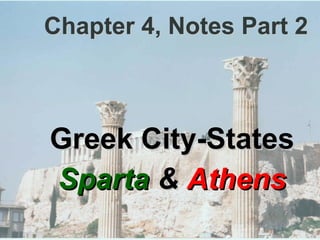
Chapter 4, Notes Part 2 Greek City-States Sparta  &  Athens
Sparta – Military State
In Search of… “The Perfect Cheer!”
EASTLAKE HIGH SCHOOL… Go Spartans! My name is Craig I give good hugs You're not my friend If you do drugs
Like many Greek city-states,  Sparta needed more land It  gained land through conquest  of the neighboring Laconians and Messenians.
 
These peoples became serfs who worked for the Spartans.  They were called  helots ,  from the Greek for  “capture.”
 
Military system based on   hoplites  =  Infantry who carried shield, sword & spear The fought shoulder to shoulder in a   phalanx  formation
Spartan  Hoplite   Phalanx
“ The Spartan Lifestyle”
Spartan Women Only in Sparta did girls receive public education in other city-states most women were completely illiterate.
Only in Sparta were girls allowed to  engage in sport .   Only in Sparta did women possess  economic power  and influence.  Scandalized observers from other Greek cities commented that not only did  Spartan women have opinions  they were not afraid to voice in public, AND their husbands actually listened to them!
Spartan Lifestyle: Military State Stayed in the army until 60 Women & men lived apart Women expected to remain fit to bear & raise healthy children Men expected to be brave in battle, to win or be killed
Spartan Government:  Oligarchy Two kings who led the Spartan army Five men known as  ephors  were responsible for the youths’ education and the citizens’ conduct.  A council of two kings and 28 men over 60 years of age decided on the issues the assembly would vote on.  The assembly did not debate, but only voted.
DISCUSSION ? Sparta kept its strict discipline in part by closing itself off from outside influences and new ideas.  Why was doing so important to maintaining their authoritarian society?
Possible Answer: Being open to new and foreign ideas and influences could be a basis for criticizing society and the government.
Athenian  Democracy
ATHENS Pericles giving his famous  Funeral Oration
Athenian revolt ends the tyranny in 510  B.C. The Athenians appointed the reformer: Cleisthenes   (KLYS-thuh-neez)   leader in 508  B.C.
Athens: Birthplace of Democracy
Cleisthenes  (KLYS-thuh-neez) He created a new council of 500  proposed laws and supervised treasury and foreign affairs. “ Father of Democracy”
Assembly had final authority to pass laws after free & open debate Reforms of Cleisthenes created the foundation for Athenian democracy
Age Of Pericles Peak of Athenian Culture Athens becomes the center of Greek society
Role of Athenian Women Could take part in most religious festivals, but otherwise  excluded from public life Could not own property Always accompanied by a male guardian Chief obligation to  bear male children Supervised the slaves that did housework Married at 14 or 15 No formal education
Wars & Strife in Greece Persian Wars  – Greece defeats Persia The world becomes spilt between Athens and Sparta Peloponnesian War  – lasted about 25 years  It splintered and weakened the Greeks as a whole.  Macedonia to the north would take advantage of this


Ch 4 Greece 2

  • 1.
    Chapter 4, NotesPart 2 Greek City-States Sparta & Athens
  • 2.
  • 3.
    In Search of…“The Perfect Cheer!”
  • 4.
    EASTLAKE HIGH SCHOOL…Go Spartans! My name is Craig I give good hugs You're not my friend If you do drugs
  • 5.
    Like many Greekcity-states, Sparta needed more land It gained land through conquest of the neighboring Laconians and Messenians.
  • 6.
  • 7.
    These peoples becameserfs who worked for the Spartans. They were called helots , from the Greek for “capture.”
  • 8.
  • 9.
    Military system basedon hoplites = Infantry who carried shield, sword & spear The fought shoulder to shoulder in a phalanx formation
  • 10.
  • 11.
    “ The SpartanLifestyle”
  • 12.
    Spartan Women Onlyin Sparta did girls receive public education in other city-states most women were completely illiterate.
  • 13.
    Only in Spartawere girls allowed to engage in sport . Only in Sparta did women possess economic power and influence. Scandalized observers from other Greek cities commented that not only did Spartan women have opinions they were not afraid to voice in public, AND their husbands actually listened to them!
  • 14.
    Spartan Lifestyle: MilitaryState Stayed in the army until 60 Women & men lived apart Women expected to remain fit to bear & raise healthy children Men expected to be brave in battle, to win or be killed
  • 15.
    Spartan Government: Oligarchy Two kings who led the Spartan army Five men known as ephors were responsible for the youths’ education and the citizens’ conduct. A council of two kings and 28 men over 60 years of age decided on the issues the assembly would vote on. The assembly did not debate, but only voted.
  • 16.
    DISCUSSION ? Spartakept its strict discipline in part by closing itself off from outside influences and new ideas. Why was doing so important to maintaining their authoritarian society?
  • 17.
    Possible Answer: Beingopen to new and foreign ideas and influences could be a basis for criticizing society and the government.
  • 18.
  • 19.
    ATHENS Pericles givinghis famous Funeral Oration
  • 20.
    Athenian revolt endsthe tyranny in 510 B.C. The Athenians appointed the reformer: Cleisthenes (KLYS-thuh-neez) leader in 508 B.C.
  • 21.
  • 22.
    Cleisthenes (KLYS-thuh-neez)He created a new council of 500 proposed laws and supervised treasury and foreign affairs. “ Father of Democracy”
  • 23.
    Assembly had finalauthority to pass laws after free & open debate Reforms of Cleisthenes created the foundation for Athenian democracy
  • 24.
    Age Of PericlesPeak of Athenian Culture Athens becomes the center of Greek society
  • 25.
    Role of AthenianWomen Could take part in most religious festivals, but otherwise excluded from public life Could not own property Always accompanied by a male guardian Chief obligation to bear male children Supervised the slaves that did housework Married at 14 or 15 No formal education
  • 26.
    Wars & Strifein Greece Persian Wars – Greece defeats Persia The world becomes spilt between Athens and Sparta Peloponnesian War – lasted about 25 years It splintered and weakened the Greeks as a whole. Macedonia to the north would take advantage of this
  • 27.
  • 28.
  • 29.
  • 30.
  • 31.
  • 32.