©PearsonEducation,Inc.Allrightsreserved.
Name______________________________ Class__________________ Date ______________
Chapter 39 Endocrine and Reproductive Systems
Section 39–1 The Endocrine System (pages 997–1002)
This section describes the function of the endocrine system and explains how
it maintains homeostasis.
Introduction (page 997)
1. What makes up the endocrine system? The endocrine system is made up of glands that
release their products into the bloodstream.
2. What do the products of the endocrine system do? They deliver messages throughout
the body.
Hormones (page 997)
3. Chemicals released in one part of the body that travel through the bloodstream and
affect the activities of cells in other parts of the body are called .
4. How do hormones affect the activities of other cells? Hormones bind to specific chemical
receptors on other cells.
5. Cells that have receptors for a particular hormone are referred to as
.
6. Is the following sentence true or false? Cells without receptors are not affected by
hormones.
7. Is the following sentence true or false? Generally, the body’s responses to hormones are
quicker and shorter lasting than the responses to nerve impulses.
Glands (page 998)
8. An organ that produces and releases a substance, or secretion, is called a(an)
.
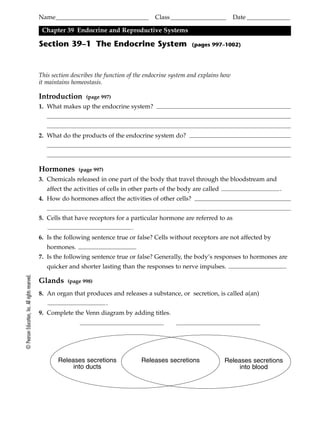
9. Complete the Venn diagram by adding titles.
gland
false
true
target cells
hormones
Releases secretions
into ducts
Releases secretions
into blood
Releases secretions
Endocrine glandExocrine gland
BIO_ALL IN1_StGd_tese_ch39 8/7/03 4:40 PM Page 551
©PearsonEducation,Inc.Allrightsreserved.
Name______________________________ Class__________________ Date ______________
10. What is the function of the parathyroid glands? Their function is to regulate the level of
calcium in the blood.
Match the endocrine gland with the hormone it produces.
Endocrine Gland
b 11. Pineal
d 12. Thyroid
a 13. Pancreas
e 14. Thymus
c 15. Adrenal
g 16. Ovary
f 17. Testis
18. The hormone that regulates metabolism is .
Hormone Action (page 999)
19. List the two general groups into which hormones may be classified.
a.
b.
20. Circle the letter of each sentence that is true about steroid hormones.
a. They are lipids.
b. They cannot cross cell membranes.
c. They help regulate gene expression.
d. They can enter the nucleus.
21. Is the following sentence true or false? Steroid hormones are produced from
cholesterol.
22. Circle the letter of each sentence that is true about nonsteroid hormones.
a. They are proteins, small peptides, or modified amino acids.
b. They can cross cell membranes.
c. They rely on secondary messengers.
d. They cannot enter the nucleus.
23. Is the following sentence true or false? Secondary messengers may include calcium
ions, cAMP, nucleotides, and fatty acids.
Prostaglandins (page 1000)
24. Hormonelike substances produced by other kinds of cells and tissues are called
.prostaglandins
true
true
Nonsteroid hormones
Steroid hormones
thyroxine
Hormone It Produces
a. Glucagon
b. Melatonin
c. Epinephrine
d. Thyroxine
e. Thymosin
f. Testosterone
g. Estrogen
BIO_ALL IN1_StGd_tese_ch39 8/7/03 4:40 PM Page 552
©PearsonEducation,Inc.Allrightsreserved.
Name______________________________ Class__________________ Date ______________
25. Why are prostaglandins known as “local hormones”? They generally affect only nearby
cells and tissues.
26. Is the following sentence true or false? Some prostaglandins cause smooth muscles to
contract.
Control of the Endocrine System (pages 1000–1001)
27. When does feedback inhibition occur? It occurs when an increase in any substance “feeds
back” to inhibit the process that produced the substance in the first place.
28. Fill in the missing labels in the diagram to show how the thyroid gland is regulated by
feedback controls.
true
TSHHypothalamus TRH Thyroxine
Anterior
pituitary Thyroid
Inhibition
29. Circle the letter of each event that occurs when core body temperature begins to drop.
a. The hypothalamus produces less TRH.
b. More TSH is released.
c. Less thyroxine is released.
d. Metabolic activity increases.
30. Is the following sentence true or false? As you lose water, the concentration of
dissolved materials in the blood falls.
Complementary Hormone Action (page 1002)
31. What is complementary hormone action? It refers to the joint control of part of the body’s
internal environment by two hormones with opposite effects.
32. Is the following sentence true or false? Calcitonin increases the concentration of
calcium in the blood.
33. If calcium levels drop too low, the parathyroid glands release .
34. How does PTH increase calcium levels? PTH stimulates the intestine to absorb more
calcium from food, causes the kidneys to retain more calcium, and stimulates bone cells to release
some of the calcium stored in bone.
35. Why is the regulation of calcium levels so important? If calcium levels drop below their
normal range, blood cannot clot, muscles cannot contract, and transport across cell membranes
may fail.
PTH
false
false
BIO_ALL IN1_StGd_tese_ch39 8/7/03 4:40 PM Page 553

Ch. 39 1 endocrine syst WS

  • 1.
    ©PearsonEducation,Inc.Allrightsreserved. Name______________________________ Class__________________ Date______________ Chapter 39 Endocrine and Reproductive Systems Section 39–1 The Endocrine System (pages 997–1002) This section describes the function of the endocrine system and explains how it maintains homeostasis. Introduction (page 997) 1. What makes up the endocrine system? The endocrine system is made up of glands that release their products into the bloodstream. 2. What do the products of the endocrine system do? They deliver messages throughout the body. Hormones (page 997) 3. Chemicals released in one part of the body that travel through the bloodstream and affect the activities of cells in other parts of the body are called . 4. How do hormones affect the activities of other cells? Hormones bind to specific chemical receptors on other cells. 5. Cells that have receptors for a particular hormone are referred to as . 6. Is the following sentence true or false? Cells without receptors are not affected by hormones. 7. Is the following sentence true or false? Generally, the body’s responses to hormones are quicker and shorter lasting than the responses to nerve impulses. Glands (page 998) 8. An organ that produces and releases a substance, or secretion, is called a(an) . 9. Complete the Venn diagram by adding titles. gland false true target cells hormones Releases secretions into ducts Releases secretions into blood Releases secretions Endocrine glandExocrine gland BIO_ALL IN1_StGd_tese_ch39 8/7/03 4:40 PM Page 551
  • 2.
    ©PearsonEducation,Inc.Allrightsreserved. Name______________________________ Class__________________ Date______________ 10. What is the function of the parathyroid glands? Their function is to regulate the level of calcium in the blood. Match the endocrine gland with the hormone it produces. Endocrine Gland b 11. Pineal d 12. Thyroid a 13. Pancreas e 14. Thymus c 15. Adrenal g 16. Ovary f 17. Testis 18. The hormone that regulates metabolism is . Hormone Action (page 999) 19. List the two general groups into which hormones may be classified. a. b. 20. Circle the letter of each sentence that is true about steroid hormones. a. They are lipids. b. They cannot cross cell membranes. c. They help regulate gene expression. d. They can enter the nucleus. 21. Is the following sentence true or false? Steroid hormones are produced from cholesterol. 22. Circle the letter of each sentence that is true about nonsteroid hormones. a. They are proteins, small peptides, or modified amino acids. b. They can cross cell membranes. c. They rely on secondary messengers. d. They cannot enter the nucleus. 23. Is the following sentence true or false? Secondary messengers may include calcium ions, cAMP, nucleotides, and fatty acids. Prostaglandins (page 1000) 24. Hormonelike substances produced by other kinds of cells and tissues are called .prostaglandins true true Nonsteroid hormones Steroid hormones thyroxine Hormone It Produces a. Glucagon b. Melatonin c. Epinephrine d. Thyroxine e. Thymosin f. Testosterone g. Estrogen BIO_ALL IN1_StGd_tese_ch39 8/7/03 4:40 PM Page 552
  • 3.
    ©PearsonEducation,Inc.Allrightsreserved. Name______________________________ Class__________________ Date______________ 25. Why are prostaglandins known as “local hormones”? They generally affect only nearby cells and tissues. 26. Is the following sentence true or false? Some prostaglandins cause smooth muscles to contract. Control of the Endocrine System (pages 1000–1001) 27. When does feedback inhibition occur? It occurs when an increase in any substance “feeds back” to inhibit the process that produced the substance in the first place. 28. Fill in the missing labels in the diagram to show how the thyroid gland is regulated by feedback controls. true TSHHypothalamus TRH Thyroxine Anterior pituitary Thyroid Inhibition 29. Circle the letter of each event that occurs when core body temperature begins to drop. a. The hypothalamus produces less TRH. b. More TSH is released. c. Less thyroxine is released. d. Metabolic activity increases. 30. Is the following sentence true or false? As you lose water, the concentration of dissolved materials in the blood falls. Complementary Hormone Action (page 1002) 31. What is complementary hormone action? It refers to the joint control of part of the body’s internal environment by two hormones with opposite effects. 32. Is the following sentence true or false? Calcitonin increases the concentration of calcium in the blood. 33. If calcium levels drop too low, the parathyroid glands release . 34. How does PTH increase calcium levels? PTH stimulates the intestine to absorb more calcium from food, causes the kidneys to retain more calcium, and stimulates bone cells to release some of the calcium stored in bone. 35. Why is the regulation of calcium levels so important? If calcium levels drop below their normal range, blood cannot clot, muscles cannot contract, and transport across cell membranes may fail. PTH false false BIO_ALL IN1_StGd_tese_ch39 8/7/03 4:40 PM Page 553