




MANISH ADLAKHA
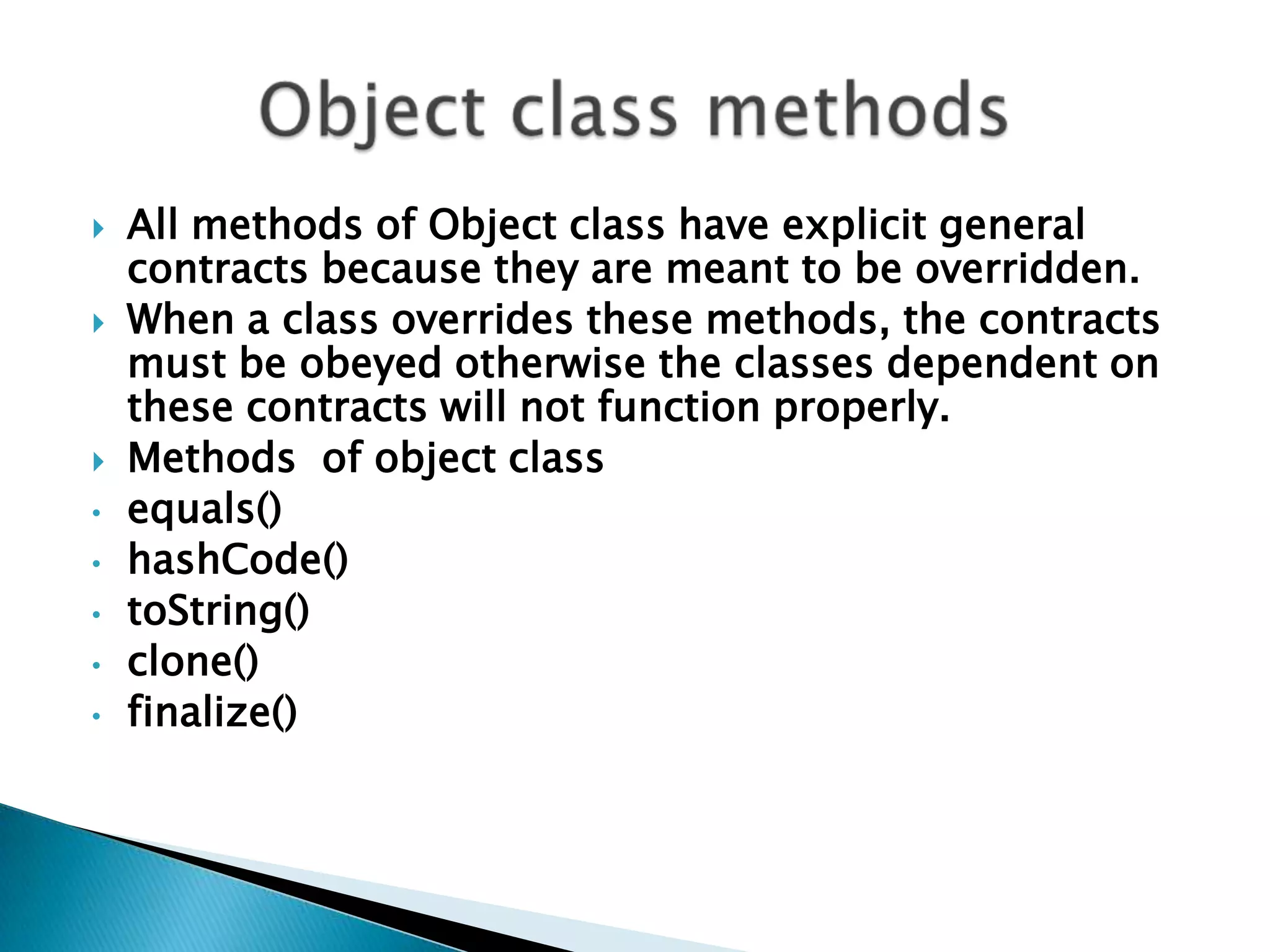
   All methods of Object class have explicit general
    contracts because they are meant to be overridden.
   When a class overrides these methods, the contracts
    must be obeyed otherwise the classes dependent on
    these contracts will not function properly.
   Methods of object class
•   equals()
•   hashCode()
•   toString()
•   clone()
•   finalize()
Obey the general contract when overriding
                                  equals
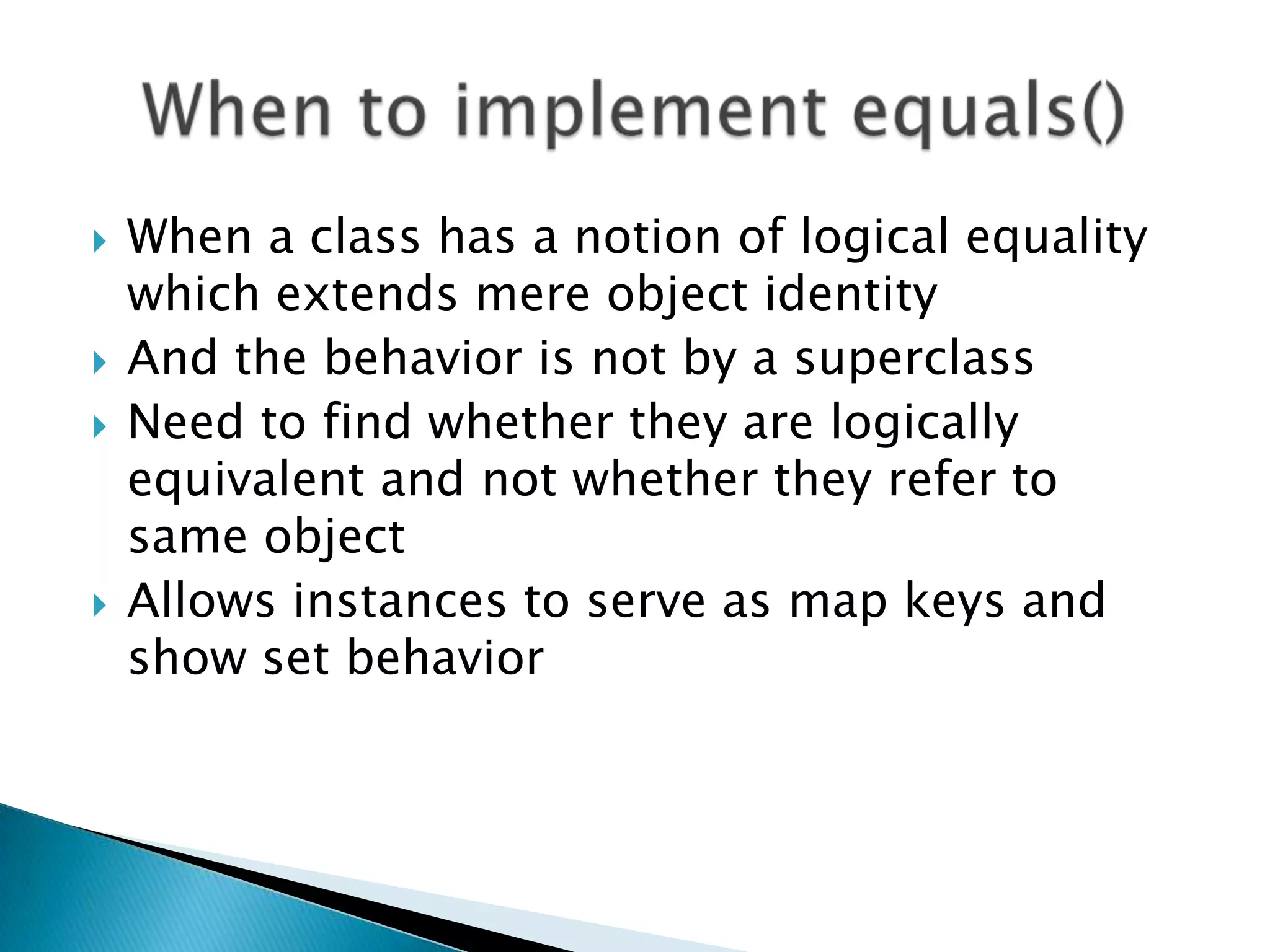
   When a class has a notion of logical equality
    which extends mere object identity
   And the behavior is not by a superclass
   Need to find whether they are logically
    equivalent and not whether they refer to
    same object
   Allows instances to serve as map keys and
    show set behavior
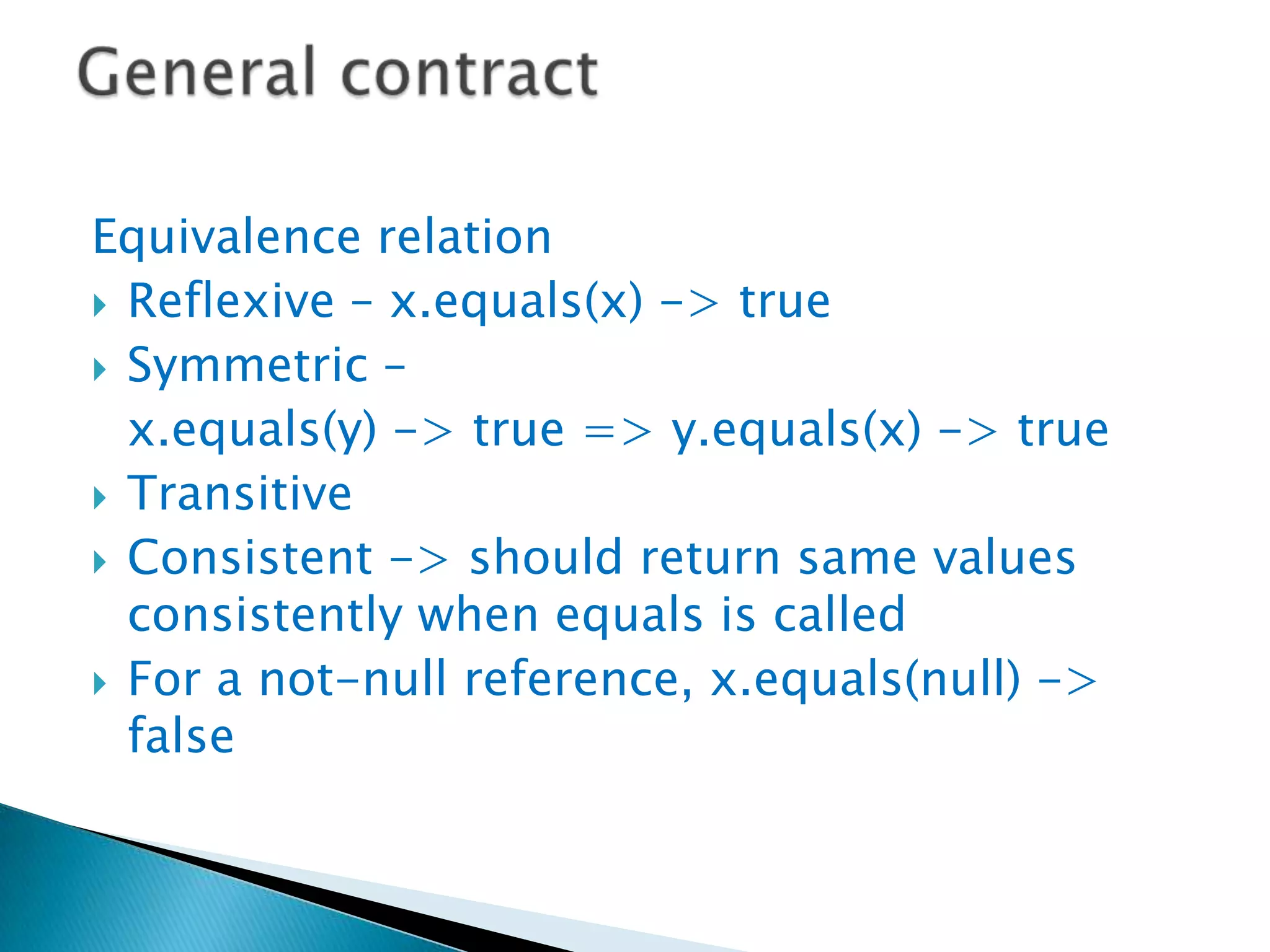
Equivalence relation
 Reflexive – x.equals(x) -> true
 Symmetric –
  x.equals(y) -> true => y.equals(x) -> true
 Transitive
 Consistent -> should return same values
  consistently when equals is called
 For a not-null reference, x.equals(null) ->
  false
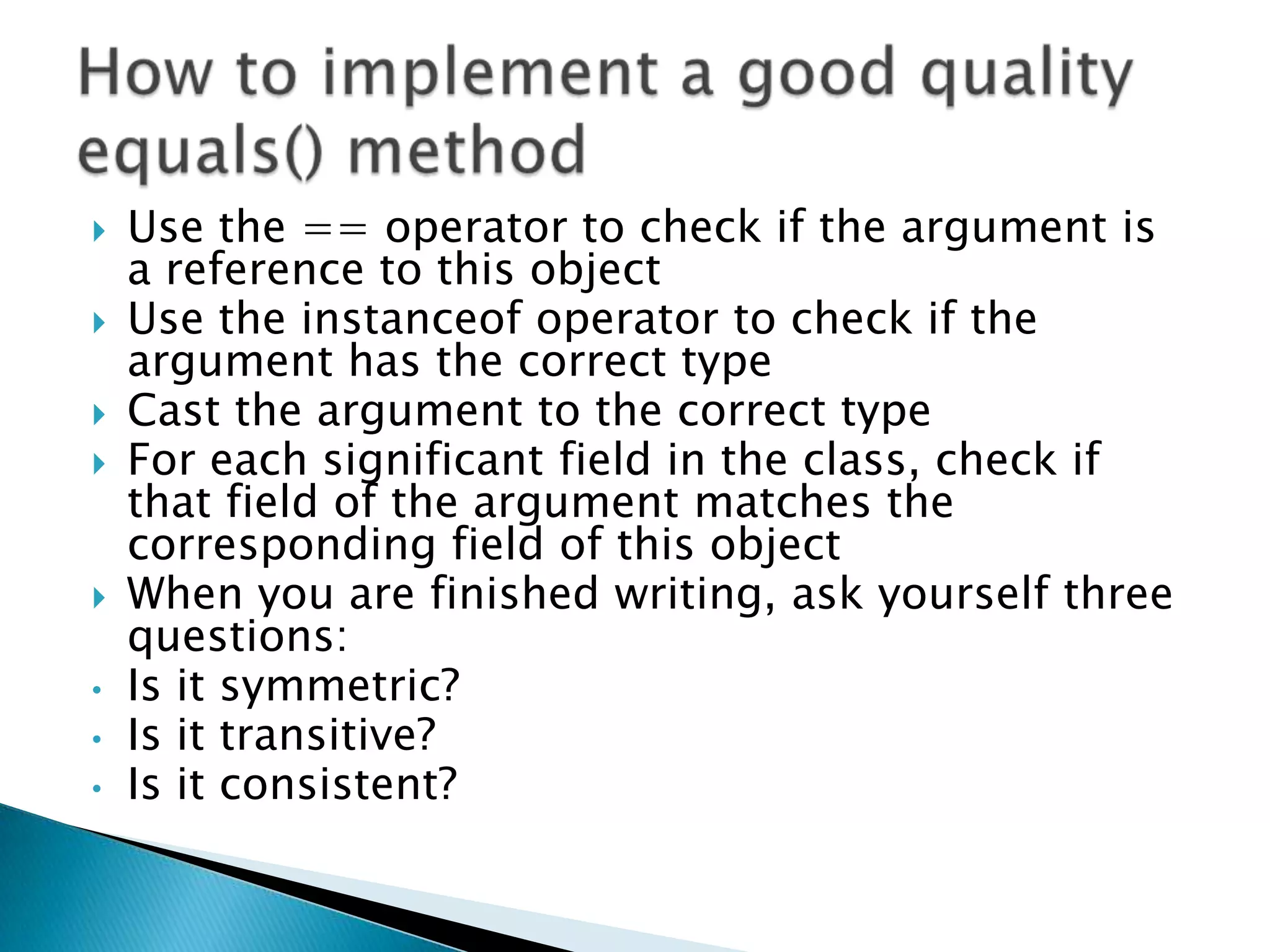
   Use the == operator to check if the argument is
    a reference to this object
   Use the instanceof operator to check if the
    argument has the correct type
   Cast the argument to the correct type
   For each significant field in the class, check if
    that field of the argument matches the
    corresponding field of this object
   When you are finished writing, ask yourself three
    questions:
•   Is it symmetric?
•   Is it transitive?
•   Is it consistent?
Always override hashCode when you override
                                   equals
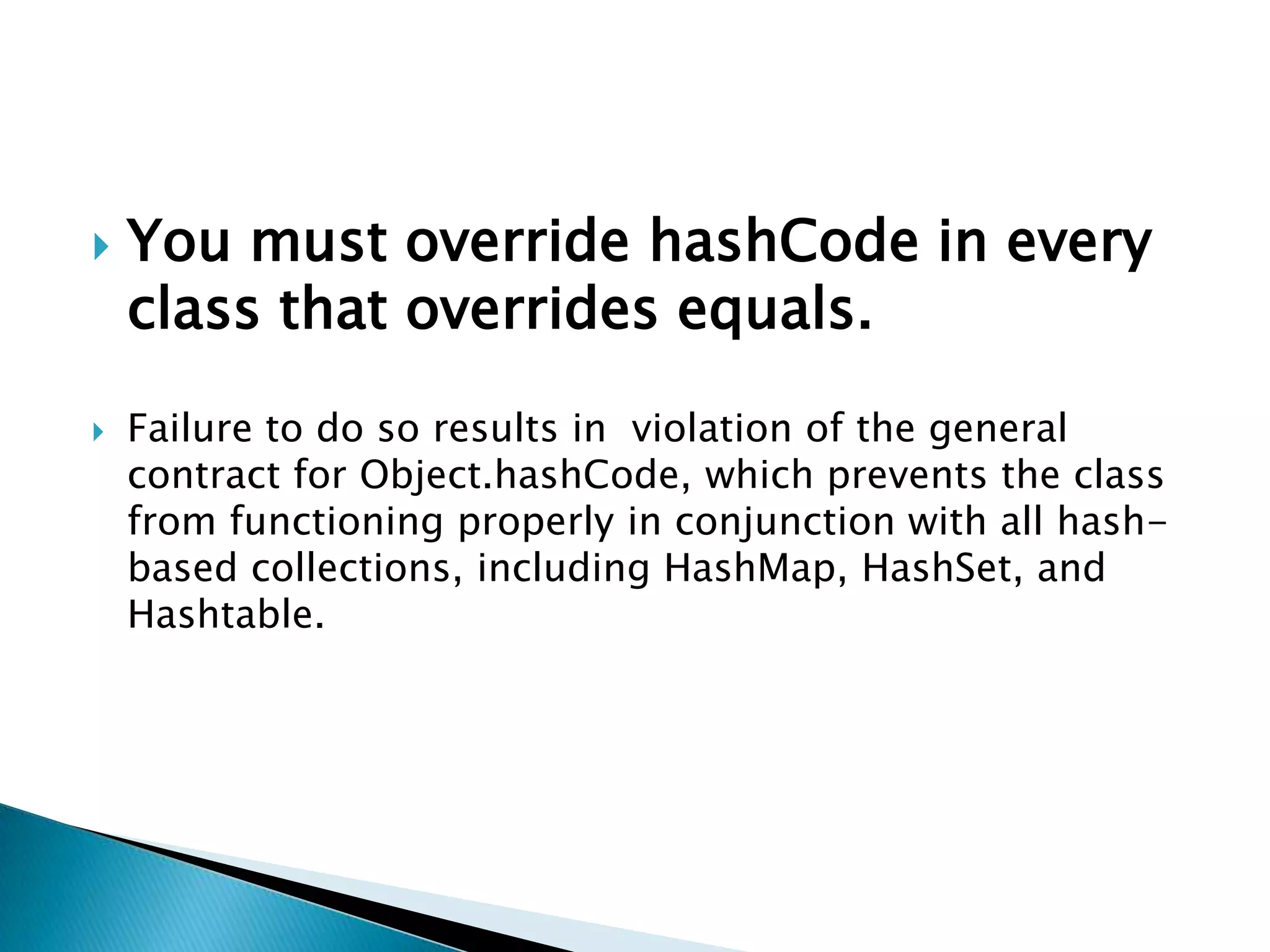
   You must override hashCode in every
    class that overrides equals.

   Failure to do so results in violation of the general
    contract for Object.hashCode, which prevents the class
    from functioning properly in conjunction with all hash-
    based collections, including HashMap, HashSet, and
    Hashtable.
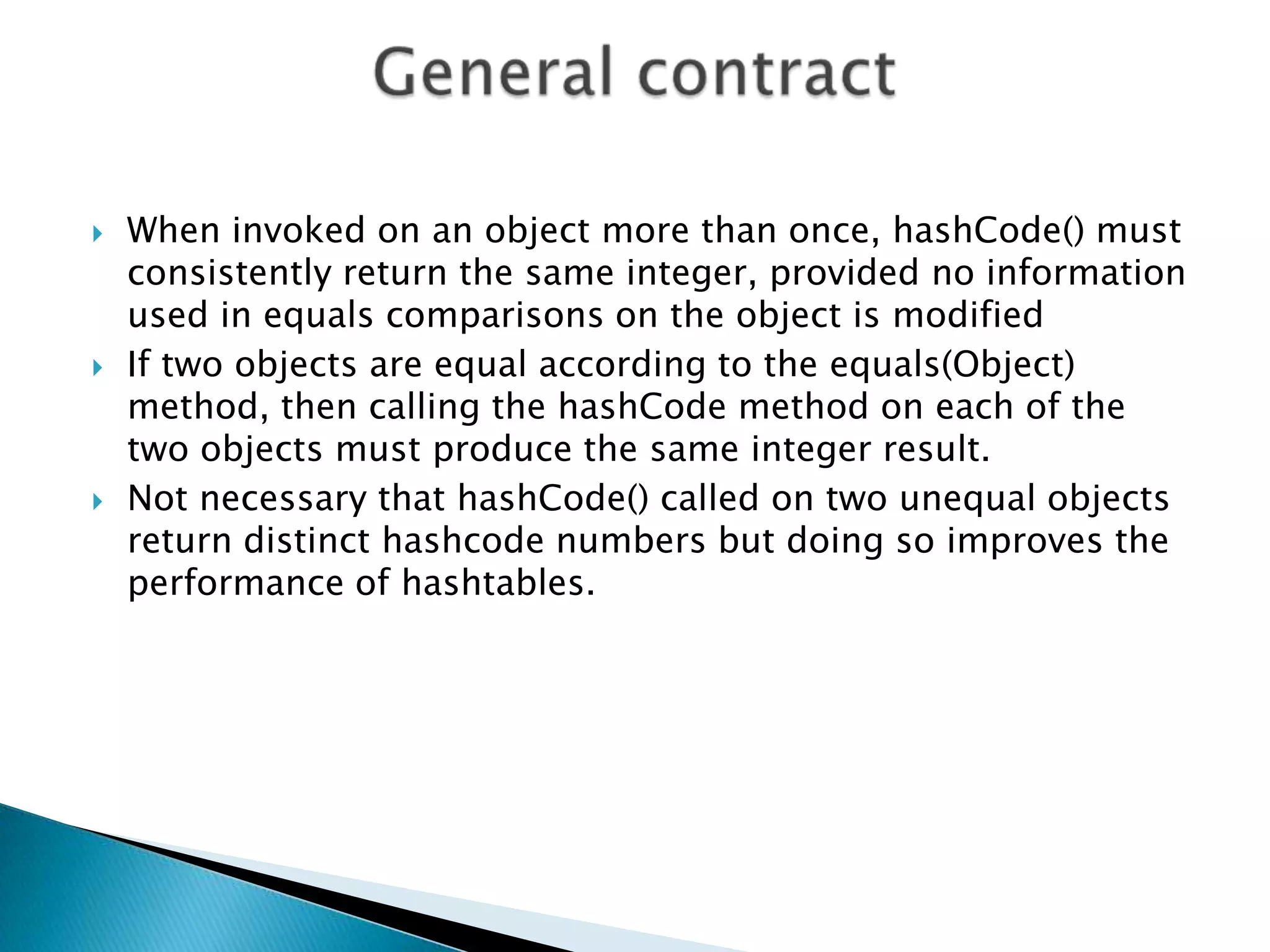
   When invoked on an object more than once, hashCode() must
    consistently return the same integer, provided no information
    used in equals comparisons on the object is modified
   If two objects are equal according to the equals(Object)
    method, then calling the hashCode method on each of the
    two objects must produce the same integer result.
   Not necessary that hashCode() called on two unequal objects
    return distinct hashcode numbers but doing so improves the
    performance of hashtables.
   The key provision that is violated when you fail to override
    hashCode is the second one: equal objects must have equal
    hash codes.
   We may exclude redundant fields from the hashCode
    computation.
   Do not be tempted to exclude significant parts of an object
    from the hash code computation to improve performance.
Always override toString()
   Default return - class name followed by an “at” sign
    (@) and the unsigned hexadecimal representation
    of the hash code, for example,
    “PhoneNumber@163b91
   General contract
    • returned string should be “a concise but informative
      representation that is easy for a person to read”
   providing a good toString() implementation makes your class
    much more pleasant to use.

   toString() invoked when an object is
    ◦ Passed to println() and printf()
    ◦ Used in string concatenation operator or assert
    ◦ Printed by the debugger


   When practical, the toString method should return all of the
    interesting information contained in the object
   Whether or not you decide to specify the format, you should
    clearly document your intentions
   provide programmatic access to all of the information
    contained in the value returned by toString()
Override clone() judiciously
   A flag interface that advertises that an object permits cloning
   Lacks a clone() method
   Object class’ clone() is protected -> so cannot be used
    without using reflection
   Cloneable interface determines the behavior of Object’s
    clone() implementation
   It modifies the behavior of a protected method on a
    superclass
   x.clone() !=x
   x.clone().getclass() == x.getclass()
   x.clone().equals(x) should be true but it is not an
    absolute requirement
   No constructors are to be called when creating a
    clone
   If you override the clone method in a nonfinal class, you
    should return an object obtained by invoking super.clone().
   In practice, a class that implements Cloneable is expected to
    provide a properly functioning public clone method.
   In effect, the clone method should function as another
    constructor; you must ensure that it does no harm to the
    original object and that it properly establishes invariants on
    the clone
   The clone architecture is incompatible with normal use of
    final fields referring to mutable objects
Consider implementing Comparable
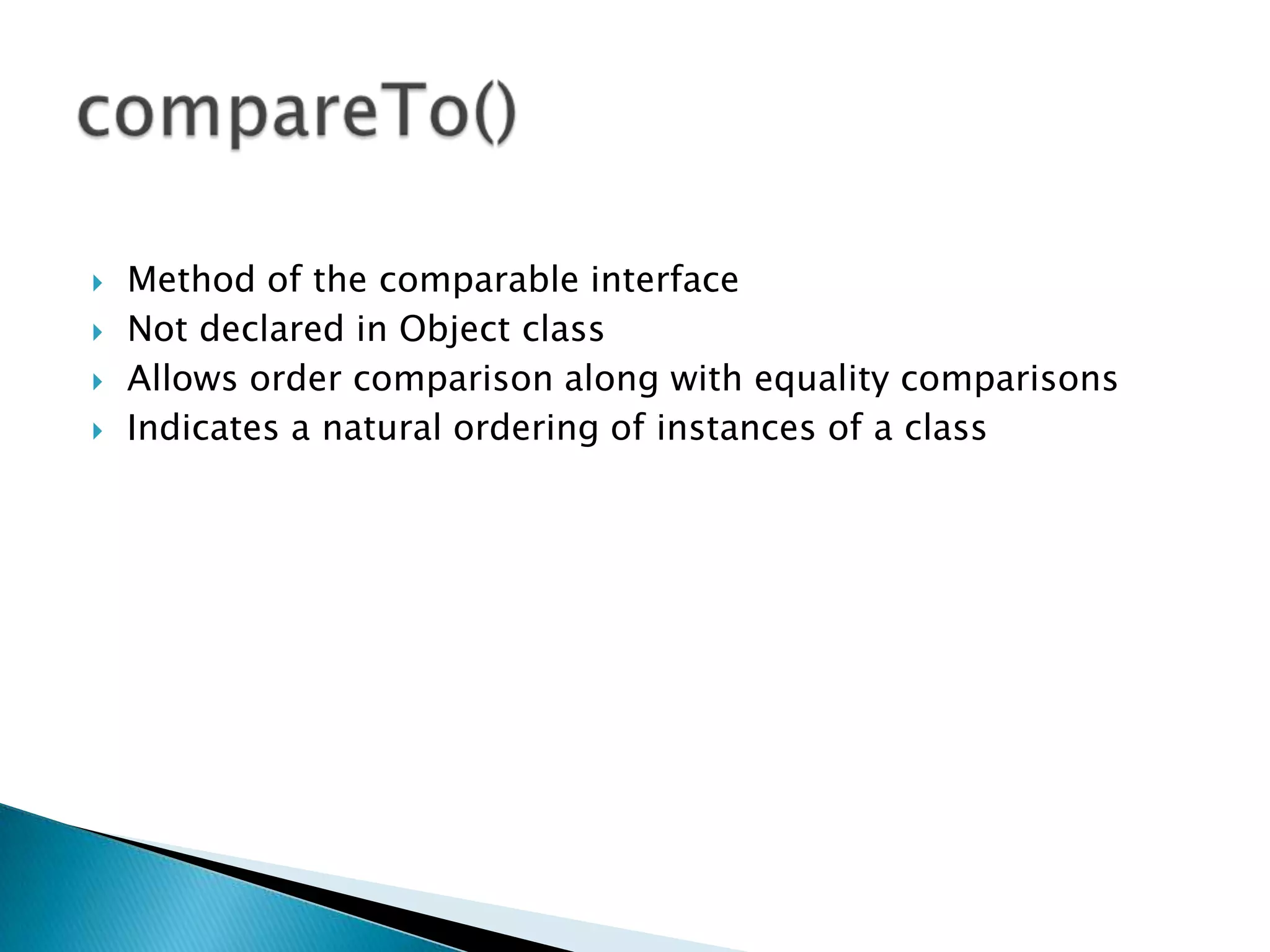
   Method of the comparable interface
   Not declared in Object class
   Allows order comparison along with equality comparisons
   Indicates a natural ordering of instances of a class
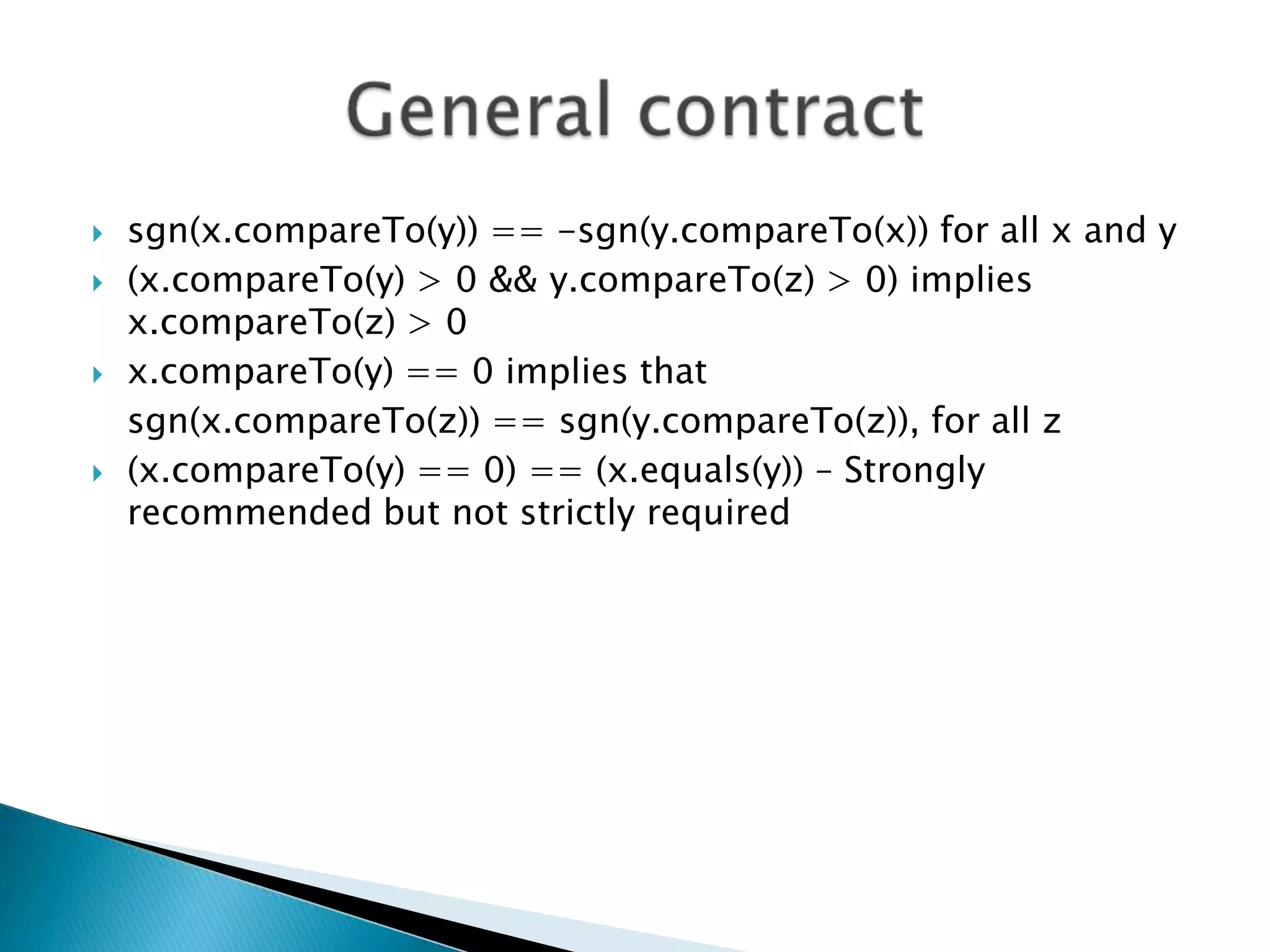
   sgn(x.compareTo(y)) == -sgn(y.compareTo(x)) for all x and y
   (x.compareTo(y) > 0 && y.compareTo(z) > 0) implies
    x.compareTo(z) > 0
   x.compareTo(y) == 0 implies that
    sgn(x.compareTo(z)) == sgn(y.compareTo(z)), for all z
   (x.compareTo(y) == 0) == (x.equals(y)) – Strongly
    recommended but not strictly required
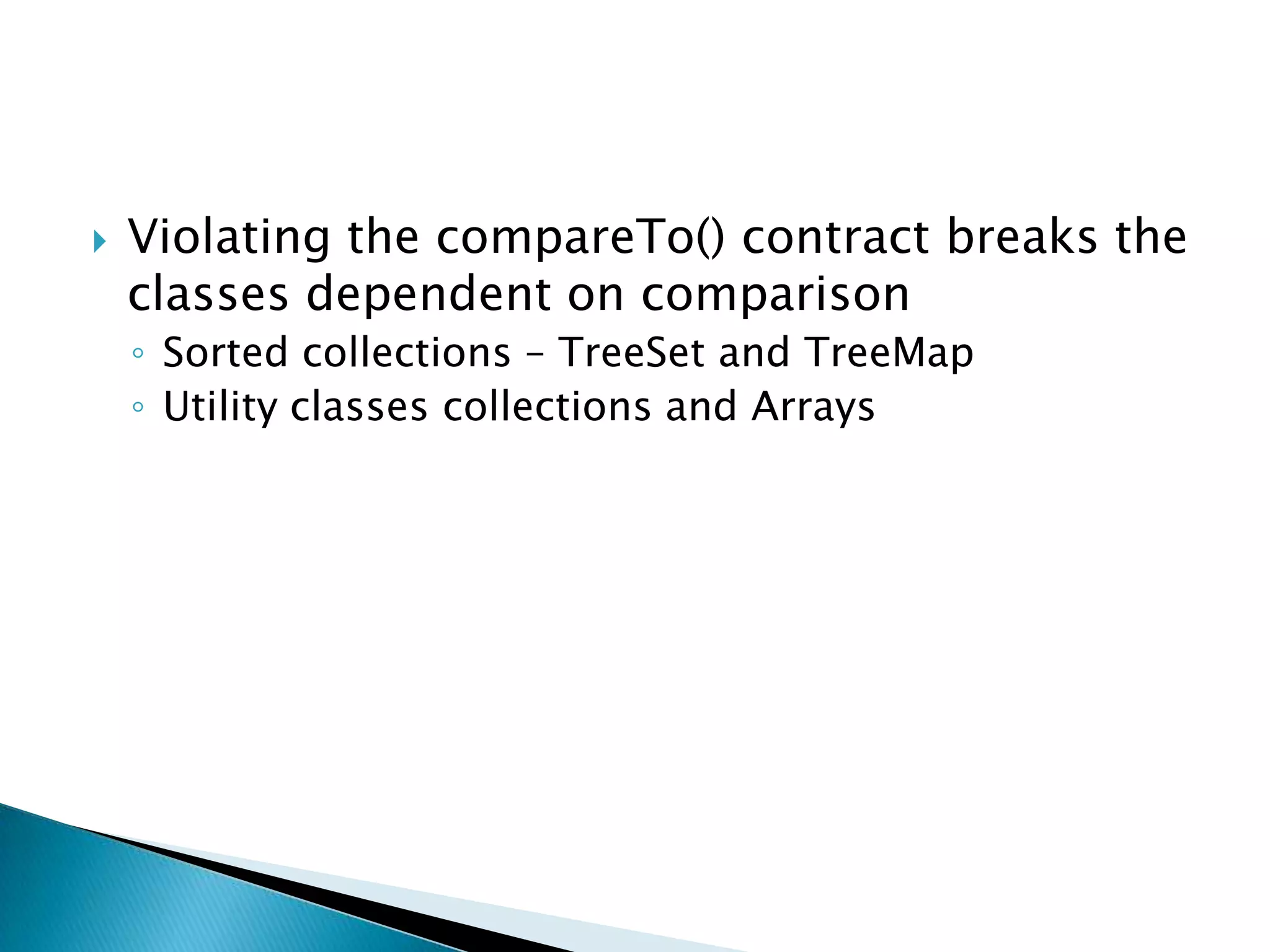
   Violating the compareTo() contract breaks the
    classes dependent on comparison
    ◦ Sorted collections – TreeSet and TreeMap
    ◦ Utility classes collections and Arrays

Methods common to all objects

  • 1.
  • 2.
    All methods of Object class have explicit general contracts because they are meant to be overridden.  When a class overrides these methods, the contracts must be obeyed otherwise the classes dependent on these contracts will not function properly.  Methods of object class • equals() • hashCode() • toString() • clone() • finalize()
  • 3.
    Obey the generalcontract when overriding equals
  • 4.
    When a class has a notion of logical equality which extends mere object identity  And the behavior is not by a superclass  Need to find whether they are logically equivalent and not whether they refer to same object  Allows instances to serve as map keys and show set behavior
  • 5.
    Equivalence relation  Reflexive– x.equals(x) -> true  Symmetric – x.equals(y) -> true => y.equals(x) -> true  Transitive  Consistent -> should return same values consistently when equals is called  For a not-null reference, x.equals(null) -> false
  • 6.
    Use the == operator to check if the argument is a reference to this object  Use the instanceof operator to check if the argument has the correct type  Cast the argument to the correct type  For each significant field in the class, check if that field of the argument matches the corresponding field of this object  When you are finished writing, ask yourself three questions: • Is it symmetric? • Is it transitive? • Is it consistent?
  • 7.
    Always override hashCodewhen you override equals
  • 8.
    You must override hashCode in every class that overrides equals.  Failure to do so results in violation of the general contract for Object.hashCode, which prevents the class from functioning properly in conjunction with all hash- based collections, including HashMap, HashSet, and Hashtable.
  • 9.
    When invoked on an object more than once, hashCode() must consistently return the same integer, provided no information used in equals comparisons on the object is modified  If two objects are equal according to the equals(Object) method, then calling the hashCode method on each of the two objects must produce the same integer result.  Not necessary that hashCode() called on two unequal objects return distinct hashcode numbers but doing so improves the performance of hashtables.
  • 10.
    The key provision that is violated when you fail to override hashCode is the second one: equal objects must have equal hash codes.  We may exclude redundant fields from the hashCode computation.  Do not be tempted to exclude significant parts of an object from the hash code computation to improve performance.
  • 11.
  • 12.
    Default return - class name followed by an “at” sign (@) and the unsigned hexadecimal representation of the hash code, for example, “PhoneNumber@163b91  General contract • returned string should be “a concise but informative representation that is easy for a person to read”
  • 13.
    providing a good toString() implementation makes your class much more pleasant to use.  toString() invoked when an object is ◦ Passed to println() and printf() ◦ Used in string concatenation operator or assert ◦ Printed by the debugger  When practical, the toString method should return all of the interesting information contained in the object  Whether or not you decide to specify the format, you should clearly document your intentions  provide programmatic access to all of the information contained in the value returned by toString()
  • 14.
  • 15.
    A flag interface that advertises that an object permits cloning  Lacks a clone() method  Object class’ clone() is protected -> so cannot be used without using reflection  Cloneable interface determines the behavior of Object’s clone() implementation  It modifies the behavior of a protected method on a superclass
  • 16.
    x.clone() !=x  x.clone().getclass() == x.getclass()  x.clone().equals(x) should be true but it is not an absolute requirement  No constructors are to be called when creating a clone
  • 17.
    If you override the clone method in a nonfinal class, you should return an object obtained by invoking super.clone().  In practice, a class that implements Cloneable is expected to provide a properly functioning public clone method.  In effect, the clone method should function as another constructor; you must ensure that it does no harm to the original object and that it properly establishes invariants on the clone  The clone architecture is incompatible with normal use of final fields referring to mutable objects
  • 18.
  • 19.
    Method of the comparable interface  Not declared in Object class  Allows order comparison along with equality comparisons  Indicates a natural ordering of instances of a class
  • 20.
    sgn(x.compareTo(y)) == -sgn(y.compareTo(x)) for all x and y  (x.compareTo(y) > 0 && y.compareTo(z) > 0) implies x.compareTo(z) > 0  x.compareTo(y) == 0 implies that sgn(x.compareTo(z)) == sgn(y.compareTo(z)), for all z  (x.compareTo(y) == 0) == (x.equals(y)) – Strongly recommended but not strictly required
  • 21.
    Violating the compareTo() contract breaks the classes dependent on comparison ◦ Sorted collections – TreeSet and TreeMap ◦ Utility classes collections and Arrays