French Revolution
Reasons for Revolution
1. Social Discrimination – The social ladder was
divided into three parts.
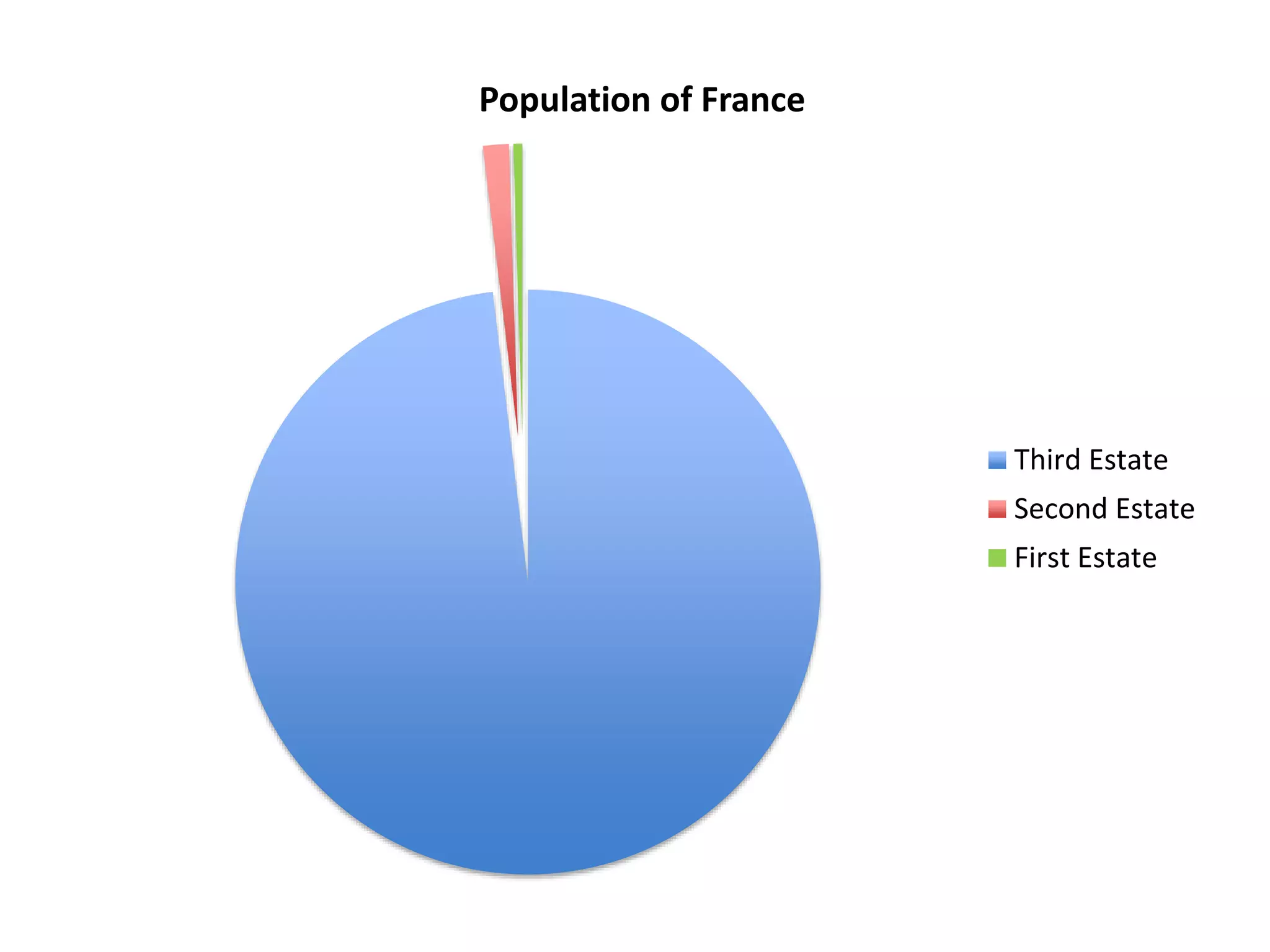
Population of France
Third Estate
Second Estate
First Estate
First Estate
• Leaders of the French church
• They were exempt from most taxes
Second Estate
• Nobles and aristocrats
• Also exempt from taxes
• Charged rent to
peasants who farmed
their land and charged
fees for the use of their
mills, wine presses and
bakeries.
Third Estate
• Contained a wide variety
of citizens
– Middle class, artisans,
townsmen and peasants
• The wealthy produced little of the wealth
• Those who produced the nation’s wealth were
taxed heavily
2. Economic Collapse
– France was nearly bankrupt
• King Louis XVI called for the
Estates-General
• This was the only political body
with the authority to reform the
tax system.
• It consisted of representatives
from the First and Second
Estates elected by the king and
from the Third elected by the
people.
3. Political Incompetence
• King Louis XVI and Marie-Antoinette proved to
be totally unqualified to lead the nation
• When the Estates-General met things went
bad
– The Third Estate demanded one vote per
representative
– First and Second Estate refused and the Third
Estate walked out
National Assembly
• The Third Estate formed this group
• They signed the Tennis Court Oath
• They simply wanted a constitution that would
guarantee basic rights to all French citizens
• The citizens began to panic
• The crowd charges the Bastille on July 14
• July 14 is celebrated as France’s Day of
Independence
• National Assembly signed the Declaration of
the Rights of Man on August 26, 1789
• Many French nobles fled France and went to
Austria.
• France declared war on Austria
Reign of Terror
• Called for the removal of opposition and had a
period of mass execution
• A five-man committee known as the Directory
headed up the new government

Ch 12 Sec 1 "French Revolution"

  • 1.
  • 2.
    Reasons for Revolution 1.Social Discrimination – The social ladder was divided into three parts.
  • 3.
    Population of France ThirdEstate Second Estate First Estate
  • 5.
    First Estate • Leadersof the French church • They were exempt from most taxes
  • 6.
    Second Estate • Noblesand aristocrats • Also exempt from taxes • Charged rent to peasants who farmed their land and charged fees for the use of their mills, wine presses and bakeries.
  • 7.
    Third Estate • Containeda wide variety of citizens – Middle class, artisans, townsmen and peasants
  • 8.
    • The wealthyproduced little of the wealth • Those who produced the nation’s wealth were taxed heavily
  • 9.
    2. Economic Collapse –France was nearly bankrupt
  • 10.
    • King LouisXVI called for the Estates-General • This was the only political body with the authority to reform the tax system. • It consisted of representatives from the First and Second Estates elected by the king and from the Third elected by the people.
  • 12.
    3. Political Incompetence •King Louis XVI and Marie-Antoinette proved to be totally unqualified to lead the nation
  • 13.
    • When theEstates-General met things went bad – The Third Estate demanded one vote per representative – First and Second Estate refused and the Third Estate walked out
  • 14.
    National Assembly • TheThird Estate formed this group • They signed the Tennis Court Oath • They simply wanted a constitution that would guarantee basic rights to all French citizens
  • 16.
    • The citizensbegan to panic • The crowd charges the Bastille on July 14 • July 14 is celebrated as France’s Day of Independence
  • 18.
    • National Assemblysigned the Declaration of the Rights of Man on August 26, 1789
  • 19.
    • Many Frenchnobles fled France and went to Austria. • France declared war on Austria
  • 20.
    Reign of Terror •Called for the removal of opposition and had a period of mass execution
  • 23.
    • A five-mancommittee known as the Directory headed up the new government

Editor's Notes

  • #4 Third estate 98.08% Second estate 1.43% First estate .49%
  • #6 Numbered about 10,000 Archbishops and bishops Managed land for the Roman Church Had luxurious lifestyle that differed from the regular priest or monk that interacted with the people
  • #7 About 350,000 people
  • #8 24 million people
  • #9 This system reduced many to poverty, and it limited opportunities for economic growth. At the same time, those who paid the most in taxes, rents and fees were denied basic freedoms and political representation in the governing of France.
  • #10 France was in trouble…wars, lavish castles, helping the Americas all put a huge strain on France’s finances Payments on the national debt consumed nearly half of the annual income from taxes
  • #11 Once this body met, things quickly spiraled out of control
  • #13 Married when she was 15 and he was 16 At first they were very popular with the people
  • #14 King Louis humiliated the member of the third estate Traditionally each estate had one vote, the third estate wanted one vote per representative
  • #17 King Louis ordered troops to assemble outside of Paris Search for weapons Bastille is fortress prison used to house political prisoners The mob stormed the building and killed those assigned to guard it The mob attacked government buildings and destroyed documents that recorded debts and rents due to member of the first and second estates
  • #19 Demanded the end of many of the abuses suffered by the French people and advocated ideals that included innocence until guilt is proven and liberty to do anything that does not injure another.
  • #20 Marie Antoinette’s homeland (Austria) They warned them to not harm the king (King Louis XIV) Tried him and executed him
  • #21 25,000 men and women were sent to the guillotine including Marie Antionette
  • #23 Beheading of Marie Antoinette
  • #24 Had to rely on the army for support because it lacked the support of most of the French