European History: Part 1 of The French Revolution1789-1791William A. HansenEDU 290: Central Michigan University
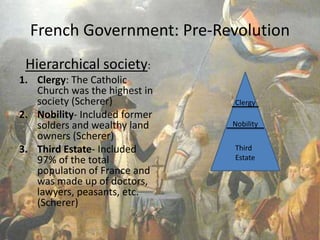
French Government: Pre-RevolutionHierarchical society:Clergy: The Catholic Church was the highest in society (Scherer)Nobility- Included former solders and wealthy land owners (Scherer)Third Estate- Included 97% of the total population of France and was made up of doctors, lawyers, peasants, etc. (Scherer)ClergyNobilityThird Estate
Pre-Revolution Continued..The top two estates (Clergy and Nobility) did not have to pay taxesThe government was made up of two branches, but the representatives were all from the top two estatesThe top two estates held over half the land in FranceThe third estate was forced to pay the Nobility “dues”
Overview of The French RevolutionBegan in 1789The people of France wanted King Louis XVI removed from powerThere is time of peace and happiness in 1791 (end of Part 1)More extreme uprisings occur  Napoleon takes over in 1799, ending the Revolution
Leading up to the Revolution	What factors could have had influence on the people of France to begin a revolution?The Scientific RevolutionThe Enlightenment
The Scientific Revolutions Influence on The French RevolutionResearchers began to question things that were stated in the bible because they did not have any proof that these stories were trueSome of the advancements in science during the Scientific Revolution are:Proving that the earth was not the center of the universeProving there is more in the sky than we can see with the naked eyeCreating a scientific method where scientists started with a small part of an idea and worked up until they found a conclusion (inductive reasoning)
The Enlightenments Influence on the French RevolutionThe Enlightenment was a time when philosophers stressed equality before the law (all aspects of life)Led by Voltaire, philosophers uncovered new ways of thinking. These ways included:“…we must consider what state all men are naturally in, and that is, a state of perfect freedom…”- John Locke (Scherer)“Everything in this world can be made good if we diminish its faults…”- Joseph II (Scherer)“When the legislative and executive powers are united in the same person, or in the same body of magistrates, there can be no liberty”- Baron de Montequieu (Scherer)
Long Term Reasons For The French RevolutionScientific RevolutionEnlightenment languageComplaints about noble privileges, guild monopolies, and corrupt royal officialsThe third estate not having any say in the government, resulting in an addition of another branch of government that was made up of peoples of the third estate (Estates General)The third estate wants the Clergy and Nobility to have to pay the same dues and taxes as they do
Short Term Reasons For RevolutionFrance’s financial crisis- was an accumulation of debt, mainly from past wars including the Seven Years’ War, the War of the Austrian Succession, and the financial backing of America during the American War of Independence.Unfair politics between the three branches:	- All branch’s get 1/3 vote	- Nobility and Clergy always sided together	- King over-rides motions to count votes by head (with 	all the Estates General’s votes and some of the lower 	nobility votes, the Estates General would be able to get 	what they wanted once and a while) King stops Estates General from meeting
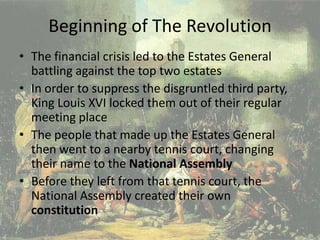
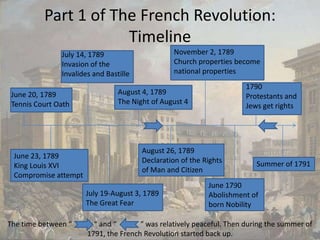
Beginning of The RevolutionThe financial crisis led to the Estates General battling against the top two estatesIn order to suppress the disgruntled third party, King Louis XVI locked them out of their regular meeting placeThe people that made up the Estates General then went to a nearby tennis court, changing their name to the National AssemblyBefore they left from that tennis court, the National Assembly created their own constitution
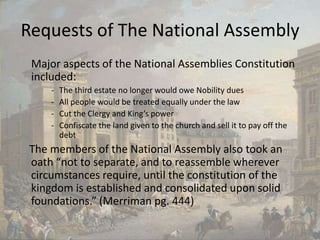
Requests of The National Assembly	Major aspects of the National Assemblies Constitution included: The third estate no longer would owe Nobility dues
All people would be treated equally under the law
Cut the Clergy and King’s power
Confiscate the land given to the church and sell it to pay off the debtThe members of the National Assembly also took an oath “not to separate, and to reassemble wherever circumstances require, until the constitution of the kingdom is established and consolidated upon solid foundations.” (Merriman pg. 444)
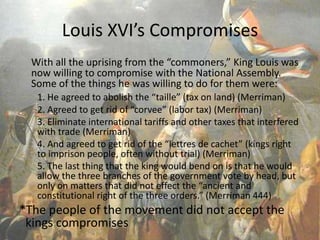
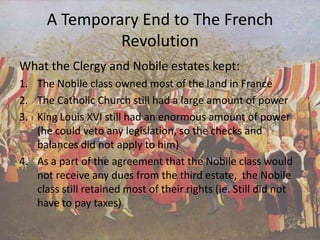
Louis XVI’s Compromises	With all the uprising from the “commoners,” King Louis was now willing to compromise with the National Assembly. Some of the things he was willing to do for them were:1. He agreed to abolish the “taille” (tax on land) (Merriman)	2. Agreed to get rid of “corvee” (labor tax) (Merriman)	3. Eliminate international tariffs and other taxes that interfered with trade (Merriman)	4. And agreed to get rid of the “lettres de cachet” (kings right to imprison people, often without trial) (Merriman)	5. The last thing that the king would bend on is that he would allow the three branches of the government vote by head, but only on matters that did not effect the “ancient and constitutional right of the three orders.” (Merriman 444)*The people of the movement did not accept the kings compromises
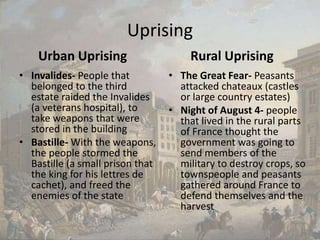
UprisingUrban UprisingRural UprisingInvalides- People that belonged to the third estate raided the Invalides (a veterans hospital), to take weapons that were stored in the buildingBastille- With the weapons, the people stormed the Bastille (a small prison that the king for his lettres de cachet), and freed the enemies of the stateThe Great Fear- Peasants attacked chateaux(castles or large country estates)
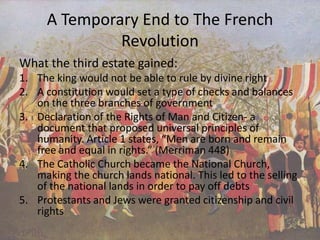
Night of August 4- people that lived in the rural parts of France thought the government was going to send members of the military to destroy crops, so townspeople and peasants gathered around France to defend themselves and the harvestA Temporary End to The French RevolutionWhat the third estate gained:The king would not be able to rule by divine rightA constitution would set a type of checks and balances on the three branches of governmentDeclaration of the Rights of Man and Citizen- a document that proposed universal principles of humanity. Article 1 states, “Men are born and remain free and equal in rights.” (Merriman 448)The Catholic Church became the National Church, making the church lands national. This led to the selling of the national lands in order to pay off debtsProtestants and Jews were granted citizenship and civil rights

French Revolution: Part 1-Powerpoint

  • 1.
    European History: Part1 of The French Revolution1789-1791William A. HansenEDU 290: Central Michigan University
  • 2.
    French Government: Pre-RevolutionHierarchicalsociety:Clergy: The Catholic Church was the highest in society (Scherer)Nobility- Included former solders and wealthy land owners (Scherer)Third Estate- Included 97% of the total population of France and was made up of doctors, lawyers, peasants, etc. (Scherer)ClergyNobilityThird Estate
  • 3.
    Pre-Revolution Continued..The toptwo estates (Clergy and Nobility) did not have to pay taxesThe government was made up of two branches, but the representatives were all from the top two estatesThe top two estates held over half the land in FranceThe third estate was forced to pay the Nobility “dues”
  • 4.
    Overview of TheFrench RevolutionBegan in 1789The people of France wanted King Louis XVI removed from powerThere is time of peace and happiness in 1791 (end of Part 1)More extreme uprisings occur Napoleon takes over in 1799, ending the Revolution
  • 5.
    Leading up tothe Revolution What factors could have had influence on the people of France to begin a revolution?The Scientific RevolutionThe Enlightenment
  • 6.
    The Scientific RevolutionsInfluence on The French RevolutionResearchers began to question things that were stated in the bible because they did not have any proof that these stories were trueSome of the advancements in science during the Scientific Revolution are:Proving that the earth was not the center of the universeProving there is more in the sky than we can see with the naked eyeCreating a scientific method where scientists started with a small part of an idea and worked up until they found a conclusion (inductive reasoning)
  • 7.
    The Enlightenments Influenceon the French RevolutionThe Enlightenment was a time when philosophers stressed equality before the law (all aspects of life)Led by Voltaire, philosophers uncovered new ways of thinking. These ways included:“…we must consider what state all men are naturally in, and that is, a state of perfect freedom…”- John Locke (Scherer)“Everything in this world can be made good if we diminish its faults…”- Joseph II (Scherer)“When the legislative and executive powers are united in the same person, or in the same body of magistrates, there can be no liberty”- Baron de Montequieu (Scherer)
  • 8.
    Long Term ReasonsFor The French RevolutionScientific RevolutionEnlightenment languageComplaints about noble privileges, guild monopolies, and corrupt royal officialsThe third estate not having any say in the government, resulting in an addition of another branch of government that was made up of peoples of the third estate (Estates General)The third estate wants the Clergy and Nobility to have to pay the same dues and taxes as they do
  • 9.
    Short Term ReasonsFor RevolutionFrance’s financial crisis- was an accumulation of debt, mainly from past wars including the Seven Years’ War, the War of the Austrian Succession, and the financial backing of America during the American War of Independence.Unfair politics between the three branches: - All branch’s get 1/3 vote - Nobility and Clergy always sided together - King over-rides motions to count votes by head (with all the Estates General’s votes and some of the lower nobility votes, the Estates General would be able to get what they wanted once and a while) King stops Estates General from meeting
  • 10.
    Beginning of TheRevolutionThe financial crisis led to the Estates General battling against the top two estatesIn order to suppress the disgruntled third party, King Louis XVI locked them out of their regular meeting placeThe people that made up the Estates General then went to a nearby tennis court, changing their name to the National AssemblyBefore they left from that tennis court, the National Assembly created their own constitution
  • 11.
    Requests of TheNational Assembly Major aspects of the National Assemblies Constitution included: The third estate no longer would owe Nobility dues
  • 12.
    All people wouldbe treated equally under the law
  • 13.
    Cut the Clergyand King’s power
  • 14.
    Confiscate the landgiven to the church and sell it to pay off the debtThe members of the National Assembly also took an oath “not to separate, and to reassemble wherever circumstances require, until the constitution of the kingdom is established and consolidated upon solid foundations.” (Merriman pg. 444)
  • 15.
    Louis XVI’s Compromises Withall the uprising from the “commoners,” King Louis was now willing to compromise with the National Assembly. Some of the things he was willing to do for them were:1. He agreed to abolish the “taille” (tax on land) (Merriman) 2. Agreed to get rid of “corvee” (labor tax) (Merriman) 3. Eliminate international tariffs and other taxes that interfered with trade (Merriman) 4. And agreed to get rid of the “lettres de cachet” (kings right to imprison people, often without trial) (Merriman) 5. The last thing that the king would bend on is that he would allow the three branches of the government vote by head, but only on matters that did not effect the “ancient and constitutional right of the three orders.” (Merriman 444)*The people of the movement did not accept the kings compromises
  • 16.
    UprisingUrban UprisingRural UprisingInvalides-People that belonged to the third estate raided the Invalides (a veterans hospital), to take weapons that were stored in the buildingBastille- With the weapons, the people stormed the Bastille (a small prison that the king for his lettres de cachet), and freed the enemies of the stateThe Great Fear- Peasants attacked chateaux(castles or large country estates)
  • 17.
    Night of August4- people that lived in the rural parts of France thought the government was going to send members of the military to destroy crops, so townspeople and peasants gathered around France to defend themselves and the harvestA Temporary End to The French RevolutionWhat the third estate gained:The king would not be able to rule by divine rightA constitution would set a type of checks and balances on the three branches of governmentDeclaration of the Rights of Man and Citizen- a document that proposed universal principles of humanity. Article 1 states, “Men are born and remain free and equal in rights.” (Merriman 448)The Catholic Church became the National Church, making the church lands national. This led to the selling of the national lands in order to pay off debtsProtestants and Jews were granted citizenship and civil rights